Skip to content
CareRulebook
MenuClose

Where are you starting?

United StatesTexas, North Carolina, Georgia, Virginia, Indiana, Ohio, New York, Illinois, Washington, Colorado, Tennessee, Maryland, Kansas, South Carolina, Nevada
TexasManual
North CarolinaManual
GeorgiaManual
VirginiaManual
IndianaManual
OhioGuideNew YorkGuide
IllinoisManual
WashingtonManual
ColoradoManual
TennesseeManual
MarylandManual
KansasManual
South CarolinaManual
NevadaManual
All US states →
United KingdomEngland
Free toolsChecklists, calculators and templates

Nevada · Personal care agency license · NAC 449.3974

Nevada personal care agency policies and procedures

Nevada does not ask for your policies with the application. The Division reads them at the prelicensure survey, before it issues the license, and HCQC’s surveyor works from a 55-tag checklist. Here are the 13 topics the rule names, the other written duties, what the rules changed since 2023, every tag with what it needs, where the rules are silent, and all 127 requirements mapped to a policy.

  • Rule-verified October 3, 2026
  • 127 requirements quoted verbatim
  • From NAC 449, NRS 449B and HCQC’s workbook
A man with a short beard, in a navy quarter-zip sweater, places a printed page behind a yellow tab in an open teal binder at a kitchen table, beside an upright CareRulebook binder with yellow tabs, a closed laptop, a white mug, a green pen and two sticky notes reading 13 topics and 55 tags, with a patio, an agave plant, a block wall and desert mountains outside the glass door

Quick answer

The rule names 13 topics. "An agency shall maintain written policies and procedures concerning the qualifications, responsibilities and conditions of employment for each attendant and other members of the staff of the agency." They are reviewed and revised as needed, given to staff on hire and whenever they change, and at a minimum cover 13 topics, from attendant duties to special populations (NAC 449.3974). Other rules add more written policies and documents, such as a termination policy, a signed disclosure statement, a complaint policy and log, and an infection control plan.

They are read at the survey, not uploaded. HCQC’s checklist lists the uploads: administrator resume and elder abuse training, state business license, lease or deed, LLC or corporate documents, three-year business history, certificate of liability insurance, surety bond, local business license or use permit, owner background checks, administrator diploma and proof of age. Policies are not on the upload list. (HCQC Licensing Checklist) Instead, "the Division shall conduct an investigation concerning the premises, facilities, qualifications of personnel, methods of operation and policies of the applicant and perform a prelicensure survey" (NAC 449.0112(1)).

HCQC’s surveyor uses a checklist. The workbook ends with a checklist of 55 tags (P0015 to P0950) naming the policy, form or document the surveyor expects for each rule. (HCQC workbook (12.2024)) It is HCQC’s survey tool, not rule text, and it was printed before the rules changed in February 2026.

13

Policy topics NAC 449.3974 names

NAC 449.3974(1)-(13)

55

Tags on HCQC’s policies, forms and documents checklist

HCQC workbook (12.2024)

127

Requirements mapped to 35 CareRulebook policies

NRS 449B; NAC 449

Feb 27, 2026

When R089-24 changed the personal care rules

R089-24, cover

The 13 topics in NAC 449.3974

"At a minimum, the policies and procedures must" cover these topics (NAC 449.3974(1)-(13)). Each is also a tag on HCQC’s checklist, and HCQC asks for an extra document with five of them: job descriptions (P0035), screening and service plan forms (P0070), a list of community resources (P0080), an evaluation form (P0085) and examples for special populations (P0095) (HCQC checklist). The last column is where each topic sits in the CareRulebook manual.

(n)The policies must coverHCQC tagCareRulebook policy
(1)Duties and responsibilities of attendantsP00354.1 Job descriptions and qualifications
(2)Activities attendants are prohibited from: personal long-distance calls, gifts and loans, money or gratuities, becoming the client’s guardian or attorney-in-factP00404.2 Prohibited activities: calls, gifts, loans, gratuities and legal authority
(3)Rights of clientsP00453.1 Client rights and the signed rights statement
(4)Ethics, including confidentiality of client informationP00503.5 Ethics, confidentiality and privacy
(5)Prevention, control and investigation of infections and communicable diseasesP00552.14 Infection control plan, training and personal protective equipment
(6)The personal care services the agency providesP00602.1 Personal care services offered
(7)How attendants are assigned to clients, and any supervisionP00652.7 Assigning and supervising attendants: supervisory visits and calls
(8)Documenting each client’s needs and the services providedP00702.10 Client records and service documentation2.5 Initial screening and service plan
(9)Emergency responses, medical and nonmedicalP00752.12 Emergency response and emergency preparedness
(10)The agency’s role and coordination with other community service agenciesP00802.9 Coordination with community services and other providers
(11)Periodic performance evaluations of attendants and staffP00854.9 Performance evaluations
(12)Current personnel records that confirm the policies are followedP00904.4 Personnel records
(13)Information needed for any special populations servedP00952.13 Special populations

The same section sets three duties for the whole set: the policies cover the qualifications, responsibilities and conditions of employment of each attendant and staff member; "The written policies and procedures must be reviewed and revised as needed"; and "The written policies and procedures must be made available to the attendants and other members of the staff of the agency upon hire and whenever revisions are made to those policies and procedures" (NAC 449.3974). The administrator is the one who develops and carries them out (NAC 449.3973(2)(f)), and the statute requires that an agency’s practices and policies "provide adequately for the protection of the health, safety and physical, moral and mental well-being of each person served by the agency" (NRS 449B.125(2)).

Other written policies and documents the rules require

Outside NAC 449.3974, the personal care rules, the general NAC 449 rules and the statute name these. Rows marked with a condition apply only in that situation.

Written dutySourceCareRulebook policy
Policies on ending a client’s servicesNAC 449.3973(2)(f)1.3 Policies and procedures: adoption, staff access, review and the HCQC checklist index2.11 Ending services, transfers and referrals
A written disclosure statement, signed by the client and kept in the recordNAC 449.3979(1)2.6 Written disclosure statement
A policy for telling clients about price increases (in the disclosure)NAC 449.3979(2)(c)-(d)2.6 Written disclosure statement1.5 Accounting, charges, billing and contracted services
An on-call policy (in the disclosure)NAC 449.3979(2)(f)2.6 Written disclosure statement2.8 Missed visits, extra visits and on-call
A procedure for grievances, incidents and complaintsNAC 449.398(2)3.2 Grievances, incidents and complaints
A written description of client rights with six statements, and a signed receiptNAC 449.398(4)-(5)3.1 Client rights and the signed rights statement
Procedures for a missed visit and for an extra visit, reviewed with the clientNAC 449.3981(3)(c)2.8 Missed visits, extra visits and on-call
A documented, dated and signed initial screening and service planNAC 449.3981(1)-(2)2.5 Initial screening and service plan
A documented, dated and signed record of each supervisory visit or callNAC 449.3982(2)2.7 Assigning and supervising attendants: supervisory visits and calls2.10 Client records and service documentation
A written infection control plan, updated yearly and given to every employee, contractor and clientNRS 449B.220(3)(c)-(d)2.14 Infection control plan, training and personal protective equipment
Policies to prevent the prohibited types of discriminationNRS 449B.260(1)-(2)(a); NAC 449.0119133.4 Non-discrimination, preferred names and pronouns, and accessible notices
The non-discrimination statement on any marketing websiteif the agency markets on a websiteNRS 449B.260(2)(b)3.4 Non-discrimination, preferred names and pronouns, and accessible notices
A written complaint policy and a discrimination complaint logNAC 449.011926 (as amended by R004-24)3.2 Grievances, incidents and complaints3.4 Non-discrimination, preferred names and pronouns, and accessible notices
Policies on preferred names and pronounsNAC 449.011943 (as amended by R004-24); NRS 449B.2903.4 Non-discrimination, preferred names and pronouns, and accessible notices2.10 Client records and service documentation
Transfer, discharge and service policies that do not depend on who paysNAC 449.0119162.11 Ending services, transfers and referrals3.4 Non-discrimination, preferred names and pronouns, and accessible notices
A medication training program and a medication record for each clientif attendants assist with medicationR089-24 section 14(3)2.4 Medication assistance2.10 Client records and service documentation

Some duties are not policies but still need a written trail: the patients’ rights law applies to personal care agencies, so clients are told of their statutory rights on admission (NRS 449A.118(1)), and the statute sets privacy duties for care given while a client is unclothed and for confidential information (NRS 449B.270). Screening, disclosure and rights on the Nevada guide.

What the rules changed since 2023

Three regulations changed what a Nevada personal care agency writes down. The compiled code on the Legislature’s site is marked "NAC-449 Revised Date: 8-24", so it does not show R004-24 or R089-24 (NAC chapter 449 page). A permanent regulation takes effect when the Legislative Counsel files it with the Secretary of State, unless the regulation sets a later date. R089-24 sets no later date for its personal care sections. (NRS 233B.070(1))

R063-21 · filed Aug 22, 2023

Infection control plan and training

  • The administrator develops a written plan for the control of infectious diseases, updates it every year, and gives a copy to every employee, contractor and client. (NRS 449B.220(3)(c)-(d))
  • A coordinator; evidence-based policies (for example CDC) fitting the services; procedures to find and correct lapses; review of activities; investigating and reporting communicable diseases under chapter 441A; an outbreak strategy covering staffing, admissions and protecting clients. Our reading: these contents apply because R063-21 was adopted for the same statutory plan now in NRS 449B.220 (see R063-21 section 5(2)). (R063-21 section 5)
  • R063-21 says that where another rule requires written infection control policies or a plan, that document satisfies the written plan duty even if it does not meet R063-21’s list of contents. (R063-21 section 5(2))
  • Each unlicensed caregiver completes evidence-based infection control training from a nationally recognized organization every year, covering hand hygiene, PPE, cleaning and disinfection, the goals of infection control, how pathogens spread and source control. (R063-21 section 4(1))

R004-24 · filed Nov 15, 2024

Complaints, names and pronouns

  • Complaint policy and log. A written policy on how a complaint may be filed and how it will be documented, investigated and resolved, and a log of discrimination complaints with the action taken or why none was taken. (NAC 449.011926)
  • Preferred names and pronouns. "Develop policies to ensure that a patient or resident is addressed by his or her preferred name and pronoun and in accordance with his or her gender identity or expression" (NAC 449.011943)
  • Cultural competency. Staff who give care or support with direct client contact at least weekly on average, and their supervisors, complete an approved cultural competency course within 90 days of hire and at least 2 hours every two years. Staff who take such a course for their own license renewal are exempt. (NAC 449.011931)

R089-24 · in force Feb 27, 2026

Medication assistance and new tasks

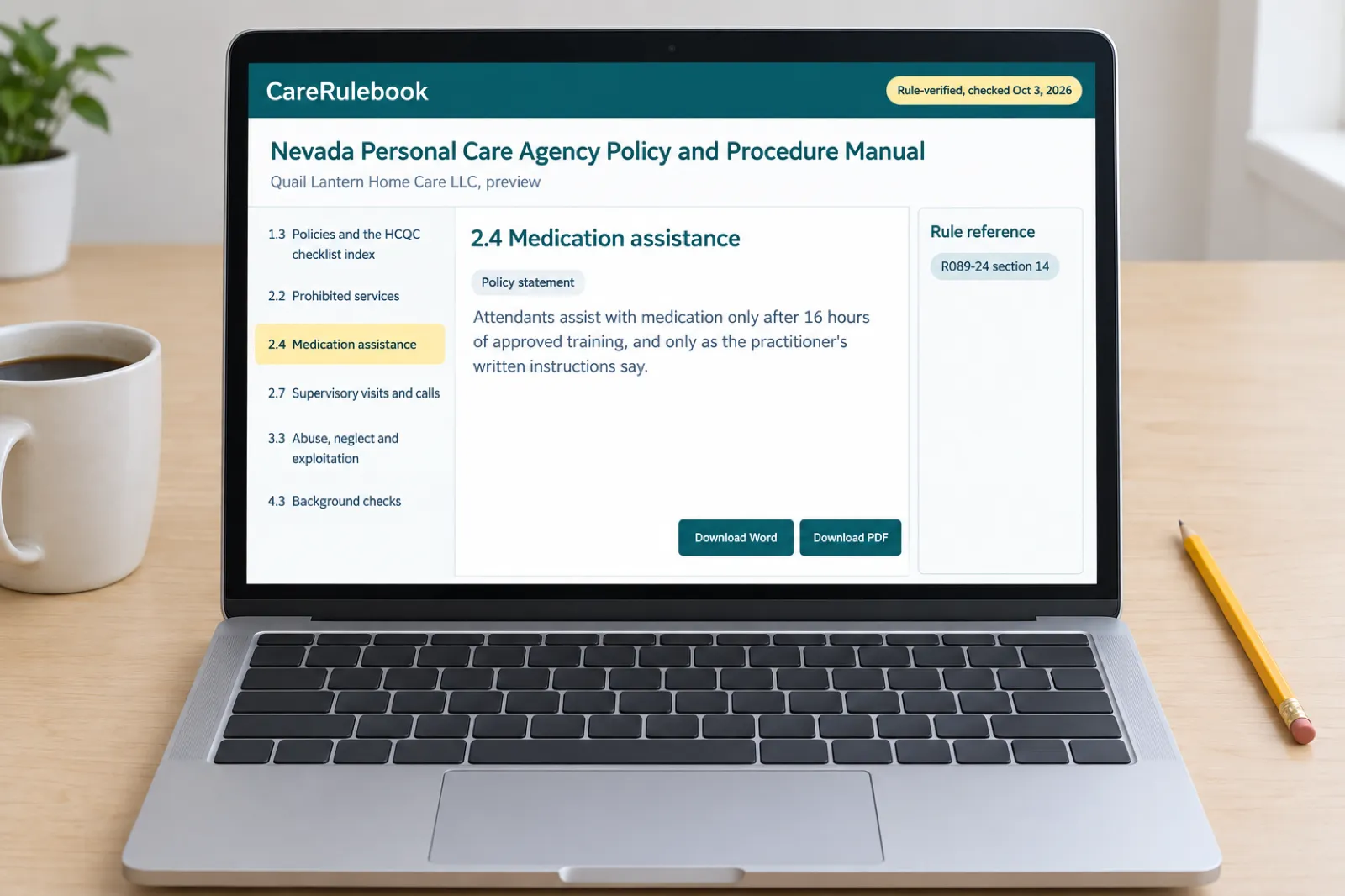
  • Medication assistance. Before assisting with medication, an attendant completes at least 16 hours of medication management training from a Division-approved course and gets a certificate, then at least 8 hours a year. An agency whose attendants assist with medication develops a training program and keeps a record for each client: medication type, date and time given, refusals or missed doses, and current instructions from the practitioner. (R089-24 section 14)
  • A new prohibited list. R089-24 struck four items from the prohibited list: administration of medication (including rectal suppositories, prescribed skin lotions and eye drops), trimming or cutting toenails, specialized range of motion services, and medical case management such as going with a client to the doctor. (R089-24 section 62)
  • New tasks with limits. Nail care, exercise assistance and help with appointments, each with conditions the services policy has to carry (NAC 449.39775(6)).

In the manual: Policies 2.14, 3.2, 3.4 and 2.4 carry these duties, and the prohibited list in Policy 2.2 is the one in force since February 27, 2026. If your agency is already licensed, Policy 1.3 ends with a checklist of every change since 2023 and the policy that now answers it. The 2026 changes on the Nevada guide, and every task with its conditions: what Nevada attendants may and may not do.

HCQC’s 55 tags, heading by heading

HCQC’s personal care agency page links an "Initial Inspection Workbook for Agencies to Provide Personal Care Services in the Home" (HCQC PCA page). Every page of the workbook has a P&P column next to each rule, so the surveyor records whether a written policy exists for it. (workbook, column headings) It ends with a checklist headed "PCS - Policies & Procedures/Form/Document Checklist" (workbook, final pages).

Below, every tag in HCQC’s order under HCQC’s headings, with the headings and HCQC’s wording shortened. The kind of each tag and the last column are ours: the kind is our reading of what stands behind the tag, and the last column is the policy or form that answers it in the CareRulebook manual’s HCQC checklist index (Policy 1.3). "Your document" means something only you can supply.

Rule names a written policy: 18Rule names a document or record: 14Rule duty, HCQC asks for the policy or form: 19HCQC’s expectation: 4

NAC 449.3973: Qualifications and duties of administrator

4 tags
TagHCQC asks for (shortened)Rule behind itAnswered in the manual
P0015

Administrator qualifications; duties

Rule duty, HCQC asks for the policy or form

NAC 449.3973(1) (as amended by R089-24)NAC 449.3973(2)(a)-(b)Policy 1.2, Administrator and designeePolicy 4.1, with the administrator job description
P0020

Appointment of the administrator designee; responsibilities

Rule duty, HCQC asks for the policy or form

NAC 449.3973(2), (2)(g)Policy 1.2, with the designee appointment letter
P0025

The designee’s access to all records

Rule duty, HCQC asks for the policy or form

NAC 449.3973(3)Policy 1.2, Administrator and designee
P0030

Abuse, neglect and exploitation

Rule duty, HCQC asks for the policy or form

NAC 449.3973(4)(a)NAC 449.3973(4)(b) (as amended by R089-24); NRS 200.5093Policy 3.3, Abuse, neglect, exploitation, isolation and abandonment: prevention and reporting

NAC 449.3974: Qualifications, responsibilities and conditions of employment for staff

13 tags
TagHCQC asks for (shortened)Rule behind itAnswered in the manual
P0035

Duties and responsibilities, with job descriptions for each position

Rule names a written policy

NAC 449.3974(1)Policy 4.1, with the job descriptions
P0040

Prohibited activities

Rule names a written policy

NAC 449.3974(2)Policy 4.2, Prohibited activities: calls, gifts, loans, gratuities and legal authority
P0045

Client’s rights (see P0185, P0190, P0195)

Rule names a written policy

NAC 449.3974(3)Policy 3.1, Client rights and the signed rights statement
P0050

Code of ethics and confidentiality of client information

Rule names a written policy

NAC 449.3974(4)Policy 3.5, with the staff confidentiality agreement
P0055

Prevention, control and investigation of infections and communicable diseases

Rule names a written policy

NAC 449.3974(5)Policy 2.14, Infection control plan, training and personal protective equipment
P0060

Personal care services provided by the agency

Rule names a written policy

NAC 449.3974(6)Policy 2.1, with the services menu
P0065

Assignment of attendants to clients

Rule names a written policy

NAC 449.3974(7)Policy 2.7, Assigning and supervising attendants: supervisory visits and calls
P0070

Documentation of client’s needs and services, with the initial screening and service plan forms

Rule names a written policy

NAC 449.3974(8)Policy 2.10, Client records and service documentationPolicy 2.5, with the screening and service plan forms
P0075

Emergency response

Rule names a written policy

NAC 449.3974(9)Policy 2.12, Emergency response and emergency preparedness
P0080

Coordination with community service agencies, with a list of community resources

Rule names a written policy

NAC 449.3974(10)Policy 2.9, with the community resources list
P0085

Periodic performance evaluation, with the evaluation form

Rule names a written policy

NAC 449.3974(11)Policy 4.9, with the performance evaluation form
P0090

Maintenance of current personnel records

Rule names a written policy

NAC 449.3974(12)Policy 4.4, Personnel records
P0095

Information on special needs, with examples

Rule names a written policy

NAC 449.3974(13)Policy 2.13, Special populations

NAC 449.3975: Attendants: qualifications and annual training

2 tags
TagHCQC asks for (shortened)Rule behind itAnswered in the manual
P0100

Attendant qualifications

Rule duty, HCQC asks for the policy or form

NAC 449.3975(1)-(5)Policy 4.1, Job descriptions and qualifications
P0125

Annual training requirement

Rule duty, HCQC asks for the policy or form

NAC 449.3975(6)Policy 4.8, Annual and required training

NAC 449.3976: Attendants: personnel file and competency

4 tags
TagHCQC asks for (shortened)Rule behind itAnswered in the manual
P0130

The attendant’s personnel file (application, hire and start dates, proof of age, physical clearance and TB testing, references, background check, CPR and first aid, auto insurance if driving clients, training and evaluations)

Rule names a document or record

NAC 449.3976(1)NAC 449.3976(1)(c); NAC 441A.375NAC 449.3976(1)(h)Policy 4.4, with the personnel file checklistPolicy 4.3, Background checksPolicy 4.5, Health certificate and tuberculosis screeningPolicy 4.11, Transporting clients
P0135

Documentation of each training course, with certificate

Rule names a document or record

NAC 449.3976(1)(i), (2)Policy 4.8, with the training record
P0140

Initial competency evaluation and additional training, with the evaluation form

Rule duty, HCQC asks for the policy or form

NAC 449.3976(3)Policy 4.7, with the competency checklist
P0145

Securing employee files

Rule duty, HCQC asks for the policy or form

NAC 449.3976(4)Policy 4.4, Personnel records

NAC 449.3977: Attendants: required knowledge and training

5 tags
TagHCQC asks for (shortened)Rule behind itAnswered in the manual
P0150

Working knowledge of NAC 449.396 to 449.3982, with attendants’ signed statement

Rule duty, HCQC asks for the policy or form

NAC 449.3977(1)(a)Policy 4.6, with the acknowledgement of the rules
P0151

Training before providing services; on-the-job training, with certificates

Rule duty, HCQC asks for the policy or form

NAC 449.3977(1)(b)Policy 4.6, with the on-the-job instruction record
P0152

Initial attendant training: the required topics

Rule duty, HCQC asks for the policy or form

NAC 449.3977(1)(c)Policy 4.6, with the initial training record
P0155

Competency evaluation after initial training

Rule duty, HCQC asks for the policy or form

NAC 449.3977(2)Policy 4.7, Competency evaluation
P0160

Training completed within the 12 months before the start of service

Rule duty, HCQC asks for the policy or form

NAC 449.3977(3)Policy 4.6, Orientation and initial training

NAC 449.3978: Prohibited services

1 tag
TagHCQC asks for (shortened)Rule behind itAnswered in the manual
P0165

Prohibited services: list them specifically

Rule duty, HCQC asks for the policy or form

NAC 449.3978 (as amended by R089-24)NAC 449.3978(2)Policy 2.2, with the prohibited services list, as in force since R089-24

NAC 449.3979: Written disclosure statement

2 tags
TagHCQC asks for (shortened)Rule behind itAnswered in the manual
P0175

Disclosure form with a signature line for the client or responsible party, kept in the client’s file

Rule names a document or record

NAC 449.3979(1)Policy 2.6, with the written disclosure statement
P0180

Specific disclosures: unstable conditions not managed, attendant qualifications and training, charges, billing, termination, contacting the administrator at all hours, on-call, rights, grievances

Rule names a document or record

NAC 449.3979(2)(a)NAC 449.3979(2)(b)NAC 449.3979(2)(c)-(d)NAC 449.3979(2)(e)NAC 449.3979(2)(f)NAC 449.3979(2)(g)Policy 2.6, Written disclosure statementPolicy 1.5, Accounting, charges, billing and contracted servicesPolicy 2.1, Personal care services offeredPolicy 2.8, Missed visits, extra visits and on-callPolicy 2.11, Ending services, transfers and referrals

NAC 449.398: Rights of clients

3 tags
TagHCQC asks for (shortened)Rule behind itAnswered in the manual
P0185

Clients may speak to anyone who advocates for clients’ rights

Rule duty, HCQC asks for the policy or form

NAC 449.398(1)Policy 3.1, Client rights and the signed rights statement
P0190

Procedures for responding to grievances, incidents and complaints

Rule names a written policy

NAC 449.398(2)Policy 3.2, with the report form and log
P0195

Specific client rights, signed and dated copy kept in the client’s file

Rule names a document or record

NAC 449.398(4)-(5)Policy 3.1, with the client rights statement and receipt

NAC 449.3981: Initial screening and service plan

2 tags
TagHCQC asks for (shortened)Rule behind itAnswered in the manual
P0210

Initial screening form and service plan form, signed and dated

Rule names a document or record

NAC 449.3981(1)-(2)Policy 2.5, with the initial screening form and service plan
P0220

Tasks before care starts: resources, plan review with the client, no-show policy, daily living check, coordination

Rule duty, HCQC asks for the policy or form

NAC 449.3973(2)(h); 449.3981(3)(a)NAC 449.3981(3)(b)NAC 449.3981(3)(c)NAC 449.3981(3)(d)NAC 449.3981(3)(e)Policy 2.5, with the pre-service checklistPolicy 2.8, Missed visits, extra visits and on-callPolicy 2.9, Coordination with community services and other providers

NAC 449.3982: Supervisory home visits or telephone calls

1 tag
TagHCQC asks for (shortened)Rule behind itAnswered in the manual
P0225

Supervisory visit or call form with the rule’s five questions, signed and dated by the administrator or designee

Rule names a document or record

NAC 449.3982(1)NAC 449.3982(2)Policy 2.7, with the supervisory visit or call record

NAC 449.39775: Attendants: performance of certain tasks

4 tags
TagHCQC asks for (shortened)Rule behind itAnswered in the manual
P0320

CLIA waiver if attendants perform blood glucose testing

Rule names a document or recordif attendants test blood glucose

NAC 449.39775(1)-(3), (5), (7)-(8); NRS 449B.130Policy 2.3, Health-related tasks: vital signs, blood glucose tests, insulin auto-injectors, weighing, nail care and exerciseYour document: the CLIA certificate of waiver
P0340

Consent form if weighing; attendant training if taking vital signs, testing blood glucose or using an insulin auto-injector

Rule names a document or recordif attendants do these tasks

NAC 449.39775(1)-(3), (5), (7)-(8); NRS 449B.130Policy 2.3, with the task consent and task training and competency record
P0350

Trainer meets the requirements

Rule duty, HCQC asks for the policy or formif attendants do these tasks

NAC 449.39775(7)Policy 2.3, with the trainer qualification record
P0360

Training topics meet the requirements

Rule duty, HCQC asks for the policy or formif attendants do these tasks

NAC 449.39775(1)-(3), (5), (7)-(8); NRS 449B.130Policy 2.3, Health-related tasks: vital signs, blood glucose tests, insulin auto-injectors, weighing, nail care and exercise

NRS 449.101 (for personal care agencies, now NRS 449B.260): Discrimination

2 tags
TagHCQC asks for (shortened)Rule behind itAnswered in the manual
P0405

Develop an anti-discrimination policy and post the statement

Rule names a written policy

NRS 449B.260(1)-(2)(a); NAC 449.011913Policy 3.4, Non-discrimination, preferred names and pronouns, and accessible notices
P0410

Internet marketing requirements

Rule names a document or recordif you market on a website

NRS 449B.260(2)(b)Policy 3.4, with the website statement text

NAC 449.011916 to 449.011946, as amended by R004-24

5 tags
TagHCQC asks for (shortened)Rule behind itAnswered in the manual
P0600

Transfer, discharge and service policies that do not depend on who pays

Rule names a written policy

NAC 449.011916Policy 2.11, Ending services, transfers and referralsPolicy 3.4, Non-discrimination, preferred names and pronouns, and accessible notices
P0605

Posting of the notice that a client who has experienced prohibited discrimination may file a complaint with the Division

HCQC’s expectation

HCQC checklist; NAC 449.011921Policy 3.4, with the printed notice
P0620

Complaint policy and complaint log

Rule names a written policy

NAC 449.011926 (as amended by R004-24)Policy 3.2, with the complaint log and discrimination complaint log
P0640

Approved cultural competency training within 90 days of hire, then every 2 years

Rule names a document or record

NRS 449B.280; NAC 449.011931 (as amended by R004-24)NAC 449.011931(3)-(4) (as amended by R004-24)Policy 4.8, Annual and required trainingPolicy 3.4, Non-discrimination, preferred names and pronouns, and accessible notices
P0700

Preferred names and pronouns; record content; English and accessible formats

Rule names a written policy

NAC 449.011943 (as amended by R004-24); NRS 449B.290NAC 449.011946Policy 3.4, Non-discrimination, preferred names and pronouns, and accessible noticesPolicy 2.10, Client records and service documentation

NAC 449.01065, NAC 449.0109 and R063-21: PPE and infection control

7 tags
TagHCQC asks for (shortened)Rule behind itAnswered in the manual
P0910

A 30-day supply of personal protective equipment

Rule names a document or record

NAC 449.01065Policy 2.14, Infection control plan, training and personal protective equipment
P0915

PPE supplier contract and PPE tracking form

Rule names a document or record

NAC 449.01065Policy 2.14, with the PPE tracking formYour document: the supplier contract
P0920

Infection control program and policy, reviewed every year; emergency preparedness plan

HCQC’s expectation

NAC 449.0109, as applied in HCQC workbook tags P0920 to P0945NAC 449.0109(1)(c), (6), as applied in HCQC workbook tag P0920Policy 2.14, Infection control plan, training and personal protective equipmentPolicy 2.12, with the emergency preparedness plan
P0935

Infection control responsible person and designee, identified

HCQC’s expectation

NAC 449.0109, as applied in HCQC workbook tags P0920 to P0945Policy 2.14, with the designation form
P0940

Proof of their infection control training

HCQC’s expectation

NAC 449.0109, as applied in HCQC workbook tags P0920 to P0945Policy 2.14, Infection control plan, training and personal protective equipmentYour document: their training certificates
P0945

Employee training cost paid by the agency

Rule duty, HCQC asks for the policy or form

NAC 449.39735NAC 449.0109, as applied in HCQC workbook tags P0920 to P0945Policy 4.8, Annual and required training
P0950

Infection control training for unlicensed caregivers (R063-21 section 4)

Rule names a document or record

NRS 449B.220(1), (3)(a)-(b); R063-21 section 4Policy 2.14, Infection control plan, training and personal protective equipmentPolicy 4.8, Annual and required training

What some tags ask for in detail

  • P0130, the attendant’s file. HCQC’s checklist lists the attendant file contents it expects: application form, hire and start of service dates, proof of age, pre-employment physical clearance and TB testing, references and proof they were checked, criminal background check, CPR and first aid certificate, auto insurance if the attendant drives clients, and training and evaluation records. (checklist P0130)
  • P0175 and P0210, signatures. HCQC’s checklist asks for the written disclosure form with a signature line for the client or responsible party, kept in the client’s file. (checklist P0175) HCQC’s checklist asks for the initial screening form and the service plan form, signed and dated by the person who did the screening and the person who developed or accepted the plan. (checklist P0210)
  • P0225, the supervisory form. HCQC’s checklist says the supervisory visit or call form must include the rule’s five questions and be signed and dated by the administrator or the designee. (checklist P0225) For supervisory visits and calls, HCQC’s workbook asks for a policy stating how often they happen and who performs them; the rule itself sets no frequency. (workbook P0225)
  • P0165, the prohibited list. HCQC’s checklist asks for a written policy listing the specific prohibited services; its workbook says the list does not need to be signed or kept in each employee’s file. (checklist P0165)
  • P0920, the yearly review. HCQC’s checklist says the infection control program and policy must be reviewed every year and must include current guidelines from a nationally recognized infection control organization that fit the agency’s services. (checklist P0920) HCQC’s training summary lists 15 hours of infection control training within 3 months for the infection control staff member and designee, then yearly. (workbook, training requirements)
  • Tags in the workbook but not on the checklist. The workbook body also has P0010 (liability coverage and the bond), P0099 (elder abuse training), P0131 to P0134 (background checks) and P0164 (prohibited services) (HCQC workbook (12.2024)). The CareRulebook index answers those too.

The training tags in full: Nevada caregiver training. The administrator tags: Nevada administrator and designee. How the survey runs, and what follows a finding: Nevada personal care agency surveys.

Tag kinds are our reading. "HCQC’s expectation" marks tags where the rule HCQC cites is written for other facilities (NAC 449.0109) or where the posting rule behind the tag was repealed; the manual meets them anyway. How each tag is checked at the survey is not published.

Where HCQC’s workbook is out of date

The workbook is dated 12.2024 and R089-24 took effect on February 27, 2026 (R089-24, cover). Four things to know when you use it:

  • The prohibited list. HCQC’s 12.2024 workbook, still linked as the initial inspection workbook, prints the prohibited list from before R089-24, including medication, toenail trimming, specialized range of motion and medical case management. (workbook P0164) The list in force is shorter (NAC 449.3978(2), as amended).
  • No medication tag. Attendants may now assist with medication after approved training (R089-24 section 14), and the workbook has no tag for it.
  • Old citations. HCQC’s checklist files the anti-discrimination tags (P0405, P0410) under NRS 449.101. For personal care agencies the same duties are now in NRS 449B.260. (checklist heading)
  • The administrator and abuse tags. HCQC’s 12.2024 workbook still prints the administrator rule as it stood before R089-24, with the diploma as the only education route. (workbook P0015) Since R089-24 a Nevada long-term care administrator license also qualifies (NAC 449.3973(1), as amended), and the administrator also ensures that isolation and abandonment are reported (NAC 449.3973(4), as amended), words the workbook does not use.

HCQC has not said whether it will publish a new workbook. HCQC runs an email list for personal care agencies with guidance on regulations, inspections, infection control and more. To join, use the link on HCQC’s personal care agency page and put only "subscribe PERSONALCAREAGENCY" in the body. (HCQC PCA page)

Every Nevada requirement, mapped to a policy

All 127 rows, filterable by topic or manual section. Each row quotes NRS 449B, NAC 449, R063-21, R004-24, R089-24, another Nevada statute, or the HCQC or Medicaid document named. Rows citing HCQC’s workbook are HCQC’s checklist, not rule text, and rows citing the Medicaid Services Manual apply only if you bill Nevada Medicaid. 22 rows apply only in the situation shown, and 2 rows are marked Recommended practice because no rule requires them.

127 rows

RuleWhat it requiresPolicy in your manual
NRS 449B.100

Hold the license before operating

No services before the license is issued; operating unlicensed is a misdemeanor.

"no person, state or local government or agency thereof may operate or maintain in this State an agency to provide personal care services in the home without first obtaining a license"

1.1 License, ownership, surety bond, changes and renewal
NAC 449.3972(1)

Keep records at the licensed location

Client, attendant, staff and operations records are kept at the location named on the license, including when the agency uses work stations.

"A person may operate an agency at multiple work stations if the agency maintains the records for the clients, attendants, other members of the staff of the agency and operations of the agency at the specific location designated on the license."

1.1 License, ownership, surety bond, changes and renewal2.10 Client records and service documentation
NAC 449.3972(2)

Responsible person on the license

The person designated as responsible for the agency is named on the license.

"The name of the person who is designated as responsible for the conduct of the agency must appear on the face of the license."

1.1 License, ownership, surety bond, changes and renewal
NAC 449.3972(3)-(4); NRS 449B.185

Liability coverage and surety bond

Keep proof of adequate liability coverage and of the surety bond (or approved deposit) sized to the number of employees; the license is suspended while there is no bond.

"Proof that it is adequately covered against liabilities resulting from claims incurred in the course of operation"

1.1 License, ownership, surety bond, changes and renewal
NRS 449B.185(1)

Bond amount by employee count

$5,000 under 7 employees, $25,000 for 7 to 25, $50,000 over 25, filed with each application and renewal. Our suggestion: review the amount when headcount changes.

"If the agency employs less than 7 employees, in the amount of $5,000"

1.1 License, ownership, surety bond, changes and renewal
NAC 449.0114(1)

Display the license

Display the license in a conspicuous place.

"Upon receipt of a license, the licensee shall display the license at a conspicuous location within the facility."

1.1 License, ownership, surety bond, changes and renewal
NAC 449.0114(4)-(5) (as amended by R089-24)

Report changes

Report a new administrator within 30 days, and changes of ownership, location or services immediately; amendments go through CLICS.

"A licensee shall notify the Division immediately of any change in:"

1.1 License, ownership, surety bond, changes and renewal
NRS 449B.210; NAC 449.0116

Renew every year

Renew before the license expires (an expired license cannot be renewed, NAC 449.0116(3)) with the fee and statements of compliance with the background check and elder abuse training rules; late renewal costs an extra charge.

"A statement that the holder of the license, the administrator or other person in charge and employees of the agency are in compliance with the provisions of NRS 449B.225."

1.1 License, ownership, surety bond, changes and renewal
NRS 449B.475

Accurate name and advertising

The agency name, signs and listings must not mislead about services.

"must not contain any terms misleading to the public with regard to the services offered"

1.1 License, ownership, surety bond, changes and renewal
NRS 449B.125(2)

Policies that protect clients

Practices and policies must provide adequately for the health, safety and well-being of each client.

"provide adequately for the protection of the health, safety and physical, moral and mental well-being of each person served by the agency"

1.3 Policies and procedures: adoption, staff access, review and the HCQC checklist index
NAC 449.3973(1) (as amended by R089-24)

Administrator qualifications

At least 18; high school diploma or equivalent, or a Nevada long-term care administrator license; mature; understands the rules and statute; English literacy. HCQC wants a resume, diploma and ID proving age.

"Be responsible and mature and have the personal qualities which will enable the administrator to understand the problems of elderly persons and persons with disabilities"

1.2 Administrator and designee4.1 Job descriptions and qualifications
NAC 449.3973(2), (2)(g)

Appoint a designee for absences

The administrator represents the licensee day to day and designates one or more employees to be in charge when absent.

"Designating one or more employees of the agency to be in charge of the agency during those times when the administrator is absent"

1.2 Administrator and designee
NAC 449.3973(3)

Designee can access records

The designee has access to all records, except confidential information the administrator keeps separately (see also NAC 449.3976(4)).

"an employee designated to be in charge of the agency when the administrator is absent must have access to all records kept at the agency"

1.2 Administrator and designee4.4 Personnel records
NAC 449.3973(2)(a)-(b)

Qualified, trained staff only

Employ qualified staff, ensure all required training, and ensure only trained attendants serve clients, following the assessment, service plan and policies.

"Ensuring that only trained attendants are providing services to a client of the agency"

1.2 Administrator and designee4.6 Orientation and initial training
NAC 449.3973(2)(c)

Accounting and reporting system

Develop and implement an accounting and reporting system showing the agency’s finances.

"Developing and implementing an accounting and reporting system that reflects the fiscal experience and current financial position of the agency"

1.5 Accounting, charges, billing and contracted services
NAC 449.3973(2)(d)

Contracted services

Negotiate contracted services lawfully and under agency policy.

"Negotiating for services provided by contract in accordance with legal requirements and established policies of the agency"

1.5 Accounting, charges, billing and contracted services4.10 Contracted attendants and temporary staffing services
NAC 449.3973(2)(e)

Oversight of staff

Provide oversight and direction so clients receive needed services.

"Providing oversight and direction for attendants and other members of the staff of the agency as necessary to ensure that the clients of the agency receive needed services"

1.2 Administrator and designee2.7 Assigning and supervising attendants: supervisory visits and calls
NAC 449.3973(2)(f)

Develop and implement policies

The administrator develops and implements the agency’s policies, including on terminating services.

"Developing and implementing policies and procedures for the agency, including, without limitation, policies and procedures concerning terminating the personal care services provided to a client"

1.3 Policies and procedures: adoption, staff access, review and the HCQC checklist index2.11 Ending services, transfers and referrals
NAC 449.3973(2)(h); 449.3981(3)(a)

Resources and capability

Show the Division on request that the agency can meet each service plan, and check capacity before starting or changing services.

"Evaluate whether the agency has sufficient resources and the capability to satisfy the requests of the client"

1.2 Administrator and designee2.5 Initial screening and service plan
NAC 449.3974

Keep, review and revise written policies

Keep written policies on staff qualifications, responsibilities and conditions of employment; review and revise them as needed.

"The written policies and procedures must be reviewed and revised as needed."

1.3 Policies and procedures: adoption, staff access, review and the HCQC checklist index
NAC 449.3974

Give policies to staff on hire and on change

Make the policies available to attendants and staff when hired and whenever revised.

"The written policies and procedures must be made available to the attendants and other members of the staff of the agency upon hire and whenever revisions are made to those policies and procedures."

1.3 Policies and procedures: adoption, staff access, review and the HCQC checklist index
HCQC workbook (12.2024), PCS Policies & Procedures/Form/Document Checklist

Map policies to HCQC’s checklist

HCQC’s initial inspection workbook ends with a 55-tag policy, form and document checklist. Keeping a crosswalk from each tag to a policy or form makes the prelicensure survey easier (HCQC expectation, not rule text).

"PCS - Policies & Procedures/Form/Document Checklist"

1.3 Policies and procedures: adoption, staff access, review and the HCQC checklist index1.4 Inspections, investigations and plans of correction
NAC 449.3974(1)

Attendant duties and responsibilities

Describe attendants’ duties and responsibilities. HCQC asks for job descriptions for each position (P0035).

"Provide descriptions of the duties and responsibilities of attendants"

4.1 Job descriptions and qualifications
NAC 449.3974(2)

Prohibited activities

List activities attendants may not engage in, at least: personal long-distance calls on the client’s phone or while on duty; lending, borrowing or accepting gifts of money or items; accepting money or tips other than for the client’s groceries or medication; becoming the client’s guardian or attorney-in-fact.

"Becoming the legal guardian of a client or being named as an attorney-in-fact in a power of attorney executed by the client"

4.2 Prohibited activities: calls, gifts, loans, gratuities and legal authority
NAC 449.3974(2)(b)-(c)

No gifts, loans or gratuities

No loaning, borrowing or accepting gifts of money or personal items; no money or gratuities except money for the client’s groceries or medication.

"Accepting or retaining money or gratuities from a client, other than money needed for the purchase of groceries or medication for the client"

4.2 Prohibited activities: calls, gifts, loans, gratuities and legal authority3.5 Ethics, confidentiality and privacy
NAC 449.3974(3)

Client rights in policy

Set out the rights of clients.

"Set forth the rights of clients"

3.1 Client rights and the signed rights statement
NAC 449.3974(4)

Ethics and confidentiality

Set out ethics requirements for staff, including confidentiality of client information. HCQC looks for a confidentiality or HIPAA form (P0050).

"Set forth any requirements relating to ethics governing attendants and other members of the staff of the agency, including, without limitation, any requirements concerning the confidentiality of client information"

3.5 Ethics, confidentiality and privacy
NAC 449.3974(5)

Infection prevention, control and investigation

Provide for preventing, controlling and investigating infections and communicable diseases.

"Provide for the prevention, control and investigation of infections and communicable diseases"

2.14 Infection control plan, training and personal protective equipment
NAC 449.3974(6)

Services offered

Describe the personal care services the agency provides.

"Provide a description of the personal care services that are provided by the agency to clients"

2.1 Personal care services offered
NAC 449.3974(7)

Assigning and supervising attendants

Describe how attendants are assigned to clients and any supervision provided.

"Provide a description of the manner in which the agency assigns attendants to provide personal care services to clients and any supervision of those services that will be provided by the agency"

2.7 Assigning and supervising attendants: supervisory visits and calls
NAC 449.3974(8)

Documenting needs and services

Provide for documenting each client’s needs and the services provided (HCQC: include the initial screening and service plan forms, P0070).

"Provide for documentation of the needs of each client and the personal care services that are provided to the client"

2.10 Client records and service documentation2.5 Initial screening and service plan
NAC 449.3974(9)

Emergency responses

Set out the agency’s responses to medical and nonmedical emergencies.

"Set forth the emergency responses of the agency to both medical and nonmedical situations"

2.12 Emergency response and emergency preparedness
NAC 449.3974(10)

Coordination with community agencies

Set out the agency’s role and coordination with other community service agencies (HCQC: include a list of community resources, P0080).

"Set forth the roles of the agency and any coordination that the agency will provide with services provided by other community service agencies"

2.9 Coordination with community services and other providers
NAC 449.3974(11)

Performance evaluations

Provide for periodic performance evaluations of attendants and staff (HCQC: include the evaluation form, P0085).

"Provide for periodic evaluations of the performance of attendants and other members of the staff of the agency"

4.9 Performance evaluations
NAC 449.3974(12)

Current personnel records

Keep current personnel records that confirm the policies are followed.

"Provide for the maintenance of current personnel records which confirm that the policies and procedures are being followed"

4.4 Personnel records
NAC 449.3974(13)

Special populations

Set out any specific information needed for the special populations served (HCQC: include examples, P0095).

"Set forth any other specific information that is necessary based on the needs of any special populations served by the agency"

2.13 Special populations
NAC 449.3975(1)-(5)

Attendant qualifications

At least 18; mature; understands the rules; communicates effectively with clients; able to meet clients’ needs.

"Demonstrate the ability to meet the needs of the clients of the agency"

4.1 Job descriptions and qualifications
NAC 449.3975(6)

8 hours of training a year

Each attendant receives at least 8 hours a year of training on clients’ needs.

"Receive annually not less than 8 hours of training related to providing for the needs of the clients of the agency."

4.8 Annual and required training
NAC 449.3976(1)

Attendant personnel file contents

Name, address, phone; start date; TB tests and health certificate; reference checks; background check evidence; first aid and CPR within 6 months; proof of age; auto insurance if driving clients; training and evaluations.

"Evidence that the references supplied by the attendant were checked by the agency"

4.4 Personnel records
NAC 449.3976(1)(c); NAC 441A.375

Health certificate and TB tests

Before work: a physical exam or provider certificate of good health free of active TB, and a TB test within 12 months; then yearly TB tests unless a documented risk assessment allows less; chest X-ray route for past positives.

"Documentation that the attendant has had the tests or obtained the certificates required by NAC 441A.375"

4.5 Health certificate and tuberculosis screening4.4 Personnel records
NAC 449.3976(1)(f) (as amended by R089-24); R089-24 section 2

First aid and CPR within 6 months

Proof of first aid and CPR certification within 6 months of starting, with live (not prerecorded) skills practice or verification. First aid and CPR are also part of the initial training program (NAC 449.3977(1)(c)(5)), so the manual has attendants certified before their first client.

"is certified in first aid and cardiopulmonary resuscitation"

4.6 Orientation and initial training4.4 Personnel records
NAC 449.3976(1)(h)

Auto insurance for attendants who drive clientsif attendants transport clients

Keep proof of at least the state minimum liability insurance for attendants who transport clients.

"Proof of possession by the attendant of at least the minimum liability insurance coverage required by state law if the attendant will be providing transportation to a client in a motor vehicle"

4.11 Transporting clients4.4 Personnel records
NAC 449.3976(1)(i), (2)

Training records

For each course: content, date, hours, instructor name and signature, and a completion certificate.

"The name and signature of the instructor of the training course"

4.4 Personnel records4.8 Annual and required training
NAC 449.3976(3)

Evaluate competency of trained hires

Evaluate competency in each required area when an attendant brings proof of earlier training; further training can target gaps.

"shall evaluate the competency of an attendant in each competency area required by the agency if the attendant provides written proof of his or her current or previous training"

4.7 Competency evaluation
NAC 449.3976(4)

Secure personnel files, open to the Division

Files may be locked with restricted access but must be available to the Division on request (HCQC checks secured filing, P0145).

"The administrator may keep the personnel files of the agency in a locked cabinet"

4.4 Personnel records
NAC 449.3977(1)(a)

Give attendants the rules

Give each attendant a copy of the licensing rules before they serve clients; they gain a working knowledge (HCQC: acknowledgement form, P0150).

"Obtain a working knowledge of the provisions of this chapter which govern the licensing of agencies before providing personal care services to the clients of the agency."

4.6 Orientation and initial training
NAC 449.3977(1)(b)

Training program with supervised on-the-job instruction

Complete a training program, including on-the-job instruction supervised by the administrator or designee, before working independently.

"The training program must include an opportunity for the attendant to receive on-the-job instruction provided to clients of the agency"

4.6 Orientation and initial training
NAC 449.3977(1)(c)

Required training topics

Documentation and time records; client rights and confidentiality; aging and disability needs; communication skills; first aid and CPR; and service-specific topics: duties and techniques, emergencies, adverse behaviors, nutrition, bowel and bladder care, skin care, preventing skin breakdown, contractures and falls, hand washing and infection control, body mechanics and transfers, clean and safe environment.

"Related to communication skills, including, without limitation, active listening, problem solving, conflict resolution and techniques for communicating through alternative modes with persons with communication or sensory impairments."

4.6 Orientation and initial training
NAC 449.3977(2)

Competency in every training area

Each attendant is evaluated and found competent in the required training areas (HCQC: competency evaluation or exam after initial training, P0155).

"Each attendant of an agency must be evaluated and determined to be competent by the agency in the required areas of training"

4.7 Competency evaluation
NAC 449.3977(3)

Training within 12 months before first care

Evidence of the full training program completed within the 12 months before the attendant first provides care.

"within the 12 months immediately preceding the date on which the attendant first begins providing care to a client"

4.6 Orientation and initial training
NAC 449.39735

Agency pays for training

Provide or arrange required training; pay course and travel costs and wages for training and travel time; keep completion documents in the personnel file.

"Maintain such documentation in the personnel file of the employee."

4.8 Annual and required training4.6 Orientation and initial training
NAC 449.39775(1)-(3), (5), (7)-(8); NRS 449B.130

Vital signs, glucose tests and weighingif attendants take vital signs, run blood glucose tests or weigh clients

Only after task training (before, yearly and on device change) by a qualified trainer covering infection control, interpreting results and actions to take; follow manufacturer instructions and CLIA; one glucose meter per person; weigh only with consent. HCQC checks for a CLIA waiver and consent forms (P0320, P0340).

"An attendant may weigh a client of an agency only if:"

2.3 Health-related tasks: vital signs, blood glucose tests, insulin auto-injectors, weighing, nail care and exercise
NAC 449.39775(3)

One glucose meter per personif attendants run blood glucose tests

A blood glucose meter is never used on more than one person.

"an attendant who conducts a blood glucose test must ensure that the device for monitoring blood glucose is not used on more than one person"

2.3 Health-related tasks: vital signs, blood glucose tests, insulin auto-injectors, weighing, nail care and exercise
NAC 449.39775(4)

Insulin by auto-injector onlyif attendants assist with insulin

Pharmacist-furnished insulin by FDA-approved auto-injector, client stable per physician, PA or APRN, maintenance dose with no sliding scale.

"A physician, physician assistant or advanced practice registered nurse has determined that the client’s physical and mental condition is stable and following a predictable course"

2.3 Health-related tasks: vital signs, blood glucose tests, insulin auto-injectors, weighing, nail care and exercise2.4 Medication assistance
NAC 449.39775(7)

Who may train tasksif attendants perform tasks under NAC 449.39775

A physician, PA or licensed nurse; a pharmacist for insulin and glucose tasks; or an employee trained by one of them with a year of experience and shown competency (HCQC P0350).

"A physician, physician assistant or licensed nurse"

2.3 Health-related tasks: vital signs, blood glucose tests, insulin auto-injectors, weighing, nail care and exercise
NAC 449.39775(6)(a) (as amended by R089-24)

Nail care limitsif the agency offers nail care

Attendants may trim nails unless the provider restricts toenail care to a podiatrist or nail technologist; consult the provider first for clients with diabetes.

"If the client has been diagnosed with diabetes, the attendant shall consult with the client’s physician or other provider of health care before trimming or cutting the toenails of the client."

2.1 Personal care services offered2.3 Health-related tasks: vital signs, blood glucose tests, insulin auto-injectors, weighing, nail care and exercise
NAC 449.39775(6)(b) (as amended by R089-24)

Exercise assistance limitsif the agency offers exercise assistance

No exercises the client’s provider has said the client should not do.

"An attendant shall not assist a client with any exercises in which the physician or other provider of health care of the client has determined that the client should not participate."

2.1 Personal care services offered2.3 Health-related tasks: vital signs, blood glucose tests, insulin auto-injectors, weighing, nail care and exercise
NAC 449.39775(6)(c)-(d) (as amended by R089-24)

Appointments and sharing health informationif attendants accompany clients to appointments or communicate with providers

Attendants may help with appointments and pass information to and from providers and the client’s representatives, within the laws on protected health information.

"In accordance with the requirements of federal and state law and regulations concerning protected health information, communicate and share information pursuant to this subsection"

2.1 Personal care services offered3.5 Ethics, confidentiality and privacy
NAC 449.3978 (as amended by R089-24)

Prohibited services

The administrator keeps attendants within their scope and professional; attendants must not provide the listed skilled services (HCQC: list specific prohibited services, P0165; reviewed with each client, P0220).

"The administrator of an agency shall ensure that each attendant working for the agency is working within the attendant’s scope of service and conducts himself or herself in a professional manner."

2.2 Prohibited services and the attendant’s scope of service
NAC 449.3978(2)

The prohibited list

Catheter insertion or irrigation; body cavity irrigation; prescription or aseptic dressings; injections except as allowed; physical assessments; specialized feeding; digital rectal exams; massage; skilled nursing tasks beyond CNA scope.

"Irrigation of any body cavity, including, without limitation, irrigation of the ear, insertion of an enema or a vaginal douche"

2.2 Prohibited services and the attendant’s scope of service
R089-24 section 14(1)

When attendants may assist with medicationif attendants assist with medication

Written agreement where NRS 453.375 or 454.213 requires one; completed medication training; medication prescribed or ordered and given per written instructions. NAC 449.3978 limits still apply.

"The medication has been prescribed or ordered by a practitioner for whom the prescribing or ordering of the medication is within his or her scope of practice and is administered in accordance with the written instructions of that practitioner."

2.4 Medication assistance
R089-24 section 14(2)

Medication trainingif attendants assist with medication

16 hours from a Division-approved course with a certificate before assisting, then 8 hours a year with evidence to the agency.

"Successfully complete annually not less than 8 hours of training in the management of medication from a course approved by the Division"

2.4 Medication assistance4.8 Annual and required training
R089-24 section 14(3)

Medication training program and recordsif attendants assist with medication

A program ensuring the training, and a medication record per client: type, date and time, refusals or missed doses, current instructions.

"The date and time that a client refuses or otherwise misses an administration of medication"

2.4 Medication assistance2.10 Client records and service documentation
NRS 453.375(1)(g)

Written agreement for controlled substancesif attendants assist with medication

A controlled substance may be handled by a person the ultimate user designates in a written agreement.

"An ultimate user or any person whom the ultimate user designates pursuant to a written agreement."

2.4 Medication assistance
NAC 449.3979(1)

Written disclosure statement

Give each new client a written disclosure statement, have it signed, and file a copy (HCQC P0175).

"Ensure that a copy of the written disclosure statement is incorporated into the record of the client"

2.6 Written disclosure statement
NAC 449.3979(2)(a)

Disclose that unstable conditions are out of scope

An easy-to-understand statement that managing unstable or unpredictable medical conditions is outside the license.

"it is not within the scope of the license of the agency to manage the medical and health conditions of clients should the conditions become unstable or unpredictable"

2.6 Written disclosure statement2.1 Personal care services offered
NAC 449.3979(2)(b)

Disclose attendant qualifications and training

State the qualifications and training requirements for attendants.

"The qualifications and training requirements for the attendants who provide personal care services to the clients of the agency"

2.6 Written disclosure statement
NAC 449.3979(2)(c)-(d)

Charges, billing and price increase policy

Charges; billing methods, payment systems and due dates; the policy for notifying clients of price increases.

"the policy for notifying clients of increases in the costs of personal care services provided by the agency"

2.6 Written disclosure statement1.5 Accounting, charges, billing and contracted services
NAC 449.3979(2)(e)

Termination criteria and notice policy

The criteria for ending services and the policy for notifying clients.

"The criteria, circumstances or conditions which may result in the termination of personal care services by the agency and the policy for notifying clients of such termination"

2.6 Written disclosure statement2.11 Ending services, transfers and referrals
NAC 449.3979(2)(f)

Contacting the administrator; on-call policy

How to reach the administrator or designee during all service hours, and the on-call policy.

"Procedures for contacting the administrator of the agency or the administrator’s designee during all hours in which personal care services are provided and the on-call policy of the agency"

2.6 Written disclosure statement2.8 Missed visits, extra visits and on-call
NAC 449.3979(2)(g)

Rights and grievance procedure in the disclosure

Information on client rights and the grievance procedure.

"Information concerning the rights of clients and the grievance procedure of the agency"

2.6 Written disclosure statement3.1 Client rights and the signed rights statement3.2 Grievances, incidents and complaints
NAC 449.398(1)

Clients may speak with advocates

No client is stopped from speaking with an advocate for clients’ rights (HCQC P0185).

"a client is not prohibited from speaking to any person who advocates for the rights of the clients of the agency"

3.1 Client rights and the signed rights statement
NAC 449.398(2)

Grievance, incident and complaint procedure

Administrator or designee notified of each grievance, incident or complaint, investigates personally and promptly, and tells the client the action taken or why none (HCQC: policy, report form and tracking, P0190).

"A client who files a grievance or complaint or reports an incident concerning the agency must be notified of the action taken in response to the grievance, complaint or report or must be given a reason why no action was taken."

3.2 Grievances, incidents and complaints
NAC 449.398(3); NRS 449A.100 to 449A.118

Comply with the patients’ rights law

The administrator ensures compliance with NRS 449A.100 to 449A.118.

"The administrator of an agency shall ensure that the agency is in compliance with NRS 449A.100 to 449A.118, inclusive."

3.1 Client rights and the signed rights statement
NRS 449A.118(1)

Tell clients their statutory rights on admission

Inform each client or representative on admission of the rights in NRS 449A.100 and 449A.106 to 449A.115 (information, billing explanation, considerate care, refusing treatment, privacy, confidentiality and others).

"shall inform each patient or the patient’s legal representative, upon the admission of the patient to the facility, of the patient’s rights as listed in NRS 449A.100 and 449A.106 to 449A.115, inclusive"

3.1 Client rights and the signed rights statement
NRS 449A.115

No bequests to owners or administrators

Owners and administrators may not take money or property under a client’s will or life insurance (unless spouse, guardian or next of kin).

"an owner or administrator of a medical facility or facility for the dependent is not entitled to receive, and must not receive:"

3.5 Ethics, confidentiality and privacy4.2 Prohibited activities: calls, gifts, loans, gratuities and legal authority
NAC 449.398(4)-(5)

Written rights with six statements, signed receipt

Written description of rights with the six required statements, given at the start of the service plan, signed and dated receipt in the record (HCQC P0195).

"The agency shall develop a written description of the rights of clients and provide a copy to each client or a representative of the client upon initiation of the service plan established for the client."

3.1 Client rights and the signed rights statement
NAC 449.398(5)(c)-(d)

Bureau phone number and record access notice

The rights statement gives the Bureau’s complaint phone number and notice that the Division may examine client records.

"To receive notification of any authority of the Division to examine the records of the client as related to the regulation and evaluation of the agency by the Division"

3.1 Client rights and the signed rights statement
NRS 449B.270

Privacy and confidentiality duties

Confidentiality of sexual orientation, transgender status and HIV status; no non-care staff present during unclothed care without permission; visual barriers; right to refuse educational observation.

"Maintain the confidentiality of personally identifiable information concerning the sexual orientation of a client"

3.5 Ethics, confidentiality and privacy3.1 Client rights and the signed rights statement
NAC 449.3981(1)-(2)

Initial screening and service plan

Administrator or designee screens each prospective client and develops or accepts a service plan; documented, dated and signed (HCQC P0210).

"shall conduct an initial screening to evaluate each prospective client’s requests for personal care services and to develop a service plan for the client or to accept a service plan established for the client"

2.5 Initial screening and service plan
NAC 449.3981(3)(b)

Review the plan with the client before starting

Review the schedule, the procedure if an attendant does not deliver the plan, hiring and training policies, agency responsibilities, the grievance procedure and the prohibited services (HCQC P0220).

"Review the service plan with the client, including, without limitation, the schedule for the provision of personal care services to the client"

2.5 Initial screening and service plan
NAC 449.3981(3)(c)

No-show and extra visit procedures

Review with the client what happens if an attendant does not arrive and how an additional visit is arranged (HCQC: no-show policy, P0220).

"Review the procedure to be followed if an attendant does not appear for a scheduled visit and the procedure to be followed if an additional visit from an attendant is required"

2.8 Missed visits, extra visits and on-call
NAC 449.3981(3)(d)

Services assist with daily living

Confirm requested services assist with activities of daily living before starting and on each plan change.

"Ensure that the personal care services requested by the client are services which assist the client with the activities of daily living"

2.5 Initial screening and service plan2.1 Personal care services offered
NAC 449.3981(3)(e)

Coordinate with other providers

Coordinate the agency’s services with care from other organizations and people.

"Ensure that the agency is coordinating the personal care services that it will be providing to the client with the care and services available to the client from other organizations and persons"

2.9 Coordination with community services and other providers
NAC 449.3982(1)

Supervisory visits or calls

Administrator or designee makes supervisory home visits or calls to each client; HCQC expects the policy to state frequency and who does them (P0225).

"The administrator of an agency or the administrator’s designee shall conduct supervisory home visits or telephone calls"

2.7 Assigning and supervising attendants: supervisory visits and calls
NAC 449.3982(2)

Five-point supervisory record

Each visit or call documented, dated and signed, evaluating safe techniques, plan followed, plan meeting needs, attendant training and needed follow-up.

"The attendant providing personal care services to the client has received sufficient training relating to the personal care services that the attendant is providing to the client"

2.7 Assigning and supervising attendants: supervisory visits and calls2.10 Client records and service documentation
NAC 449.3977(1)(c)(1)

Documentation and time records

Attendants are trained to document services and verify time records, so the agency needs a visit and time record system.

"Verification of time records."

2.10 Client records and service documentation
NRS 449B.460

Dietitian after hospital dischargewhen a client comes home from hospital

Consult a dietitian as appropriate when a hospital discharges a patient home to the agency’s care.

"If a patient is released by a hospital to his or her residence to receive care from an agency to provide personal care services in the home"

2.9 Coordination with community services and other providers
NRS 449B.480

No referrals to unlicensed or unsuitable group homes

Never refer a person to an unlicensed residential facility for groups or one that does not suit their condition.

"Refer a person to a residential facility for groups if the agency to provide personal care services in the home or its employee knows or reasonably should know"

2.9 Coordination with community services and other providers2.11 Ending services, transfers and referrals
NRS 449A.100

Explain transfers and alternatives

Provide needed services or arrange transfer to a provider that can; explain the need for transfer and the alternatives, unless the client’s condition needs an immediate transfer to a higher level of care and the client cannot understand the explanation.

"A patient may be transferred to another facility only if the patient has received an explanation of the need to transfer the patient and the alternatives available"

2.11 Ending services, transfers and referrals
NAC 449.011916

Discharge and service policies blind to payer

Transfer, discharge and service policies do not discriminate by payment source (HCQC P0600).

"A facility shall adopt and maintain policies and procedures for the transfer and discharge of, and the provision of services to, patients or residents in the facility"

2.11 Ending services, transfers and referrals3.4 Non-discrimination, preferred names and pronouns, and accessible notices
NAC 449.3973(4)(a)

Protect clients from abuse

The administrator ensures clients are not abused, neglected or exploited by staff, or by visitors while staff are present (HCQC: elder abuse recognition, prevention and reporting policy, P0030).

"The clients of the agency are not abused, neglected or exploited by an attendant or another member of the staff of the agency, or by any person who is visiting the client when an attendant or another member of the staff of the agency is present"

3.3 Abuse, neglect, exploitation, isolation and abandonment: prevention and reporting
NAC 449.3973(4)(b) (as amended by R089-24); NRS 200.5093

Report suspected abuse within 24 hours

Every owner and employee reports suspected abuse, neglect, exploitation, isolation or abandonment of an older or vulnerable person to ADSD, police or ADSD’s toll-free line within 24 hours.

"Make such a report as soon as reasonably practicable but not later than 24 hours"

3.3 Abuse, neglect, exploitation, isolation and abandonment: prevention and reporting
NRS 200.5093(1)(a), (2)

Where reports go

Local ADSD office, police or sheriff, or ADSD’s toll-free service; if ADSD or police are involved in the abuse, report to a different agency.

"The local office of the Aging and Disability Services Division of the Department of Human Services"

3.3 Abuse, neglect, exploitation, isolation and abandonment: prevention and reporting
NRS 200.5093(6)

Deaths from abuse or neglect

If a reporter believes an older or vulnerable person died from abuse, neglect, isolation or abandonment, report it to the medical examiner or coroner.

"report this belief to the appropriate medical examiner or coroner"

3.3 Abuse, neglect, exploitation, isolation and abandonment: prevention and reporting
NRS 632.4725

Work assignment records for nursing staffif the agency employs a nurse, nursing assistant or medication aide - certified

Keep a record of the work assignments of each nurse, nursing assistant or medication aide - certified the agency employs, for at least 5 years.

"shall prepare and maintain, for at least 5 years, a record of the work assignments of each licensee, nursing assistant or medication aide - certified."

4.4 Personnel records
NRS 632.472(1)(d)

Report nursing licensee misconduct

Report in writing to the State Board of Nursing any conduct of a Board licensee or certificate holder (nurse, nursing assistant, medication aide) that violates the nursing law.

"shall report in writing to the Executive Director of the Board any conduct of a licensee or holder of a certificate which constitutes a violation of the provisions of this chapter"

3.3 Abuse, neglect, exploitation, isolation and abandonment: prevention and reporting
NRS 432B.220(1), (4)(f), (8)

Child abuse reportingif the agency serves clients under 18

Our reading: when serving a child, staff report suspected child abuse or neglect to child welfare or police within 24 hours, and the agency informs each new employee in writing and keeps their acknowledgement.

"Obtain a written acknowledgment or electronic record from the person that he or she has been informed of his or her duty pursuant to this section"

3.3 Abuse, neglect, exploitation, isolation and abandonment: prevention and reporting
NRS 449B.225(4)-(8)

Elder abuse training

Administrator before care begins and yearly; each care employee before their first client and yearly; topics include recognizing and responding to abuse and the relevant laws; the agency pays (HCQC P0099).

"The topics of instruction that must be included in the training required by this section must include, without limitation:"

3.3 Abuse, neglect, exploitation, isolation and abandonment: prevention and reporting4.6 Orientation and initial training4.8 Annual and required training
NRS 449B.260(1)-(2)(a); NAC 449.011913

Anti-discrimination policies

Develop and carry out policies to prevent the prohibited types of discrimination, including indirect discrimination and harassment or bullying (HCQC P0405).

"Develop and carry out policies to prevent the specific types of prohibited discrimination described in the regulations adopted by the Board"

3.4 Non-discrimination, preferred names and pronouns, and accessible notices
NRS 449B.260(2)(b)

Website non-discrimination statementif the agency markets on a website

Post the statutory statement prominently on any website used to market the agency (HCQC P0410).

"does not discriminate and does not permit discrimination, including, without limitation, bullying, abuse or harassment"

3.4 Non-discrimination, preferred names and pronouns, and accessible notices
NAC 449.011926 (as amended by R004-24)

Complaint policy and discrimination complaint log

A written policy on how complaints may be filed and will be documented, investigated and resolved, and a log of discrimination complaints and actions (HCQC P0620).

"Maintain a log that lists:"

3.2 Grievances, incidents and complaints3.4 Non-discrimination, preferred names and pronouns, and accessible notices
NAC 449.011943 (as amended by R004-24); NRS 449B.290

Preferred names and pronouns

Policies to address clients by preferred name and pronoun; adapt records where practicable (HCQC P0700).

"To the extent practicable and available within the systems in use at the facility:"

3.4 Non-discrimination, preferred names and pronouns, and accessible notices2.10 Client records and service documentation
NAC 449.011946

Notices in appropriate languages and formats

Non-discrimination statements and notices in English and other appropriate languages, with reasonable accommodations for clients who cannot read, are blind, have communication impairments or do not read English.

"A facility must make reasonable accommodations in providing the statements, notices and information described in subsection 1 for patients or residents who:"

3.4 Non-discrimination, preferred names and pronouns, and accessible notices
NRS 449B.280; NAC 449.011931 (as amended by R004-24)

Cultural competency training

Approved course within 90 days of hire and at least 2 hours every two years for staff with weekly direct client contact and their supervisors; proof in the personnel file (HCQC P0640).

"Within 90 days ... after contracting with or hiring the agent or employee"

4.8 Annual and required training3.4 Non-discrimination, preferred names and pronouns, and accessible notices
NAC 449.011931(3)-(4) (as amended by R004-24)

Proof of cultural competency training or exemption

Keep proof of completion, or of the professional license that makes a staff member exempt, in the personnel file or electronic system.

"the facility shall keep documentation in the personnel file of"

4.4 Personnel records
NRS 449B.220(3)(c)-(d)

Written infection control plan, updated yearly, given to all

Develop and annually update a written plan for the control of infectious diseases; give a copy to each employee, contractor and client.

"Develop and annually update a written plan for the control of infectious diseases"

2.14 Infection control plan, training and personal protective equipment
R063-21 section 5

What the plan must contain

A coordinator; evidence-based policies (for example CDC) fitting the services; procedures to find and correct lapses; review of activities; investigating and reporting communicable diseases under chapter 441A; an outbreak strategy covering staffing, admissions and protecting clients. Our reading: these contents apply because R063-21 was adopted for the same statutory plan now in NRS 449B.220 (see R063-21 section 5(2)).

"Include a strategy for addressing an outbreak of an infectious disease and the effects of such an outbreak at the facility"

2.14 Infection control plan, training and personal protective equipment
NRS 449B.220(1), (3)(a)-(b); R063-21 section 4

Annual infection control training for caregivers

Each unlicensed caregiver completes the annual training on the six topics, gives proof to the administrator, and it is documented in the personnel file; best practices are put in place (HCQC P0950).

"Ensure that each unlicensed caregiver who provides care for the agency completes the training required by the regulations adopted pursuant to subsection 1 and document the completion of the training in the personnel file of each unlicensed caregiver"

2.14 Infection control plan, training and personal protective equipment4.8 Annual and required training
NAC 449.01065

PPE supply, supplier contract and tracking

Use PPE per the adopted publications; keep a 30-day supply (or document shortage attempts); contract with a supplier and track stock and usage (HCQC P0910, P0915).

"Enter into a contract with a supplier of personal protective equipment"

2.14 Infection control plan, training and personal protective equipment
NAC 449.0109, as applied in HCQC workbook tags P0920 to P0945

Infection control program reviewed yearly (HCQC expectation)

HCQC’s workbook expects an infection control program and policy based on national guidelines and reviewed every year, with a named responsible person and designee who complete 15 hours of training within 3 months and yearly, at the agency’s cost. The rule text names facilities for the dependent; we treat this as HCQC’s survey expectation.

"NAC 449.0109 - Infection Control and Prevention Program -Infection Control program and policy. Must"

2.14 Infection control plan, training and personal protective equipment
NAC 449.0109(1)(c), (6), as applied in HCQC workbook tag P0920

Emergency preparedness plan (HCQC expectation)

A plan covering internal and external, local and widespread emergencies, including emerging infectious diseases.

"Emergency Preparedness Plan - Must address internal and external emergencies, including emerging infectious diseases."

2.12 Emergency response and emergency preparedness2.14 Infection control plan, training and personal protective equipment
NRS 449B.310(1)

Background check within 10 days of hire

Signed conviction statement, oral and written confirmation, license or certificate proof, fingerprints with written authorization submitted to the Central Repository, and screening on the state website where one exists; for employees, temporary agency workers and contractors (HCQC: through NABS).

"Obtain a written statement from the employee, employee of the temporary employment service or independent contractor stating whether he or she has been convicted of any crime listed in NRS 449B.440"

4.3 Background checks
NRS 449B.310(4)

Complete checks and repeat every 5 years

Complete the investigation as soon as practicable and repeat at least every 5 years.

"At least once every 5 years after the date of the initial investigation."

4.3 Background checks
NRS 449B.330

Keep background check records

Fingerprint copy or electronic submission proof, written authorization and other documentation, kept for the length of employment and available to the Division (HCQC adds the signed waiver and NABS clearance letter).

"Maintained for the period of the employment of the person with the agency"

4.3 Background checks4.4 Personnel records
NRS 449B.340(1)-(2)

Disqualifying results

End employment or the contract of a person convicted of a listed crime; if the person disputes the result, first allow at least 30 days to correct it; tell temporary agencies their worker is ineligible.

"the administrator of, or the person licensed to operate, the agency shall terminate the employment or contract of that person"

4.3 Background checks
NAC 449.0113

Undetermined results and pending charges

Notify the person within 10 working days to supply information within 30 days; protect clients meanwhile (leave, direct supervision or investigation); terminate a person who willfully fails to comply.

"shall take actions to ensure the safety of its patients, residents or clients, including:"

4.3 Background checks
NRS 449B.340(3)(a)

No unsupervised child contact before resultsif the agency serves clients under 18

Before results arrive, a new worker may not have unsupervised contact with a child.

"shall not have contact with a child without supervision before such information is received"

4.3 Background checks
NRS 449B.320(2)

Temporary staffing agreementsif the agency uses temporary staffing services

Require any temporary employment service to prove continuous employment since each worker’s last check and to tell the agency if a check is more than 5 years old.

"Notify the agency if the investigation conducted of an employee of the temporary employment service pursuant to NRS 449B.310 has not been conducted within the immediately preceding 5 years."

4.10 Contracted attendants and temporary staffing services4.3 Background checks
NAC 449.3963; NRS 449B.465

Contracted attendantsif the agency uses contracted attendants

Attendants may be employees or contractors; contractors meet the same qualification, check, training and file rules.

"“Attendant” means a person who is employed by or retained pursuant to a contract by an agency"

4.10 Contracted attendants and temporary staffing services
NRS 449B.350, 449B.360

Allow inspections at any time

Division staff may enter and inspect at any time, with or without notice; ADSD designees may investigate complaints.

"Any authorized member or employee of the Division may enter and inspect any building or premises at any time"

1.4 Inspections, investigations and plans of correction
NAC 449.9987; 449.0118(5)

Plan of correction within 10 days

Submit a plan of correction with specific actions and timeframes within 10 days of a statement of deficiencies.

"The plan of correction must include specific requirements for corrective action, which must include times within which the deficiencies are to be corrected."

1.4 Inspections, investigations and plans of correction
NAC 449.0118(6)

Cooperate with investigations

Refusing to cooperate fully with an investigation or inspection is a ground for denial, suspension or revocation.

"The failure or refusal to cooperate fully with an investigation or inspection by the Bureau."

1.4 Inspections, investigations and plans of correction
MSM 3503(3)

EVV for Medicaid visitsif the agency bills Nevada Medicaid

Medicaid personal care services are recorded in a Cures Act compliant EVV system.

"Utilize an EVV system that meets the requirements of the 21st Century Cures Act"

2.10 Client records and service documentation
MSM 3503(5)-(6)

24-hour phone line and backup caregiversif the agency bills Nevada Medicaid

A phone line available 24 hours a day for recipients, and a backup mechanism when the regular caregiver is absent.

"The provider shall maintain an available telephone line 24 hours per day, seven days per week for recipient contact."

2.8 Missed visits, extra visits and on-call
MSM 3503(16)

Serious occurrence reportsif the agency bills Nevada Medicaid

Serious Occurrence Report to the Medicaid district office (or the waiver case manager’s ADSD office) within 24 hours of discovery.

"must be completed within 24 hours of discovery and submitted to the local Nevada Medicaid District Office"

3.2 Grievances, incidents and complaints3.3 Abuse, neglect, exploitation, isolation and abandonment: prevention and reporting
NAC 449.398(2) (recommended practice)

Incident log and review

Recommended: log incidents alongside grievances and complaints with investigation and outcome, so the administrator can show the procedure works.

"The procedure established and enforced by the administrator must include a method for ensuring that the administrator or the administrator’s designee is notified of each grievance, incident or complaint."

3.2 Grievances, incidents and complaints

Every policy by manual section

Beside each policy: how many of the 127 requirements it meets, counted from the crosswalk, and the HCQC tags it answers from the table above. A requirement can be met by more than one policy.

1Licensing, administration and policies

  • 1.1 License, ownership, surety bond, changes and renewal9 requirementsNo checklist tag; carries rule duties the Division can check at any survey
  • 1.2 Administrator and designee6 requirementsHCQC tags: P0015, P0020, P0025
  • 1.3 Policies and procedures: adoption, staff access, review and the HCQC checklist index5 requirementsNo checklist tag; carries rule duties the Division can check at any survey
  • 1.4 Inspections, investigations and plans of correction4 requirementsNo checklist tag; carries rule duties the Division can check at any survey
  • 1.5 Accounting, charges, billing and contracted services3 requirementsHCQC tags: P0180

2Client services

  • 2.1 Personal care services offered6 requirementsHCQC tags: P0060, P0180
  • 2.2 Prohibited services and the attendant’s scope of service2 requirementsHCQC tags: P0165
  • 2.3 Health-related tasks: vital signs, blood glucose tests, insulin auto-injectors, weighing, nail care and exercise6 requirementsHCQC tags: P0320, P0340, P0350, P0360
  • 2.4 Medication assistance5 requirementsNo checklist tag; carries rule duties the Division can check at any survey
  • 2.5 Initial screening and service plan5 requirementsHCQC tags: P0070, P0210, P0220
  • 2.6 Written disclosure statement7 requirementsHCQC tags: P0175, P0180
  • 2.7 Assigning and supervising attendants: supervisory visits and calls4 requirementsHCQC tags: P0065, P0225
  • 2.8 Missed visits, extra visits and on-call3 requirementsHCQC tags: P0180, P0220
  • 2.9 Coordination with community services and other providers4 requirementsHCQC tags: P0080, P0220
  • 2.10 Client records and service documentation7 requirementsHCQC tags: P0070, P0700
  • 2.11 Ending services, transfers and referrals5 requirementsHCQC tags: P0180, P0600
  • 2.12 Emergency response and emergency preparedness2 requirementsHCQC tags: P0075, P0920
  • 2.13 Special populations1 requirementHCQC tags: P0095
  • 2.14 Infection control plan, training and personal protective equipment7 requirementsHCQC tags: P0055, P0910, P0915, P0920, P0935, P0940, P0950

3Client rights and protection

  • 3.1 Client rights and the signed rights statement8 requirementsHCQC tags: P0045, P0185, P0195
  • 3.2 Grievances, incidents and complaints5 requirementsHCQC tags: P0190, P0620
  • 3.3 Abuse, neglect, exploitation, isolation and abandonment: prevention and reporting8 requirementsHCQC tags: P0030
  • 3.4 Non-discrimination, preferred names and pronouns, and accessible notices7 requirementsHCQC tags: P0405, P0410, P0600, P0605, P0640, P0700
  • 3.5 Ethics, confidentiality and privacy5 requirementsHCQC tags: P0050

4Personnel and training

  • 4.1 Job descriptions and qualifications3 requirementsHCQC tags: P0015, P0035, P0100
  • 4.2 Prohibited activities: calls, gifts, loans, gratuities and legal authority3 requirementsHCQC tags: P0040
  • 4.3 Background checks7 requirementsHCQC tags: P0130
  • 4.4 Personnel records11 requirementsHCQC tags: P0090, P0130, P0145
  • 4.5 Health certificate and tuberculosis screening1 requirementHCQC tags: P0130
  • 4.6 Orientation and initial training8 requirementsHCQC tags: P0150, P0151, P0152, P0160
  • 4.7 Competency evaluation2 requirementsHCQC tags: P0140, P0155
  • 4.8 Annual and required training7 requirementsHCQC tags: P0125, P0135, P0640, P0945, P0950
  • 4.9 Performance evaluations1 requirementHCQC tags: P0085
  • 4.10 Contracted attendants and temporary staffing services3 requirementsNo checklist tag; carries rule duties the Division can check at any survey
  • 4.11 Transporting clients1 requirementHCQC tags: P0130

Requirements that depend on what you do

Where the rules are silent, and how the manual handles it

A policy still has to say what your agency does where the rules and HCQC leave it open. In each of these places the CareRulebook manual sets out a process and labels it as the agency’s own choice or reading, so you know what you are free to change and what an answer from HCQC could change.

How often supervisory visits or calls happen

NAC 449.3982 requires supervisory home visits or phone calls to each client but sets no frequency. For supervisory visits and calls, HCQC’s workbook asks for a policy stating how often they happen and who performs them; the rule itself sets no frequency.

In the manual: Policy 2.7 states the frequency you choose in the builder (the suggested default is at least every 90 days for each client, by visit or call) and says it is the agency’s own choice, made because HCQC’s workbook asks for one.

NAC 449.3982; workbook P0225

How often staff are evaluated

NAC 449.3974(11) asks for "periodic" performance evaluations and sets no interval.

In the manual: Policy 4.9 sets the agency’s own schedule: a first written evaluation within 6 months of starting, then at least every 12 months, with extra evaluations when needed.

NAC 449.3974(11)

How often the policies are reviewed

The agency keeps written policies and procedures on the qualifications, responsibilities and conditions of employment of attendants and other staff, reviews and revises them as needed, and gives them to staff on hire and whenever they change. No rule sets a review interval for the manual as a whole.

In the manual: Policy 1.3 has the administrator review every policy by the review date you set, record the review on the revision log even when nothing changes, and revise whenever the rules, HCQC guidance or a survey finding call for it. The infection control program has its own yearly review in Policy 2.14.

NAC 449.3974

How long client records are kept

NAC 449.396 to 449.3982 set no retention period for client records. Background check records are kept for the length of employment.

In the manual: Policy 2.10 keeps each client record for the number of years you set after services end (the suggested default is six, the period Nevada Medicaid’s manual uses for Medicaid records), and for Medicaid services until any open litigation, claim or audit ends.

NRS 449B.330; MSM chapter 3500

How fast a complaint is looked into

NAC 449.398(2) says the administrator or designee investigates each grievance, incident or complaint personally and "in a timely manner", with no number of days.

In the manual: Policy 3.2 uses the number of days you set (the suggested default is 14), tells the person why and when if it will take longer, and says the number is the agency’s own choice.

NAC 449.398(2)

A signed statement on the rules, or not

HCQC’s checklist asks for attendants’ signed statements that they received, read and understood the personal care rules, though the workbook body notes that a signed statement is not required (an acknowledgement or a policy will do).

In the manual: Policy 4.6 has every attendant sign an acknowledgement of the rules, filed in the personnel file, so the file answers tag P0150 either way.

Checklist P0150

First aid and CPR: before the first client, or within 6 months?

NAC 449.3976(1)(f) asks for proof of certification within 6 months of starting work, but first aid and CPR are also one of the training topics an attendant completes before working alone (NAC 449.3977(1)(b)-(c)).

In the manual: Policy 4.6 reads the two rules together: each attendant is certified before first providing care, and never later than 6 months after starting. It labels this as the agency’s reading.

NAC 449.3976(1)(f), 449.3977

The discrimination notice (P0605) after AB 519

HCQC’s checklist tag P0605, citing NAC 449.011921 and R004-24, covers posting a notice that a client who has experienced prohibited discrimination may file a complaint with the Division. R004-24 repealed the rule that required that notice to be posted in a facility (NAC 449.011919), and NRS 449B.260 asks a personal care agency for the statement only on a marketing website.

In the manual: Policy 3.4 displays a printed notice in the office, at the size and type NAC 449.011921 sets, with the non-discrimination statement and how to complain to HCQC, and labels this as the agency’s reading of what answers the tag.

Checklist P0605; NRS 449B.260

Tasks you do not offer

Tags P0320 to P0360 apply if attendants weigh clients, take vital signs, test blood glucose or use insulin auto-injectors, and P0410 if you market on a website. HCQC does not say what to show when you do neither.

In the manual: The HCQC checklist index in Policy 1.3 answers each of those tags in writing either way. For example, if you do not offer the tasks, it says attendants do not perform blood glucose tests, so no CLIA waiver is needed.

Checklist P0320 to P0360, P0410

Medication assistance has no tag

Since February 27, 2026, an attendant may assist with medication (including over-the-counter medicines and supplements) if there is a written agreement where the law requires one, the attendant has completed the required training, and the medication is prescribed or ordered and given per the practitioner’s written instructions. HCQC’s 12.2024 workbook predates this, so its checklist has no medication assistance tag. R089-24 ties the attendant medication course to the approved courses for residential facilities for groups (LCB File No. R043-22). HCQC’s medication management page is still written for group homes.

In the manual: Policy 2.4 is written for your answer in the builder: either the full program (written agreement, 16 hours of approved training, the medication record and training log), with the administrator confirming with HCQC that the course counts for attendants, or a written statement that attendants do not assist with medication. The index lists it under "None yet".

R089-24 section 14

The infection control program HCQC checks

Tags P0920 to P0945 apply NAC 449.0109. NAC 449.0109 is addressed to facilities for the dependent, a group that does not list personal care agencies in NRS chapter 449. HCQC applies it in its personal care workbook anyway.

In the manual: Policy 2.14 meets those rows as HCQC’s survey expectation: a named coordinator and designee, their 15 hours of training within 3 months and yearly, and a yearly review, alongside the written plan the statute requires.

NAC 449.0109(1); checklist P0920 to P0945

Sources for the notes above: Medicaid Services Manual, chapter 3500 (record retention); R004-24 (NAC 449.011921 and the repealed posting rule); NAC 449.3977(1)(c).

Included with the Nevada manual

The HCQC checklist index

Because HCQC’s surveyor works tag by tag, the Nevada manual comes with a second download built for the prelicensure survey:

  • All 55 tags in HCQC’s order and HCQC’s words, P0015 to P0950.
  • The answer to each tag: the policy number and title, and the pages in your PDF manual where the surveyor will find it.
  • A written answer where you do not offer a task, such as blood glucose testing or website marketing, instead of a blank.
  • Word and PDF, so you can print it for the front of your binder.

Inside the manual, Policy 1.3 prints the same index with a page column to fill in, the workbook tags that are not on the final checklist, and a line for medication assistance. Two cautions: HCQC has not approved the index, and its page numbers match the PDF as you download it, so download the index again whenever you download a new copy of the manual.

Checking a Nevada policy manual before the survey

Whichever manual you use, including ours, check these 7 things first.

  1. 1

    Is it written to the rules as amended in 2026?

    R089-24 changed the personal care rules on February 27, 2026, and the compiled code on the Legislature’s site does not show it. A manual written from the compiled code still bans toenail trimming and appointment help, and has no medication assistance program. R089-24, cover

  2. 2

    Does it cover all 13 NAC 449.3974 topics?

    Each one is also a tag on HCQC’s checklist, P0035 to P0095. NAC 449.3974

  3. 3

    Does it carry the forms HCQC names?

    Job descriptions, a community resources list, special population examples, an evaluation form, screening and service plan forms, the disclosure and rights forms with signature lines, and the supervisory form with the five questions. HCQC checklist

  4. 4

    Does it list the prohibited services in force now?

    HCQC’s 12.2024 workbook, still linked as the initial inspection workbook, prints the prohibited list from before R089-24, including medication, toenail trimming, specialized range of motion and medical case management. A manual that copies the workbook’s list is out of date. Workbook P0164

  5. 5

    Does it state a supervisory visit frequency?

    HCQC’s workbook asks for one, and the rule sets none. Pick one you can always keep. Workbook P0225

  6. 6

    Does it include what R004-24 and R063-21 changed?

    A written complaint policy covering every complaint and a discrimination complaint log, preferred name and pronoun policies, cultural competency every two years, annual infection control training and a written infection control plan given to everyone. R004-24; R063-21

  7. 7

    Does it describe how you really work?

    The Division investigates your methods of operation as well as your written policies before it issues the license. Our suggestion: read every policy before you adopt it and change anything that does not match what you will do. NAC 449.0112(1)

The CareRulebook Nevada manual preview on a laptop: policy 2.4 on medication assistance for a sample agency, citing R089-24 section 14, with six of the manual’s policies listed beside it

CareRulebook

Your Nevada manual, indexed to HCQC’s checklist

Answer a few questions and CareRulebook writes your Nevada personal care agency policies and forms, in your agency’s name, written to NAC 449.396 to 449.3982 as R089-24 changed them, with the rule quoted under each policy and the HCQC checklist index. Where the rules are silent, the policy says the choice is your agency’s own. You choose whether to include Recommended practice. Read every policy before you adopt it.

  • 35 policies in 4 sections, 127 requirements mapped
  • All 55 HCQC checklist tags answered, with a written answer where you do not offer a task
  • Already licensed? A checklist of what changed since 2023
  • Editable Word and PDF when you pay; download again free for 12 months
Preview your manual

$199CareRulebook founding price for the first 50 Nevada agencies, then $249. Not an HCQC fee; the state’s own license fee ($1,374 to apply) is separate.

Nevada policy myths, checked against the source

Do I send my policies and procedures with my Nevada application?

No. Not with the online application: HCQC’s upload checklist asks for business documents, insurance, the surety bond and background checks. Your policies are reviewed at the prelicensure survey, when the Division investigates your methods of operation and policies before issuing the license. HCQC’s initial inspection workbook lists the policies and forms it expects for each rule, so have them ready and organized by tag.

"the Division shall conduct an investigation concerning the premises, facilities, qualifications of personnel, methods of operation and policies of the applicant and perform a prelicensure survey"

Does every one of HCQC’s 55 checklist tags need its own written policy?

It depends. No, not by the checklist’s own title: it is a "Policies & Procedures/Form/Document Checklist", and many tags ask for a form or document, such as a CLIA waiver, a 30-day PPE supply or a signed rights statement. The 13 topics in NAC 449.3974 do need written policies, and several other rules name a written policy. HCQC has not published whether a form alone answers a tag that the workbook marks "P&P". Our suggestion: have a written policy for every tag that is about how you work, with the form behind it.

"PCS – Policies & Procedures/Form/Document Checklist"

Do Nevada personal care agency policies have to be reviewed every year?

It depends. Not all of them. NAC 449.3974 says the written policies must be reviewed and revised as needed, with no set interval. Two parts do run on a yearly cycle: the written infection control plan must be updated every year (NRS 449B.220(3)(c)), and HCQC’s checklist expects the infection control program and policy to be reviewed every year. A yearly review of the whole manual is a sensible choice, not a rule.

"The written policies and procedures must be reviewed and revised as needed."

Can I write my Nevada policies from the NAC on the Legislature’s website?

No. Not on its own. The compiled NAC chapter 449 page is marked "Revised Date: 8-24", so it does not show R004-24 (November 2024) or R089-24 (February 2026), which changed the personal care rules: medication assistance, nail care, exercise, appointments, CPR skills practice, complaint policies and preferred names among them. Read the approved regulation text in the Legislature’s Register alongside the compiled code, or use a manual written to the amended rules.

"NAC-449 Revised Date: 8-24"

Frequently asked questions

What policies does a Nevada personal care agency need?

NAC 449.3974 requires written policies on at least 13 topics: attendant duties, prohibited activities, client rights, ethics and confidentiality, infection control, services offered, assigning and supervising attendants, documenting client needs and services, emergencies, coordination with community agencies, performance evaluations, personnel records and special populations. Other rules add written policies or documents, such as a termination policy, a signed disclosure statement, a grievance procedure, a written rights statement, an infection control plan, a complaint policy and log, and preferred name and pronoun policies. HCQC’s survey checklist has 55 tags covering all of these.

Do I send my policies to HCQC with the license application?

No. HCQC’s upload checklist asks for business documents, insurance, the surety bond, owner background checks and the administrator’s documents, not policies. The Division reviews your policies when it investigates your methods of operation and policies and performs the prelicensure survey, before it issues the license.

What is HCQC’s 55-tag checklist?

HCQC’s initial inspection workbook for personal care agencies (dated 12.2024) lists each rule as a numbered tag with columns for a policy and procedure and for a form or document. It ends with a "Policies & Procedures/Form/Document Checklist" of 55 tags, P0015 to P0950, naming the policy, form or document the surveyor expects for each. It is HCQC’s survey tool, not rule text.

Is HCQC’s workbook up to date?

Not fully. It predates R089-24, which took effect on February 27, 2026, so it still prints the old prohibited services list (including toenail trimming and medical case management), has no tag for medication assistance, and cites NRS 449 section numbers that, for personal care agencies, have moved to NRS 449B. Follow the rules in force and keep the workbook as a guide to what the surveyor looks for.

Do I need a medication policy if my attendants will not help with medication?

The medication rules in R089-24 apply only if attendants assist with medication. A written statement that attendants do not assist, and what they do instead, still helps your staff know where the line is. HCQC’s checklist has no medication tag yet.

How often do I have to review my Nevada policies?

NAC 449.3974 says the policies must be reviewed and revised as needed, and given to staff on hire and whenever they change. No rule sets a yearly review of the whole manual, but the written infection control plan must be updated every year, and HCQC’s checklist expects the infection control program and policy to be reviewed every year.

Can I use policy templates in Nevada?

Nothing in the rules stops you. The policies must describe how your agency actually works, because the Division investigates your methods of operation as well as your policies, and they must follow the rules in force after R089-24, not the compiled code alone.

Get Nevada rule-change alerts

R089-24 changed the personal care rules on February 27, 2026, and HCQC’s workbook has not caught up. Leave your email and we will tell you when a Nevada rule change or a new HCQC checklist affects your policies.

No spam. Only emails about Nevada home care rule changes. How we use your email.

Keep reading

Sources

  1. NRS chapter 449B, Agencies to Provide Personal Care Services and Related Entities (added by AB 519, 2025; page revised 4/15/2026) · Nevada Legislature, Legislative Counsel Bureau (Internet Archive copy) · retrieved October 2, 2026
  2. NAC 449.396 to 449.3982, Agencies to Provide Personal Care Services in the Home (compiled text, NAC-449 revised 8-24, as amended by LCB File No. R089-24, filed February 27, 2026) · Nevada Legislature, Legislative Counsel Bureau (State Board of Health regulations; Internet Archive copies) · retrieved October 3, 2026
  3. LCB File No. R089-24, approved regulation of the State Board of Health (filed February 27, 2026), with the adopted text, informational statement, notice of hearing and Board packet · Nevada Legislature, Legislative Counsel Bureau, Register of Administrative Regulations; Nevada Health Authority · retrieved October 3, 2026
  4. NAC chapter 449 general provisions that apply to personal care agencies (449.0112, 449.0113, 449.0114, 449.0116, 449.0118, 449.01065, 449.011901 to 449.011951, 449.013, 449.9987), compiled text revised 8-24 · Nevada Legislature, Legislative Counsel Bureau (Internet Archive copy) · retrieved October 2, 2026
  5. LCB File No. R063-21, approved regulation (filed August 22, 2023): infection control training for unlicensed caregivers and the written infection control plan · Nevada Legislature, Legislative Counsel Bureau, Register of Administrative Regulations (Internet Archive copy) · retrieved October 3, 2026
  6. LCB File No. R004-24, approved regulation (filed November 15, 2024): cultural competency training, complaint policy and log, preferred names and pronouns · Nevada Legislature, Legislative Counsel Bureau, Register of Administrative Regulations (Internet Archive copy) · retrieved October 3, 2026
  7. NRS chapter 449A, rights of patients (449A.031 includes personal care agencies; 449A.100 to 449A.118) · Nevada Legislature, Legislative Counsel Bureau (Internet Archive copy) · retrieved October 3, 2026
  8. NRS 233B.070, effective date of regulations · Nevada Legislature, Legislative Counsel Bureau (Internet Archive copy) · retrieved October 3, 2026
  9. Agency to Provide Personal Care Services in the Home (Personal Care Agency), page last updated 07/21/2026 · Nevada Health Authority, Bureau of Health Care Quality and Compliance · retrieved October 2, 2026
  10. Licensing Checklist for Personal Care Services (PCS), page last updated 04/09/2026 · Nevada Health Authority, Bureau of Health Care Quality and Compliance · retrieved October 2, 2026
  11. Agencies to Provide Personal Care Services in the Home Workbook (12.2024), linked as the Initial Inspection Workbook, with the PCS Policies & Procedures/Form/Document Checklist · Nevada Health Authority, Bureau of Health Care Quality and Compliance · retrieved October 2, 2026
  12. Training & Education, Cultural Competency, Unlicensed Caregiver Infection Control Training and Medication Management pages · Nevada Health Authority, Bureau of Health Care Quality and Compliance · retrieved October 3, 2026
  13. Medicaid Services Manual chapter 3500, Personal Care Services Program (July 1, 2026) · Nevada Health Authority, Nevada Medicaid · retrieved October 3, 2026
Build your Nevada manualfrom $199