
Skip to content
CareRulebook
MenuClose

Where are you starting?

United StatesTexas, North Carolina, Georgia, Virginia, Indiana, Ohio, New York, Illinois, Washington, Colorado, Tennessee, Maryland, Kansas, South Carolina, Nevada
TexasManual
North CarolinaManual
GeorgiaManual
VirginiaManual
IndianaManual
OhioGuideNew YorkGuide
IllinoisManual
WashingtonManual
ColoradoManual
TennesseeManual
MarylandManual
KansasManual
South CarolinaManual
NevadaManual
All US states →
United KingdomEngland
Free toolsChecklists, calculators and templates

South Carolina · Client records · R.60-122 §601, §602, §900 and §1001

South Carolina in-home care client paperwork

Before May 22, 2026, South Carolina’s in-home care rule had no client record section. Now every client needs a care services plan, visit notes, a signed rights form and your disaster plan, and every client not served under Medicaid needs a signed service agreement. Here is what goes in each, when it is due, and what clients who were already in care need.

  • Rule-verified October 2, 2026
  • Quoted from R.60-122 as rewritten May 22, 2026
  • With DPH’s June 26, 2026 errata
An older woman in a lavender cardigan signs a document at a dining table with her adult son beside her, while a woman in a teal top points to the page, next to a teal CareRulebook binder with a sticky note reading Care plan within 7 business days and a glass of iced tea

Quick answer

Since May 22, 2026, every South Carolina in-home care provider keeps an organized record for each client (R.60-122 §601.A). For clients not served under a Medicaid program, a service agreement is signed by both sides before care starts. "For clients receiving care services pursuant to a Medicaid program, a service agreement is not required." (§601.B.2)

For every client: "The care services plan shall be completed by the provider within seven business days after care services are initially provided." (§601.B.3) Every visit is documented, and "documentation shall be maintained or updated on a weekly basis." (§601.B.1) Clients are told their five rights in writing before care, on a form both sides sign (§900), and "the provider shall provide its disaster plan to the client and/or responsible party." (§1001) Records are kept at least five years after services end (§602.C).

7

Business days to complete the care services plan

R.60-122 §601.B.3

Weekly

Visit documentation maintained or updated at least this often

R.60-122 §601.B.1

30 days

To complete the record after care ends

R.60-122 §602.B

5 years

Records kept after services end

R.60-122 §602.C

Every client document at a glance

Section 601 is marked (II) (R.60-122 §601), Section 900 is marked (I) (§900) and the disaster plan is marked (II) (§1001). Class I covers imminent danger and Class II a negative impact on clients (§205).

DocumentWhenMedicaid clientsClassRule
Service agreementSigned by both sides before care startsNot requiredII§601.B.2
Care services planWithin seven business days after care starts; revised when its items changeRequiredII§601.B.3
Visit notesEvery visit; maintained or updated weeklyRequiredII§601.B.1
Rights and assurances, signedIn writing before care starts, signed and dated by both sidesRequiredI§900
Disaster planGiven to each client or responsible party; timing not statedRequiredII§1001
Shopping receiptsFor any shopping on the client’s behalf, with client money accounted for in writingRequiredI§700.B.8

The shopping receipts duty sits in Section 700, which is marked (I) as a whole (§700). The record itself identifies the client and the provider or person responsible for the client’s care services (§601.A). Your written policies must also address each of these sections (§301.A); see South Carolina policies and procedures.

The service agreement

The rule lists four things the agreement includes (R.60-122 §601.B.2.a-d):

  1. The care services you have agreed to provide to the client.
  2. "Disclosure of fees for all care services provided to include advance notice requirements to changes in fee amounts".
  3. "Refund policy to include when monies are to be forwarded to client upon termination of care services".
  4. "Provisions regarding termination of the service agreement to include conditions under which the client may be refused further care services".
  • Signed before care. "The service agreement shall be signed and dated by the provider and the client and/or the client’s responsible party prior to the provider’s provision of in-home care." (§601.B.2) A responsible party is "a person who is authorized by law to make decisions on behalf of a client", such as a court-appointed guardian or conservator, or someone with a health care or other durable power of attorney (§102.T).
  • Changes. Changes in services may be handled by recording in the client record the specific change and that it was discussed and agreed with the person who signed, before the change. (§601.B.2)
  • It sets the floor. "Each provider is required to provide at a minimum those services that are designated in the service agreement or care services plan." (§700.A) Neglect is defined against it: "the failure or omission of a caregiver to provide the care, goods, or services necessary to maintain the health or safety of a client pursuant to the service agreement", where the failure has caused or risks injury (§102.R). And when DPH decides on enforcement, it weighs "evidence that services contracted for are not provided" (§205.E.1).
  • Medicaid clients. "For clients receiving care services pursuant to a Medicaid program, a service agreement is not required." (§601.B.2) If a Medicaid client also buys extra services privately, the rule does not say whether those need an agreement; by our reading they do, for the private services.

DPH has no form for the agreement, and the rule does not set the notice period for fee changes or the refund terms: you choose them and write them down. Before May 22, 2026, the rule had no client record section (R.60-122 before the rewrite).

The care services plan

The plan covers four items (R.60-122 §601.B.3.a-d):

  1. The types of care services provided.
  2. The expected times and frequency of care in the client’s home.
  3. The expected duration of the care.
  4. "Goals and objectives of the care services".
  • Seven business days. "The care services plan shall be completed by the provider within seven business days after care services are initially provided." (§601.B.3) The rule does not say whether state holidays count as business days. Counting every weekday, by our reading, meets either reading.
  • Revised when things change. DPH corrected a cross-reference in 601.B.3: the care services plan is revised whenever the items in 601.B.3.a to d change. (State Register 50/6, errata)
  • Who writes it. The rule does not say, and does not require a nurse (R.60-122 §402.B, §406.A).
  • Caregivers follow it. A caregiver must be capable of providing care as set out in the care services plan with minimal supervision, if applicable (§405.C). Who supervises them: South Carolina administrator and office.

Care may begin before the plan is written, but the agreement (for private clients) is signed, and the rights given in writing, before care starts (§601.B.2; §900.B). The plan lists only non-medical tasks: care is strictly non-medical, with medication reminders the only medication service the rule lists (§700.B.13).

Visit notes

"Each visit by a caregiver to a client’s residence shall be documented." "Documentation of visits shall include what care services were provided, any significant changes to the client’s physical or behavioral condition as observed by the caregiver", the caregiver’s name and signature or electronic signature or verification, and the date. "Documentation shall be maintained or updated on a weekly basis." (R.60-122 §601.B.1)

  • Signed promptly, paper or electronic. Entries are legible and complete, signed and dated promptly by the person who gave the care. "Records may be signed electronically. If an entry is signed on a date other than the date it was made, the date of the signature shall be entered." (§601.A.1)
  • Weekly, by our reading, means the record is brought up to date at least once a week; each visit still gets its own entry.
  • Significant changes. The note records changes the caregiver observes. The rule does not say who must be told; a call to the office the same day is a sensible policy, not a rule.
  • Shopping. "For any shopping on behalf of a client, receipts must be provided to the client and client funds for such shopping must be accounted for in writing." (§700.B.8)

Rights and assurances, signed before care

Every client is assured of five things (R.60-122 §900.A):

  1. The care services to be provided under the service agreement or care services plan.
  2. Respect for the client’s property.
  3. Freedom from abuse, neglect and exploitation.
  4. Respect and dignity in receiving care services.
  5. "Confidentiality of client records, to include privacy and disclosure requirements".

"The provider shall inform clients in writing of the rights and assurances in Section 900.A prior to the provider’s provision of in-home care." "The documentation of informed rights and assurances shall be signed and dated by the provider and the client and/or client’s responsible party." (§900.B). The section is Class I (§900).

The list has no complaint route. Adding DPH’s complaint line and form to the client’s copy is our suggestion, not a rule (DPH, File a Complaint). For Medicaid personal care, SCDHHS already has the agency nurse tell participants of their right to complain, on a statement they sign (SCDHHS Personal Care Scope, E.3.a.iii).

The disaster plan every client gets

"The provider shall develop a disaster plan that identifies the care services obligations, if any, of the provider to be provided to the client during a disaster event." It sets out how you notify clients or responsible parties if staff cannot provide care because of a disaster, and "the provider’s notification (or attempted notification) to the client and/or responsible party shall be documented". "The provider shall provide its disaster plan to the client and/or responsible party." (R.60-122 §1001)

  • "If any". The rule lets you decide what, if anything, you will provide in a disaster. Say it plainly, so clients and families can plan.
  • When to hand it over. The rule does not say. By our reading, at the start of care with the agreement and rights form, and at the next visit for clients already in care.
  • What counts as a disaster. Not defined in R.60-122.

Before May 22, 2026, the rule had no disaster section (R.60-122 before the rewrite). Emergency call numbers for caregivers are a separate duty (§1002).

Confidentiality

  • A right. Confidentiality of client records, including privacy and disclosure requirements, is one of the five rights (R.60-122 §900.A.5). The rule does not list the privacy and disclosure requirements it means.
  • A training topic. Caregivers are trained in confidentiality of client information and records before client contact and at least yearly (§404.C). Before May 22, 2026, confidentiality of client information appeared in the rule as a caregiver training topic. (R.60-122 before May 22, 2026)
  • Storage. Space, supplies and equipment adequate to protect and store client records (§602.A), with backup and retrieval for electronic systems (§601.A.3).
  • DPH sees the records. Records must be readily accessible for DPH’s inspections and investigations (§601.A.2). "Photocopies shall be used only for purposes of enforcement of regulations and confidentiality shall be maintained", except to verify identities in enforcement proceedings (§202.B).

Keeping the record

  • Close it within 30 days. When care ends, the record is completed within 30 calendar days and filed in an active or closed file (R.60-122 §602.B).
  • Keep it five years. "Records of clients shall be maintained for at least five (5) years following the cessation of services to the client." (§602.C) Incident records are kept five years after the client leaves (§501.A). How incidents are reported to DPH: South Carolina inspections and incidents.
  • At the primary office. All records are kept, secured and accessible at the primary office (§102.S). If you also run another line of business, its client records are kept separately (§103.C.6).
  • If you close. Give clients written notice at least 10 business days ahead and a list of licensed providers, arrange to preserve the records and tell DPH in writing where they will be (§502, §700.C; §602.B).

Every record the office keeps, staff files included: South Carolina administrator and office.

Medicaid clients: what changes

Only the service agreement is waived. The care services plan, visit notes, the signed rights form and the disaster plan apply to every client (R.60-122 §601.B.2). SCDHHS adds its own paperwork for Medicaid personal care:

  • The authorization. For Medicaid personal care, the SCDHHS authorization sets the amount, frequency and duration of service, and current and past authorizations are printed and kept in the participant’s record. (SCDHHS Personal Care Scope, E.1)
  • The SCDHHS Service Plan. For SCDHHS participants, the provider gets an updated SCDHHS Service Plan from the case manager before services start and builds the task list from it. (E.2)
  • The nurse visit. Medicaid personal care must be supervised by an RN or LPN (which may be contracted), who visits before care starts and writes the task list. (D.1, E.2-3)
  • Advance directives. At the nurse’s first visit for Medicaid personal care, the participant gets written information on advance directives and signs and dates a statement of receipt. (E.3.a.ii)

By our reading, the SCDHHS Service Plan and task list do not replace the DPH care services plan, since §601.B.3 applies to every client; one document can serve both if it carries all four §601.B.3 items. Ask DPH if you want to rely on that.

Clients who started before May 22, 2026

The rewritten rule took effect on May 22, 2026 (Document No. 5407). "This regulation will apply to all in-home care providers in South Carolina." The text has no transition period (R.60-122 §101). But the service agreement and rights form are tied to the start of care, and the plan’s seven business days run from when care was first provided, which for these clients was before the rule. The rule does not say what clients already in care need, or by when, and DPH has not published guidance.

Our reading: DPH inspects without notice (§202.A), and an inspector looking at a current client’s record will find either the new paperwork or a gap. So the safe course is to put every item in place for every current client now, and date it honestly. Do not backdate anything: a late entry carries the date it was signed (§601.A.1).

Our suggested order. Tick steps off as you go; your progress is saved in this browser only.

  1. List every current client and how they pay

    Week 1

    Mark who receives care under a Medicaid program and who pays privately. Only Medicaid clients are spared the service agreement.

    R.60-122 §601.B.2
  2. Write your disaster plan and the rights form

    Week 1

    One disaster plan for the agency and one rights and assurances form, written once and given to everyone.

    R.60-122 §900, §1001
  3. Write a care services plan for each client

    Weeks 1 to 3

    Types of service, expected times and frequency, expected duration, goals and objectives. Start with the clients who get the most care.

    R.60-122 §601.B.3
  4. Sign service agreements with private pay clients

    Next visit or meeting

    Services, fees and notice of fee changes, refunds and termination terms, signed and dated by you and the client or responsible party. Keep charging the fees already agreed until it is signed.

    R.60-122 §601.B.2
  5. Get the rights form signed and hand over the disaster plan

    Same meeting

    Signed and dated by the agency and the client or responsible party, at the same meeting. Record the date the disaster plan was given.

    R.60-122 §900.B, §1001
  6. Bring visit notes up to the new content

    From now on

    Each note shows the services, any significant change in condition, the caregiver’s name and signature, and the date, kept up to date at least weekly.

    R.60-122 §601.B.1
  7. Date everything and keep a tracker

    Throughout

    Date each document when it is signed, and keep one list showing each client and each item, so an inspector can see the work was done and when.

    R.60-122 §601.A.1

The full list of what existing agencies took on in 2026, from written policies to the zoned office: already licensed? your to-do list. In CareRulebook’s manual, choosing “Already licensed” adds a dated plan for current clients’ and staff paperwork to Policy 1.1.

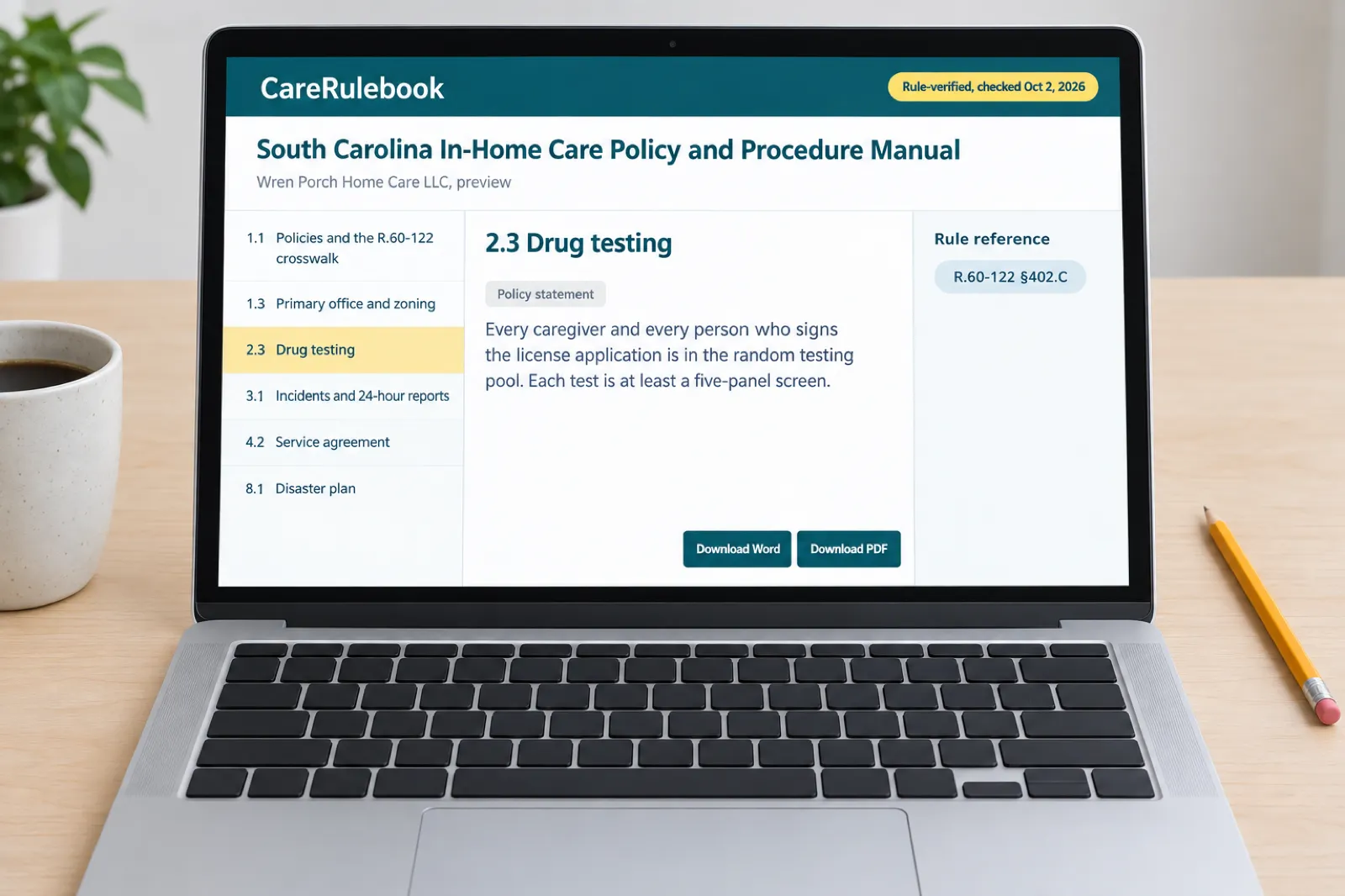
The CareRulebook South Carolina manual preview on a laptop: policy 2.3 on drug testing for a sample agency, citing R.60-122 §402.C, with six of the manual’s policies listed beside it

CareRulebook

Client paperwork that matches R.60-122, item by item

CareRulebook’s South Carolina manual includes Policy 4.1, client records: content, visit documentation, storage and retention; Policy 4.2, service agreement: services, fees, refunds and termination; Policy 4.3, care services plan; Policy 4.4, confidentiality and privacy of client information; Policy 7.1, rights and assurances; and Policy 8.1, disaster plan.

  • 29 policies, 84 requirements mapped to R.60-122 and S.C. Code 44-70
  • Service agreement, care services plan, rights form and client disaster plan, ready to sign
  • Already licensed? A dated plan for bringing current clients’ paperwork up to the 2026 rule
  • Editable Word and print-ready PDF, with the rule quoted under each policy
Preview your manual

$199CareRulebook founding price for the first 50 South Carolina agencies, then $249. Not a DPH fee.

Myths about South Carolina client paperwork

Do Medicaid clients in South Carolina need the new client paperwork?

It depends. Most of it. Only the service agreement is waived for clients receiving care under a Medicaid program. Every client still needs a care services plan within seven business days, visit notes, the signed rights and assurances form and your disaster plan. SCDHHS adds its own paperwork, such as the authorization and the SCDHHS Service Plan.

"For clients receiving care services pursuant to a Medicaid program, a service agreement is not required."

My clients started before May 22, 2026. Do they need a service agreement and care services plan now?

It depends. The rule does not say. It applies to all in-home care providers with no transition period, but ties the agreement and rights form to the start of care, which for these clients came before the rule. By our reading, the safe course is to put the new paperwork in place for every current client and date it. DPH has not published guidance.

"This regulation will apply to all in-home care providers in South Carolina."

Frequently asked questions

Does South Carolina require a service agreement for in-home care?

Yes, since May 22, 2026, for every client not receiving care under a Medicaid program. It sets out the care services you agree to provide, fees for all services with advance notice of fee changes, your refund policy including when money is returned when care ends, and the terms for ending the agreement, including when a client may be refused further care. You and the client or responsible party sign and date it before care starts (R.60-122 §601.B.2).

How soon must the care services plan be written?

Within seven business days after care services are first provided. It covers the types of care services, the expected times and frequency of visits, the expected duration and the goals and objectives, and is revised whenever any of those change (R.60-122 §601.B.3, with the cross-reference corrected by DPH’s errata of June 26, 2026). The rule does not say who writes it and does not require a nurse.

Does a nurse have to write the care plan in South Carolina?

Not under the DPH license. R.60-122 does not say who completes the care services plan and requires no nurse. Medicaid personal care is different: SCDHHS requires an RN or LPN supervisor to visit before care starts and write the task list from the SCDHHS Service Plan.

How often must visit notes be written?

Every visit by a caregiver to a client’s home is documented: the services provided, any significant change in the client’s physical or behavioral condition, the caregiver’s name and signature or electronic verification, and the date. The documentation is maintained or updated on a weekly basis (R.60-122 §601.B.1). By our reading, each visit is still documented on its own; the weekly rule sets how often the record is brought up to date.

When does the client get the disaster plan?

The rule says the provider gives its disaster plan to the client and/or responsible party, but not when (R.60-122 §1001). By our reading the safest time is at the start of care, with the service agreement and rights form, and for clients already in care, at the next visit. DPH has not said.

Can clients sign South Carolina home care forms electronically?

R.60-122 allows client records on paper or electronically and says records may be signed electronically; an entry signed on a later date shows the date of the signature (§601.A.1). Electronic systems need data backup and retrieval in a shutdown or power outage (§601.A.3). The rule does not say how a client’s electronic signature on an agreement must be captured.

How long do I keep a client’s records?

Complete the record within 30 calendar days after care ends and keep it at least five years after services end (R.60-122 §602.B-C). Incident records are kept five years after the client leaves (§501.A). If the agency closes, it arranges to preserve the records and tells DPH in writing where they are.

Get South Carolina rule-change alerts

DPH has not said what clients already in care on May 22, 2026 need, or when the disaster plan is due. Leave your email and we will tell you when DPH publishes guidance or changes R.60-122.

No spam. Only emails about South Carolina home care rule changes. How we use your email.

Keep reading

Sources

  1. Regulation 60-122, Standards for Licensing In-Home Care Providers (Document No. 5407, State Register Vol. 50, Issue 5, effective May 22, 2026, with the errata in Vol. 50, Issue 6, June 26, 2026) · South Carolina Department of Public Health; South Carolina Legislative Council (State Register) · retrieved October 2, 2026
  2. Regulation 60-122 (formerly 61-122) as in force before May 22, 2026: the 2014 text (Doc. No. 4433), from the S.C. Code of Regulations, Chapter 60, and DHEC’s unofficial copy of R.61-122 · South Carolina Legislative Council (Code of Regulations); S.C. Department of Health and Environmental Control · retrieved October 2, 2026
  3. Document No. 5407, R.60-122 rewrite: notice of proposed regulation (State Register Vol. 49, Issue 9, September 26, 2025), final regulation (Vol. 50, Issue 5, May 22, 2026), errata (Vol. 50, Issue 6), with the 2024 and 2025 drafting notices and the pre-2026 text · South Carolina Legislative Council, State Register (Department of Public Health filings) · retrieved October 2, 2026
  4. File a Complaint (health facility complaints) · South Carolina Department of Public Health · retrieved October 2, 2026
  5. HCBS Provider Manual, Scope of Services for Personal Care, HASCI Agency Attendant Care and Respite (July 1, 2025) · South Carolina Department of Health and Human Services · retrieved October 2, 2026
Build your South Carolina manualfrom $199