Purpose 1
Verify application information
What you told the OLC in your application, checked against what is in place.
Where are you starting?
Virginia · HCO inspections · 12VAC5-381-80 to -100
Applicants for a Virginia home care license are subject to inspection by the Office of Licensure and Certification, and licensed organizations are then inspected, unannounced, at least every two years. Here is what the inspector reviews, how client home visits work, and the plan of correction timeline, so an inspection is a routine day rather than a surprise.

Quick answer
Virginia home care organizations (HCOs) are inspected by the Virginia Department of Health’s Office of Licensure and Certification (OLC). Applicants are subject to inspection, and the license is issued once the OLC finds you comply. After that, an OLC representative makes unannounced on-site inspections as necessary, and at least every two years.
The inspector reviews records, interviews staff and contractors, may visit clients at home with their voluntary consent, and discusses the findings with the administrator at the end. If deficiencies are found, the administrator sends an acceptable plan of correction within 15 working days of receiving the report, and corrections are complete within 45 working days of the last day of the inspection.
The regulation says "The activities and services of each applicant and licensee shall be subject to an inspection by the OLC to determine if the organization is in compliance with the provisions of this chapter and state law." 12VAC5-381-40 C The Code of Virginia says the same of every applicant for a new or renewed license. Va. Code § 32.1-162.9 F
The license follows the finding: the Commissioner issues or renews it on finding that the organization complies with the law and the regulation. 12VAC5-381-20 B Wait until it is issued before serving clients; operating an unlicensed home care organization is a Class 6 felony. Va. Code § 32.1-162.15
When it happens: neither 12VAC5-381 nor the Code of Virginia sets a time for the first inspection, or says whether it is announced. The statute refers to following up on a "preoperational inspection" (§ 32.1-162.10) but gives no timing. The best place to ask is the OLC’s prelicensure consultation, which explains the regulation and the survey process and is arranged once a complete application is on file. 12VAC5-381-40 A
"An OLC representative shall make periodic unannounced on-site inspections of each home care organization as necessary but not less often than biennially." 12VAC5-381-80 A Within VDH, the Home Care and Hospice Unit of the Division of Acute Care Services is responsible for the state licensure and inspection of HCOs. VDH, Home Care & Hospice
The organization must permit OLC representatives to inspect for four purposes: 12VAC5-381-150 D
Purpose 1
What you told the OLC in your application, checked against what is in place.
Purpose 2
Every standard in the regulation, judged by the OLC according to applicable law.
Purpose 3
Client records, personnel files, policies and the other records the regulation asks you to keep.
Purpose 4
Complaints about alleged violations, which the OLC is responsible for investigating.
While the OLC evaluates a planned change that affects the terms of your license, a licensing representative may inspect the organization.
12VAC5-381-60 CThe OLC is responsible for investigating complaints about alleged violations. Complaints can be written or oral, and anonymous.
12VAC5-381-100Drop sites are subject to inspection at any time.
12VAC5-381-270 DAn organization exempt from licensure because it is Medicare certified or accredited by a CMS-recognized body may still be inspected, but only as far as needed to protect public health and safety.
Va. Code § 32.1-162.10The statute also limits extra visits. State agencies make only the inspections they need, and no home care organization receives additional inspections until every other HCO in Virginia has been inspected, unless they follow up a preoperational inspection or violations, follow a uniformly applied risk-based schedule, investigate a complaint, or are otherwise needed to protect public health and safety. Va. Code § 32.1-162.10
The regulation sets out the inspection in a few short sections. Here it is in order, from arrival to finished corrections. Tick steps off as you go; progress is saved in this browser only.
Routine inspections are unannounced. The administrator or a designee must be available at all times during operating hours, on the premises or by phone, so whoever is in the office knows who to call.
Make available any necessary records, and submit or make available the reports and information needed to establish compliance with the regulation and applicable law.
Allow the inspector to interview your agents, employees, contractors and anyone under the organization’s control, direction or supervision.
As part of any inspection, the inspector may visit clients at home. You arrange the visits and explain that agreeing is voluntary.
After the on-site inspection, the inspector discusses the findings with the administrator or the administrator’s designee. Take notes; this is your first view of anything you will need to correct.
If deficiencies were found, the administrator submits an acceptable plan of correction within 15 working days of receiving the inspection report.
Corrective actions are finished no later than 45 working days from the last day of the inspection. The administrator makes sure the plan is carried out and monitored so compliance is kept up.
Criminal record reports and sworn disclosure statements are confidential, but the Commissioner’s representative is one of the few people they may be shown to, so keep them where the administrator can produce them. 12VAC5-381-110 K
"As part of any inspection, an OLC representative may conduct home visits." 12VAC5-381-90 A
The organization arranges in-home visits with clients, family members and caregivers for the OLC representative. 12VAC5-381-90 B When you ask, the regulation is specific about what you say: "The organization shall explain clearly to the client, family or caretaker that the permission for the representative's home visit is voluntary and that consent to the home visit will not affect the client's care or other health benefits." 12VAC5-381-90 C
So a client who says no is simply making a choice the rule protects. A practical tip: explain it the same way each time, and note who agreed.
The organization is responsible for correcting any deficiency found during an on-site inspection. 12VAC5-381-80 A The administrator submits an acceptable plan of correction within 15 working days of receiving the inspection report, and it must contain four things: 12VAC5-381-80 D
Part 1
A description of the corrective action or actions to be taken and the personnel to implement them.
Part 2
The date you expect each correction to be complete. Corrections must be finished within 45 working days of the last day of the inspection.
Part 3
A description of the measures implemented to prevent the violation happening again.
Part 4
The signature of the person responsible for the validity of the report.
| Deadline | Counted from | Source |
|---|---|---|
| Plan of correction: 15 working days | Your receipt of the inspection report | 12VAC5-381-80 D |
| Corrections complete: 45 working days | The last day of the inspection | 12VAC5-381-80 G |
The two clocks start at different points. The 45 working days begin on the last day of the inspection, before the report reaches you, so every expected correction date in your plan needs to fall inside that window. Starting on the easy fixes straight after the exit discussion leaves more room for the rest.
If any item in the plan is unacceptable, the administrator is told. 12VAC5-381-80 E Once it is accepted, "The administrator shall be responsible for assuring the plan of correction is implemented and monitored so that compliance is maintained." 12VAC5-381-80 F In practice that means checking, some weeks later, that the change has held: the new form is being used, the overdue supervision visits are now on time.
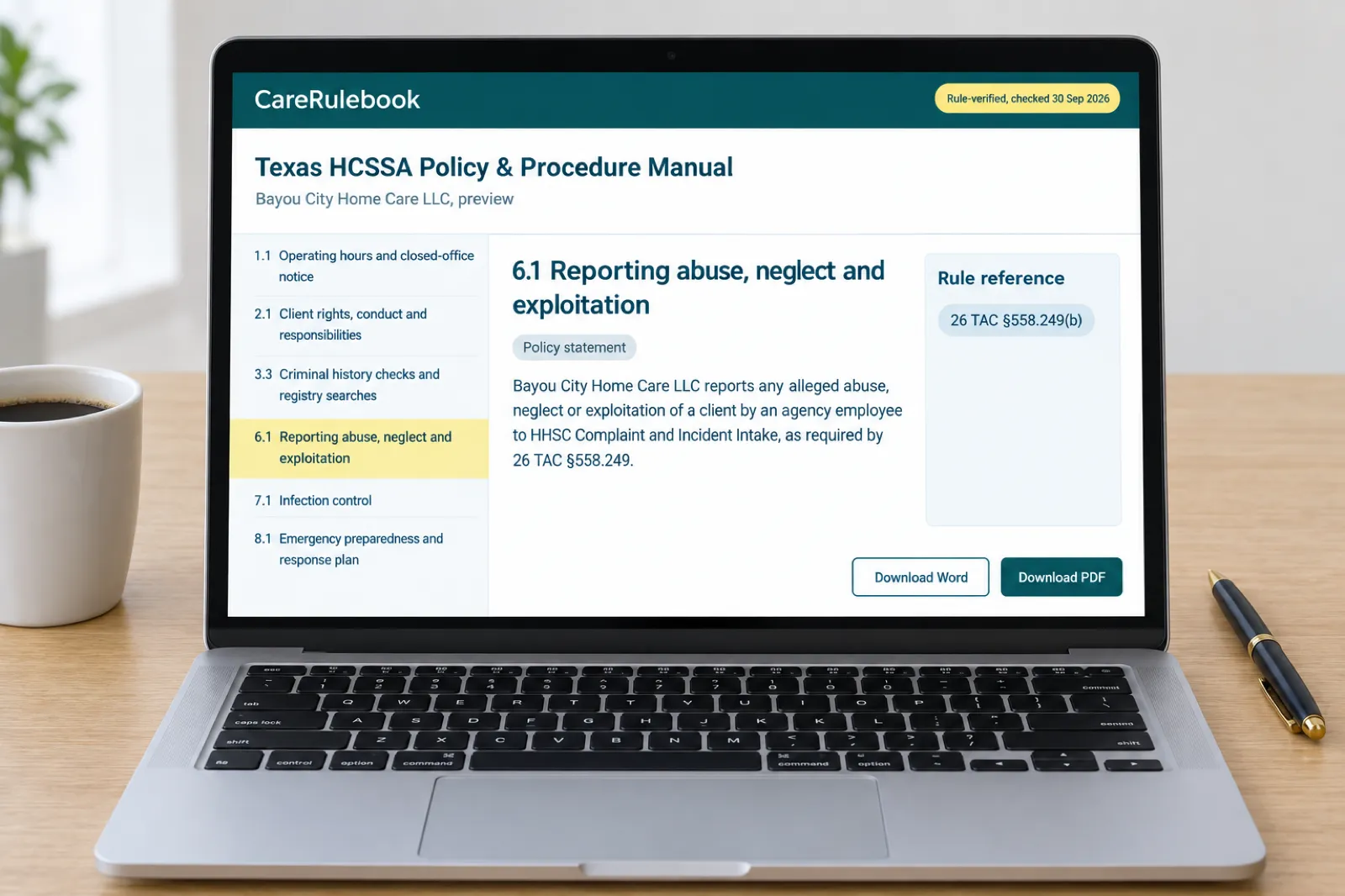
CareRulebook
CareRulebook’s Virginia manual includes Policy 1.3, surveyor entry and survey cooperation: who receives the inspector, records and interviews, arranging home visits and explaining consent, the exit discussion, and writing, signing and monitoring the plan of correction on time.
$199CareRulebook founding price for the first 50 Virginia organizations, then $249. Not an OLC fee.
The OLC investigates complaints about alleged violations of the regulation and applicable law. "Complaints may be received in writing or orally and may be anonymous." 12VAC5-381-100 A-B VDH lists home care organizations among the services whose consumer complaints the OLC investigates. VDH, File a Complaint
When the investigation is complete, the licensee and the complainant, if known, are told the findings. 12VAC5-381-100 C If deficiencies were found, the same process follows as after an inspection: an acceptable plan of correction within 15 working days of receiving the complaint report, with the same four parts, and the administrator is told in writing if any item is unacceptable. 12VAC5-381-100 D-F
Your own complaint process runs alongside this. Each client gets your complaint procedures at admission, with contacts for your organization, the State Ombudsman and the OLC’s Complaint Unit; you tell a complainant the proposed resolution within 30 days; and you keep a record of every complaint from the last inspection and for at least three years. 12VAC5-381-240 B-D
The regulation’s answer to a deficiency is a plan of correction. For completeness, here is what the law allows if an organization does not comply.
Sending the plan of correction on time, and doing what it says, is how the regulation expects deficiencies to be resolved.
Our practical suggestions, not rule text. Each card links the rule it helps you meet. Across the OLC, inspections are carried out by health care professionals such as registered nurses and social workers, VDH OLC so expect questions about care as well as paperwork.
Name the person who welcomes an OLC inspector when the administrator is out, and make sure every staff member knows to contact the administrator or designee at once.
Your written policies cover every topic in 12VAC5-381-180, are approved by the governing body and reviewed at least once a year. Keep the approval and review records with them.
Each file holds what 12VAC5-381-200 lists, including the criminal record check and sworn statement, obtained within 30 days of employment.
Each personal care client has an RN-written plan of services and supervision no more than 90 days apart, and visit notes reach the record within seven working days.
Every complaint and its status from receipt to resolution, kept from the date of the last inspection and for at least three years.
The current license from the department is posted for public inspection.
If you use drop sites, records kept there are readily available to inspection staff, and the sites can be inspected at any time.
A short, plain explanation staff can give clients and families: the OLC may ask to visit, saying yes or no is their choice, and either answer will not affect their care or other health benefits.
Want the full list of steps for your organization, including inspections? Use the free Virginia license checklist →
No. The regulation says an OLC representative makes periodic unannounced on-site inspections, as necessary and at least every two years. The administrator or a designee must be available at all times during operating hours, so plan who receives the inspector.
"An OLC representative shall make periodic unannounced on-site inspections of each home care organization as necessary but not less often than biennially."
No. The organization arranges the visits, but it must explain clearly to the client, family or caretaker that permission is voluntary and that agreeing will not affect the client’s care or other health benefits.
"The organization shall explain clearly to the client, family or caretaker that the permission for the representative's home visit is voluntary and that consent to the home visit will not affect the client's care or other health benefits."
No. Running an unlicensed home care organization is a Class 6 felony. Apply at least 60 days before your planned opening; the Commissioner issues the license only after finding you comply, and applicants are subject to OLC inspection.
"A completed application for initial licensure must be submitted at least 60 days prior to the organization's planned opening date to allow the OLC time to process the application."
No. You need malpractice insurance, at least $1 million per occurrence of general liability, and crime insurance or a fidelity bond of at least $50,000, at all times. VDH accepts umbrella and excess liability policies toward the minimums. Letting cover lapse results in revocation of the license.
"Failure to maintain these requirements shall result in revocation of the home care organization's license."
An OLC representative makes periodic unannounced on-site inspections as necessary, and at least every two years (biennially). The OLC may also inspect while it evaluates a proposed change to your license, and to investigate a complaint.
Applicants are subject to OLC inspection, and the Commissioner issues the license on finding the organization complies with the law and the regulation. Neither 12VAC5-381 nor the Code of Virginia sets when that first inspection happens, so ask the OLC at your prelicensure consultation and do not serve clients until the license is issued.
The regulation lets the OLC inspect to verify application information, determine compliance with 12VAC5-381, review necessary records and documents, and investigate complaints. You make the necessary records available and allow interviews with your employees, agents, contractors and anyone under your control or supervision. The inspector may also visit clients at home.
The administrator submits an acceptable plan of correction within 15 working days of receiving the inspection report. It describes the corrective action and who will carry it out, the expected correction date, the measures to prevent a recurrence, and is signed by the person responsible for the validity of the report.
Within 45 working days from the last day of the inspection. Note the different starting points: the 15 working days for the plan run from receipt of the report, but the 45 working days for corrections run from the last day of the inspection.
No. You arrange the visits, but you must explain clearly to the client, family or caretaker that permission is voluntary and that agreeing will not affect the client’s care or other health benefits.
When the investigation is complete, the licensee and the complainant, if known, are told the findings. If deficiencies were found, the administrator submits an acceptable plan of correction within 15 working days of receiving the complaint report, with the same four parts as after an inspection.
VDH has two amendments to the home care organization regulations in progress. Leave your email and we will tell you when they move forward and what they change for your inspections and policies.
No spam. Only emails about Virginia home care rule changes. How we use your email.
Virginia
How to start a home care agency in Virginia
The HCO license, RN supervision every 90 days and the 35 policy topics.
Virginia
The Virginia license application
The OLC Portal, what to have ready, fees, renewal and changes.
Virginia
Virginia home care policies and procedures
Every rule that asks for a written policy, mapped to the policy that meets it.
Virginia
Can you run a Virginia home care organization from home?
Posted hours, records and being ready for an unannounced inspection.
Virginia
Virginia home care rule changes
A 2022 draft proposed inspections every three years. Where it stands.
Virginia
Virginia caregiver background checks
Sworn statements, the State Police report within 30 days and barrier crimes.
Tool
Virginia license checklist
Every step, tailored to your organization, emailed to you.
Manual
Build your Virginia policy manual
Including Policy 1.3 on inspections and plans of correction.
Texas
The Texas HCSSA initial survey
How Texas does it: Form 2020 and the ten most-cited violations.
North Carolina
North Carolina survey and inspections
The desk review, inspections every 3 years and plans of correction.
Georgia
Georgia survey and inspections
The provisional license, initial survey and re-licensure surveys.