Skip to content
CareRulebook
MenuClose

Where are you starting?

United StatesTexas, North Carolina, Georgia, Virginia, Indiana, Ohio, New York, Illinois, Washington, Colorado, Tennessee, Maryland, Kansas, South Carolina, Nevada
TexasManual
North CarolinaManual
GeorgiaManual
VirginiaManual
IndianaManual
OhioGuideNew YorkGuide
IllinoisManual
WashingtonManual
ColoradoManual
TennesseeManual
MarylandManual
KansasManual
South CarolinaManual
NevadaManual
All US states →
United KingdomEngland
Free toolsChecklists, calculators and templates

Kansas · Staff · K.A.R. 28-51-117

Kansas caregiver training: competency in 10 areas, then every year

Kansas sets no training hours and no certification for supportive care workers. Instead, each worker demonstrates competency in 10 areas before serving a client without the manager present, and is re-evaluated in the same areas every year. Ongoing and abuse training are yearly too, lifts and oxygen tanks need their own training, and every employee has a health assessment and a two-step TB skin test before working with clients.

  • Rule-verified October 2, 2026
  • Quoted from K.A.R. 28-51-103, -104 and -117
  • With KDHE’s Instruction Guide and its April 2026 answers
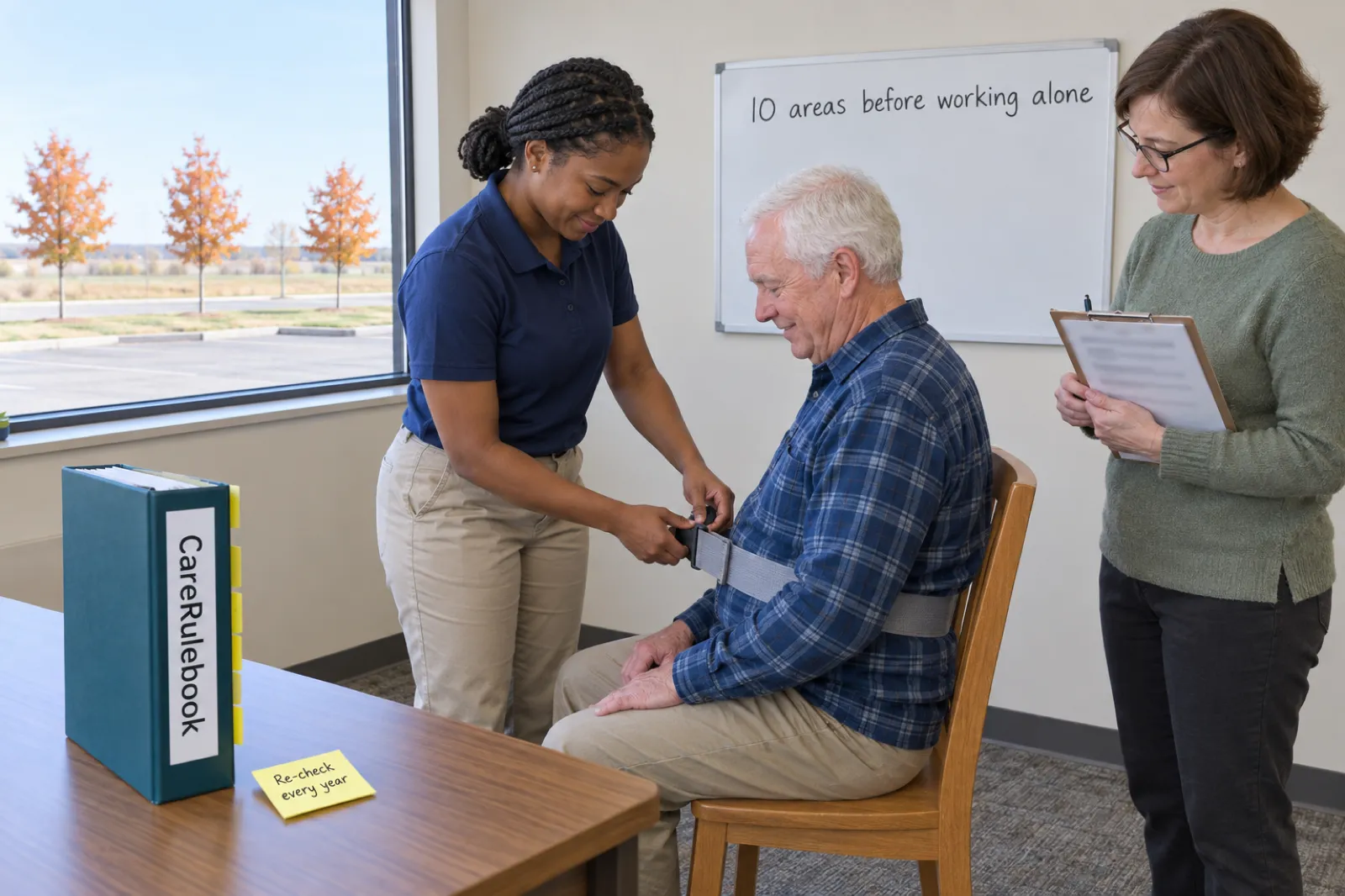
In a bright office training corner, a young caregiver in a navy polo fastens a gray gait belt around an older man seated on a wooden chair while a manager with a clipboard watches; a whiteboard reads 10 areas before working alone, and a CareRulebook binder and a sticky note reading Re-check every year sit on a table

Quick answer

"Each licensee shall ensure that each supportive care worker demonstrates competency before providing supportive care services to a client without the manager being present" and shall re-evaluate each worker every year in 10 subject areas (K.A.R. 28-51-117(c)). The rules set no minimum hours and no certification for supportive care workers (K.A.R. 28-51-117(d); 28-51-113(a)).

On top of that: ongoing training at least yearly on your services and equipment (28-51-117(d)), abuse, neglect and exploitation training at hire and yearly (28-51-103(g)(1)), and, before working with clients, a health assessment and a two-step TB skin test (28-51-103(d)(6)).

10 areas

of competency before working without the manager present

K.A.R. 28-51-117(c)

0 hours

set by the rules for supportive care workers

K.A.R. 28-51-117

Every year

competency re-evaluation, ongoing training and abuse training

K.A.R. 28-51-117(c)-(d); 103(g)(1)

2 years

at most between health assessments

K.A.R. 28-51-103(d)(7)

From hire to working alone

The rule duties in the order a new caregiver meets them. Tick steps off as you go; progress is saved in this browser only. The background check runs alongside: see Kansas caregiver background checks.

  1. Orientation for every new staff member

    At hire

    The administrator provides orientation for new staff, regular in-service education and chances for continuing education. The rule names no orientation topics.

  2. Health history, health assessment and TB test

    Before working with clients

    A self-reported health history, a health assessment certifying the employee can do the job, and a current two-step TB skin test. The details.

    K.A.R. 28-51-103(d)(6)
  3. Abuse, neglect and exploitation training

    At hire or contract

    Training on recognizing the signs and symptoms, documented in the personnel file.

    K.A.R. 28-51-103(g)(1)
  4. Train to deliver the plan of care

    Before working alone

    Managers and caregivers are trained in nine areas, from communication to hygiene and grooming. The areas.

  5. Visits with the manager present

    Until competency is shown

    Until the worker has demonstrated competency, they serve clients only with the manager present.

    K.A.R. 28-51-117(c)
  6. Demonstrate competency in 10 areas

    Before working alone

    Once every area is signed off, the worker may serve clients without the manager there. Add task sign-offs for gait belts, lifts and oxygen tanks before those tasks. Task training.

  7. First performance evaluation

    Within 6 months

    Within six months of employment, then every year.

    K.A.R. 28-51-103(d)(4)
  8. Every year after

    Yearly (health: 2 years)

    Competency re-evaluated in the same 10 areas, ongoing training on your services and equipment, abuse training and a performance evaluation. A new health assessment at least every two years.

The 10 competency areas

Two rules list training topics, and they almost match. K.A.R. 28-51-117(c) lists the 10 areas in which each worker demonstrates competency before working alone and every year (K.A.R. 28-51-117(c)). K.A.R. 28-51-104(c)(3)(D) requires "training of managers and supportive care workers to deliver the plan of care in accordance with the home health agency regulations", with competency in nine areas (K.A.R. 28-51-104(c)(3)(D)).

#Competency area (117(c))Also in the plan-of-care training (104(c)(3)(D))?
1Communication skills, with special focus on clients with a hearing deficit, dementia or other special needsYes
2Observation, reporting and documentation of the client’s status and the service providedYes
3Basic infection control proceduresYes
4Basic body functioning, and changes in body function to report to the supervisorYes
5Maintaining a clean, safe and healthy environmentYes
6Recognizing emergencies and knowing the agency’s emergency proceduresYes
7Respecting the client and the client’s privacy and propertyYes
8Knowledge of the clients’ bill of rights (K.A.R. 28-51-111)No
9Appropriate and safe techniques in personal hygiene and groomingYes
10Appropriate use of any equipment needed for the servicesNo
+Not in 117(c): recognizing the physical, emotional and developmental needs of your clientsYes, 104(c)(3)(D)(vii)

By our reading, one training outline and one competency checklist that cover all 11 topics meet both rules. Area 10 is "appropriate use of any equipment needed for the provision of supportive care services" (K.A.R. 28-51-117(c)(10)), and the plan-of-care list adds "recognizing physical, emotional, and developmental needs of the clients served by the home health agency" (K.A.R. 28-51-104(c)(3)(D)(vii)).

The scope of practice policy names the training too. Your written scope of practice must cover "the training required for each supportive care worker to provide the necessary supportive care services to a client" (K.A.R. 28-51-117(b)(3)). The tasks themselves are the 16 assigned duties on what Kansas caregivers may and may not do.

How competency is shown. The rule says "demonstrates" but sets no method. CareRulebook’s manual has the worker do each hands-on task while the manager watches, and answer questions or a short quiz for the knowledge areas, with every line marked competent before the worker goes out alone (Policy 2.6). That is the manual’s practice, not a KDHE form.

The manager is present until then

The competency rule doubles as a supervision rule: until a worker has shown competency, they do not serve a client "without the manager being present" (K.A.R. 28-51-117(c)). The manager is an employee who supervises caregivers and has at least a year of experience in home health, HCBS or supportive care services (K.A.R. 28-51-100(aa)); who can be your manager is on Kansas administrator and manager rules.

  • Plan the first weeks. By our reading, "present" means at the visit, so a new worker’s early shifts need the manager there. A small agency with one manager should plan training visits before taking on clients the new worker will serve.
  • Provisional hires. A worker hired provisionally while the KDADS check is pending is supervised by an employee who has completed all required training (K.A.R. 28-51-103(e)). Until they have shown competency, the manager must be present at their client visits in any case, so the manager can be that supervisor.
  • After competency. Supervision continues: a manager available to workers at all times, and on-site supervision at least every three months, including client satisfaction and adherence to the plan of care (K.A.R. 28-51-117(e)).

Gait belts, lifts and oxygen tanks

Some of the 16 assigned duties may be done only after specific training. Each is a line on the competency checklist before the worker does the task.

  • Gait belts. "A gait belt may be used in a transfer as a safety device for the supportive care worker if the supportive care worker has been properly trained in the use of a gait belt." (K.A.R. 28-51-117(g)(14))
  • Adaptive and safety equipment. "Adaptive and safety equipment may be used in a transfer if the client and the supportive care worker are fully trained in the use of the equipment and the client, client’s family member, or guardian can direct the transfer step-by-step." Examples in the rule are wheelchairs, tub seats and grab bars (K.A.R. 28-51-117(g)(14)). Note that the client must be trained too.
  • Lift devices. "Any supportive care worker with training and demonstrated competency may assist a client in a transfer involving a lift device." But the same paragraph says "A supportive care worker shall not perform assistance with a transfer if the client is unable to assist with the transfer." (K.A.R. 28-51-117(g)(14)). By our reading, a lift transfer is allowed only for a client who can still assist with it, and CareRulebook’s manual says so. KDHE’s view on training: "KDHE maintains that training is required to use a lift and must be conducted by an individual with knowledge of the device, beyond reading the user manual." It added that training on one lift does not carry over to another (KDHE, Questions and Feedback, April 2026). Our suggestion: train and check each worker on each model of lift they will use, with someone who knows that device, such as the supplier.
  • Oxygen tanks. "Any supportive care worker may set a client’s oxygen flow according to written instructions when changing tanks", "if the supportive care worker has been specifically trained and has demonstrated competency for setting a client’s oxygen flow" (K.A.R. 28-51-117(g)(16)). Respiratory care stays out of scope (K.A.R. 28-51-117(g)(15)). Whose written instructions count (the prescriber’s, the supplier’s, or your written assignment) is not stated, and is on our list of questions for KDHE.
  • Masks and cannulas. "Any supportive care worker may temporarily remove and replace a cannula or mask from a client’s face for the purposes of shaving or washing the client’s face." (K.A.R. 28-51-117(g)(16)). The rule names no special training for this; CareRulebook’s manual trains every worker on it anyway.

Both the lift and the oxygen permissions are in KDHE’s sights: what the draft would change.

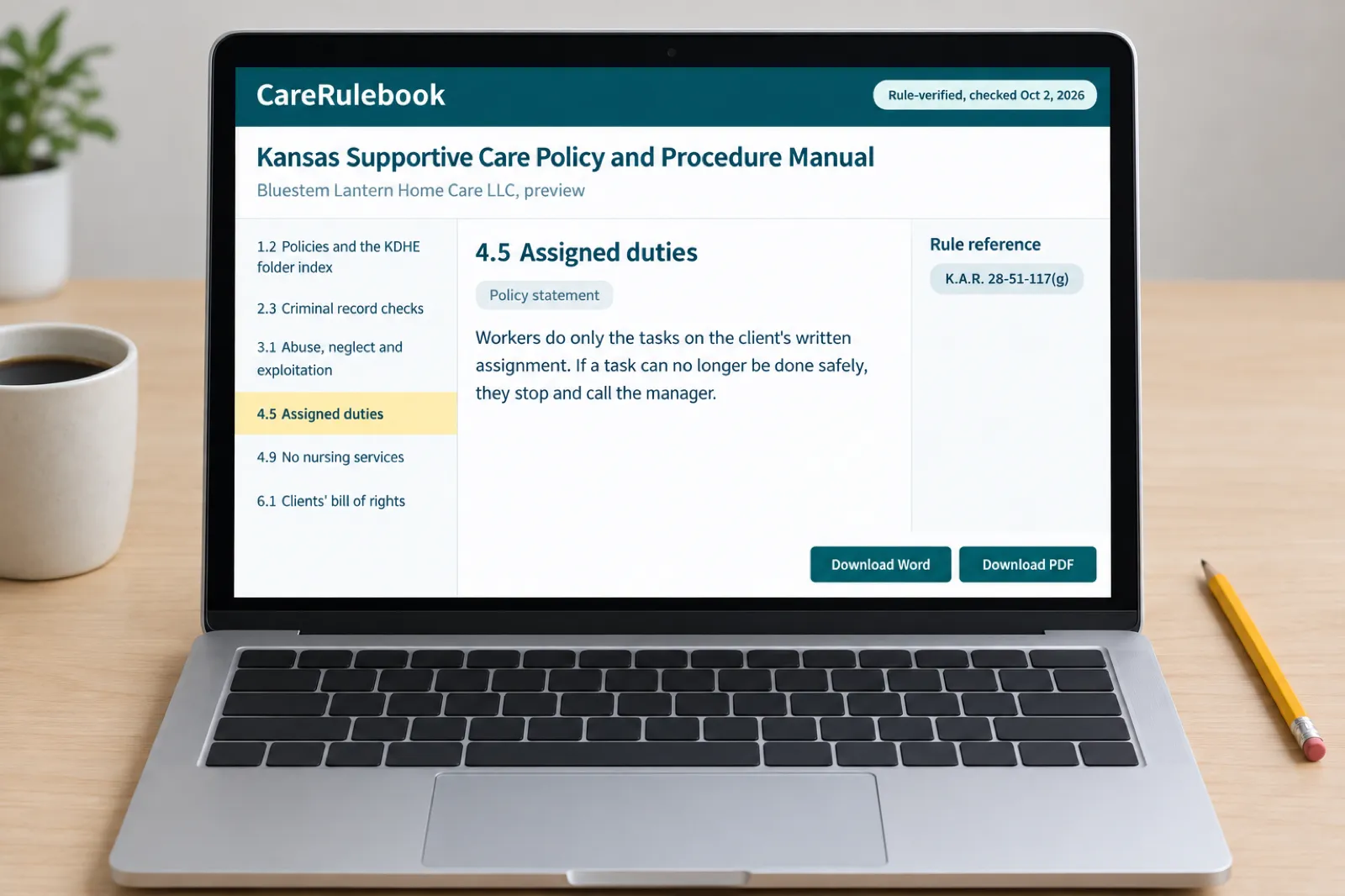
The CareRulebook Kansas manual preview on a laptop: policy 4.5 on assigned duties for a sample agency, citing K.A.R. 28-51-117(g), with six of the manual’s policies listed beside it

CareRulebook

Training records written for Kansas

CareRulebook’s Kansas manual includes Policy 2.6 (Orientation, training and competency): orientation and an in-service calendar, who trains (you, an outside course, or both), training to the plan of care, a 10-area competency checklist with gait belt, lift and oxygen rows if you offer those tasks, and yearly ongoing and abuse training records. Policy 2.5 covers the health history, health assessment form and two-step TB record; Policy 4.5 the 16 assigned duties.

  • 31 policies, 130 requirements mapped
  • Ordered to KDHE’s 13 upload folders
  • Editable Word and print-ready PDF, with the rule quoted under each policy
Preview your manual

$199CareRulebook founding price for the first 50 Kansas agencies, then $249. Not a KDHE fee.

Every year

  • Competency, again. The licensee "shall reevaluate each supportive care worker on an annual basis in the following subject areas" listed above (K.A.R. 28-51-117(c)). When providers objected to yearly hands-on checks in KDHE’s draft, KDHE answered: "Demonstrating competencies on an annual basis is not a new regulation." (KDHE, Questions and Feedback). The rule does not say whether "annual" means within 12 months or once each calendar year; CareRulebook’s manual uses 12 months.
  • Ongoing training. It is provided "annually or more often as needed to adequately provide the supportive care services needed by the clients served by the home health agency". "Ongoing training shall include training on the supportive care services provided and the equipment used by the home health agency." "The subject matter and date of the ongoing training provided shall be documented in each manager’s and supportive care worker’s file." (K.A.R. 28-51-117(d)). It covers managers as well as caregivers.
  • Abuse, neglect and exploitation. The agency must "provide in-service training recognizing the signs and symptoms of abuse, neglect, or exploitation to home health agency employees and contracted personnel at the time of hire or contract and annually thereafter", documented in each personnel file (K.A.R. 28-51-103(g)(1)). What to teach about reporting is on the hub guide.
  • In-service education. The administrator must "provide orientation for new staff, regularly scheduled in-service education programs, and opportunities for continuing education of the staff" (K.A.R. 28-51-103(b)(1)(F)).
  • Performance evaluations. Personnel files hold "performance evaluations made within six months of employment and annually thereafter" (K.A.R. 28-51-103(d)(4)). The manual’s evaluation form is in Policy 2.4.

Our suggestion: pick one month a year for the yearly items, so the competency re-check, ongoing training, abuse training and evaluation fall together and nothing slips past 12 months.

Health assessments and TB

Each personnel record holds a health record, and the assessment and TB test come before the employee works with clients (K.A.R. 28-51-103(d)(6)):

  1. A self-reported health history.
  2. A health assessment: "a current health assessment performed by a physician, nurse practitioner, clinical nurse specialist, physician assistant, or registered nurse certifying that the employee is physically able to perform job functions" (K.A.R. 28-51-103(d)(6)(B)).
  3. A TB test: "a current two-step tuberculosis skin test following the U.S. centers for disease control and prevention testing guidelines for healthcare workers taken before working with clients or patients" (K.A.R. 28-51-103(d)(6)(C)).

After hire. Further assessments follow your own policy, with "a subsequent health assessment at least every two years or following a significant health event" (K.A.R. 28-51-103(d)(7)). "‘Significant health event’ means any occurrence that affects the ability of an employee to perform the employee’s job duties." (K.A.R. 28-51-100(xx)). Whether a short illness counts is not stated; CareRulebook’s manual reads it as not counting when the worker recovers fully, and that reading is on our list of questions for KDHE.

  • Who does the assessment. A supportive care agency may not provide nursing of any kind, and KDHE’s attestation form says that includes a nurse supervising or doing assessments (KDHE attestation form). By our reading, the employee health assessment should come from an outside provider, such as the employee’s own doctor or a clinic, not a nurse on your staff.
  • Repeat TB tests. The rule sets no interval, and does not say how long a test stays "current". CareRulebook’s manual accepts a two-step test read within the 12 months before client work; how long KDHE accepts is on our list of questions for KDHE.
  • A positive test. The rule is silent. KDHE’s personnel file list names "TB Test/Chest X-ray" (Instruction Guide, Personnel Records). Our suggestion: keep the worker away from clients until a provider confirms in writing that they do not have active TB.
  • Office staff. The rule puts the health record in every employee’s file, "before working with clients or patients". Whether KDHE expects it for staff who never work with clients is on our list of questions for KDHE; CareRulebook’s manual asks every employee for it.

What KDHE asks to see

KDHE reviews your documents before it licenses you, folder by folder (the Kansas license application). For training and health it asks for:

  • Policies with templates: "Competency (Policy and Template) (16)" and "Tuberculosis (TB) Testing and Screening (Policy and Template) (15)" in the personnel policies (Instruction Guide, Personnel Policies).
  • Training materials: "Training documents and or template used to train managers and supportive care workers to deliver the plan of care (12)", and a competency checklist template and policy, in the provision of services folder (Instruction Guide, Provision of Services).
  • Evidence in the personnel files: Application, resume, signed job description, credential checks, interview and reference checks before hire, evaluations, health history, health assessment, TB test, criminal record check evidence, orientation, competency, supervisory visit and ANE training records. (Instruction Guide, Personnel Records). Surveyors later look for personnel records that show all training received (K.A.R. 28-51-104(d)(2)).

A new agency may have only its administrator, alternate and manager on staff when it applies. Whether KDHE accepts blank caregiver templates in place of completed files is on our list of questions for KDHE. The full list of required policies is on Kansas policies and procedures.

What is not required

  • Hours. The rules set competency topics and annual ongoing training, not a minimum number of hours, for supportive care workers. (Home health aides under a Skilled Services license need CNA certification plus a 20-hour course.) (K.A.R. 28-51-117(d); 28-51-113(a))
  • Certification. "Certified Nursing Assistant (CNA) and/or Home Health Aide positions are excluded with a Supportive Care Service license." A CNA can work for you as a supportive care worker, without using their skilled tasks (KDHE attestation form). KDADS certifies nurse aides and home health aides and keeps the registry (KDADS); none of that applies to your caregivers.
  • A state test or approved course. The rules name none for supportive care workers. The KDHE-approved course KDHE links is for administrators (KDHE).
  • CPR or first aid. K.A.R. 28-51 does not mention either. Recognizing emergencies and your emergency procedures is a competency area, so our suggestion is to decide what your workers do in an emergency and train that.
  • Nurse delegation. Not available: a supportive care agency may not provide nursing services, including nurse supervision (KDHE attestation form). Training cannot add skilled tasks to the license.

What KDHE’s drafted rewrite would change

KDHE has drafted a rewrite of K.A.R. 28-51 and told providers it is in the early phases (KDHE). Nothing below is a rule. We found no Notice of Hearing, but we could not search the 2026 Kansas Register on rules.ks.gov, which blocks automated access.

  • One training section for every agency type: "Added orientation, training, and competency requirements including an annual requirement for orientation, training, and competencies which shall be completed before providing unsupervised care to patients or clients." (Summary of Changes, Sept 2025)
  • No lifts: "Removed the ability to use lifts" (KDHE slides, Oct 2025). In April 2026 KDHE said: "Based on feedback from agencies, this regulation is being reviewed further." (KDHE, Questions and Feedback)
  • No setting oxygen flow: "Removed the ability to set oxygen flow" (KDHE slides). KDHE’s reason: "As oxygen is considered a medication, it must be handled and managed by or under the supervision of a healthcare professional." (KDHE, Questions and Feedback)
  • Health screening: The drafted rewrite would drop the two-yearly health assessment, replace the self-reported health history with a health status form, and accept a TB blood test as well as the two-step skin test. It is a draft, not a rule. (Summary of Changes; KDHE slides, TB testing)

Until a change is adopted, train to the current rule. If you offer lift transfers or oxygen tank changes, plan for the possibility of dropping them.

Myths about Kansas caregiver training

Do my Kansas caregivers need to be CNAs or have a set number of training hours?

No. Supportive care workers are not home health aides, and the rules set no hours. Each worker must show competency in 10 areas before working without the manager present, be re-checked every year, get annual ongoing training and abuse training at hire and yearly. CNAs can work as supportive care workers but may not use their skilled tasks under this license.

"Each licensee shall ensure that each supportive care worker demonstrates competency before providing supportive care services to a client without the manager being present"

Is a Kansas caregiver’s competency check a one-time thing at hire?

No. Each supportive care worker shows competency before working without the manager present and is then re-evaluated every year in the same 10 areas. KDHE told providers in April 2026 that yearly competency is not new; it is in the current rule.

"shall reevaluate each supportive care worker on an annual basis in the following subject areas:"

Can non-medical caregivers in Kansas use a Hoyer lift?

It depends. Yes under the current rule, if the worker has training and demonstrated competency with the lift. The same rule says a worker shall not help with a transfer if the client is unable to assist with it, so our reading is that a lift transfer is allowed only for a client who can still assist. KDHE’s draft rewrite would remove lift transfers from supportive care, but in April 2026 KDHE said it was reviewing that change after provider feedback. Nothing has been formally proposed yet.

"Any supportive care worker with training and demonstrated competency may assist a client in a transfer involving a lift device."

Must a Kansas caregiver wait for the KDADS result before starting work?

It depends. Not always. Once you have requested the KDADS eligibility determination, you may hire the person provisionally, on a one-time basis, for up to 60 calendar days while the result is pending. A provisional employee may only be supervised by an employee who has completed all required training. And until they have shown competency, the rules keep the manager present at their client visits anyway.

"may hire an applicant for provisional employment on a one-time basis of 60 calendar days pending the results from the Kansas department for aging and disability services"

Frequently asked questions

How many training hours does a Kansas supportive care worker need?

None are set. K.A.R. 28-51 sets competency topics and yearly ongoing training, not a number of hours, for supportive care workers. Each worker must demonstrate competency in 10 areas before serving a client without the manager present and is re-evaluated every year. Home health aides, who work only under a Skilled Services license, are different: they must be certified nurse aides and complete a 20-hour course.

Do Kansas non-medical caregivers need to be CNAs?

No. Supportive care workers need no certification. KDHE’s attestation form says CNA and home health aide positions are excluded under the supportive care license, so a CNA can work for you as a supportive care worker but may not use the skilled tasks their certification allows.

Who can train and check competency at a Kansas supportive care agency?

The rules do not say who trains or evaluates. The manager writes the plan of care and the written assignments and supervises the workers, so the manager is the natural trainer, and must be present at client visits until a worker has shown competency. A supportive care agency may not use a nurse for nursing of any kind, including supervision, so training should not rely on nurse delegation. Outside courses can help, but the agency still has to ensure each worker demonstrates competency.

Can a new Kansas caregiver work alone before the competency check?

No. K.A.R. 28-51-117(c) says each supportive care worker demonstrates competency before providing supportive care services to a client without the manager being present. Until then, the manager is at the visit.

Does a Kansas caregiver need a TB test?

Yes. Each employee needs a current two-step tuberculosis skin test, following the CDC’s guidelines for health care workers, taken before working with clients. KDHE asks for a TB testing and screening policy and template, and its personnel file list names "TB Test/Chest X-ray". The rules set no repeat interval. KDHE’s drafted rewrite would also accept a TB blood test, but that is not yet a rule.

Who can do the health assessment for a Kansas caregiver?

A physician, nurse practitioner, clinical nurse specialist, physician assistant or registered nurse, certifying that the employee is physically able to do the job functions in their job description, before they work with clients. It is repeated at least every two years and after a significant health event. Because a supportive care agency may not provide nursing, by our reading the assessment comes from an outside provider, such as the employee’s own doctor or a clinic.

Can Kansas supportive care workers use a Hoyer lift or change oxygen tanks?

Under the current rule, yes, with conditions. A worker with training and demonstrated competency may assist a lift-device transfer, and the rule still bars any transfer for a client who is unable to assist with it. A worker may set oxygen flow by written instructions when changing tanks if specifically trained and competent. KDHE’s drafted rewrite would remove both, and in April 2026 KDHE said the lift change is being reviewed further.

Get Kansas rule-change alerts

KDHE has drafted a rewrite of K.A.R. 28-51 that would remove lift transfers and oxygen flow from supportive care and change the health screening rules. No official text has been published yet. Leave your email and we will tell you when a Kansas change affects your training or your policies.

No spam. Only emails about Kansas home care rule changes. How we use your email.

Keep reading

Sources

  1. K.A.R. 28-51-100 to 28-51-118, Home Health Agency Licensure (as amended or adopted in Kansas Register Vol. 41, No. 18, May 5, 2022, effective May 20, 2022; 28-51-108 and 28-51-114 to -116 from the Cornell LII mirror) · Kansas Secretary of State, Kansas Register (KDHE regulations); Cornell Legal Information Institute mirror · retrieved October 2, 2026
  2. Home Health Agency Non-Medical Supportive Care Services Application Submission Requirements and Instruction Guide (reviewed/revised 03/2024) · Kansas Department of Health and Environment, Bureau of Facilities and Licensing · retrieved October 2, 2026
  3. Home Health Agency Non-Medical Supportive Care Services Attestation Form (reviewed/revised 03/2024) · Kansas Department of Health and Environment, Bureau of Facilities and Licensing · retrieved October 2, 2026
  4. Non-Medical Supportive Care Services (license scope, documents, renewal, criminal record check) · Kansas Department of Health and Environment · retrieved October 2, 2026
  5. 2025 Home Health Agency Regulations Summary of Changes Guide (September 8, 2025), with the October 9, 2025 Supportive Care listening session slides and KDHE’s answers to feedback (April 2026) · Kansas Department of Health and Environment, Bureau of Facilities and Licensing · retrieved October 2, 2026
  6. HHA Listening Sessions Questions and Feedback (KDHE responses; PDF dated April 14, 2026) · Kansas Department of Health and Environment, Bureau of Facilities and Licensing · retrieved October 2, 2026
  7. Health Occupations Credentialing (Kansas Nurse Aide Registry, CNA, HHA and CMA certification), Internet Archive copy of May 21, 2026 · Kansas Department for Aging and Disability Services · retrieved October 2, 2026
Build your Kansas manualfrom $199