Skip to content
CareRulebook

North Carolina · Home care agency license · 10A NCAC 13J

How to start a home care agency in North Carolina (2026)

To start a home care agency in North Carolina you need a license from the Division of Health Service Regulation (DHSR). It costs $510 a year. After you apply, DHSR asks for your policies, procedures and personnel records and reviews them before it licenses you, so they need to be right first time.

  • Rule-verified October 1, 2026
  • Quoted from 10A NCAC 13J and G.S. 131E
  • 8 official sources
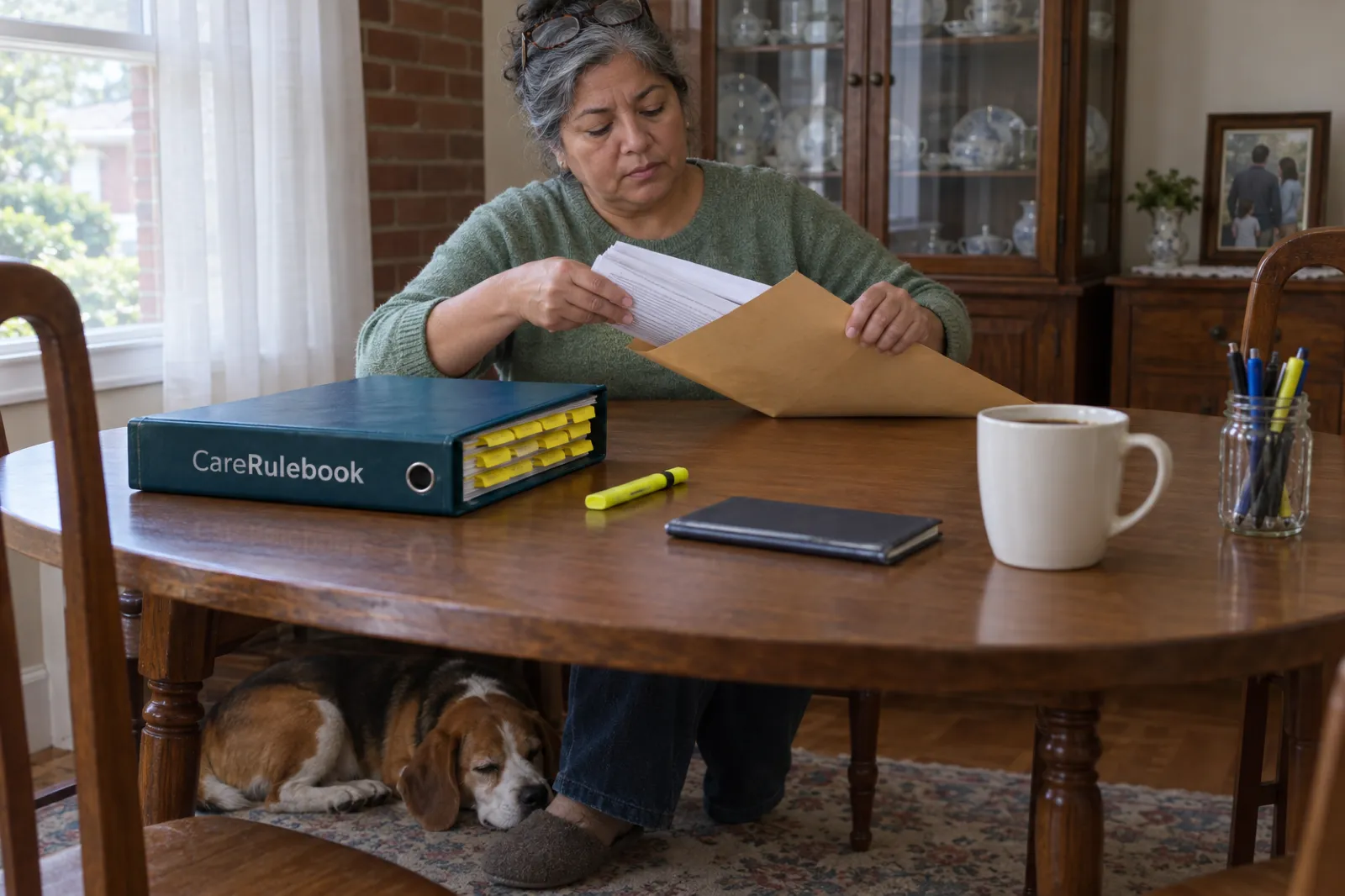
A home care founder at her dining table in Charlotte slides printed pages into a mailing envelope, with a CareRulebook binder beside her and a beagle asleep under the table

Quick answer

To provide hands-on in-home aide care in North Carolina you need a home care agency license from DHSR, for each site. It costs $510 a year, non-refundable, and every license expires on December 31. If you have never owned a home care agency, you must complete DHSR-approved training first.

You mail the application and fee. DHSR then emails you to request your policies, procedures and personnel documents, and "An initial survey is conducted by reviewing the policies, procedures, and personnel documents for compliance with licensure requirements." You have 12 months from applying to finish. DHSR says the main reason applicants are not approved is that they "do not understand and/or comply with the initial survey checklist and/or NC licensure rules".

Companion, sitter or respite care on its own needs a license too, as a home assistance services provider.

$510

DHSR license fee, every year

G.S. 131E-138(c)

12 months

To finish after applying

DHSR checklist

32

Policy items on DHSR’s checklist

DHSR checklist

3,336

Licensed home care sites, August 2026

DHSR list

Interactive check

Which North Carolina license do you need?

What will your caregivers do?

Pick the highest level of care you plan to offer.

How to start a North Carolina home care agency, step by step

Tick steps off as you go. Your progress is saved in this browser only.

  1. Decide which services you will offer

    Hands-on in-home aide care is a home care service. Companion, sitter or respite care on its own is a home assistance service, which also needs a license.

    G.S. 131E-136, 131E-138(a)
  2. Complete DHSR-approved training

    Before licensing

    If you have never owned or operated a home care agency, DHSR will not issue a license until you complete training it approves.

    10A NCAC 13J .0903(a)
  3. Appoint an agency director and an RN supervisor

    The director needs health care practitioner status, two years of home care management, or a relevant degree plus one year. For in-home aide services, an RN must be available while aides work.

    13J .1001(b); DHSR FAQ 43
  4. Set up a site and write your policies

    Each site is licensed separately. Write the policies and procedures on DHSR’s initial survey checklist and set up personnel records for your first staff.

    13J .0902; DHSR checklist
  5. Mail the application with the $510 fee

    Day 0

    Send the application, the fee by check or money order, and proof of past ownership or of the approved training. The fee is not refundable.

    G.S. 131E-138(c); DHSR
  6. Send DHSR your policies and personnel documents

    When DHSR asks

    DHSR emails to confirm receipt, then emails to request your policies, procedures and personnel documents.

    DHSR, Establishing a Home Care Agency
  7. Pass the desk-based initial survey

    DHSR sets no time frame

    DHSR reviews the documents for compliance. If nothing more is needed, it emails the approval letter and instructions to print your license.

    DHSR
  8. Finish within 12 months

    Within 12 months

    You must complete everything within 12 months of DHSR receiving your application and fee.

    DHSR checklist
  9. Renew by December 31 every year

    Every year

    Every license expires at midnight on December 31. Renew with the $510 fee before then. Expect an unannounced inspection every three years.

    DHSR FAQ 24-35

What DHSR checks: the 32-item policy checklist

DHSR tells applicants to use its Home Care Initial Survey Checklist as their guide. These are the policies and procedures on it, with the rule DHSR prints beside each. It also checks supporting documents (organization chart, proof of premises, annual budget) and a sample of personnel records.

Administrative · 14

  • Scope of services .1001(a)(1)
  • Emergency preparedness .1001(5)
  • Geographic service area .1001(g); .1107(h)
  • Agency director job description .1001(b)(d)(e)
  • Companion and sitter agency director (if applicable) .1503(1)
  • Service supervisor job description .1001(c)(d)
  • Job descriptions for other positions .1003(e)
  • Annual program evaluation .1004
  • Client record review .1004(d)(e)
  • Infection control, with employee risk categories .1003(a)
  • Bloodborne pathogens, with training and updates all in-home caregivers
  • TB skin test .1003(b)
  • Hepatitis B immunization or declination all in-home caregivers
  • Exposure control and post-exposure follow-up .1003(a)
Client care · 12

  • Client rights and responsibilities .1007; G.S. 131E-144.3
  • Coordination and referral .1001(a)(11); .1101(8)
  • Acceptance of clients .1101(1)-(8)
  • Initial assessment .1107(d)(e)
  • No smoking G.S. 131E-143
  • Supervision of staff .1001(a)(3); .1110; .1504(2)
  • Arrangements with other agencies or individuals .1111
  • Discharge .1001(a)(2); .1402
  • Complaints, with the state hotline number .1007(b)(c); G.S. 131E-144.6(b)
  • Health Care Personnel Registry reporting 10A NCAC 13O .0102
  • Plan of care, with 90-day review .1202; .1107(a)(b)
  • Client record content and handling .1401; .1402

Personnel · 6

  • Competency verification and skills checklist .1003(e)(g); .1110; .1504(1)
  • Personnel records and content .1003(f)
  • Annual performance evaluation .1003(f)(7)
  • In-service training .1003(d)
  • Orientation .1003(d)
  • Criminal background investigation G.S. 131E-265

DHSR, Home Care Initial Survey Checklist (rev. 9/21). Rule numbers are in 10A NCAC 13J unless stated.

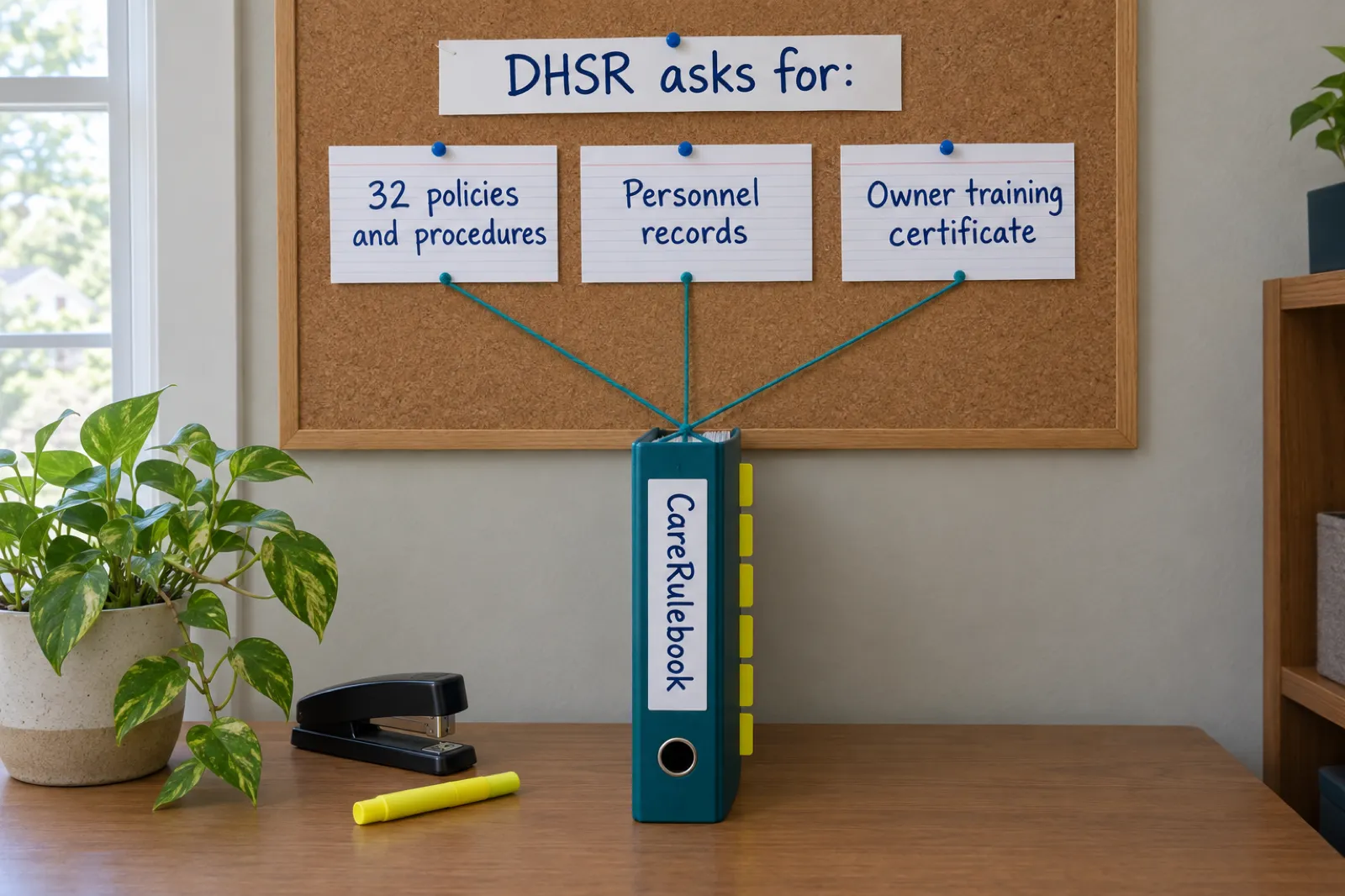
A cork board with index cards reading DHSR asks for: 32 policies and procedures, personnel records, owner training certificate, strung to a CareRulebook binder
What DHSR asks for after you apply: policies and procedures, personnel records, and proof of ownership experience or approved training.

DHSR treats what you send as a sample: "The policies and procedures submitted by the agency represent a sampling of the policies and procedures necessary to direct all administrative, personnel, and client care operations of the agency as required by 10A NCAC 13J." It does not return the documents.

The 11 operating policies the rules require

Rule .1001(a) says "The governing body or its designee shall establish and implement written policies governing agency operation. Such policies shall be available for inspection by the Department." They must include:

  1. 1A description of the scope of services offered
  2. 2Admission and discharge
  3. 3Supervision of personnel
  4. 4Developing and updating the plan of care
  5. 5Managing emergency care situations in the home
  6. 6The time frame for completing and returning service records
  7. 7Personnel qualifications
  8. 8An organizational chart
  9. 9Program evaluation
  10. 10Employee and client confidentiality
  11. 11Coordination of, and referral to and from, other community agencies

Other rules add written policies on infection control and communicable disease (.1003(a)), personnel records, orientation and in-service education (.1003(d)), accepting clients (.1101), plans of care (.1201), client records (.1401) and, if your staff administer any medication or treatment, accountability for side effects and reactions (.1301). The governing body also evaluates the whole agency every year and reviews sample client records every 90 days (.1004).

Agency director, RN and in-home aides

Agency director

A health care practitioner; or two years of supervisory or management experience in home care or another licensed provider; or a bachelor’s degree in health, business or public administration plus one year. Tell DHSR within five working days if the post falls vacant.

13J .1001(b), (e)

RN supervision

For in-home aide services an RN must be available for supervision and consultation while aides work. The RN does the initial assessment at home and develops the plan of care. An LPN cannot do assessments or supervisory visits.

DHSR FAQ 43-47

Aide competencies

Aides only do tasks they have shown they can do. For aides not on the Nurse Aide Registry, an RN verifies six core skills: mobility, bathing, toileting, dressing, eating and continence. Aides giving extensive assistance must be on the Nurse Aide Registry.

13J .1003(g), .1107(b), .1110

Health checks

Hands-on staff need a baseline TB skin test, and Hepatitis B immunization or a signed declination, with bloodborne pathogen training every year.

13J .1003(b), (f)

Registry

Do not hire anyone with a substantiated finding on the NC Health Care Personnel Registry, and report abuse, neglect and misappropriation to it.

13J .1003(c)

Criminal history check

An offer for a job entering clients’ homes is conditional on consent to a criminal history check: state, plus national with fingerprints if the person has lived in North Carolina under five years.

G.S. 131E-265

Plans of care and supervision

For in-home aide services, the health care practitioner assesses the client at home first, then writes a plan of care, signed and dated by the practitioner and the client or their responsible party. "The plan of care shall be reviewed every 90 days by the health care practitioner and revised as needed based on the client's needs."

Supervision follows the same rhythm: the practitioner makes "a supervisory visit to each client's place of residence every 90 days with or without the in-home caregiver's presence, and annually, while the in-home caregiver is providing care". One home visit can cover the 90-day plan review and the supervisory visit. Companion and sitter clients are contacted every three months and visited at least every six months.

To keep supervision possible, in-home aide services are limited to your county, neighboring counties, or 90 minutes’ drive from your site, whichever is greater.

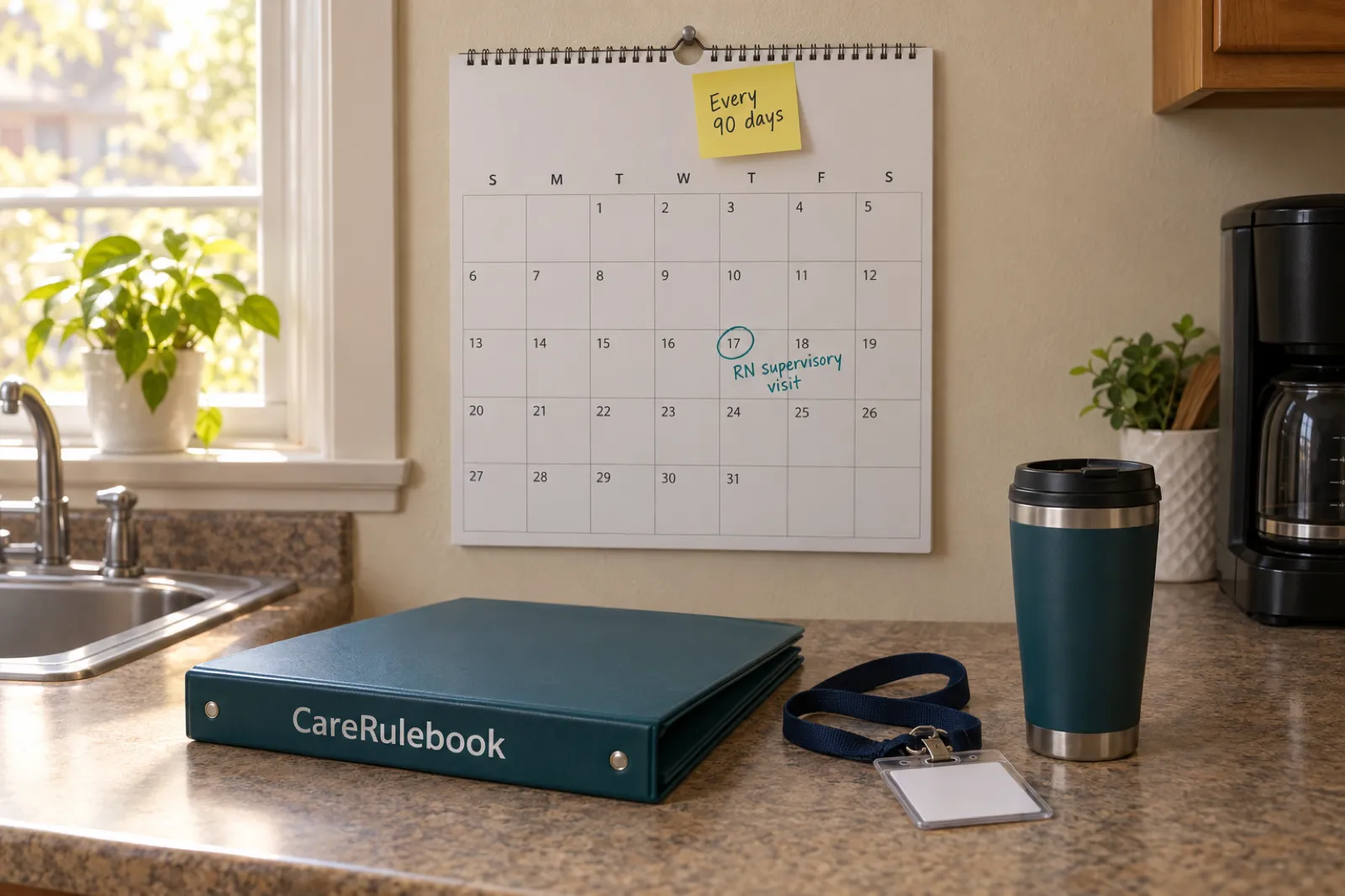
A kitchen wall calendar with one date circled and marked RN supervisory visit, a sticky note reading Every 90 days, and a CareRulebook binder on the counter
Plan of care review and RN supervisory visits: every 90 days (10A NCAC 13J .1110(c), .1202(a)).

Client rights, notices and complaints

The statute sets out a declaration of home care clients’ rights. Before services start, give each client the declaration, your policies on client responsibilities, and contact details for complaints to you and to DHSR, and keep their signed receipt (G.S. 131E-144.3, 144.4).

  • Complaints: "A home care agency shall investigate, within 72 hours, complaints made to the agency by a home care client or the client's family and must document both the existence of the complaint and the resolution of the complaint."
  • Reducing or ending services: give at least 48 hours’ notice, unless the client agrees, someone is in danger or the physician ends services (.1101(7)).
  • No smoking: staff must not smoke in clients’ homes, and clients must be told. DHSR can fine up to $200 per violation (G.S. 131E-143).
  • Records: keep client records at least five years after discharge (.1401(f)).

North Carolina home care myths, checked against the source

Can you run a companion-only agency in North Carolina without a license?

No. Since 2023 the statute calls companion, sitter and respite services "home assistance services", and a home assistance services provider needs a license too.

"No person or governmental unit shall operate a home care agency or a home assistance services provider without a license obtained from the Department."

Can the Medicaid PCS service plan be your plan of care?

No. DHSR says the Medicaid personal care services plan is not a plan of care and cannot replace one.

"The Service Plan is not a Plan of Care and may not be substituted as a Plan of Care."

Can an LPN do the assessments and supervisory visits for in-home aides?

No. DHSR says an LPN may not perform assessments or supervisory visits for in-home aide services.

"The LPN may not perform assessments or conduct supervisory visits for in-home aide services."

Frequently asked questions

How much does a home care license cost in North Carolina?

DHSR charges $510 a year, non-refundable, for an initial license, a change of ownership and each annual renewal. This is a state fee, not a CareRulebook price. New owners also need DHSR-approved training, which has its own cost.

How long does it take to get a home care license in North Carolina?

DHSR does not set a time frame. It depends on how complete your application is, whether more information is needed and surveyor workload. You must complete every requirement within 12 months of DHSR receiving your application and fee.

What policies does a North Carolina home care agency need?

The 11 operating policies in 10A NCAC 13J .1001(a), plus policies on infection control, personnel, client acceptance, plans of care and client records. DHSR’s initial survey checklist lists 32 policy and procedure items in three groups, and it reviews them before licensing.

Do I need a nurse to open a home care agency in North Carolina?

For in-home aide services, yes. DHSR says the agency must have an RN available for supervision and consultation while aides work. The RN does the initial assessment, develops the plan of care, verifies aides’ competencies and makes the 90-day supervisory visits. An LPN cannot do the assessments or supervisory visits.

Is there a home care license for companion care only?

Since 2023 companion, sitter and respite care on its own is a "home assistance service", and the provider needs a license. Home assistance providers must carry liability insurance, tell clients they give no hands-on care and run background checks.

Will DHSR inspect my office before licensing?

DHSR’s process page describes the initial survey as a review of the policies, procedures and personnel documents you send. Once licensed, agencies are inspected about every three years, unannounced.

How far can my aides travel?

In-home aide services are limited to your county, the neighboring counties, or 90 minutes’ drive from your site, whichever is greater, so the RN can supervise.

When must I renew?

Every year. All home care licenses expire at midnight on December 31. If DHSR receives the renewal after January 1, it takes effect from the date received, and you are operating without a license in the meantime.

Get your North Carolina manual at launch

Leave your email and we will send your North Carolina manual preview as soon as it is ready. The first 50 North Carolina agencies get the founding price of $199.

No spam. One email when your guide's pack launches, and rule-change alerts if you want them. How we use your email.

Keep reading

Sources

  1. 10A NCAC 13J, The Licensing of Home Care Agencies · NC Office of Administrative Hearings · retrieved October 1, 2026
  2. N.C. General Statutes Chapter 131E, Article 6 (home care agency licensure and home care clients’ bill of rights) · North Carolina General Assembly · retrieved October 1, 2026
  3. Home Care Initial Survey Checklist (rev. 9/21) · NC DHSR · retrieved October 1, 2026
  4. Home Care Frequently Asked Questions (rev. 5/30/25) · NC DHSR · retrieved October 1, 2026
  5. Requirements for Establishing a Home Care Agency · NC DHSR · retrieved October 1, 2026
  6. 10A NCAC 13O, Health Care Personnel Registry · NC Office of Administrative Hearings · retrieved October 1, 2026
  7. 29 CFR 1910.1030, Bloodborne pathogens · eCFR (OSHA) · retrieved October 1, 2026
  8. Home Care All: agencies licensed by the State of North Carolina (as of 08/2026) · NC DHSR · retrieved October 1, 2026
NC manual: coming soonGet notified at launch