Skip to content
CareRulebook
MenuClose

What do you run?

Home care in the US19 states with a manual, 6 with a free guide
ColoradoManual
ConnecticutPack
DelawareManual
GeorgiaManual
IllinoisManual
IndianaManual
KansasManual
MaineManual
MarylandManual
MinnesotaManual
NevadaManual
North CarolinaManual
OklahomaManual
OregonManual
South CarolinaManual
TennesseeManual
TexasManual
VirginiaManual
WashingtonManual
CaliforniaGuideFloridaGuideNew JerseyGuideNew YorkGuideOhioGuidePennsylvaniaGuideAll US home care states →
Care homes in the USCalifornia, Michigan, Minnesota; more states coming
Home care in the UKEngland, Scotland, Wales
Free toolsChecklists, calculators and templates

Florida · Hiring · F.S. 408.809, ch. 435 and 59A-35.090

Florida caregiver background screening: level 2, before any client contact

Florida home care providers screen caregivers through AHCA’s Care Provider Background Screening Clearinghouse: a level 2 fingerprint check by FDLE and the FBI, taken by a Livescan Service Provider, with no client contact until it clears. The same rules cover homemaker and companion registrants, nurse registries and home health agencies. This guide sets out who is screened, each step, the disqualifying offenses, exemptions and the 5-year rescreen.

  • Rule-verified October 8, 2026
  • Quoted from the Florida Statutes and 59A-35.090
  • Free guide
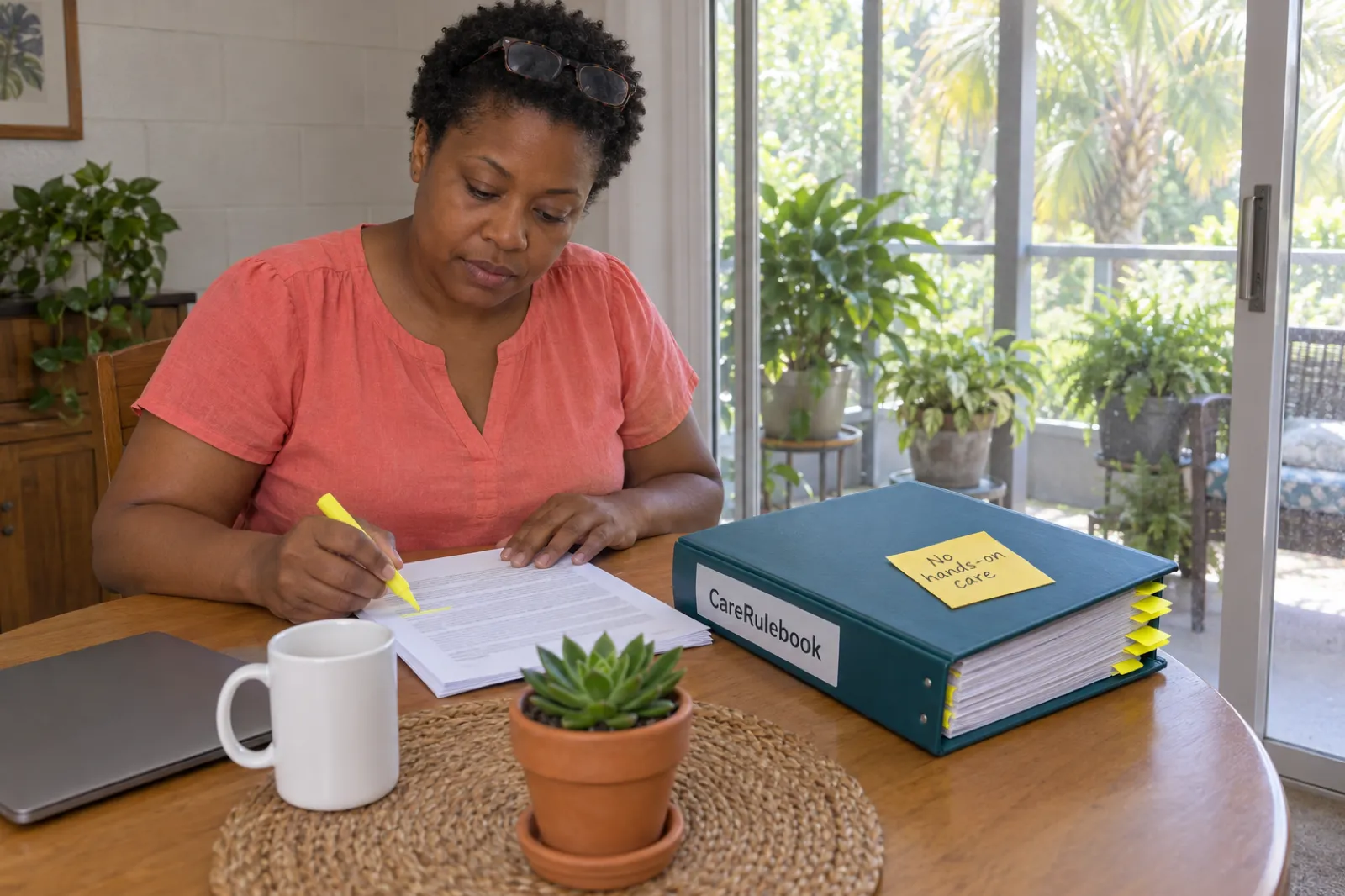
A woman in a coral blouse highlights a printed page beside a teal CareRulebook binder at a kitchen table in a Florida home, with a sticky note reading No hands-on care and a screened porch with plants behind her

Quick answer

"The agency, registry, or service shall require level 2 background screening for employees or contractors as required in s. 408.809(1)(e) pursuant to chapter 435 and s. 408.809." (F.S. 400.512) Level 2 means "fingerprinting for statewide criminal history records checks through the Department of Law Enforcement, national criminal history records checks through the Federal Bureau of Investigation", among other searches (F.S. 435.04(1)(a)).

Employers "must register with and initiate all criminal history checks through the clearinghouse before referring an employee or potential employee" for fingerprinting (F.S. 435.12(2)(d)), and "an employer may not hire, select, or otherwise allow an employee to have contact with any vulnerable person that would place the employee in a role that requires background screening until the screening process is completed and demonstrates the absence of any grounds for the denial or termination of employment" (F.S. 435.06(2)(a)).
Level 2

fingerprint checks by FDLE and the FBI, through AHCA’s Clearinghouse

F.S. 435.04(1)(a)

5 years

between one level 2 screening and the next rescreen

F.S. 408.809(2)

5 days

business days to report a new status or a change in the Clearinghouse

F.S. 435.12(2)(c)2.

90 days

away from a screened job before a national screening is needed again

F.S. 435.12(2)(b)1.

Short answers

What background check do Florida companion and homemaker caregivers need?

A level 2 background screening through AHCA: fingerprint-based state (FDLE) and national (FBI) criminal history checks, started in AHCA’s Care Provider Background Screening Clearinghouse. Companion and homemaker providers, nurse registries and home health agencies all require it for the staff and contractors s. 408.809(1)(e) covers.

F.S. 400.512; 435.04(1)(a)

Can a new Florida caregiver start before screening clears?

Only for training and orientation. An employer may hire someone into a screened position for training and orientation first, but they may not have direct contact with vulnerable people until screening is complete and shows no grounds to deny employment.

F.S. 435.06(2)(a), (d)

How often are Florida caregivers rescreened?

Every 5 years. AHCA’s pages call this a Clearinghouse Renewal: the employer can start it 60 days before the retained prints expire, and if it lapses the person is fingerprinted again as a new screening.

F.S. 408.809(2); AHCA Clearinghouse Renewals page

Who pays for level 2 screening in Florida?

The provider or the person screened, and providers may reimburse. For a new screening, payment goes to the Livescan Service Provider; a Clearinghouse Renewal is requested and paid for in the Clearinghouse itself. AHCA’s Clearinghouse Renewals page (July 2025 copy) put a renewal at $43.25 and the average new screening at $75.00; those are AHCA’s and vendors’ charges as of that page, not CareRulebook prices.

F.S. 408.809(5); 59A-35.090(2)(b); AHCA renewals FAQ 8

Who is screened

Level 2 screening "must be conducted through the agency", meaning AHCA, on each of these people (F.S. 408.809(1)):

Caregivers and other staff

Anyone expected to provide personal care or services directly to clients, or to have access to client funds, personal property or living areas.

F.S. 408.809(1)(e)

Contractors

Contractors who provide personal care or services directly, or who work 20 hours a week or more with access to client funds, property or living areas. Evidence of their screening may be kept by their own employer or by you.

F.S. 408.809(1)(e)

Owners and managers

The licensee if an individual, the administrator, the financial officer and every controlling interest (officers, directors and owners of 5% or more, including those of a management company). The administrator and financial officer are screened and qualified before appointment.

F.S. 408.809(1)(a)-(d); AHCA Form 3110-1003, section 3

AHCA’s own table lists homemaker, sitter and companion providers, nurse registries and home health agencies among the provider types whose owners, administrator, financial officer and direct-care or access staff need level 2 screening (AHCA, Who is Required to be Screened?). On the registration application, you attest that every employee required to be screened has met level 2 standards or holds an exemption (AHCA Form 3110-1003, section 12). The statute adds that each licensed or registered employer submits a signed attestation of compliance, under penalty of perjury, to AHCA every year or at renewal (F.S. 435.05(3)).

Our reading: office staff who never visit clients’ homes and have no access to client funds or property fall outside s. 408.809(1)(e). Anyone who does an intake visit or handles client money falls inside it.

Each new hire, step by step

The statute’s and the rule’s duties set out as steps, in our suggested order. Tick steps off as you go; progress is saved in this browser only.

  1. Apply for your registration, then join the Clearinghouse

    Before your first hire

    AHCA says a new provider submits its application to the licensure unit before it can use the Clearinghouse. Employers register with the Clearinghouse and start every check there.

  2. Screen the administrator and financial officer first

    With the application

    They must be screened and qualified before appointment, and the application asks for a Clearinghouse screening for each controlling interest.

  3. Get and verify employment history

    When they apply to work for you

    Ask each person who will have contact with clients in their homes for their employment or contract history and verify it. Two documented attempts count as diligent effort when it cannot be verified.

  4. Start the check in the Clearinghouse

    At the job offer

    Enter the person’s full name, Social Security number (or an individual taxpayer identification number), date of birth, mailing address, sex and race, before referring them for fingerprints.

    F.S. 435.12(2)(d)
  5. Send them to a Livescan Service Provider

    Within 5 working days of getting their details

    Prints are taken electronically by a provider contracted through AHCA or approved by FDLE, with a photograph, and paid to that provider. The statute gives the employer 5 working days after receiving the information to submit it to FDLE (F.S. 435.05(1)(c)). How Livescan works.

  6. Training and orientation only, until the result

    While waiting

    They may train and attend orientation, but no direct contact with vulnerable people until screening is complete and shows no grounds to deny employment.

    F.S. 435.06(2)(a), (d)
  7. Read the result on AHCA’s secure website

    When AHCA decides

    AHCA posts whether the person qualifies. If the result disqualifies them, tell them in writing, naming the record. If someone is disqualified.

  8. File the attestation and the result

    On hire

    The person signs AHCA’s Attestation of Compliance (Form 3100-0008) on hire; the statute makes it an attestation under penalty of perjury (F.S. 435.05(2)). AHCA says the first time someone is screened through the Clearinghouse they also sign its Privacy Policy (AHCA renewals FAQ 11). The signed forms and the eligibility result go in their personnel file.

    59A-35.090(2)(d), (3)(c)
  9. Keep the Clearinghouse roster current

    Within 5 business days

    Report the person’s initial status and any change within 5 business days. AHCA says the roster is also how employers receive arrest and expiring retained prints notifications (AHCA renewals FAQ 7).

    F.S. 435.12(2)(c)2.
  10. Diary the Retained Prints Expiration Date

    Every 5 years

    Rescreening is due every 5 years. AHCA says the date that counts is each person’s Retained Prints Expiration Date, shown on their Clearinghouse profile, and that the renewal can be started in the 60 days before it (AHCA renewals FAQ 3, 9).

The Clearinghouse and Livescan fingerprints

The Clearinghouse. "The Agency for Health Care Administration in consultation with the Department of Law Enforcement shall create a secure web-based system, which shall be known as the “Care Provider Background Screening Clearinghouse” or “clearinghouse.”" (F.S. 435.12(1)) AHCA’s Background Screening Unit decides eligibility, reviews exemption applications and runs it (AHCA, January 2025). "An employer of persons subject to screening or a qualified entity participating in the clearinghouse must register with the clearinghouse and maintain the employment or affiliation status of all persons included in the clearinghouse." (F.S. 435.12(2)(c))

Livescan. "Persons required to undergo Level 2 background screening must submit fingerprints electronically through a Livescan Service Provider contracted through the Agency or approved through the Florida Department of Law Enforcement." "Payment for screening services must be made to the Livescan Service Provider at the time of services or through a payment arrangement with the Livescan Service Provider." (59A-35.090(2)(b)) The statute adds that prints are "Submitted with a photograph of the person taken at the time the fingerprints are submitted" (F.S. 435.12(2)(a)5.). AHCA says there are Livescan sites around the state run by providers on FDLE’s list, some offering mobile screening on site, and that providers may buy or lease their own FDLE-approved machines (AHCA Livescan page, December 2024).

Rejected prints. If the FBI rejects prints as illegible, AHCA tells you through its secure website, and "The individual must return to the same Livescan Service Provider and submit a second set of fingerprints" (59A-35.090(2)(c)).

What the check covers. Besides the FDLE and FBI checks, level 2 includes "local criminal records checks through local law enforcement agencies. A security background investigation under this section also includes a search of the sexual predator and sexual offender registries of any state in which the current or prospective employee resided during the immediate preceding 5 years" (F.S. 435.04(1)(a)).

How long it takes. As of October 2025, AHCA said Livescan vendors can take 24 to 72 business hours to send prints to FDLE, and its unit averages 5 to 7 business days to review once FDLE’s results arrive (AHCA Screening Information). If the record is incomplete, AHCA writes to the person for the arrest report and court disposition, and they have 30 days to send them or may be disqualified (59A-35.090(3)(b)). On your side, the statute gives the employer 5 working days after receiving a person’s information to submit it to FDLE (F.S. 435.05(1)(c)). Build that time into your start dates.

What it costs. "The costs associated with obtaining the required screening must be borne by the licensee or the person subject to screening. Licensees may reimburse persons for these costs." (F.S. 408.809(5)) AHCA’s Clearinghouse Renewals page, as archived in July 2025, said: "The current cost for a Clearinghouse Renewal is $43.25. That's a cost-saving of over $30 with the average cost for a new screening being $75.00!" (AHCA, July 2025) Those are AHCA’s and the Livescan vendors’ charges as of that page, not AHCA registration fees and not CareRulebook prices. A new screening is paid to the Livescan provider; a renewal is requested and paid for in the Clearinghouse itself (AHCA renewals FAQ 8). Ask your Livescan provider for its current price.

The disqualifying offenses

Level 2 screening must ensure that the people screened "have not been arrested for and are awaiting final disposition of; have not been found guilty of, regardless of adjudication, or entered a plea of nolo contendere or guilty to; or have not been adjudicated delinquent and the record has not been sealed or expunged for, any offense prohibited under any of the following provisions of state law or similar law of another jurisdiction" (F.S. 435.04(2)). So an arrest still awaiting disposition counts, and so does a finding of guilt or a guilty or no contest plea, whether or not adjudication was withheld. The list is long; among the offenses on it:

  • adult abuse, neglect or exploitation of aged persons or disabled adults (s. 415.111), and abuse, aggravated abuse or neglect of an elderly person or disabled adult (s. 825.102);
  • murder (s. 782.04) and aggravated assault (s. 784.021);
  • sexual battery (s. 794.011);
  • burglary (s. 810.02), and theft, robbery and related crimes under ch. 812 if the offense is a felony;
  • drug offenses under ch. 893, if the offense was a felony or another person involved was a minor (F.S. 435.04(2));
  • "any offense that constitutes domestic violence as defined in s. 741.28, whether such act was committed in this state or in another jurisdiction" (F.S. 435.04(3)).

Health care licensing adds more. On top of the chapter 435 list, s. 408.809(4) adds offenses such as Medicaid provider fraud and battery when the victim is a vulnerable adult, and repeats domestic violence (F.S. 408.809(4)), and fraud and forgery offenses such as false insurance claims, patient brokering, criminal use of personal identification information and forgery (F.S. 408.809(4)(i)-(p)). The full lists are in s. 435.04 and s. 408.809; AHCA applies them and decides eligibility.

Not every record disqualifies. AHCA says: "Not all criminal offenses are disqualifying. An individual may have a criminal history record and still be ‘Eligible’." (AHCA Screening Information) AHCA, not the employer, decides eligibility, and posts the result on its secure website (F.S. 408.809(3)).

If someone is disqualified

  • Tell them in writing. "If an employer or agency has reasonable cause to believe that grounds exist for the denial or termination of employment of any employee as a result of background screening, it shall notify the employee in writing, stating the specific record that indicates noncompliance with the standards in this chapter." It is then for them to contest or seek an exemption, and "The only basis for contesting the disqualification is proof of mistaken identity." (F.S. 435.06(1))
  • No client contact. They may not have contact with any vulnerable person in a screened role "unless the employee is granted an exemption for the disqualification" (F.S. 435.06(2)(a)).
  • Terminate or move. "The employer must terminate the employment of any of its personnel found to be in noncompliance with the minimum standards of this chapter or place the employee in a position for which background screening is not required unless the employee is granted an exemption from disqualification pursuant to s. 435.07." (F.S. 435.06(2)(c)) For a companion or homemaker business, our reading is that few roles fall outside screening, since most staff work with clients at home.
  • Refusals. Someone who refuses to cooperate or to give fingerprints in time "must be disqualified for employment in such position or, if employed, must be dismissed" (F.S. 435.06(3)).
  • Liability. The statute says there is no monetary liability or cause of action for damages against an employer that terminates someone on notice of a disqualifying conviction or arrest, even if they have applied for an exemption (F.S. 435.06(4)). Take employment law advice on the rest of the decision.

Exemptions from disqualification

A disqualified person can ask AHCA for an exemption. AHCA says "The granting of an exemption does not change an individual’s criminal history. It only provides eligibility for employment in a health care setting." (AHCA Exemption page)

  • When. For a felony, once at least 2 years have passed since the person completed or was released from the sentence, supervision or court conditions; for a listed misdemeanor, once they have completed it (F.S. 435.07(1)(a)). For an unsealed juvenile finding of delinquency for an offense that would be a felony for an adult, the wait is 3 years (F.S. 435.07(1)(a)4.). AHCA’s exemption page (February 2026 copy) gives the same 2 years for felonies (AHCA). Any court-ordered fee, fine, restitution or costs for the offense must be paid in full first (F.S. 435.07(1)(b)).
  • The evidence. The person "must demonstrate by clear and convincing evidence that the employee or person with an affiliation should not be disqualified from employment" (F.S. 435.07(3)(a)). AHCA weighs the offense and the harm, probation or parole, restitution, other offenses and the time since the last one, the person’s history since, work experience, references, evaluations, education, other evidence of rehabilitation, and their honesty (59A-35.090(4)(e)).
  • How to apply. In writing on AHCA Form 3110-0019. AHCA closes an application still incomplete 30 days after receipt, and will not consider one without a level 2 screening in the last 6 months (59A-35.090(4)(a), (d)). People licensed or certified by the Department of Health apply to their board instead, unless they will work outside their licensed role (59A-35.090(4)(b)).
  • No exemption possible for sexual predators, career offenders or registered sexual offenders (unless the duty to register has been removed) (F.S. 435.07(4)(b)), and a felony disqualification is not lifted "solely by reason of any pardon, executive clemency, or restoration of civil rights" (F.S. 435.07(4)(a)).
  • Other agencies’ exemptions. "Exemptions granted by one agency shall be considered by subsequent agencies, but are not binding on the subsequent agency." (F.S. 435.07(5))

Arrests, rescreens and Clearinghouse renewals

  • Arrests. "If an employer becomes aware that an employee has been arrested for a disqualifying offense, the employer must remove the employee from contact with any vulnerable person that places the employee in a role that requires background screening until the arrest is resolved in a way that the employer determines that the employee is still eligible for employment under this chapter." (F.S. 435.06(2)(b)) Each person agrees on hire to tell you immediately if arrested for a disqualifying offense (59A-35.090(2)(d)).
  • Every 5 years. Each screened person "must submit to level 2 background rescreening as a condition of retaining such license or continuing in such employment or contractual status" (F.S. 408.809(2)). Retained prints are kept "on a 5-year renewal basis with fees collected at the time of initial submission or resubmission of fingerprints" (F.S. 435.12(2)(a)4.).
  • The Clearinghouse Renewal. AHCA says: "Providers may initiate a Clearinghouse Renewal 60 days before the Retained Prints Expiration Date is reached." If it lapses, the person is fingerprinted again as a new screening (AHCA Clearinghouse Renewals). The Clearinghouse sends reminders 60, 30 and 21 days before expiry, but only for people on your roster without an end date (AHCA renewals FAQ), so keep the roster current.
  • A break of more than 90 days. Until prints are enrolled in the FBI’s retained print program, a person returning to a screened position after a break of more than 90 days must submit to a national screening (F.S. 435.12(2)(b)1.). AHCA calls this a resubmission, and says it does not extend the retained prints expiry date (AHCA renewals FAQ).
  • An offense that has since become disqualifying. If a rescreen shows an offense committed before the last screening that has since become disqualifying, the person may apply for an exemption and, if you agree, keep working until AHCA decides, as long as the request reaches AHCA within 30 days of their receiving the results (F.S. 408.809(4)).

Records and confidentiality

  • The personnel file. "The eligibility results of employee screening and the signed Attestation referenced in subsection 59A-35.090(2), F.A.C., must be in the employee’s personnel file, maintained by the provider." (59A-35.090(3)(c)) AHCA adds that contractor screenings may be kept either by the contractor’s employer or by you (AHCA Screening Information).
  • Employment history. Keep the history each person gave you and your verification, or your two documented attempts (59A-8.025(7)). AHCA’s surveyor guidance expects a file for each worker showing their employment history (AHCA regulation set, tag I0011).
  • Confidential. AHCA says "Level 2 screening records are confidential and may not be shared with anyone other than the individual that was screened." Providers who start a screening can see the Florida public rap sheet (AHCA Screening Information).
  • Dementia training certificates go in the same file (Elder Affairs).

Nurse registries and home health agencies

The screening statute names all three routes: "The agency, registry, or service shall require level 2 background screening" (F.S. 400.512).

  • Nurse registries screen every person they refer: "Each nurse registry must comply with the background screening requirements in s. 400.512 for all persons referred for contract." People continuously registered with the registry since October 1, 2000 may not need an initial screening (F.S. 400.506(9)). Each registry also sets written procedures for selecting, documenting, screening and verifying the credentials of each contractor it refers (59A-18.005(2)).
  • Home health agencies follow the same level 2 rules for their staff and contractors (F.S. 400.512). That license is a different route with its own aide training and nurse supervision: see the routes for hands-on personal care.

Training after clearance: the dementia rule

Florida’s companion and homemaker rules name little caregiver training beyond one dementia course. "A person employed, contracted, or referred by a nurse registry or a person registered with the agency to provide companion or homemaker services must complete the training required under s. 430.5025." (F.S. 400.51) Home health agency staff are covered too (F.S. 400.4785).

  • On hire: basic written information about interacting with people who have Alzheimer’s disease or related dementia (s. 430.5025(4)(a)).
  • Within 30 days: the Department of Elder Affairs’ 1-hour program, free and online, for each employee who gives personal care or has regular contact (s. 430.5025(4)(b)).
  • Within 7 months: 2 more hours for each employee who gives personal care (s. 430.5025(4)(c)). For this training only, personal care includes "homemaker or companion services" given in person (s. 430.5025(2)(c)).
  • Nothing else named. We found no other caregiver training or orientation rule for companion and homemaker registrants; the rule asks for staff "capable of delivering contracted or agreed upon services, including all visits" (59A-8.025(9); our reading).

More detail, including staff hired before July 1, 2023: training in the Florida guide. The caregiver training comparison shows Florida next to other states.

Myths about Florida screening

Can a new Florida companion start work before the background screening clears?

No. Not with clients. Chapter 435 lets you hire someone for training and orientation before screening is complete, but they may not have direct contact with vulnerable people until the level 2 screening is complete and shows no grounds to deny employment.

"An employer may hire an employee to a position that requires background screening before the employee completes the screening process for training and orientation purposes."

Do Florida companions need dementia training?

Yes. Staff of a registered companion or homemaker provider must complete the training in s. 430.5025: written information on hire, the Department of Elder Affairs’ free 1-hour online course within 30 days for those who give personal care or have regular contact, and 2 more hours within 7 months for those who give personal care. In that section, personal care includes homemaker or companion services. Section 400.6045 is the hospice rule, not this one.

"A person employed, contracted, or referred by a nurse registry or a person registered with the agency to provide companion or homemaker services must complete the training required under s. 430.5025."

Frequently asked questions

What is level 2 background screening in Florida?

A fingerprint-based check through the Florida Department of Law Enforcement (state records) and the FBI (national records), plus local criminal records checks and a search of the sex offender registries of every state the person lived in during the last 5 years. For home care providers it is run through AHCA’s Care Provider Background Screening Clearinghouse, and AHCA decides whether each person is eligible.

Does a Florida companion agency have to screen office staff?

Level 2 screening covers anyone expected to provide personal care or services directly to clients, or to have access to client funds, personal property or living areas, plus the administrator, the financial officer and the controlling interests. On our reading, office staff who do none of those things fall outside the list, but someone who visits clients’ homes or handles client money falls inside it.

Can someone with a criminal record work for a Florida home care provider?

Sometimes. AHCA says not every offense is disqualifying, and a person can have a record and still be eligible. If the record does include a disqualifying offense, the person may apply to AHCA for an exemption, generally once they have finished their sentence (at least 2 years after it for a felony, 3 for an unsealed juvenile finding of delinquency for a felony-level offense) and paid any court-ordered amounts. Sexual predators, career offenders and registered sexual offenders cannot be exempted.

Do I need to rescreen a caregiver who worked for another Florida provider?

Not always. Clearinghouse results are shared among the state agencies that use it, so, on our reading, someone whose retained prints are current may not need new fingerprints; the Clearinghouse shows what is needed. If they have had a break of more than 90 days from a screened position, they must submit to a national screening again until their prints are enrolled in the FBI’s retained print program. Either way, you start the check in the Clearinghouse, add them to your roster and keep their signed attestation.

What happens if a Florida caregiver is arrested?

If you learn that an employee was arrested for a disqualifying offense, you must remove them from contact with vulnerable people until the arrest is resolved in a way that leaves them eligible. On hire, each person attests that they will tell you immediately if arrested for a disqualifying offense.

Do Florida companions need training as well as screening?

Yes, the dementia training in s. 430.5025: written information on hire, a free 1-hour online course within 30 days for staff who give personal care or have regular contact, and 2 more hours within 7 months for staff who give personal care. For that training only, personal care includes companion and homemaker services. We found no other training rule for companion and homemaker registrants.

Get Florida rule-change alerts

Leave your email and we will tell you when the Legislature or AHCA changes the screening rules or the companion and homemaker rules, with what it means for your hiring.

No spam. Only emails about Florida home care rules. How we use your email.

Keep reading

Sources

  1. Florida Statutes s. 400.509, Registration of particular service providers exempt from licensure (2026) · The Florida Legislature (Online Sunshine) · retrieved October 8, 2026
  2. Florida Statutes ch. 400 part III, Home Health Services (ss. 400.462, 400.464, 400.471, 400.476, 400.4785, 400.487, 400.51, 400.512) (2026) · The Florida Legislature (Online Sunshine) · retrieved October 8, 2026
  3. Florida Statutes s. 400.506, Licensure of nurse registries (2026) · The Florida Legislature (Online Sunshine) · retrieved October 8, 2026
  4. Florida Statutes s. 408.809, Background screening; prohibited offenses (2026) · The Florida Legislature (Online Sunshine) · retrieved October 8, 2026
  5. Florida Statutes ch. 435, Employment Screening (ss. 435.02 to 435.07, 435.12) (2026; s. 435.05 from flsenate.gov) · The Florida Legislature (Online Sunshine) · retrieved October 8, 2026
  6. Florida Statutes s. 430.5025, Alzheimer’s Disease and Related Forms of Dementia Education and Training Act (2026) · The Florida Legislature (Online Sunshine) · retrieved October 8, 2026
  7. Chapter 59A-8, F.A.C., Minimum Standards for Home Health Agencies (incl. 59A-8.025, Registration Requirements for Homemaker and Companion Services Providers, effective 7/27/2016) · Agency for Health Care Administration (Florida Administrative Code, flrules.org) · retrieved October 8, 2026
  8. Chapter 59A-35, F.A.C., Health Care Licensing Procedures · Agency for Health Care Administration (Florida Administrative Code, flrules.org) · retrieved October 8, 2026
  9. Chapter 59A-18, F.A.C., Nurse Registries Standards and Licensing · Agency for Health Care Administration (Florida Administrative Code, flrules.org) · retrieved October 8, 2026
  10. Health Care Licensing Application, Homemaker and Companion Services Provider, AHCA Form 3110-1003 (July 2024) · Agency for Health Care Administration (incorporated by reference in 59A-35.060, F.A.C.) · retrieved October 8, 2026
  11. ASPEN State Regulation Set I 1.07, Homemaker Companion Services (printed September 9, 2021), Internet Archive copy of June 2025 · Agency for Health Care Administration (state regulation set used by surveyors) · retrieved October 8, 2026
  12. Alzheimer’s Disease and Related Dementias Training page · Florida Department of Elder Affairs · retrieved October 8, 2026
  13. Background Screening pages (Background Screening Unit, Screening Information, Who is Required to be Screened, Exemption from Disqualification, Livescan Service Provider Information, Clearinghouse Renewals), Internet Archive copies of June 2024 to February 2026 (the pages moved to /health-quality-assurance/ in 2025) · Agency for Health Care Administration, Background Screening Unit · retrieved November 10, 2026
Florida rule-change alertsFree, by email