Help with daily living
Bathing, dressing, eating, transferring, walking, toileting and continence care, within the limits for each task in Chapter 26.
Ch. 26, 2.20; 7.4(E)-(F)Where are you starting?
Colorado · Home health vs home care · 6 CCR 1011-1 Chapter 26, Part 4.1
In Colorado’s rules, home health and non-medical home care share one license. CDPHE licenses every home care agency in one of two classes: Class B for personal care only, and Class A for skilled care such as nursing or therapy. CDPHE’s initial fee is $2,720.30 for Class B and $3,709.49 for Class A. Here is what each class covers, what a Class B agency may and may not do, how Medicaid personal care fits, and what CMS’s 2026 home health moratorium does and does not touch.

Quick answer
In Colorado, home health and non-medical home care are two classes of the same home care agency license from CDPHE. A home care agency is one that offers "skilled home health services or personal care services" in the consumer’s home. Ch. 26, 2.10 Class B provides only personal care and "shall not provide any skilled healthcare service". Ch. 26, 4.1(A)(2) Class A provides skilled care and may provide personal care too. Ch. 26, 4.1(A)(1)
CDPHE’s initial fee is $2,720.30 for Class B and $3,709.49 for Class A (2026/27). CDPHE fee schedule Since July 1, 2025, Medicaid personal care under Community First Choice needs a Class A or Class B license, and HCPF and CDPHE strongly recommend Class B. HCPF PM 25-001
We found no certificate of need rule for either class. Separately, CMS halted Medicare enrollment of new home health agencies nationwide from May 13, 2026. That is federal enrollment, not CDPHE’s license, and the memo does not mention non-medical home care (our reading of QSO-26-11).
Chapter 26 says "Class A – a home care agency that provides any skilled healthcare service. Agencies with a Class A license may also provide personal care services." Ch. 26, 4.1(A)(1) and "Class B – a home care agency that provides only personal care services. An agency with a Class B license shall not provide any skilled healthcare service." Ch. 26, 4.1(A)(2)
CDPHE describes Class A as skilled care "provided by a licensed medical professional including licensed nurses, certified nursing assistants, and licensed therapy and respiratory professionals". CDPHE, Home Care Agencies Each applicant names the type and extent of services it will provide and asks for the matching class. Ch. 26, 4.5(A)
Personal care is wider than it sounds. "“Personal care services” means assistance with activities of daily living, including but not limited to: bathing, dressing, eating, transferring, walking or mobility, toileting, continence care, housekeeping, personal laundry, medication reminders, and companionship services" Ch. 26, 2.20 Only an organization that provides housekeeping services alone is excluded, so by our reading a companion-only agency needs the Class B license. Ch. 26, 2.10(B)(1)
Skilled services, which only Class A may provide, are health and medical services in the home that include wound care, medical supplies and drugs prescribed by a physician, in-home infusion, nursing, certified nurse aide services that need a licensed or certified professional’s supervision, occupational, physical and speech therapy, respiratory care, dietetics and nutrition counseling, medication administration and medical social services. Delivering durable medical equipment or medical supplies is not a skilled service. Ch. 26, 2.29
"Home health" in CDPHE’s data. CDPHE still uses the label: its web page is headed "Home Care Agencies (HCA/HHA)" (CDPHE, Home Care Agencies), and its public facility data lists "Home Care Agency" and "Home Health Agency" records separately, with 429 active home health records in June 2026; the data does not use the words Class A or Class B. By our reading the home health records are Class A licenses, which CDPHE has not confirmed. CDPHE facility data, our count
Each line is from Chapter 26, CDPHE, HCPF or CMS, linked in the cell. Lines marked "by our reading" are ours.
| Class B (personal care) | Class A (skilled care) | |
|---|---|---|
| What it covers | Personal care services only: help with activities of daily living, and also housekeeping, personal laundry, medication reminders and companionship. No skilled healthcare service of any kind. Ch. 26, 2.20; 4.1(A)(2) | Any skilled healthcare service, such as nursing, wound care, infusion, therapy, respiratory care or medication administration, and personal care as well. Ch. 26, 2.29; 4.1(A)(1) |
| The rules | Parts 4, 5 and 7 of Chapter 26, plus Chapter 2 (General Licensure Standards). Ch. 26, 1.2(A)(2); 4.1(A) | Part 5 and Part 6 (skilled care), and Part 7 for personal care, plus Chapter 2. Ch. 26, 4.1(A) |
| Governance | A governing body, or one designated individual who takes on all the governing body’s tasks. Ch. 26, 7.1(A) | An organized governing body whose members have business and healthcare experience. Ch. 26, 6.1(A) |
| Who runs it | An HCA manager: 21 or older, with supervisory experience in personal care (or a degree route), an 8-hour manager course, then 12 hours of training a year. Ch. 26, 7.2(B) | An administrator; a first-time administrator completes 24 clock hours of training in the first 12 months. Ch. 26, 6.4 |
| Clinical lead | None required. Supervisors are 18 or older, trained in personal care, with the experience your own policy sets. No rule requires a nurse. Ch. 26, 7.7 | Skilled nursing is supervised by a physician or a registered nurse with two years of nursing experience, one in home care or a closely related service. Ch. 26, 6.5(A) |
| Care plan | Services follow the service plan and your policies. Chapter 26 does not say what a Class B service plan must contain. Ch. 26, 7.1(C)(4) | A written plan of care established and periodically reviewed by a physician or licensed independent practitioner. Ch. 26, 6.8(A) |
| Medications | Reminders only, from containers such as medication minders, with the medications pre-selected by the consumer, family, a nurse or a pharmacist. No medication set-up. Ch. 26, 7.4(F)(14); 7.4(G)(2) | Medication administration is a skilled home health service, which a Class A agency may provide. Ch. 26, 2.29 |
| Insurance minimum | $100,000 per occurrence and $300,000 aggregate, or a surety bond instead. Ch. 26, 4.2(B) | $500,000 per occurrence and $3,000,000 aggregate. Ch. 26, 4.2(B) |
| CDPHE initial fee (2026/27) | $2,720.30, non-refundable. CDPHE fee schedule | $3,709.49, non-refundable. CDPHE fee schedule |
| Medicaid | Accepted for personal care under Community First Choice; HCPF and CDPHE strongly recommend Class B for personal care providers. HCPF PM 25-001 | Required for an agency whose Medicaid services include skilled care or services delivered by a licensed professional. Ch. 26, 4.1(B)(1) |
| Medicare | CMS’s 2026 moratorium memo covers home health agencies and hospices. It does not mention non-medical home care. QSO-26-11 | By our reading, a Class A agency is the one that would seek Medicare certification. Enrollment of new home health agencies is halted nationwide from May 13, 2026. Ch. 26, 2.4; QSO-26-11 |
Fees are CDPHE’s, from its schedule for July 1, 2026 to June 30, 2027, paid to the state and separate from any CareRulebook price. The full Class B process is on the Colorado guide.
Part 7.4(F) of Chapter 26 sets out each personal care task with its limits. The rule calls them "examples of limitations where skilled home health care would be needed to meet higher needs of the consumer". Ch. 26, 7.4(F) Part 7.4(G) then bars the agency from letting personal care workers perform any skilled home health service, set up medications, or do anything its own policy, the rules or the law prohibit. Ch. 26, 7.4(G)
Bathing, dressing, eating, transferring, walking, toileting and continence care, within the limits for each task in Chapter 26.
Ch. 26, 2.20; 7.4(E)-(F)Light housecleaning, meal preparation, errands such as shopping or laundry, and companionship: conversation, reassurance and activities that stimulate the mind.
Ch. 26, 7.3(F)Asking whether medications were taken, prompting, handing over a marked medication minder and opening it if the consumer cannot. Irregularities are reported to the supervisor at once.
Ch. 26, 7.4(F)(14)Only when the consumer can reliably stand, pivot and help to some extent. Gait belts and adaptive equipment need training, and adaptive equipment also needs the consumer, a family member or guardian able to direct the transfer. Lift devices need training and demonstrated competency; the bathing rule treats a lift transfer as an exception to its balance and weight-bearing limit.
Ch. 26, 7.4(F)(13); 7.4(F)(3)(a)Respiratory care is skilled, but a worker specifically trained and shown competent may set oxygen flow by written instruction when changing tanks.
Ch. 26, 7.4(F)(15)(c)Wound care, nursing, infusion, therapies, respiratory care, dietetics, medication administration, medical social services or speech-language pathology. A Class B agency may not provide any of them, and must not let its personal care workers perform them.
Ch. 26, 2.29; 4.1(A)(2); 7.4(G)(1)Workers may not fill pill organizers or otherwise set up medications for a consumer.
Ch. 26, 7.4(G)(2)Skin care only on unbroken skin with no active chronic skin problem. Wound care beyond basic first aid, dressing changes and prescription medications on the skin are skilled.
Ch. 26, 7.4(F)(1)No passive range of motion, and no help with a plan of exercise prescribed by a licensed health care professional; workers may encourage movement and remind.
Ch. 26, 7.4(F)(5)Soaking, filing and pushing back cuticles without utensils only. Consumers whose condition might involve circulation problems or loss of sensation are for a skilled agency.
Ch. 26, 7.4(F)(9)Workers may empty catheter and ostomy bags, but may not insert or remove catheters, care for external catheters, insert suppositories, give enemas or do digital stimulation.
Ch. 26, 7.4(F)(12)No syringe or tube feeding or intravenous nutrition. Where feeding carries a high risk of choking, the consumer should be with a skilled agency, and mouth care for consumers who are unconscious, have difficulty swallowing or are at risk of choking is for a skilled agency.
Ch. 26, 7.4(F)(6), (8)Postural drainage, cupping, adjusting oxygen flow within set parameters and suctioning are skilled care.
Ch. 26, 7.4(F)(15)(a)When a consumer’s needs go past a limit. For several tasks the rule says the consumer should be, or shall be, in the care of an agency licensed to provide skilled home health services: for example "When a consumer has skilled skin care needs or skilled dressings that will need attention before, during, or after bathing, the consumer should be in the care of an HCA licensed to provide skilled home health services for those needs". Ch. 26, 7.4(F)(3)(b) By our reading, a Class B agency then arranges or refers for that skilled care rather than giving it, and keeps giving only the personal care it is licensed for.
A worker’s credential does not change the class. A personal care worker with a current healthcare license or certification may skip initial personal care training if that discipline’s training is recognized as covering personal care tasks, but still has orientation and a competency evaluation. Ch. 26, 7.5(A)(3) By our reading, they still work within the Class B limits above.
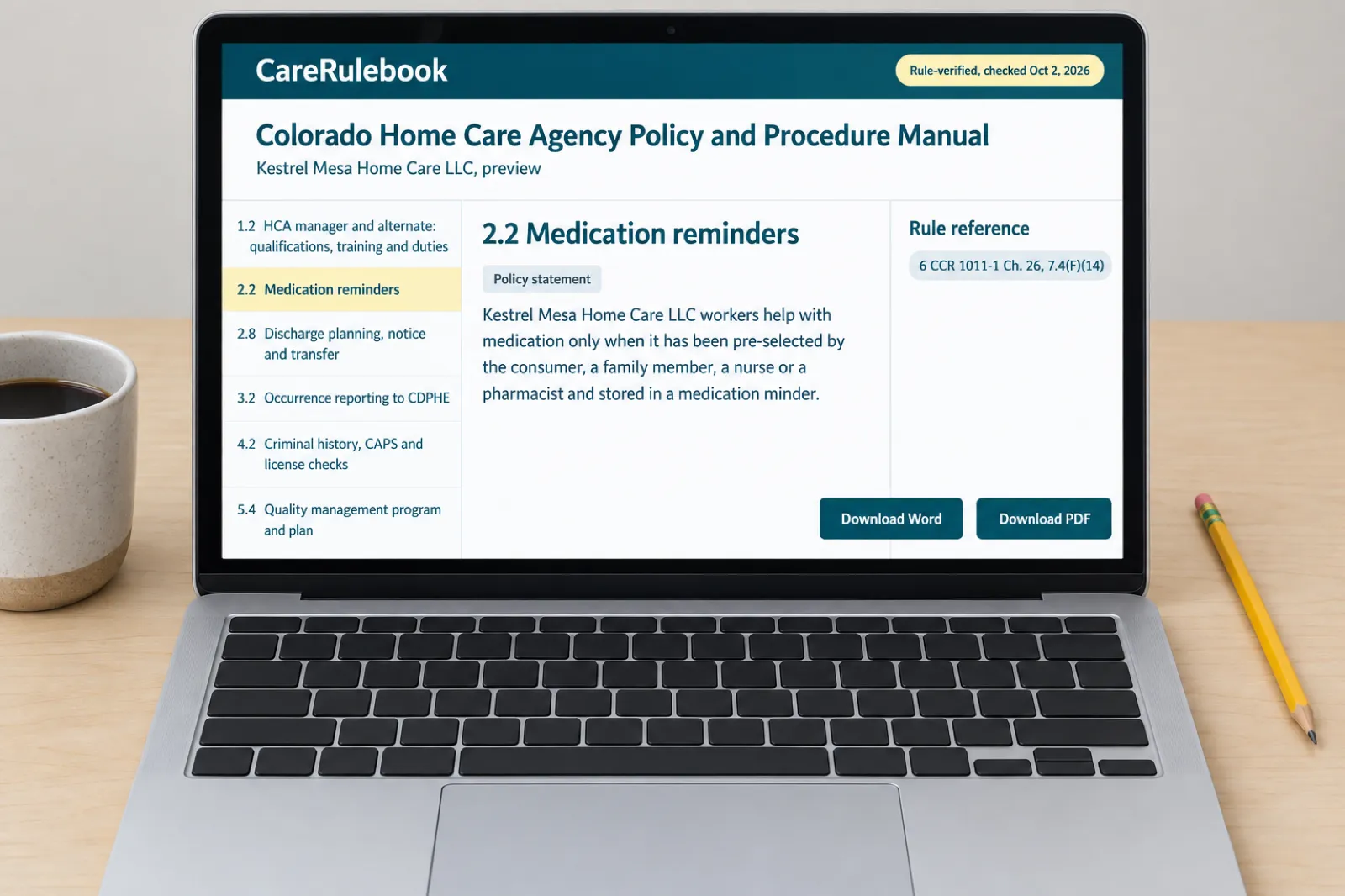
CareRulebook’s manual sets out each service and task limit for your workers in Policy 2.1, services offered and what workers do and do not do, written from the services you choose, with medication reminders in Policy 2.2.
A licensed Class B agency that wants to become Class A files a new initial application and pays the Class A initial fee. Chapter 2 also asks for a letter of intent at least 30 calendar days before a change of license category or scope of services, and CDPHE’s approval.
Part 6 of Chapter 26: an organized governing body, a qualified administrator, a nursing or healthcare supervisor, assessments and a plan of care with a physician or licensed independent practitioner, and higher insurance.
We found no Colorado rule reserving the words "home health" for Class A. But a name that includes services "shall not mislead or confuse the public", marketing must describe only what you can provide, and misrepresenting what you can provide under your license type is a ground for revocation or suspension.
Payers · since July 1, 2025
HCPF’s Community First Choice page lists personal care as a CFC service: "Providers must have a Class A or Class B License". HCPF, Community First Choice Option HCPF’s memo says the requirement applies from when CFC began on July 1, 2025, and adds: "Under CFC, either license will be accepted, but HCPF and the Colorado Department of Public Health and Environment (CDPHE) strongly recommend applying for a Class B license." HCPF PM 25-001
The Colorado guide’s Medicaid section covers timing and the separate license for each Medicaid site.
We found no certificate of need requirement for either class in Chapter 26, Chapter 2, C.R.S. 25-27.5 or CDPHE’s application checklist, which lists the documents an applicant uploads. CDPHE checklist Chapter 26 adds, in defining an agency’s geographic area: "There is no restriction as to the number of agencies that may provide services in a particular geographic area." Ch. 26, 2.8
We have not reviewed every Colorado statute for a need review. If your plan depends on it, for example a Medicare-certified home health agency, confirm with CDPHE before you commit.
A decision aid we built from the definitions and memos cited in each row. It is our reading, not CDPHE’s or HCPF’s, and not legal advice. If a service sits near the line, ask CDPHE before you apply.
| If you plan to offer | What matches, by our reading | CDPHE fee | Source |
|---|---|---|---|
| Companionship, personal laundry, medication reminders, or hands-on help with bathing, dressing or toileting, by people you employ or contract with | Class B home care agency license | $2,720.30 initial (CDPHE) | Ch. 26, 2.20Ch. 26, 4.1(A)(2) |
| Housekeeping only, and nothing else | No home care license (the housekeeping-only exclusion) | None | Ch. 26, 2.10(B)(1) |
| Nursing, wound care, therapy, infusion, medication administration or any other skilled service | Class A home care agency license | $3,709.49 initial (CDPHE) | Ch. 26, 2.29Ch. 26, 4.1(A)(1) |
| Mostly personal care, plus an occasional skilled task such as a dressing change | Class A: a Class B agency may not provide any skilled service | $3,709.49 initial (CDPHE) | Ch. 26, 4.1(A)(2)Ch. 26, 7.4(F)(1) |
| Medicaid personal care under Community First Choice | Class A or Class B (Class B strongly recommended), plus a separate HCPF enrollment | $2,720.30 initial for Class B (CDPHE) | HCPF PM 25-001CDPHE checklist |
| Medicaid services that include skilled care or services by a licensed professional | Class A | $3,709.49 initial (CDPHE) | Ch. 26, 4.1(B)(1) |
| In-Home Support Services (a Medicaid program) | Class A or Class B, plus HCPF’s IHSS requirements; check HCPF’s current rules on nurse staffing | Depends on the class (CDPHE) | Ch. 26, 4.1(B)(1)(b)HCPF IM 25-017 (expired) |
| Referring caregivers to clients for a fee, without employing, directing, scheduling or training them | Home care placement agency registration, not a license | Not covered here | Ch. 26, 2.12; 3.1(A) |
| Working on your own, with no employees or contractors | No agency license | None | Ch. 26, 2.10(B)(3) |
| Medicare-certified home health | Class A, then Medicare certification; enrollment of new home health agencies is halted from May 13, 2026 | $3,709.49 initial (CDPHE); Medicare costs not covered here | Ch. 26, 2.4QSO-26-11 |
The license check on the Colorado guide asks what your business will do and who pays, and points you to the right route.
National · In force from May 13, 2026
Medicare enrollment is a federal step, separate from CDPHE’s license. For new home health agencies it is paused: "Effective May 13, 2026, CMS will halt the enrollment of new Hospice and HHA providers or HHA branch or practice locations." CMS, QSO-26-11
What it does not do, by our reading: QSO-26-11 is about enrollment. It says nothing about state licensing, so it does not stop CDPHE licensing a Class A agency, and it does not mention non-medical home care, which is what a Class B license covers.
Its instructions speak of Medicare enrollment applications. Its background adds that CMS announced the moratoria under its authority to fight fraud, waste and abuse in Medicare, Medicaid and CHIP, without saying how that applies to enrollment with Colorado’s Medicaid program. We make no claim about Medicaid either way; if you plan to bill Medicaid for skilled home health, check with HCPF. QSO-26-11, page 1
CareRulebook
CDPHE expects all required policies and procedures ready for review at the initial survey. CareRulebook writes them for your Class B agency, policy by policy against Chapter 26 and Chapter 2, with the services and task limits you choose. It covers Class B, not Class A skilled care.
$199CareRulebook founding price for the first 50 Colorado agencies, then $249. Not a CDPHE fee.
It depends. Not the state license. Chapter 26 still sets out a Class A license for skilled care, says there is no restriction on the number of agencies in an area, and we found no certificate of need rule in the Colorado sources we saved. What is paused is federal Medicare enrollment: from May 13, 2026, CMS halted the enrollment of new home health agencies nationwide for six months, which it can extend, with no exceptions for individual providers. CMS’s memo does not mention state licenses or non-medical home care, so it does not touch a Class B license.
"Effective May 13, 2026, CMS will halt the enrollment of new Hospice and HHA providers or HHA branch or practice locations."
No. Since Community First Choice began on July 1, 2025, personal care under it needs a Class A or Class B license, and HCPF and CDPHE strongly recommend Class B for personal care providers. Class A is for agencies that also provide skilled care. Medicaid billing is a separate enrollment with HCPF.
"Under CFC, either license will be accepted, but HCPF and the Colorado Department of Public Health and Environment (CDPHE) strongly recommend applying for a Class B license."
No. A Class B agency needs an HCA manager (21 or older, high school diploma or GED, one year of documented supervisory experience in personal care or a degree-plus-experience alternative, and an 8-hour manager course) and supervisors whose experience is set by your own policy. A nurse is needed for Class A skilled care, and an HCPF memo that expired on June 2, 2026 required a registered nurse for In-Home Support Services agencies (check HCPF’s current rules), but the Class B license itself does not.
"Be at least twenty-one (21) years of age, possess a high school diploma or GED, and have at least one (1) year documented supervisory experience in the provision of personal care services;"
No. Chapter 26 bars personal care workers from medication set-up. They may only remind, using medication minders already filled by the client, family, a nurse or a pharmacist, and must report irregularities to the supervisor straight away.
"Perform or provide medication set-up for a consumer; or"
In Colorado both are home care agencies licensed by CDPHE, in two classes. A Class B agency provides only personal care services: help with daily living, housekeeping, personal laundry, medication reminders and companionship, and no skilled service. A Class A agency provides skilled services such as nursing, therapy or wound care, and may provide personal care too. CDPHE’s initial fee is $2,720.30 for Class B and $3,709.49 for Class A on its 2026/27 schedule. These are CDPHE’s fees, not CareRulebook prices.
No. A Class B agency may not provide any skilled healthcare service, and must not let personal care workers perform skilled home health services. The class sets what the agency provides, so by our reading a worker’s own license does not change that. Chapter 26 does let a worker with a current healthcare license or certification skip initial personal care training, where that discipline’s training is recognized as covering personal care tasks, but they still get orientation and a competency evaluation and work within the personal care limits.
We found no certificate of need requirement for either class in Chapter 26, Chapter 2, C.R.S. 25-27.5 or CDPHE’s application checklist. Chapter 26 says there is no restriction on the number of agencies that may provide services in a geographic area. We have not reviewed every Colorado statute, so if your plan depends on it, confirm with CDPHE.
You can apply to CDPHE for a Class A license; the CMS memo does not mention state licensing. Medicare enrollment is a separate federal step, and CMS halted the enrollment of new home health agencies nationwide from May 13, 2026, for six months, which it can extend, with no exceptions for individual providers. Initial enrollment applications submitted during the moratorium are denied and must be resubmitted once it is lifted.
Yes, by becoming Class A. Chapter 26 says a licensed Class B agency that wants Class A submits an initial license application and pays the Class A initial fee, and Chapter 2 asks for a letter of intent at least 30 calendar days before a change of license category or scope of services, with CDPHE’s approval. Class A then brings Part 6 of Chapter 26: a nursing or healthcare supervisor, plans of care with a physician or licensed independent practitioner, and higher insurance.
We found no Colorado rule that reserves the words "home health" for Class A. But Chapter 2 says a license name must not mislead or confuse the public about the license or type of services, Chapter 26 requires marketing to describe only the services you can provide, and CDPHE may revoke or suspend a license for misrepresenting what an agency can provide under its license type. By our reading, "home health" in a Class B name invites exactly that confusion.
Yes, after you enroll with HCPF. Since Community First Choice began on July 1, 2025, personal care under it needs a Class A or Class B license, and HCPF and CDPHE strongly recommend Class B for personal care providers. CDPHE’s Medicaid survey does not approve billing; enrollment with HCPF is a separate application.
CDPHE has proposed changes to Chapter 2 (written comments due November 12, 2026), and CMS’s home health moratorium runs to about November 13, 2026 unless extended. Leave your email and we will tell you when a Colorado change affects your agency or your policies.
No spam. Only emails about Colorado home care rule changes and the CMS moratorium. How we use your email.
Colorado
How to start a home care agency in Colorado
The Class B license, the COHFI application, the initial survey and every written policy.
Colorado
The Colorado CDPHE survey
The initial survey with zero deficiencies, re-licensure surveys and plans of correction.
Manual
Colorado policy manual
Every written policy a Class B agency needs, ready for CDPHE’s initial survey.
Colorado
The Colorado license application
CDPHE’s seven steps, from the letter of intent to the license.
Colorado
Colorado policies and procedures
What CDPHE checks in a Class B agency’s written policies.
Texas
Texas home health vs home care
One HCSSA license with separate service categories.
Washington
Washington home health vs home care
Four categories of one DOH in-home services license.
Illinois
Illinois home health vs home care
Five IDPH licenses: home services, home nursing, home health and two placement types.
Indiana
Indiana home health vs home care
Two IDOH licenses: personal services agency and home health agency.
Georgia
Georgia home health vs home care
Two licenses there, and a Certificate of Need for home health.
North Carolina
North Carolina home health vs home care
Three licenses there, and a Certificate of Need for Medicare-certified home health.
Virginia
Virginia home health vs home care
One HCO license covers both, with no Certificate of Public Need.