Quick answer
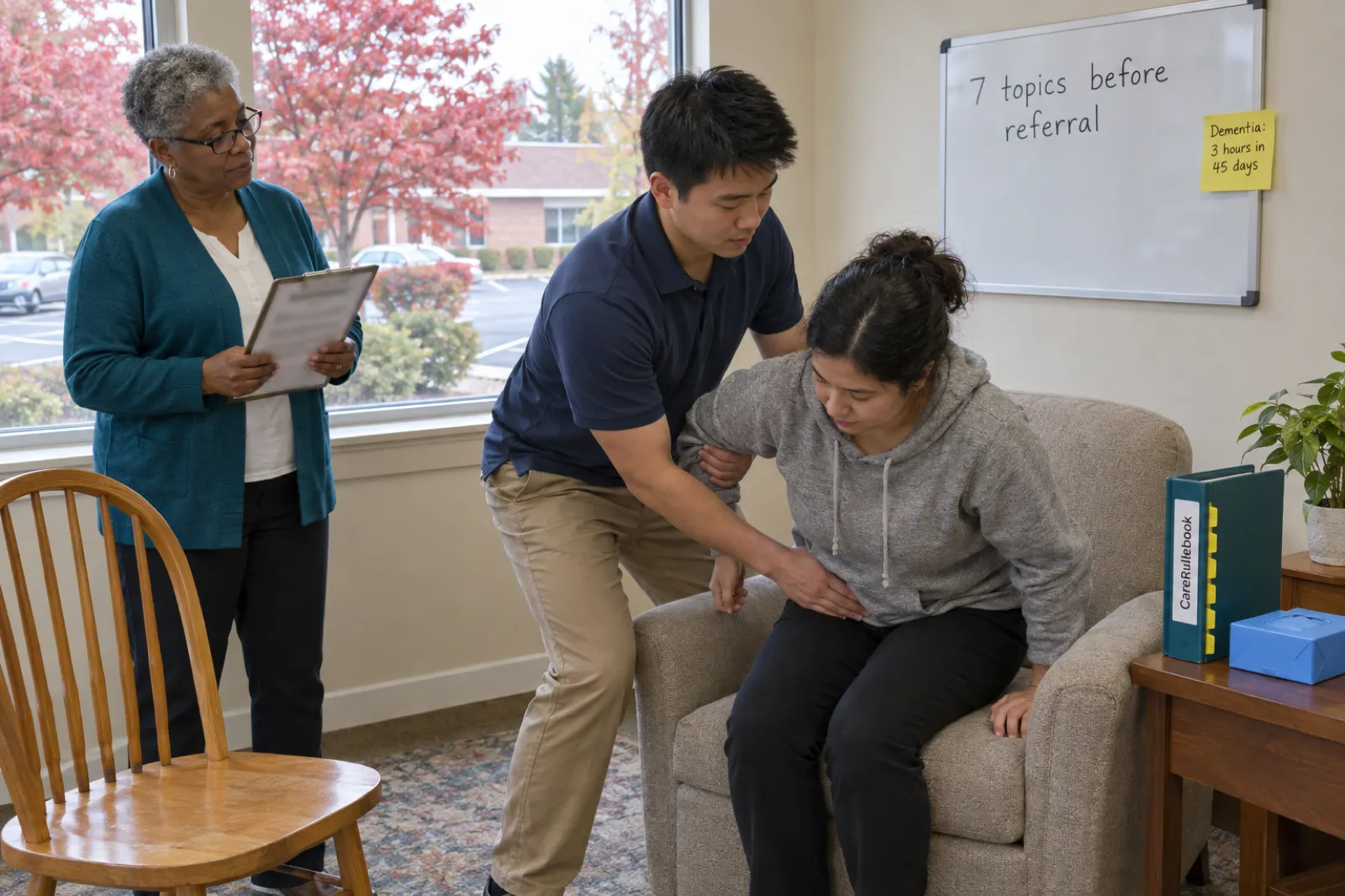
"An agency shall ensure that individuals that are referred are trained appropriately to provide care that is needed by the agency’s clients." (COMAR 10.07.05.11A) "At a minimum, training for individuals providing care in clients’ homes shall include" seven topics, from supervised practice in personal care to CPR and abuse prevention (.11C). Before referral to clients, each person also completes a skills assessment and demonstration (.10B(1)(i)).
There is no hour minimum for the seven topics. The hours in law are for dementia: at least 3 hours within 45 days of starting as direct care or supervisory staff, and 2 hours every calendar year (Health-General §19-4A-03.1). You may train your own staff; "If an outside trainer is used, that individual must have OHCQ’s approval prior to training." (OHCQ)
CareRulebook
Training records written for your agency
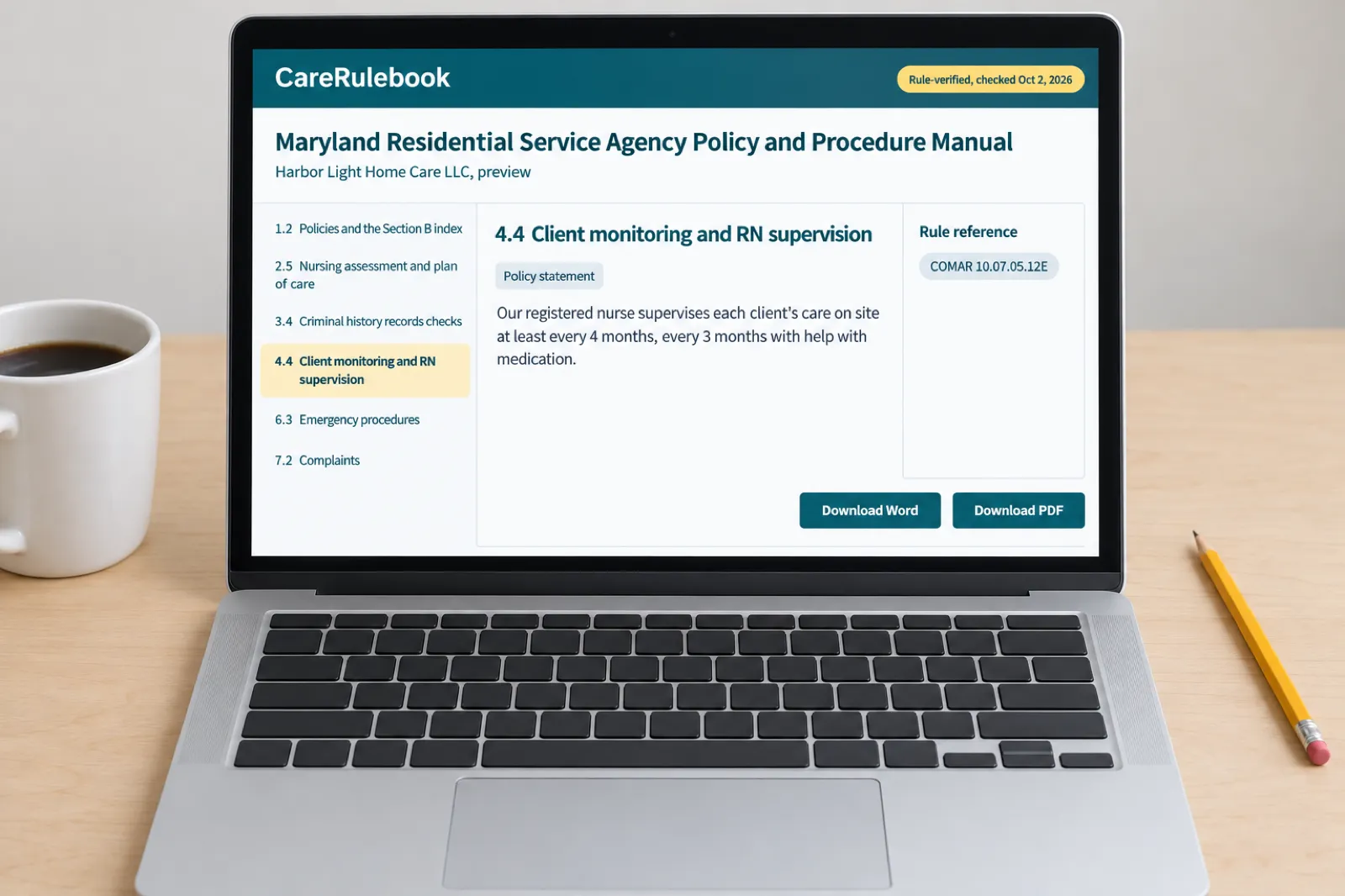
CareRulebook’s Maryland manual includes Policy 3.5 (Training, including dementia training): in-house or OHCQ-approved outside training, the seven topics before referral, a training plan and record, dementia training within 45 days and every calendar year with a certificate and log, and an outside trainer approval record. Policy 3.2 holds the skills competency checklist and delegated task record; Policy 3.6 covers certified and uncertified caregivers.
- 33 policies, 102 requirements mapped to COMAR 10.07.05 and Health-General Title 19
- OHCQ’s signalled 26 Reg Update items offered as Recommended practice, clearly labelled
- Clinical policies end with an adoption line for your own registered nurse, who reviews them before you apply
Preview your manual$199CareRulebook founding price for the first 50 Maryland agencies, then $249. Not an OHCQ fee.
Frequently asked questions
How many hours of training does a Maryland home care aide need?+
COMAR 10.07.05.11C lists seven training topics and sets no hours for them. The only hours in law are for dementia training: at least 3 hours within 45 days of starting, then 2 hours each calendar year, for direct care and supervisory staff. Certified nursing assistants have also completed a Board-approved training program and passed a competency evaluation to be certified.
What training topics does a Maryland residential service agency have to cover?+
At a minimum: instruction and supervised practice in relevant personal care services of the sick or disabled at home; identifying situations that need referral to a registered nurse, including significant changes in a client’s condition; record keeping; ethical behavior and confidentiality; CPR; standard precautions for infection control; and prevention of abuse and neglect. Each worker also completes a skills assessment and demonstration before referral to clients.
Do Maryland home care caregivers need to be CNAs?+
Not always. The default is a certified caregiver for a client who needs one for activities of daily living or needs medication administration. By our reading of COMAR 10.07.05.10D, an uncertified caregiver may serve a client who needs no help with activities of daily living, a client who needs only that help where the supervising nurse judges there are no predictable adverse health consequences, or a cognitively capable adult who signs a waiver of skilled services.
Can a Maryland RSA train its own caregivers?+
Yes. OHCQ says an agency may train its own staff who provide care in clients’ homes, and the registered nurse takes part in training and retraining. An outside trainer must have OHCQ’s written approval before training, and OHCQ reviews outside courses against its trainer checklist.
Is dementia training required for home care workers in Maryland?+
Yes, for residential service agencies (other than those that only provide durable medical equipment). Since July 1, 2022, each member of the direct care or supervisory staff gets at least 3 hours of online or in-person dementia training within 45 days of starting and 2 hours of continuing education each calendar year. Someone with 24 consecutive months of dementia care experience and a certificate of completion is exempt from the first 3 hours.
Does CPR training have to be hands-on for a Maryland RSA?+
The rule names CPR as a training topic without saying more. OHCQ’s outside trainer checklist, revised September 24, 2026, marks hands-on CPR taught by a certified instructor every 2 years as a "26 Reg Update". No proposal had been published when we checked, so it is not rule text yet; a hands-on course is still the cautious choice.
What is the difference between CNA-I and CNA-II in Maryland?+
Since April 2026 the Board of Nursing certifies two levels. CNA-I includes former geriatric nursing assistants and certified medicine aides and may practice in any setting. CNA-II covers people who were certified nursing assistants but not geriatric nursing assistants on March 31, 2026, and may not practice in a nursing facility or skilled nursing facility. Either can work in home care.
Get Maryland rule-change alerts
OHCQ has signalled a 2026 update to the RSA training rules (hands-on CPR, emergency preparedness and training timing), and the Board of Nursing has proposed criminal history checks for all its certificate holders (in force as emergency rules since August 25, 2026). Leave your email and we will tell you when a Maryland change affects your training or your policies.
No spam. Only emails about Maryland home care rule changes. How we use your email.
Sources
- COMAR 10.07.05, Residential Service Agencies (Regulations .01 to .28; last amended effective March 13, 2017) · Maryland Division of State Documents, Library of Maryland Regulations (Maryland Department of Health rules) · retrieved October 2, 2026
- Health-General Article, §§19-4A-01 to 19-4A-11 (Residential Service Agencies) · Maryland General Assembly · retrieved October 2, 2026
- Health Occupations Article, §§8-6A-01 and 8-6A-02 (certified nursing assistants and medication technicians) · Maryland General Assembly · retrieved October 2, 2026
- COMAR 10.27.11, Delegation of Nursing Functions (Board of Nursing) · Maryland Division of State Documents, Library of Maryland Regulations · retrieved October 2, 2026
- COMAR 10.39.01, Certified Nursing Assistants (revised effective June 8, 2026) · Maryland Division of State Documents, Library of Maryland Regulations · retrieved October 2, 2026
- Chapter 487 of 2021 (HB 141), Residential Service Agencies: Training Requirements, with fiscal and policy note · Maryland General Assembly · retrieved October 2, 2026
- Maryland Register: Table of Pending Proposals, Cumulative Table and Emergencies list (as of September 30, 2026) · Maryland Division of State Documents · retrieved October 2, 2026
- Residential Service Agencies · Maryland Department of Health, Office of Health Care Quality · retrieved October 2, 2026
- OHCQ Review of Training Materials Provided by Outside Source: COMAR 10.07.05.11 Outside Trainer Checklist (revised 09.24.2026) · Maryland Department of Health, Office of Health Care Quality · retrieved October 2, 2026
- Nursing Assistant Certification (certification verification and Look Up a License) · Maryland Board of Nursing · retrieved October 2, 2026