Skip to content
CareRulebook
MenuClose

Where are you starting?

United StatesTexas, North Carolina, Georgia, Virginia, Ohio
United KingdomEngland
Free toolsChecklists, calculators and templates

North Carolina · Staffing · G.S. 131E-265 · G.S. 131E-256 · 10A NCAC 13J .1003

North Carolina home care background checks: criminal history, the registry and aides

Before a caregiver enters a client’s home, a North Carolina home care agency makes a conditional offer, gets consent to a criminal history check and submits it within five business days, and searches the Health Care Personnel Registry. Here is each check, how to decide on what it shows, and what DHSR expects to see in your files.

  • Rule-verified October 1, 2026
  • Quoted from G.S. 131E-265 and 131E-256
  • From 10A NCAC 13J and DHSR’s checklist
An agency director reviews a new caregiver’s personnel file beside a folder labelled Signed consent, a sticky note reading Check the registry before hiring, and a CareRulebook binder

Quick answer

In North Carolina, "An offer of employment by a home care agency licensed under this Chapter to an applicant to fill a position that requires entering the patient's home is conditioned on consent to a criminal history record check of the applicant." Within five business days of the offer, you submit the request to the State Bureau of Investigation or a private entity. Someone who has lived in the state less than five years needs a State and national check, with fingerprints.

Before hiring anyone, you also search the Health Care Personnel Registry, note the search in your files, and do not hire anyone with a substantiated finding. A conviction is not an automatic bar: the statute lists seven factors you must weigh. Aides giving extensive assistance must be on the Nurse Aide Registry.

Who is checked

  • New hires who will enter clients’ homes. The criminal history check applies to an applicant offered "a position that requires entering the patient's home". The test is the position, not the person’s license, so it reaches anyone whose job takes them into clients’ homes, such as aides and the RN supervisor. G.S. 131E-265(a)
  • Current staff moving into a home-visiting role. An employee moving from an office job to one that enters clients’ homes must also consent to a check, and you cannot move them if they refuse. G.S. 131E-265(a)
  • Staff supplied by a contract agency. A contract agency of a home care agency must make its own offers conditional on consent to a criminal history check, for positions that do not need an occupational license, and show on request that the check was completed. G.S. 131E-265(a1)
  • Everyone you hire, for the registry. You may not hire any individual, "either directly or by contract", with a substantiated finding on the Health Care Personnel Registry. 13J .1003(c)

The checks, step by step

For each person you offer a position that requires entering a client’s home. Tick steps off as you go; progress is saved in this browser only.

  1. Make a written conditional offer, with a consent form

    At the offer

    Any offer for a position that requires entering a client’s home is conditional on consent to a criminal history check. If the person will not consent, you cannot employ them.

    G.S. 131E-265(a)
  2. Work out which check applies

    At the offer

    Lived in North Carolina less than five years: a State and national check, with fingerprints. Five years or more: a State check.

    G.S. 131E-265(a)
  3. Submit the request within five business days

    5 business days

    To the State Bureau of Investigation for a State or national check, or to a private entity for a State check.

    G.S. 131E-265(a)
  4. Search the Health Care Personnel Registry

    Before hire

    Before hiring, search the registry and note the search in your files. Do not hire anyone with a substantiated finding.

  5. Check the Nurse Aide Registry for aides

    Before assignment

    An aide whose client’s plan of care calls for extensive assistance must be listed on the Nurse Aide Registry. Aides who are not listed need an RN to verify six core skills.

    13J .1107(b), .1003(g)
  6. TB screening for hands-on staff

    Before assignment

    A baseline TB skin test. Anyone who tests positive shows they are not infectious before working in a client’s home.

    13J .1003(b)
  7. Decide on any conviction, and write it down

    When results arrive

    If the check shows a conviction of a relevant offense, weigh the seven factors in the statute before deciding whether to hire.

    G.S. 131E-265(b)
  8. Keep the proof

    Always

    Be ready to show that a criminal history check was completed on every covered staff member. DHSR looks for a signed consent and a registry check in personnel records.

    G.S. 131E-265(a)

The criminal history check

State, or State and national. "If the applicant for employment or if the current employee who is changing employment status has been a resident of this State for less than five years, then the offer of employment or change in employment status is conditioned on consent to a State and national criminal history record check." The national check includes a check of the person’s fingerprints. For someone who has lived in North Carolina five years or more, the offer is conditional on consent to a State check. G.S. 131E-265(a)

Five business days. Within five business days of making the conditional offer, submit the request to the State Bureau of Investigation, for a State or national check, or to a private entity, for a State check only. A private entity is "a business regularly engaged in conducting criminal history record checks utilizing public records obtained from a State agency". G.S. 131E-265(a), (h)

National results go to DHHS, not to you. The State Bureau of Investigation returns national results to the DHHS Criminal Records Check Unit, which tells the agency within five business days of receiving them whether the information may affect the person’s employability. "In no case shall the results of the national criminal history record check be shared with the nursing home or home care agency." G.S. 131E-265(a)

Starting before the results. You may employ someone conditionally before the results arrive, but not before you have their consent or completed fingerprint cards, and you must submit the request no later than five business days after they begin. G.S. 131E-265(f)

False information. An applicant who willfully gives false information on an application that is the basis for the check commits a Class A1 misdemeanor, so it is worth saying so on your consent form. G.S. 131E-265(e)

A note on DHSR’s FAQ: question 56 (rev. 5/30/25) quotes an earlier version of the statute that named the Department of Public Safety. The current G.S. 131E-265 names the State Bureau of Investigation. DHSR FAQ 56

Deciding on a conviction

North Carolina’s licensing statute does not list convictions that bar home care work. Instead, "The fact of conviction of a relevant offense alone shall not be a bar to employment; however, the listed factors shall be considered" by the agency. G.S. 131E-265(b)

The seven factors you must consider

  1. The level and seriousness of the crime.
  2. The date of the crime.
  3. The age of the person at the time of the conviction.
  4. The circumstances surrounding the commission of the crime, if known.
  5. The nexus between the criminal conduct of the person and the job duties of the position to be filled.
  6. The prison, jail, probation, parole, rehabilitation, and employment records of the person since the date the crime was committed.
  7. The subsequent commission by the person of a relevant offense.
G.S. 131E-265(b)(1)-(7)

After you decide

  • If you disqualify an applicant, you may tell them the information from the check that is relevant, but you "may not provide a copy of the criminal history record check to the applicant". (b)
  • All criminal history information you receive is confidential and may only be disclosed to the applicant in that way. (a)
  • An agency that complies in good faith is not liable for not employing someone because of their check, and is immune from civil liability for failing to check someone if the check was requested and received as the statute requires. (c) (g)
  • “Relevant offense” takes its meaning from G.S. 131D-40. (d)

Write the decision down: which factors you weighed, what you decided and who decided. The statute does not set a form; a short signed note, kept in a confidential file, shows that you considered every factor.

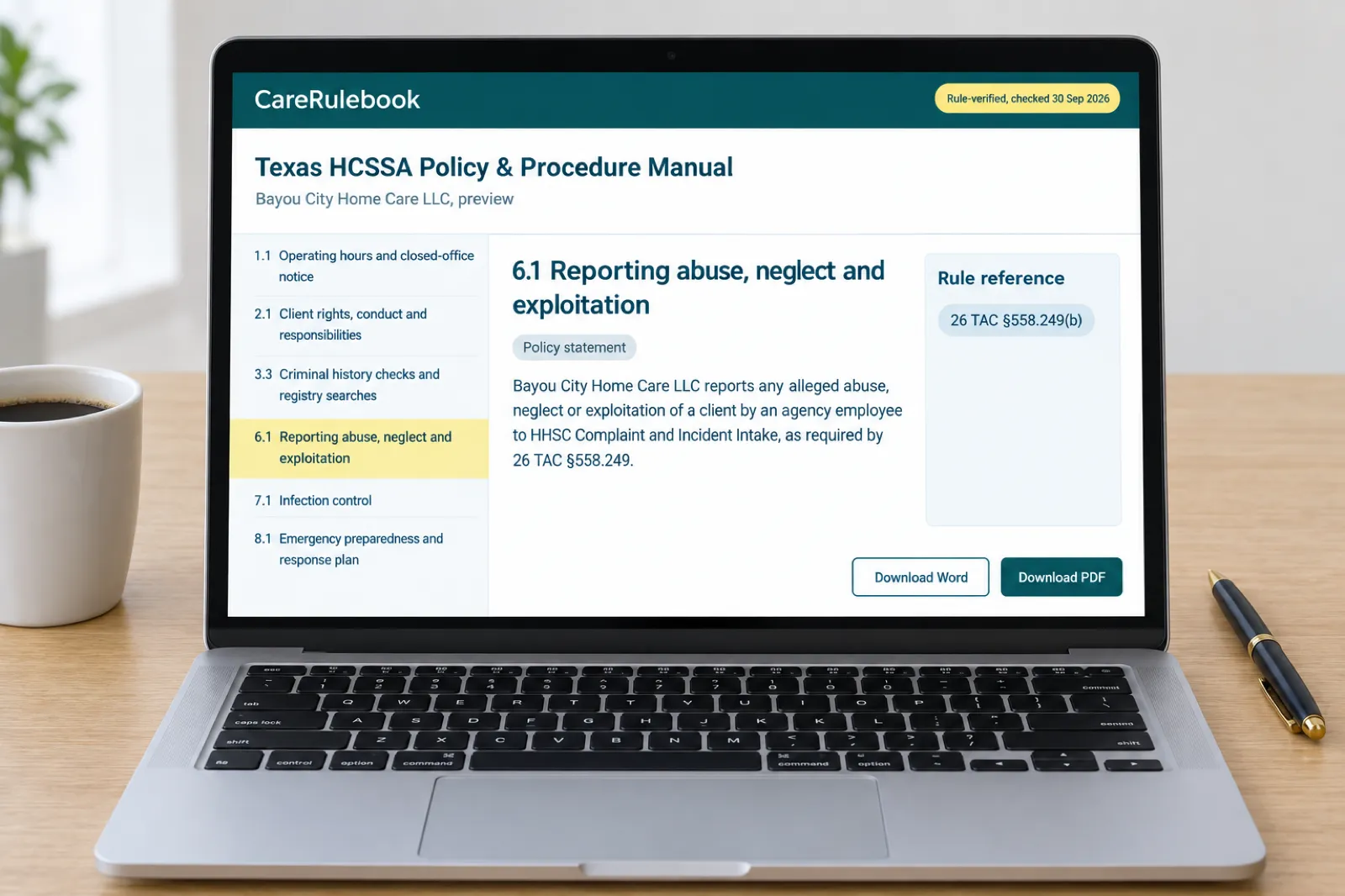
The CareRulebook manual preview on a laptop

CareRulebook

DHSR reads your background check policy before it licenses you

DHSR’s initial survey checklist asks for a criminal background investigation policy under G.S. 131E-265, and a Health Care Personnel Registry reporting policy. CareRulebook’s North Carolina manual includes both, with the conditional offer, the five-day deadline, the seven factors and the registry searches written for your agency.

  • 31 policies, 47 rule requirements mapped
  • All 32 items on DHSR’s Initial Survey Checklist
  • Editable Word and PDF, delivered instantly
Preview your manual

$199CareRulebook founding price for the first 50 North Carolina agencies, then $249. Not a DHSR fee.

The Health Care Personnel Registry and the Nurse Aide Registry

Health Care Personnel Registry

"Before hiring health care personnel into a health care facility or service, every employer at a health care facility shall access the Health Care Personnel Registry and shall note each incident of access in the appropriate business files." Home care agencies are health care facilities under this law.

The registry lists unlicensed staff with findings of abuse or neglect, misappropriation of a client’s or the agency’s property, drug diversion, or fraud against the agency or a client. It also lists people accused of those acts once DHSR has screened the allegation and decided to investigate.

You must not hire anyone with a substantiated finding. For a pending allegation, DHSR gives employers the nature of the allegation and the status of the investigation, and you are not liable for using registry information in good faith to screen applicants.

G.S. 131E-256(d2)(a)(e)(f)13J .1003(c)

Nurse Aide Registry

"If the client's plan of care requires the in-home aide to provide extensive assistance, the in-home aide shall be listed on the Nurse Aide Registry". An aide who is not listed can give limited assistance only.

For aides not on the Nurse Aide Registry, an RN verifies six core skills in the personnel record: mobility, bathing, toileting, dressing, eating and continence.

13J .1107(b)13J .1003(g)

DHSR’s Health Care Personnel Investigations section says "Information from the registries is used by health care providers in their hiring process". For registry questions, DHSR’s FAQ points agencies to the Health Care Personnel Registry on 919-855-3968. DHSR DHSR FAQ 55

Reporting allegations to the registry

The registry depends on agencies reporting. A home care agency must make sure DHSR is told of every allegation against health care personnel, including injuries of unknown source, that appears related to abuse, neglect, misappropriation, drug diversion or fraud. G.S. 131E-256(g)

  • Within 24 hours of becoming aware of the allegation: report it. 10A NCAC 13O .0102
  • While you investigate: "Facilities must have evidence that all alleged acts are investigated and must make every effort to protect residents from harm while the investigation is in progress." G.S. 131E-256(g)
  • Within five working days of the first report: send DHSR the results of your investigation. G.S. 131E-256(g)

DHSR’s initial survey checklist also asks for a Health Care Personnel Registry reporting policy. 10A NCAC 13O .0102; G.S. 131E-256(g)

TB screening and Hepatitis B: the related hiring steps

Not background checks, but they sit in the same personnel file and DHSR checks them at the same time.

  • TB. "Hands-on care employees must have a baseline skin test for TB." Anyone who tests positive must show they are not infectious before being assigned to a client’s home. Anyone who has tested positive before gets a baseline and then yearly verification that they are free of TB symptoms. 13J .1003(b)
  • Hepatitis B. Hands-on care employees’ records document Hepatitis B immunization or a declination, under your exposure control plan. 10A NCAC 13J .1003(f)(5)

Medicaid PCS aides: convictions Medicaid will not pay for

If you provide Medicaid personal care services, Clinical Coverage Policy 3L adds a firmer line on top of the licensing statute. Policy 3L says: "Criminal background checks are conducted on all in-home aides before they are hired as specified in licensure requirements." Aides hired must not be listed on the registry with a substantiated finding, and each aide’s file documents training, background checks and competency evaluations. Policy 3L, 7.10 c

Providers shall not bill for PCS given by someone with

  • Felonies related to the manufacture, distribution, prescription or dispensing of a controlled substance
  • Felony health care fraud
  • Felony abuse, neglect, assault, battery, criminal sexual conduct (1st, 2nd or 3rd degree), fraud or theft against a minor or vulnerable adult
  • Felony or misdemeanor patient abuse
  • Felony or misdemeanor involving cruelty or torture
  • Misdemeanor health care fraud
  • Misdemeanor abuse, neglect or exploitation listed with the NC Health Care Registry
  • Any substantiated allegation listed with the NC Health Care Registry that would prohibit the person from working in health care in North Carolina

Policy 3L, 6.0PCS aides: qualifications and training →

What to keep in the personnel file

DHSR reviews personnel records at the initial survey, and its checklist lists what it wants to see. For these checks that means:

  • a signed consent for criminal background check; DHSR checklist
  • a Nurse Aide listing verification or Health Care Personnel Registry check, with the date of each registry search; DHSR checklist G.S. 131E-256(d2)
  • reference checks or verification of previous employment; 13J .1003(f)(3)
  • TB screening records and Hepatitis B immunization or declination for hands-on staff. 13J .1003(f)

You must be able to show, on request, that a criminal history check has been completed on every covered staff member, and keep each personnel record for at least one year after the person leaves. Keep the criminal history information itself confidential. G.S. 131E-265(a) 13J .1003(f)

Myths

Does a criminal conviction automatically stop someone working for a North Carolina home care agency?

No. Not under the licensing statute. If a check shows a conviction of a relevant offense, the agency must weigh the factors G.S. 131E-265(b) lists, such as how serious and how old the crime is and how it relates to the job, and decide. Medicaid personal care services are stricter: providers cannot bill for PCS given by someone with certain convictions.

"The fact of conviction of a relevant offense alone shall not be a bar to employment"

Will you see the results of a national fingerprint check?

No. The State Bureau of Investigation sends national results to the DHHS Criminal Records Check Unit, which tells the agency within five business days whether the information may affect the person’s employability.

"In no case shall the results of the national criminal history record check be shared with the nursing home or home care agency."

Frequently asked questions

What background checks does a North Carolina home care agency need?

For anyone offered a position that requires entering a client’s home: a criminal history check under G.S. 131E-265, made a condition of the offer, with the request submitted within five business days. Before hiring anyone, a search of the Health Care Personnel Registry, noted in your files; you cannot hire a person with a substantiated finding. Aides giving extensive assistance must also be listed on the Nurse Aide Registry.

Do I need a national fingerprint check?

Only if the person has lived in North Carolina for less than five years. Then the offer is conditional on consent to a State and national check, and the national check includes fingerprints. For someone who has lived in the state five years or more, a State check is required.

Who runs the criminal history check?

You submit the request to the State Bureau of Investigation, for a State or national check, or to a private entity, for a State check. A private entity is a business that regularly runs criminal history checks using public records from a State agency. National results go to the DHHS Criminal Records Check Unit, which tells you whether the information may affect the person’s employability; you never see the national results themselves.

Can a caregiver start work before the results come back?

Yes, conditionally, if you already have their consent (or completed fingerprint cards) and you submit the request no later than five business days after they start. The Health Care Personnel Registry search still comes before hiring.

Does a conviction mean I cannot hire someone?

Not automatically. Under G.S. 131E-265(b) a conviction of a relevant offense is not on its own a bar to employment, but you must consider seven factors, including how serious and how old the crime is and how it relates to the job. Medicaid is stricter for personal care services: providers cannot bill for PCS given by someone with certain convictions.

What is the Health Care Personnel Registry?

DHSR’s list of unlicensed health care personnel with substantiated findings of abuse, neglect, misappropriation of property, drug diversion or fraud, or with allegations under investigation. Home care agencies must search it before hiring and must not hire anyone with a substantiated finding. For questions, DHSR points agencies to the registry on 919-855-3968.

How quickly do I report an allegation against a caregiver?

Report it to DHSR’s Health Care Personnel Registry within 24 hours of becoming aware of it, including injuries of unknown source, then report the results of your own investigation within five working days of that first report. Protect clients while the investigation runs.

Get North Carolina rule-change alerts

The General Assembly amends the background check statutes and DHSR updates its checklist and FAQ. Leave your email and we will tell you when a change affects your hiring.

No spam. Only emails about North Carolina home care rule changes. How we use your email.

Keep reading

Sources

  1. 10A NCAC 13J, The Licensing of Home Care Agencies · NC Office of Administrative Hearings · retrieved October 1, 2026
  2. N.C. General Statutes Chapter 131E, Article 6 (home care agency licensure and home care clients’ bill of rights) · North Carolina General Assembly · retrieved October 1, 2026
  3. Home Care Initial Survey Checklist (rev. 9/21) · NC DHSR · retrieved October 1, 2026
  4. Home Care Frequently Asked Questions (rev. 5/30/25) · NC DHSR · retrieved October 1, 2026
  5. 10A NCAC 13O, Health Care Personnel Registry · NC Office of Administrative Hearings · retrieved October 1, 2026
  6. Complaint Intake and Health Care Personnel Investigations Section · NC DHSR · retrieved October 1, 2026
  7. NC Medicaid Clinical Coverage Policy 3L, State Plan Personal Care Services (PCS) in In-Home Settings (amended January 1, 2026) · NC Medicaid, Division of Health Benefits · retrieved October 1, 2026

Build your NC manualfrom $199