Skip to content
CareRulebook
MenuClose

What do you run?

Home care in the US19 states with a manual, 6 with a free guide
ColoradoManual
ConnecticutPack
DelawareManual
GeorgiaManual
IllinoisManual
IndianaManual
KansasManual
MaineManual
MarylandManual
MinnesotaManual
NevadaManual
North CarolinaManual
OklahomaManual
OregonManual
South CarolinaManual
TennesseeManual
TexasManual
VirginiaManual
WashingtonManual
CaliforniaGuideFloridaGuideNew JerseyGuideNew YorkGuideOhioGuidePennsylvaniaGuideAll US home care states →
Care homes in the USCalifornia, Michigan, Minnesota; more states coming
Home care in the UKEngland, Scotland, Wales
Free toolsChecklists, calculators and templates

California · Assisted living (RCFE) · HSC 1569 and 22 CCR 87100

How to open an assisted living facility in California (the RCFE license, 2026)

To open an assisted living facility in California, you need a residential care facility for the elderly (RCFE) license from the California Department of Social Services (CDSS). You send a written plan of operation with the application, CDSS interviews you about it and inspects before licensing, and a certified administrator runs the home. No nurse is required. This guide walks through each step, quoted from the RCFE Act, Title 22 and CDSS’s own forms.

  • Rule-verified November 13, 2026
  • Quoted from HSC 1569 and 22 CCR 87100
  • 15 sources
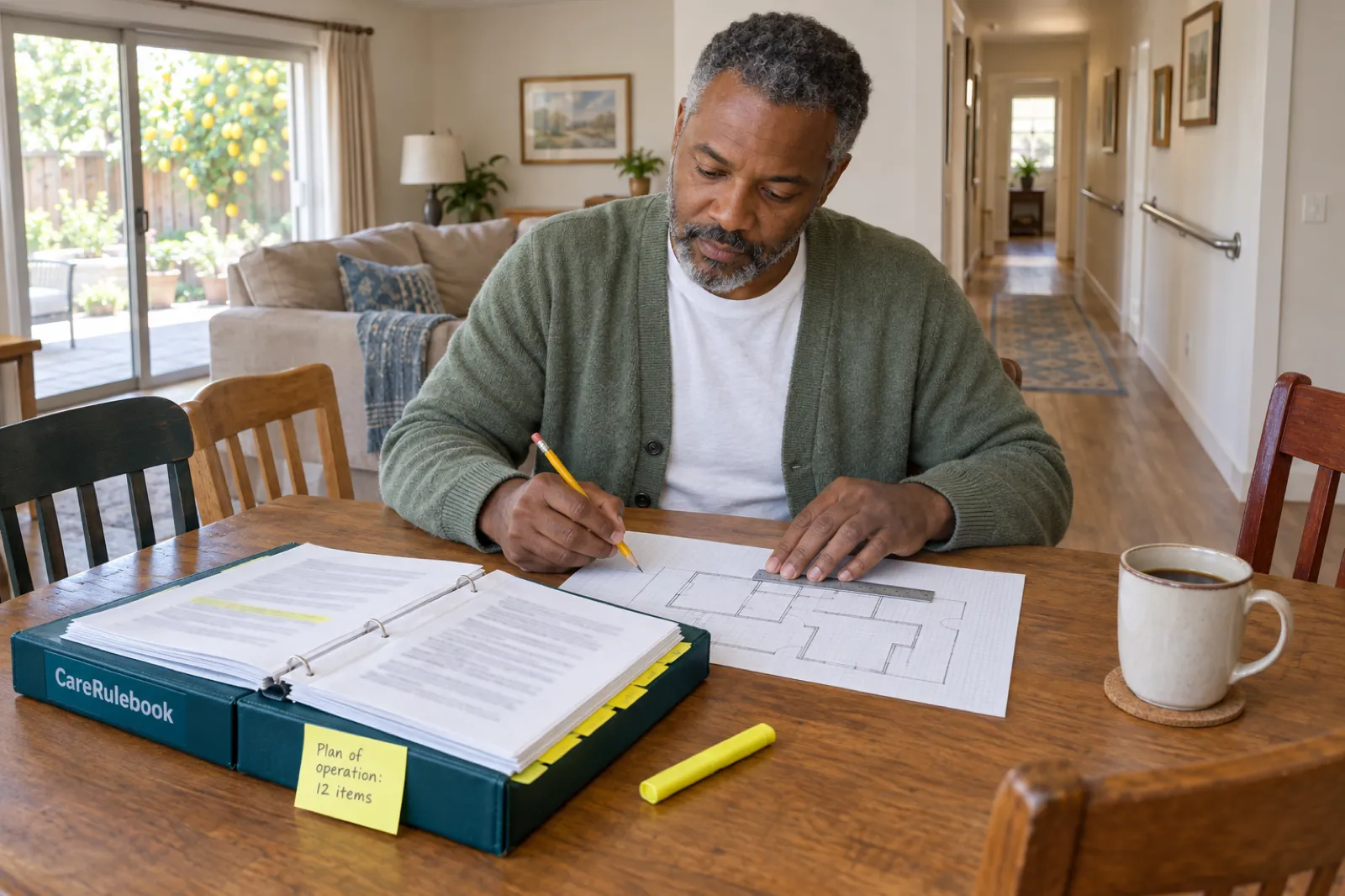
A man in a sage green cardigan at a dining table in a single-story California house measures a hand-drawn floor plan with a ruler, beside an open teal CareRulebook binder with yellow tabs, a highlighter, a mug of coffee and a sticky note reading Plan of operation: 12 items, with a lemon tree outside the patio door

Running a home care agency instead? California licenses home care separately: read the California home care guide.

Quick answer

In California, no one may "operate, establish, manage, conduct, or maintain a residential facility for the elderly in this state without a current valid license" (HSC 1569.10). In its 2026 rulemaking, CDSS refers to "RCFEs, as assisted living facilities" (CDSS, ORD 0326-03).

The heart of the application is a written plan of operation: "The plan and related materials shall be on file in the facility and shall be submitted to the licensing agency with the license application." (22 CCR 87208(a)). CDSS’s fee is $990 for a 4 to 6 bed home (HSC 1569.185), and CDSS says to expect 90 to 120 days (CDSS).

8,419

RCFEs licensed in CDSS’s facility data, November 12, 2026 (our count)

CDSS facility data

82%

Of them licensed for six beds or fewer: 6,905 homes (our count)

CDSS facility data

$990

CDSS’s application fee for a 4 to 6 bed home (a state fee, not our price)

HSC 1569.185(a)(1)

12

Items the written plan of operation must contain

22 CCR 87208(a)

Direct answers

Who licenses assisted living in California?

The California Department of Social Services (CDSS), Community Care Licensing Division, licenses residential care facilities for the elderly (RCFEs) under the RCFE Act (Health and Safety Code 1569 et seq.) and Title 22, Chapter 8 of the California Code of Regulations. Applications go to its Centralized Applications Bureau in Sacramento.

HSC 1569.10; 22 CCR 87105(a)

How much does an RCFE license cost in California?

CDSS’s application fee is $990 for 4 to 6 beds ($495.60 for 1 to 3, $1,486.80 for 7 to 15), then $495.60 a year for up to 6 beds. These are state fees set by statute, not CareRulebook prices. The administrator exam ($100) and certificate application ($140) and the $54.85 orientation are CDSS fees too.

HSC 1569.185(a)(1); CDSS

Do I send policies to CDSS?

Yes. The plan of operation and related materials are submitted with the license application, along with the documents in Section B of CDSS’s application instructions (LIC 281), such as job descriptions, personnel policies, a training plan, a program description and admission policies. Inspectors later check that the plan is the one CDSS approved.

22 CCR 87208(a); LIC 281; LIC 9123

Do I need a nurse to run an RCFE?

No. An RCFE needs a certified administrator, not a nurse. Staff help residents with medications they self-administer and, except those authorized by law, do not give injections. Incidental medical care can come from a licensed home health agency under the rules, and some restricted health conditions need care or staff training from a licensed health professional.

22 CCR 87465(a)(5), 87609(b), 87612-87613

Interactive check

Do you need a California RCFE license?

Where will the people you care for live?

Pick the option closest to your plan.

Who needs an RCFE license

A residential care facility for the elderly "means a housing arrangement chosen voluntarily by persons 60 years of age or over, or their authorized representative, where varying levels and intensities of care and supervision, protective supervision, or personal care are provided" (HSC 1569.2(o)(1)). The rules put the duty on the operator: "any individual or legal entity providing or intending to provide care and supervision to the elderly in a residential facility shall obtain a current valid license pursuant to the provisions of this chapter" (22 CCR 87105(a)).

  • Care and supervision is the test. It means the facility takes on ongoing help with daily living, and "Assistance includes assistance with taking medications, money management, or personal care." (HSC 1569.2(c)).
  • Age. Residents are 60 or over, and "Persons under 60 years of age with compatible needs may be allowed to be admitted or retained" as the Act allows (HSC 1569.2(o)(1)).
  • Owner and administrator. "The licensee, if an individual, and the administrator may be one and the same person." (HSC 1569.2(a)) That person then meets every licensee and certified administrator requirement (22 CCR 87405(i)).
  • Not home care. Sending caregivers into people’s own homes is a home care organization (HCO), a different CDSS license; the home care law lists residential care facilities for the elderly among the providers that are not HCOs (HSC 1796.17(b)(8)). See how to start a home care agency in California.

One license, but size changes the rules

There is one RCFE license at every size, but the bed count changes the fee and several duties. Most California RCFEs are small homes: 6,905 of 8,419 licensed RCFEs have six beds or fewer (our count of CDSS data).

What changes with the size of an RCFE
Rule1 to 6 beds7 to 15 bedsSource
CDSS application fee$495.60 (1 to 3 beds), $990 (4 to 6)$1,486.80HSC 1569.185
ZoningA residential use of property; no conditional use permit a family home in the same zone would not needCDSS lists getting a conditional use permit for larger facilitiesHSC 1569.85 CDSS
Organization chartUnder 16 residents, a list of positions and the hours each covers can replace the chart87155(a)(11)
Night supervisionUnder 16 residents, a qualified person on call on the premises; at least one night staff member awake and on duty if a resident with dementia needs awake night supervision87415(a)(1) 87705(b)(2)
MenusUnder 16 residents, a sample menu kept on file87555(b)(6)
Administrator21, high school or GED, certified. No college or experience requirement below 16 beds; LIC 281 says CDSS does not verify experience for 1 to 6 beds87405(d) 87405(e) LIC 281
Neighborhood complaintsA procedure if the owner does not live there, sent with the application (LIC 281 B15)Not in LIC 281’s Section B list. Our reading: the weekly time when the owner or a designee is present applies to “any facility with a nonresident owner”, so plan for itLIC 281 B15 HSC 1569.175

Fees are CDSS’s, set by statute. Homes of 16 or more beds have further rules this guide does not cover.

A six-or-fewer home also "shall not be subject to any business taxes, local registration fees, use permit fees, or other fees to which other family dwellings of the same type in the same zone are not likewise subject" (HSC 1569.84). No fee may be charged for its fire inspection either (HSC 1569.84). Local health and safety and building rules that apply to every family home still apply (HSC 1569.85(d)), and every facility keeps a fire clearance (22 CCR 87202(a)).

How a new RCFE gets licensed, step by step

Tick steps off as you go. Your progress is saved in this browser only. For a list tailored to your facility, with the steps for buyers and licensed facilities too, use the free California RCFE license checklist.

  1. Take CDSS’s online orientation

    Before applying

    Component I of CDSS’s three-part orientation, taken before you apply. CDSS charges $54.85 including processing (a CDSS fee).

    CDSS Online Orientations
  2. Become, or hire, a certified administrator

    Before applying, if you can

    An 80-hour certification course from a CDSS-approved vendor, then CDSS’s exam within 60 days and the certificate application ($100 and $140, CDSS fees). LIC 281 accepts proof of course registration with the application and asks for the certificate before licensure, but CDSS’s application page asks for the administrator certificate in the packet. Our reading: finish the course and exam first if you can, or ask the Centralized Applications Bureau. Details.

  3. Secure the property

    Before applying

    A lease or proof of ownership goes in the application. A home for six or fewer is a residential use of property with no conditional use permit beyond what a family home in the same zone needs; for larger facilities, CDSS lists getting a conditional use permit as part of the process.

    HSC 1569.85; LIC 281 B11
  4. Write the plan of operation and the other documents

    Before applying

    The 12-item plan of operation, the Section B documents, the emergency and disaster plan (LIC 610E), the infection control plan and a completed LIC 9282. What each must contain.

    22 CCR 87208(a); LIC 281
  5. Line up funds and insurance

    Before applying

    Start-up funds for at least three months of operating costs. The law requires liability insurance of at least $1 million per occurrence and $3 million in the annual aggregate, and Section B13 asks you to state your coverage and carrier.

  6. Mail the packet with the fee

    Day 0

    The fee and the Section A and B documents go together, in the same order as the application booklet, to the Centralized Applications Bureau, 744 P Street, MS 9-14-8201, Sacramento, CA 95814. LIC 281 warns that incomplete forms send the whole packet back.

  7. Background checks for you and other adults in the home

    Before presence in the facility

    Every applicant and every adult living in the facility completes the background check before being present in a licensed facility, and needs a criminal record clearance or, after a conviction for anything other than an infraction, an exemption. CDSS encourages starting in its Guardian system, which generates the Live Scan form. Background checks, step by step.

    CDSS steps, step 6
  8. The analyst reviews it

    After CDSS receives it

    The bureau sends the fire clearance request to your local fire authority, reviews finances (three months of start-up funds for a new facility), runs a credit check and your compliance history, and schedules the Component II interview.

    CDSS steps, step 7
  9. Component II interview

    During review

    A one-on-one interview with the reviewing analyst, by phone or video, to go over your packet and make sure you and your administrator understand, and can provide, the services in the program you submitted.

  10. Fire clearance inspection

    During review

    The local fire authority contacts you to schedule a fire safety clearance inspection, then sends CDSS the clearance once you pass.

    CDSS steps, step 8
  11. Pre-licensing inspection and Component III

    Before the license

    The regional office visits to verify that the physical plant and facility policies meet the standards and you are ready to operate, and schedules Component III, a category-specific training session on continuing requirements. CDSS issues no initial license before an on-site review. The pre-licensing inspection.

  12. Corrections and final review

    Before the license

    Your analyst tells you of any corrections or missing items with a due date. CDSS then runs a final review to verify every licensing requirement is met.

  13. License, then yearly inspections

    From licensure

    Post the license where the public can see it. CDSS inspects every RCFE unannounced every year, and the annual state fee ($495.60 for up to 6 beds) is due on each license anniversary.

The plan of operation: 12 items in 87208

"The licensee shall have and maintain a current, written definitive plan of operation for the facility. The licensee shall operate the facility in accordance with the terms specified in the plan of operation and may be cited for not doing so" (22 CCR 87208(a)). It goes in with the application, and "Any significant changes in the plan of operation which would affect the services to residents shall be submitted to the licensing agency for approval." (87208(a)) The rule lists what it must contain:

The 12 items of an RCFE plan of operation under 22 CCR 87208(a)
ItemWhat the plan containsNotes
(a)(1)Purposes and program goalsLIC 281 B7 asks for the purpose, goals and program philosophy in the program description. 22 CCR 87208(a)(1); LIC 281 B7
(a)(2)Admission agreementA copy of your agreement, with basic and optional services. Its content is set by 87507, and rate increases now need 90 days’ notice. 22 CCR 87208(a)(2)
(a)(3)Admission policies and proceduresWho you accept, appraisals, medical assessment, emergency information, sign-in and sign-out, TB. 22 CCR 87208(a)(3); LIC 281 B9
(a)(4)Administrative organizationAn organization chart, or under 16 residents a list of positions and the hours each covers. 22 CCR 87208(a)(4); 87155(a)(11)
(a)(5)Staffing plan, qualifications and dutiesEnough competent staff at all times, with qualifications and duties for each position. 22 CCR 87208(a)(5); 87411(a)
(a)(6)Plan for training staffBuilt on HSC 1569.625, 1569.626 and 1569.69 and 22 CCR 87411 and 87705: what, when, who trains and how it is recorded. 22 CCR 87208(a)(6); LIC 281 B6
(a)(7)Sketches of buildings and groundsA dimensioned floor plan showing room uses and rooms for nonambulatory or bedridden residents. 22 CCR 87208(a)(7); LIC 281 A15
(a)(8)Transportation arrangementsFor residents who do not have their own. 22 CCR 87208(a)(8)
(a)(9)Residents’ money and valuablesWhether you will handle them and, if so, how you safeguard them. 22 CCR 87208(a)(9); 87215-87217
(a)(10)Visiting and communication policyEncourages family involvement; stated on the admission agreement (or client information form) and the rights form, and posted. 22 CCR 87208(a)(10); HSC 1569.313
(a)(11)Behavioral expressionAssessments, care practices and safety measures. Added with the 2025 dementia rules. 22 CCR 87208(a)(11); 87463(c)
(a)(12)Infection control planNames an Infection Control Lead, sets practices and staff training (87470). 22 CCR 87208(a)(12); 87470(c)

Summarized from 22 CCR 87208(a)(1)-(12), CDSS’s posted text of Title 22, Chapter 8.

Two additions, only if they apply

  • Dementia special care. If you advertise or promote special care, programming or environments for residents with dementia, the plan adds a narrative on philosophy, admission, staff training, activities, physical environment, changes in condition and success indicators, and you keep that advertising for three years (22 CCR 87706(a)). Caring for residents with dementia without advertising it still brings 87705’s training and safety rules (87705).
  • Bedridden residents. "The facility's Plan of Operation includes a statement of how the licensee intends to meet the overall health, safety and care needs of residents who are bedridden." You also notify the fire authority within 48 hours of accepting or keeping a bedridden resident (22 CCR 87606).

Each item, with what the rules ask it to cover and the addenda in full: the California RCFE plan of operation, item by item.

Write it for your own home. At inspections, CDSS’s checklist tells the analyst: "Plan of Operation should be verified during inspection to confirm it is the same as approved by CDSS." (LIC 9123)

The other written documents CDSS asks for

CDSS’s application instructions, LIC 281, list the Section B supporting documents. "The application fee plus section A and B documents must be completed and sent to the licensing agency as a packet." (LIC 281) "Submit the Section A and B documents in the same sequence as they are in the application booklet." (LIC 281) The ones you write yourself:

The written Section B documents in CDSS’s LIC 281 for an RCFE
ItemDocumentWhat CDSS’s instructions say it covers
B2Administrator qualificationsProof of registration in the certification course with the application, and a CDSS-issued certificate before licensure. CDSS’s application page asks for the certificate in the packet, and the form still says “40-hour” (see administrator). LIC 281, B2
B4Job descriptionsOne for each classification on your LIC 500 personnel report, with duties, minimum qualifications and lines of supervision. LIC 281, B4
B5Personnel policiesWork hours and shifts, abuse reporting procedures (to licensing, police and adult protective services) and hiring practices, including fingerprints, the criminal history statement, TB clearance and health screening. LIC 281, B5
B6In-service training planNew employee training and who gives it, ongoing topics, how often, how it is documented, and administrator continuing education. LIC 281, B6
B7Program descriptionPurpose and goals, days and hours, a daily schedule, a one-month activity calendar, basic and optional services, medical emergencies, help with self-administered medications, transportation, community resources and how you respond to incidents and complaints. LIC 281, B7
B8Discipline and personal rightsCDSS checks that the policy does not violate personal rights and states clearly that no corporal or unusual punishment will be used. LIC 281, B8
B9Admission policiesWho is accepted, rates and refunds, acceptance and retention limits, appraisals, needs and services plans, medical assessments, emergency information, sign-in and sign-out, immunizations and TB testing, and the admission agreement. LIC 281, B9
B10Sample menuOne week of planned meals and snacks from the four basic food groups, with portion sizes and meal times. LIC 281, B10
B13Insurance informationA statement whether insurance will cover the operation and, if so, the type and carrier. LIC 281, B13
B14Theft and loss policyProperty inventory at admission and changes to it, safeguarding property when a resident dies, documenting and reporting losses, marking property and a secure area. LIC 281, B14
B15Neighborhood complaint policyOnly where the owner of a home for six or fewer does not live there: how you respond to incidents and complaints, with a time when the owner, licensee or designee meets neighbors. LIC 281, B15

Summarized from LIC 281 (11/25), CDSS’s form instructions, not a regulation. Section B also asks for documents you gather rather than write, such as entity papers, a lease or proof of ownership, first aid cards and your orientation certificate.

Plans the rules require on top

  • Emergency and disaster plan. "An applicant seeking a license for a new facility shall submit the emergency and disaster plan with the initial license application" (HSC 1569.695(h)). It covers evacuation, 72 hours of self-reliance, transportation, contact lists, shelter locations, utility shut-offs, medications and accounting for every resident (HSC 1569.695(a)), and CDSS’s application instructions say the plan "must show two relocation sites away from the facility" (LIC 281, A14). For an RCFE, LIC 281 lists the plan in Section A on CDSS’s form LIC 610E (LIC 281, Section A). Staff are trained on it when hired and yearly, you run a drill at least quarterly for each shift, and you review it every year (HSC 1569.695(b)-(d)).
  • Infection control plan. Part of the plan of operation (item 12). New applicants send one with the application. LIC 9282 says it "is provided as a courtesy and its use is voluntary" (LIC 9282), but CDSS’s How to Become Licensed page says "All application submissions for an initial, change of ownership, change of location or change of facility type must include a completed LIC 9282" (CDSS). Our reading: fill in LIC 9282 from your own plan and send both.
  • Plan for incidental medical and dental care. "A plan for incidental medical and dental care shall be developed by each facility." (22 CCR 87465(a)) Inspectors check it against the approved version (LIC 9123). Our reading: LIC 281 does not list it in Section B, so the program description (B7) is the natural place for it until CDSS says otherwise.
  • Theft and loss program. A posted policy, staff orientation within 90 days, a written inventory at admission, records of losses of $25 or more within 72 hours and police reports within 36 hours for thefts of $100 or more (HSC 1569.153).
  • Financial plan. "Start-up funds shall be sufficient to meet a minimum of three (3) months operating costs." (22 CCR 87155(a)(13))

What CDSS reviews, and when

Your written plan is read more than once:

  1. At application. The Centralized Applications Bureau analyst reviews the packet, orders the fire clearance, checks finances and your compliance history (CDSS steps, step 7). Incomplete forms send the packet back (LIC 281).
  2. At Component II. The analyst meets you one-on-one "to discuss the application packet and to ensure that the applicant and designated administrator, or director, understands and is capable of providing the services outlined in the facility program submitted" (CDSS CAU FAQ). Know your own plan.
  3. At the pre-licensing inspection. "These visits serve to verify that the physical plant and facility policies meet regulatory standards for licensure and are ready to begin operating." (CDSS steps, step 9) CDSS publishes the RCFE Pre-Licensing CARE tool, the list of rules the analyst checks before licensing (CDSS CARE tools).
  4. Every year after. "On and after January 1, 2019, the department shall conduct annual unannounced inspections of all residential care facilities for the elderly." (HSC 1569.33(e)) Inspectors confirm the plan of operation, admission agreement and incidental medical and dental care plan are the ones CDSS approved (LIC 9123), and deficiencies are fixed within 10 days unless the plan of correction says otherwise (HSC 1569.33(f)(2)).

What each visit looks at, the LIC 9242 entrance checklist and what happens after a deficiency: California RCFE inspections.

A provisional license is the exception, not the route: CDSS may issue one only where there are no life safety risks, the facility is in substantial compliance and there is an immediate need (22 CCR 87162(c)(1)).

CareRulebook

CDSS approves your plan of operation, and checks the plan on file against it at inspections.

CareRulebook’s California RCFE manual writes the plan of operation in the order of 22 CCR 87208, so each policy lines up with the rule for the analyst, and adds the admission agreement, the other LIC 281 documents and the operating policies CDSS checks at inspections. Your facility’s details go in throughout, and the rule each part meets is quoted under it.

  • The twelve plan items, with the dementia, bedridden and adult protective services addenda where they apply
  • An admission agreement template written from the rules it cites, with 90 days’ notice of rate increases and a contents checklist. Have a California lawyer review it before residents sign it
  • A CDSS application copy for your LIC 281 packet, a CDSS application index and a Pre-Licensing CARE tool crosswalk, with page numbers
  • Already licensed? Policy 4.8 ends with a LIC 9242 entrance checklist index and a What changed checklist
  • 41 policies and documents mapped to 111 requirements, in Word and PDF, with 12 months of updates
Preview your manual

$299CareRulebook founding price for the first 50 California facilities, then $349. Not a CDSS fee.

Free sample, no email needed

Read a full policy before you buy

Policy 1.12, Infection Control Plan, as it prints in the California assisted living manual, filled in for a fictional facility. The rule text it rests on is quoted word for word under Rule basis.

PDF · 18 pages · 178 KB · Rule-verified November 13, 2026

Collecting answers for a facility or a client? The intake questionnaire lists all 101 questions the builder asks, what each decision changes in the manual, and a completed example: Word · PDF.How consultants use CareRulebook.

Download the sample (PDF)
Or email it to me

We send the link once. Nothing else unless you tick the box. Privacy notice.

Administrator certification: 80 hours and an exam

"All facilities shall have a qualified and currently certified administrator." (22 CCR 87405(a)) The administrator is at least 21 with a high school diploma or GED (87405(d)).

  • The course. "An administrator certification training program for residential care facilities for the elderly shall require a minimum of 80 hours of coursework, which shall include at least 60 hours of instruction conducive to learning" (HSC 1569.616(c)(1)), taken from a CDSS-approved vendor (LIC 281 B2). CDSS’s fee list does not include the course.
  • The exam. Within 60 days of finishing the course, you pass CDSS’s exam within three attempts, or retake the course (CDSS). The exam fee is $100 for up to three attempts, and the certificate application is $140 (CDSS’s fees) (HSC 1569.616(l)(2); CDSS fees).
  • Renewal. Every two years, with 40 hours of continuing education, at least eight on dementia (CDSS training guide).
  • Someone always in charge. An administrator, facility manager or designated substitute aged 21 or over "shall be on the premises 24 hours per day" (HSC 1569.618(b)). A new administrator is reported to CDSS in writing within 30 days (22 CCR 87211(g)).

40 or 80 hours? Where the sources disagree

CDSS’s application instructions still say: "For RCFE only: Proof of registration in a 40-hour certification program should be submitted with the application." and "A Department issued certificate verifying completion of the 40-hour RCFE certification program by an approved vendor is required prior to licensure." (LIC 281 (11/25), B2). The statute sets 80 hours (HSC 1569.616(c)(1)), and CDSS’s own certification FAQ says "80 hours, 20 of which may be completed using the self-paced format" (CDSS FAQ). Our reading: the form is out of date; plan on the 80-hour course. It is on our list of questions for CDSS.

When the certificate is due. LIC 281 accepts proof of registration with the application and asks for the certificate before licensure, but CDSS’s application page says: "Make sure the application is complete with all required documents including the orientation certificate, administrator certificate and appropriate application fee." (CDSS, How to Become Licensed). Our reading: finish the course and exam before you apply if you can; if not, ask the Centralized Applications Bureau whether proof of registration will do.

The course topics, the exam, renewal and the shorter route for nursing home administrators: administrator certification in detail.

Staff: coverage, training and checks

Direct care staff: 40 hours, then 20 a year

  • 20 hours before working on their own, including 6 on dementia and 4 on postural supports, restricted health conditions and hospice
  • 20 more within four weeks, 6 of them on dementia; 16 of the 40 hands-on
  • Then 20 hours a year, 8 of them on dementia care
HSC 1569.625(b) 22 CCR 87705(b)

Medication help (15 or fewer beds): 10 hours and an exam

  • In homes for 15 or fewer: 6 hours of hands-on shadowing before helping, 4 more within two weeks
  • Pass an exam on the topics
  • Then 8 hours a year
HSC 1569.69(a)
  • CPR and first aid. The facility must employ, and the administrator schedule, enough staff to "ensure that at least one staff member who has cardiopulmonary resuscitation (CPR) training and first aid training is on duty and on the premises at all times" (HSC 1569.618(c)(3))
  • Every staff member. Elder and dependent adult abuse recognition and reporting within 60 days of starting (CDSS training guide), and the disaster plan on hire and yearly (HSC 1569.695(b)).
  • Trainers. Training is given by someone knowledgeable who meets one of the rule’s routes: a degree plus two years’ experience, a California health care license, or two years as a compliant RCFE administrator; records note which (22 CCR 87411(c)(4)).
  • Background checks first. Employees and volunteers subject to a criminal record review get a clearance or exemption, or request a clearance transfer (an exemption transfer must be approved), before they work or are present in the facility (22 CCR 87411(g)).
  • Health screening and TB. All personnel, including the licensee and administrator, have a health screening with a chest x-ray or skin test no more than six months before or seven days after starting (22 CCR 87411(f)).
  • In detail. Every training requirement by role: California RCFE staff training. Who needs a clearance, who is exempt and how long it takes: California RCFE background checks.
  • Reporting abuse. For most suspected abuse in a facility, "immediately or as soon as practically possible, but no longer than two hours, the reporter shall submit a verbal report of the known, suspected, or alleged instance of abuse to the local law enforcement agency", then a written report within 24 hours to law enforcement, the long-term care ombudsman and CDSS (22 CCR 87211(c)). Other incidents, such as deaths and serious injuries, are reported to CDSS in writing within seven days (87211(a)(1)).

Fees and money

CDSS’s RCFE license fees and other CDSS fees
State or CDSS feeAmountWhen
Initial application fee, 1 to 3 beds (state fee, nonrefundable)$495.60new license (state fee) HSC 1569.185(a)(1)
Annual fee, 1 to 6 beds (state fee)$495.60year, on the license anniversary (state fee) HSC 1569.185(a)(1)
Initial application fee, 4 to 6 beds (state fee, nonrefundable)$990new license (state fee) HSC 1569.185(a)(1)
Initial application fee, 7 to 15 beds (state fee, nonrefundable)$1,486.80new license (state fee) HSC 1569.185(a)(1)
Annual fee, 7 to 15 beds (state fee)$742.80year, on the license anniversary (state fee) HSC 1569.185(a)(1)
Orientation (CDSS fee, incl. $4.85 processing)$54.85person (CDSS fee) CDSS, Online Orientations
Administrator certificate application (CDSS fee)$140application or two-year renewal (CDSS fee) CDSS, Administrator Certification Program Fees
Administrator exam (CDSS fee)$100up to three attempts (CDSS fee) HSC 1569.616(l)(2)

These are the State of California’s and CDSS’s fees, not CareRulebook prices. The administrator course is bought from an approved vendor and is not on CDSS’s fee list. Fees for larger facilities, other CDSS fees and the timeline step by step: California RCFE license cost and timeline.

  • Annual fee. "After initial licensure, a fee shall be charged by the department annually on each anniversary of the effective date of the license." (HSC 1569.185(a)(1))
  • Insurance. Every RCFE (except one that is part of a continuing care retirement community) "shall maintain liability insurance covering injury to residents and guests in the amount of at least one million dollars ($1,000,000) per occurrence and three million dollars ($3,000,000) in the total annual aggregate" (HSC 1569.605).
  • Start-up funds. At least three months of operating costs for a new facility (22 CCR 87155(a)(13)).
  • Residents’ money. If you will safeguard residents’ cash, you file a surety bond with CDSS (22 CCR 87216(a)).
  • Rate increases. "the licensee shall provide no less than 90 days’ prior written notice to the residents or the residents’ representatives setting forth the amount of the increase and the reason or reasons for the increase" (HSC 1569.655(a))

Medications and health limits: a non-medical license

"Facility staff, except those authorized by law, shall not administer injections, but staff designated by the licensee may assist persons with self-administration as needed." (22 CCR 87465(a)(5)) For every PRN (as needed) medication you help with, you keep a signed, dated physician order with the dose and limits (87465(e)).

  • Prohibited conditions. People with the health conditions the rule lists "shall not be admitted or retained in a residential care facility for the elderly", among them stage 3 and 4 pressure injuries and feeding tubes, unless an exception or hospice waiver applies (22 CCR 87615(a)).
  • Restricted conditions. Conditions such as oxygen, catheters, diabetes and wounds can be cared for under the rule’s conditions, with resident-specific plans and staff training (22 CCR 87612-87613).
  • Hospice. "In order to accept or retain terminally ill residents and permit them to receive care from a hospice agency, the licensee shall have obtained a facility hospice care waiver from the Department." (22 CCR 87632(a))
  • Outside help. "Incidental medical care may be provided to residents through a licensed home health agency", under the conditions the rule sets (22 CCR 87609(b)).
  • Reappraisals and visits. Each resident’s appraisal "shall be updated in writing as frequently as necessary or once every 12 months, whichever occurs first" (22 CCR 87463(a)), and since 2025 you ask every resident to have a routine visit with a licensed medical professional every 12 months (87463(h)).

Rule changes: what licensed RCFEs should know

The Act says: "All licensees shall subscribe to the appropriate regulation subscription service and are responsible for keeping current on changes in regulatory requirements." (HSC 1569.155). The changes we track, newest first:

  • In force: Admission agreements: 90 days’ notice of rate increases written into 22 CCR 87507 (in force October 21, 2026). A Section 100 change (no new requirement) aligns 87507(g)(4) with HSC 1569.655(a) as amended by SB 1406 (2024): admission agreements state at least 90 days’ written notice of rate or rate structure changes, up from 60. Other edits are technical (section titles, gender-neutral wording). When we checked on November 13, 2026: CDSS’s ORD 0726-04 page showed it filed with the Secretary of State and effective October 21, 2026. CDSS’s posted 87507 text still shows 60 days. 22 CCR 87507(g)(4)
  • Adopted: SB 991 (Chapter 994, Statutes of 2026): CDSS to categorize abuse citations from July 1, 2029. New HSC 1569.493: when CDSS cites an RCFE for an abuse-related rights violation, it will categorize the type of abuse (physical, financial, neglect, abandonment, isolation and others) and list it in its public database. No new duty for licensees; it changes how citations appear publicly. When we checked on November 13, 2026: SB 991 was chaptered on September 30, 2026 as Chapter 994. Two RCFE bills introduced in 2025, SB 434 and AB 508, died in early 2026 without passing. HSC 1569.493 (added)
  • In force: Mandated reporting of elder abuse updated in 22 CCR 87211 (Section 100, in force July 14, 2026). CDSS aligned 87211 with WIC 15630 as amended by AB 1417 (2023): abuse by a resident with physician-diagnosed dementia and no serious bodily injury goes in writing to the ombudsman and law enforcement within 24 hours; other abuse is phoned to law enforcement within two hours and reported in writing within 24 hours to law enforcement, the ombudsman and CDSS. CDSS says it adds no new requirements. When we checked on November 13, 2026: CDSS announced it in PIN 26-05-ASC (August 4, 2026), and its posted Chapter 8 text carries the new wording. PIN 26-05-ASC
  • Proposed: disposing of resident medication (new 22 CCR 87465.5; amendments to 87465(i) and 87633(i)). CDSS would move medication disposal into a new section: dispose of prescription and over-the-counter medication under state and federal hazardous waste law, add authorized drug take-back programs as a method, and require a disposal record for prescription medication signed by the administrator, manager or designated substitute and one other adult who is not a resident, naming the pharmacy, quantity and method. Licensees using paid disposal companies would no longer need waivers. When we checked on November 13, 2026: CDSS’s ORD 0326-03 page showed the comment period (July 31 to September 15, 2026) and no submission to the Office of Administrative Law and no effective date yet. 22 CCR 87465.5 (proposed)
  • In force: Civil penalties, follow-up visits and appeals updated in 22 CCR 87759, 87761 and 87763 (Section 100, in force May 18, 2026). CDSS aligned the RCFE enforcement sections with HSC 1569.49 (AB 2231 of 2016): civil penalty amounts, serious and repeat violations, enhanced penalties and appeal rights. CDSS says it adds no new requirements. When we checked on November 13, 2026: CDSS announced it in PIN 26-02-ASC (June 19, 2026). PIN 26-02-ASC
  • In force: SB 582 (2025): emergency and disaster plans shared with the medical health operational area coordinator; inactive license status (in force January 1, 2026). HSC 1569.695(j) now encourages RCFEs to give their emergency and disaster plan to the medical health operational area coordinator (MHOAC) instead of having local emergency authorities review it. Licensees can ask for inactive license status after a declared disaster (HSC 1796.80 et seq.); general inactive status for other periods starts January 1, 2028. When we checked on November 13, 2026: In force since January 1, 2026; CDSS summarized it in PIN 25-09-ASC. PIN 25-09-ASC

Before these, CDSS’s dementia care regulations took effect on January 1, 2025 (CDSS), and residents in privately operated RCFEs have had the right "to request, refuse, or discontinue a service" since SB 1406 took effect on January 1, 2025 (PIN 24-08-ASC); CDSS added it to the regulations in July 2025 (22 CCR 87468.2(a)(28)). In November 2026, CDSS reminded licensees that visitor sign-in rules are fine "as long as these policies do not interfere with the rights of persons in care to receive visitors" (PIN 26-07-ASC).

Update your admission agreement. CDSS’s sample agreement is "LIC 604A (2/05)" (LIC 604A), and CDSS’s posted 87507 text still shows 60 days’ notice of rate changes. The statute and the October 2026 change both say 90, so use 90.

All states’ open changes are on our rule changes page, and you can get California RCFE alerts by email.

How many RCFEs does California have?

CDSS reports 8,344 licensed RCFEs with a capacity of 177,707 as of June 2026, up from 7,889 a year earlier (CDSS capacity data). CDSS describes licensed RCFEs as a group "a majority of which are licensed for 6 beds or fewer" (CDSS, ORD 0326-03).

  • By size (our count, data last edited November 12, 2026). 8,419 RCFEs licensed (status code 3, which we read as licensed; CDSS reported 8,344 in June 2026), of which 6,905 have six beds or fewer, 296 have 7 to 15 and 1,218 have 16 or more. The counties with the most six-or-fewer homes are Los Angeles (1,615), Orange (995), Sacramento (595), Riverside (499) and San Diego (448). (CDSS facility data, our count)
  • New licenses a year (our count). By first license date in CDSS’s RCFE file (data dated May 25, 2025, posted May 27, 2025): 705 to 888 RCFEs a year were first licensed from 2019 to 2024 (862 in 2024), of which 567 to 738 had six beds or fewer (738 in 2024). Our reading: a change of owner or location takes a new license application, so these counts likely include those. (CDSS RCFE file, our count; CDSS’s application process covers changes of owner and location: CDSS steps)
  • In the queue. CDSS’s RCFE file (data dated May 25, 2025) lists 736 RCFEs as pending, 621 of them for six beds or fewer (our count). (our count)

You can look up any licensed facility in CDSS’s facility search (Transparency Site).

The CareRulebook manual for California RCFEs

CareRulebook’s California RCFE plan of operation and policy manual is written for privately operated facilities of 1 to 15 residents, to the RCFE Act, Title 22, Chapter 8 and CDSS’s LIC 281 instructions. It has 41 policies and documents in four sections: the plan of operation in the order of 22 CCR 87208, the other application documents with the plan for incidental medical and dental care, residents, and staff, safety and the license. Your facility’s details go in throughout, and the rule each one meets is quoted under it.

With it come a CDSS application copy (Sections 1 and 2, the rules cited but not quoted, for your LIC 281 packet), a CDSS application index and a Pre-Licensing CARE tool crosswalk, both with page numbers. CDSS has not approved either index. Already licensed? Policy 4.8 ends with a LIC 9242 entrance checklist index and a What changed checklist.

Every quote in it is checked against the official text we saved, and it is not legal advice. The admission agreement template was written from the California rules it cites: have a California lawyer review it before residents sign it. For 12 months after you buy, you can download it again after a rule change.

Writing your own instead? Start with the 12 plan items and the Section B documents, use CDSS’s voluntary forms where they help, put 90 days’ notice of rate increases in your admission agreement, and keep a copy of everything you send for Component II and the inspection.

Preview your manual

$299 CareRulebook founding price for the first 50 California facilities, then $349. Not a CDSS fee.

California RCFE myths, checked against the source

Thirteen common questions, each with the law or guidance it rests on.

Do I send my policies to CDSS with a California RCFE application?

Yes. The plan of operation and related materials go to CDSS with the license application, along with the Section B documents in LIC 281 (job descriptions, personnel policies, training plan, program description, admission policies, sample menu, theft and loss policy and more), the emergency and disaster plan and the infection control plan. The analyst reviews them, discusses them at the Component II interview, and inspectors later check that the facility runs as the approved plan says.

"The plan and related materials shall be on file in the facility and shall be submitted to the licensing agency with the license application."

Do I need a nurse to open a small assisted living home (RCFE) in California?

No. An RCFE is a non-medical license: staff help residents with medications they self-administer and do not give injections unless authorized by law. Incidental medical care can come from a licensed home health agency or hospice under the rules, and some restricted health conditions need a licensed professional to train staff. You need a certified administrator, not a nurse.

"Incidental medical care may be provided to residents through a licensed home health agency provided the following conditions are met:"

Do I need a conditional use permit to open a six-bed RCFE in my house?

No. Not if your city does not require one of other family homes in the same zone. State law treats an RCFE for six or fewer as a residential use and bars a conditional use permit, variance or zoning clearance that a family dwelling of the same type would not need. Larger facilities usually need a conditional use permit. Building, fire and health codes still apply.

"No conditional use permit, zoning variance, or other zoning clearance shall be required of a residential care facility for the elderly that serves six or fewer persons that is not required of a family dwelling of the same type in the same zone."

Is the California RCFE administrator course 40 hours?

No. It is at least 80 hours, including at least 60 hours of interactive instruction, then a state exam within 60 days (up to three attempts). A licensed nursing home administrator does 12 hours instead. CDSS’s LIC 281 application instructions still mention a 40-hour program; the statute and CDSS’s certification pages say 80.

"An administrator certification training program for residential care facilities for the elderly shall require a minimum of 80 hours of coursework"

How much does a six-bed RCFE license cost in California?

It depends. The state application fee is $990 for 4 to 6 beds ($495.60 for 1 to 3), then $495.60 a year on the license anniversary. Add CDSS’s $54.85 orientation, the administrator course (set by the vendor), the $100 exam and $140 certificate application, Live Scan fingerprints, any fire safety work the inspector asks for (for six or fewer residents, no fee may be charged for the fire inspection itself, HSC 1569.84) and liability insurance of at least $1 million per occurrence. CDSS also expects three months of operating funds.

"4–6 $990.00 $495.60"

How long does it take to get an RCFE license in California?

It depends. CDSS says to expect 90 to 120 days for the whole application process. Delays come from missing documents, background clearances, the fire clearance, construction and readiness for the pre-licensing inspection. The administrator course and exam come before that.

"Expectations for completing the entire application process are 90 to 120 days."

Do I have to use CDSS’s infection control plan form (LIC 9282)?

It depends. You must have an infection control plan in your plan of operation either way. The LIC 9282 form says it is a courtesy and its use is voluntary, but CDSS’s How to Become Licensed page says every application, including a change of ownership, change of location or change of facility type, must include a completed LIC 9282. Our reading: complete LIC 9282 for the application packet, filled in from your own written plan.

"All application submissions for an initial, change of ownership, change of location or change of facility type must include a completed LIC 9282"

Can RCFE caregivers give residents their medications?

It depends. They can assist with medications residents self-administer, within the rule’s limits, after medication training (10 hours in homes of 15 or fewer, six of them shadowing, plus an exam). They may not force or hide medication, and except those authorized by law they do not give injections. PRN medications need a signed physician order with dose limits.

"Facility staff, except those authorized by law, shall not administer injections, but staff designated by the licensee may assist persons with self-administration as needed."

Can a resident on hospice stay in my RCFE?

It depends. Only if the facility holds a hospice care waiver from CDSS. You request it in writing, naming the maximum number of terminally ill residents, and then follow each resident’s hospice care plan. The hospice agency is contracted by the resident, not the licensee.

"In order to accept or retain terminally ill residents and permit them to receive care from a hospice agency, the licensee shall have obtained a facility hospice care waiver from the Department."

Do I need extra paperwork to care for residents with dementia?

It depends. Every RCFE that cares for residents with dementia meets 87705 (staff training, exit alerts for residents at risk of elopement, awake night staff in small homes when needed). Only a facility that advertises or promotes dementia special care adds the 87706 narrative to its plan of operation and keeps its advertising for three years.

"This section applies to the care of residents diagnosed with dementia."

Is it still 60 days’ notice for an RCFE rate increase?

No. Not 60 any more: it is 90. SB 1406 changed the statute to at least 90 days’ written notice, and CDSS changed 87507 to match on October 21, 2026. CDSS’s posted regulation file and its 2005 sample admission agreement still say 60, so update your agreement.

"the licensee shall provide no less than 90 days’ prior written notice to the residents or the residents’ representatives"

Does a California RCFE need liability insurance?

Yes. Since July 1, 2015 every RCFE (except one that is part of a continuing care retirement community) keeps liability insurance covering injury to residents and guests of at least $1 million per occurrence and $3 million in the annual aggregate.

"shall maintain liability insurance covering injury to residents and guests in the amount of at least one million dollars ($1,000,000) per occurrence"

Do RCFE owners have to keep up with regulation changes themselves?

Yes. The Act makes every licensee subscribe to the appropriate regulation subscription service and keep current on changes. CDSS also announces changes through Provider Information Notices (PINs).

"All licensees shall subscribe to the appropriate regulation subscription service and are responsible for keeping current on changes in regulatory requirements."

Frequently asked questions

How long does it take to get an RCFE license in California?

CDSS says to expect 90 to 120 days for the whole application process. The administrator course and exam usually come first. Incomplete forms send the whole packet back, so a complete packet in booklet order saves time.

Can I open an RCFE in my own house?

It can be done, if the house meets the rules. A home for six or fewer counts as a residential use of property, and the city or county may not require a conditional use permit or zoning clearance that a family home in the same zone would not need. Someone in charge (the administrator, a facility manager or a designated substitute aged 21 or over) must be on the premises 24 hours a day, and if the owner does not live there, CDSS asks for a neighborhood complaint procedure. Every adult who lives in the home also completes CDSS’s background check and needs a clearance or exemption.

Can the owner also be the administrator?

Yes. An individual licensee and the administrator may be the same person (HSC 1569.2(a)), who then meets every licensee and certified administrator requirement, including the administrator certificate (22 CCR 87405(i)).

Does CDSS give me a template plan of operation?

We found no CDSS sample plan of operation. CDSS does offer forms you can use: LIC 9282 for the infection control plan (the form calls itself voluntary, but CDSS’s application page says every application must include a completed LIC 9282), and LIC 610E for the emergency and disaster plan, which LIC 281 lists in Section A of an RCFE application. Its LIC 604A sample admission agreement dates from 2005, before later rules such as the 90-day rate notice.

Is there an inspection before the license is issued?

Yes. CDSS’s regional office inspects the facility before licensing to verify that the physical plant and facility policies meet the standards, and the rules say no initial license is issued without an on-site review and a fire clearance.

What is the difference between an RCFE and a home care organization?

An RCFE provides care and supervision to residents who live in the facility. A home care organization (HCO) sends employed caregivers into clients’ own homes and is licensed by a different CDSS branch under a different law. Our California home care guide covers the HCO license.

How many training hours do RCFE caregivers need?

Staff who help residents with daily living get 40 hours of initial training (20 before working on their own, including dementia care, and 20 within four weeks), then 20 hours a year. Staff who help with medications in a home for 15 or fewer get 10 hours of medication training and pass an exam, then 8 hours a year.

Does CareRulebook sell a California RCFE manual?

Yes. The California RCFE plan of operation and policy manual is written for facilities of 1 to 15 residents, whether you are applying, buying an existing RCFE or already licensed: the twelve items of 22 CCR 87208 in the rule’s order, an admission agreement template, the other written documents LIC 281 asks for and the operating policies CDSS checks at inspections, with your facility’s details throughout and the rule quoted under each one. It comes with a CDSS application copy and two page-numbered indexes. The admission agreement is not legal advice: have a California lawyer review it before residents sign it. You can preview it free before you buy, and this guide stays free.

Get California RCFE rule-change alerts

We will email you when CDSS changes the RCFE regulations or forms, or when the RCFE Act changes, with what it means for your facility.

No spam. Only emails about California assisted living (RCFE) rules. How we use your email.

Keep reading

Tool

California RCFE license checklist 

Every step to a CDSS license, tailored to your facility, emailed to you.

California

The California RCFE plan of operation 

The 12 items of 87208, the addenda and the LIC 281 documents, item by item.

California

California RCFE license cost and timeline 

CDSS’s fees by size, other CDSS fees and CDSS’s 90 to 120 day estimate.

California

California RCFE background checks 

Clearances before presence, exemptions, Guardian and Live Scan.

California

California RCFE staff training 

40 hours, dementia and medication training, and the administrator course.

California

California RCFE inspections 

The pre-licensing visit, annual inspections and deficiencies.

Minnesota

How to open an assisted living facility in Minnesota 

MDH’s provisional license, the policy attestation and the 15 named policies.

California

How to start a home care agency in California 

The HCO license, if you plan to send caregivers into clients’ own homes instead.

California

California home care aide registration 

Guardian, Live Scan and clearances for home care aides.

Michigan

How to open an adult foster care home in Michigan 

Michigan’s license for small residential homes, under rules in force since November 2025.

US

All US states 

Every state we cover, for home care and residential care.

Tracker

Rule-change tracker 

Every rule change we track, by state, with dates and status.

Trust

How we verify rules 

Every quote is checked against the saved official text, dated, and linked.

Sources

  1. 22 CCR Division 6, Chapter 8, Residential Care Facilities for the Elderly (CDSS Manual of Policies and Procedures version, files updated 01/01/25, 07/14/26, 07/22/25 and 05/18/26) · California Department of Social Services, Community Care Licensing Division · retrieved November 13, 2026
  2. Welfare and Institutions Code 15630 (mandated reporting of elder and dependent adult abuse) and 15610.07 (definition of abuse), Public.Law copy of leginfo (WIC 15630 updated January 1, 2024) · California Legislature (Public.Law copy) · retrieved November 13, 2026
  3. California Residential Care Facilities for the Elderly Act, Health and Safety Code 1569 to 1569.889 (Public.Law copy; Public.Law marks each section verified against leginfo on November 11, 2026) · California Legislature (Public.Law copy; Public.Law marks each section verified against leginfo on Nov. 11, 2026) · retrieved November 13, 2026
  4. LIC 281 (11/25), Application Instructions for a Facility License (Sections A and B) · California Department of Social Services, Community Care Licensing Division · retrieved November 13, 2026
  5. CDSS licensing forms: LIC 200, 308, 309, 311F, 401, 403, 500, 602A, 604, 604A, 606, 610E, 613C-2, 625, 9123, 9165, 9242, 9282 and 9283 · California Department of Social Services, Community Care Licensing Division · retrieved November 13, 2026
  6. How to Become Licensed (Centralized Application Units), Online Orientations, CCLD Steps to Obtaining an ASCP License and Centralized Application Unit FAQ · California Department of Social Services, Community Care Licensing Division · retrieved November 13, 2026
  7. CARE tools page and the RCFE Pre-Licensing and Standard CARE Tools (Excel) · California Department of Social Services, Community Care Licensing Division · retrieved November 13, 2026
  8. Reference Guide to RCFE Administrator, Staff, and Volunteer Training Requirements (updated January 2025) · California Department of Social Services, Adult and Senior Care Program · retrieved November 13, 2026
  9. Administrator Certification Bureau pages (fees, how to become a certified administrator, renewal, FAQ, exams) · California Department of Social Services, Community Care Licensing Division · retrieved November 13, 2026
  10. Adult and Senior Care Provider Information Notices 2023 to 2026 (incl. PIN 23-16-ASC, 24-09-ASC, 25-09-ASC, 26-02-ASC, 26-05-ASC, 26-07-ASC) · California Department of Social Services, Community Care Licensing Division · retrieved November 13, 2026
  11. Office of Regulations Development: Regulations in Process (ORD 0326-03 resident medication disposal; ORD 0726-04 RCFE rate increase; ORD 0825-04 tuberculosis assessment) and regulations pages · California Department of Social Services, Office of Regulations Development · retrieved November 13, 2026
  12. SB 991 (Chapter 994, Statutes of 2026), SB 434, AB 508 and SB 435 bill pages, and CALCRA legislative summary · CalMatters Digital Democracy (mirror of California Legislature bill data); California Continuing Care Residents Association · retrieved November 13, 2026
  13. Adult and Senior Care Program Total Number of Licensed Facilities and Capacity by Facility Type, June 2017 to June 2026 · California Department of Social Services, Community Care Licensing Division · retrieved November 10, 2026
  14. CDSS Community Care Licensing facilities data: the CCL facilities map layer (data last edited November 12, 2026) and the CHHS Open Data RCFE file (data dated May 25, 2025, posted May 27, 2025); counts are ours · California Department of Social Services, Community Care Licensing Division (California Health and Human Services Open Data Portal) · retrieved November 13, 2026
  15. California Keys Amendment certification letters, FFY 2025 and FFY 2026 (state certification of board and care settings) · California Department of Social Services (hosted by the U.S. Department of Housing and Urban Development) · retrieved November 13, 2026
Build your California RCFE manualfrom $299