Skip to content
CareRulebook

England · CQC registration · Stage two assessment

CQC registration interview for home care: what to expect

If your application passes CQC’s first checks, CQC may interview you and your registered manager. It does not publish its questions, but it does publish a homecare application it refused and one it registered. Here is where the interview fits, what those examples show CQC looks for, and how to prepare.

  • Rule-verified 30 September 2026
  • Built from CQC’s published examples
  • No invented “CQC questions”
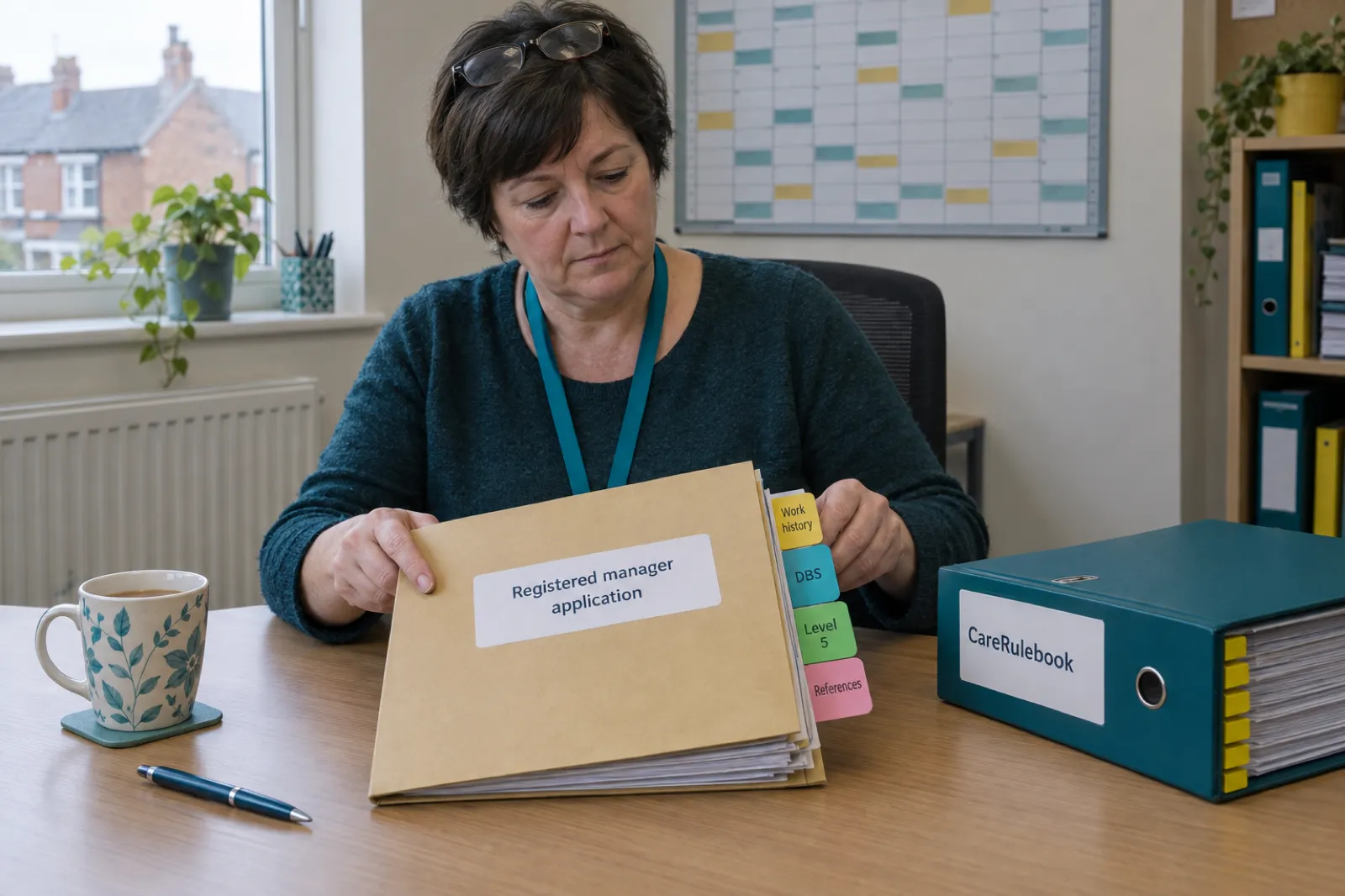
A home care manager preparing a folder for the CQC registered manager application

Quick answer

CQC assesses a new homecare application in two stages. First it checks that your forms, statement of purpose and supporting documents are complete, accurate and relevant, and rejects the application if they are not. If you pass, CQC decides whether your application proves you can provide care that meets the regulations. At that stage it "may need to: interview you and your registered manager by telephone, online or face-to-face" and visit your premises.

CQC does not publish its interview questions. It does publish two real homecare applications. It refused one where the founder "could not tell us about their content or how they applied to the agency" about the policies she had bought, had no supervisory experience and could not say where her money came from. It registered one where the founder had adapted his policies, could explain them in detail, had years of management experience and could evidence his funding.

So prepare to explain, in your own words and with real examples, your experience, your documents, how you will keep people safe, how you will train and supervise staff, and the money behind the business.

Where the interview fits

CQC’s homecare guidance sets out what happens after you apply. The interview is part of stage two, so you only get there if your documents pass stage one.

StageWhat CQC doesIf it goes wrong
Stage one, step 1CQC checks your application forms and statement of purpose are complete and every required document is there.Missing anything: rejected, with an email explaining why. CQC
Stage one, step 2CQC reviews your supporting documents: complete, accurate, relevant to your service and in line with its requirements.Not good enough: rejected, with an email explaining why. CQC
Stage twoCQC decides whether your application proves you can provide care that meets the regulations. It may interview you and your registered manager, by phone, online or face to face, and visit your premises, and it assesses your documents in detail.Agree assessment dates within 28 days of being contacted, or the application may be returned or refused. CQC

CQC says "Our registration assessment is thorough and can take a few months. You cannot manage regulated activities until we confirm your registration."

Who CQC interviews

CQC’s homecare guidance names two people: you, the applicant, and your registered manager. Its guidance for new managers says CQC will "contact you to arrange an interview".

If you are a company, you also name a nominated individual: a director, manager or secretary "responsible for supervising the management of the carrying on of the regulated activity" (2014 Regulations, regulation 6; what the role requires). In both of CQC’s published examples, one person was the only director, the nominated individual and the proposed registered manager, so the same person answered for the business and for running the care.

Before the interview, make sure the DBS checks are right: registered persons need a CQC-countersigned enhanced DBS, and "Applications with expired DBS checks (over 12 months old) will be rejected without further review."

What CQC looks for: its refused and registered examples

CQC publishes these as real homecare applications with the names changed. Smith Care was refused; Jones Care was registered.

AreaRefused (Smith Care)Registered (Jones Care)
Manager experienceEighteen months as a part-time carer. Had never managed, recruited or supervised staff, run quality assurance, implemented policies for a provider or assessed anyone’s needs. CQCTwo years as an area manager and three as a registered manager running a service with over 30 care staff, with significant experience of managing quality assurance systems. CQC
TrainingHad an NVQ level 2 in care and training with Social Care TV, but could not give examples of applying it at work, and planned to get the experience after registration. CQCNVQ levels 2, 3 and 4, mandatory training up to date, and extra training in mental health; a dementia champion. CQC
Policies and proceduresBought a set online but could not say what was in them or how they applied to the agency. CQCBought some online, reviewed and adapted them, wrote others, and could explain in detail how they applied. CQC
Quality and safetyDid not know how she would make sure the service was safe, or how to monitor and improve it. CQCA proven track record of implementing a provider’s policies and overseeing quality assurance. CQC
StaffNo firm plan for staff training. CQCA clear induction, appraisal, supervision and training system that supported the service’s aims. CQC
MoneyCould not say where the start-up money came from, had not worked out break-even, and the business plan missed essentials. CQCCould evidence the money and its source, allowed for contingencies such as lost income, and had talked to the local council. CQC

CQC refused Smith Care because it was not assured the company had enough money, or that Mrs Smith had the qualifications, competence, skills and experience to manage personal care, the supervisory experience, or enough knowledge of the policies and their importance to running the service safely. In its words: "We will not register services where key people plan to get the training and experience they need after they are registered."

Preparation prompts

These are not CQC’s questions. CQC does not publish a question list. They are prompts drawn from what CQC says it expects and from where its refused applicant fell short. Practise answering each one out loud, with a real example and with your own documents in front of you.

Your experience

CQC expects a homecare manager to have experience with complaints, mental capacity assessments, safeguarding concerns and medication errors. CQC

  • Describe a complaint you handled: what happened, what you did and what changed.
  • Talk through a mental capacity assessment you were involved in, and how the decision was made and recorded.
  • Describe a safeguarding concern you raised or managed, who you told and when.
  • Describe a medication error you dealt with, and how you made sure it did not happen again.
  • What have you managed before: how many staff, which systems, for how long?

Your documents

The refused applicant could not explain the policies she had bought; the registered one could explain his in detail. CQC

  • Walk through your safeguarding procedure from the moment a care worker is worried, using your own policy.
  • What support does your medicines policy let care workers give, and what can they never do?
  • What does your statement of purpose say about who you support, and why can you meet their needs?
  • Which parts of your policies did you change for your agency, and why?

Quality and safety

The refused applicant did not know how she would make sure the service was safe or how to monitor and improve it. CQC

  • How will you know your service is safe in the first month? Which checks, how often, by whom?
  • What will you audit, and what will you do with the results?
  • How will you find out about late or missed visits?

Your staff

The registered applicant had a clear induction, appraisal, supervision and training system; the refused one had no firm training plan. CQC

  • Talk through a new care worker’s first two weeks, from checks to working alone.
  • Who supervises care workers, how often, and how are spot checks done?
  • What training does each role get, from which provider, and when is it refreshed?

Money

The refused applicant could not say where her money came from or what she needed to break even; the registered one could evidence his funds and contingency. CQC

  • Where has your start-up money come from, and can you show it?
  • How many care hours a week do you need to break even, and when do you expect to reach it?
  • What will you do if income is lower than forecast?
  • What do you know about your local market and council commissioning?

Myths about the interview

Can your manager get the experience they need after CQC registers you?

No. CQC will not register a service where key people plan to get the training and experience they need after registration.

"We will not register services where key people plan to get the training and experience they need after they are registered."

Does buying policies online get you refused?

It depends. Not by itself. In CQC’s own examples, an applicant who bought policies but could not explain them was refused, and one who adapted them and could explain how they applied was approved.

"Mr Jones had reviewed and adapted these to the service and written others himself. He could tell us in detail how they applied to the running of the service."

Will CQC contact you to fix gaps in your application?

No. Not for homecare since 1 July 2025. CQC rejects the application and emails you why. A corrected resubmission counts as a new application and loses its place in the queue.

"You can correct and resend it, but this will count as a new application and will not keep its place in the queue."

Can you use the DBS Update Service for your CQC application?

No. CQC needs a CQC-countersigned enhanced DBS for registered persons, under 12 months old.

"We cannot accept certificates from the DBS update service or submissions from 3rd party services, such as U-check."

Frequently asked questions

Does CQC interview every new home care provider?

CQC says that at the assessment stage it may need to interview you and your registered manager, by phone, online or face to face, and visit your premises. Its registered manager guidance says it will contact the manager to arrange an interview.

What questions does CQC ask at the registration interview?

CQC does not publish a list of questions. Its homecare guidance says the assessment decides whether your application proves you can provide care that meets the regulations, and its refused and registered examples show what it tested: management experience, applied training, knowledge of your own policies, how you will keep the service safe and improve it, staff training and supervision, and the money behind the business.

When does the interview happen?

After your application passes CQC’s initial checks: first that the forms, statement of purpose and documents are complete, then that the documents are accurate and relevant. Incomplete applications are rejected before this point. If CQC contacts you to arrange assessment activities, agree a date within 28 days or your application may be returned or refused.

Can I use policies I bought online?

Yes, if they are right for your service and you know them. CQC refused an applicant who could not explain the policies she had bought, and registered one who had reviewed and adapted bought policies, written others and could explain how they all applied.

Is the nominated individual interviewed?

CQC’s homecare guidance says it may interview “you”, the applicant, as well as the registered manager. For a company, the nominated individual supervises the management of the service for the company. In both of CQC’s examples, one person was director, nominated individual and proposed registered manager.

How long does the CQC registration assessment take?

CQC says its registration assessment is rigorous and can take a few months, and you cannot manage regulated activities until it confirms registration.

Get CQC rule-change alerts

CQC consulted in 2026 on new assessment frameworks for adult social care. Leave your email and we will tell you when a change affects your registration documents.

No spam. Only emails about rule changes that affect homecare in England. How we use your email.

Keep reading

Sources

  1. Health and Social Care Act 2008 (Regulated Activities) Regulations 2014 · legislation.gov.uk · retrieved 30 September 2026
  2. Registering a homecare agency (personal care) · Care Quality Commission · retrieved 30 September 2026
  3. A better registration process for new homecare applications · Care Quality Commission · retrieved 30 September 2026
  4. Register as a new manager (page last updated 6 January 2026) · Care Quality Commission · retrieved 30 September 2026
  5. DBS checks for CQC registration · Care Quality Commission · retrieved 30 September 2026
  6. Register as a provider · Care Quality Commission · retrieved 30 September 2026
Build your CQC registration pack