Skip to content
CareRulebook
MenuClose

Where are you starting?

United StatesTexas, North Carolina, Georgia, Virginia, Indiana, Ohio, Illinois, Washington, Colorado
TexasManual
North CarolinaManual
GeorgiaManual
VirginiaManual
IndianaManual
OhioGuide
IllinoisManual
WashingtonManual
ColoradoGuideAll US states →
United KingdomEngland
Free toolsChecklists, calculators and templates

Washington · Hiring · WAC 246-335-425(6) · RCW 74.39A.056

Washington caregiver background checks: DSHS first, then the State Patrol every two years

A Washington home care agency runs each caregiver’s first background check through DSHS’s Background Check Central Unit, with an FBI fingerprint check DSHS pays for, and repeats the check through the Washington State Patrol within two years. DSHS never sends a private agency a “Disqualify” letter, so the agency reads each result and decides itself. Here is the process step by step, the 120-day provisional period, which list of crimes applies, and what to keep on file.

  • Rule-verified October 2, 2026
  • Quoted from WAC 246-335 and RCW 43.43 and 74.39A
  • And DOH’s and DSHS’s guidance
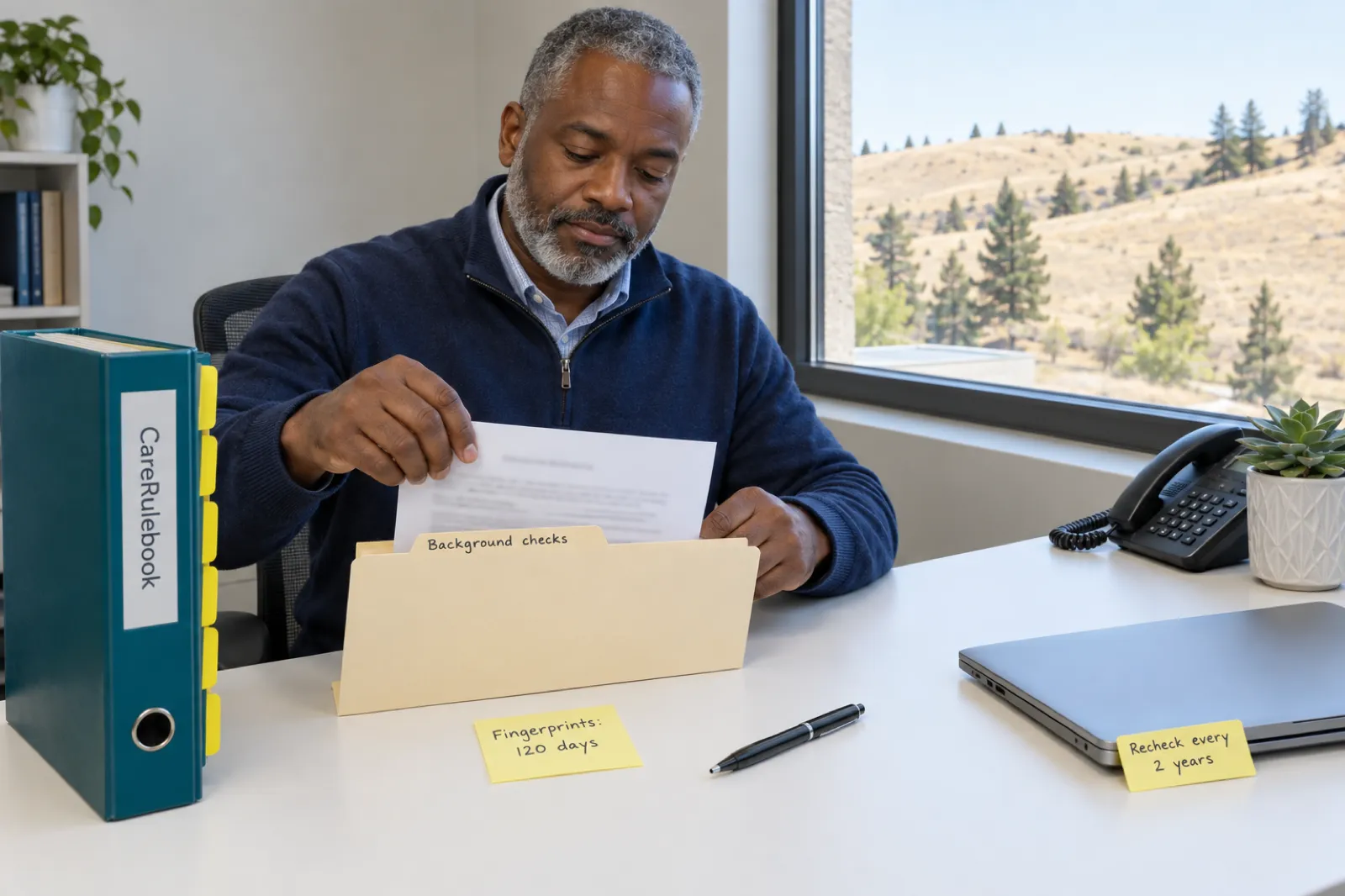
A man in a navy sweater files a printed page into a folder labelled Background checks, beside a CareRulebook binder, a sticky note on the desk reading Fingerprints: 120 days and one on a closed laptop reading Recheck every 2 years, with a dry hillside and pine trees outside the window

Quick answer

DOH’s rule requires criminal history background checks and DOH-approved disclosure statements for personnel, contractors, volunteers, students and anyone associated with the agency who has direct contact with vulnerable persons, renewed within two years (WAC 246-335-425(6)). Every home care client is a vulnerable person under DOH’s rule (WAC 246-335-310(44)). DOH’s guidance says "Home care agencies must process initial hiring background checks through the Washington State Department of Social and Health Services Background Check Central Unit (DSHS BCCU) and subsequent two-year checks through WSP." (DOH, Updated Rules). BCCU’s first check includes the FBI fingerprint check, at no charge to the agency.

Once you have reviewed the Washington State result and decided to hire, DSHS says the worker "can be hired for a 120-day provisional hire period pending fingerprint results", and the results must arrive within 120 days of hire (DSHS, Private Home Care Agencies). A private agency never gets a "Disqualify" letter or FBI record details, so the agency reads each result against the disqualifying lists itself (DOH’s rule points to the statute, DSHS links its own longer list, and neither says which governs) and makes a documented character, competence and suitability decision for anything else on the record (WAC 246-335-425(7)).

Two sets of rules, one process

DOH’s licensing rule requires policies on "Criminal history background checks and disclosure statements for personnel, contractors, volunteers, students, and any other individual associated with the licensee having direct contact with children under sixteen years of age, people with developmental disabilities or vulnerable persons according to RCW 43.43.830 through 43.43.842", and adds that the checks are processed through the Washington State Patrol (WSP), the disclosure statements are approved by DOH, and both are renewed within two years of the previous check (WAC 246-335-425(6)(a)-(c)).

The long-term care law says "All long-term care workers shall be screened through state and federal background checks in a uniform and timely manner to verify that they do not have a history that would disqualify them from working with vulnerable persons." For workers hired on or after January 7, 2012, that includes an FBI fingerprint check, and DSHS may not pass its cost on to the workers or their employers (RCW 74.39A.056(1)).

DOH’s guidance joins the two. Home care agencies run the first check at hire through DSHS’s Background Check Central Unit (BCCU) and the two-year rechecks through WSP, and "processing background checks through the BCCU satisfies the requirement in WAC 246-335-425(6)." (DOH, Updated Rules). DOH adds that BCCU is required to provide only the initial checks for long-term care workers and certified home care aides at no charge to the agency (DOH, Updated Rules), and DSHS says it pays for background checks for all long-term care workers (DSHS, Background Checks). An agency with a DSHS contract runs every check, first and later, through BCCU under its contract (DOH, Updated Rules). This page is about agencies without one, which includes every newly licensed agency: DOH’s instructions say "Contracts are not available to newly licensed home care agencies." (DOH 505-053).

Who is checked

Everyone with direct contact with clients

The rule covers personnel, contractors, volunteers, students and anyone else associated with the agency who has direct contact with children under 16, people with developmental disabilities or vulnerable persons. Every client of a licensed home care agency is a vulnerable person under DOH’s rule, so by our reading that means everyone who has direct contact with clients.

WAC 246-335-425(6); -310(44)(e)

Caregivers: fingerprints as well

The long-term care law requires state and federal background checks for every long-term care worker, and an FBI fingerprint check for those hired since January 7, 2012. DSHS says that covers private pay as well as Medicaid.

RCW 74.39A.056(1); DSHS

The administrator and the supervisor, before you apply

Your license application includes a Washington State Patrol check and a DOH disclosure statement for each, obtained within three months of the application date. Each renewal application includes copies of their most current checks.

WAC 246-335-320(2)(d); -325(4)

Office staff who never meet clients

The rule ties checks to direct contact, and DOH’s guidance names the administrator, the supervisor of direct care services and all employees who provide care. By our reading, someone with no direct contact with clients is outside the rule. CareRulebook’s manual still checks any owner or office employee who visits clients or meets them at the office.

WAC 246-335-425(6); DOH, Updated Rules

The fingerprint duty is for long-term care workers, which the statute defines as people who give paid, hands-on personal care (RCW 74.39A.009(20)). By our reading, a worker who only does housework or shopping still needs DOH’s check and disclosure statement if they have direct contact with clients, but the long-term care law’s fingerprint duty does not name them. DOH’s note on free BCCU checks names long-term care workers and certified home care aides. CareRulebook’s manual selects the fingerprint check for every caregiver, as DSHS’s instructions for private agencies say, and runs the first check through the State Patrol, which the rule names, for anyone BCCU will not process.

Each new caregiver, step by step

The DSHS steps for a private home care agency, with the DOH and statute duties around them. Tick steps off as you go; progress is saved in this browser only.

  1. Tell the applicant about the check

    At application

    The law says a business may not ask the State Patrol, or a federal agency, about an applicant unless it has told them that an inquiry may be made. Put it on your job application.

    RCW 43.43.834(1)
  2. Get a signed disclosure statement

    Before the check

    Each person discloses in writing, under penalty of perjury, their crimes against children or other persons, crimes relating to financial exploitation and crimes relating to drugs. DOH’s rule says the statement must be on a form DOH has approved; DOH’s is the Disclosure Statement, DOH 505-055, in its application packet.

  3. Have them fill in DSHS’s authorization form

    Before the check

    The worker completes DSHS’s online Background Check Authorization form and writes down the confirmation code it shows at the end. DSHS says the code cannot be recovered once the page is closed, and is valid for 90 days.

    DSHS, Background Checks
  4. Submit it in BCS with the fingerprint check selected

    Hiring

    The agency retrieves the form in DSHS’s Background Check System (BCS) with the worker’s date of birth and confirmation code, reviews it and submits it. DSHS says to select the fingerprint check, which covers both the Washington State check and the FBI check. Your DOH application names a primary account administrator who receives BCCU results.

  5. Read the Washington result and decide

    Before hiring

    When the Washington State name and date of birth result arrives, DSHS says the agency reviews it and decides whether the person may have unsupervised access to vulnerable adults. How to read each letter.

  6. Book the fingerprint appointment straight away

    Right after the decision

    Print the fingerprint appointment and notification forms from BCS and give them to the worker. DSHS says to book the appointment right away, at an IdentoGO site or through law enforcement, which may cost something.

  7. Watch day 120

    By day 120

    DSHS says the fingerprint results must reach the agency within 120 days of hire, with no exceptions. If they have not, the worker cannot work unsupervised after that deadline.

  8. Read the final result

    When it arrives

    The fingerprint-based result letter comes through BCS. It does not include FBI record details for a private agency; the worker can ask BCCU for them and choose to share them.

  9. Give the worker a copy within 10 days

    Within 10 days

    DSHS’s instructions say to keep a copy of each result notification and give the worker a copy within 10 days of receiving it. The statute sets the same 10 days for State Patrol results.

  10. File it and set the recheck date

    After the decision

    Keep evidence of the check and the disclosure statement in the personnel file, and diary the recheck: checks and disclosure statements are renewed within two years of the previous check.

The law allows a person to be employed on a conditional basis while a required state check is pending (RCW 43.43.832(5)), and DSHS’s process puts the decision to hire after the Washington result. CareRulebook’s manual uses that conditional period only for work without client contact, such as orientation and training; that is the manual’s choice.

Reading the result letters

DSHS says "Because Private Home Care Agencies are not subject to DSHS rule, they will never receive a Disqualify letter". A private agency receives one of three letters (DSHS, Private Home Care Agencies):

LetterWhat DSHS says it meansWhat you do
No RecordNo criminal or negative action records were reported.Keep a copy and give the worker a copy within 10 days. DSHS
Review RequiredOne or more sources reported criminal or negative action records.Decide whether the person may have unsupervised access, using a character, competence and suitability review, and document it. Give the worker a copy within 10 days. DSHS
Additional Information NeededBCCU needs more information from the applicant before it can give a result.Treat the check as pending until a new result arrives. DSHS

DSHS tells the agency: "you must determine whether they are qualified, disqualified, or require a Character, Competence and Suitability Review" (DSHS, Private Home Care Agencies). DSHS’s description of a Review Required letter speaks of records not on "the oversight program’s list" of disqualifying crimes (DSHS, Background Checks), and it does not say how a record that would be disqualifying is shown to an agency that is not subject to DSHS rule. Our suggestion: read every Review Required result against the lists below before you decide, and never treat one as clear without reading it.

State Patrol results (the two-year rechecks, and the administrator and supervisor checks for your application) read differently. DOH says they show "No Record Found" or "Record Found", and "If the results say “Record,” agencies must review the crimes listed to determine if there are any disqualifying crimes per RCW 43.43.830." Non-disqualifying crimes, pending charges or negative actions then need a character, competence and suitability review (DOH, Updated Rules).

FBI results. "The law prohibits BCCU from including FBI criminal history results to non-governmental agencies or clients." DSHS says the worker can request those records from BCCU and choose to share them, and that if they do not, you may not have enough information to hire them (DSHS, Private Home Care Agencies).

Which crimes disqualify: two lists

The statute DOH’s rule points to. DOH’s rule requires the checks "according to RCW 43.43.830 through 43.43.842" (WAC 246-335-425(6)). Under RCW 43.43.842(1), a person with unsupervised access to a vulnerable adult may not be the respondent in an active vulnerable adult protection order, and may not have been convicted of a crime against children or other persons or a crime relating to financial exploitation, or found in a disciplinary board final decision to have abused a vulnerable adult (RCW 43.43.842(1)(a)). The two crime lists are in RCW 43.43.830(9) and (11): the second is extortion, theft in the first, second or third degree, robbery and forgery (RCW 43.43.830).

Some older offenses are not automatic bars: simple or fourth degree assault, prostitution and third degree theft after three years, and second degree theft and forgery after five years, counted from the most recent conviction to the employment application, among others. "The offenses set forth in (a) through (g) of this subsection do not automatically disqualify an applicant from employment by a licensee." (RCW 43.43.842(2)). Drug crimes are disclosed on the statement but are not on the RCW 43.43.842(1) list (RCW 43.43.842(1)(b)).

The long-term care law adds findings. A provider may not be employed in care with unsupervised access if they are on the vulnerable adult abuse registry or another registry based on a finding of abuse, abandonment, neglect or financial exploitation of a vulnerable adult; or if the Department of Children, Youth, and Families (or its predecessor) made a founded finding of child abuse or neglect against them on or after October 1, 1998, or a disciplining authority or a court made a finding of abuse, abandonment, neglect or financial exploitation of a minor or vulnerable adult. For the child abuse and court findings, a certificate of parental improvement lifts the bar (RCW 74.39A.056(2)).

The list DSHS links. DSHS’s page for private agencies links "List of Disqualifying Convictions and Pending Charges WAC 388-113-0020" (DSHS, Private Home Care Agencies). That rule says people must not work in a position that may involve unsupervised access if they have "been convicted of or has a pending charge for" any crime on its list (WAC 388-113-0020(1)). The chapter says it applies to DSHS’s programs and the facilities it lists, starting with long-term care workers in DSHS’s in-home long-term care services (WAC 388-113-0005(2)), and DSHS says private home care agencies are not subject to DSHS rule.

Where the two lists differ: some examples

RecordRCW 43.43.830 to .842 (DOH’s rule)WAC 388-113-0020 (DSHS’s list)
Theft 1Bar; not among the older offenses the agency may considerBar if less than 10 years
Theft 2Bar, but the agency may consider it after five yearsBar if less than five years
Theft 3Bar, but the agency may consider it after three yearsBar if less than three years
Identity theftNot listedBar if less than five years
Delivering a drug other than marijuanaDisclosed, not listed as a barBar
A pending chargeNot a bar; a character, competence and suitability determination under WAC 246-335-425(7)Bar, for a crime on the list

RCW 43.43.842(2) · RCW 43.43.830(9)-(11) · WAC 388-113-0020(1) · WAC 246-335-425(7). Our comparison of a few rows; read both lists in full.

What we found, and what we did not

DOH ties its rule, and its instructions for reading State Patrol results, to RCW 43.43.830. DSHS points private agencies to its own rule while saying they are not subject to it. We found no DOH or DSHS statement on which list governs a private agency’s decision when the two differ. CareRulebook’s manual (Policy 4.3) treats the RCW 43.43.842(1) and RCW 74.39A.056(2) lists as automatic bars, and handles everything else, including offenses that appear only on DSHS’s list and pending charges, through a documented character, competence and suitability determination (Policy 4.4). That is the manual’s reading, and it differs from DSHS’s CC&S page, which says a review can never clear an "automatically Disqualifying" record and links those words to WAC 388-113-0020 (DSHS, CC&S Review). Our suggestion: ask DOH which list its surveyors apply before you rely on either, and take employment law advice before refusing someone for a record that is on neither statutory list.

Character, competence and suitability decisions

DOH’s rule requires policies that describe a "Character, competence, and suitability determination conducted for personnel, contractors, volunteers, and students whose background check results reveal nondisqualifying convictions, pending charges, or negative actions" (WAC 246-335-425(7)). The factors include, but are not limited to:

  • whether there is a reasonable, good faith belief that the person would be unable to meet clients’ care needs;
  • how vulnerable the clients in their care are;
  • their behavior since the conviction, charge, negative action or other adverse behavior;
  • any pattern of offenses or behavior that may put clients at risk;
  • how many years have passed;
  • whether they disclosed it themselves; and
  • other health and safety concerns (WAC 246-335-425(7)(a)-(g)).

DSHS gives two examples: a worker who would drive the client and has multiple DUIs, and a worker with recent theft convictions who would work for a client with dementia (DSHS, CC&S Review). It also says "The decision as to whether the applicant/employee may or may not have unsupervised access to minors or vulnerable adults must be documented as part of the CC&S review." Once the form is completed, DSHS says to keep it under your own program rules: "Please do not submit a copy to BCCU." (DSHS, CC&S Review). And "A CC&S determination can never be used to allow a provider to work when the individual has automatically Disqualifying" convictions, pending charges or negative actions (DSHS, CC&S Review). DSHS’s page links the words "automatically Disqualifying" to its own list, WAC 388-113-0020, not to the statute DOH’s rule names.

Your decision does not bind DOH: although an agency may decide a worker is suitable, "the department has the final authority to deny, revoke, modify, or suspend any professional credential it issues based on application and criminal background check information." (WAC 246-335-425(7)(h)). That includes a home care aide certification.

CareRulebook’s manual (Policy 4.4) has the administrator talk to the person before deciding, weigh each factor in writing, and choose between unsupervised access, access with written conditions (for example, no driving clients) or no unsupervised access, with the alternate administrator deciding when the administrator is not independent. The conditions option and the conversation are the manual’s procedure, not rule text.

The 120-day provisional period

The statute says "A long-term care worker who is not disqualified by the state background check can work and have unsupervised access pending the results of the federal bureau of investigation fingerprint background check as allowed by rules adopted by the department." (RCW 74.39A.056(1)(b)(ii)). For private agencies, DSHS puts it this way:

  • "The HCA will review the applicant’s results and determine if the applicant can have unsupervised access to vulnerable adults. If the HCA decides to hire the applicant, he/she can be hired for a 120-day provisional hire period pending fingerprint results." (DSHS, Private Home Care Agencies)
  • "The applicant’s fingerprint results MUST be received by the HCA within 120-days of hire- no exceptions. If they are not, the applicant will not be able to work unsupervised past that 120-day deadline." (DSHS, Private Home Care Agencies)

DSHS’s own rule for its programs allows the 120 days when the person is not disqualified by the name and date of birth check and a fingerprint appointment has been scheduled (WAC 388-113-0109). "Unsupervised" means not in the presence of another employee or volunteer of the agency, or of the client’s relative or guardian (RCW 43.43.830(18)).

Rejected prints do not stop the clock. The State Patrol may reject fingerprints more than once, and the FBI may reject them twice before it runs only a national name and date of birth check; DSHS says to book a new appointment right away (DSHS, Private Home Care Agencies). DSHS’s 120 days have no stated exception.

When day one is. DSHS says "within 120-days of hire" and does not define hire on that page. CareRulebook’s manual counts from the caregiver’s start date with the agency, not the "date of hire" used for training deadlines (which can be earlier), and from day 121 has a fully checked worker stay with them, or takes them off client visits, until the result arrives. That is the manual’s reading.

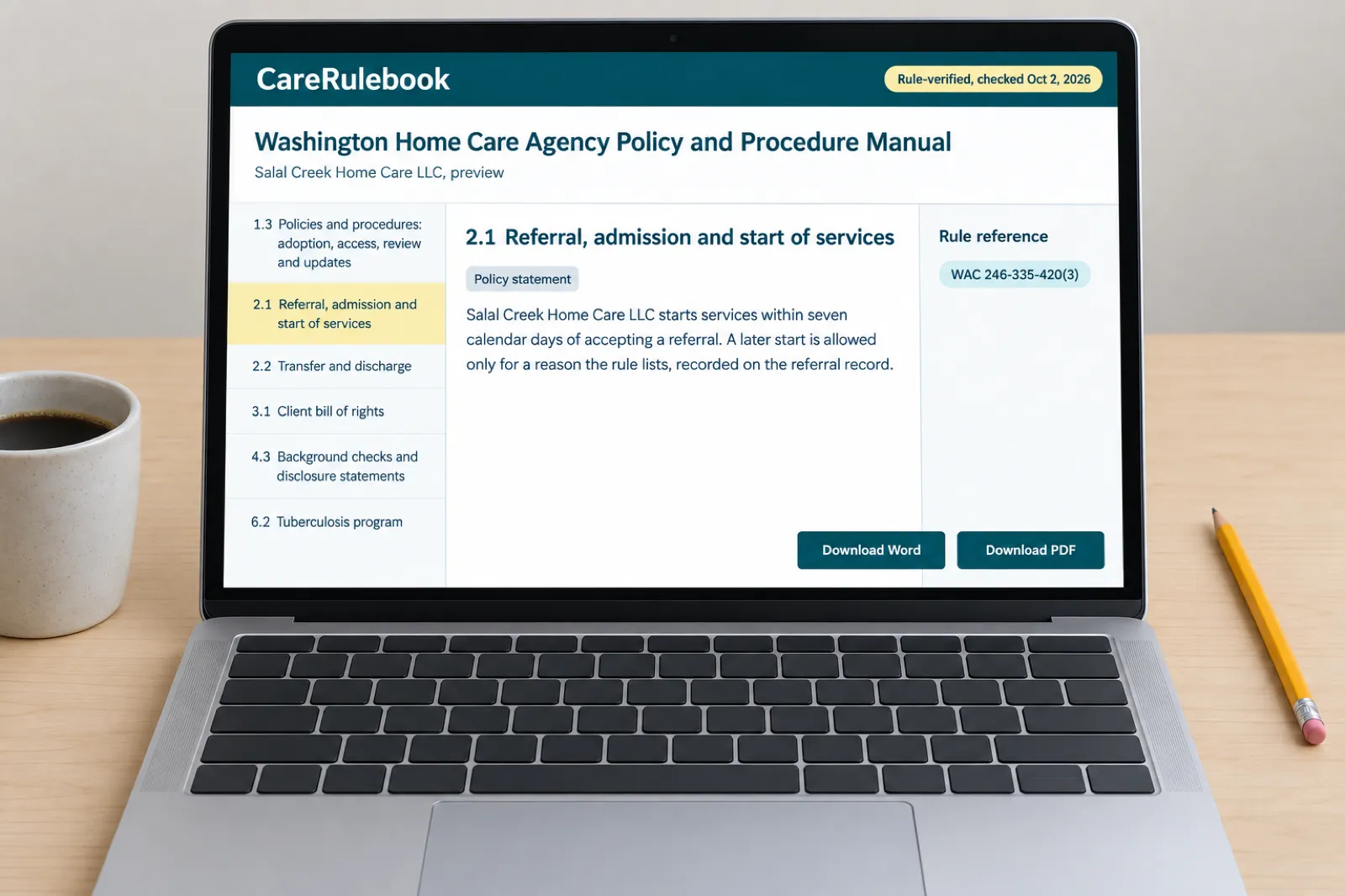
The CareRulebook Washington manual preview on a laptop: policy 2.1 on referral, admission and start of services for a sample agency, citing WAC 246-335-420(3), with policy 4.3 on background checks and disclosure statements in the contents

CareRulebook

Background checks written for your agency

CareRulebook’s Washington manual includes Policy 4.3, background checks and disclosure statements: the BCCU first check with fingerprints, the 120-day watch, the result letters, the disqualifying lists, two-year State Patrol rechecks and the administrator and supervisor checks DOH asks for, with a log. Policy 4.4 gives you a character, competence and suitability determination record.

  • 42 policies, 154 requirements mapped
  • Every tag on DOH’s home care policy checklist, plus a DOH review copy
  • Editable Word and PDF, delivered instantly
Preview your manual

$199CareRulebook founding price for the first 50 Washington agencies, then $249. Not a DOH fee.

Rechecks every two years, through the State Patrol

The rule says "All criminal history background checks and disclosure statements required under this chapter must be renewed within two years from the date of the previous check" (WAC 246-335-425(6)(c)), so each recheck comes with a new disclosure statement. DOH’s guidance sends the two-year rechecks through WSP (DOH, Updated Rules), and for a State Patrol check "the business or organization shall pay such reasonable fee for the records check as the state patrol may require under RCW 43.43.838." (RCW 43.43.834(3)). DOH’s page links the State Patrol to its online WATCH service.

  • Fingerprints are not repeated every two years. A home care agency provider completes a fingerprint check at initial hire, when federal law requires it, or when the employer documents in writing a reasonable, good faith belief that one is needed because of potential new findings. A worker rehired by the same employer who has not lived outside Washington since their last fingerprint check need not repeat it at hire (RCW 74.39A.056(1)(c)).
  • DOH can ask for more. DOH may require new checks and disclosure statements for anyone associated with the agency if it has reason to believe an offense listed in RCW 43.43.830 has occurred since the last check (WAC 246-335-340(6)).
  • What the surveyor’s tool lists. DOH’s 2018 personnel survey tool has three background items under tag Z0655: the initial WSP check, the subsequent WSP check every two years, and the disclosure statement (DOH 655-014). Its "initial WSP" wording differs from DOH’s guidance that a home care agency’s first check goes through BCCU. Our reading: keep the BCCU result as the initial check, and ask DOH if a surveyor raises it.

The administrator and the supervisor: DOH’s own checks

DOH’s application rule says "For home care agencies, copies are required for the administrator and the supervisor of direct care services": a State Patrol check and a DOH disclosure statement for each, obtained within three months of the application date (WAC 246-335-320(2)(d)). Each renewal includes "Copies of the most current criminal history background checks and disclosure statements for the administrator, director of clinical services, or supervisor of direct care services" (WAC 246-335-325(4)). The application also asks you to name a primary account administrator, who receives DSHS background check results securely (DOH 505-051).

A new administrator or supervisor is one of the changes you tell DOH about within 30 days (WAC 246-335-335(5)). CareRulebook’s manual has the new person’s checks done before they start.

Records

Each personnel file holds "Evidence of initial and subsequent criminal history background checks and disclosure statements according to RCW 43.43.830 through 43.43.842 and this chapter" (WAC 246-335-430(6)). Give the worker a copy of each result within 10 days of receiving it: the statute says so for State Patrol results (RCW 43.43.834(4)) and DSHS’s instructions say so for BCCU results (DSHS, Background Checks). "The business or organization shall use this record only in making the initial employment or engagement decision." (RCW 43.43.834(5))

We found no period for keeping personnel records in chapter 246-335 WAC. CareRulebook’s manual keeps results, disclosure statements and determinations in a confidential background check section of each personnel file that only the administrator and the alternate can open, and keeps each file for three years after the person leaves (Policy 4.8). Both are the manual’s choices, not rule text.

Under consideration since August 18, 2025 · no draft text yet

DOH is considering standard background check rules

On August 18, 2025 DOH filed a preproposal statement of inquiry (CR-101, WSR 25-17-068), the stage before a proposal. It says "The department will take the opportunity to review the current background check requirements of these facility types to consider a standardized process for the purpose of streamlining the licensing process and establishing consistent standards applicable to the facility type." (WSR 25-17-068). The same notice covers fine amounts under the 2024 enforcement law.

No proposed text, hearing or comment deadline has been published, and DOH lists it as a rule in progress (DOH, Rules in Progress). Until DOH adopts something, the BCCU and State Patrol steps above stand. If it changes WAC 246-335-425(6), the steps on this page, and Policy 4.3 in the manual, will need updating. To follow it: Join DOH’s interested parties list (GovDelivery, "In-Home Services" topic) or contact Julie Tomaro, PO Box 47843, Olympia, WA 98504-7843, 360-236-2937, julie.tomaro@doh.wa.gov.

All rule changes we track →

Myths about Washington hiring checks

Do caregivers at a private-pay agency need FBI fingerprint checks?

Yes. DSHS says every long-term care worker hired since January 7, 2012, Medicaid and private pay, needs a fingerprint-based background check, and DOH says home care agencies run the first check through DSHS’s Background Check Central Unit, at no charge to the agency. A worker who is not disqualified by the Washington State check may be hired for a 120-day provisional period while the fingerprint results are pending.

"All long-term care workers (both Medicaid AND private pay) hired on or after January 7, 2012 must have a fingerprint-based background check."

If BCCU never sends my agency a "Disqualify" letter, is everyone it checks cleared?

No. DSHS says private home care agencies never receive a Disqualify letter, only No Record, Review Required or Additional Information Needed, and that the agency decides from the letter whether the applicant is qualified, disqualified or needs a character, competence and suitability review. So the agency reads every Review Required result against the disqualifying lists itself.

"Because Private Home Care Agencies are not subject to DSHS rule, they will never receive a Disqualify letter"

Frequently asked questions

Do private-pay home care agencies in Washington need fingerprint checks for caregivers?

Yes. DSHS says every long-term care worker hired on or after January 7, 2012, Medicaid and private pay, must have a fingerprint-based background check. DOH says home care agencies run the first check through DSHS’s Background Check Central Unit (BCCU), which satisfies DOH’s rule, and BCCU runs it at no charge to the agency.

How long can a new caregiver work before the fingerprint results come back?

DSHS says that once the agency has reviewed the Washington State results and decided to hire, the worker "can be hired for a 120-day provisional hire period pending fingerprint results", and that the results must reach the agency within 120 days of hire, with no exceptions. If they have not, the worker cannot work unsupervised after the deadline. Unsupervised means not in the presence of another employee or volunteer of the agency, or of the client’s relative or guardian.

Why does BCCU never send my agency a "Disqualify" letter?

DSHS says private home care agencies are not subject to DSHS rule, so they only ever receive No Record, Review Required or Additional Information Needed. DSHS tells the agency to decide from the letter whether the applicant is qualified, disqualified or needs a character, competence and suitability review. So the agency reads each result against the disqualifying lists itself; which list governs when they differ is not settled (see the next answer).

Which crimes disqualify a caregiver in Washington?

DOH’s rule ties the checks to RCW 43.43.830 to .842, which bar crimes against children or other persons, crimes relating to financial exploitation (theft, robbery, extortion, forgery), disciplinary findings of abuse of a vulnerable adult and active vulnerable adult protection orders, with exceptions for some older offenses. RCW 74.39A.056(2) adds the abuse registry and findings of abuse or neglect. DSHS’s page for private agencies links a longer list, WAC 388-113-0020, which also covers pending charges. We found no DOH or DSHS statement on which list governs when they differ; ask DOH.

Who pays for home care background checks in Washington?

DSHS pays for the first check, including the FBI fingerprint check, and the statute bars DSHS from passing that cost to workers or employers. The two-year rechecks go through the State Patrol, and the law says the business pays the State Patrol’s fee. Fingerprinting through law enforcement instead of IdentoGO may cost something, DSHS says.

How often do Washington home care agencies redo background checks?

Checks and disclosure statements are renewed within two years of the previous check, through the State Patrol, as DOH’s guidance says. The fingerprint check is not repeated every two years: the law requires it at initial hire, when federal law requires it, or when the employer documents a reasonable, good faith belief that one is needed because of potential new findings. DOH may also require new checks if it has reason to believe a listed offense has occurred.

Can my agency see a worker’s FBI record?

Not from BCCU. DSHS says the law prohibits BCCU from giving FBI criminal history to non-governmental agencies. The worker can request their records from BCCU and share them with you if they choose, and DSHS adds that if they do not, you may not have enough information to hire them.

Get Washington rule-change alerts

DOH is considering standardizing the background check rules for home care agencies (WSR 25-17-068). Leave your email and we will tell you when a Washington change affects your hiring checks or your policies.

No spam. Only emails about Washington home care rule changes. How we use your email.

Keep reading

Sources

  1. Chapter 246-335 WAC, In-home services agencies (Parts 1, 2 and 13; home health and hospice parts for comparison) · Washington State Legislature (app.leg.wa.gov) · retrieved October 1, 2026
  2. RCW 43.43.830 to 43.43.845, background checks (Washington State Patrol) · Washington State Legislature (app.leg.wa.gov) · retrieved October 2, 2026
  3. Chapter 74.39A RCW, Long-term care services options (sections .009, .056, .074, .076, .086, .341) · Washington State Legislature (app.leg.wa.gov) · retrieved October 2, 2026
  4. Chapter 388-113 WAC, Disqualifying crimes and negative actions (DSHS background checks) · Washington State Legislature (app.leg.wa.gov) · retrieved October 2, 2026
  5. WSR 25-17-068, Uniform facility enforcement framework and background check standardization (preproposal statement of inquiry, CR-101, filed August 18, 2025) · Washington State Register (Code Reviser); Department of Health · retrieved October 2, 2026
  6. In-Home Services License Application Packet, DOH 505-052 (April 2026), with 505-053 instructions (February 2026), 505-109 license requirements (April 2026), 505-051 application, 505-055 disclosure statement and 505-137 FTE worksheet · Washington State Department of Health · retrieved October 1, 2026
  7. Home Care Personnel Survey Tool, DOH 655-014 (May 2018) · Washington State Department of Health · retrieved October 2, 2026
  8. Home Care Agencies: Updated Rules (guidance on the 2018 rules: background checks, character, competence and suitability, TB risk assessment) · Washington State Department of Health · retrieved October 2, 2026
  9. Home Care Agencies: Rules in Progress · Washington State Department of Health · retrieved October 2, 2026
  10. Background Checks: Private Home Care Agencies (HCA) · Washington State Department of Social and Health Services · retrieved October 2, 2026
  11. Background Checks (long-term care background check requirements) · Washington State Department of Social and Health Services · retrieved October 2, 2026
  12. Background Checks: Character, Competence, and Suitability (CC&S) Review · Washington State Department of Social and Health Services · retrieved October 2, 2026
Build your Washington manualfrom $199