A DHSR home care license for each county you serve
Only a home care agency licensed by DHSR to operate in the county or counties where PCS is provided can bill for it.
Where are you starting?
North Carolina · Medicaid PCS · Clinical Coverage Policy 3L
Medicaid personal care services (PCS) pay for hands-on in-home aide care for North Carolina beneficiaries who qualify. To provide them you need your DHSR license first, then Medicaid enrollment, the Provider Interface and EVV. Here is how referrals reach you and what NC Medicaid expects once they do.
Quick answer
NC Medicaid personal care services (PCS) are hands-on help with bathing, dressing, mobility, toileting and eating for Medicaid beneficiaries who qualify through an independent assessment. Under Clinical Coverage Policy 3L, only "a home care agency licensed by the DHSR to operate in the county or counties where the PCS Services are being provided" can bill for them.
So the order is: get your DHSR home care license, enroll with Medicaid (signing the DHHS Provider Administrative Participation Agreement), enroll in the Provider Interface, and set up electronic visit verification. Beneficiaries then choose providers from a randomized list, and you have 2 business days to accept each referral.
Four things, starting with the license.
Only a home care agency licensed by DHSR to operate in the county or counties where PCS is provided can bill for it.
Meet Medicaid participation qualifications and sign the DHHS Provider Administrative Participation Agreement. DHSR, the Division of Health Benefits and NCTracks are separate, so keep each informed of counties and address changes.
Every PCS provider enrolls in the Provider Interface, the web system that carries referrals, independent assessments and service plans.
Use the state’s electronic visit verification solution or a compliant alternative, tell each beneficiary about EVV in writing, and train staff on it at least once a year.
To qualify, a beneficiary needs a medical condition, disability or cognitive impairment and unmet needs for "Three of the five ADLs with limited hands-on assistance", or two ADLs with one needing extensive assistance or full dependence. NC Medicaid, PCS The five ADLs are bathing, dressing, mobility, toileting and eating. Policy 3L, 5.4.1
Hours are capped: up to 60 a month under 21 and up to 80 a month for adults, with up to 50 more for adults who meet extra criteria, such as needing more supervision because of a degenerative memory disease. Policy 3L, 5.3.1
Beneficiaries choose: "Each beneficiary may select at least three providers from a randomized list of available providers" licensed for home care in their county. They can change provider during the service period, and the new provider writes a new service plan within seven business days of accepting the referral. Policy 3L, 5.4.11
You may not win clients with gifts: agencies are "prohibited from offering gifts or service-related inducements of any kind". Policy 3L, 7.5
Tick steps off as you go; progress is saved in this browser only.
Their primary care practitioner or attending physician refers them on NC Medicaid’s form (NC Medicaid-3051).
NC Medicaid or its designee assesses eligibility. NC LIFTSS / Acentra Health carries out the assessments (833-522-5429).
They pick at least three providers from a randomized list of agencies licensed for home care in their county.
The referral comes through the Provider Interface. If you do not accept, it goes to the beneficiary’s next choice.
Based on the independent assessment, addressing every unmet ADL, IADL, special assistance or delegated medical monitoring need, with the frequencies the assessment sets.
Aides follow the service plan, and each visit is captured through EVV.
CareRulebook
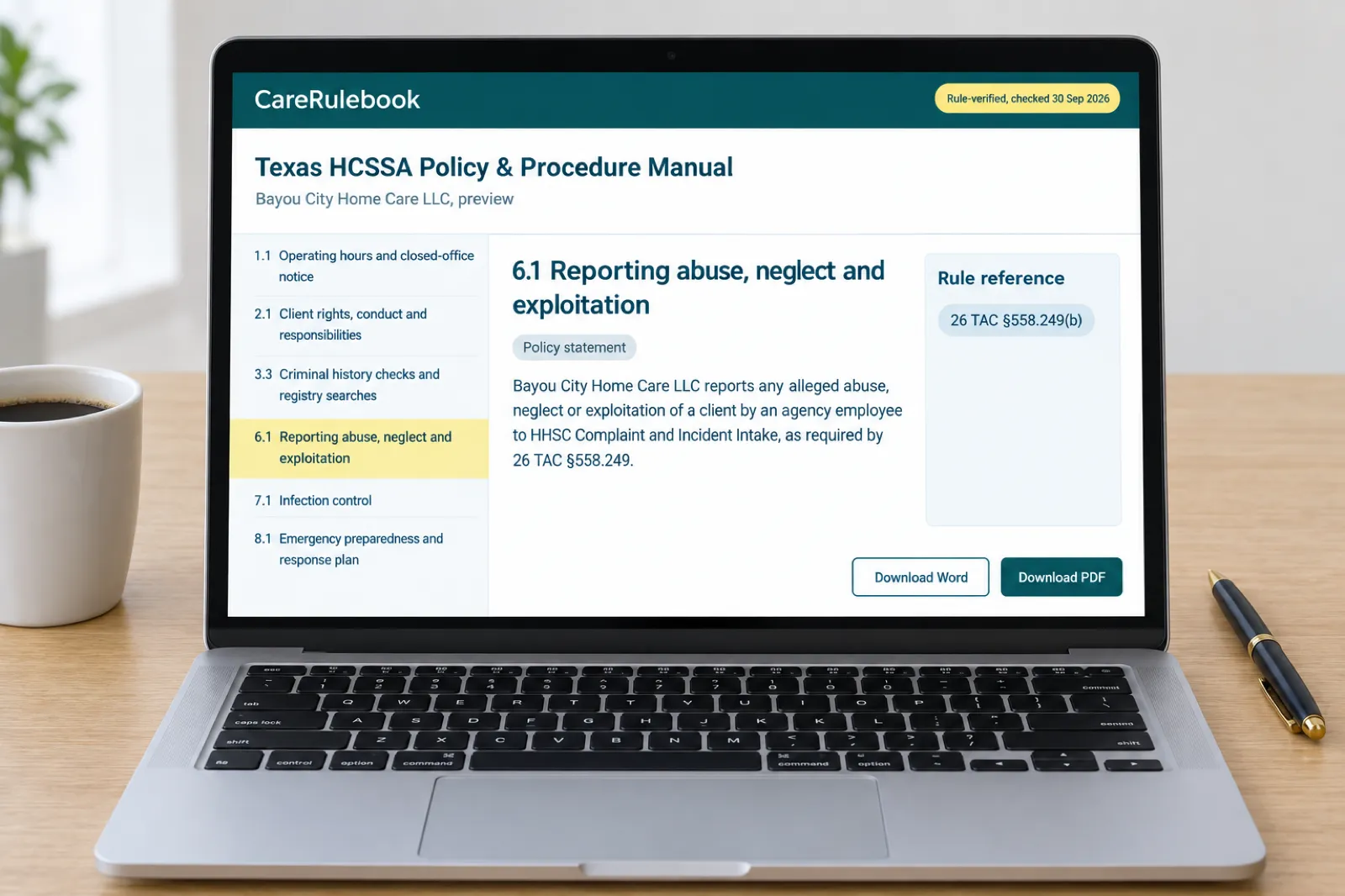
To bill for PCS you need the DHSR home care license first, and DHSR reviews your policies, procedures and personnel documents before it licenses you. CareRulebook writes every policy on DHSR’s initial survey checklist for your agency.
$199CareRulebook founding price for the first 50 North Carolina agencies, then $249. Not a DHSR or Medicaid fee.
Policy 3L sets a minimum: "PCS Aides shall be a high school graduates or equivalent; or Eighteen (18) years of age or older." Policy 3L, 6.1.1 Aides must also meet the home care licensure rules, including competency checks by an RN and the Nurse Aide Registry for extensive assistance. Director, RN and aide rules →
Each PCS aide’s personnel record documents training in, at minimum: beneficiary rights; confidentiality and privacy; personal care skills for bathing, dressing, mobility, toileting and eating; documenting and reporting accidents and incidents; recognizing and reporting abuse and neglect; and infection control. Aides serving beneficiaries who receive the extra hours also need training or experience in dementia care. Policy 3L, 6.1.2
Medicaid will not pay for PCS given by someone with certain convictions, such as felony health care fraud, patient abuse, or abuse, neglect or exploitation listed with the NC Health Care Personnel Registry. Policy 3L, 6.0
These Medicaid duties sit alongside the DHSR licensing rules, including your own plan of care, 90-day RN supervisory visits and annual program evaluation. Plans of care and supervision →
No. DHSR says the Medicaid personal care services plan is not a plan of care and cannot replace one.
"The Service Plan is not a Plan of Care and may not be substituted as a Plan of Care."
No. In-home aides may assist clients with self-administration of medication ordered by a prescriber, but may not administer it.
"No, In-home aides may not administer medications."
You need a DHSR home care agency license for each county you serve, Medicaid enrollment with a signed DHHS Provider Administrative Participation Agreement, enrollment in the Provider Interface, and an electronic visit verification (EVV) solution. Referrals then come to you through the Provider Interface when beneficiaries choose your agency.
A Medicaid beneficiary with a medical condition, disability or cognitive impairment and unmet needs for three of the five ADLs (bathing, dressing, mobility, toileting, eating) with limited hands-on help, or two ADLs with one needing extensive assistance or full dependence. An independent assessment decides eligibility.
Up to 60 hours a month for a beneficiary under 21 and up to 80 hours a month for one 18 or older, with up to 50 more hours for adults who meet additional criteria such as needing more supervision because of a degenerative memory disease.
Policy 3L sets the minimum as a high school graduate or equivalent, or 18 or older, with documented training in beneficiary rights, confidentiality, personal care skills for the five ADLs, accidents and incidents, recognizing and reporting abuse and neglect, and infection control. Aides must also meet North Carolina’s home care licensure rules.
No. Agencies providing PCS may not offer gifts or service-related inducements of any kind to get beneficiaries to choose them or switch to them.
No. DHSR says the Medicaid PCS service plan is not a plan of care and cannot replace one, so a licensed agency still needs its own plan of care under the home care rules.
NC Medicaid’s Personal Care Services Unit on 919-855-4360 or PCS_Program_Questions@dhhs.nc.gov. Beneficiaries in a Prepaid Health Plan contact their plan about PCS benefits.
NC Medicaid updates Policy 3L and DHSR updates its checklist and FAQ. Leave your email and we will tell you when a change affects your agency.
No spam. Only emails about North Carolina home care rule changes. How we use your email.
North Carolina
How to start a home care agency in North Carolina
The license, DHSR’s 32-item checklist, staffing and supervision.
North Carolina
The North Carolina license application
The form, the fee, where to mail it and what DHSR does next.
North Carolina
Home health vs home care in North Carolina
Three licenses, and the Certificate of Need for Medicare home health.
Tool
North Carolina license checklist
Every step, tailored to your agency, emailed to you.