Skip to content
CareRulebook
MenuClose

Where are you starting?

United StatesTexas, North Carolina, Georgia, Virginia, Indiana, Ohio, New York, Delaware, Maine, Oregon, California, Florida, Pennsylvania, New Jersey, Illinois, Washington, Colorado, Tennessee, Maryland, Kansas, South Carolina, Nevada
TexasManual
North CarolinaManual
GeorgiaManual
VirginiaManual
IndianaManual
OhioGuideNew YorkGuideDelawareGuideMaineGuideOregonGuideCaliforniaGuideFloridaGuidePennsylvaniaGuideNew JerseyGuide
IllinoisManual
WashingtonManual
ColoradoManual
TennesseeManual
MarylandManual
KansasManual
South CarolinaManual
NevadaManual
All US states →
United KingdomEngland
Free toolsChecklists, calculators and templates

Oregon · In-home care agency · ORS 443.305 to 443.350 · OAR 333-536

How to start a home care agency in Oregon (the in-home care agency license, 2026)

To run a non-medical home care agency in Oregon, you need an in-home care agency license from the Oregon Health Authority (OHA). You choose one of four classes, upload every policy, procedure and form with the application against OHA’s 101-item checklist (our count), and pass an on-site survey before you serve anyone. This guide walks through each step, quoted from the statute, the rules and OHA’s own guidance.

  • Rule-verified October 8, 2026
  • Quoted from ORS 443 and OAR 333-536
  • 34 sources
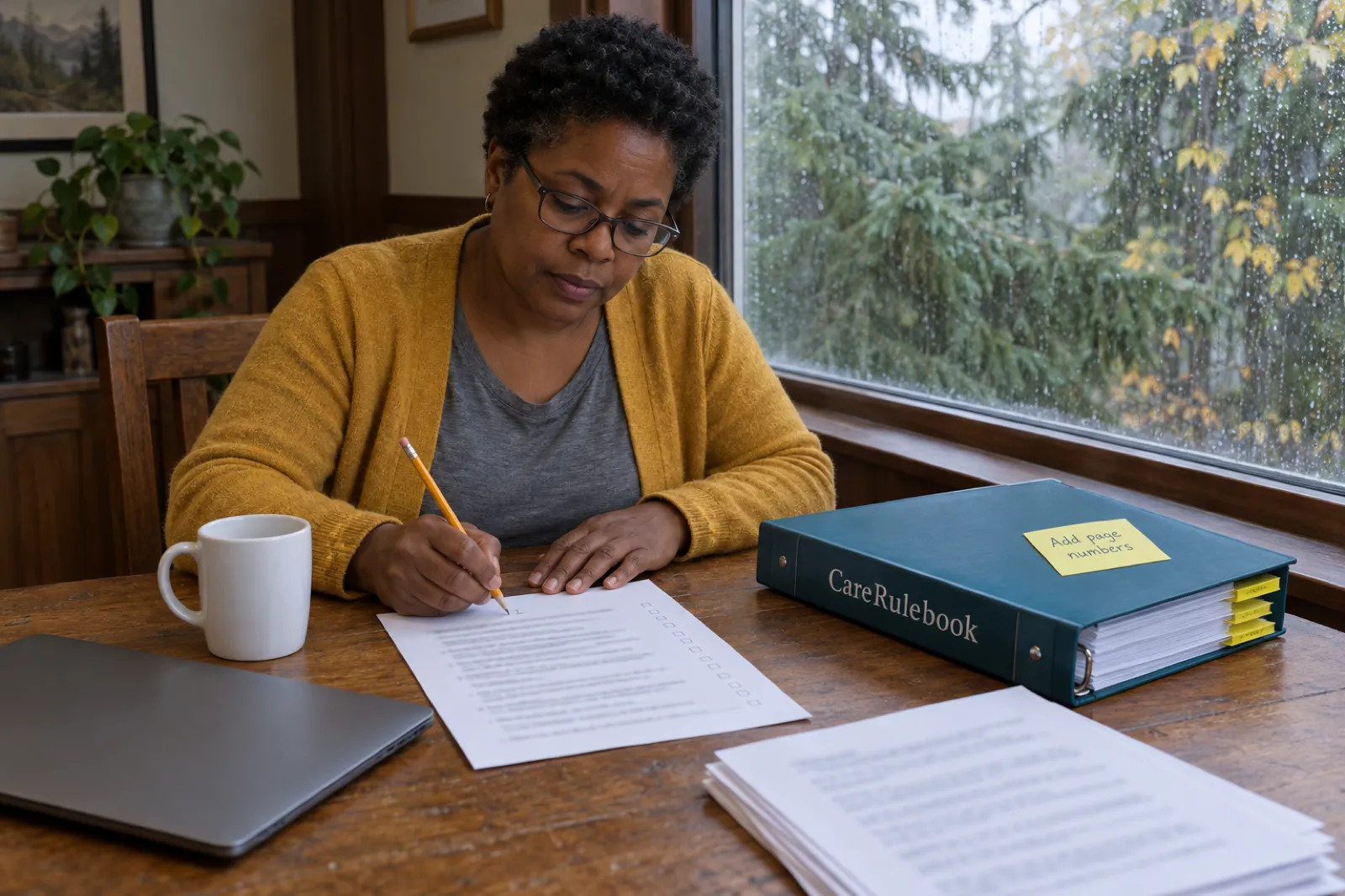
A woman in reading glasses and a mustard cardigan writes a page number on a printed checklist at an oak kitchen table, beside a teal CareRulebook binder with a sticky note reading Add page numbers, with rain on the window and fir trees outside

Quick answer

In Oregon, "A person may not establish, manage or operate an in-home care agency or purport to manage or operate an in-home care agency without obtaining a license from the Oregon Health Authority." (ORS 443.315(1)). An in-home care agency is one "primarily engaged in providing in-home care services for compensation to an individual in that individual’s place of residence" (ORS 443.305(1)), and OHA describes the work as "provide non-medical services using caregivers" (OHA).

Non-medical agencies without a nurse apply as Limited or Basic, which need no nurse (OAR 333-536-0007 Table 1). You apply online, attach all your policies, procedures and forms with OHA’s IHC Initial Checklist completed with page numbers (OHA FAQ 5), and OHA surveys you on site before any services (ORS 443.315(7)). OHA says: "It is currently taking an average of 6-9 months to get through the entire initial application process" (OHA, July 2026).

235

Licensed in-home care agencies on July 1, 2026 (OHA’s count)

OHA July 2026 update

$2,000

Oregon’s nonrefundable initial fee for the Limited class (a state fee, not our price)

ORS 443.315(4)(a)

101

Items on OHA’s IHC Initial Checklist, each with a page number (our count)

OHA IHC Initial Checklist

6 to 9

Months, on average, for the whole initial process, OHA says

OHA July 2026 update

Direct answers

Who licenses non-medical home care in Oregon?

The Oregon Health Authority (OHA), through the In-Home Care program in its Health Care Regulation and Quality Improvement section. The license is an in-home care agency license under ORS 443.305 to 443.350, and the rules are OAR chapter 333, division 536. OHA describes in-home care agencies as providing non-medical services using caregivers.

ORS 443.315(1); OHA forms page

How much does an Oregon in-home care agency license cost?

It depends on the class. Oregon’s initial fee is $2,000 for Limited, $2,250 for Basic, $2,500 for Intermediate and $3,000 for Comprehensive, and it is nonrefundable. Renewal is $1,000 a year for Limited or Basic. These are the state’s fees, set in ORS 443.315, not CareRulebook prices.

ORS 443.315(4); OAR 333-536-0010(3)

Do I need a nurse to open an in-home care agency in Oregon?

Not for the Limited or Basic class. OHA’s classification table requires an employed Oregon registered nurse only for Intermediate (adds medication administration) and Comprehensive (adds nursing services).

OAR 333-536-0007 Table 1

Does OHA review my policies before licensing?

Yes. OHA’s FAQ asks you to attach all your policies, procedures and forms to the online application, with OHA’s IHC Initial Checklist showing the page number of each item. OHA says its admin staff check completeness and a surveyor checks sufficiency, and the on-site survey is scheduled once both are done. This process is OHA’s guidance; the rule itself says OHA confirms a complete application, surveys and assesses compliance.

OHA FAQ 5; July 2026 update; OAR 333-536-0015

Interactive check

Do you need an Oregon in-home care agency license?

What will your business do?

Pick the option closest to your plan.

Who needs a license, and who doesn’t

"An agency that establishes, conducts, or represents itself to the public as providing in-home care services must be licensed by the Authority" (OAR 333-536-0010(1)). In-home care services are "personal care services ... that are necessary to assist an individual in meeting the individual’s daily needs, but does not include curative or rehabilitative services" (ORS 443.305(2)). The personal care tasks are bathing; personal grooming and hygiene; dressing; toileting and elimination; mobility and movement; nutrition, hydration and feeding; care of the client’s body, such as foot or nail care; and medication reminding (OAR 333-536-0045(1)). An agency may add housekeeping and other supportive services (0045(8)).

Only a licensed agency may provide these services or use the name: "No entity shall provide in-home care services or use the term "in-home care agency" in its advertising, publicity, or any other form of communication unless it holds a current valid license as an in-home care agency issued by the Authority." (OAR 333-536-0010(6)).

Who is outside it

  • Housekeeping-only businesses. The licensing law does not apply to "Independent individuals, volunteers, family, neighbors, or to agencies offering only housekeeping or on-call staffing for facilities, or to support services provided and funded by the Oregon Department of Human Services (ODHS)" (OAR 333-536-0010(1)(b)). OHA’s FAQ: "You do not need to be licensed if your business is only providing housekeeping and supportive services such as laundry or shopping and errands." (OHA FAQ 2)
  • Referral and matching services, unless they schedule caregivers, assign work, set pay rates, define working conditions, negotiate for a caregiver or client, or place a caregiver with a client (OAR 333-536-0010(1)(d)). A business that supplies a list of private contractor caregivers is a caregiver registry, a separate license (OHA determination tool).
  • Home health agencies (a different, medical license). A licensed home health agency that provides personal care "is not required to be licensed as an in-home care agency under ORS 443.315" (ORS 443.090(1)). OHA asks it to attest to the in-home care rules: "The ORS requires that the HHA comply with all laws and rules concerning IHC services." (OHA 8953)

Companion-only businesses: our reading

Companionship is not one of the personal care tasks listed in OAR 333-536-0045(1), though the rule’s definition of personal care services says it is "not limited to" that list (OAR 333-536-0005(31)). Our reading: a business that only offers companionship, with no hands-on help and no medication reminders, may be outside the license, as housekeeping-only businesses are. OHA has not said so in writing; its FAQ names housekeeping and supportive services such as laundry, shopping and errands. Ask OHA’s In-Home Care program, or use its licensure determination tool, before relying on it.

The four license classes

Every agency is licensed in one classification, and "No agency licensed by the Authority shall provide services or use a classification title in its advertising, publicity, or any other form of communication other than what the agency is licensed to provide." (OAR 333-536-0007(2)).

Oregon’s four in-home care agency classes: services, medication training, RN employment and Oregon’s fees
LimitedBasicIntermediateComprehensive
ServicesPersonal care, which may include medication remindingAdds medication assistanceAdds medication administration, including filling pill organizersAdds nursing services
Medication training for caregiversNoYesYesYes
Employed Oregon RNNoNoYesYes
Initial fee (Oregon’s)$2,000$2,250$2,500$3,000
Yearly renewal (Oregon’s)$1,000$1,000$1,250$1,500

From the rule and OHA’s Table 1. OAR 333-536-0007(1); OHA Table 1 (effective October 23, 2023); OHA medication guidance; ORS 443.315(4). The fees are the State of Oregon’s, not CareRulebook prices.

  • Limited: "An agency that provides personal care services that may include medication reminding but does not provide medication assistance, medication administration, or nursing services" (0007(1)(a)).
  • Basic: "An agency that provides personal care services that may include medication reminding and medication assistance but does not provide medication administration or nursing services" (0007(1)(b)).
  • Intermediate adds medication administration, and Comprehensive adds nursing services (0007(1)(c)-(d)). OHA’s FAQ says medication and nursing services "require additional conditions for approval. These conditions include additional policies and procedures and a nurse on staff." (OHA FAQ 3). OHA’s FAQ speaks loosely here: under the rule and Table 1, only medication administration (Intermediate) and nursing (Comprehensive) need an employed RN; Basic’s medication assistance does not (OHA Table 1).

Branches and subunits. The service area is "60 miles in any direction from the parent agency or subunit’s physical location" (OAR 333-536-0005(12)). A branch office within that area must be added to the license before it is used (0050(3)(c)), and OHA says "There is no fee charge for branch requests" (OHA). "If an agency provides services from an office that exceeds 60 miles from the location of the parent agency, that office will constitute a subunit of the agency." (0050(4)) A subunit is separately licensed and pays its own fee (0050(4)).

How a new agency gets licensed, step by step

Tick steps off as you go. Your progress is saved in this browser only.

  1. Choose your class and read the rules

    Before applying

    Decide which class fits (see the four classes). OHA’s FAQ asks applicants to read and understand all the rules, which were revised effective October 23, 2023, and says new applicants need policies, procedures and forms that comply with them.

    OHA FAQ 5
  2. Find a qualified administrator

    Before applying

    The owner is qualified or employs an administrator with a high school diploma and at least two years of professional or management experience in a health-related field or program. OHA asks for the administrator’s resume with proof.

  3. Write every policy, procedure and form

    Before applying

    Agency-specific documents for every rule, filed against OHA’s IHC Initial Checklist with a page number for each item. See the 101-item checklist.

  4. Apply in OHA’s online portal

    Day 0

    Since May 12, 2025, initial applications go through OHA’s online licensing portal. Attach the administrator’s resume, a background check request form for any owner or administrator with direct client contact, all policies, procedures and forms, and the completed checklist, and pay the nonrefundable fee. Incomplete applications cannot be submitted.

  5. Completion and sufficiency reviews

    6 to 9 months in all, OHA says

    OHA’s admin staff check your application is complete and a surveyor checks your documents are sufficient. OHA says the whole initial process takes 6 to 9 months on average.

    OHA July 2026 update
  6. Prepare a mock client record and a caregiver file

    Before the survey

    For the survey you need your policies, a quality improvement program plan, a mock client record with every form you will use, and at least one caregiver who has been hired, trained and found competent.

    OHA FAQ 6
  7. The on-site survey

    Before any clients

    Scheduled for a date and time you and the surveyor agree, before any services. OHA inspects on site before services start and once every two years after.

  8. License, then clients

    Within ten business days

    After a passed survey, OHA says the license follows within ten business days, and you may not accept clients until you have it. Post it in an office the public can see.

  9. Renew every year

    Yearly

    A license expires 12 months from issue. Renew in the portal at least 30 days before; unless something changed, the only document OHA needs is the owner or administrator background check form.

OHA’s IHC Initial Checklist: 101 items (our count), each with a page number

The rule asks for written policies and procedures that "include, but are not limited to" ten topics (OAR 333-536-0051):

  1. Administrative operations
  2. Personnel operations: traveling with a client, reporting a change in condition while outside the service area, client care practices, and investigating complaints, adverse events, errors and abuse or neglect allegations
  3. Preemployment screening, criminal records checks and fitness determinations
  4. Client notification: cost increases, deposits and refunds, cancellation, termination, and reimbursement for stolen, broken or misappropriated property or funds
  5. Client records: access, storage, retention and destruction
  6. Infection control
  7. Medical and non-medical emergency response
  8. Medication reminding, assistance and administration
  9. Nursing services
  10. Quality assessment and performance improvement (QAPI)

Summarized from the rule’s list. OAR 333-536-0051(1)-(10)

OHA adds: "Other requirements can be found throughout the rules, including sections 0050, 0052, 0055, 0070, 0075, 0080, and 0093." (OHA policy and procedure memo). Its IHC Initial Checklist turns most of this into one list. "Prospective licensees must develop agency specific policies and procedures (including associated forms or documentation, such as the initial assessment form, disclosure form, etc.) to address and ensure compliance with the In-Home Care (IHC) Oregon Administrative Rules (OARs), Chapter 333, Division 536." It asks you to "fill out the page numbers of this form and include the completed form with the policies and procedures" (IHC Initial Checklist). The checklist has no separate line for medical and non-medical emergency response (OAR 333-536-0051(7)), but the rule still requires that policy, and OHA’s own criteria ask you to "Ensure all requirements contained in the applicable OARs are addressed."

By our count, the checklist has 101 items under 17 rule headings, nearly all listed as a separate policy, procedure, and form or documentation (our count of OHA’s checklist):

OHA’s IHC Initial Checklist headings with our count of items under each
OAR 333-536OHA’s headingItemsWhat the items cover (our summary)
0005Definitions6Abuse policy, procedure and reporting form; qualified trainer, individual and entity policy and determination form; a definitions page
0045Services Provided5Services and safe provision; medication reminding, assisting and (if pertinent) administration; the client self-direct form
0050Organization, Administration, and Personnel11Owner, administration, service area, branch or subunit, travel outside the service area
0051Policies and Procedures16Complaints and incidents, preemployment, notifications, client records, infection control, nursing (Comprehensive), QAPI
0052Administrator5Administrator; change in condition
0053Personnel Records5Personnel record, position description, fitness determination, annual performance
0055 & 0060Disclosure, Screening and Acceptance of Clients & Client’s Rights5Disclosure policy, procedure and statement; client’s rights; service agreement
0065Service Plan6Service plan and initial evaluation
0066Initial Visit and Monitoring6Initial and quarterly visits
0070Caregiver Training9Qualifications, orientation, training, trainer proof, competency exam, annual log; medication training and return demonstration (Basic, Intermediate, Comprehensive)
0075(1-2)(4-6)Medication Services (Basic, Intermediate and Comprehensive)2Medication services policy and procedure
0075(3)Medication Services – Medication Administration (Intermediate and Comprehensive)5MAR, narcotics count, 90-day RN review
0080Nursing Services (Comprehensive)4Nursing policy and procedure, stable and predictable form, delegation form
0082Infection Control4Policy, procedure, active surveillance form, PPE availability
0085Client Records4Policy, procedure, documentation of services, end-of-service summary
0090Quality Assessment and Performance Improvement3Policy, procedure, meeting minutes and committee form
0093Criminal Records Checks5Policy, procedure, fitness determination, weighing test, OHA’s crime list
Total101

Headings in OHA’s words; item counts and summaries are ours. OHA IHC Initial Checklist (in the FAQ and the policy and procedure memo)

Items outside your class

Some headings name the classes they apply to, such as "Medication Services – Medication Administration (Intermediate and Comprehensive)" (IHC Initial Checklist). The checklist does not say how a Limited or Basic applicant should mark the medication administration and nursing items. Ask OHA; a short note that your agency does not provide the service, with the page where your policy says so, is one approach (our suggestion, not OHA’s). Some documents also appear under two headings, such as infection control, QAPI, client records and the fitness determination form.

What OHA will accept

Under the checklist, OHA prints what makes submitted policies and procedures acceptable. In OHA’s words, "In order for submitted policies and procedures to be acceptable, you must:"

  • "Ensure policies and procedures do not only restate OAR language."
  • "Ensure policy statements are clear."
  • "Ensure you include clear procedures, which describe the steps necessary to carry out policies."
  • "Ensure all requirements contained in the applicable OARs are addressed."
  • "Ensure the language contained in the documents submitted do not contradict applicable OAR requirements."
  • "Ensure the language contained in the documents submitted do not contradict language in other documents submitted."
  • "Ensure applicable or referenced forms/documentation were submitted for review."

(IHC Initial Checklist, acceptability criteria)

OHA’s policy and procedure memo adds (OHA memo, May 5, 2025):

  • "Your policies and procedures should match the actual practice of the agency."
  • "Policies and procedures must be updated when Oregon Administrative Rules are revised or the agency’s practice has changed."
  • "If policies or procedures reference a form, the form should be kept with the policy or procedure (as an attachment)."
  • "In order to keep changes to a minimum, use “titles” of positions not names."

The memo’s own example numbers a policy by its rule section, "0065(1-2)" (OHA memo, appendix a), which makes the checklist easier to fill in. It also asks for a definitions page: "Include all IHC Rule definitions in a “definitions page” available for reference" (IHC Initial Checklist).

The reviews before the survey, and the survey itself

Before the survey: completeness and sufficiency

"Incomplete applications cannot be submitted and will not be processed until complete." (OHA FAQ 5) OHA’s July 2026 update describes two reviews: "All applicants get a completion review from the admin staff and a sufficiency review from a surveyor." "Surveys are scheduled once the applicant’s submitted materials have been reviewed and determined to be complete and sufficient." "Insufficiency includes unqualified administrators, missing information (RN or address), or policies and procedures that do not comply with OARs." (OHA, July 2026)

This two-stage process is OHA’s guidance. The rule itself says that in reviewing an application, OHA confirms the fee and a complete application, conducts a survey, and assesses compliance (OAR 333-536-0015).

How long it takes

  • "It is currently taking an average of 6-9 months to get through the entire initial application process", and "Our office is only able to devote ½ FTE Surveyor for 45-60 initial applicants" (OHA, July 2026). OHA’s FAQ said the same in August 2025: "application processing times are currently taking six to nine months." (OHA FAQ)
  • "Applicants who turn in complete and sufficient documentation, return the attestation quickly, and have flexible availability for scheduling the survey may see a shorter processing time." (OHA, July 2026). OHA does not say which attestation it means; ask when you apply.
  • Applicants are generally reviewed first come, first served, but "applicants located in a rural area may be given priority review and survey scheduling" (OHA, July 2026).

The initial on-site survey

The statute says "the authority shall conduct an on-site inspection of each in-home care agency prior to services being rendered and once every two years thereafter as a requirement for licensing." (ORS 443.315(7)). "The survey will be scheduled for a date and time agreed upon by the agency and the surveyor who will conduct the survey." (OHA FAQ 6) OHA’s FAQ lists what to have ready (OHA FAQ 6):

  • all your policies and procedures, well organized and easy to find;
  • forms that document each caregiver’s training;
  • "Quality Improvement Program Plan which demonstrates an assurance of compliance with the OARs";
  • "A mock client record, which contains all documents and forms to be used by the agency";
  • "At least one caregiver record for staff who has been hired, trained and determined to be competent and ready to provide IHC services".

So you hire, screen, orient and train at least one caregiver before you are licensed, without any clients.

Accreditation instead. OHA may accept a federal certification or an accreditation from a body OHA approves in place of the on-site inspection, if the agency lets OHA join any exit interview and gives OHA the documents it asks for (ORS 443.315(8); (8)(a)-(b)).

After the survey

  • Pass: "A license will be issued for your agency or subunit within ten business days." "You are not allowed to accept clients until you have received your license." (OHA FAQ 7)
  • Corrections needed: OHA sends a list of corrections, which must be completed before licensing. "If the request for a new survey is not received within 15 days, or if compliance is not achieved during the second initial survey, the agency will be required to submit a new application, including fee, and repeat all steps of the initial licensure process." (OHA FAQ 8) "If your agency is substantially out of compliance with Chapter 333, Division 536 of the OARs, your application may be denied." (OHA FAQ 8)

Fees

Oregon’s in-home care agency fees and the Fieldprint fingerprint fee
FeeAmountPer
Initial license, Limited (state fee, nonrefundable)$2,000initial license (state fee) ORS 443.315(4)(a)(A)
Initial license, Basic (state fee, nonrefundable)$2,250initial license (state fee) ORS 443.315(4)(a)(B)
Initial license, Intermediate (state fee, nonrefundable)$2,500initial license (state fee) ORS 443.315(4)(a)(C)
Initial license, Comprehensive (state fee, nonrefundable)$3,000initial license (state fee) ORS 443.315(4)(a)(D)
Initial subunit license (state fee)$1,250each subunit (state fee) ORS 443.315(4)(b)
Annual renewal, Limited or Basic (state fee)$1,000year (state fee) ORS 443.315(4)(c)(A)
Annual renewal, Intermediate (state fee)$1,250year (state fee) ORS 443.315(4)(c)(B)
Annual renewal, Comprehensive (state fee)$1,500year (state fee) ORS 443.315(4)(c)(C)
Subunit renewal (state fee)$1,000each subunit per year (state fee) ORS 443.315(4)(d)
Change of ownership between renewals (state fee)$350change of ownership, plus $350 per subunit (state fee) ORS 443.315(4)(e)
Fieldprint fingerprint appointment for owners or administrators with out-of-state history (vendor fee)$60.50appointment, incl. state police and FBI fees (vendor fee) Scheduling

The license fees are the State of Oregon’s, set in ORS 443.315 and paid to OHA. The fingerprint fee is Fieldprint’s. None is a CareRulebook price.

  • Nonrefundable. "The completed application to license an agency must be accompanied by a nonrefundable licensing fee specified in ORS 443.315." (OAR 333-536-0010(3))
  • Changing class. "The fee for change of classification request requires the difference between the initial fee for the current classification and the initial fee for the new classification requested." (OHA change of classification instructions)
  • Caregiver background checks. The agency pays its own screening vendor; the rule sets the vendor standards but no price (OAR 333-536-0093(8)).
  • Owner fingerprints. Owners or administrators with direct client contact who have lived in another state, had an out-of-state address, or been outside Oregon for more than 60 consecutive days in the last five years submit electronic fingerprints through Fieldprint (OHA Fieldprint instructions): "Fingerprint appointments cost $60.50 (which include OSP & FBI processing fees)."
  • Bond and insurance. We found no surety bond and no insurance amount in ORS 443.305 to 443.350 or OAR 333-536 (our reading of the saved text; OAR 333-536). Ask your insurer what cover suits your services.

Penalties (not fees)

  • "An individual who operates an agency without a license is subject to the imposition of a civil penalty not to exceed $500 a day per violation." (OAR 333-536-0125(2))
  • An agency that violates the in-home care laws or rules can face a civil penalty "not to exceed $1,000 per violation and may not total more than $2,000" (OAR 333-536-0125(1)). Each day a violation continues counts as an additional violation (0125(5)).

Medication reminding and OHA’s self-direct form

Medication reminding is a personal care task in every class. It means "providing a client with an audio, visual or oral reminder to take his or her medication when a client is able to self-direct" (OAR 333-536-0005(24)). OHA adds: "This is a personal care service and must not include touching medication or medication containers." (OHA medication guidance)

"Medication reminding or medication assistance services may only be provided by an agency that is licensed and classified to provide those services for a client who can self-direct." (OAR 333-536-0045(3)) Before reminding or assisting, the agency must:

  • "document the client’s knowledge of the following information using a standardized form required by the Authority": the reason for each medication, the dose, the route and the time of day (0045(4)(a));
  • keep a copy of that form, signed by the client, in the client’s record (0045(4)(b), (6)); and
  • re-evaluate: "An agency must evaluate whether a client can continue to self-direct at a minimum of every 90 days." If the client can no longer self-direct, arrange the right services without delay or transfer the client to an agency in a higher class within 30 days (0045(5)).

The standardized form is OHA’s Medication Self-Direct Evaluation Tool. It says: "Any time you are asked to provide medication reminding or medication assistance to a client, the following questions must be asked and answered affirmatively by the client." (OHA form) Self-direct evaluation, medication reminding and reminding documentation were all among OHA’s ten most cited survey tags from January to July 2026; self-direct evaluation was cited 14 times (OHA, July 2026).

Assistance and administration

  • Medication assistance (Basic and above). "Medication assistance does not include putting medication in the client’s mouth, eyes, ears, nose, applying medicated lotions/cremes/salves, or crushing or modifying the medication." (OHA medication guidance) A family member or client representative may fill secondary containers under a signed agreement with the agency (OAR 333-536-0075(2)).
  • Pill organizers. "Medication Set-up, moving medication from the original container into a secondary container, is medication administration" (OHA medication guidance), which needs the Intermediate or Comprehensive class.
  • Injectables. "Medication administration to provide injectable medication to clients must include a delegation from an Oregon licensed Registered Nurse (RN) prior to administration and can only be provided by Comprehensive IHCs." (OHA medication guidance)
  • Naloxone. OHA’s January 2026 update answered a question about Narcan: "Narcan = medication administration", which must meet the medication administration rule (0075(3)). OHA said agencies may request a waiver, with a training plan and clear service plan documentation, if they expect to need it (OHA, January 2026).

Caregiver orientation, training and agency trainers

Oregon caregiver orientation, training and education by class
StepHoursWhenClassesWho teaches
OrientationAt least 4Before working independentlyAllAdministrator, designee or delegate
Initial caregiver trainingAt least 82 before any services; the rest within 120 days of hireAllQualified trainer, individual or entity
Competency evaluationUp to 1 counts toward the 8Before working independentlyAllAdministrator or designee
Medication training and return demonstrationAt least 4Before any medication servicesBasic, Intermediate, ComprehensiveQualified individual or entity; a qualified individual watches the demonstration
Annual education6, plus 1 for medication servicesEvery yearAllSee where the sources disagree

Summarized from the rule. OAR 333-536-0070(5)-(8), (14); OHA training memo (rev. 06/2024)

  • Orientation. "Caregivers shall complete an agency-specific orientation, conducted by the agency administrator, administrator's designee, or administrator's delegate before independently providing services to clients." "The orientation shall be a minimum of four hours, obtained online or in person", and covers ten subject areas, from the caregiver’s job description and clients’ rights to what counts as medication reminding and its limits (OAR 333-536-0070(5)).
  • Initial training and competency. "Caregivers shall complete appropriate caregiver training from a qualified individual, qualified entity, or qualified trainer and must have their competency evaluated and documented by the administrator or administrator's designee before independently providing services to clients." "The competency evaluation shall include a combination of both direct observation and written or oral testing." (0070(6)) The eight hours cover 14 listed topics, as applicable to your services, from medical emergencies and adverse behaviors to cultural competence and first aid (0070(7)).
  • Medication training (Basic and above). "Caregivers assigned to provide medication services must obtain a minimum of four hours of basic non-injectable medication training before providing the services." The caregiver’s techniques "must be evaluated by a qualified individual through a successful return demonstration." (0070(8)) A qualified individual is someone who has completed an OHA-approved program, "is currently an LIP, registered nurse, licensed practical nurse, physician associate, or pharmacist", or another health professional OHA approves (0005(37)). OHA says "at this time there are no Authority approved training programs to become a qualified individual to provide caregiver or medication training" (OHA memo), and its training memo says the return demonstration "must be conducted by a Qualified Individual (see 333-5360005(37)(b) for a list of acceptable qualified individuals)": an LIP, RN, LPN, physician associate or pharmacist (OHA training memo). Limited agencies give no medication services, so their caregivers need none of this.
  • Licensed caregivers. "A caregiver with proof of a current Oregon health-care related license or certificate is exempt from in-home caregiver training." (0070(13)) OHA’s training memo says medication training is still required for caregivers who give medication services (OHA training memo).
  • Records. "Orientation, Caregiver Training, and Medication Training all need to be separately documented in order to ensure topic, length, and instructor requirements have been met." (OHA training memo) When an agency records all its training on one day, OHA’s April 2026 update says: "Payroll records must show the full 16 hours of training time required, plus any additional competency evaluation time, completed on that same day." (OHA, April 2026). OHA’s 16 hours is orientation, caregiver training and medication training together (4 + 8 + 4); a Limited agency’s caregivers need no medication training.

Training your own caregivers

An agency can designate its own qualified trainer, who "has two or more years of experience working with an agency, a long-term care facility as defined under ORS 442.015, a residential care facility as defined under ORS 443.400, or other health care setting" and, if the trainer is a caregiver, is current with the caregiver training rules (OAR 333-536-0005(38)(b)). OHA says "at this time there are no Authority approved training programs to become a qualified trainer to provide caregiver training", and "a qualified trainer can conduct agency specific orientation" (OHA qualified trainer memo, updated September 16, 2026). OHA also says a qualified trainer cannot teach the medication training; that needs a qualified individual or entity (OHA memo). Keep proof that each trainer or entity qualifies (0070(10)).

OHA also lists approved online qualified entities by name and what each is approved for (OHA memo). "QE courses cannot be mixed between entities, the entire program must be completed for each QE." (OHA memo) Check the current list before you choose, as OHA updates the memo.

The administrator, and RN duties by class

The administrator

"An agency owner shall be qualified or employ a qualified administrator." In the rule, qualified means "possessing a high school diploma and having at least two years of professional or management experience in a health-related field or program" (OAR 333-536-0052(1)-(2)). Professional experience means a nursing, CNA, medication aide, medical or therapeutic license, certificate or degree used in a health-related field, or an OHA-approved training program; management experience means supervising people in a health-related field, including hiring, assigning, evaluating and discipline (0005(35); 0005(20)).

The administrator or designee is accessible during all hours services are provided and "shall be on-site at the agency multiple days per week" (0052(5)-(6)). A designee named in writing covers temporary absences and meets every administrator qualification (0052(3)); OHA’s January 2026 update says "Designee must be temporary only" (OHA).

Registered nurse duties in the Oregon in-home care rules, by class
ClassRN duties in the rules
LimitedNone. No medication services, so no medication training either.
BasicNo RN required. A qualified individual (OHA’s training guide points to a licensed independent practitioner, RN, LPN, physician associate or pharmacist) watches each caregiver’s medication return demonstration; medication training comes from a qualified individual or entity.
IntermediateEmploy an Oregon-licensed RN. The agency’s medication administration policies cover RN supervision; telephone orders are recorded by the RN and sent to the practitioner for signature within 72 hours; an RN evaluates each client’s medication regimen every 90 days; the RN sits on the quality improvement committee.
ComprehensiveAll of the above, plus nursing services by the employed RN, only for clients who are stable and predictable, with teaching and delegation under the Board of Nursing’s rules (OAR 851-047). OHA’s medication guidance adds that injectable medication needs RN delegation first and only Comprehensive agencies may give it.

OHA Table 1; OAR 333-536-0075(3); 0075(3)(d), (6); 0075(3)(e); 0090(4); 0080; 0070(8); OHA training memo; OHA medication guidance (injectables)

Whatever the class, the disclosure statement each client signs states the agency’s classification and services, including the extent of RN involvement, and "a clear statement indicating that it is not within the scope of the agency’s license to manage the medical and health conditions of clients who are no longer stable and predictable" (OAR 333-536-0055(3)). "A client who is no longer stable and predictable may only receive housekeeping or other support services from the agency." (0055(4)(a))

Background checks, and what HB 4115 changed

The statute: "An in-home care agency shall conduct a criminal background check before hiring or contracting with an individual and before allowing an individual to volunteer to provide services on behalf of the in-home care agency, if the individual will have direct contact with a client of the in-home care agency." (ORS 443.004). If the check shows a conviction for a crime listed in ORS 443.004, "the home health agency or in-home care agency may not employ the individual" (ORS 443.004(6), formerly (4); renumbered by HB 4115); OHA publishes the crime list.

  • Before hire. "An agency shall conduct a criminal records check and make a fitness determination before hiring an SI" who will have direct contact with a client (OAR 333-536-0093(2)). Your written policy covers the barred crimes, preliminary fitness and a documented weighing test for other convictions (0093(5)-(7)).
  • The vendor. A screening company accredited by the National Association of Professional Background Screeners (NAPBS), or one in business at least two years with the licenses its home state requires and at least $1 million of errors and omissions insurance (0093(8)).
  • What the check covers. A name and address trace, identity verification, local records for the last seven years, a nationwide criminal database search, a nationwide sex offender registry search, and arrest, warrant and conviction data with sources (0093(10)). "An agency shall perform and document a query of the List of Excluded Individuals and Entities (LEIE)." (0093(11))
  • While results are pending. "an agency may employ an individual pending the outcome of a criminal records check if the agency ensures that there is no direct contact with any client prior to making a final fitness determination." Document a preliminary fitness determination, keep the person actively supervised at all times, and keep a written employee disclosure in their file saying they may have no client contact until the check is complete (0093(4)). For staff serving ODHS Medicaid clients, preliminary hire follows the BCU’s rule (OAR 407-007-0315) instead (0093(9)(b)).
  • Every three years. "An agency shall ensure that a criminal records check is performed on an SI every three years from the date of the SI’s last criminal records check in accordance with these rules." (0093(13))
  • Medicaid (ODHS) clients. "The agency shall submit a criminal records check request on any SI working with an ODHS client to the ODHS, Background Check Unit (BCU)." (0093(9)) "The BCU shall make the final fitness determination for an SI working with an ODHS client." A BCU check replaces the vendor check for that person (0093(9)(c), (f)).
  • Owners and administrators. OHA, not the agency, checks an owner or administrator who has direct contact with clients, at application and every three years (0010(4); 0093(14)). "If you have criminal history, the Health Care Regulation & Quality Improvement (HCRQI) program will weigh several factors to decide if you are fit for the license/position for which you are applying." (OHA background check request form)
  • After hire. Staff with client contact report "any new arrests, charges, or convictions after hire to determine if any personnel action is necessary" (0052(7)(a)).

HB 4115 (2026)

Oregon Laws 2026, chapter 59 (HB 4115), in force since June 5, 2026, amended ORS 443.004. The amendments apply to checks completed on or after that date (Oregon Laws 2026, ch. 59, section 3):

  • Three years. For checks completed on or after June 5, 2026, the statute says: "Except as provided by the authority by rule, a criminal background check under this subsection shall last for three years." (ORS 443.004(3)(c) as amended). That matches the three-year re-check the rule already sets.
  • Portable BCU checks. A valid check means a current, approved check completed by the ODHS Background Check Unit (ORS 443.004(1)(i) as amended). ODHS and OHA may not require a new check on a worker who holds one solely because the worker changes employer or care setting (ORS 443.004(4)(a) as amended), and both must publish how portability works ((4)(b)). OHA has not said how this fits with the agency’s own pre-hire check under OAR 333-536-0093(2); ask OHA. Under the rule, "to maintain portability, the SI must be rechecked through the BCU every three years." (OAR 333-536-0093(9)(d))

The official ORS page still shows the 2025 edition, so we cite the session law for these changes.

Reporting abuse, neglect and exploitation

What the agency must do

  • The administrator ensures "the timely reporting of any allegation of abuse or neglect to the appropriate authority that includes but is not limited to the ODHS, Authority, or local law enforcement agency" (OAR 333-536-0052(6)(i)). Among the rule’s listed violations: "Fail to report suspected abuse of elderly persons as defined in ORS 124.050" (0110(6)).
  • Investigate every complaint, adverse event, error and abuse or neglect allegation, and keep the documentation in a separate file from client and caregiver records (0051(2)(d); 0052(6)(h)).
  • "An agency shall cooperate with investigations of allegations of client abuse and neglect conducted by the ODHS- Adult Protective Services, ODHS-Child Protective Services, Authority, or other agencies such as law enforcement." (0043(4))
  • OHA’s checklist asks for an abuse policy, an abuse procedure and an abuse reporting form (IHC Initial Checklist).

What caregivers report themselves (our reading)

Oregon’s three reporting laws each list "home health aide or employee of an in-home health service" among mandatory reporters: for people 65 or older (ORS 124.050(9)(b)), for children (ORS 419B.005(6)(d)), and for certain adults with developmental disabilities, mental illness or substance use disorders who receive services from a community program, facility or state hospital, as ORS 430.735 defines them (ORS 430.735(11)(b)). The statutes do not say "in-home care agency", but ODHS’s Medicaid rule says "All employees of an in-home health service, which does include IHCA are required by statute (ORS 124.050-124.095) to report suspected abuse or neglect" (OAR 411-033-0020(5)(b), an ODHS program rule). Our reading: treat every caregiver as a mandatory reporter.

  • How. For elder abuse, "an oral report shall be made immediately by telephone or otherwise to the local office of the Department of Human Services or to a law enforcement agency" (ORS 124.065(1)). OHA’s FAQ: "All abuse reporting can be made to the main hotline at 1-855-503-SAFE (7233)." (OHA FAQ 12)
  • OHA’s guidance. If you have reasonable cause to believe a client is being or has been abused, "you are required to report this information to the appropriate Department of Human Services (DHS) office immediately." (OHA abuse reporting guidelines)

A gap. We found no deadline in the rules or OHA’s guidance for the agency to tell OHA itself about an abuse report, beyond the duty to ensure timely reporting to ODHS, OHA or police. Ask OHA what it expects.

After you are licensed

  • Surveys every two years. The rule has OHA "conduct at least one survey of each agency prior to services being rendered and once every two years thereafter" (OAR 333-536-0041(1)). "The Authority shall notify the agency owner and administrator no less than 72 hours prior to the date of an initial or biennial licensing survey." (0041(2)) OHA’s January 2026 update adds: "No rescheduling of surveys" (OHA). "An unannounced complaint investigation shall be carried out as soon as practicable" (0043(1)).
  • What the notice asks for. OHA’s relicensure memo asks for lists of clients, caregivers and nurses, and "a list of complaints, which include allegations of abuse or neglect, adverse events, and medication or treatment errors" (OHA relicensure memo).
  • Deficiencies. "A signed plan of correction must be mailed to the Authority within 10 business days from the date the statement of deficiencies was received by the agency." (0117(3)) "An agency shall correct all deficiencies within 60 days from the date of the exit conference" (0117(4)). OHA’s tip: "Ensure you are addressing all five of the required POC elements." (OHA plan of correction guidance)
  • What OHA cites most. In 2025, service plan elements (tag 0530) was cited 46 times, the most of any tag (OHA, January 2026). From January 1 to July 1, 2026, client records (tag 0675) led with 20 citations, followed by caregiver orientation (OHA, July 2026).
  • Changes. "An agency shall submit a revised application to the Authority within 30 days of the change." (0010(5)) A new administrator, a change of classification, and a branch or subunit need OHA’s approval before they take effect (0010(5)(a)). To change class, OHA asks you to "attach all agency Policies and Procedures, revised as required for updated classification requested" (OHA change of classification instructions).
  • Keep policies current. "Policies and procedures must be updated when Oregon Administrative Rules are revised or the agency’s practice has changed." (OHA memo)
  • Non-competes. ODHS, OHA and the Oregon Home Care Commission say "it is not a legal practice to require in-home agency caregivers to sign these agreements" (provider alert, October 26, 2023).
  • Medicaid (a program, not the license). "In-home care agency (IHCA) services are one of the in-home service options available for individuals eligible for Medicaid in-home services." Under that ODHS program rule, "the IHCA shall begin services within five business days from the date of acceptance" of a referral (OAR 411-033-0020, an ODHS program rule).

Rule changes

  • HB 4115 (in force). Oregon Laws 2026, chapter 59 (HB 4115), in force since June 5, 2026, amended ORS 443.004. For checks completed on or after that date, an in-home care agency’s background check lasts three years unless OHA’s rules say otherwise, and ODHS and OHA may not require a new check on a worker who holds a valid ODHS Background Check Unit check solely because the worker changes employer or care setting. We found no amendment to OAR 333-536 that follows it. See background checks (Oregon Laws 2026, ch. 59).
  • OAR 333-536. The rules were rewritten in 2021 and last amended in 2023 (OHA says the revised rules took effect on October 23, 2023: OHA FAQ 5), with a minor correction to the definitions in 2024. On our check of October 8, 2026, OHA’s rulemaking page listed no in-home care proposal, filing or advisory committee (OHA rulemaking page). We could not search the Oregon Bulletin, so we cannot rule out a notice there.
  • OHA’s guidance moves faster than the rules. The qualified trainer memo was updated on September 16, 2026 (OHA memo), and OHA publishes an update each quarter with its most cited tags (July 2026 update). Check OHA’s forms page before you submit.

We will email rule-change alerts when OHA proposes a change (sign up below), and all states’ open changes are on our rule changes page.

Where the sources disagree, and our readings

  • Who may teach the six annual hours. The rule says annual education comes "from a qualified trainer, qualified individual or qualified entity" (OAR 333-536-0070(14)), and its definition lets an agency designate a qualified trainer for "agency specific orientation, initial caregiver training and annual caregiver training required by these rules" (0005(38)(b)). OHA’s quick reference guide lists "QE or QI as defined by Rule" for continued education (OHA training memo, rev. 06/2024). Our reading: the rule allows your own qualified trainer; until OHA confirms, using a qualified individual or entity for the annual hours satisfies both.
  • A new administrator. The rule says a change of administrator needs OHA’s approval before it takes effect (OAR 333-536-0010(5)(a)). OHA’s FAQ says: "If the ownership, address, or administrator of your agency or subunit changes at any time, you must notify this office, in writing, within 30 days of the change." (OHA FAQ 9) Our reading: get approval first, as the rule says.
  • The review before the survey. The completeness and sufficiency reviews, the checklist with page numbers and the acceptability criteria are OHA’s guidance. The rule says OHA confirms a complete application, surveys and assesses compliance (OAR 333-536-0015). In practice, follow OHA’s process: it decides when your survey is scheduled.
  • Companion-only businesses. Covered above: on our reading possibly outside the license, not confirmed by OHA.
  • Caregivers as mandatory reporters. The statutes say "employee of an in-home health service", and ODHS’s Medicaid rule says that includes in-home care agencies (above). Our reading: every caregiver reports.
  • Home offices. We found no office type or zoning standard in the rules, but the license is posted "in an office that is viewable by the public" (0021(3)), client records are kept in the agency’s office (0085(1)), and the administrator is on site at the agency multiple days per week (0052(6)(a)). Ask OHA before relying on a home office.
  • The rule text we quote. We quote OAR 333-536 from the Cornell Legal Information Institute’s copy (LII), because the Secretary of State’s rule database blocks our tools. We compared that copy’s history notes for all 35 rules with the official division 536 list on October 8, 2026, and they match. The statutes are quoted from the Legislature’s official 2025 edition.

Is there a CareRulebook manual for Oregon?

Not yet. We do not sell an Oregon manual, and this guide is free.

What we suggest if you are writing your own: pick your class first, then work through OHA’s checklist heading by heading, write each policy in your own words with step-by-step procedures, keep each form with its policy, use job titles rather than names, and number your pages as you go so the checklist is easy to fill in. Sign up for Oregon rule-change alerts below. If you are weighing another state, our policy requirements by state table shows where we do sell a manual.

How many in-home care agencies does Oregon have?

OHA’s own counts: "Total IHC Agencies Licensed: 235 as of 7/1/2026" (OHA, July 2026), up from 217 on January 1 and 223 on April 1, 2026 (January; April). "Licensed IHC agencies have increased 88% since 2012 (125 in 2012 vs. 235 in 2026)." (OHA)

  • New licenses (initial surveys that led to a license, OHA’s count): 20 in 2024, 17 in 2025 (OHA, January 2026) and 24 from January 1 to July 1, 2026 (OHA, July 2026).
  • Applications. "Initial applications have increased 241% since 2020 (17 in 2020 vs 58 in 2025)." OHA had 50 submitted applications in the queue in July 2026 and says its queue has stayed between 45 and 60 since 2023 (OHA, July 2026).
  • Who applies. Since 2023, OHA says, "nearly half of all applicants have held another ODHS license, most commonly adult foster home licensure", and a quarter of applicants do not live in Oregon (OHA, July 2026). OHA issued 9 subunit licenses from 2020 to 2025 and 6 in 2026 by July (OHA).

OHA’s public list of licensed agencies is blocked to our tools, so we cannot say how many hold each class.

Oregon home care myths, checked against the source

Fifteen common questions, each with the rule or guidance it rests on.

Do companion or housekeeping-only businesses need an Oregon in-home care license?

It depends. A business that only provides housekeeping and supportive services, such as laundry, shopping and errands, does not need the license, OHA says. Once you help with personal care, such as bathing, dressing, toileting, mobility or eating, or remind clients about medication, you do. Companionship is not one of the personal care tasks in the rule, so on our reading a companion-only business may be outside the license, but OHA has not said so; ask OHA, or use its determination tool.

"You do not need to be licensed if your business is only providing housekeeping and supportive services such as laundry or shopping and errands."

Do I need a nurse to open an in-home care agency in Oregon?

It depends. Not for a Limited or Basic agency. Oregon has four license classes. Limited (personal care plus medication reminding) and Basic (adds medication assistance) do not need an RN. Intermediate (medication administration, including filling pill organizers) and Comprehensive (nursing services) must employ an Oregon-licensed registered nurse.

"Registered Nurse No No Yes Yes"

Does Oregon review my policies before licensing my agency?

Yes. OHA’s FAQ asks you to attach all your policies, procedures and forms to the application, with OHA’s IHC Initial Checklist showing the page where each item sits. OHA says its admin staff check the application is complete and a surveyor checks the documents are sufficient, and the on-site survey is scheduled once both are done. At that survey you also need a mock client record and at least one trained caregiver file.

"All applicants get a completion review from the admin staff and a sufficiency review from a surveyor."

Can I just copy the Oregon rules into my policy manual?

No. OHA’s checklist says policies must not only restate the rule language, must include clear step-by-step procedures, must not contradict the rules or each other, and must come with the forms they mention. OHA’s July 2026 update counts policies that do not comply with the rules as insufficient, and it schedules surveys only once materials are complete and sufficient.

"Ensure policies and procedures do not only restate OAR language."

Can a Limited in-home care agency remind clients to take their medication?

It depends. Yes, but only for a client who can self-direct. Before reminding, document the client’s knowledge of each medication on OHA’s standardized self-direct form, keep the copy the client signed, and check at least every 90 days that they can still self-direct. Reminding means a spoken, visual or audio reminder; OHA says it must not include touching medication or its containers. Client self-direct evaluation was among the ten tags OHA cited most in 2025 and in the first half of 2026.

"Medication reminding or medication assistance services may only be provided by an agency that is licensed and classified to provide those services for a client who can self-direct."

Can my caregivers fill weekly pill organizers in Oregon?

It depends. Only in an Intermediate or Comprehensive agency. OHA says moving medication from the original container into a secondary container is medication administration, and an agency that administers medication employs an RN, gets practitioner orders, keeps medication records and has an RN review each client’s regimen every 90 days. Otherwise, a client representative or family member may fill the containers under a signed agreement with the agency, and caregivers of an agency classified for medication services (Basic and above) may then assist.

"Medication Set-up, moving medication from the original container into a secondary container, is medication administration"

How much does an Oregon in-home care agency license cost?

It depends. The state fee depends on the class: $2,000 Limited, $2,250 Basic, $2,500 Intermediate or $3,000 Comprehensive to start, then $1,000 a year to renew a Limited or Basic license ($1,250 Intermediate, $1,500 Comprehensive). Each subunit adds $1,250. Fees are nonrefundable. Owners or administrators with direct client contact who have out-of-state history also pay Fieldprint $60.50 for fingerprints.

"Limited, the fee is $2,000."

How long does it take to get an Oregon in-home care agency license?

It depends. OHA says six to nine months on average. It has about half a surveyor for 45 to 60 initial applications. OHA says complete and sufficient documents, a quick return of the attestation and flexible survey dates may shorten it, and rural applicants may be given priority. After a passed survey the license comes within ten business days.

"It is currently taking an average of 6-9 months to get through the entire initial application process"

Do Oregon in-home caregivers need training?

Yes. At least four hours of agency orientation and eight hours of initial caregiver training (two before the first shift, the rest within 120 days of hire), with a competency evaluation before working independently, then six hours a year. Caregivers who give medication services add four hours of medication training with a return demonstration, and one extra hour a year. Caregivers with a current Oregon health care license or certificate are exempt from the caregiver training; OHA says medication training is still required for medication services.

"A caregiver shall receive a minimum of eight hours of initial caregiver training:"

Can my agency train its own caregivers in Oregon?

Yes. For orientation and caregiver training. You can designate a qualified trainer with two or more years of experience in an agency or care setting, and OHA has no approved trainer course to take. Medication training is different: it must come from a qualified individual (such as an RN, LPN or pharmacist) or an OHA-approved entity, and the return demonstration must be watched by a qualified individual.

"At this time there are no Authority approved training programs to become a qualified trainer to provide caregiver training."

Can a new Oregon caregiver start before the background check comes back?

It depends. Only away from clients. The rule lets you employ someone while the check is pending if they have no direct contact with any client before your final fitness determination. You also document a preliminary fitness determination, keep them actively supervised at all times, and keep a written employee disclosure in their file saying they may have no client contact until the check is complete. For staff serving ODHS Medicaid clients, preliminary hire follows the Background Check Unit’s rule (OAR 407-007-0315) instead.

"an agency may employ an individual pending the outcome of a criminal records check if the agency ensures that there is no direct contact with any client prior to making a final fitness determination."

Are Oregon in-home caregivers mandatory abuse reporters?

Yes. On our reading of the statutes, yes. Oregon’s abuse reporting laws list home health aides and employees of an in-home health service, and ODHS’s own Medicaid rule says that includes in-home care agencies. Report suspected abuse immediately by phone to ODHS (855-503-SAFE) or the police. The agency must also make sure every allegation is reported and investigated, and failing to report suspected elder abuse is a rule violation.

"Licensed practical nurse, registered nurse, nurse practitioner, nurse’s aide, home health aide or employee of an in-home health service."

Can I run an Oregon in-home care agency from home?

It depends. We found no office type or zoning standard in the Oregon rules. They do require you to post the license in an office the public can see, keep client records in the agency’s office, keep agency records separate from other businesses, and have the administrator or designee on site at the agency several days a week. Check with OHA and your local zoning before relying on a home office.

"The license shall be conspicuously posted in an office that is viewable by the public."

Can I open an Oregon in-home care agency if I live in another state?

It depends. We found nothing in the rules that bars an owner who lives in another state, and OHA says a quarter of applicants since 2023 do not live in Oregon. But the agency’s service area is within 60 miles of its office, the administrator or designee must be on site at the agency several days a week, and owners or administrators with direct client contact who have lived in another state, had an out-of-state address, or been outside Oregon for more than 60 consecutive days in the last five years submit fingerprints.

"25% of the applicants are from people that do not live in Oregon."
Frequently asked questions

How long does it take to get an in-home care agency license in Oregon?

OHA says it is taking an average of 6 to 9 months to get through the whole initial application process, with half a surveyor’s time for 45 to 60 initial applicants. Complete and sufficient documents, a quick return of the attestation and flexible survey dates may shorten it, and rural applicants may get priority. After a passed survey, the license follows within ten business days.

What is the difference between the Limited and Basic classes?

Both provide personal care, which may include medication reminding. Basic adds medication assistance, so caregivers who give medication services need four hours of medication training and a return demonstration watched by a qualified individual. Neither class needs an RN. Oregon’s initial fee is $2,000 for Limited and $2,250 for Basic, and both renew at $1,000 a year.

Can I use the same policies for a Limited and a Basic license?

Not as they stand. An agency may advertise and provide only the services of its licensed class, and changing class means attaching all your policies and procedures, revised for the new class, to the request. Your medication policies and disclosure statement should match your class.

Can I run an Oregon in-home care agency from home?

We found no office type or zoning standard in the rules. They do require the license to be posted in an office the public can see, client records kept in the agency’s office, and the administrator or designee on site at the agency several days a week. Ask OHA and your local zoning office before relying on a home office.

Do Oregon in-home caregivers need CPR?

No. The initial caregiver training includes abdominal thrust and first aid, and the rule says CPR is recommended but not required.

Can my agency make caregivers sign a non-compete?

ODHS, OHA and the Oregon Home Care Commission said in October 2023 that it is not a legal practice to require in-home agency caregivers to sign non-compete agreements.

Does CareRulebook sell an Oregon manual?

No, not yet. We publish this free guide and send free Oregon rule-change alerts. If you are writing your own manual, build it against OHA’s IHC Initial Checklist and the acceptability criteria printed under it.

Get Oregon rule-change alerts

We will email you when OHA proposes changes to OAR 333-536, or changes its checklist, training or medication guidance, with what it means for your agency.

No spam. Only emails about Oregon home care rules. How we use your email.

Keep reading

Sources

  1. OAR chapter 333, division 536, In-Home Care Agencies (OAR 333-536-0000 to 333-536-0125) · Oregon Health Authority, Public Health Division (Oregon Secretary of State, Oregon Administrative Rules Database; text saved from the Cornell LII mirror) · retrieved October 8, 2026
  2. ORS chapter 443 (2025 edition): ORS 443.004, 443.011, 443.013, 443.090 and 443.305 to 443.350 · Oregon State Legislature, Legislative Counsel · retrieved October 8, 2026
  3. ORS 124.050 to 124.065, abuse of elderly persons: definitions and duty to report · Oregon State Legislature, Legislative Counsel · retrieved October 8, 2026
  4. ORS 430.735 and 430.765, abuse of adults with mental illness or developmental disabilities · Oregon State Legislature, Legislative Counsel · retrieved October 8, 2026
  5. ORS 419B.005, child abuse reporting: definitions · Oregon State Legislature, Legislative Counsel · retrieved October 8, 2026
  6. Oregon Laws 2026, chapter 59 (HB 4115), amending ORS 443.004 (effective June 5, 2026) · Oregon State Legislature · retrieved October 8, 2026
  7. HCRQI Forms and Applications page, In-Home Care Agencies (IHC) section · Oregon Health Authority, Health Care Regulation and Quality Improvement · retrieved October 8, 2026
  8. HCRQI Rulemaking Activity page · Oregon Health Authority, Health Care Regulation and Quality Improvement · retrieved October 8, 2026
  9. IHC Initial Application FAQs and Information, with the IHC Initial Checklist (updated 08/01/2025) · Oregon Health Authority, In-Home Care program · retrieved October 8, 2026
  10. IHC Policy and Procedure Guidance memo (5/5/2025), with the IHC Initial Checklist · Oregon Health Authority, In-Home Care program · retrieved October 8, 2026
  11. In-Home Care (IHC) Update, January 2026 (survey activity 2024-25, top citations) · Oregon Health Authority, In-Home Care program · retrieved October 8, 2026
  12. In-Home Care (IHC) Update, April 2026 · Oregon Health Authority, In-Home Care program · retrieved October 8, 2026
  13. In-Home Care (IHC) Update, July 2026 (initial licensure trends) · Oregon Health Authority, In-Home Care program · retrieved October 8, 2026
  14. OAR 333-536-0007 Table 1: In-Home Care License Classification Table (effective October 23, 2023) · Oregon Health Authority, In-Home Care program · retrieved October 8, 2026
  15. IHC Agency Caregiver Orientation, Training, and Competency Evaluation memo and quick reference guide (rev. 06/2024) · Oregon Health Authority, In-Home Care program · retrieved October 8, 2026
  16. IHC Qualified Individual, Qualified Entity, and Qualified Trainer Memo (updated September 16, 2026) · Oregon Health Authority, In-Home Care program · retrieved October 8, 2026
  17. IHC Services: Medication Reminding, Medication Assistance and Medication Administration Guidance (updated 9/2024) · Oregon Health Authority, In-Home Care program · retrieved October 8, 2026
  18. Medication Self-Direct Evaluation Tool (updated October 2023) · Oregon Health Authority, In-Home Care program · retrieved October 8, 2026
  19. In-Home Care Mandatory Abuse Reporting Guidelines (last updated October 2023) · Oregon Health Authority, In-Home Care program · retrieved October 8, 2026
  20. IHC Relicensure Survey Information (5/12/2025) · Oregon Health Authority, In-Home Care program · retrieved October 2, 2026
  21. In-Home Care Statement of Deficiency (SOD) and Plan of Correction (POC) Guidance (5/12/2025) · Oregon Health Authority, In-Home Care program · retrieved October 8, 2026
  22. IHC Service Plan Signature Requirements Clarification (January 3, 2025) · Oregon Health Authority, In-Home Care program · retrieved October 8, 2026
  23. IHC Change of Classification Request Instructions (5/1/2025) · Oregon Health Authority, In-Home Care program · retrieved October 8, 2026
  24. IHC Branch Request Instructions (05/01/2025) · Oregon Health Authority, In-Home Care program · retrieved October 8, 2026
  25. In-Home Care (IHC) Online Licensure Portal: Renewing your license (May 2025) · Oregon Health Authority, In-Home Care program · retrieved October 8, 2026
  26. In-Home Care Owner/Administrator Background Check Request (revised 02/2024) · Oregon Health Authority, Health Care Regulation and Quality Improvement · retrieved October 8, 2026
  27. Fieldprint Livescan Fingerprinting Instructions for In-Home Care Agencies (revised Oct 2026) · Oregon Health Authority, Health Facility Licensing and Certification Program · retrieved October 8, 2026
  28. ORS 443.004 Crimes (home health and in-home care agency background check crime list) · Oregon Health Authority, Public Health Division · retrieved October 8, 2026
  29. IHC Licensure Determination Tool (last updated 02/2018) · Oregon Health Authority, Health Facility Licensing and Certification · retrieved October 8, 2026
  30. In-Home Care services provided under the Home Health Agency license, and HHA attestation (OHA 8953) · Oregon Health Authority, Health Care Regulation and Quality Improvement · retrieved October 8, 2026
  31. In-Home Agency Providers: non-competition agreements alert (October 26, 2023) · Oregon Department of Human Services (Aging and People with Disabilities), Oregon Health Authority and Oregon Home Care Commission · retrieved October 8, 2026
  32. Health Facility Licensing and Certification: slides to the Senate Committee on Health Care (November 18, 2025) · Oregon Health Authority · retrieved October 2, 2026
  33. OAR chapter 411, division 033, In-Home Services Provided by In-Home Care Agencies (Medicaid), Cornell LII mirror · Oregon Department of Human Services, Aging and People with Disabilities · retrieved October 8, 2026
  34. How to Report Abuse or Neglect · Oregon Department of Human Services · retrieved October 8, 2026
Oregon rule-change alertsFree, by email