Skip to content
CareRulebook
MenuClose

Where are you starting?

United StatesTexas, North Carolina, Georgia, Virginia, Ohio, Illinois
TexasManual
North CarolinaManual
GeorgiaManual
VirginiaManual
OhioGuide
IllinoisManual
All US states →
United KingdomEngland
Free toolsChecklists, calculators and templates

Illinois · Hiring · 225 ILCS 46 · 77 Ill. Adm. Code 955

Illinois caregiver background checks: the registry, fingerprints and waivers

Every Illinois home services agency is a health care employer under the Health Care Worker Background Check Act, and Part 245 makes following it a licensing requirement. Here is each step from the registry check to the yearly verification, the six web searches IDPH’s survey guidance highlights, what bars someone from direct care, how waivers work, and what to keep on file.

  • Rule-verified October 1, 2026
  • Quoted from 225 ILCS 46 and 77 Ill. Adm. Code 955
  • And IDPH’s checklist (archived copy)
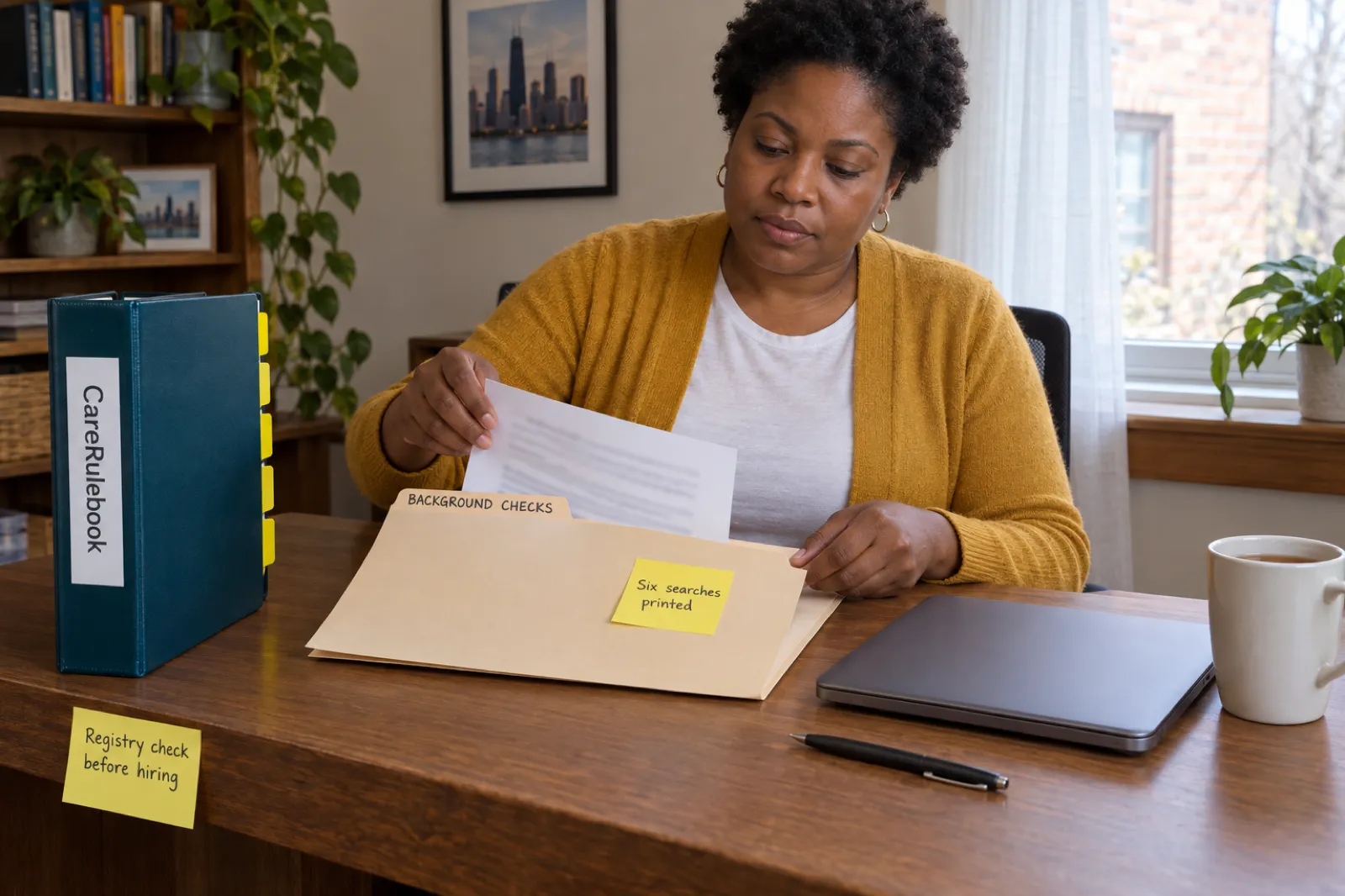
A woman at a desk files a printout into a folder labelled Background checks with a sticky note reading Six searches printed, beside a CareRulebook binder and a sticky note on the desk reading Registry check before hiring

Quick answer

Part 245 says: "An agency shall comply with the Health Care Worker Background Check Act [225 ILCS 46] and the Health Care Worker Background Check Code (77 Ill. Adm. Code 955)." In practice, before hiring anyone into a direct care position, check the Health Care Worker Registry and run six web searches. If the person has not had a fingerprint-based check, or is not active on the registry, make a conditional offer and start a livescan fingerprint check through the registry: details to IDPH within 2 working days, fingerprints within 10 working days.

A new hire can work conditionally for up to three months while results are pending, with supervision enough to prevent abuse, neglect or theft. Someone with a disqualifying conviction cannot work in direct care unless IDPH grants a waiver, and registry findings of abuse, neglect, misappropriation of property or theft also bar direct care work. Verify every employee in the registry at least once a year, and keep the files: missing records can bring a fine of up to $500.

IDPH’s website did not respond when we checked, so IDPH’s documents on this page are Internet Archive copies, each dated in its citation: the New Hire/Rehire checklist (October 19, 2025), the deficiency guidance, FAQ and application form (March 21, 2026), and Attachment E and the surveyor checklist (August 30, 2025). The Act and rules come from the Illinois General Assembly’s site directly.

Who is checked

Home services agencies are named in the definition of a health care employer. 955.110, "Health care employer" The checks apply to the people in these groups:

Unlicensed staff who give direct care

Direct care means nursing care or help with feeding, dressing, movement, bathing, toileting or other personal needs, and it expressly includes home services. Part 955 covers unlicensed people in that kind of work.

77 Ill. Adm. Code 955.100; 955.110

Volunteers

An “employee” under the Act is anyone hired, employed or retained, paid or as a volunteer, so a volunteer in direct care is checked the same way.

955.110, "Employee"

Contracted workers

Any unlicensed contracted or subcontracted worker goes through the fingerprint-based check. A staffing agency may start checks for its own staff through the portal; if it cannot, you may start them and ask it to repay the cost.

955.135(a)-(c)

Not covered

A person licensed by the Department of Financial and Professional Regulation or IDPH under another Illinois law, a person whose check another Illinois law requires, a student in a licensed health care field unless employed in direct care, and people who give only infrequent services such as deliveries or maintenance.

955.130

Your written list of direct care positions

"For purposes of the Act and this Part, the health care employer shall establish a policy defining which unlicensed employees provide direct care." 955.140 The rule tells you what to weigh: each position’s duties in its job description, whether the person is required to be, or has the opportunity to be, alone with clients to help with personal needs (other than on infrequent or unusual occasions), and whether the job involves physical contact with clients. The fingerprint process may be used only for positions the Act covers. 955.140(a); 955.165(d)(1)

Caregivers are the clear case. The rules do not settle whether an agency manager or supervisor who gives care only when a caregiver is off sick is in a direct care position or falls under “infrequent or unusual occasions”. CareRulebook’s manual writes covering visits into those job descriptions and treats the roles as direct care positions; that is our choice, and the question is on our list for IDPH. The agency manager and supervisors →

A person licensed by the Department of Financial and Professional Regulation or IDPH under another Illinois law is outside Part 955. For any position that needs a state professional license, Part 245 has you check the license is active with that department before hiring and file the verification. 245.30(c)(2)

Registry access comes first

Every check runs through the Health Care Worker Registry in IDPH’s secure web portal. The rule: "health care employers shall gain access to the secure login by having an employee register for access to the Department's secure web portal". Once IDPH authorizes that first access, that employee can give access to others. You cannot start fingerprint checks until IDPH has authorized it. 955.115(a)

It is also part of your license application: "Documents demonstrating the agency is registered with the DPH Web Portal and granted access to the Health Care Worker Registry." 245.90(a)(3)(J) At the survey, "the agency manager or designee must be able to demonstrate access to the Health Care Worker Registry through the IDPH Web portal" IDPH surveyor checklist (archived August 30, 2025) What else goes in the application envelope →

The checks, step by step

For each new hire into a direct care position. The registry steps follow IDPH’s New Hire/Rehire Background Check checklist (archived October 19, 2025). Tick steps off as you go; progress is saved in this browser only.

  1. Make a conditional offer

    Before hire

    A conditional offer is a real job offer that depends on IDPH’s report showing no conviction for a disqualifying offense. If the person has not had a fingerprint-based check, you start one after making the offer.

    955.110; 955.165(f)
  2. Check the Health Care Worker Registry

    Before hire

    Search the person in the registry through the IDPH web portal. IDPH’s checklist: “Eligible” means already fingerprinted, so no new fingerprints; “Not Yet Determined” or not listed means send them for fingerprinting; “Ineligible” means they cannot be hired. Look for registry findings too.

  3. Run the six web searches and print them

    Before hire

    For every new hire and rehire, including someone already Eligible. The six sites.

    955.165(c); 955.220(c)
  4. Give the notice and get the authorization signed

    When you request the check

    Tell the applicant about the check, their right to a copy of a report showing a disqualifying conviction and to challenge it through the Illinois State Police, their right to ask for a waiver, and what a disqualifying conviction means for their job. They sign the authorization and disclosure form.

    955.190(a); 955.165(d)
  5. Enter their details in the registry

    Within 2 working days of the authorization

    Submit the person’s Social Security number, demographics and the disclosure and authorization information to IDPH through the registry.

    955.165(h)
  6. Fingerprints at a livescan vendor

    Within 10 working days of signing

    The person has fingerprints taken electronically and brings back the vendor’s part of the livescan request form as proof. You send all necessary information and fees to the vendor and the Illinois State Police within 10 working days of receiving the authorization.

    955.165(i)-(j)
  7. Suspend if not fingerprinted; end it at 30 days

    10 working days / 30 days

    No fingerprints within 10 working days of signing the authorization: the employee is suspended from work until they show proof. None within 30 days of hire: employment ends and you withdraw the background check application from the registry.

    955.165(i)(4)-(5)
  8. Act on the result

    When the result arrives

    A clear result: enter the work history record in the person’s registry profile and print the profile for the file, as IDPH’s checklist describes. A notice of disqualifying conditions: the person may not work in direct care from that moment until IDPH grants a waiver.

    955.280; IDPH checklist
  9. Record hire and separation dates

    Within 30 days

    Enter employment and separation dates in the registry within 30 days of hiring or ending employment, with the employment category and type.

    955.145(a)(2)-(3)

If the Illinois State Police reject the fingerprints, the person is fingerprinted again; after a second rejection you run a complete name-based UCIA check through the State Police and mail IDPH a copy of the results within 10 working days of receiving them. 955.165(i)(2)-(3) Registry questions: dph.hcwr@illinois.gov or 844-789-3676. IDPH deficiency guidance

The six web searches

The rule names the sites: "the Illinois Sex Offender Registry, the Department of Corrections' Sex Offender Search Engine, the Department of Corrections' Inmate Search Engine, the Department of Corrections Wanted Fugitives Search Engine, the National Sex Offender Public Registry, and the website of the Health and Human Services Office of Inspector General". They show whether the applicant has been adjudicated a sex offender, been a prison inmate or committed Medicare or Medicaid fraud. 955.165(c) The rule’s list is not closed (“including without limitation”), and the links are in the registry’s web application. IDPH’s checklist lists the same six, calling the HHS Office of Inspector General site its exclusions database.

IDPH names this step in its own guidance. Its Guidance for Common Deficiency Findings names failure to conduct six website verifications as a common Health Care Worker Registry survey finding, and explains that it applies even when the new hire is already Eligible: "The new hire or rehire does not need another background check, HOWEVER, you are required to check the six registries in the web portal." IDPH, Guidance for Common Deficiency Findings (archived March 21, 2026)

IDPH’s instructions for an Eligible hire: open the Livescan Requests section of their profile, run each search and tick each box if the person is not found, then click “Print”, not “Save”, because saving creates a new livescan request. If you click “Save” by mistake, delete the request. Put the printout in the employee file. IDPH deficiency guidance

Part 955 does not list a search result itself among the bars to employment; the bars are the convictions and findings in the next sections. The file rule only says the screen print shows you "found no results from those web sites that would prevent the employee from being hired", without saying which results would. 955.220(c) So what you do if a search finds the person is for your own policy. CareRulebook’s manual does not hire someone found on a sex offender registry, the wanted fugitives search or the exclusions database into direct care, and has the manager weigh an inmate search result; that is our policy choice, not rule text.

Working while results are pending

"A health care employer or long-term care facility may conditionally employ an applicant for up to three months pending the results of a fingerprint-based criminal history records check" The same rule adds: "During this time, the employee shall have adequate supervision, which is the type and frequency of supervision required to prevent abuse, neglect, or theft regarding patients, clients, or residents." 955.165(l)

The rule does not say what adequate supervision looks like in a client’s home. Part 245 adds that no worker gets an assignment before passing a competency evaluation on the first five hours of training. 245.71(c)

Our suggestion, not rule text

How CareRulebook’s manual defines adequate supervision

  • Orientation and training that involve no client contact can go ahead.
  • The new hire is never alone with a client: time with clients is in the presence of the supervisor or another employee whose check is complete.
  • The new hire does not handle a client’s money or property.
  • If three months pass without a result, they do not continue in a direct care position until it arrives.

The rule leaves the details to you. Your policy can set a different level, as long as it is enough to prevent abuse, neglect or theft.

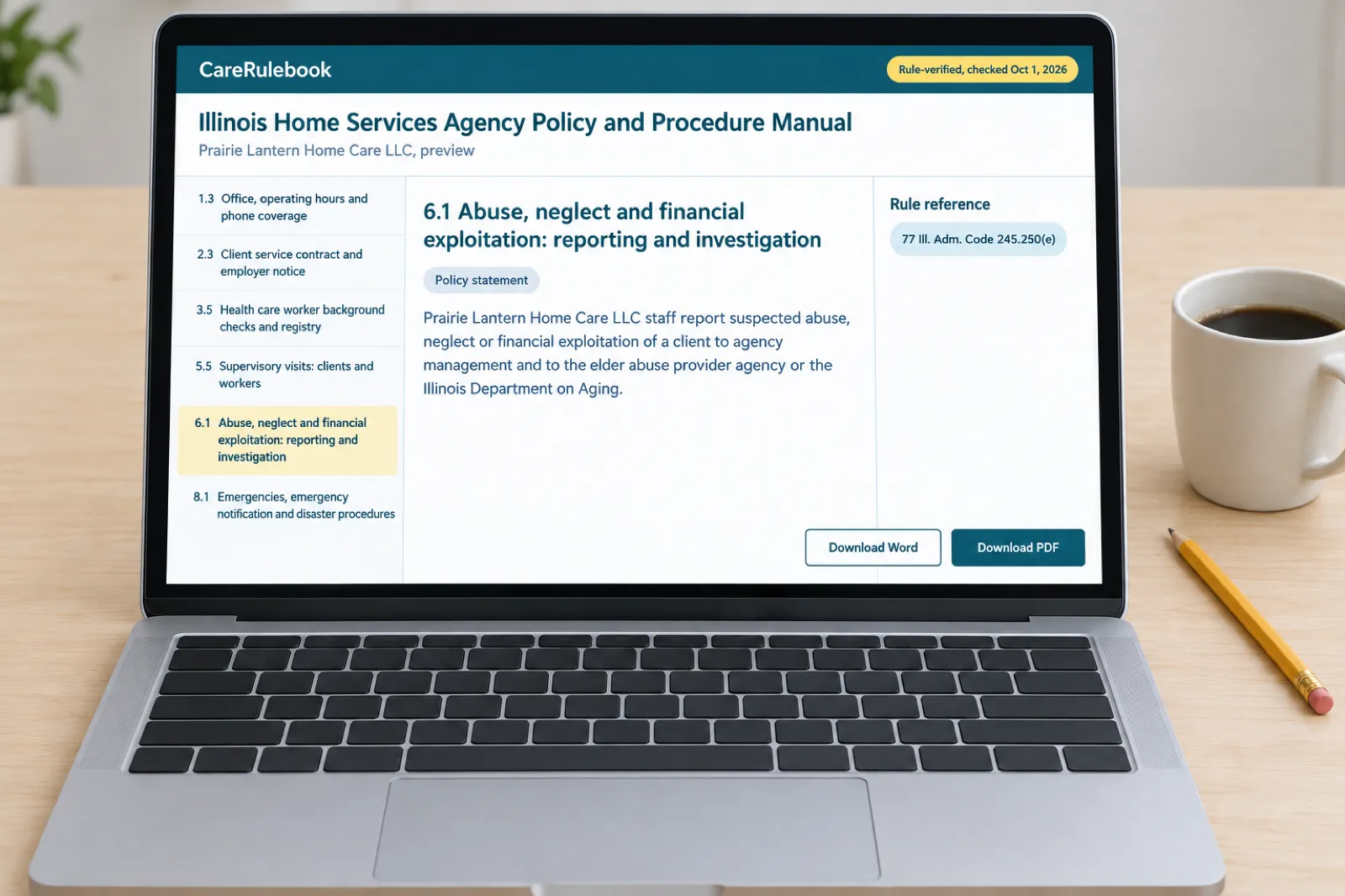
The CareRulebook Illinois manual preview on a laptop, showing the table of contents, policy 6.1 on reporting abuse, neglect and financial exploitation and its 77 Ill. Adm. Code 245.250(e) citation

CareRulebook

Background checks your IDPH surveyor can follow

CareRulebook’s Illinois manual includes Policy 3.5, health care worker background checks and registry, with your list of direct care positions, every Part 955 step and deadline, supervision while results are pending, your policy on employing people with waivers, a notice for applicants and a background check record for each hire.

  • 37 policies, 113 rule requirements mapped
  • The background check policy IDPH asks for with the application
  • Editable Word and PDF, delivered instantly
Preview your manual

$199CareRulebook founding price for the first 50 Illinois agencies, then $249. Not an IDPH fee.

Who cannot work in direct care

You may not hire, employ or retain, paid or as a volunteer, in a position involving direct care, anyone with:

An out-of-state conviction with the same or similar elements, once you become aware of it, without a waiver

955.150(b)

An IDPH finding of abuse, neglect, misappropriation of property or theft on the registry

955.150(c)

A verified and substantiated finding of abuse, neglect or financial exploitation on the Adult Protective Service Registry

955.150(d)

A Department of Human Services finding on the registry of physical or sexual abuse, financial exploitation, egregious neglect or material obstruction of an investigation

225 ILCS 46/25(e)

The disqualifying offenses

The list in 955.160 is long and specific, so read it in the rule rather than from a summary. It includes, among others, homicide offenses, kidnapping and unlawful restraint, sex offenses, assault and battery, criminal abuse or neglect of an elderly person or a person with a disability, theft and identity theft, financial exploitation of an elderly person or a person with a disability, forgery, robbery, burglary and home invasion, arson, weapons offenses, some cannabis and controlled substance offenses, methamphetamine offenses, practicing nursing without a license and animal cruelty, plus substantially equivalent offenses in other states or under federal law. 77 Ill. Adm. Code 955.160

Part 955 sorts disqualifying offenses into three appendices: Appendix A offenses are always disqualifying except through IDPH's appeal process; Appendix B offenses may be considered for a rehabilitation waiver; Appendix C offenses may be considered for a waiver when the person applies. Part 955, Appendices A to C

For convictions in other states, the bar applies once you become aware of the conviction, verified by court records, state agency records or an FBI check. "This shall not be construed to mean that a health care employer has an obligation to conduct a criminal history records check in other states in which an employee has resided." 955.150(b) The fingerprint check itself runs against Illinois State Police and FBI criminal history databases. 225 ILCS 46/33(b)

Convictions that are not disqualifying

"The Health Care Worker Registry will indicate only those criminal convictions that are disqualifying under the Act. Nothing in this Part shall prohibit the health care employer from developing policies concerning employment of individuals whose criminal history records checks indicate convictions for offenses that are not disqualifying." 955.165(o) Our suggestion: take legal advice before turning someone down for a conviction that is not on the list.

A new conviction after you hire

The registry keeps watching. If the State Police report a new disqualifying conviction for a worker already fingerprinted, the registry emails the worker's last known employer and records the offense, and the worker can no longer work as an employee unless they obtain a waiver. 955.165(n) Our suggestion: make sure the email address on your portal account is one someone reads every working day.
Waivers

A waiver is between the worker and IDPH. The worker applies to IDPH on its form, with a work history or resume for the last five years if previously employed, a written explanation of each conviction (what happened, how long ago, who was involved, their age then and other circumstances), proof that fines are paid and any probation or parole completed, proof of any court-ordered rehabilitation program, and fingerprint-based check results. References are optional. 955.260

IDPH marks the registry to show a waiver is pending, acts within 30 days after it has all the necessary information, enters the decision on the registry and tells the person in writing which offenses are waived or not. 955.270(f) Until a waiver is granted, the person may not work in direct care once you have IDPH’s notice of disqualifying conditions. 955.280 IDPH automatically revokes a waiver if the person is convicted of another disqualifying offense. 955.270(h)(1)

How long after the most recent conviction

Disqualifying convictionsWaiver on application (no earlier than)Rehabilitation waiver, no application (Appendix B offenses)
One disqualifying misdemeanor1 year5 years
Two misdemeanors3 years7 years
Three misdemeanors3 years9 years
More than three misdemeanors5 years9 years
One felony3 years7 years
Two felonies5 years9 years
Three felonies5 yearsNot considered
More than three felonies10 yearsNot considered

955.270(d) · 955.275(c), (e)-(f) · Appendix A offenses get a waiver only through IDPH’s appeal process. For rehabilitation waivers the rule counts from the “conviction date” without saying which one. IDPH grants one when the time has passed, no more information is needed, the registry shows no administrative findings and there are no other disqualifying convictions; if it does not, the person can still apply for a waiver.

Your policy on employing people with waivers

"A health care employer is not obligated to employ or offer permanent employment to an applicant, or to retain an employee who is granted a waiver." But you must have a policy: "The health care employer shall develop policies concerning employment of individuals who have been granted waivers." 955.210 CareRulebook’s manual has the agency manager consider each applicant with a waiver individually, looking at IDPH’s written decision, the offense, the time since and the duties of the job, and record the decision and reasons. That is one way to write it; the rule leaves the content to you.

The yearly registry verification

"Each health care employer or its designee shall provide an employment verification and update the demographic information for each employee and each contracted or subcontracted worker no less than annually." You also enter employment and separation dates within 30 days of hiring or ending employment, with the employment category and type. 955.145(a) Failing to do this is a licensing violation, and a fine of up to $500 may be imposed. 955.145(b); 225 ILCS 46/33(i)

IDPH's checklist for the yearly verification: open the Employee tab, tick the green checkmark for each employee still in the position with current details, remove leavers with a separation date, and print the Employee Verification page for your records. IDPH New Hire/Rehire checklist (archived October 19, 2025) IDPH’s deficiency guidance lists the annual registry verification among its common survey deficiencies. IDPH deficiency guidance

Our suggestion: set a calendar reminder for the verification and include contracted workers, who are covered by the same rule.

Records to keep, and the fines

Criminal records requests

For every employee, kept for 5 years.

955.220(a)

Forms and notices

The disclosure and authorization forms, the livescan request form, every notification from the fingerprint check and any waiver, kept for as long as the person works for you.

955.220(a); 225 ILCS 46/50

Registry screen print at hire

Showing no disqualifying offenses or administrative findings at hire, or a waiver; or, if they were not on the registry before hire, a screen print showing they were not found.

955.220(b)

The six searches

A screen print of the background check initiation page, showing the searches were done and found nothing that would prevent hiring. No other screen prints from those sites are needed.

955.220(c)

Eligibility documents

For each home services worker who is not otherwise licensed, certified or registered, the file shows no disqualifying background check without a waiver, a copy of their Social Security card, and a visa or proof of citizenship in compliance with federal requirements for employment.

245.71(a)

Annual verifications

IDPH’s checklist has you print the Employee Verification page each year. Surveyors ask for “IDPH Health Care Worker Registry verifications for staff”.

IDPH checklist; surveyor checklist

The background check documents go in the employee's personnel file or another secure location IDPH can access. 955.220(d) The files are open to IDPH inspection. 955.220(a) On the fine for missing files, the Act and the rule are worded differently: the Act says "A fine of up to $500 may be imposed by the appropriate agency for failure to maintain these records." 225 ILCS 46/50, while Part 955 says "A fine of $500 shall be imposed for failure to maintain these records." 955.220(a)

These records matter beyond the survey. If you ever send IDPH a report about a worker for review of a possible abuse, neglect or theft finding, IDPH asks for "Proof of initial and annual health care worker employment verifications and the initial fingerprint-based background check", along with your background check policy. IDPH FAQ (archived March 21, 2026) CareRulebook’s manual keeps them under Policy 3.5 and Policy 3.6, personnel records.

Your own convictions: the form, the rule and Attachment E

Separately from your caregivers’ checks, IDPH asks about the people behind the agency. The three documents use different look-back periods:

The rule

The previous year

For a corporation applicant: any felony conviction or guilty plea, or two or more misdemeanors involving moral turpitude, for the applicant and its officers during the previous year. Each renewal asks the same for the licensee and its officers (245.90(b)(3)).

245.90(a)(3)(C)(iii)

Form 445104

The last five years

Whether the applicant, any officer or director of a corporation, or the administrator or manager has been convicted of a felony or of two or more misdemeanors involving moral turpitude in the last five years, with an explanation as Exhibit A for any yes.

Form 445104, page 4 (archived March 21, 2026)

The form is what IDPH hands you, so our suggestion is to answer each question as printed, even where it reaches further back than the rule. A conviction is not an automatic bar to the license: "In determining moral character, the Department may take into consideration any convictions of the applicant or supervisor for criminal offenses, but such convictions shall not operate as a bar to licensing." 245.130(b)(2) Misrepresentation on the application may be cause for denial or later revocation. Form 445104, page 8

If an owner or manager will also give hands-on care, that position is assessed for the caregiver checks like any other. Who can be the agency manager →

Myths about hiring checks

Does every new Illinois caregiver need to be fingerprinted again?

No. A worker who has already had the fingerprint-based check and stays active on the Health Care Worker Registry does not need another. You still check the registry before hiring, run the six web searches for every new hire and rehire, and keep the printout in the employee file.

"As long as the student, applicant or employee has had a background check and stays active on the Health Care Worker Registry, no further fingerprint-based criminal history record checks are required."

Does any criminal record stop someone working as a caregiver for an Illinois home services agency?

No. Only the disqualifying offenses in the Health Care Worker Background Check Act and 77 Ill. Adm. Code 955.160 bar direct care work, and IDPH can waive many of them. The registry shows only disqualifying convictions, and you may set your own policy for other convictions. Registry findings of abuse, neglect, misappropriation or theft are a separate bar.

"The Health Care Worker Registry will indicate only those criminal convictions that are disqualifying under the Act. Nothing in this Part shall prohibit the health care employer from developing policies concerning employment of individuals whose criminal history records checks indicate convictions for offenses that are not disqualifying."

Can a new Illinois caregiver start work before fingerprint results come back?

It depends. Yes, conditionally, for up to three months, if the registry check and six web searches are clear and the worker has supervision enough to prevent abuse, neglect or theft. Before the first assignment they must also pass a competency evaluation, after 5 hours of training (or with proof of training at another licensed home services agency in the past year). Someone marked Ineligible on the registry cannot be hired.

"A health care employer or long-term care facility may conditionally employ an applicant for up to three months pending the results of a fingerprint-based criminal history records check"

Does a criminal conviction stop you getting an Illinois home services license?

It depends. Not automatically. IDPH may consider adverse licensure action on satisfactory evidence that the moral character of the applicant or the agency's supervisor is not reputable, and it may take convictions into account, but the rule says convictions do not bar licensing. The application form and Attachment E ask about convictions, so answer them fully. Separately, anyone the agency employs in a direct care position needs a clear background check or an IDPH waiver.

"In determining moral character, the Department may take into consideration any convictions of the applicant or supervisor for criminal offenses, but such convictions shall not operate as a bar to licensing."

Frequently asked questions

What background checks does an Illinois home services agency need?

The ones in the Health Care Worker Background Check Act (225 ILCS 46) and 77 Ill. Adm. Code 955, which Part 245 makes a licensing requirement. Before hiring anyone into a direct care position, check the Health Care Worker Registry and run six web searches. If the person has not had a fingerprint-based check or is not active on the registry, start a livescan fingerprint check through the registry after a conditional offer. Verify every employee in the registry at least once a year.

How long does a new caregiver have to get fingerprinted?

Ten working days after signing the authorization and disclosure form. If they miss that, they are suspended from work until they show proof of fingerprinting. If they have not been fingerprinted within 30 days of being hired, their employment ends and you withdraw the application from the registry. You enter their details in the registry within 2 working days of the authorization, and send the information and fees within 10 working days.

Can a caregiver start work before the fingerprint results come back?

Yes, conditionally, for up to three months, with the type and frequency of supervision needed to prevent abuse, neglect or theft. The rule does not spell out what that supervision looks like. Part 245 separately requires a passed competency evaluation before any worker’s first assignment, after five hours of training or with proof of training at another licensed home services agency in the past year.

Does a caregiver who is already on the registry need new fingerprints?

Not if they have had the fingerprint-based check and stay active on the registry: “no further fingerprint-based criminal history record checks are required.” You still check the registry before hiring and run the six web searches for every new hire and rehire. IDPH’s deficiency guidance names skipping those searches as a common survey finding.

Which convictions stop someone working as a caregiver in Illinois?

The disqualifying offenses in Section 25 of the Act and 77 Ill. Adm. Code 955.160, and substantially equivalent offenses in other states or under federal law. They include homicide, sex offenses, assault and battery, criminal abuse or neglect of an elderly person or a person with a disability, theft, financial exploitation, robbery and burglary. IDPH can grant waivers for many of them. The registry shows only disqualifying convictions; for others, your own hiring policy applies.

How does an Illinois caregiver get a background check waiver?

The worker applies to IDPH, not the agency, with a written explanation of each conviction, proof that fines are paid and any probation or parole completed, a work history and fingerprint results. Waiting periods apply: one year after a single disqualifying misdemeanor, up to ten years after more than three felonies. For some offenses IDPH can grant a rehabilitation waiver without an application after a longer wait. IDPH decides within 30 days of having everything it needs.

Do Illinois home care agencies have to re-check caregivers every year?

Not with new fingerprints. The State Police tell IDPH about later convictions linked to fingerprints already on file, and the registry emails the last known employer. What you must do every year is an employment verification in the registry for each employee and contracted worker, updating their details. Missing it is a licensing violation with a fine of up to $500.

Who pays for the fingerprints?

The rules let you require applicants and employees who are not certified nursing assistants to pay the application and fingerprinting fees. Neither the Act nor Part 955 sets a dollar amount: the Act says the State Police fee may not exceed the actual cost of the check, and the livescan vendor charges for taking and sending the prints. CareRulebook’s manual has the agency pay.

Get Illinois rule-change alerts

Leave your email and we will tell you when an Illinois rule change affects your hiring checks or your policies.

No spam. Only emails about Illinois home services rule changes. How we use your email.

Keep reading

Sources

  1. 77 Ill. Adm. Code 245, Home Health, Home Services, and Home Nursing Agency Code (current through 50 Ill. Reg. 2147, effective January 30, 2026) · Illinois Department of Public Health (Illinois Administrative Code, Joint Committee on Administrative Rules, ilga.gov) · retrieved October 1, 2026
  2. Health Care Worker Background Check Act (225 ILCS 46) · Illinois General Assembly (Illinois Compiled Statutes, ilga.gov) · retrieved October 1, 2026
  3. 77 Ill. Adm. Code 955, Health Care Worker Background Check Code · Illinois Department of Public Health (Illinois Administrative Code, ilga.gov) · retrieved October 1, 2026
  4. Home Services Agencies Frequently Asked Questions (archived copy of March 21, 2026) · Illinois Department of Public Health · retrieved October 1, 2026
  5. Home Services Application, Form 445104 (Initial, Renewal and Change of Ownership; archived copy of March 21, 2026) · Illinois Department of Public Health · retrieved October 1, 2026
  6. Surveillance Nurse Visit Checklist (Home Services) (archived copy of August 30, 2025) · Illinois Department of Public Health · retrieved October 1, 2026
  7. Agency Manager Qualification Review Form, Attachment E (archived copy of August 30, 2025) · Illinois Department of Public Health · retrieved October 1, 2026
  8. New Hire/Rehire Background Check checklist (archived copy of October 19, 2025) · Illinois Department of Public Health · retrieved October 1, 2026
  9. Guidance for Common Deficiency Findings (archived copy of March 21, 2026) · Illinois Department of Public Health · retrieved October 1, 2026
Build your Illinois manualfrom $199