Skip to content
CareRulebook
MenuClose

Where are you starting?

United StatesTexas, North Carolina, Georgia, Virginia, Ohio
United KingdomEngland
Free toolsChecklists, calculators and templates

Virginia · Office, records and premises · 12VAC5-381

Can you run a Virginia home care organization from home?

The rules in force do not say where a Virginia home care organization’s office has to be, and they do not mention home offices. What they do ask for is posted business hours, a posted license, records kept safe and an office ready for unannounced inspections. Here is each rule, plus branch offices, drop sites, moving, and the 2022 draft that would have required commercial zoning.

  • Rule-verified October 1, 2026
  • Quoted from 12VAC5-381 and the Code of Virginia
  • Draft status checked on Town Hall
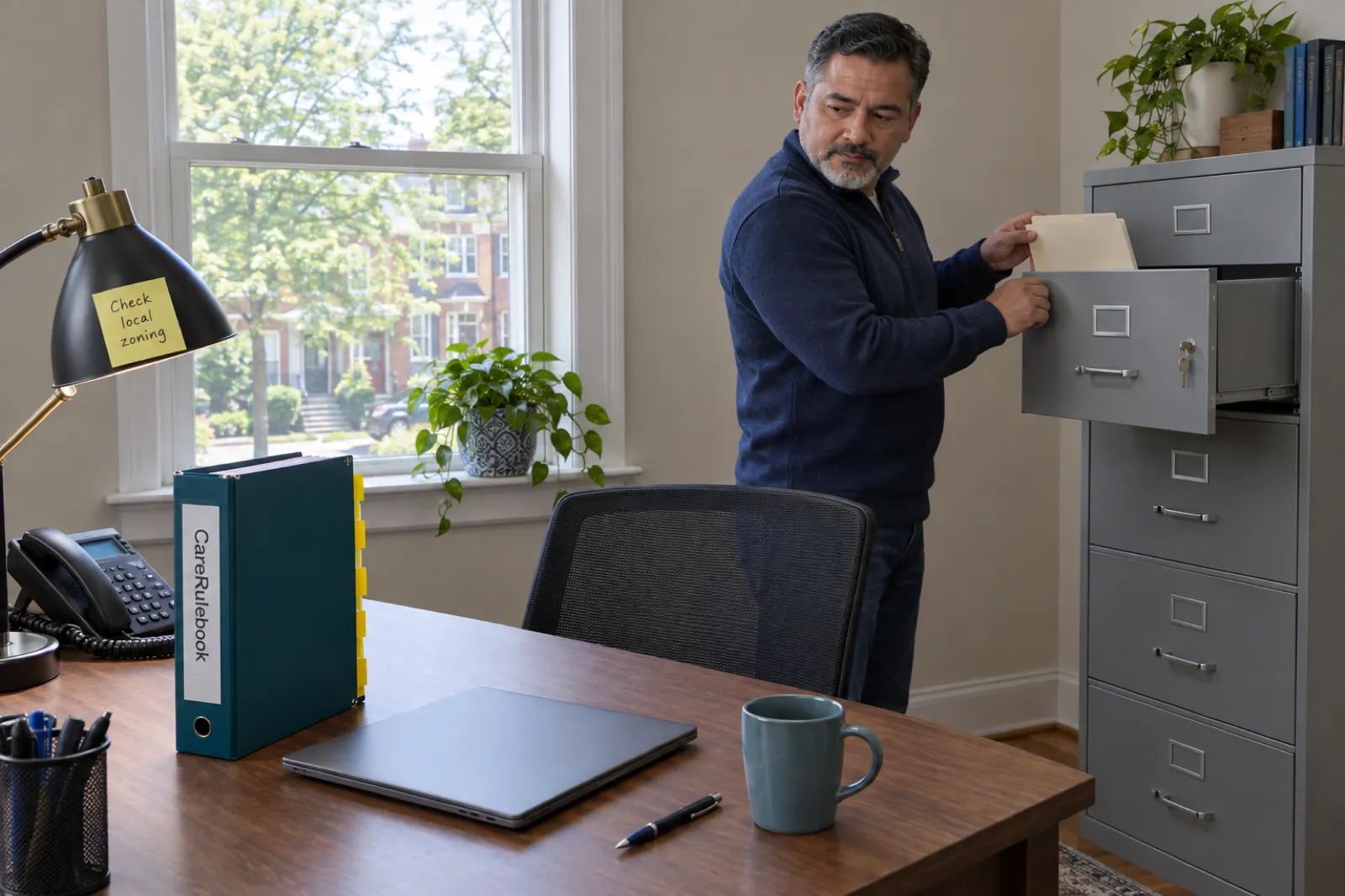
A home care founder files a folder in a locked metal cabinet in his spare-room office in a Virginia townhouse, beside a CareRulebook binder and a sticky note reading Check local zoning

Quick answer

As far as the state rules in force go, yes. Virginia’s home care organization regulation, 12VAC5-381, does not say where your office must be. Neither it nor the licensing statute says whether the office can be in a home, and neither mentions zoning. It does require you to comply with "Other applicable federal, state or local laws and regulations;" 12VAC5-381-150 B 2, so local zoning decides whether a home office is allowed at your address.

Wherever the office is, you need regular posted business hours and to be fully operational during them, the license posted for public inspection, records kept confidential and safe, and someone able to receive an unannounced OLC inspection.

Worth knowing: a 2022 draft rewrite would have required offices, branch offices and drop sites to be in buildings zoned for business or commercial use. That proposed stage was withdrawn on April 7, 2022 and is not in force. A later version has not been published.
What the rules say about your office

None of these rules mention where the office is. They describe how it must work, and they apply the same to a rented suite and a spare bedroom.

Posted business hours, fully operational

Set regular business hours, post them, and be fully operational during them. Outside those hours you still provide or arrange services on call, 24 hours a day, seven days a week.

"The organization shall have regular posted business hours and be fully operational during such business hours."

12VAC5-381-150 I

The license on display

Your current license from VDH is posted where the public can inspect it.

"The current license from the department shall be posted for public inspection."

12VAC5-381-150 F

Someone in charge, reachable

The administrator or a designee is available at all times during operating hours and for emergencies. The rule defines "available" as readily available on the premises or by telecommunications.

"The administrator or his designee shall be available at all times during operating hours and for emergency situations."

12VAC5-381-170 D; -10

Ready for an unannounced inspection

The OLC inspects without notice, as often as it needs and at least every two years. You make any necessary records available and let the inspector interview your staff and contractors.

"The home care organization shall make available to the OLC's representative any necessary records and shall allow access to interview the agents, employees, contractors, and any person under the organization's control, direction or supervision."

12VAC5-381-80 A-B

Inspectors may also visit clients at home during any inspection, and you arrange those visits. What happens during a Virginia OLC inspection →

Running it from home, step by step

These steps turn the rules above into a home office setup. The first and last are our suggestions for the parts the state rules leave open. Tick steps off as you go; progress is saved in this browser only.

  1. Check local zoning and any lease or HOA rules first

    Before you apply

    The state rules say nothing about running a home care organization from a residence, but they do require you to comply with applicable local laws. Ask your city or county planning or zoning office whether a home-based business office is allowed at your address, and check your lease or homeowners association rules.

    12VAC5-381-150 B 2
  2. Choose and post your business hours

    Decide your regular business hours, post them, and plan to be fully operational during them. Write them into your after-hours and on-call policy too.

    12VAC5-381-150 I
  3. Set up 24/7 on-call and a nurse on call

    Before your first client

    Clients need services provided or arranged on call around the clock, and a registered nurse or licensed practical nurse must be available during all hours that personal care is being provided.

    12VAC5-381-150 I; -360 F
  4. Post the license when it arrives

    Put the current license where visitors can see it, for example by the entrance to your office space.

    12VAC5-381-150 F
  5. Give records a locked, private place

    Client records are confidential and safeguarded against loss or unauthorized use. Criminal record reports go in locked files only the administrator or a designee can open. In a family home, that means a lockable cabinet or room, and passwords on electronic records.

  6. Plan for an inspector at the door

    Any time

    Inspections are unannounced. Decide who receives the inspector when you are out on visits, how they reach you, and where the records they ask for are kept.

  7. Ask the OLC if anything is unclear

    The OLC’s Home Care Organization supervisor is on (804) 367-2104 or (804) 367-4879. It is worth confirming your office setup before you sign a lease or apply.

    VDH OLC, Contact Us

Records: where they live and who can see them

The regulation does not say records must be kept at your office, but it does say how they are protected and that inspectors can see them. A client record can be "whether hard copy or electronic". 12VAC5-381-10

RecordWhat the rule asksSource
Client recordsConfidential, safeguarded against loss or unauthorized use, kept on paper or electronically. Provide for safe storage of the original and legible reproductions.12VAC5-381-280 B-D
How longClient records at least five years after discharge or last contact (minors: five years after they turn 18). Personnel records three years after employment ends.12VAC5-381-280 I; -200 Q
Personnel filesAn organized system that manages and protects the confidentiality of personnel files and records.12VAC5-381-200 N
Criminal record reportsConfidential, in locked files that only the administrator or a designee can access.12VAC5-381-110 J
Records at a drop siteSafeguarded, seen only by authorized personnel, and readily available to inspection staff.12VAC5-381-270 B
For the OLCAny necessary records made available to the OLC representative during an inspection.12VAC5-381-80 B
If you closeTell clients and the OLC where all home care records will be kept, and return the license within five working days.12VAC5-381-140 C

In the CareRulebook manual these are Policy 10.1 Client records: content and handling, Policy 10.2 Records retention and Policy 3.2 Personnel records.

Branch offices, drop sites and your service area

Virginia’s rules recognize three kinds of location beyond your main office. Only one of them can work as a second office under your license.

Under your license

Branch office

A branch office is a geographically separate office that performs all or part of the organization’s primary functions on a smaller scale. It serves part of your total geographic area under your supervision and administrative control, and its address goes on your license. No separate license is needed.

12VAC5-381-1012VAC5-381-20 C§ 32.1-162.9 C

For staff convenience

Drop site

A drop site is a place staff use for daily tasks such as getting supplies, using fax and copy machines, charting notes and storing client records. It may also be called a charting station, workstation or convenience site. It cannot have staff assigned, accept referrals or be advertised, and it can be inspected at any time.

12VAC5-381-1012VAC5-381-270 A-D

Needs its own license

A drop site used as an office

The rule is direct: "Operation of a drop site as a business office shall constitute a separate organization and shall require licensure."

12VAC5-381-270 C

Your service area is defined as "a clearly delineated geographic area in which the organization arranges for the provision of home care services, personal care services, or pharmaceutical services to be available and readily accessible to persons." 12VAC5-381-10 The current rules do not tie the office to a particular distance from clients. A change to the service area is one of the changes you tell the OLC about 30 days in advance.

If you will use drop sites, Policy 5.7 Drop sites in the CareRulebook manual covers the three limits and the records rules.

Moving, renaming or adding an office

A license cannot be transferred or assigned, and some changes need it reissued. Give notice early: the rules count in advance, not after the move. 12VAC5-381-20 E

Moving the office (a new address)

A change of address needs a reissued license and the OLC’s $250 reissue fee (a state fee). Give written notice 30 working days in advance, to the attention of the director of the OLC.

12VAC5-381-60 B; -70 C

Changing the mailing address or service area

Tell the OLC 30 days in advance. The same notice applies to changes in ownership, services, operator, administrator, name and closure.

12VAC5-381-150 E

Changing the name

Notify the OLC before the name changes. A new name also needs a reissued license.

12VAC5-381-20 D; -60 B

Adding a branch office

Send VDH the branch address. For a branch that meets the statute’s criteria, VDH issues an updated license with the branch address within 10 business days.

Va. Code § 32.1-162.9 C

How you tell the OLC

VDH sends home care organizations to the VDH OLC Portal to report changes to their licensing record, such as a change of name or location. Since May 22, 2025, a request for a license change goes on the relevant application.

VDH Applications & Forms; 12VAC5-381-70

What the OLC does next

The OLC evaluates the planned change, may inspect while it does, and tells you in writing whether a new application is needed.

12VAC5-381-60 C-D

The Virginia license application guide walks through the portal, and the cost and timeline page lists every OLC fee.

Draft · withdrawn in 2022 · not in force

The 2022 draft that would have required commercial zoning

VDH’s rewrite of 12VAC5-381 included a new section on office location. In the March 2022 draft: "The location of the parent HCO's office and of any branch office or drop site of an HCO shall be located: 1. In a building that is zoned for business or commercial use or if in a mixed use zoned building, in a unit zoned for business or commercial use; and 2. In the total geographic area it serves." Organizations would also have had to submit proof of occupancy such as a lease, rental agreement or deed, for each location. Draft 12VAC5-381-35 B

VDH said the intent was to "clarify that HCO offices, branch offices, and drop sites cannot be in residential spaces", and gave its reason: "allowing HCOs to conduct their businesses out of residential spaces places the agency's inspectors in potentially dangerous circumstances and is inconsistent with the other licensure programs administered by the agency". Organizations already licensed would have had one year to comply. Stage 9512 background document

Where it stands: Town Hall shows that proposed stage was "Stage withdrawn on 04/07/2022 before DPB completed its review." Town Hall, stage 9512 A later proposed stage is listed as "Returned to agency requesting additional information." Town Hall, action 5352 Its text is not public, so we do not know whether the zoning section is still in it. Nothing has been published for comment.

What this means for you: a home office is not against the rules today, but this is a sign of how VDH has thought about home offices. If you choose one, check local zoning, and keep the setup simple to move if the rules change.

Both pending Virginia rule changes, explained →

What the state rules do not cover

We read every section of 12VAC5-381 and the home care organization statute (Va. Code §§ 32.1-162.7 to 32.1-162.15). They do not address:

  • whether the office can be in a residence, or how it must be zoned;
  • local business licenses, home occupation permits or signs;
  • a minimum office size, separate entrance or meeting space;
  • whether clients or job applicants may visit a home office.

For zoning, business licenses and permits, ask your city or county. For anything about how the OLC applies 12VAC5-381 to your setup, call the OLC’s Home Care Organization supervisor on (804) 367-2104 or (804) 367-4879. VDH OLC, Contact Us

Myths about Virginia home care offices

Does Virginia ban running a home care organization from a home office?

No. Not under the rules in force. 12VAC5-381 does not say where your office must be. A 2022 draft rewrite would have required offices in buildings zoned for business or commercial use, but that proposed stage was withdrawn before review finished, and no new text has been published. Local zoning still applies, because the regulation requires you to follow applicable local laws.

"Stage withdrawn on 04/07/2022 before DPB completed its review."

Can a Virginia home care organization run a second office as a drop site under its license?

No. Not as a business office. A drop site is for staff convenience: it cannot have staff assigned, accept referrals or be advertised. Operating one as a business office makes it a separate organization that needs its own license. A branch office, which runs under your license with its address on it, is the route for a second working office.

"Operation of a drop site as a business office shall constitute a separate organization and shall require licensure."

Does each Virginia branch office need its own license?

No. Branch offices operate under the main license. Send OLC the branch address and it issues an updated license within 10 business days. A drop site used as a business office is different: it counts as a separate organization and needs its own license.

"Branch offices shall be operated under the initial license issued to the home care organization and shall not be required to obtain an additional license."

Does the OLC tell a Virginia HCO before a routine inspection?

No. The regulation says an OLC representative makes periodic unannounced on-site inspections, as necessary and at least every two years. The administrator or a designee must be available at all times during operating hours, so plan who receives the inspector.

"An OLC representative shall make periodic unannounced on-site inspections of each home care organization as necessary but not less often than biennially."

Frequently asked questions

Can I run a Virginia home care organization from my house?

The state rules in force do not stop you. 12VAC5-381 does not say where your office must be, does not address home offices and does not mention zoning. It does require posted business hours, a posted license, safeguarded records and access for unannounced OLC inspections, and it requires you to follow applicable local laws, so check your local zoning first. A 2022 draft rewrite would have required offices in buildings zoned for business or commercial use, but it was withdrawn and is not in force.

Do I need a commercial office to get a Virginia HCO license?

Not under the current regulation. The commercial zoning requirement appeared only in a 2022 draft of the rewrite of 12VAC5-381, and Town Hall shows that proposed stage was withdrawn on April 7, 2022. A later proposed stage has been returned to VDH and its text is not public, so we cannot say whether the idea will come back. Before signing a long lease, it is reasonable to ask the OLC.

Can my home office address be on the license?

The rules do not say it cannot. Whatever address you use, an address change later needs a reissued license with a $250 state reissue fee and 30 working days’ written notice to the OLC. Choose an address you expect to keep.

What business hours does a Virginia home care organization need?

The rule does not set specific hours. You keep regular posted business hours, are fully operational during them, and provide or arrange services on call 24 hours a day, seven days a week. The administrator or a designee is available during operating hours, on the premises or by phone or other telecommunications.

Can I keep client records on a laptop or in the cloud?

The definition of a client record covers hard copy or electronic records. Whatever you use, records must be confidential, safeguarded against loss or unauthorized use, and readily available to an OLC inspector. The regulation does not name specific systems or security standards.

What is the difference between a branch office and a drop site?

A branch office is a separate office doing all or part of your main functions on a smaller scale, under your supervision and administrative control, with its address on your license. A drop site is only a convenience spot for staff: it cannot have staff assigned, accept referrals or be advertised. Running a drop site as a business office makes it a separate organization that needs its own license.

Do I need a local business license or home occupation permit?

The state home care rules do not cover this. 12VAC5-381 only says you must follow applicable local laws. Ask your city or county, because the answer depends on where you are.

Tell me if the office rules change

VDH has two amendments to 12VAC5-381 in progress, and an earlier draft would have required commercial zoning. Leave your email and we will tell you if a new draft is published and what it means for your office.

No spam. Only emails about Virginia home care rule changes. How we use your email.

Keep reading

Sources

  1. 12VAC5-381, Regulations for the Licensure of Home Care Organizations · Virginia State Board of Health (Virginia Administrative Code, law.lis.virginia.gov) · retrieved October 1, 2026
  2. Code of Virginia §§ 32.1-162.7 to 32.1-162.15, Home care organizations (incl. § 32.1-162.9:1, barrier crimes, criminal records checks and drug testing) · Virginia General Assembly (Code of Virginia, law.lis.virginia.gov) · retrieved October 1, 2026
  3. Contact Us · Virginia Department of Health, Office of Licensure and Certification · retrieved October 1, 2026
  4. Applications & Forms · Virginia Department of Health, Office of Licensure and Certification · retrieved October 1, 2026
  5. Virginia Regulatory Town Hall, 12VAC5-381 action 5352 (periodic review and rewrite): action page, proposed stage 9512 and its Agency Background Document of March 8, 2022 (archived copies) · Virginia Department of Health, via the Virginia Regulatory Town Hall · retrieved October 1, 2026
Build your Virginia manualfrom $199