Skip to content
CareRulebook
MenuClose

Where are you starting?

United StatesTexas, North Carolina, Georgia, Virginia, Indiana, Ohio, Illinois, Washington, Colorado, Tennessee, Maryland
TexasManual
North CarolinaManual
GeorgiaManual
VirginiaManual
IndianaManual
OhioGuide
IllinoisManual
WashingtonManual
ColoradoManual
TennesseeManual
MarylandGuideAll US states →
United KingdomEngland
Free toolsChecklists, calculators and templates

Tennessee · Personal Support Services Agency license · TDMHSAS’s application

Tennessee PSSA license application: TDMHSAS’s seven steps

You apply for a Tennessee PSSA license on paper or web forms sent to a TDMHSAS regional office. Here are TDMHSAS’s seven steps, the four forms item by item, your own fingerprint check, TDMHSAS’s $810 fee by invoice, the electronic desk audit, the initial license, and how renewal, changes, a sale and closing work.

  • Rule-verified October 2, 2026
  • Quoted from Tenn. Comp. R. & Regs. 0940-05-02 and 0940-05-38
  • From TDMHSAS’s own forms
A man in a navy quarter-zip sweater fills in a printed form at a desk beside a CareRulebook binder, an index card reading $810 TDMHSAS fee and a sticky note reading Four forms to the regional office, with a wooden fence and wooded hills outside the window

Quick answer

A Tennessee Personal Support Services Agency (PSSA) license comes from the Tennessee Department of Mental Health and Substance Abuse Services (TDMHSAS), Office of Licensure, when 50% or more of your clients will be aged or have a mental illness or substance abuse diagnosis (0940-05-38-.04(3)(a)). You send four forms to the regional office nearest the location to be licensed (TDMHSAS, step 2), and TDMHSAS sends an invoice for its fee: $810 per site for one category, TDMHSAS’s fee, not a CareRulebook price (0940-05-02-.05(1)).

There is no fire inspection. Instead, "Initial inspections for Personal Support Services Agencies (PSSAs), D.U.I. Schools, and Non-Residential Office-Based Opiate Treatment offices (OBOTs) are conducted via an electronic desk audit." (TDMHSAS, step 5). TDMHSAS says initial inspections cover certain policies and procedures, and the applicant "will be notified and must correct deficiencies before a license is issued" (0940-05-02-.06(5)(b)). Then TDMHSAS issues an initial license for up to one year, and only then may services begin (0940-05-02-.03(1)).

"Rule requires" means Tenn. Comp. R. & Regs. 0940-05-02 (licensure administration and procedures) or 0940-05-38 (the PSSA rules). "TDMHSAS asks" or "TDMHSAS says" rests on TDMHSAS’s own forms, its Become a Licensed Provider and Provider FAQ pages, or its 2025 PSSA slides. Where we add our own reading or advice, we say so.

4

Forms TDMHSAS lists for an initial application

Become a Licensed Provider, step 2

$810

TDMHSAS fee per site for one category, by invoice, non-refundable

0940-05-02-.05(1)

12 months

Longest term of the initial license TDMHSAS issues

0940-05-02-.02(1)

15 days

To ask in writing for a hearing if TDMHSAS denies the application

0940-05-02-.06(5)(c)

TDMHSAS’s seven steps

TDMHSAS’s Become a Licensed Provider page sets out seven steps (TDMHSAS, Become a Licensed Provider). Tick them off as you go; your progress is saved in this browser only.

  1. 1. Read the rules, and check which department licenses you

    First

    TDMHSAS starts by pointing applicants to its licensure rules. For a PSSA they are 0940-05-02, 0940-05-38 and parts (1) to (6) of 0940-05-06-.03. If 50% or more of your clients will be aged, or have a mental illness or substance abuse diagnosis, you apply to TDMHSAS; if 50% or more will have an intellectual or developmental disability, to the Department of Disability and Aging instead.

  2. 2. Send four forms to the regional office

    Day 0

    The Initial Application (MH-4385), a Fact Sheet (MH-4386) for each location, the Background Check and Privacy Statement form, and the Financial Statement, to the West, Middle or East regional office nearest the location to be licensed. The four forms, item by item.

  3. 3. Pay TDMHSAS’s invoice

    TDMHSAS sends an invoice once it has your forms, with the fee amount and mailing instructions. For one category at one site the fee is $810, TDMHSAS’s fee, not a CareRulebook price. It is non-refundable, and no license is issued until it is paid.

  4. 4. No fire inspection for a PSSA

    TDMHSAS says PSSAs currently do not need a life safety or fire inspection, so there is nothing to book here.

  5. 5. The electronic desk audit

    After the fee

    When the paperwork is in and the fee is paid, the Office of Licensure contacts you about a date. For a PSSA the initial inspection is an electronic desk audit, and TDMHSAS says initial inspections cover certain policies and procedures. What to have ready.

  6. 6. Correct any deficiencies, then the initial license

    After the desk audit

    Once the inspection is done and any deficiencies are corrected, TDMHSAS issues an initial license for up to one year. Services may not start before the license is issued.

  7. 7. Read TDMHSAS’s PSSA slides

    TDMHSAS points new and recently licensed PSSAs to its PSSA Provider Information slides, with its common deficiencies, the tasks a PSSA may not do and its reading of the background check and reference rules.

What to have ready before you apply

Each card says whether the item comes from the rules or from TDMHSAS’s forms and guidance.

Rule requires

Your licensing department

You attest in writing, when you apply and at every renewal, to the category of the majority of your clients. On TDMHSAS’s Fact Sheet the PSSA box asks whether 50% or more will be aged or have a mental health or substance abuse diagnosis, or have an intellectual or developmental disability.

0940-05-38-.04(3)-(4); MH-4386, item 4TDMHSAS or DDA? →

TDMHSAS asks

The business and its names

The application uses the proprietors’ names or the corporate name registered with the Tennessee Secretary of State, and a corporation sends its charter certified by the Secretary of State. The Fact Sheet asks for the name the public will know, which is printed on the license.

MH-4385, items 2 and 6; MH-4386, item 3

TDMHSAS asks

Three character references

People who can vouch that the responsible person is of reputable character and able to run a service for vulnerable people. They may not be related by marriage, blood or a shared business venture.

MH-4385, item 9

TDMHSAS asks

A written description of your services

The application asks for a written description of the services you will provide. Our suggestion: use the same words as the description of services in your policies, which is item (a) of the 17 the rules list.

MH-4385, item 12; 0940-05-38-.06(1)(a)

Rule says

Your counties and records address

A list of the counties you will serve and the address where you will keep employee and client records. The rule says "should".

0940-05-38-.04(6)

TDMHSAS says

Your policies, before the desk audit

Not one of the four forms, but the desk audit covers certain policies and procedures and TDMHSAS does not publish which. Our suggestion: have every policy the rules list written and adopted before you send the forms.

Become a Licensed Provider, step 5The written policies →

Rule requires

Liability insurance

The licensee must have proof of liability insurance for the agency, its workers and others who provide services; no minimum is set. None of the four forms asks for it, so by our reading it must be in place before services start rather than with the application.

0940-05-38-.07(3)

The four forms, item by item

TDMHSAS’s process page lists four forms: the Initial Application, the Fact Sheet, the Background Check and Privacy Statement Form, and the Financial Statement (TDMHSAS, step 2). "TDMHSAS Licensing forms are available in both printable PDF and web-based formats." (TDMHSAS, Licensing Forms) The rules add that applications are made on TDMHSAS’s forms and "must be submitted in writing, legible, with all the information requested on the application" (0940-05-02-.04(2)), because TDMHSAS uses them "to determine the applicant’s responsible and reputable character and the applicant’s ability to meet the minimum standards for the operation of a facility or service" (0940-05-02-.04(2)).

FormWhat it asks forSource
Initial Application (MH-4385)Every applicantApplicant and organizational structure (items 2 and 5); the person with overall responsibility and any management firm, whose contract goes with the application (item 3); the contact for invoices and compliance documents (item 4); governing body members for a corporation or association (item 6); background and history (item 7); personal details (item 8); three references (item 9); accreditation, optional (item 10); financial resources, which item 11 says applies only to office-based opiate treatment applicants; a written description of services (item 12); the fee (item 13); and the signed certification.MH-4385 (rev. 05/15/2020)
Fact Sheet (MH-4386)Each locationOne for each location. Tick purpose (a), a new applicant, and give the name as it will appear on the license, the address, county and whether the site is inside city limits. Item 4 is the category: tick Personal Support Services Agency and answer the client-mix question. Item 5 names the site manager and asks about any felony conviction or pending charge. Items 6 to 22, about buildings and occupancy, do not apply to PSSAs: mark them N/A.MH-4386 (rev. 10/27/2025)
Background Check and Non-Criminal Justice Privacy Rights formThe responsible personFor the person named in item 3 of the application and any other applicant listed in item 2. TDMHSAS publishes it as a printable PDF and a web form. We could not read the text of the PDF we saved, so we do not describe its contents here.MH-4385, item 7; TDMHSAS, Licensing Forms
Financial Statement (MH-4466)Ask TDMHSASTDMHSAS’s form, or another written statement, covering at least your assets, liabilities and funds available to run the service; the form also asks for monthly operating expenses and income. If you send one, it is signed, dated and sent with the application. TDMHSAS’s process page lists it for every applicant, but item 11 of the application says the financial solvency item applies only to opiate treatment applicants. Ask your regional office whether a PSSA must send it.Financial Statement form; MH-4385, item 11

The Initial Application, in more detail

  • Who applies. The application is made by the owner, CEO, executive director or another governing body member responsible for the agency’s standards, policies and procedures, and goes to the regional office where the license will be issued. (MH-4385, Instructions) The certification is signed by the individual applicant (or the partners), or for a corporation or association by the CEO, president, chairperson or equivalent officer. (MH-4385, Certification)
  • The person in charge. Item 3 names the person with overall responsibility for the agency: for a proprietorship or partnership, one of the owners; for a corporation or other organization, for example the chief executive officer or executive director. Item 3 also asks whether a management firm has been contracted. If a management firm has been contracted, "A copy of the contract between the corporation and the management firm listed above must be submitted with this application." (MH-4385, item 3)
  • Invoices. Item 4 asks for the person responsible for invoices and compliance documents, with their phone, email and billing address. (MH-4385, item 4) Our suggestion: name someone who reads email daily, since the invoice must be paid before the desk audit is scheduled.
  • Governing body. A corporation, association or other collective organization lists each governing body member (for example owner, co-owner, president or board members) with title and city and state of residence. Sole proprietors and partnerships skip this item. "A corporation must submit a copy of its corporate charter as certified by the Tennessee Secretary of State." (MH-4385, item 6)
  • Accreditation. Accreditation is optional. An accredited applicant may send proof of current status, its dates and the findings (with any plans of correction) to be considered for deemed compliance with certain program rules. (MH-4385, item 10)
  • The certification. The signer declares the application true, correct and complete, and agrees to "agree to comply with the rules promulgated under Tennessee Code Annotated, Title 33, Chapter 2, Part 4" (MH-4385, Certification). Giving TDMHSAS false information is a ground for denying or revoking a license (0940-05-02-.14(1)(d)).

The Fact Sheet and your client mix

A new applicant ticks the first purpose on the Fact Sheet, and an Initial Application must go with it. (MH-4386, item 2(a)) "A separate Fact Sheet is required for each location." (MH-4386, Instructions) The rules require a written attestation of the category of the majority of your clients, on a form developed by the department you apply to (0940-05-38-.04(3)). By our reading the Fact Sheet’s PSSA question is that form (MH-4386, item 4); TDMHSAS has not said whether it also expects a separate attestation, so ask your regional office.

The Fact Sheet also has a "Non-Medical Home Health" box beside the PSSA box (MH-4386, item 4). We found no TDMHSAS rule or definition for that category, so if you provide non-medical home care, ask your regional office which box to tick.

Your own background check and references

The rules ask the application to show, for the person or people responsible for running the service, "including Social Security number and date of birth, place of residence during the past five years and place of birth, proof of citizenship or evidence of legal immigration status, and criminal background check" (0940-05-02-.04(3)(c)). On TDMHSAS’s form that becomes:

  • Fingerprints. "Additionally, a fingerprint background check through the Tennessee Bureau of Investigation is required for this individual." If the responsible person chooses a TBI fingerprint check, the Office of Licensure schedules the appointment. An FBI fingerprint check, or a check by a state-licensed private investigator, is accepted instead if it covers current and previous states of residence. The individual pays. (MH-4385, item 7)
  • Who. The person named in item 3, and any additional individuals listed as applicants in item 2, send proof of citizenship or legal immigration status, the Background Information Check form and the Non-Criminal Justice Privacy Rights Statement (MH-4385, item 7).
  • Three questions. Item 7 asks, for the responsible person and any other applicant: any conviction or pending charge (traffic fines under $100 and juvenile-court offenses may be left out); any license ever held, in any state, to run a care facility or service; and any professional license revoked, denied or suspended. (MH-4385, item 7(a)-(c)) By our reading a yes is not an automatic refusal, since the form asks for details. Answer fully: the rules make false information a ground for denial (0940-05-02-.14(1)).
  • Personal details. Item 8 asks for full name, Social Security number, place and date of birth, highest education, home address (and the previous one if at the current address less than five years) and the past five years of employment or business occupation. (MH-4385, item 8)
  • References. The three references, each with a mailing or email address, can attest that the person is of reputable character and able to run a service for people vulnerable to neglect, abuse and exploitation. "Individuals providing a reference may not be related to the applicant by marriage, blood, or in a vested business venture." (MH-4385, item 9) These are different from your caregivers’ references, where TDMHSAS says relatives may count (PSSA slides, slide 39).
  • The site manager. The Fact Sheet names the person in charge of the site’s daily management and asks whether they have ever been convicted of, or are currently charged with, a felony (MH-4386, item 5).

TDMHSAS does not publish what the fingerprint check costs; the individual pays (MH-4385, item 7). These checks are for the people who run the agency. Your caregivers’ checks come later, before any of them has contact with a client: background checks for caregivers.

Sending the forms

  • Which office. Applications go to the regional office: West (Memphis, 901-543-7442), Middle (Nashville, 615-532-6590) or East (Knoxville, 865-594-6551), open weekdays 8 a.m. to 4:30 p.m. (TDMHSAS regional contacts) The application goes to the regional office where the license is to be issued (MH-4385, Instructions). TDMHSAS’s Provider FAQ page has a table of counties by region (TDMHSAS Provider FAQs).
  • How. The forms list each regional office’s postal address, fax number and email address (LicensureWest.fax@tn.gov, LicensureMiddle.fax@tn.gov, LicensureEast.fax@tn.gov) and say to send the completed forms to the appropriate regional office. (MH-4385, page 3) For the web versions, TDMHSAS says to follow the directions on each form for submission (TDMHSAS, Licensing Forms).
  • In person. "The Office of Licensure accepts documents or payments in person at our Middle Tennessee Office on Tuesdays and Thursdays between 8:00am – 4:00pm." Documents and payments can also be dropped off in person by contacting the regional offices. (TDMHSAS, Licensing)
  • Counties and records. "The agency should submit to the licensing department a list of the counties in which they provide services and the address at which the agency maintains its employee and service recipient records." (0940-05-38-.04(6)) The rule does not say when, and none of the four forms has a field for it; our suggestion is a short signed letter sent with the forms.

Our suggestion: keep a copy of everything you send and a note of the date, and send a complete set at once, since the invoice follows only once TDMHSAS has the forms.

TDMHSAS’s fee

These are TDMHSAS’s fees from its licensure rules. They are paid to the state and are not CareRulebook prices.

TDMHSAS feeAmountSource
License, one distinct category (a PSSA), per site, with each initial and renewal application$8100940-05-02-.05(1)
License, two distinct categories at one site$1,0100940-05-02-.05(1)
Onsite inspection other than the initial or annual one (maximum)$500940-05-02-.23(1)
  • By invoice. Once it has the Initial Application and the Fact Sheet, the Office of Licensure sends an invoice with the fee amount and mailing instructions. The fee depends on the number of distinct non-residential categories at each site, and fees are non-refundable. (MH-4385, item 13) "All payments must be accompanied by a copy of the fee invoice before the fee will be credited to the appropriate agency or service." (0940-05-02-.07(2))
  • Non-refundable, and paid first. "Each initial and renewal application for licensure must be submitted with the appropriate fees. All fees submitted are non-refundable." (0940-05-02-.05(1)) The PSSA rules add: "No license shall be issued until the appropriate fee or fees are submitted by the agency seeking an initial or renewal license" (0940-05-38-.04(5)).
  • Extra inspections. Invoiced and due within 30 days, or before the license expires if sooner; TDMHSAS may withhold a license until fees are paid (0940-05-02-.23(2)-(3)).
  • Other costs. The responsible person pays for their own fingerprint check (MH-4385, item 7), and you need liability insurance before services; the rules set no minimum (0940-05-38-.07(3)).

The proposed rewrite of 0940-05-02 keeps the $810 amount and says "An Initial License inspection will not be scheduled or completed, absent exigent circumstances, by the Department without first having the site’s applicable fees paid and registered as such by the Department" (proposed 0940-05-02-.05(2)). That is not in force, but it matches TDMHSAS’s current steps. The full cost and timeline →

Step 5

The electronic desk audit

When. "Upon receipt of the completed application and the required fees, the Department will arrange for needed inspections of the proposed site or sites, when applicable." (0940-05-02-.06(4)) TDMHSAS’s page says that when all paperwork is received and the fee is paid, "you will be contacted by the Office of Licensure regarding a date for an on-site inspection by a Licensure surveyor", and that for a PSSA the initial inspection is "conducted via an electronic desk audit" (TDMHSAS, step 5).

What it covers. TDMHSAS says: "Generally (with a few exceptions), life safety and environment/ancillary services are inspected as well as certain policies and procedures." (TDMHSAS). For a PSSA, life safety does not apply (TDMHSAS, step 4), which leaves the policies and procedures. TDMHSAS does not publish which ones, or a desk audit checklist; it says "A Regional Manager can provide an in-depth explanation of the next steps."

What TDMHSAS commonly cites. Its own list of common PSSA deficiencies includes three policy items: the lift and gait belt policy, the rights and grievance statement and the policy on cooperating with investigations, along with client and personnel records such as the medication assistance authorization, the consumer notice and semi-annual client evaluations (PSSA slides, slides 12-16). It also says an agency should only be cited for policy rules listed in its applicable rules (PSSA slides, slide 38).

Our suggestion. Have all 17 policy items in 0940-05-38-.06(1) and all 8 personnel-policy topics in .07(2) written, adopted and dated before you send the forms, with a short index showing where each is met (0940-05-38-.06(1), .07(2)). Have your blank client and personnel forms ready too: the consumer notice, worker notice, fee agreement, rights acknowledgement and semi-annual evaluation form. Ask the Regional Manager which policies the audit will look at and in what format to send them. The 17 policy items and 8 personnel topics, and the desk audit and later inspections in detail.

What the proposed rewrite would add. Before an initial license TDMHSAS "may review policies, procedures, personnel files, service recipient records, attestations, accreditation, certification, virtual review materials, or other documentation sufficient to determine compliance" (proposed 0940-05-02-.06(5)). It is not in force; by our reading it would put into the rule what the desk audit already does.

Corrections, the initial license and a denial

  • Corrections. "If the review indicates deficiencies, the applicant will be notified and must correct deficiencies before a license is issued" (0940-05-02-.06(5)(b)) TDMHSAS "may allow a reasonable time period for facility or service to correct deficiencies found by inspection" (0940-05-02-.11). The rules set no number of days.
  • The initial license. An initial license lets a new agency put the program rules in place while TDMHSAS evaluates compliance. It lasts no more than 12 months. (0940-05-02-.02(1)) "Each licensee will be issued one license for each site at which the licensee is operating a facility or service." (0940-05-02-.09)
  • Post it. "The license certificate shall be posted for public viewing in a conspicuous place at the facility or service." (0940-05-02-.16) Post TDMHSAS’s complaint number sign as well (0940-05-02-.20(2)).
  • Then services. "No person, partnership, association or corporation may begin delivering services until the Department issues a license." (0940-05-02-.03(1))
  • A denial. An applicant who is denied may ask in writing, within 15 calendar days, for a hearing before the Licensure Review Panel. (0940-05-02-.06(5)(c)) Grounds include violating licensure law or rules, conduct harmful to clients, false information to TDMHSAS, and subterfuge such as reapplying through a second party after a denial. (0940-05-02-.14(1))
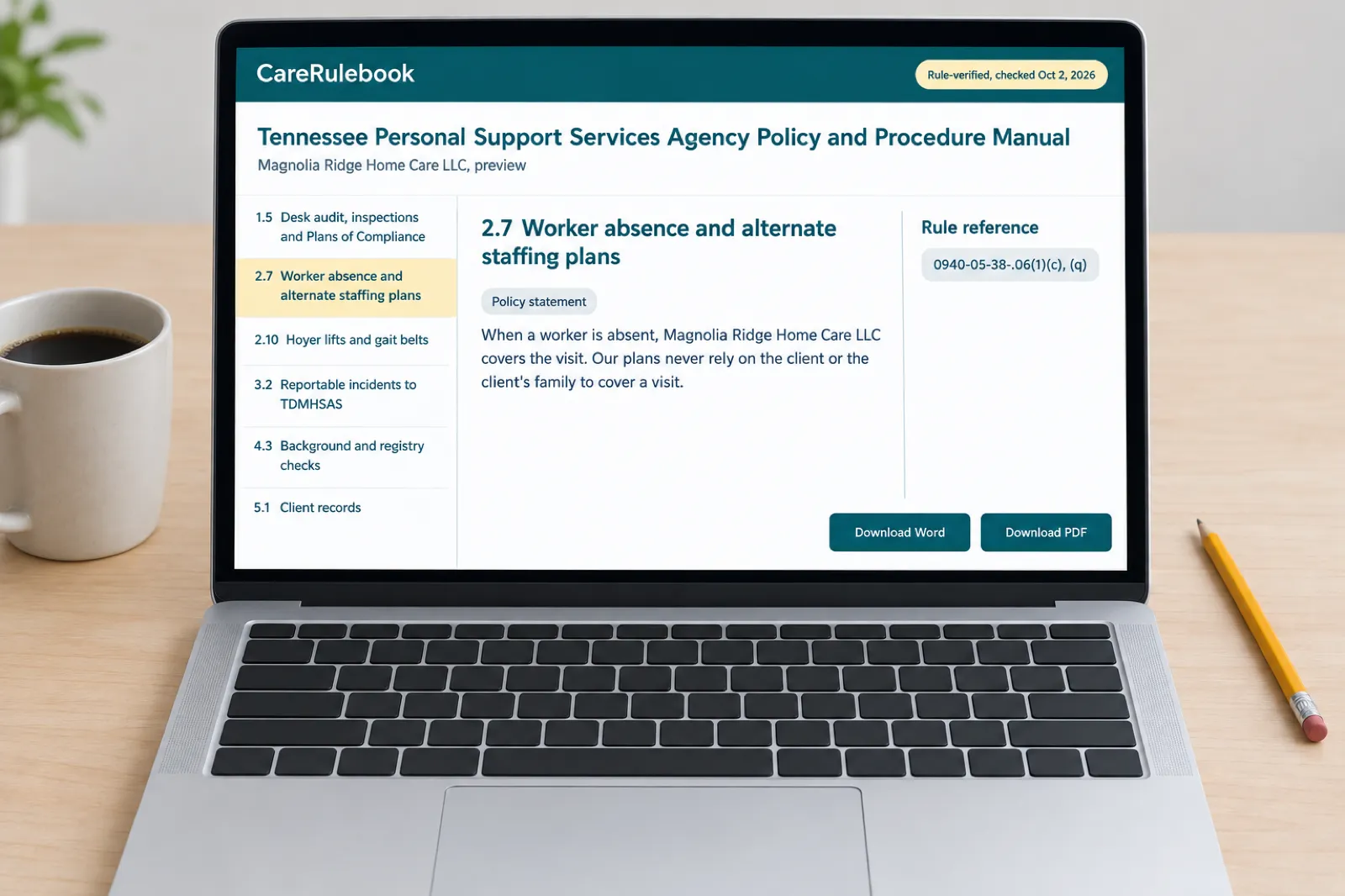
The CareRulebook Tennessee manual preview on a laptop: policy 2.7 on worker absence and alternate staffing plans for a sample agency, citing 0940-05-38-.06(1)(c), (q), with the manual’s contents listed beside it

CareRulebook

The policies TDMHSAS’s desk audit reads, written for your agency

CareRulebook’s Tennessee manual is built on the 17 policy items, the 8 personnel topics and every other requirement in 0940-05-38, 0940-05-02 and 0940-05-06-.03, written from your answers, with the rule quoted under each policy, the forms the records rules need, and a crosswalk that shows the desk audit where each item is met. Read every policy and adopt it before you apply.

  • 32 policies, 107 requirements mapped
  • Free preview before you pay
  • Editable Word and PDF
  • 12 months of updates: download again after a rule change
Preview your manual

$199CareRulebook founding price for the first 50 Tennessee agencies, then $249. Not a TDMHSAS fee.

From the initial license to a full license, and renewal

  • Notice first. Before an initial, full or provisional license expires, TDMHSAS tells you to apply for renewal and what to send, with the fee by invoice (0940-05-02-.07(1)-(2)). Each renewal includes a new client-mix attestation (0940-05-38-.04(4)).
  • What decides it. At renewal TDMHSAS reviews the application material and the agency’s performance history. If every facility or service the licensee runs complies, it issues a full license; if not, it may issue a provisional license for the service not in full compliance, or deny the renewal, with 15 calendar days to ask in writing for a hearing. (0940-05-02-.07(4)-(5)) "The maintenance and renewal of a license is contingent upon evidence of continued compliance with licensure laws, ordinances, rules and regulations." (0940-05-02-.14(1))
  • Full or provisional. A full license is valid for up to 12 months and is issued when the licensee shows compliance with all applicable licensure laws and rules. (0940-05-02-.02(2)) TDMHSAS may issue a provisional license to an agency not meeting every requirement, if it is making a diligent effort, clients are not endangered, it has an acceptable compliance plan and it met last year’s plan. (0940-05-02-.02(3)) The rules do not say what must happen during the initial license (for example a number of clients served) before a full license; ask your regional office.
  • On time keeps it alive. If you file a timely and complete renewal with the fee, "the existing license does not expire until the status of the application has been determined by the Department" (0940-05-02-.15).
  • Inspections. "The Department shall make at least one (1) unannounced inspection of each licensed facility/service yearly." (0940-05-02-.22) "Dates for unannounced inspections will be random varying from year to year." (0940-05-02-.07(4)) Any non-compliance found comes as a Notice of Non-Compliance, answered by a written Plan of Compliance by the date given (0940-05-02-.21(2)-(3)); keep the most recent plans together in one place (0940-05-02-.21(5)).

Changes between renewals

TDMHSAS uses two forms for changes: the Fact Sheet for a new site, a new category or a relocation, and the Change of Status form (MH-4454) for most other changes (TDMHSAS Provider FAQs; MH-4454). Both go to your regional office.

A new chief executive or executive director

TDMHSAS asks

The Change of Status form (MH-4454) with proof of citizenship, three character references and the background and privacy forms for the new person. The regional office schedules their fingerprinting.

MH-4454, item 1; Provider FAQs

A new site director

Not stated

The Change of Status form says not to use it for a site director change, and we found nothing saying how to report one. Ask your regional office.

MH-4454, item 1

A new name

TDMHSAS asks

A change in the licensee’s name only goes on the Change of Status form with legal proof, such as a revised charter from the Secretary of State. A new public name for a site needs one form for each site.

MH-4454, items 2-3

Moving the office

Rule requires; TDMHSAS asks

Licenses are address-specific, so a move needs a new license first: a Fact Sheet for the new location and a Change of Status form closing the old one. The move may not happen before the paperwork is in, the fees are paid and any inspection is done.

0940-05-02-.10; Provider FAQs; MH-4454, item 8

A second site, or another category

Rule requires; TDMHSAS asks

A current licensee uses a Fact Sheet to open a new site or add a category. Each site gets its own license and pays its own fee: one category at a site is TDMHSAS’s $810 fee, two categories $1,010.

0940-05-02-.05(1), .09; MH-4386

Counties or records address

Rule says

The rule says the agency should give TDMHSAS its counties and records address, and does not say how to report a change. Our suggestion: tell your regional office in writing when either changes.

0940-05-38-.04(6)

Your client mix

Rule requires

You serve only clients who will not take the agency outside its licensed category, and attest again at every renewal. The rules do not say how the 50% is counted. Our suggestion: if your mix is heading past 50% intellectual or developmental disability, ask TDMHSAS before renewal.

0940-05-38-.04(4), .05(5)

Selling or buying an agency

  • No transfer. "Licenses are not assignable or transferable except as provided by law. A new application must be made and a new license issued before services are provided when there is a change in the ownership of a facility/service or a change of location." (0940-05-02-.10)
  • Not on the Change of Status form. "This form is not for use in changing the ownership or operator of a currently licensed facility or service" (MH-4454, Instructions) By our reading the buyer files its own Initial Application and Fact Sheet, with its own fee and checks.
  • The certificate. The seller surrenders the license certificate on a transfer of ownership (0940-05-02-.17).
  • What counts as a sale. The current rules do not define a change of ownership. The proposed rewrite would: Change of ownership would cover a change in the licensee or governing body, or in who owns, manages or controls the licensee; TDMHSAS decides. (Proposed 0940-05-02-.10(2)-(4)) Not in force.

Our suggestion: plan the sale with TDMHSAS before it closes, so the buyer’s license is in place before the buyer provides services.

Closing an agency

  • Tell TDMHSAS. To close voluntarily, the Change of Status form asks for the closure date, a summary of the reason and arrangements for displaced clients. (MH-4454, item 6) The same form closes a single category (MH-4454).
  • Return the certificate. "The license certificate must be surrendered to the Department upon revocation or suspension of the license, upon transfer of ownership of the facility or service, or when the facility or service otherwise ceases to operate." (0940-05-02-.17)
  • Records. TDMHSAS says licensed providers keep records 10 years, citing a statute that keeps records detailing services for at least ten years after service ends (PSSA slides, slide 30). The rules do not say who holds them after a closure; our suggestion is to say in your closure summary where they will be kept.
  • If TDMHSAS ends a license. When a license is to be denied, suspended or revoked, TDMHSAS notifies state and local agencies that may help clients by coordinating placement. (0940-05-02-.24)

Proposed · not in force · hearing November 18, 2026

What the proposed rewrite would change in the application

On September 24, 2026 TDMHSAS filed proposed amendments rewriting every rule in Chapter 0940-05-02 (notice 09-31-26). The changes that touch applying and renewing:

  • Review before the license. TDMHSAS may review policies, procedures, personnel files, client records, attestations and virtual review materials before issuing an initial license; no license until deficiencies are corrected. (Proposed 0940-05-02-.06(5))
  • Fees first. No initial inspection until the site’s fees are paid and registered; fees follow an invoice. Amounts unchanged ($810 for one category). (Proposed 0940-05-02-.05(2))
  • No building inspection without an in-person site. The proposed rewrite would say life safety and environmental inspections apply only when the applicant owns, leases, operates or controls a physical site where clients are served in person, unless the category rules say otherwise. Not in force. (proposed 0940-05-02-.06(4))
  • License types. A site not yet serving clients would renew to another initial license; a full license needs substantial compliance; a provisional license lasts up to 12 months and has the same force as a full license. The proposed rewrite would issue an initial license to a licensed site whenever TDMHSAS has been unable to verify its program compliance. Not in force. (proposed 0940-05-02-.02) The proposed rewrite would renew a site that has served no clients under its category since the last license as another initial license. Not in force. (proposed 0940-05-02-.07(5)(c))
  • Renewal. A license would not be renewed while any Plan of Compliance is overdue. TDMHSAS may extend a license 60 days while a timely renewal is decided, then monthly on written request. (proposed 0940-05-02-.07(6), .15)

What it means for a new agency. By our reading, little changes in practice: pay the invoice promptly, have your policies and records ready for review, and start serving clients once licensed, since a site that has served no one would renew to another initial license. To comment: Attend the hearing on November 18, 2026, 10:00 a.m. Central, Ground Floor Hearing Room, Andrew Jackson Building, 500 Deaderick Street, Nashville (sign up to speak at the start; state-issued ID needed), or email written comments to Krysten.Velloff@tn.gov by 4:30 p.m. CDT on Friday, December 4, 2026. Contact: Krysten Velloff, 615-881-5280. (Secretary of State hearings list)

The proposal in full →

Myths about applying

Do I mail my policy manual with the Tennessee PSSA application?

It depends. Not with the forms: TDMHSAS lists four forms (the Initial Application, a Fact Sheet, the Background Check and Privacy Statement form and the Financial Statement), and none of them is a policy. But the initial inspection for a PSSA is an electronic desk audit that covers certain policies and procedures, and deficiencies must be corrected before a license is issued. Have every policy written and adopted when you apply, and send what the surveyor asks for.

"Initial inspections for Personal Support Services Agencies (PSSAs), D.U.I. Schools, and Non-Residential Office-Based Opiate Treatment offices (OBOTs) are conducted via an electronic desk audit."

Can I start serving private-pay clients while my PSSA application is pending?

No. No one may begin delivering services until TDMHSAS issues the license, and providing personal support services without a license is unlawful. TDMHSAS issues an initial license (up to one year) after its desk audit and after any deficiencies are corrected.

"No person, partnership, association or corporation may begin delivering services until the Department issues a license."

Do I need accreditation to get a Tennessee PSSA license?

No. The Initial Application says accreditation is optional. An accredited agency may send proof of its status to be considered for deemed compliance with certain program rules, but it still has the yearly unannounced inspection and must cooperate with TDMHSAS investigations.

"Accreditation or certification of an applicant’s facility/service is not required in order to be approved for license."

Can I buy an existing Tennessee PSSA and keep using its license?

No. A PSSA license cannot be assigned or transferred. After a change of ownership a new application must be made and a new license issued before services are provided, and the seller surrenders the old certificate. A proposed rewrite of the rules would define a change of ownership, including a change in who controls the licensee, and leave the final decision to TDMHSAS.

"A new application must be made and a new license issued before services are provided when there is a change in the ownership of a facility/service or a change of location."

Can I move my PSSA office first and tell TDMHSAS afterwards?

No. TDMHSAS licenses are address-specific, and a new license is needed before a relocation. You send a Fact Sheet for the new location and a Change of Status form closing the old one, and the move may not happen before the paperwork is in, the fees are paid and any inspection is done.

"Licenses are address-specific requiring a new license before a relocation may occur."

Does my PSSA office need a fire marshal inspection?

No. Not for the license. TDMHSAS says PSSAs currently do not need a life safety or fire inspection, and the initial inspection is an electronic desk audit. Check local zoning and business rules separately.

"Personal Support Services Agencies (PSSAs), D.U.I. Schools, and Non-Residential Office-Based Opiate Treatment offices (OBOTs) currently do not require a life safety/fire inspection."

Frequently asked questions

How do I apply for a PSSA license in Tennessee?

Send four forms to the TDMHSAS regional office nearest your location: the Initial Application, a Fact Sheet for each location, the Background Check and Privacy Statement form, and the Financial Statement. TDMHSAS then invoices you for its fee, $810 for one category at one site. When the paperwork is in and the fee is paid, the Office of Licensure contacts you about the initial inspection, which for a PSSA is an electronic desk audit. Once any deficiencies are corrected, TDMHSAS issues an initial license for up to one year.

Can I apply online?

Partly. TDMHSAS publishes each licensing form as a printable PDF and as a web form, and the forms list each regional office’s email address and fax number as well as its postal address. The fee is paid against TDMHSAS’s invoice, which comes with mailing instructions. TDMHSAS also accepts documents and payments in person at its Middle Tennessee office on Tuesdays and Thursdays, 8:00am to 4:00pm.

How long does the Tennessee PSSA application take?

Neither the rules nor TDMHSAS’s pages give a processing time. The waits come at the invoice, the scheduling of the desk audit and any corrections it asks for. Ask your regional office when you send the forms; TDMHSAS says a Regional Manager can explain the next steps.

Who has to be fingerprinted?

The application asks for a fingerprint background check through the Tennessee Bureau of Investigation for the person with overall responsibility for the agency, and proof of citizenship or legal immigration status and the background and privacy forms for that person and any other applicant listed. If they choose TBI fingerprinting, the Office of Licensure schedules the appointment. An FBI fingerprint check, or a check by a state-licensed private investigator, is accepted if it covers current and previous states of residence. The individual pays for it.

Do I need an office before I apply?

The Fact Sheet asks for a street address and county, licenses are tied to an address, and you tell TDMHSAS where you keep employee and client records. Fact Sheet items 6 to 22, about buildings and occupancy, do not apply to PSSAs, and TDMHSAS says PSSAs need no fire inspection. Whether the address can be your home is not stated in the rules we saved; ask your regional office before you apply.

Can I hire caregivers before the license?

Nothing we found stops you hiring before the license, but no services may be delivered until TDMHSAS issues it. If you hire early, finish the checks before anyone has contact with a client. The rules require Abuse Registry and Sex Offender Registry checks before direct contact and documented competency in seven areas before work. The criminal background check is due within 10 days of employment, and TDMHSAS reads the statute as needing the results in hand before any direct contact; it also reads it as needing references checked before employment.

What if TDMHSAS denies my application?

TDMHSAS notifies you, and within 15 calendar days of that notice you may file a written request for a hearing before the Licensure Review Panel. Grounds for denial include violating licensure law or rules, conduct harmful to clients, giving TDMHSAS false information, and subterfuge such as reapplying through a second party after a denial.

Is the $810 fee per agency or per site?

Per site. TDMHSAS issues one license for each site, and its fee is $810 for one distinct category of service at a site, or $1,010 for two, with every initial and renewal application. These are TDMHSAS’s fees, not CareRulebook prices, and they are non-refundable.

Get Tennessee rule-change alerts

TDMHSAS has proposed a rewrite of its licensure procedure rules, Chapter 0940-05-02, which govern the application, the initial license and renewal (hearing November 18, 2026; comments by December 4, 2026). Leave your email and we will tell you when a Tennessee change affects your application or your policies.

No spam. Only emails about Tennessee home care rule changes. How we use your email.

Keep reading

Tennessee

How to start a home care agency in Tennessee

Who needs the PSSA license, TDMHSAS vs DDA vs HFC, the policies, background checks and fees.

Tool

Tennessee license checklist

Every step to a PSSA license, tailored to your agency, emailed to you.

Manual

Tennessee policy manual

The 17 policy items and 8 personnel topics, ready for the desk audit. Preview free.

Tennessee

Tennessee PSSA inspections

The desk audit, unannounced inspections and Plans of Compliance.

Tennessee

Tennessee home health vs home care

TDMHSAS, DDA or HFC, and the Fact Sheet’s "Non-Medical Home Health" box.

Tennessee

Tennessee PSSA policies and procedures

The 17 policy items and 8 personnel topics TDMHSAS checks.

Tennessee

Tennessee PSSA license cost and timeline

TDMHSAS’s $810 fee per site, other costs with official prices and each step to the license.

Tennessee

Who runs a Tennessee PSSA

The licensee, the person responsible and when a nurse is needed.

Tennessee

Tennessee caregiver background checks

The criminal check, the Abuse Registry and the Sex Offender Registry, before contact.

Colorado

The Colorado license application

How Colorado does it: a letter of intent, COHFI and a survey with zero deficiencies.

Indiana

The Indiana license application

How Indiana does it: the IDOH Gateway, nine policies with seven forms, and IDOH’s $250 fee each year.

North Carolina

The North Carolina license application

DHSR also reviews your policies before it licenses you.

Illinois

The Illinois license application

A paper form, your policies in the envelope and a 240-day provisional license.

Washington

The Washington license application

DOH’s orientation class, a paper packet and a manual DOH approves.

Virginia

The Virginia license application

The VDH OLC Portal, 60 days before opening.

Georgia

The Georgia license application

GAHLES and a three-month provisional license.

Sources

  1. Tenn. Comp. R. & Regs. 0940-05-38, Minimum Program Requirements for Personal Support Services Agencies (rules effective June 2, 2016; December 2022 revised edition) · Tennessee Secretary of State, Publications Division (TDMHSAS rules) · retrieved October 1, 2026
  2. Tenn. Comp. R. & Regs. 0940-05-02, Licensure Administration and Procedures (December 2022 revised edition) · Tennessee Secretary of State, Publications Division (TDMHSAS rules) · retrieved October 1, 2026
  3. Notice of Rulemaking Hearing 09-31-26: TDMHSAS amendments to Chapter 0940-05-02, Licensure Administration and Procedures (filed September 24, 2026; hearing November 18, 2026) · Tennessee Secretary of State; Tennessee Department of Mental Health and Substance Abuse Services · retrieved October 1, 2026
  4. Rulemaking Hearings list (0940-05-02 entry, notice 4392) · Tennessee Secretary of State · retrieved October 2, 2026
  5. Become a Licensed Provider · Tennessee Department of Mental Health and Substance Abuse Services, Office of Licensure · retrieved October 1, 2026
  6. Licensing Forms · Tennessee Department of Mental Health and Substance Abuse Services, Office of Licensure · retrieved October 1, 2026
  7. Licensed Provider Frequently Asked Questions · Tennessee Department of Mental Health and Substance Abuse Services, Office of Licensure · retrieved October 1, 2026
  8. Licensing (Office of Licensure) · Tennessee Department of Mental Health and Substance Abuse Services · retrieved October 2, 2026
  9. Personal Support Services Agency (PSSA) Provider Information (2025 slide deck; file modified November 2025) · Tennessee Department of Mental Health and Substance Abuse Services, Office of Licensure · retrieved October 1, 2026
  10. Initial Application for License, MH-4385 (rev. 05/15/2020) · Tennessee Department of Mental Health and Substance Abuse Services, Office of Licensure · retrieved October 2, 2026
  11. Licensure Application Addendum: Fact Sheet Form, MH-4386 (rev. 10/27/2025) · Tennessee Department of Mental Health and Substance Abuse Services, Office of Licensure · retrieved October 2, 2026
  12. Licensure Application Addendum: Financial Statement Form · Tennessee Department of Mental Health and Substance Abuse Services, Office of Licensure · retrieved October 2, 2026
  13. Agency/Service Change of Status Form, MH-4454 (rev. 5/15/2020) · Tennessee Department of Mental Health and Substance Abuse Services, Office of Licensure · retrieved October 2, 2026
Build your Tennessee manualfrom $199