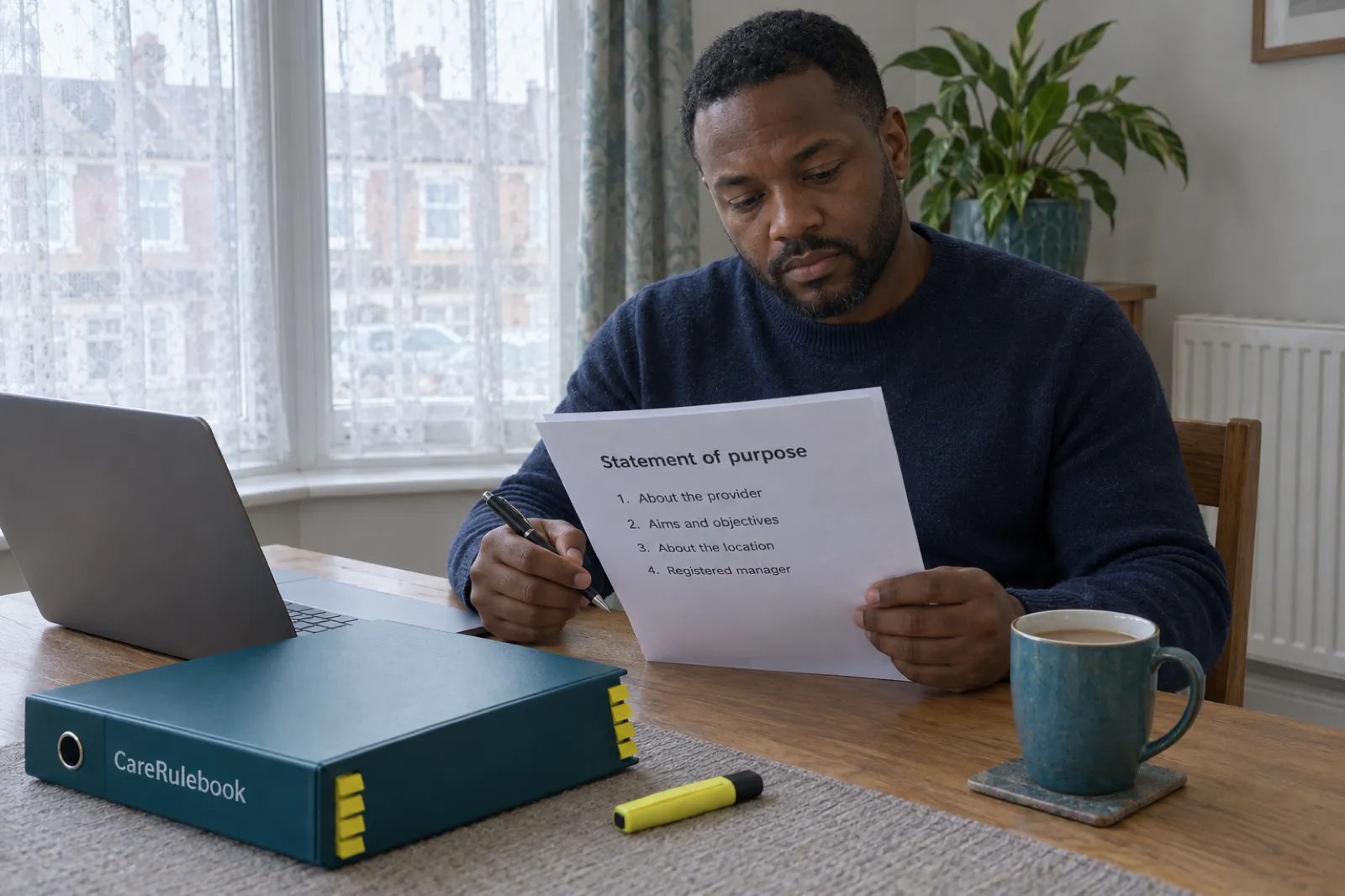
1. About the provider
- Name of the business
- Legal status: sole trader, partnership or organisation
- Business address, phone and email, including the address for serving notices
- Names of any partners
England · CQC registration · 2009 Regulations, reg. 12
Every CQC registration application needs a statement of purpose: what you do, where you do it and who your service is for. The law sets five things it must contain, CQC adds detail for each location and registered manager, and any later change must reach CQC within 28 days.
Quick answer
A statement of purpose is a document you must give CQC under regulation 12 of the Care Quality Commission (Registration) Regulations 2009. CQC describes it as where you tell it in your own words: what you do, where you do it, and the people your service is for.
Schedule 3 of the Regulations says it must contain five things: your aims and objectives; the services you provide and the needs they meet; names and contact details for the provider and any registered manager; your legal status; and your locations. A home care agency sends it with its CQC registration application. "If you do not, we will return your application to you."
After you register, you must keep it under review and send CQC written details of any revision within 28 days.
Regulation 12(1): "The registered person must give the Commission a statement of purpose containing the information listed in Schedule 3." Schedule 3 lists five items:
What you are trying to achieve in providing personal care.
"The aims and objectives of the service provider in carrying on the regulated activity."
2009 Regulations, Sch. 3 para. 1The kinds of services you provide and the range of needs they are meant to meet.
"The kinds of services provided for the purposes of the carrying on of the regulated activity and the range of service users’ needs which those services are intended to meet."
2009 Regulations, Sch. 3 para. 2Full name, business address, phone and email for the provider and any registered manager, plus an address (and, if you agree, an email) where CQC can serve notices.
"in relation to the service provider and any registered manager— (i)full name, (ii)business address, (iii)business telephone number, (iv)electronic mail address where available;"
2009 Regulations, Sch. 3 para. 3For example sole trader, partnership or limited company.
"The legal status of the service provider."
2009 Regulations, Sch. 3 para. 4Details of the places your service is run from.
"Details of the locations at which the services provided for the purposes of the regulated activity are carried on."
2009 Regulations, Sch. 3 para. 5CQC’s guidance turns Schedule 3 into four parts, and publishes a template for each. If you use them, "copy and paste all the parts into one document before submitting it with your application."
CQC, Statement of purpose (updated 25 March 2026)
Running it from home? For each location CQC asks for "a description of your location, including any other uses for the property (e.g. is it a domestic dwelling?)". Say so plainly. Your main office must be in England, and CQC does not accept a PO box.
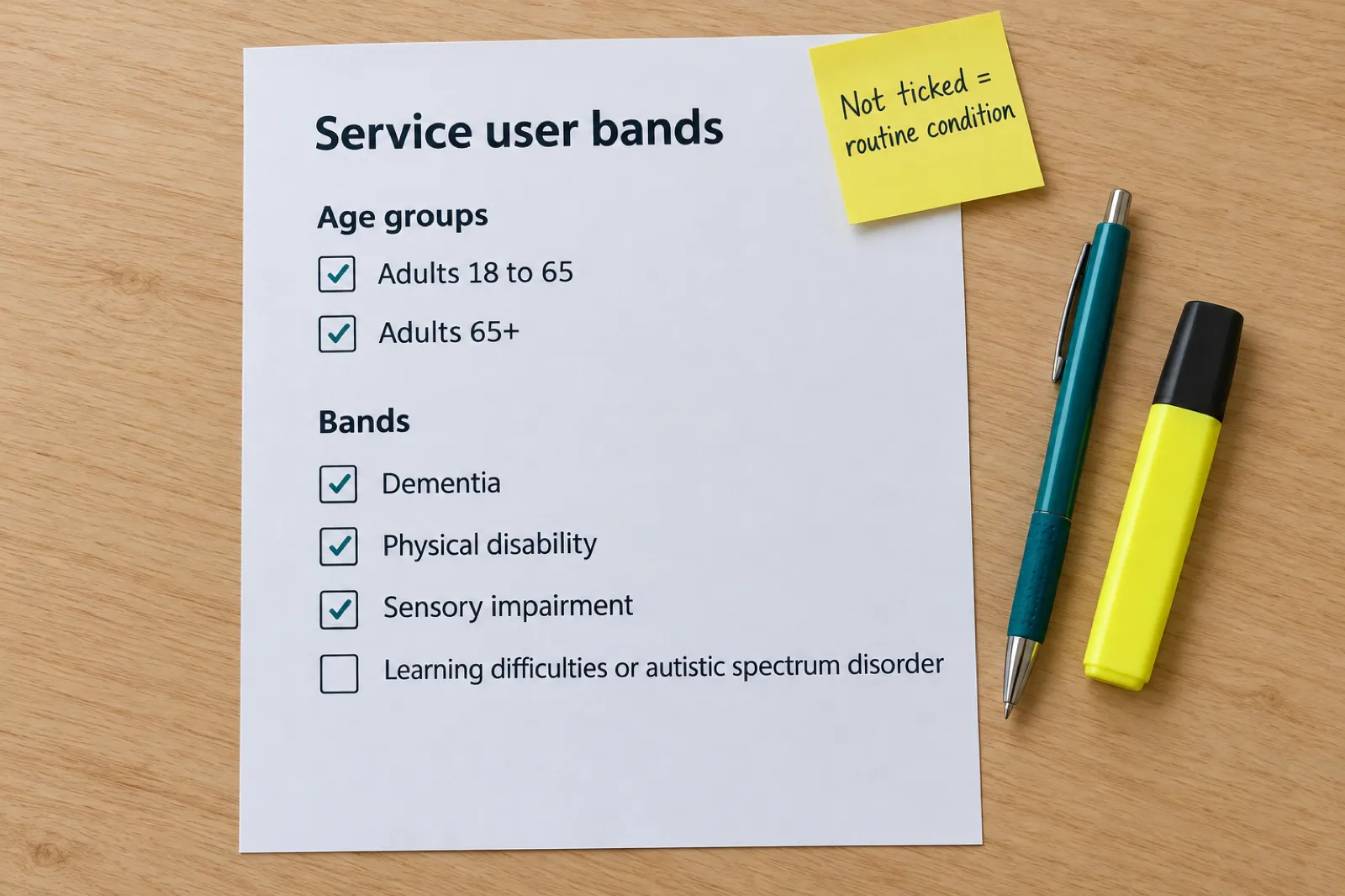
For each location you record who the service is for. The application form (section 6.14) has age groups, from children 0 to 3 up to adults 65 and over, or the whole population, and these bands:
Your statement of purpose and your application should describe the same people. If you provide personal care and do not select the learning difficulties or autism band, section 6.15 asks you to agree in writing to this condition:
"The registered provider must not provide [regulated activity] in a specialist service to people whose presenting need for care or support is as a direct result of the person’s learning disability and or autism at or from [this location]."
It applies to any personal care provider that is not planning a specialist service for those needs, and CQC says that because of it, it will not assess you against its Right support, right care, right culture guidance. If you want to offer a specialist service later, you must apply to remove the condition and wait for approval. If you plan to be a specialist service from the start, CQC wants to see how you have considered the needs of autistic people and people with a learning disability, including how they can access and use your statement of purpose.
CQC wants this in your own words, so treat this as a shape, not text to copy. Everything in it should be true of your service, because your other documents will be checked against it.
Example wording · replace the brackets
[Agency name] provides personal care to adults in their own homes in [town or local authority area]. We support people aged [18 to 65 and over 65] who are living with [dementia, physical disability, sensory impairment], so they can stay safely and comfortably at home.
Our aims are to:
We do not provide a specialist service to people whose need for care is a direct result of a learning disability or autism.
The last line only belongs there if you have agreed to the section 6.15 condition. Each aim should connect to a policy you can show CQC.
CareRulebook
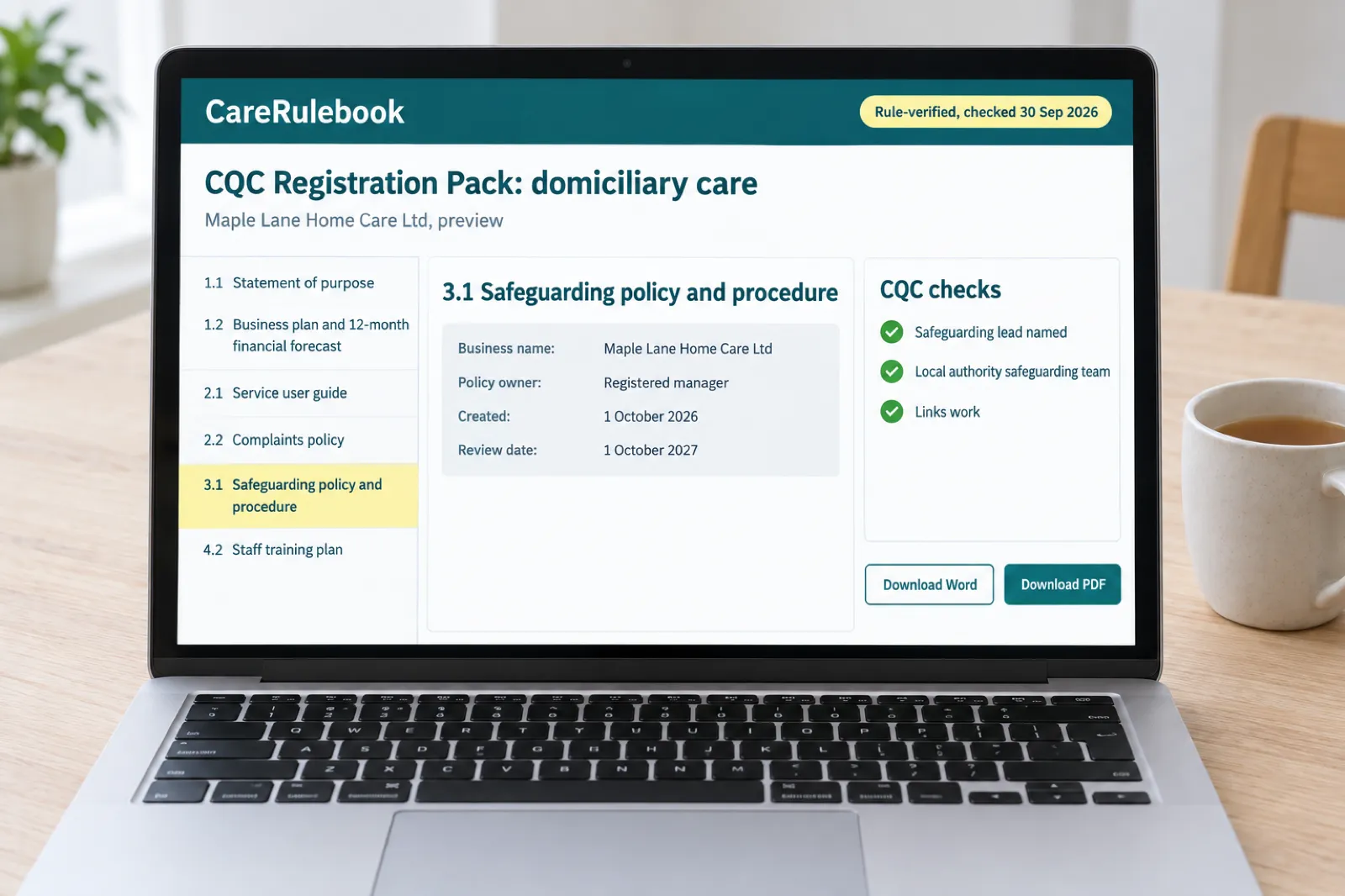
CareRulebook builds your CQC documents from one set of answers about your agency, area and the people you support, so your statement of purpose, business plan, training plan, service user guide and policies describe the same service.
CQC reads your statement of purpose first and checks the rest against it:
For homecare applications, CQC’s first step is checking that your forms and statement of purpose are complete. If anything is missing, it rejects the application.
CQCIt must cover the training your staff need, in line with the aims and objectives in your statement of purpose.
CQCRegulation 13 requires you to stay financially viable so you can achieve the aims in your statement of purpose, and CQC wants your business plan tied to the same service user bands. Homecare agencies send a business plan and 12-month forecast instead of a financial viability statement.
reg. 13Every document must be consistent with your other policies, and a template written for another service type will not work.
CQCSince 1 July 2025, CQC has rejected homecare applications that are not complete or accurate when they arrive, rather than asking for fixes. A resubmission counts as a new application. What CQC checks in every document →
Regulation 12 does not end at registration: "The registered person must keep under review and, where appropriate, revise the statement of purpose." When you revise it, you must send CQC written details within 28 days. CQC asks you to notify it of the change and email a copy of the updated statement with the notification.
Typical triggers are a new registered manager, a new office address, a change to the people you support or the services you offer, and a change to the address or email CQC uses to serve notices. The application form’s declaration spells the last one out: you must update the statement, notify CQC and send a copy.
A document, required by regulation 12 of the Care Quality Commission (Registration) Regulations 2009, that tells CQC in your own words what you do, where you do it and who your service is for. Schedule 3 lists what it must contain: your aims and objectives, the services and needs you meet, names and contact details, your legal status and your locations.
Yes. CQC’s application form says you must draft and send one with the application, and that it will return your application if you do not. For homecare applications, the completeness of the forms and statement of purpose is the first thing CQC checks.
Yes. CQC publishes a four-part template: about the provider, aims and objectives, about the location and registered managers. If you use it, CQC asks you to combine the parts into one document before sending it.
The law does not set a schedule. You must keep it under review, revise it when things change and send CQC written details of any revision within 28 days.
The groups of people your service is for, recorded for each location: age groups, and bands such as dementia, mental health, sensory impairment, physical disability, and learning difficulties or autistic spectrum disorder. If you do not select the learning disability or autism band, you agree to a condition that you will not provide a specialist service for those needs.
CQC asks you to describe each location, including any other uses for the property, such as whether it is a domestic dwelling. Your main office must be in England, and a PO box is not allowed.
Leave your email and we will send your CQC pack preview, including your statement of purpose, as soon as it is ready.
No spam. One email when your guide's pack launches, and rule-change alerts if you want them. How we use your email.
England
How to start a home care agency in England
CQC registration, managers, documents and timelines.
Tool
CQC registration checklist
Every step and document, tailored and emailed to you.
England
CQC business plan and forecast
The eight sections and a free 12-month forecast template.
Trust
How we verify rules
Every quote checked against the official text.