Skip to content
CareRulebook
MenuClose

Where are you starting?

United StatesTexas, North Carolina, Georgia, Virginia, Indiana, Ohio, Illinois, Washington, Colorado
TexasManual
North CarolinaManual
GeorgiaManual
VirginiaManual
IndianaManual
OhioGuide
IllinoisManual
WashingtonManual
ColoradoGuideAll US states →
United KingdomEngland
Free toolsChecklists, calculators and templates

Washington · Caregivers · RCW 74.39A.074 · Chapter 246-980 WAC

Washington caregiver training and certification: 75 hours in 120 days, certified in 365

Caregivers who give hands-on personal care for a Washington home care agency are long-term care workers. Unless exempt, each one completes 75 hours of DSHS-approved training (5 before their first client) within 120 days of hire, applies to DOH for home care aide certification within 14 days, and must be certified within 365 days, or 425 with a provisional certificate, under timelines that run to the end of 2027. Then 12 hours of continuing education a year. Here is who is exempt, what changed in 2026, and what your agency has to track and prove.

  • Rule-verified October 2, 2026
  • Quoted from RCW 74.39A, RCW 18.88B and chapter 246-980 WAC
  • Including the July 2026 DOH rule
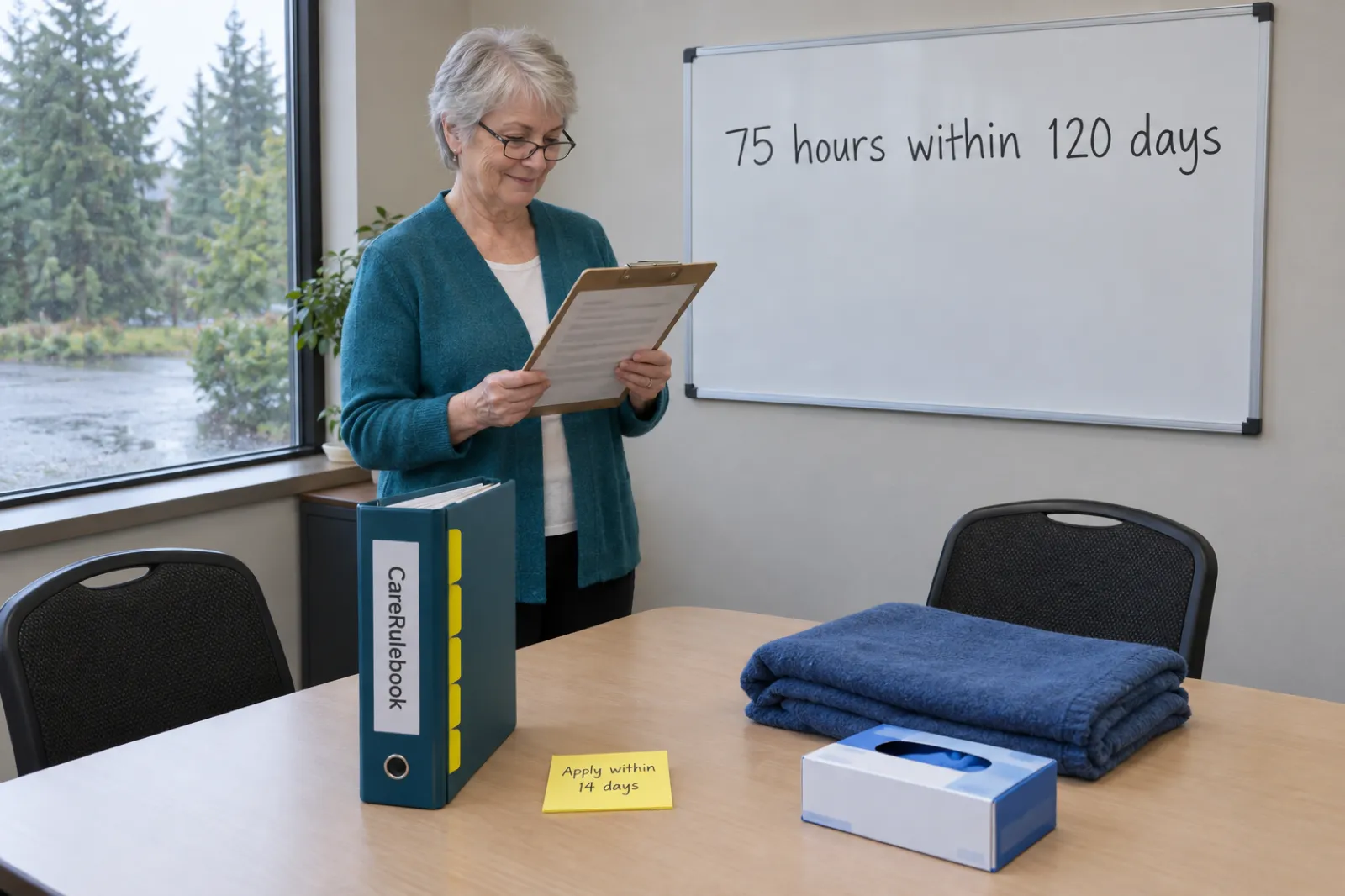
A woman with silver hair in a teal cardigan reads a clipboard in a small training room beside a whiteboard reading 75 hours within 120 days, with a CareRulebook binder, a sticky note reading Apply within 14 days, a box of gloves and a folded blanket on the table

Quick answer

The statute says "the minimum training requirement is seventy-five hours of entry-level training approved by the department. A long-term care worker must successfully complete five of these seventy-five hours before being eligible to provide care." (RCW 74.39A.074(1)(b)). Those 75 hours must be finished within 120 calendar days of hire, and only DSHS-approved curricula count (RCW 74.39A.074(2)).

Unless exempt, a direct care employee of a home care agency must also become a certified home care aide with DOH: apply within 14 days of hire, and be certified within 365 days, or 425 with a provisional certificate, for original applications submitted by December 31, 2027 (WAC 246-980-030). The statute’s own deadline is 200 days (RCW 18.88B.021(1)). Nurses and certified nursing assistants are exempt from both the certification and the 75 hours. Family and limited-hour workers are exempt from certification but owe shorter training; respite-only workers are exempt from certification, and only some of them qualify for the shorter respite training.

Every long-term care worker then completes 12 hours of continuing education a year (RCW 74.39A.341(1)). At an agency, by our reading, the only exemption is for registered and licensed practical nurses, because the statute’s other exemptions name individual providers (RCW 74.39A.341(3)). Since April 25, 2026, DSHS’s rules say family caregivers working through an agency owe it too (WSR 26-08-045).

Who these rules cover

The statute says long-term care workers "include all persons who provide paid, hands-on personal care services for the elderly or persons with disabilities, including but not limited to individual providers of home care services, direct care workers employed by home care agencies" (RCW 74.39A.009(20)). DOH’s licensing rule adds: "A long-term care worker employed by a home care agency is either credentialed as a certified home care aide under chapters 18.88A RCW and 246-980 WAC or meets the exemption criteria according to chapter 246-980 WAC." (WAC 246-335-410(6)), and "For home care agencies, minimum health care credentialing is a certified home care aide or higher credential." (WAC 246-335-310(23)(a)).

Two agencies are involved. DSHS sets and approves the training (chapter 74.39A RCW, chapter 388-71 WAC). DOH issues the home care aide credential (chapter 18.88B RCW, chapter 246-980 WAC) and licenses your agency. Your manual can require and track the training, but it cannot supply it: only DSHS-approved curricula count.

Staff who give no hands-on personal care. By our reading of the statute’s definition, a worker who only does housework, shopping, meals or errands is not a long-term care worker, so the 75 hours and certification do not apply to them. DOH’s own rules still do: in-person orientation to your policies and a check of skills or training before anyone gives care on their own (WAC 246-335-425(9)), and ongoing training pertinent to clients’ care needs (WAC 246-335-425(10)). And back-up care that needs help with activities of daily living may only be given by credentialed or exempt staff (WAC 246-335-420(8)).

A new caregiver’s deadlines, in order

For a caregiver who is not exempt. Every deadline runs from their date of hire, which may be earlier than the day they join you if they have worked as a caregiver before (see below). Tick steps off as you go; progress is saved in this browser only.

  1. Five hours of training before any care

    Before the first client

    2 hours of orientation on the caregiver role and terms of employment, and 3 hours of safety training covering basic safety precautions, emergency procedures and infection control, from a DSHS-approved curriculum. Separately, DOH’s rule requires your own in-person orientation to your policies and a check of skills or training before the worker gives care on their own.

  2. Apply to DOH for home care aide certification

    Within 14 days of hire

    The worker submits the application within 14 calendar days of hire. It counts as submitted on the postmark date, or for an online or in-person application, the date DOH accepts it. DOH’s application fee is $100.

  3. Finish the other 70 hours

    Within 120 days of hire

    Long-term care basic training on core competencies and population-specific competencies, from a DSHS-approved curriculum, so that all 75 hours are complete within 120 calendar days of hire.

  4. Pass the certification exam

    After training

    After the training: a written knowledge test and a skills demonstration, scheduled with DOH’s examination contractor, whose fees the vendor sets. A failed portion can be retaken three times.

    WAC 246-980-040(2); -100
  5. Be certified

    By day 365 (425)

    Within 365 calendar days of hire, or 425 with a provisional certificate, for a worker who submits their original application by December 31, 2027. A worker who is not certified in time may no longer give care without the credential.

    WAC 246-980-030(2)(b)
  6. Renew every year with 12 hours of continuing education

    Every year

    A home care aide renews by their birthday each year and sends proof of 12 hours of DSHS-approved continuing education with the renewal. No continuing education is due at a first renewal that comes less than a full year after certification. DOH’s renewal fee is $100.

If a deadline is missed, the rule is direct: "A long-term care worker is no longer eligible to provide care without a credential under the following circumstances:" when the training is not finished within 120 days of the date of hire, or certification is not obtained within 365 days (425 provisional) (WAC 246-980-030(2)). A worker who fails both parts of the exam four times in a row retakes the core competencies training, and "Cannot continue to provide care as a long-term care worker until the certification has been issued." (WAC 246-980-100(7)(c)).

When the clock starts: two rules to read together

DOH’s rule says date of hire "means the first day the long-term care worker is employed by any employer as a long-term care worker or the date the long-term care worker provides direct care for pay from any employer." (WAC 246-980-010(2)). Read alone, that means a caregiver who has worked for another employer could already be part way through, or past, their 120 and 365 days when they join you.

The statute adds a reset: "A long-term care worker who is not currently certified or eligible to reactivate an expired credential shall receive a new date of hire when beginning work with either a new employer or returning to a former employer after prior employment has ended." (RCW 18.88B.021(1)). DSHS’s rule adds that an agency must not employ someone who worked as a long-term care worker before without finishing the required training or certification, unless their date of hire has been reset (WAC 388-71-0980).

The sources we read do not say how DOH applies the two together to a caregiver who has worked elsewhere before, so we cannot tell you which date DOH will use. Our suggestion: ask every new caregiver whether, when and where they have worked as a caregiver before, check any credential on DOH’s provider credential search before you schedule them, and confirm the date with DOH. CareRulebook’s manual uses the earlier date until DOH confirms which one applies.

Certification deadlines: 365 days now, 200 days in the statute

DOH’s rule, in its permanent form in effect since July 3, 2026 (WSR 26-12-065), says a worker may no longer give care without a credential if they have "not obtained their certification within 365 calendar days from their date of hire, or 425 calendar days if granted a provisional certificate under RCW 18.88B.035." It adds: "These timelines go into effect August 25, 2025, through December 31, 2027. These timelines apply to a pending applicant or a new applicant who has submitted an original application for certification as a home care aide by December 31, 2027." (WAC 246-980-030(2)(b)).

The statute itself says "except as provided in RCW 18.88B.041 and 18.88B.022, any person hired as a long-term care worker must be certified as a home care aide as provided in this chapter within 200 calendar days after the date of hire" (RCW 18.88B.021(1)). The longer timelines rest on RCW 18.88B.022, which says "Rules adopted under this section must be effective until 90 days after adjournment of the session proceeding the publishing of the 2026 biennial performance audit" and that "This section expires December 31, 2027." (RCW 18.88B.022).

What that means for hiring. By our reading, a caregiver whose original application is submitted by December 31, 2027 (postmarked, or accepted by DOH if made online or in person) has 365 days (425 provisional); one who applies after that date is back to the statute’s 200 days unless the legislature changes the law. Whether the statute’s audit-linked wording ends the longer window earlier is not something we could settle from the text; ask DOH if you are hiring near the end of 2027.

Provisional certificate

For workers with limited English, once

DOH may issue a provisional certificate, only once, to a worker with limited English proficiency who asks for it. For an agency worker, the request includes a DOH form "completed by the employer who hired the applicant as a long-term care worker, verifying the applicant’s date of hire". It takes effect 365 days after the date of hire and expires at 425 days: "The applicant must stop working after 425 days of employment if the certification has not been granted for any reason."

WAC 246-980-065

The surveyor’s 2018 checklist

Still says 200 days

DOH’s long-term care worker checklist for surveyors (May 2018) sorts each worker into one of six types and still reads "Is within 200 day from date of hire." The rule now says 365 days. Our reading: keep records against the rule, and ask DOH if a surveyor raises the difference.

DOH 346-097

Who is exempt from home care aide certification

These long-term care workers do not need home care aide certification (WAC 246-980-025). As the rule says, "Long-term care workers who are exempt from obtaining a home care aide certification may be required to complete minimum training requirements under RCW 74.39A.074 or 74.39A.076."

WorkerCertificationTraining they still oweSource
Registered nurse, licensed practical nurse or ARNP with an active Washington credentialExemptNoneWAC 246-980-025(2)(a); RCW 18.88B.041(1)(a)
Nursing assistant-certified (NA-C), activeExemptNoneWAC 246-980-025(2)(a)
In an approved NA-C training programExempt if the program is finished within 120 days of hire and the NA-C credential issued within 365 days (through December 31, 2027)The NA-C programWAC 246-980-025(2)(c)
Employed as a long-term care worker on January 6, 2012, or between January 1, 2011 and January 6, 2012, with the training then requiredExempt, until they go three consecutive years without giving careNoneWAC 246-980-025(2)(e)
Caring only for their own child or parent, or only for a sibling, aunt, uncle, cousin, niece, nephew, grandparent or grandchild (including by marriage or domestic partnership)Exempt35 hours within 120 days, 5 before care (12 hours for a parent caring only for their child with a developmental disability)WAC 246-980-025(1)(a)-(b); RCW 74.39A.076(1)(a), (d)
Caring only for their spouse or registered domestic partnerExempt (since July 1, 2026, without the earlier Veterans Affairs funding condition)From July 1, 2026: 15 hours of basic training and at least 6 hours of focused training in the statute; DSHS’s chart lists 2 hours of orientation, 3 of safety and 16 of basic trainingWAC 246-980-025(1)(c); RCW 74.39A.076(1)(b); WAC 388-71-0523
Giving 20 hours or less of care to one person in a calendar monthExempt35 hours within 120 days, 5 before careWAC 246-980-025(1)(d); RCW 74.39A.076(1)(d)
Giving only respite services, under 300 hours a yearExemptDepends on who the clients are: see belowWAC 246-980-025(1)(h)

Workers exempt under RCW 18.88B.041(1)(a), the nurses, nursing assistants and trainees, Medicare-certified home health aides, holders of a similar credential DOH accepts, people with a special education endorsement and pre-2012 workers, are excused from the 75 hours (RCW 74.39A.074(1)(a)). The other exemptions remove the certification; the training those workers owe is in the table.

Prove it. Each personnel file holds the worker’s "Current practice certification, credential, licensure, or documentation that noncredentialed long-term care workers meet the exemption criteria in chapter 246-980 WAC, as applicable" (WAC 246-335-430(1)). By our reading, an exemption based on hours lasts only while the hours stay within the limit. CareRulebook’s manual checks those hours every month and records the evidence for each exemption, such as a signed statement of the family relationship; those are the manual’s procedures.

Respite-only caregivers

Family respite care is one of the home care services you can tick on DOH’s application (DOH 505-051). Two rules apply to a worker who gives only respite care:

  • Certification. "A person working as a long-term care worker providing in-home care who only provides respite services and works less than 300 hours in any calendar year" is exempt (WAC 246-980-025(1)(h)).
  • Training. A respite-only worker who gives respite "only for individuals with developmental disabilities receiving services under Title 71A RCW or only for individuals who receive services under this chapter", and works 300 hours or less a year, "must complete 14 hours of training within the first 120 days after becoming a long-term care worker providing in-home care. Five of the 14 hours must be completed before becoming eligible to provide care" (RCW 74.39A.076(1)(c)).

Our reading. "This chapter" is chapter 74.39A RCW, the state’s long-term care services law. A private-pay client is not, as far as we can see, receiving services under it, so the 14-hour route may not fit a private-pay agency’s respite worker. If it does not, the default applies: 75 hours within 120 days (RCW 74.39A.074(1)(b)), though the worker remains exempt from certification. The two rules also count hours differently: the certification exemption says "less than 300 hours", the training rule "300 hours or less". CareRulebook’s manual has the supervisor confirm the hours that apply with the DSHS-approved training program before the worker starts. Our suggestion: ask DSHS before you hire respite-only staff on the shorter training; its background checks page lists 360-725-2563 for home care agency training and certification questions (DSHS, Background Checks).

Continuing education: 12 hours a year

"All long-term care workers shall complete 12 hours of continuing education training in advanced training topics each year." (RCW 74.39A.341(1)). "Completion of continuing education as required in this section is a prerequisite to maintaining home care aide certification under chapter 18.88B RCW." (RCW 74.39A.341(2)), and only DSHS-approved curricula count (RCW 74.39A.341(5)), so an agency in-service counts only if DSHS has approved it.

  • Home care aides renew every year by their birthday and send verification of the 12 hours with the renewal (WAC 246-980-115(1)). "If the first renewal period is less than a full year from the date of certification, no continuing education will be due for the first renewal period." (WAC 246-980-110(2))
  • Nurses. Registered nurses and licensed practical nurses are exempt unless they are voluntarily certified as home care aides (RCW 74.39A.341(3)).
  • Everyone else, by our reading. The statute’s other exemptions, for family caregivers, for 20 hours or less of care a month to one person and for respite-only work, name individual providers, for example "A person working as an individual provider who provides 20 hours or less of care for one person in any calendar month" (RCW 74.39A.341(3)). In DSHS’s rules, individual providers are caregivers employed by the consumer directed employer (WAC 388-71-0836), not agency staff, so by our reading your certified nursing assistants and your family, limited-hour and respite workers all owe the 12 hours.
  • When it is due for exempt workers. DSHS’s rule says a worker exempt from certification who owes continuing education completes 12 hours within 45 days of hire or by their birthday in the year hired, whichever is later, then by their birthday each year (WAC 388-71-0991(2)).

In force since April 25, 2026

The April 2026 change for family caregivers

DSHS amended its training rules under SHB 1142 (2025). Its filing says the changes include "that family providers working for home care agencies are required [to complete] annual continuing education" (WSR 26-08-045). DSHS’s training chart now reads, for a worker caring only for a listed relative: "12 hours is required every year following completion of basic training while working in long-term care as an agency provider" (WAC 388-71-0523(7)). A family caregiver "must complete continuing education on or before their birthday in the year after basic training was completed." (WAC 388-71-0991(4)).

The same amendments added the spouse or domestic partner training from July 1, 2026; DSHS’s chart lists 16 hours of basic training for it (WAC 388-71-0523(8)), while the statute says "must receive 15 hours of basic training, and at least six hours of additional focused training based on the care-receiving spouse’s or partner’s needs" (RCW 74.39A.076(1)(b)). Confirm with your training program which course a spouse caregiver takes.

A caveat on DSHS’s rules. DSHS’s training chapter defines a home care agency as one providing home care "through a contract arrangement with the department" (WAC 388-71-0503), so how far its agency duties reach a private-pay agency is unclear. For continuing education it matters less: by our reading, the statute itself requires the 12 hours of every long-term care worker it does not exempt.

What your agency must track and prove

Credential or exemption on file

Each worker’s current certification, credential or license, or the documentation that a non-credentialed long-term care worker meets an exemption in chapter 246-980 WAC.

WAC 246-335-430(1)

Credentials current

The administrator makes sure staff, contractors and volunteers are currently credentialed by Washington when their work calls for it.

WAC 246-335-415(11)(h)

Orientation and skills before working alone

In-person orientation to your current policies and verification of skills or training, such as a written test, observation, or evidence of earlier training, before anyone gives care on their own; evidence of both in the personnel file.

WAC 246-335-425(9); -430(3), (5)

Training on your policies

Records of training on current and revised policies, including client care issues, and ongoing training pertinent to clients’ care needs.

WAC 246-335-430(7); -425(10)

Back-up care by the right staff

Back-up care that needs help with activities of daily living only by credentialed or exempt staff; others cover only household tasks or emergencies.

WAC 246-335-420(8)

Yearly evaluation with observation

An annual performance evaluation of everyone who gives direct care, including on-site observation of care and skills.

WAC 246-335-425(13)

Supervisor’s own 10 hours

The supervisor of direct care services and the alternate each complete at least ten hours of training a year, documented in their personnel files.

WAC 246-335-445(3)

Training certificates (DSHS rule)

DSHS’s rule says a home care agency keeps a copy of each worker’s proof of completion of training, and reviews a worker’s training and certification before hiring. By our reading, given DSHS’s definition of a home care agency, they are good practice rather than settled duties for a private-pay agency.

WAC 388-71-0970, -0971

What the surveyor uses. DOH’s long-term care worker checklist for surveyors (May 2018) says "The long-term care worker must fit into one of six categories." The six are: within the certification window, a provisional certificate, an active home care aide certification, another credential (NA-C, RN or LPN), nursing assistant training, and the 2011 to 2012 employment exemption, each with the proof the surveyor checks (DOH 346-097). Its six types do not include the family, limited-hour or respite exemptions. DOH’s personnel survey tool (May 2018) has columns for license, credential or certification (Z0630), evidence of orientation (Z0640), verification of skills (Z0650) and training on current and revised policies (Z0660) (DOH 655-014).

How CareRulebook’s manual handles training

Policy 4.5, orientation, skills verification and ongoing training, covers DOH’s side: in-person orientation from a checklist of topics tied to the manual’s policies, TB education with DOH’s materials, skills verification checklists for every worker and for each service you offer (personal care, transfers, medication help, housework, shopping, travel, meals, respite, and the optional services if you offer them), an optional written test, retraining on a failed step, ongoing training when clients’ needs or policies change, and the supervisors’ 10 hours, all on one training log.

Policy 4.6, caregiver training and home care aide certification, covers the state rules on this page: working out each caregiver’s date of hire, the 5 hours before the first visit, the 14-day application, the 120 and 365 (425) day deadlines, the exemption table with the evidence to keep, the training hours exempt workers still owe, removal from care the day a deadline is missed, continuing education and renewals, and who may give back-up care. A tracker for each caregiver puts every due date on one page. You choose whether you arrange the training through a DSHS-approved program or hire only people who have already completed it, and the policy is written for that choice.

Policy 4.8, personnel, contractor and volunteer records, lists what goes in each file, in the order of WAC 246-335-430.

The manual cannot supply the 75 hours, the exam or continuing education: those come from DSHS-approved programs and DOH’s exam vendor.

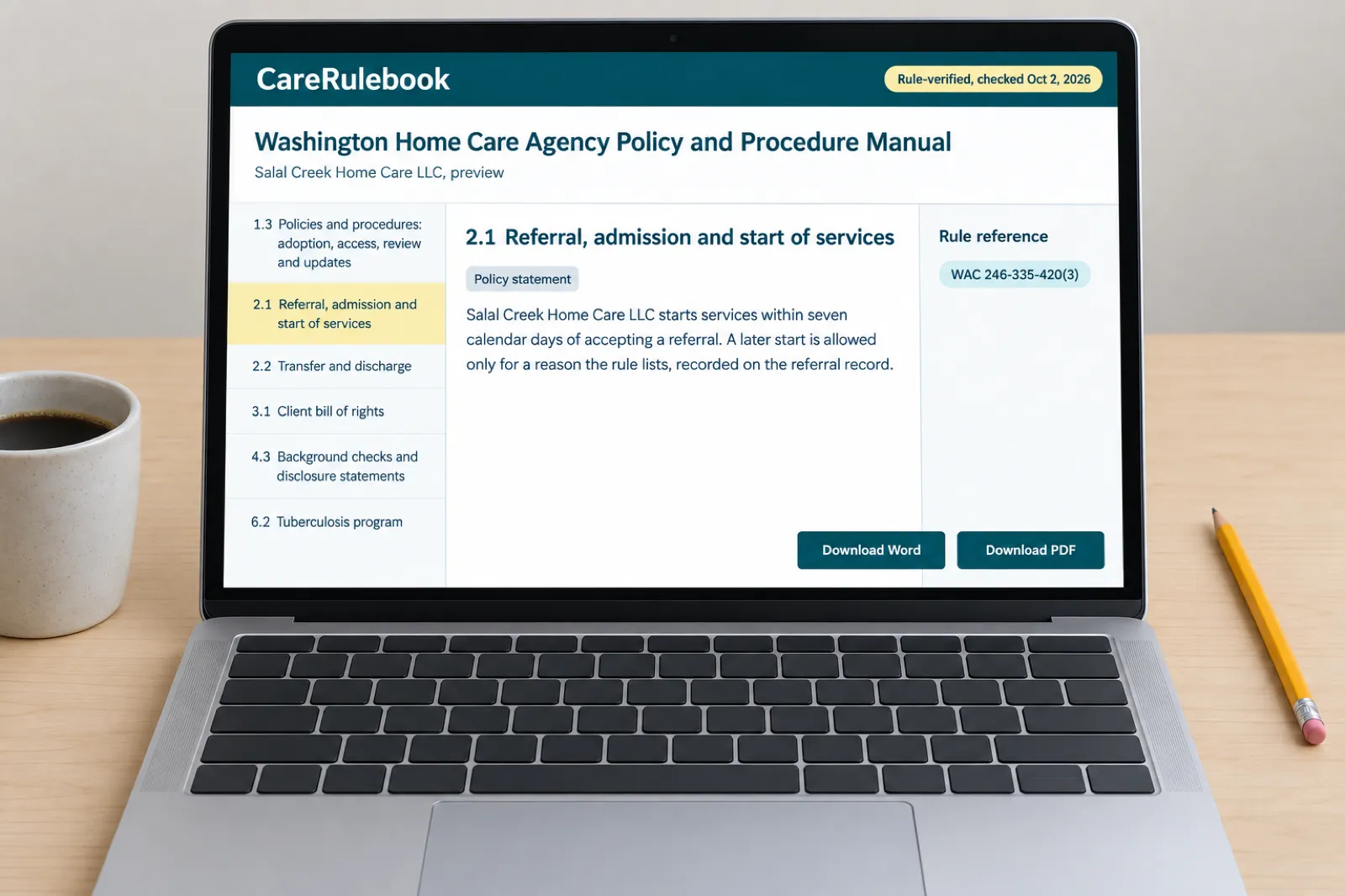
The CareRulebook Washington manual preview on a laptop: policy 2.1 on referral, admission and start of services for a sample agency, citing WAC 246-335-420(3), with the manual’s contents listed beside it

CareRulebook

Caregiver training and certification, tracked for your agency

CareRulebook’s Washington manual includes Policy 4.6 with a deadline tracker for every caregiver and Policy 4.5 with checklists for the orientation and skills verification DOH’s rule asks for, written from your answers.

  • 42 policies, 154 requirements mapped
  • Every tag on DOH’s home care policy checklist, plus a DOH review copy
  • Editable Word and PDF, delivered instantly
Preview your manual

$199CareRulebook founding price for the first 50 Washington agencies, then $249. Not a DOH fee.

Myths about Washington caregiver training

Can a new caregiver work before they are a certified home care aide?

It depends. Yes, within limits. They must first finish 5 hours of orientation and safety training and apply for certification within 14 days of hire; they must finish the 75 hours within 120 days of hire and be certified within 365 days (425 with a provisional certificate, for applications submitted by December 31, 2027), or stop giving care.

"Before providing care, the long-term care worker must complete the training required by RCW 74.39A.074 (1)(d)(i)(A) and (B)."

Can my agency teach the 75 hours of caregiver training itself?

It depends. Only with a curriculum DSHS has approved. The statute says only DSHS-approved curricula count toward the 75 hours, and DSHS approves only curricula that require comprehensive instruction by qualified instructors. Your own in-person orientation to your policies and your skills checks are separate DOH duties; they do not count toward the 75 hours unless DSHS has approved them.

"Only training curriculum approved by the department may be used to fulfill the training requirements specified in this section."

Do family members who work as caregivers through my agency owe continuing education?

Yes. By our reading, yes. The statute’s continuing education exemptions for family caregivers name individual providers, not agency workers, and DSHS’s April 2026 rule chart says 12 hours is required every year after basic training for a family caregiver working as an agency provider. A worker caring only for a listed relative is still exempt from home care aide certification.

"12 hours is required every year following completion of basic training while working in long-term care as an agency provider"

Frequently asked questions

How many training hours does a home care aide need in Washington?

75 hours of DSHS-approved entry-level training within 120 calendar days of hire: 2 hours of orientation and 3 hours of safety training before giving any care, then 70 hours of basic training. Only DSHS-approved curricula count. Some workers exempt from certification owe fewer hours (35, 14 or 12, or the spouse training, in the cases the statute lists), and nurses and certified nursing assistants owe none.

How long does a caregiver have to get certified as a home care aide in Washington?

Under DOH’s rule in effect since July 3, 2026, a worker must be certified within 365 calendar days of their date of hire, or 425 days with a provisional certificate, if they submit their original application by December 31, 2027. The statute’s own deadline is 200 days, and the section that allows the longer timelines expires December 31, 2027. The training itself must still be finished within 120 days.

Can a new caregiver work before they are certified?

Yes, within limits. They must first complete the 5 hours of orientation and safety training, and apply to DOH within 14 days of hire. They must finish the 75 hours within 120 days and be certified within 365 days (425 with a provisional certificate), or stop giving care. Your agency also needs to give its own in-person orientation and check their skills before they work alone.

Does a certified nursing assistant need home care aide certification?

No. An active Washington nursing assistant-certified credential exempts a worker from home care aide certification and the 75 hours. The statute’s continuing education exemptions cover registered and licensed practical nurses but not nursing assistants, so by our reading a CNA working for your agency still owes 12 hours a year.

Do family members who work for my agency need training and certification?

A worker caring only for their own child or parent, or another listed relative, is exempt from home care aide certification but owes 35 hours of training within 120 days, 5 of them before giving care. One caring only for a spouse or registered domestic partner is exempt from certification and, from July 1, 2026, owes the shorter spouse training. DSHS’s April 2026 amendments say family providers working for home care agencies owe 12 hours of continuing education a year after basic training.

Who pays for home care aide certification in Washington?

DOH’s fees are $100 to apply, $100 for each yearly renewal and a $50 late renewal penalty, all nonrefundable; the exam fee is set by DOH’s exam vendor. The rules we read do not say whether the worker or the agency pays these fees or for the training. Our suggestion: take employment law advice before you pass any of these costs, or unpaid training time, to workers. These are DOH’s and the vendor’s fees, not CareRulebook prices.

Do housekeeping or companion staff need home care aide certification?

The statute defines long-term care workers as people who give paid, hands-on personal care, so by our reading a worker who only does housework, shopping, meals or errands, with no hands-on personal care, is not one and does not need the 75 hours or certification. DOH’s own rules still apply to them: in-person orientation and a skills check before working alone, ongoing training, and a background check if they have direct contact with clients. Back-up care that involves help with activities of daily living can only be given by credentialed or exempt staff.

Get Washington rule-change alerts

DOH’s longer certification timelines run to December 31, 2027, and DSHS changed its training rules in April 2026. Leave your email and we will tell you when a Washington change affects your caregivers or your policies.

No spam. Only emails about Washington home care rule changes. How we use your email.

Keep reading

Sources

  1. Chapter 246-335 WAC, In-home services agencies (Parts 1, 2 and 13; home health and hospice parts for comparison) · Washington State Legislature (app.leg.wa.gov) · retrieved October 1, 2026
  2. Chapter 74.39A RCW, Long-term care services options (sections .009, .056, .074, .076, .086, .341) · Washington State Legislature (app.leg.wa.gov) · retrieved October 2, 2026
  3. Chapter 18.88B RCW, Home care aides · Washington State Legislature (app.leg.wa.gov) · retrieved October 2, 2026
  4. Chapter 246-980 WAC, Home care aide rules (as amended by WSR 26-12-065, effective July 3, 2026) · Washington State Legislature (app.leg.wa.gov) · retrieved October 2, 2026
  5. Chapter 388-71 WAC, Home and community services and programs (sections 388-71-0503 to -0562 and -0836 to -1001: home care agency workers, training and certification) · Washington State Legislature (app.leg.wa.gov) · retrieved October 2, 2026
  6. WSR 26-12-065, Home care aide certification rules (permanent rule, filed June 2, 2026, effective July 3, 2026) · Washington State Register (Code Reviser) · retrieved October 2, 2026
  7. WSR 26-08-045, DSHS long-term care worker training and certification amendments (permanent rule, filed March 25, 2026, effective April 25, 2026) · Washington State Register (Code Reviser) · retrieved October 2, 2026
  8. Home Care Personnel Survey Tool, DOH 655-014 (May 2018) · Washington State Department of Health · retrieved October 2, 2026
  9. Long-Term Care Worker Checklist for IHS Surveyors, DOH 346-097 (May 2018) · Washington State Department of Health · retrieved October 2, 2026
Build your Washington manualfrom $199