Skip to content
CareRulebook
MenuClose

What do you run?

Home care in the US19 states with a manual, 6 with a free guide
ColoradoManual
ConnecticutPack
DelawareManual
GeorgiaManual
IllinoisManual
IndianaManual
KansasManual
MaineManual
MarylandManual
MinnesotaManual
NevadaManual
North CarolinaManual
OklahomaManual
OregonManual
South CarolinaManual
TennesseeManual
TexasManual
VirginiaManual
WashingtonManual
CaliforniaGuideFloridaGuideNew JerseyGuideNew YorkGuideOhioGuidePennsylvaniaGuideAll US home care states →
Care homes in the USCalifornia, Michigan, Minnesota; more states coming
Home care in the UKEngland, Scotland, Wales
Free toolsChecklists, calculators and templates

California · Assisted living (RCFE) · HSC 1569.185

California RCFE license: cost and timeline

CDSS charges $990 to apply for a 4 to 6 bed RCFE license ($495.60 for 1 to 3 beds, $1,486.80 for 7 to 15), then a yearly fee on the license anniversary. CDSS says to expect 90 to 120 days for the whole application. Here are the state’s fees by size, the other CDSS fees, the costs the rules require you to carry, each step to the license and the deadlines the rules fix.

  • Rule-verified November 13, 2026
  • Quoted from HSC 1569.185 and CDSS
  • Every fee linked to its source
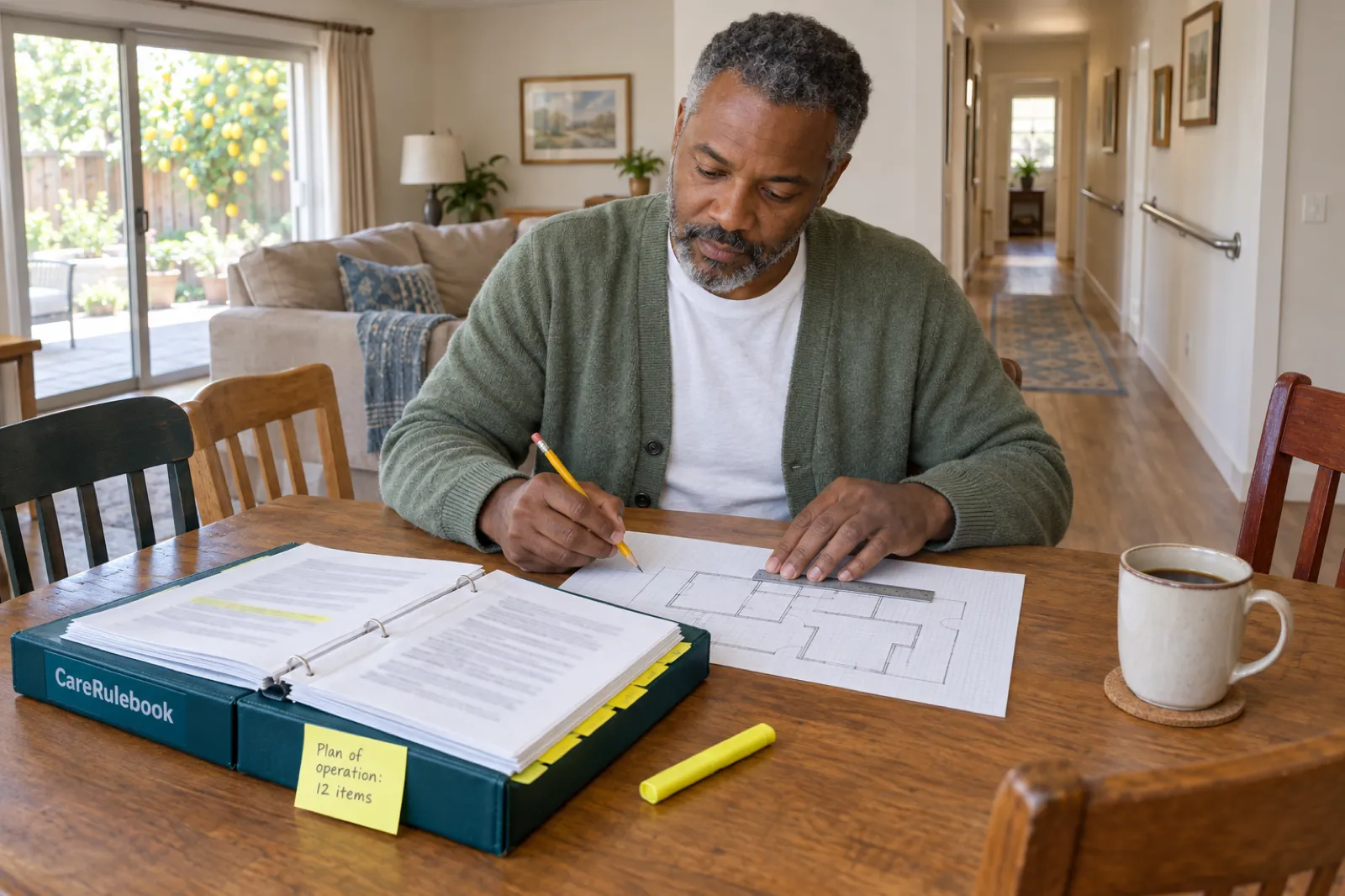
A man in a sage green cardigan at a dining table in a single-story California house measures a hand-drawn floor plan with a ruler, beside an open teal CareRulebook binder with yellow tabs, a highlighter, a mug of coffee and a sticky note reading Plan of operation: 12 items, with a lemon tree outside the patio door

Quick answer

Cost: CDSS’s initial application fee is $990 for 4 to 6 beds, $495.60 for 1 to 3 and $1,486.80 for 7 to 15 (HSC 1569.185(a)(1)). "After initial licensure, a fee shall be charged by the department annually on each anniversary of the effective date of the license." (HSC 1569.185(a)(1)) These are the state’s fees, not CareRulebook prices.

Time: "Expectations for completing the entire application process are 90 to 120 days." (CDSS, How to Become Licensed)

$990

CDSS’s application fee for a 4 to 6 bed home (a state fee, not our price)

HSC 1569.185(a)(1)

$495.60

CDSS’s yearly fee for up to 6 beds, on each license anniversary

HSC 1569.185(a)(1)

90 to 120

days for the whole application process, CDSS says

CDSS

3 months

of operating costs in start-up funds

22 CCR 87155(a)(13)

CDSS’s license fees by size

The RCFE Act sets the fees by licensed capacity. Every amount below is the State of California’s fee, paid to CDSS, not a CareRulebook price. Most California RCFEs are licensed for six beds or fewer (our count of CDSS data).

CDSS’s RCFE license fees by capacity
Licensed capacityInitial application feeAnnual feeSource
1 to 3 beds$495.60$495.60HSC 1569.185(a)(1)
4 to 6 beds$990$495.60HSC 1569.185(a)(1)
7 to 15 beds$1,486.80$742.80HSC 1569.185(a)(1)
16 to 30 beds$1,980.00$990.00HSC 1569.185(a)(1)
31 to 49 beds$2,476.80$1,238.40HSC 1569.185(a)(1)

The schedule continues upward for larger facilities. Our manual and this page focus on 1 to 15 beds.

  • Non-refundable. "The application fee is non-refundable. Your application cannot be started until all the forms are filed with the licensing agency." (LIC 281, Introduction) CDSS’s older FAQ adds that the fee cannot be transferred to a later application (CDSS older FAQ 24) or to a different facility type (question 25).
  • Pay on time. "The failure of an applicant for licensure or a licensee to pay all applicable and accrued fees and civil penalties shall constitute grounds for denial or forfeiture of a license." (HSC 1569.185(e))

Other CDSS fees

Other CDSS fees for an RCFE
What forCDSS feeNotesSource
Online orientation (Component I)$54.85$50 plus a $4.85 processing fee, per person.CDSS, Online Orientations
Administrator exam$100For up to three attempts.HSC 1569.616(l)(2)
Administrator certificate application$140Initial or two-year renewal.CDSS fees
Moving the facility50% of the application feeWhen an existing licensee moves to a new address.HSC 1569.185(b)(1)(A)
Changing licensed capacity$25.00To increase or decrease capacity.HSC 1569.185(b)(1)(C)
Late annual fee50% of the annual feeAdded when the annual fee is paid late.HSC 1569.185(b)(1)(F)
Plan of correction not carried out$200.00When a plan of correction is not implemented by its date.HSC 1569.185(b)(1)(H)

The statute itself sets the orientation fee at $50 (HSC 1569.185(b)(1)(D)); CDSS adds a $4.85 processing fee. None of these is a CareRulebook price.

Working out your CDSS fees

Simple arithmetic, not a state figure

The first two years, 4 to 6 beds. $990 + $495.60 = $1,485.60 in state license fees (HSC 1569.185).

Simple arithmetic, not a state figure

The first two years, 7 to 15 beds. $1,486.80 + $742.80 = $2,229.60 in state license fees (HSC 1569.185).

Simple arithmetic, not a state figure

Orientation and certificate. $54.85 + $100 + $140 = $294.85 in CDSS fees for one person who takes the orientation and becomes the administrator, before the vendor’s course price.

Other costs the rules require

Each card says where the duty comes from. We give a price where an official source sets one simply, and say so where we found none.

Liability insurance

Every RCFE, except one that is an integral part of a continuing care retirement community, keeps liability insurance covering injury to residents and guests of at least $1 million per occurrence and $3 million in the annual aggregate. The premium is set by your insurer.

HSC 1569.605

Start-up funds

The financial plan shows start-up funds for at least three months of operating costs. CDSS’s steps page says its financial review looks for three months for a new facility and one month for an existing one, such as one you are buying. CDSS’s older FAQ says the funds must be readily accessible and in the applicant’s name, and balances are verified with the bank and a credit report.

22 CCR 87155(a)(13)CDSS steps, step 7

Food budget

For the monthly operating statement (LIC 401), CDSS’s older FAQ suggests budgeting at least $200 per person a month for food at the capacity you request.

CDSS older FAQ 23

Live Scan fingerprints

For you, the administrator, adults in the home and every staff member the law covers. The Department of Justice may charge a fee sufficient to cover its cost in providing services in accordance with Section 1569.17. We found no price in the CDSS sources we saved; ask your Live Scan location.

HSC 1569.172Background checks →

Staff training

40 hours for each direct care worker, then 20 a year, plus medication training for staff who help with medications. The rules set the hours and who may teach, not a price.

HSC 1569.625(b)Staff training →

A surety bond, if you hold residents’ cash

A licensee entrusted with residents’ cash files a surety bond with CDSS. The bond is $1,000 for $750 or less safeguarded a month, $2,000 for $751 to $1,500, $3,000 for $1,501 to $2,500, and $1,000 more for each further $1,000 or part of it. The premium is set by the surety company.

22 CCR 87216(a)

Zoning and local fees

A six-or-fewer home is a residential use with no conditional use permit beyond what a family home needs, and no extra local business taxes or fees, and no fee may be charged for the fire inspection. For larger facilities, CDSS lists getting a conditional use permit; your city or county sets that fee.

HSC 1569.84, 1569.85CDSS

Your written documents

The 12-item plan of operation and the LIC 281 Section B documents go in with the application. You can write them yourself or start from a manual.

22 CCR 87208(a)The plan of operation →

Fees are set by the State of California, CDSS, vendors and other providers, not by CareRulebook.

CareRulebook

The documents your packet needs, written for your facility

CDSS returns an incomplete packet, and an application cannot start until every form is in. CareRulebook’s California RCFE manual writes the 12-item plan of operation in the order of 22 CCR 87208 and the other written documents LIC 281 asks for, with your facility’s details and the rule quoted under each one, plus a CDSS application copy for your packet and page-numbered indexes.

  • 41 policies and documents mapped to 111 requirements
  • An admission agreement template with 90 days’ notice of rate increases (have a California lawyer review it)
  • Editable Word and print-ready PDF, with 12 months of updates
Preview your manual

$299CareRulebook founding price for the first 50 California facilities, then $349. Not a CDSS fee; CDSS’s $990 application fee for 4 to 6 beds is separate.

How long it takes, step by step

The order follows CDSS’s steps page. Only steps with a fixed or published time show one. Tick steps off as you go; progress is saved in this browser only. For a list tailored to your facility, use the free California RCFE license checklist.

  1. Take CDSS’s online orientation

    Before applying

    Component I, before you apply. $54.85 including processing (a CDSS fee).

  2. The administrator course

    Before applying, if you can

    At least 80 hours from a CDSS-approved vendor. Administrator certification.

    HSC 1569.616(c)(1)
  3. The exam, within 60 days of the course

    Within 60 days

    CDSS’s exam, passed within three attempts ($100, a CDSS fee).

  4. The certificate application, within 30 days of passing

    Within 30 days

    $140 (a CDSS fee). LIC 281 accepts proof of course registration with the application and requires the certificate before licensure; CDSS’s How to Become Licensed page asks for the certificate in the packet, so finish it first if you can (our reading).

  5. Secure the property and write your documents

    Before applying

    CDSS’s older FAQ says the application must name the facility address. Then the 12-item plan of operation, the Section B documents, the emergency and disaster plan, the infection control plan and a completed LIC 9282. The plan of operation.

  6. Mail the packet with the fee

    Day 0

    The fee and the Section A and B documents go together, in booklet order (LIC 281), to the Centralized Applications Bureau, 744 P Street, MS 9-14-8201, Sacramento, CA 95814, with the proposed facility address on the check or money order.

    CDSS steps, step 4
  7. The acceptance letter

    After CDSS receives it

    CDSS’s steps page says the Centralized Applications Bureau sends an acceptance letter naming your assigned analyst and listing any missing or incomplete documents. Its older FAQ says the analyst also phones within the first five days.

    CDSS steps, step 5
  8. Background checks

    Days to months

    You, the administrator and other adults in the home complete Live Scan. CDSS’s older FAQ says a clearance can take from several days to a few months if an exemption is needed. Background checks.

    CDSS older FAQ 30
  9. Review, fire clearance and Component II

    During review

    The analyst orders the fire clearance, reviews finances and your compliance history, and interviews you and your administrator about the program you submitted.

  10. Pre-licensing inspection and Component III

    Before the license

    Once the fire clearance is approved, the regional office tours the facility, and you attend the category-specific Component III session. The pre-licensing inspection.

    CDSS steps, step 9
  11. Corrections, final review, license

    CDSS’s goal: 90 to 120 days in all

    Send any corrections by the due date; CDSS runs a final review and issues the license.

  12. First resident, then CDSS’s first inspection

    After licensing

    For a new facility: tell CDSS within five business days of accepting your first resident; CDSS inspects within 90 days after that.

    HSC 1569.24

What moves the timeline

  • CDSS’s figure. "Expectations for completing the entire application process are 90 to 120 days." (CDSS, How to Become Licensed)
  • The variables. CDSS’s steps page: "The timeframe for processing an application can vary, depending on different factors, such as an applicant’s timely submission of all required documents", criminal record clearances or exemptions, the fire clearance, any construction and the facility’s readiness for the pre-licensing inspection (CDSS steps, introduction). CDSS’s older FAQ also names overconcentration rules, but says "Residential care facilities for the elderly are excluded from this requirement." (CDSS older FAQ 13)
  • An incomplete packet. "The application fee plus section A and B documents must be completed and sent to the licensing agency as a packet." CDSS will not start an incomplete application (LIC 281). That includes a completed LIC 9282, which CDSS’s application page says every application must include (CDSS, How to Become Licensed).
  • The administrator. LIC 281 accepts proof of course registration with the application and requires a CDSS-issued certificate before licensure (LIC 281, B2); CDSS’s How to Become Licensed page asks for the certificate in the packet (CDSS). The exam comes within 60 days of the course and the certificate application within 30 days of passing, so plan them before you apply (HSC 1569.616(c)(2)).
  • Exemptions. "It can take anywhere from several days to a few months if an exemption is necessary." (CDSS older FAQ 30)
  • Readiness at the visit. CDSS’s steps page names readiness for the pre-licensing inspection as a factor. CDSS’s older FAQ says the facility should be furnished and ready for use, with a seven-day supply of non-perishable food, and that a follow-up visit may be needed if corrections are due (CDSS older FAQ 4, 19 and 20).

Our suggestion: the part you control is the packet. Finish the administrator certificate, write every document, and send everything in booklet order before CDSS’s clock starts. CDSS’s RCFE file dated May 25, 2025 listed 736 RCFEs as pending, 621 of them for six beds or fewer (our count of CDSS data).

The deadlines the rules and CDSS fix

Deadlines for California RCFE applicants and licensees, with who meets each and the source
WhatWhenWhoSource
Administrator examWithin 60 days of finishing the course, within three attemptsAdministratorCDSS
Administrator certificate applicationWithin 30 days of being told you passedAdministratorHSC 1569.616(c)(2)
Department of Justice statement for staff after licensing, when there is no recordWithin 14 calendar days of the fingerprintsDepartment of JusticeHSC 1569.17(c)(2)
Exemption decisionWithin 60 days of receiving all the informationCDSSHSC 1569.17(f)(2)
Whole application process90 to 120 days, CDSS’s estimateCDSSCDSS, How to Become Licensed
Decision on a buyer’s complete applicationWithin 60 daysCDSSHSC 1569.191(d)
Notice of a new facility’s first residentWithin 5 business days of accepting themYouHSC 1569.24
First inspection after licensingWithin 90 days after the first residentCDSSHSC 1569.24
New administrator noticeWithin 30 days of hiringYou22 CCR 87211(g)
Correcting deficienciesBy the date in CDSS’s notice; the statute’s default is 10 days unless the plan of correction says otherwiseYouHSC 1569.33(f)(2)
Selling the facilityWritten notice to CDSS and residents at least 30 days before the transferSellerHSC 1569.191(a)(1)
Buyer’s license applicationWithin 5 days of the seller accepting the offerBuyerHSC 1569.191(b)(2)

After licensing: yearly fees, moves and sales

  • Yearly. The annual fee falls on each license anniversary ($495.60 for up to 6 beds, $742.80 for 7 to 15, $990.00 for 16 to 30). "A late fee that represents an additional 50 percent of the established current annual fee when a licensee fails to pay the current annual licensing fee on or before the due date" (HSC 1569.185(b)(1)(F)).
  • Moving or selling. An RCFE license is forfeited by law when the licensee sells or transfers the facility (other than a non-majority stock transfer), surrenders the license, moves the facility, or in the other cases the statute lists. (HSC 1569.19) A move costs half the application fee (HSC 1569.185(b)(1)(A)).
  • Buying an RCFE. A buyer who will keep running the facility as an RCFE applies for a license within five days of the seller accepting the offer (HSC 1569.191(b)). If buyer and seller both follow these steps, the sale can close and CDSS issues the buyer an Emergency Approval to Operate while it decides (22 CCR 87111(f)); CDSS gives these applications priority and decides within 60 days of a complete application (HSC 1569.191(d)). CDSS’s application process covers changes of ownership, so the steps above apply (CDSS steps).
  • Deficiencies cost money. Deficiencies not corrected by their date bring a $100 a day penalty per violation, and a plan of correction not carried out brings CDSS’s $200 fee (22 CCR 87761(a); HSC 1569.185(b)(1)(H)). Inspections and deficiencies.

Myths about cost and timing

How much does a six-bed RCFE license cost in California?

It depends. The state application fee is $990 for 4 to 6 beds ($495.60 for 1 to 3), then $495.60 a year on the license anniversary. Add CDSS’s $54.85 orientation, the administrator course (set by the vendor), the $100 exam and $140 certificate application, Live Scan fingerprints, any fire safety work the inspector asks for (for six or fewer residents, no fee may be charged for the fire inspection itself, HSC 1569.84) and liability insurance of at least $1 million per occurrence. CDSS also expects three months of operating funds.

"4–6 $990.00 $495.60"

How long does it take to get an RCFE license in California?

It depends. CDSS says to expect 90 to 120 days for the whole application process. Delays come from missing documents, background clearances, the fire clearance, construction and readiness for the pre-licensing inspection. The administrator course and exam come before that.

"Expectations for completing the entire application process are 90 to 120 days."

Does a California RCFE need liability insurance?

Yes. Since July 1, 2015 every RCFE (except one that is part of a continuing care retirement community) keeps liability insurance covering injury to residents and guests of at least $1 million per occurrence and $3 million in the annual aggregate.

"shall maintain liability insurance covering injury to residents and guests in the amount of at least one million dollars ($1,000,000) per occurrence"

Do I need a conditional use permit to open a six-bed RCFE in my house?

No. Not if your city does not require one of other family homes in the same zone. State law treats an RCFE for six or fewer as a residential use and bars a conditional use permit, variance or zoning clearance that a family dwelling of the same type would not need. Larger facilities usually need a conditional use permit. Building, fire and health codes still apply.

"No conditional use permit, zoning variance, or other zoning clearance shall be required of a residential care facility for the elderly that serves six or fewer persons that is not required of a family dwelling of the same type in the same zone."

Frequently asked questions

How much does an RCFE license cost in California?

CDSS’s initial application fee, set by statute, is $495.60 for 1 to 3 beds, $990 for 4 to 6 and $1,486.80 for 7 to 15. The annual fee is $495.60 for up to 6 beds and $742.80 for 7 to 15, charged on each license anniversary. Add CDSS’s $54.85 orientation, the administrator exam ($100) and certificate application ($140), the administrator course (priced by the vendor), Live Scan, liability insurance and three months of start-up funds. These are the state’s and others’ fees, not CareRulebook prices.

How long does it take to get an RCFE license in California?

CDSS says to expect 90 to 120 days for the whole application process. Its steps page says the time varies with how promptly you send every document, criminal record clearances, the fire clearance, any construction and how ready you are for the pre-licensing inspection. The administrator course and exam usually come first. For a buyer, CDSS decides within 60 days of a complete application.

Is the RCFE application fee refundable?

No. LIC 281 says the application fee is non-refundable, and CDSS’s application page says the same. CDSS’s older FAQ adds that fees cannot be transferred to a later application or a different facility type, so apply when your packet is complete.

How much money do I need to open an RCFE?

The rule asks for start-up funds covering at least three months of operating costs; CDSS’s steps page says its financial review looks for three months for a new facility and one month for an existing one, such as one you are buying. CDSS’s older FAQ says the funds must be readily accessible, in the applicant’s name and verified with your bank and a credit report. For the food line of the monthly operating statement, the older FAQ suggests at least $200 per person a month at the capacity you request. Beyond that it depends on your property, staffing and insurance; CDSS publishes no total.

Do I pay a business license fee for a six-bed RCFE?

A six-or-fewer RCFE is not subject to business taxes, local registration fees, use permit fees or other fees that other family homes of the same type in the same zone do not pay (HSC 1569.84), and no fee may be charged for the fire inspection itself. CDSS’s state fees still apply.

What does it cost to move or change capacity?

CDSS charges 50% of the application fee when an existing licensee moves the facility to a new address, and $25 to increase or decrease licensed capacity. A move also ends the license by law, so you apply for the new location.

Get California RCFE rule-change alerts

California’s RCFE fees are set in statute and CDSS changes its forms and process between rule changes. Leave your email and we will tell you when a California change affects your facility.

No spam. Only emails about California assisted living (RCFE) rules. How we use your email.

Keep reading

Sources

  1. 22 CCR Division 6, Chapter 8, Residential Care Facilities for the Elderly (CDSS Manual of Policies and Procedures version, files updated 01/01/25, 07/14/26, 07/22/25 and 05/18/26) · California Department of Social Services, Community Care Licensing Division · retrieved November 13, 2026
  2. California Residential Care Facilities for the Elderly Act, Health and Safety Code 1569 to 1569.889 (Public.Law copy; Public.Law marks each section verified against leginfo on November 11, 2026) · California Legislature (Public.Law copy; Public.Law marks each section verified against leginfo on Nov. 11, 2026) · retrieved November 13, 2026
  3. LIC 281 (11/25), Application Instructions for a Facility License (Sections A and B) · California Department of Social Services, Community Care Licensing Division · retrieved November 13, 2026
  4. How to Become Licensed (Centralized Application Units), Online Orientations, CCLD Steps to Obtaining an ASCP License and Centralized Application Unit FAQ · California Department of Social Services, Community Care Licensing Division · retrieved November 13, 2026
  5. Administrator Certification Bureau pages (fees, how to become a certified administrator, renewal, FAQ, exams) · California Department of Social Services, Community Care Licensing Division · retrieved November 13, 2026
  6. CDSS Community Care Licensing facilities data: the CCL facilities map layer (data last edited November 12, 2026) and the CHHS Open Data RCFE file (data dated May 25, 2025, posted May 27, 2025); counts are ours · California Department of Social Services, Community Care Licensing Division (California Health and Human Services Open Data Portal) · retrieved November 13, 2026

Free sample, no email needed

Read a full policy before you buy

Policy 1.12, Infection Control Plan, as it prints in the California assisted living manual, filled in for a fictional facility. The rule text it rests on is quoted word for word under Rule basis.

PDF · 18 pages · 178 KB · Rule-verified November 13, 2026

Collecting answers for a facility or a client? The intake questionnaire lists all 101 questions the builder asks, what each decision changes in the manual, and a completed example: Word · PDF.How consultants use CareRulebook.

Download the sample (PDF)
Or email it to me

We send the link once. Nothing else unless you tick the box. Privacy notice.

Build your California RCFE manualfrom $299