Skip to content
CareRulebook
MenuClose

Where are you starting?

United StatesTexas, North Carolina, Georgia, Virginia, Indiana, Ohio, New York, Illinois, Washington, Colorado, Tennessee, Maryland, Kansas, South Carolina, Nevada
TexasManual
North CarolinaManual
GeorgiaManual
VirginiaManual
IndianaManual
OhioGuideNew YorkGuide
IllinoisManual
WashingtonManual
ColoradoManual
TennesseeManual
MarylandManual
KansasManual
South CarolinaManual
NevadaManual
All US states →
United KingdomEngland
Free toolsChecklists, calculators and templates

New York · Licensed Home Care Services Agency · PHL Article 36 · 10 NYCRR 765-766

How to start a home care agency in New York (the LHCSA license, 2026)

To start a home care agency in New York that gives hands-on personal care, you need a Licensed Home Care Services Agency (LHCSA) license from the Department of Health, and the Public Health and Health Planning Council must approve you first. New licenses are rare: a county need test presumes no need in New York City, Long Island and the counties of Buffalo, Rochester, Syracuse and Albany, so applicants there must prove need, and most approvals are ownership changes at existing agencies. This guide sets out the rules, the real waits and the routes that are still open.

  • Rule-verified October 3, 2026
  • Quoted from PHL Article 36 and 10 NYCRR Parts 765 and 766
  • 39 sources
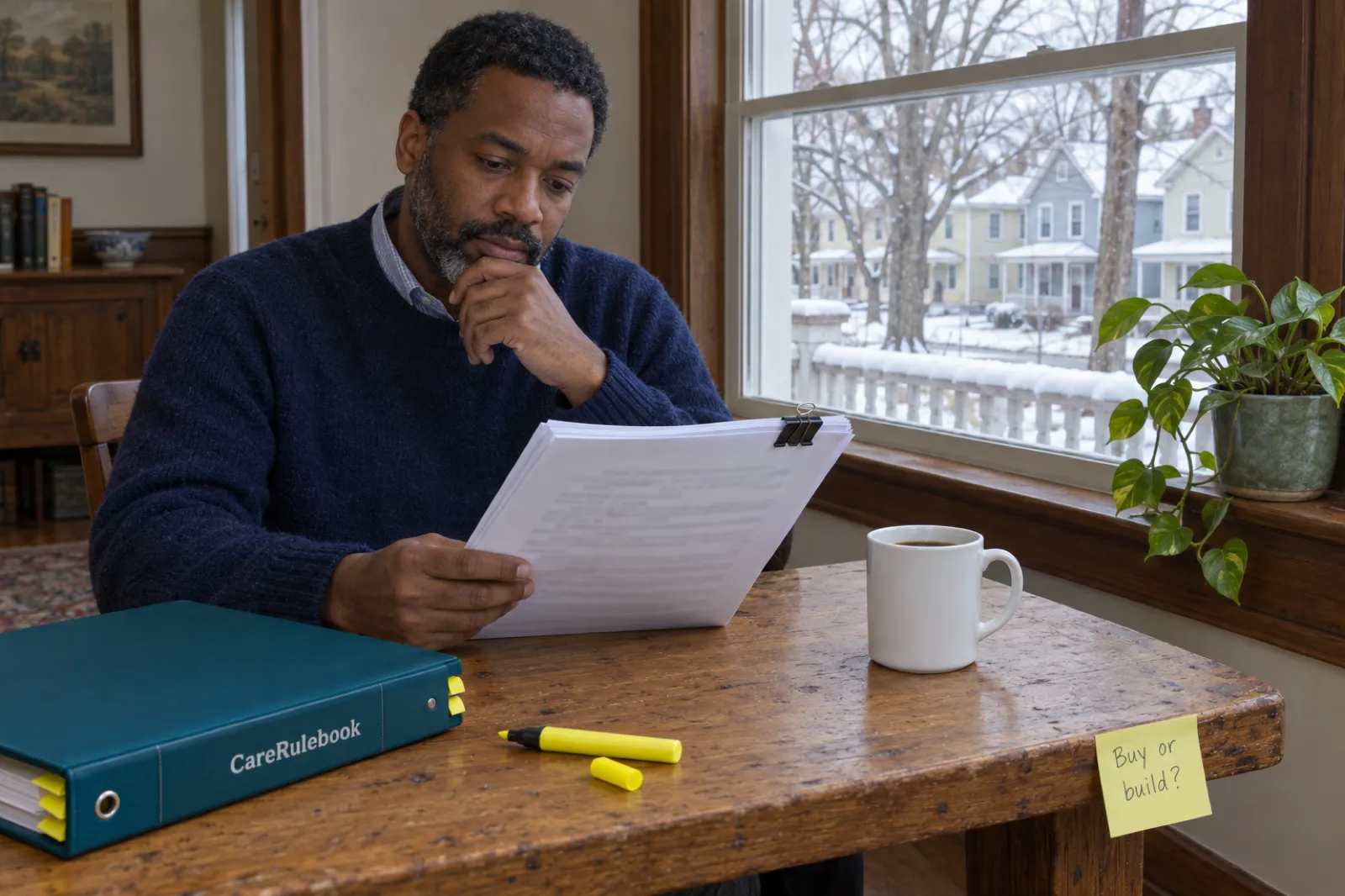
A man in a navy sweater reads a clipped stack of printed pages at a pine kitchen table, beside a closed teal CareRulebook binder with yellow tabs, a yellow highlighter, a white mug and a sticky note reading Buy or build?, with snowy porches and clapboard houses outside the window

Quick answer

In New York, "no home care services agency which is engaged in providing, directly or through contract arrangement, nursing services, home health aide services, or personal care services shall be operated without a license issued by the commissioner" (PHL s. 3605(1)). Personal care means help with personal hygiene, dressing, feeding and household tasks essential to the person’s health (10 NYCRR 700.2(c)(16)). The license is a LHCSA license, and DOH cannot issue it without the written approval of the Public Health and Health Planning Council (PHHPC) (PHL s. 3605(2)).

Getting one is hard. PHHPC must be satisfied about "the public need for the existence of the licensed home health care service agency at the time and place and under the circumstances proposed" (PHL s. 3605(4)(a)), and DOH’s latest county list presumes no need for more agencies in 20 counties, including all of New York City and Long Island (DOH need report). In PHHPC agendas from January 2024 to September 2026 we found two new LHCSAs approved without a limit to one program’s patients, both serving upstate counties; most other approvals were ownership changes at existing agencies (PHHPC agendas, our count). Most applications we checked waited about one and a half to two and a half years for a vote.

Routes that are still open: buy an existing agency, apply in one of the 42 counties with presumed need, use the restricted route if you own an assisted living program, PACE program or retirement community, or start in another state. Separately, a six-month freeze on LHCSA Medicaid enrollment started on July 27, 2026 (PHHPC condition).
20

Counties where DOH presumes no need for more LHCSAs, including all of New York City and Long Island (2022 survey)

DOH need report

2

New LHCSAs approved without a program limit, January 2024 to September 2026 (our count of PHHPC agendas)

PHHPC agendas

$2,000

New York State’s application fee, not refunded once DOH acknowledges the application (a state fee)

PHL s. 3605(13); DOH FAQ B

1,203

LHCSA licenses registered for 2026 in DOH’s registration list (our count)

Health Data NY

Direct answers

Who licenses home care agencies in New York?

The New York State Department of Health (DOH) issues the Licensed Home Care Services Agency (LHCSA) license, but only with the written approval of the Public Health and Health Planning Council (PHHPC). An agency that provides nursing, home health aide or personal care services, directly or through contract, needs one.

PHL s. 3605(1)-(2); 10 NYCRR 765-2.1(a)

Can I open a new home care agency in New York in 2026?

It is possible but rare. PHHPC must find a public need, and DOH’s latest county list presumes no need in 20 counties, including all of New York City and Long Island. In PHHPC agendas from January 2024 to September 2026 we found two new LHCSAs approved without a limit to one program’s patients, both serving upstate counties; most other approvals were ownership changes at existing agencies (our count).

10 NYCRR 765-1.16(c); DOH need report; PHHPC agendas

How much does a New York LHCSA license cost?

New York State charges a $2,000 application fee, which is not refunded once DOH acknowledges the application. You also need a CPA to confirm at least two months of working capital, and an RN on staff before you open. This is the state’s fee, not a CareRulebook price.

PHL s. 3605(13); DOH FAQ B; 10 NYCRR 765-1.2(b)(3)

Do I need a registered nurse to run a home care agency in New York?

Yes. Every LHCSA must employ at least one licensed, currently registered RN responsible for directing and supervising patient care, and DOH’s application says the RN must be employed directly by the agency. An RN, or someone an RN directly supervises, decides whether each patient can be accepted, and an RN supervises the aides.

10 NYCRR 766.9(h), 766.3(a); DOH application, Section B

Interactive check

Do you need a New York LHCSA license?

What will your business do?

Pick the option closest to your plan.

What needs a LHCSA license, and what doesn’t

The statute covers any home care services agency that provides nursing, home health aide or personal care services, "directly or through contract arrangement" (PHL s. 3605(1)). The rule adds advanced home health aide services and says no agency may provide any of them "unless it has been approved by the Public Health and Health Planning Council and has been issued a license" (10 NYCRR 765-2.1(a)).

  • Personal care. "Personal care services shall mean assistance to the patient with personal hygiene, dressing, feeding and household tasks essential to his/her health." (10 NYCRR 700.2(c)(16)) This is most private-pay home care.
  • Housekeeper (chore) services. "Housekeeper services shall mean the provision of light work or household tasks which do not require the services of a trained homemaker." (10 NYCRR 700.2(c)(19)) These are not in the license trigger.
  • Homemaker services: the gray area. "Homemaker services shall mean assistance and instruction in managing and maintaining a household, dressing, feeding and incidental household tasks for persons at home because of illness, incapacity or the absence of a caretaker relative." (10 NYCRR 700.2(c)(18)) Homemaker services are not in the trigger either, but they include dressing and feeding, which also appear in the definition of personal care.

Our reading: a business that offers only housekeeping, errands or companionship, with no hands-on help, probably needs no LHCSA license. No rule we found mentions companion care. Any help with hygiene, dressing or feeding puts you at or over the line. DOH has not confirmed this; ask the Bureau of Home Care Licensure and Certification before you start.

How DOH decides you are an agency

"The following criteria shall be used to determine whether an organization or group of individuals are subject to licensure as a home care services agency": who is accountable for admission and discharge decisions, for providing or arranging care, for care standards and policies, and for setting charges; the employment relationship of the staff; and the scope of services (10 NYCRR 765-2.1(d)).

Who is exempt

Exempt: certified home health agencies, long term home health care programs, AIDS home care programs and hospices; agencies serving only people in a program run or regulated by another State agency; licensed nurses’ registries; sole-practitioner nurses; dialysis facilities for home dialysis (10 NYCRR 765-2.1(c)). Consumer directed personal assistance (CDPAS) now runs through one statewide fiscal intermediary, PPL, since April 1, 2025 (DAL DHCBS 25-02), so by our reading it is not a route into the market for a new business.

Before the license. New applicants sign this: "The applicant is aware that they may not commence operation of the home care agency until after the application has been approved by the Public Health and Health Planning Council and the agency has obtained a license from the Department of Health." (DOH application, Section F).

Why new licenses are rare

New York has limited new home care agencies since 2018, first with a moratorium and then with a need test. The 2018 budget stopped new LHCSA licensing until March 31, 2020: "The moratorium on the licensure of Licensed Home Care Services Agencies (LHCSAs) pursuant to Part B of Chapter 57 of the Laws of 2018 expired on March 31, 2020." (DOH FAQ). The same law added public need to what PHHPC must consider, and a county need test replaced the moratorium from April 1, 2020 (PHL s. 3605(4)(a); 10 NYCRR 765-1.16).

To see what that means in practice, we read PHHPC’s agendas and staff reports from January 2024 to September 17, 2026. This is our count, not an official statistic.

New LHCSA approvals in PHHPC agendas, January 2024 to September 2026 (our count)
What PHHPC approvedCountDetails
New LHCSA, no program limit2June 2024: an agency approved to serve five upstate counties around Rochester, with an accepted rebuttal for no-need Monroe County (project 222202-E). December 2024: an agency in Hudson for Columbia County, a presumed-need county (project 231215-E).
New LHCSA limited to one program or system7Three serving an Assisted Living Program, two serving a PACE program, one serving two continuing care retirement communities, one serving a hospital system’s patients (staff reports).
Changes of ownershipMostMost other LHCSA items were new operators taking over existing agencies or ownership transfers. A new operator gets a new license number (DOH FAQ E).

What the rebuttal took. For the Monroe County approval, PHHPC’s staff report says: "A rebuttal to the presumption of no need was submitted for Monroe County, which was determined by the Department to be sufficient based on the criteria set forth in 10 NYCRR §765-1.16(d)." The applicant gave demographic data for the county and addressed subpopulations, cultural needs and waiting lists (PHHPC, June 2024).

A note on license dates. DOH’s 2026 registration list shows license dates of 31 in 2024 and 11 in 2025, but a change of owner gets a new license number, so most recent dates are ownership changes, not new agencies (Health Data NY, our count).

We did not check agendas before 2024, so we cannot say whether 2024 to 2026 is typical.

The need test and the 2022 county lists

"The commissioner shall designate each county as a separate planning area." (10 NYCRR 765-1.16(b)) "There shall be a rebuttable presumption of no need for additional licensed home care service agencies in a planning area if there are 5 or more Licensed Home Care Service Agencies (LHCSA) actively serving patients within the planning area" (10 NYCRR 765-1.16(c)(1)).

  • What "actively serving" means. DOH counts an agency as actively serving a county when it has a plan of care in place and is serving at least 25 patients there. The 25-patient figure for the presumption is DOH’s, from its FAQ and need report, not in the rule’s presumption text in (c)(1); the rule does use 25 patients for the ownership-change exemption in (c)(2) (DOH FAQ C, Q3-Q4).
  • The date need is measured. "The target date for the Department to determine need has been adjusted to April 1, 2022" (DAL DHCBS 22-14). We found no later date and no newer county list on DOH’s site on October 3, 2026.
  • Applying in a no-need county. "An application may still be submitted; however, it must contain a rebuttal and present data-driven evidence." (DOH FAQ C, Q2) "You will need to provide a rebuttal for each county where there is a presumption of no need." (DOH FAQ C, Q9)
  • The factors. Factors include demographics and health status, documented waiting lists, the number and capacity of existing agencies, their quality, workforce availability, training resources, cultural competency and subpopulations needing specialty services. (10 NYCRR 765-1.16(d))
  • A commitment for every new applicant. A new applicant meets public need only if it agrees to serve groups in the county who have difficulty getting LHCSA care because of minority status, age, medical history, case complexity, payment source or location. (10 NYCRR 765-1.16(e))

No need presumed (20)

A rebuttal with data is needed for each of these counties.

  • Albany
  • Bronx
  • Broome
  • Chautauqua
  • Dutchess
  • Erie
  • Kings
  • Monroe
  • Nassau
  • New York
  • Onondaga
  • Orange
  • Putnam
  • Queens
  • Richmond
  • Rockland
  • Saratoga
  • Suffolk
  • Ulster
  • Westchester

Presumed need (42)

No rebuttal needed, but the rest of the review and the wait still apply.

  • Allegany
  • Cattaraugus
  • Cayuga
  • Chemung
  • Chenango
  • Clinton
  • Columbia
  • Cortland
  • Delaware
  • Essex
  • Franklin
  • Fulton
  • Genesee
  • Greene
  • Hamilton
  • Herkimer
  • Jefferson
  • Lewis
  • Livingston
  • Madison
  • Montgomery
  • Niagara
  • Oneida
  • Ontario
  • Orleans
  • Oswego
  • Otsego
  • Rensselaer
  • Schenectady
  • Schoharie
  • Schuyler
  • Seneca
  • St. Lawrence
  • Steuben
  • Sullivan
  • Tioga
  • Tompkins
  • Warren
  • Washington
  • Wayne
  • Wyoming
  • Yates

DOH, LHCSA County Presumption of "No Need" Report, Section 2 (2022 survey). Bronx, Kings, New York, Queens and Richmond are the five boroughs of New York City.

Routes that skip the need review. Buying an agency that is actively serving at least 25 patients (10 NYCRR 765-1.16(c)(2)), and an agency owned by the same people as an Assisted Living Program, PACE program, Nurse-Family Partnership or continuing care retirement community that serves only that program’s people (10 NYCRR 765-1.16(c)(3)). What you can do.

How a new LHCSA gets licensed, step by step

Tick steps off as you go. Your progress is saved in this browser only.

  1. Check your counties against DOH’s list

    Before applying

    Counties are the planning areas. DOH’s latest list (2022 survey) presumes no need in 20 counties and presumes need in the other 42. A first application may ask for up to 5 counties in one DOH region (one may be in a neighboring region if it borders another requested county). The need test and county lists.

  2. Form the business and gather the owners’ records

    Before applying

    Each principal stockholder (10% or more), board officer and board member signs a Schedule 1, and PHHPC reviews the character and competence of everyone named, including their record at any health facility they have been involved with.

  3. Line up a CPA and two months of working capital

    Before applying

    A CPA confirms the working capital, which must cover at least two months of estimated operating expenses. Loans count only if awarded by the time you apply. You also estimate first- and third-year operating costs.

  4. Apply in NYSE-CON and pay the state fee

    Day 0

    Submit through DOH’s electronic Certificate of Need system (it needs a Health Commerce System account), with a rebuttal for each no-need county, the staffing plan with an RN employed directly, your quality assurance program and a signed statement that you are not providing services. Send New York State’s $2,000 fee within 30 days.

  5. DOH reviews need, character and finances

    After acknowledgement

    DOH reviews applications in the order it acknowledged them and asks for more information as it goes. It publishes no timeline. Real waits.

    DOH FAQ A, Q2-Q3
  6. PHHPC votes

    About 1.5 to 2.5 years in

    PHHPC meets six times a year. Its Establishment and Project Review Committee recommends, then the full Council votes, usually with conditions. You then have one year to be licensed and operating, or the approval is treated as abandoned.

  7. Send your policy manual on paper

    After PHHPC approval

    Only after PHHPC approval: a hard-copy manual to the DOH home care regional office, with an index, a crosswalk to the regulations and DOH’s applicant worksheet. The manual DOH reviews.

  8. Pre-opening survey, then the license

    After the manual

    Once the manual is acceptable, the regional office schedules a pre-opening survey. After a successful survey it recommends licensure, and the Bureau of Home Care Licensure and Certification issues the license.

    DOH FAQ A, Q3
  9. Register every year

    Ongoing

    Register with DOH each year by filing the statistical report through the Health Commerce System. Late registration costs $500 for each month or part month (a state penalty).

Real waits, from PHHPC’s agendas

DOH says: "It is difficult to give an exact timeframe for completion as there are many steps in the licensure process." Applications are reviewed in the order DOH acknowledged them (DOH FAQ A, Q3). PHHPC’s staff reports print each application’s acknowledgement date, so we compared them with the meeting dates. These are our readings of the agendas:

  • New agency, with a rebuttal: acknowledged in December 2022, approved in June 2024, about 18 months (project 222202-E).
  • New agency, presumed-need county: acknowledged on June 7, 2023, approved in December 2024, about 18 months (project 231215-E).
  • Ownership changes, late 2025: Of the 13 LHCSA ownership changes on PHHPC’s November and December 2025 agendas, 10 had been acknowledged between June 13, 2023 and January 23, 2024, about 2 to 2.5 years earlier; three later ones had waited about 7 to 13 months (our reading). Priority Care’s new-agency application, acknowledged in December 2022, was approved in June 2024. (PHHPC, November and December 2025).
  • Ownership changes, September 2026: the four on the agenda had been acknowledged between June 7, 2024 and February 20, 2025, about 19 months to 2 years 3 months earlier (PHHPC, August and September 2026).

After the vote, you send the manual, DOH reviews it, and the regional office schedules the pre-opening survey. DOH publishes no time for those steps, and "within one year of issuance of the Public Health Council's approval or contingent approval of the application shall constitute an abandonment" (10 NYCRR 765-1.7), so have the manual and your RN ready before PHHPC votes.

What you can do

New York is one of the hardest states to enter with a brand new agency. That is not a reason to give up on home care, but it is a reason to plan around the rules rather than against them.

  • Buy an existing LHCSA

    The most common route on PHHPC’s agendas. If the agency is actively serving at least 25 patients and you stay in its counties, the need review does not apply, and you can adopt the seller’s approved manual.

    10 NYCRR 765-1.16(c)(2)Read more →

  • Apply in a presumed-need county

    In the 42 counties with presumed need, no rebuttal is needed. You still need PHHPC approval, the state fee, two months of working capital and an RN, and the wait still applies. One of the two new, unrestricted approvals we found was for Columbia County.

    DOH need report; PHHPC, Dec 2024Read more →

  • The restricted route, if you own a program

    An agency with identical owners to an Assisted Living Program, PACE program, Nurse-Family Partnership or continuing care retirement community can skip the need review and serve only that program’s people, on a restricted license.

    10 NYCRR 765-1.16(c)(3); DOH FAQ FRead more →

  • Rebut the presumption, with data

    Possible in any county, but you need data-driven evidence for each no-need county, and a commitment to serve groups who find it hard to get care. We found one such new, unrestricted approval in 2024 to 2026, plus two program-limited agencies whose no-need rebuttals were accepted.

    10 NYCRR 765-1.16(d)-(e)Read more →

  • Start in another state

    Many states license non-medical home care with no need test. Our state guides show who licenses home care, the fees and the written policies in each.

    CareRulebook state guidesAll US state guides →

  • Work in home care first

    If you are new to the field, an approved personal care aide course is free to trainees and takes at least 40 hours. If you later apply to buy an agency, PHHPC reviews each owner’s character and competence.

    DAL DRS 26-02; 10 NYCRR 765-1.3(b)(4)Read more →

Buying an existing LHCSA

A license does not come with the business: "A LHCSA license is not transferrable." A new operator needs PHHPC approval, and DOH issues a new license with a new license number while the seller surrenders theirs (DOH FAQ E, Q6).

  • The agency must be operating. DOH allows a change of operator or ownership only if the existing agency is actively serving at least one patient and is registered under PHL s. 3605-b. To skip the need review, it must be actively serving at least 25 patients, counted across its counties. (DOH FAQ E, Q2 and Q4)
  • The need review. "Applications for licensure based on change of ownership for Licensed Home Care Service Agencies actively serving at least 25 patients will not be subject to public need review", unless you want to serve counties outside its approved area (10 NYCRR 765-1.16(c)(2)). PHHPC still reviews your character, competence and finances.
  • The manual. DOH says "the applicant (buyer) may choose to adopt the approved Policy & Procedures manual that is currently in use from the existing (seller) agency", and that this speeds licensing (DOH FAQ A, Q3). DOH may still ask for agency-specific materials.
  • The fee and the forms. The same $2,000 state application fee applies to a change of ownership (PHL s. 3605(13); DOH FAQ B). The application asks for organizational charts of the current and proposed ownership and the current operating costs of the agency you are buying (DOH application, Sections F and G).
  • The wait. Most ownership changes on PHHPC’s 2025 and 2026 agendas had waited about 19 months to 2.5 years since acknowledgement, and a few waited less (Real waits).
  • Medicaid. Since July 27, 2026, Medicaid enrollment applications for LHCSA ownership changes are paused for six months. DOH’s recommended conditions for ownership changes on PHHPC’s August and September 2026 agendas tell the new operator to enroll after the moratorium before serving Medicaid members (Medicaid: the 2026 freeze).

Get a New York health care lawyer before you sign: whether a deal is an asset purchase, a new operator or a transfer of ownership interest changes what PHHPC must approve.

Fees and money

New York State feeAmountWhen
NYS DOH LHCSA application fee$2,000application (new license, change of ownership or expanding a restricted license); not refunded once acknowledged (state fee) PHL s. 3605(13)
NYS DOH late registration fee$500each month or part month an agency is not registered (state fee) PHL s. 3605-b(1)(b), (d)

These are New York State’s fees, paid to DOH, not CareRulebook prices.

Payment. The application fee is paid by check to the New York State Department of Health within 30 days of submission. "Application fees are not refundable once the application has been acknowledged." (DOH FAQ B, Q1 and Q3), even if PHHPC disapproves it.

Working capital. Applicants must show working capital of at least two months of estimated operating expenses, pass a reasonableness test, and show revenue will cover expenses over time. (10 NYCRR 765-1.2(b)(3)(i)) A CPA must confirm the working capital available (balance sheet and CPA letter, or personal financial statements on CPA letterhead for equity contributions). First- and third-year operating cost estimates are required. (DOH application, Section G) "A loan or grant will only be considered working capital if the award was made prior to or at the time of application and supportive documentation is submitted." (DOH FAQ D, Q5)

Other costs we cannot price. The CPA’s fee (DOH says the applicant pays all costs of developing and submitting the application, including the CPA (DOH FAQ D, Q7)), legal advice, an RN on staff before the pre-opening survey, and printing the manual. We found no insurance minimum in Parts 765 or 766.

The registered nurse and physician orders

Every New York LHCSA is RN-led, including private-pay personal care. The rule says the governing authority must "employ at least one licensed and currently registered professional nurse" responsible for directing and supervising all patient care (10 NYCRR 766.9(h)). DOH’s application goes further: "at least one Registered Nurse must be employed directly by the agency for the purpose of supervision of Home Health Aides and/or Personal Care Aides"; nursing services beyond that may be contracted (DOH application, Section B).

  • Accepting patients. "All patients are accepted for health care services only after a determination has been made by a registered professional nurse" (or someone the RN directly supervises) that the agency can meet the patient’s needs (10 NYCRR 766.3(a)).
  • Plan of care. Each patient has a plan of care based on a professional assessment, reviewed as needed and at least every six months. (10 NYCRR 766.3(b), (d))
  • Supervising aides. Home health aides and personal care aides are supervised by an RN (or a therapist for simple therapy procedures), with in-home visits to instruct and evaluate. (10 NYCRR 766.5(c), (d))
  • Quality improvement. The governing authority appoints a QI committee with a consumer and health professionals that meets at least four times a year to review policies and clinical records and report to the governing authority. (10 NYCRR 766.9(l)) The application adds: "Please note: The Quality Assurance Committee must include at least one nurse." (DOH application, Section F)

Physician orders

The statute defines personal care services as services that a physician prescribes under a plan of home care supervised by a registered nurse; a nurse practitioner may also prescribe or order them where the law allows (PHL s. 3602(5), Public.Law copy). The LHCSA rule is narrower: an authorized practitioner’s order is needed for patients under active treatment for a diagnosed problem, with a health need needing medical intervention, or who are aide patients of a certified home health agency; orders are reviewed at least every six months (up to a year for Medicaid personal care). (10 NYCRR 766.4)

The EISEP exception. DOH and the Office for the Aging told LHCSAs that clients admitted for the non-medical EISEP program (age 60+, not Medicaid-eligible) need no physician orders, and surveys will reflect this. In DOH’s words: "As the program is non-medical, physician orders are not necessary." (DAL DHCBS 26-01, January 2, 2026)

Our reading: outside EISEP, plan on practitioner orders for personal care clients. The statute defines personal care as prescribed, and we found no DOH statement exempting other private-pay clients. Ask DOH how it applies 766.4 to private-pay clients who are not under active treatment.

Aide training, the registry and background checks

Training

  • Hours. DOH: personal care aides need at least 40 hours of training and home health aides at least 75 hours, from an approved program, with valid certificates. (DAL DHCBS 25-02) A personal care aide may also qualify through a home health aide program (10 NYCRR 700.2(b)(14)).
  • No more competency shortcut. On July 16, 2026, DOH wrote that "the Department is discontinuing the Alternative Competency Demonstration provision for Personal Care Aide certification." Everyone seeking personal care aide certification now completes a basic training program of at least 40 hours (DAL DRS 26-02 / DHCBS 26-05). "Department-approved Personal Care Aide Training Programs are prohibited from charging candidates a fee" (same letter)
  • Every year. Personal care aides need 6 hours of in-service education a year, home health aides 12 and advanced home health aides 18. Medicaid personal care adds 3 hours every six months. (10 NYCRR 766.11(i); 18 NYCRR 505.14(e)) "All in-service education must be done under the supervision of an RN" (DAL DHCBS 21-09)
  • LGBTQIA+ affirming care. Home health aides and personal care aides take the Affirming Care for Older LGBTQIA+ Individuals training at certification and recertification; existing aides must take it too. (DAL DRS 25-02)

Before an aide starts

  • Home Care Worker Registry. Before an aide starts, the agency checks the Home Care Worker Registry; it records the aide’s employment within 10 business days of hire and updates it within 10 business days of termination. (10 NYCRR 403.5)
  • Criminal history record check. The agency submits a fingerprint-based criminal history record check through DOH for each prospective unlicensed direct care employee (volunteers and licensed staff are excluded). (10 NYCRR 402.6(a)) First, the agency asks each applicant for a sworn statement disclosing any prior finding of patient or resident abuse or any criminal conviction (PHL s. 2899-a(2); 10 NYCRR 402.5(a)).
  • While the check is pending. A prospective employee may start while results are pending, with direct observation on site in the home in the first week, then at least every other week (phone contacts allowed on alternate weeks), documented in the personnel file. (10 NYCRR 402.4(b)(2)(ii))
  • No cost to workers. Agencies may not charge applicants or employees for criminal history check fees or costs. (10 NYCRR 402.4(e)) Employers may not charge, or send other employers to paid vendors, to verify a worker’s employment history. (DAL DHCBS 22-10)
  • Who runs the checks. DOH’s March 2026 letter says CHRC authorized persons should be agency staff, not a third-party contractor, with no shared Health Commerce System logins and criminal history kept separately. (DOH letter, March 20, 2026)

Reporting abuse

Registered nurses are among the professionals who must report suspected child abuse or maltreatment. (Social Services Law s. 413, Public.Law copy) By our reading, New York has no general duty for home care agencies or aides to report suspected abuse of adult clients; we found none in the rules we saved, so ask a New York lawyer what your policy should say. Complaints about home care go to DOH’s hotline, 1-800-628-5972 (DOH, Information for Consumers), and agencies respond in writing within 15 days to written complaints, and to oral ones on request (10 NYCRR 766.9(j)).

The policy and procedure manual DOH reviews

When. "Policy and Procedure Manuals must be submitted AFTER the LHCSA application has been approved by the Public Health and Health Planning Council (PHHPC) and Department of Health." (DOH LHCSA page) It goes to the DOH home care regional office for your area.

  • On paper. "All materials must be submitted in hard copy to the appropriate Regional Office. Electronic copies will not be accepted." DOH’s guidance asks for a hard-covered binder with dividers (DOH guidance, Submission item 2 and All submissions should).
  • An index and a crosswalk. The manual needs an index listing each policy’s name, number, the regulation or DOH directive it addresses and review dates, plus a crosswalk from policies to regulations. (DOH guidance, Submission item 4)
  • Format. Policies should be written in Microsoft Word, at least 12 point, with "Page 1 of X" numbering for each policy. Each policy shows the agency name as approved by PHHPC, a policy number, title, purpose, dates, page numbering, authority, application, responsible party, terminology, cross-references and a step-by-step procedure. (DOH guidance, Writing a Policy)
  • DOH’s directives too. "Guidance and policy directives issued by the Department supplement the regulatory requirements and also must be incorporated into the agency’s policies and procedures." (DOH guidance, Background)
  • The worksheet. "This worksheet must be submitted with the Policy and Procedure Manual." "A policy must be submitted for each service requested by the applicant." (DOH applicant worksheet, page 1)

DOH’s review tool

DOH publishes the two-part tool its reviewers use. Part A checks the minimum list: patient rights, complaints, admission, discharge, plan of care, assessment, medical orders, clinical supervision, clinical records, QA/QI, contracts, Health Commerce System, personnel, criminal history checks and the Home Care Registry (if aides), infection control, ownership change and license amendment, governing authority, emergency preparedness; plus a policy and job description for each approved service (nursing is required). (Review Tool Part A, pages 4 to 5). Part B scores each policy against the regulation text: "Regulation language is copied from 10 NYCRR Parts 765, 766, 402 and 403." (Review Tool Part B, instructions).

A New York manual is more clinical than most states’ because the RN’s duties (acceptance, assessment, plans of care, orders and aide supervision) each need a policy. Buyers of an existing agency can adopt the seller’s approved manual instead (Buying an existing LHCSA).

In force from July 27, 2026 · six months unless extended

Medicaid: the 2026 enrollment freeze and other limits

The freeze. The official text we hold is DOH’s condition in PHHPC staff reports for LHCSA ownership changes on the August 27 and September 17, 2026 agendas: "Effective July 27, 2026, there is a six-month moratorium on all Licensed Home Care Services Agency (LHCSA) applications for Medicaid Provider Enrollment, including changes of ownership applications." Each condition goes on to say the new operator must enroll through New York’s Provider Services Portal after the moratorium before serving Medicaid members (PHHPC, August 27, 2026).

Where it comes from. We have not found DOH’s own notice on health.ny.gov. A law firm alert reports that New York’s Medicaid Director announced the moratorium on July 30, 2026 for six provider types, including LHCSAs (Holland & Knight alert, not an official source). Six months from July 27, 2026 runs to late January 2027, unless it is extended.

What it means for a new agency. By our reading, it does not stop licensing for private-pay care: DOH recommended approval of LHCSA ownership changes on PHHPC’s August and September 2026 agendas, with the Medicaid condition attached. It does mean a newly licensed agency, or a buyer, cannot count on Medicaid income for now.

Other Medicaid limits. Under PHL s. 3605-c, a LHCSA may not enroll in or bill Medicaid without a contract with DOH; whether and how DOH runs that contracting process in 2026 we could not confirm from a DOH source (PHL s. 3605-c(1), Public.Law copy). Managed long term care partial capitation plans may contract with only a limited number of LHCSAs: from 2019, 1 per 100 enrollees downstate and 1 per 60 in the rest of the state. (PHL s. 4403-f(7)(j); DOH guidance)

All rule changes we track →Get an email when it changes

After licensing: what a LHCSA keeps up

  • Register every year. A LHCSA license has no expiry date in the statute, but the agency must register with DOH every year to operate or be paid. (PHL s. 3605-b(1)(a)) Agencies register for 2027 by filing the 2025 LHCSA Statistical Report through the Health Commerce System by December 31, 2026; agencies licensed in 2026 complete the registration part. (DAL DHCBS 26-06) Late registration costs $500 for each month or part month, and missing two registration periods leads to revocation proceedings (PHL s. 3605-b(1)(b), (d)).
  • The Health Commerce System. Agencies keep Health Commerce System (HPN) accounts with 24/7 emergency contacts and a written HPN coverage policy reviewed at least yearly. DOH’s 2025 letter says to check the system daily and fill set roles, including CHRC authorized person and registry roles for aide agencies. (10 NYCRR 766.9(o)) "The HCS should be accessed daily." (DAL DHCBS 25-10)
  • The SHIN-NY. Under 10 NYCRR 300.6, LHCSAs must connect to the Statewide Health Information Network for New York, starting by signing the Statewide Common Participation Agreement with a health information network. (DAL DHCBS 25-14)
  • Changes. An existing LHCSA adding nursing, home health aide or personal care services applies at least 90 days ahead and needs written DOH approval first; other services need 30 days’ notice. (10 NYCRR 765-2.2) Adding or removing a service, county or site can be approved administratively by the DOH regional office (procedure revised January 13, 2026), without PHHPC. (DOH FAQ F, Q2; DAL DHCBS 26-02)
  • Offices. Tell DOH in writing at least 10 days before moving or adding an office; DOH’s 2021 letter says recruitment or satellite offices need regional office approval first, with no services or records there. (DAL DHCBS 21-07; 10 NYCRR 765-2.2(d)) DOH’s July 2021 letter allowed remote agency operations only during the declared COVID-19 State of Emergency and said DOH would give an update. We found no later DOH statement on remote or home-based offices. (DAL DHCBS 21-07)
  • Management contracts. A management contract takes effect only with the Commissioner’s prior written consent (submitted at least 60 days ahead); franchise agreements likewise. (10 NYCRR 766.9(m), (n))
  • Records. Patient records are kept securely for at least six years after discharge (for minors, the longer of six years or three years after age 18). (10 NYCRR 766.6)
  • Closing. Closing, stopping nursing, aide or personal care services, or surrendering the license needs 30 days’ written notice to DOH with a plan for patients and records, and DOH’s written approval. (10 NYCRR 765-2.3(a)) Since January 2026, closing a site or surrendering a license is handled through a separate regional office process, not the administrative amendment procedure. (DAL DHCBS 26-02)
  • Surveys. We did not find a set survey frequency for licensed LHCSAs in Article 36 or Part 766.

How many home care agencies does New York have?

DOH’s 2026 registration list (rows updated June 5, 2026) has 1,266 LHCSA licenses, 1,203 of them registered for 2026. Going by the first four characters of the license number, about 934 operators hold them. By DOH region, the list has 597 licenses in New York City, 189 on Long Island and 480 in the other five regions (Health Data NY, our count). DOH’s list is the place to look for an agency’s registration status before you talk to a seller.

New York home care myths, checked against the source

Nine about getting started, each with the rule or guidance it rests on.

Do I need a license for companion or housekeeping-only care in New York?

It depends. Probably not, by our reading. The LHCSA license is triggered by nursing, home health aide or personal care services (hands-on help with hygiene, dressing, feeding). Housekeeper and homemaker services are separate, and no rule names companion care. But homemaker services include help with dressing and feeding, so any hands-on help is a gray area. Ask DOH before relying on it.

"shall provide nursing, advanced home health aide, home health aide, or personal care services to persons in their home unless it has been approved by the Public Health and Health Planning Council and has been issued a license"

Can I open a new home care agency in New York City or Long Island?

It depends. Only with a strong rebuttal. DOH’s latest county list presumes no need for more LHCSAs in all five boroughs, Nassau, Suffolk, Westchester and 12 other counties, so an application there must prove need with data for each county. In PHHPC agendas from January 2024 to September 2026 we found two new, unrestricted LHCSAs approved anywhere in the state, neither in New York City or Long Island; most other approvals were ownership changes at existing agencies (our count).

"If an application includes any county where there is a presumption of “no need,” the applicant must submit a rebuttal to the presumption of “no need” for each county listed above in which the LHCSA is seeking approval."

Does buying an existing LHCSA avoid the need test?

It depends. Yes, if the agency is actively serving at least 25 patients and you stay in its approved counties. You still need PHHPC approval (character, competence and finances), the $2,000 state fee and a new license; the license itself cannot be transferred. Medicaid enrollment for ownership changes is paused for six months from July 27, 2026.

"Applications for licensure based on change of ownership for Licensed Home Care Service Agencies actively serving at least 25 patients will not be subject to public need review"

Do I need a registered nurse to run a home care agency in New York?

Yes. Every LHCSA must employ at least one licensed, currently registered RN responsible for directing and supervising all patient care, and DOH’s application says the RN must be employed directly by the agency. The RN decides who is accepted and supervises aides in the home.

"employ at least one licensed and currently registered professional nurse"

Do I send my policy manual with the LHCSA application?

No. DOH says to send the manual only after PHHPC and DOH approve the application. It then goes on paper to the regional office, with an index, a crosswalk to the regulations and DOH’s applicant worksheet. A pre-opening survey follows once the manual is accepted.

"Policy and Procedure Manuals must be submitted AFTER the LHCSA application has been approved by the Public Health and Health Planning Council (PHHPC) and Department of Health."

Does the 2026 Medicaid moratorium stop me opening a private-pay agency?

No. By our reading. The moratorium (from July 27, 2026, six months) stops Medicaid enrollment applications by LHCSAs, including ownership changes. DOH recommended approval of LHCSA ownership changes on PHHPC’s August and September 2026 agendas, with a condition to enroll in Medicaid after the moratorium. The need test, not the moratorium, is the main barrier to a new agency.

"Effective July 27, 2026, there is a six-month moratorium on all Licensed Home Care Services Agency (LHCSA) applications for Medicaid Provider Enrollment, including changes of ownership applications."

Frequently asked questions

How long does it take to get a LHCSA license in New York?

DOH does not publish a timeline and says it is difficult to give an exact timeframe. In the PHHPC agendas we read, applications reached a PHHPC vote about one and a half to two and a half years after DOH acknowledged them: the two new, unrestricted agencies approved in 2024 had waited about 18 months, and most of the 13 ownership changes on the November and December 2025 agendas had waited about 2 to 2.5 years (three later ones waited 7 to 13 months). The manual review and the pre-opening survey come after that vote, and DOH publishes no time for them either.

Which counties are closed to new home care agencies in New York?

None is closed outright, but DOH’s latest list (from a 2022 survey) presumes no need for more LHCSAs in 20 counties: Albany, Bronx, Broome, Chautauqua, Dutchess, Erie, Kings, Monroe, Nassau, New York, Onondaga, Orange, Putnam, Queens, Richmond, Rockland, Saratoga, Suffolk, Ulster and Westchester. An application there needs a data-driven rebuttal for each county. We found no newer list on DOH’s site on October 3, 2026.

Is it easier to buy a home care agency in New York?

Usually, yes. Buying an agency that is actively serving at least 25 patients skips the need review, and DOH lets the buyer adopt the seller’s approved policy manual, which DOH says speeds licensing. You still need PHHPC approval, the $2,000 state fee and a new license number, and most ownership changes on PHHPC’s 2025 and 2026 agendas had waited about 19 months to 2.5 years. Since July 27, 2026, Medicaid enrollment for ownership changes is paused for six months.

Do I need a license for companion care in New York?

Probably not, by our reading, if there is no hands-on help. The license covers nursing, home health aide and personal care services, and personal care means help with personal hygiene, dressing, feeding and household tasks essential to health. Housekeeper services are defined as light work that needs no trained homemaker. But homemaker services include help with dressing and feeding, so ask DOH before you rely on an exemption.

Do personal care clients need a doctor’s order in New York?

The statute defines personal care services as prescribed by a physician (or a nurse practitioner where the law allows) under a plan of care supervised by a registered nurse (PHL s. 3602(5); we hold the text from the unofficial Public.Law copy, because the official site was unavailable to us). The LHCSA rule requires an authorized practitioner’s order for patients under active treatment and some others (10 NYCRR 766.4). In January 2026 DOH told agencies that clients in the non-medical EISEP program need no physician orders. For other private-pay personal care clients the rules do not give a clear exception, so ask DOH.

Can I run a New York home care agency from home or remotely?

We did not find a rule that says. DOH’s July 2021 letter allowed remote agency operations only during the declared COVID-19 State of Emergency and said DOH would give an update; we found no later statement. Any new office, including a recruitment office, needs written notice to DOH at least 10 days ahead. Ask your DOH regional office before you plan a home-based agency.

How often does DOH inspect a licensed LHCSA?

We did not find a set frequency in Article 36 or Part 766. DOH surveys a new agency before it opens, and its survey protocols apply after that, but we could not confirm how often routine surveys happen.

Get New York rule-change alerts

We will email you when DOH publishes a new county need list, proposes changes to Part 765 or 766, or ends or extends the 2026 Medicaid enrollment freeze, with what it means for a new agency.

No spam. Only emails about New York home care rules. How we use your email.

Keep reading

Sources

  1. Public Health Law Article 36, Home Care Services (ss. 3600 to 3622, incl. 3602, 3605, 3605-a, 3605-b, 3605-c, 3611, 3613) · New York State Legislature (NY Senate Open Legislation; Internet Archive copies and the Public.Law mirror) · retrieved October 3, 2026
  2. Public Health Law ss. 2899 and 2899-a (Article 28-E, criminal history record checks), s. 12-b, and Executive Law s. 845-b · New York State Legislature (Public.Law mirror) · retrieved October 3, 2026
  3. Public Health Law s. 4403-f(7)(j) (MLTC plan limits on contracted LHCSAs) with DOH contract limitation guidance · New York State Legislature; New York State Department of Health · retrieved October 3, 2026
  4. Social Services Law s. 413 (persons required to report suspected child abuse or maltreatment) · New York State Legislature (Public.Law mirror) · retrieved October 3, 2026
  5. 10 NYCRR Part 765, Approval and Licensure of Home Care Services Agencies (Subparts 765-1 and 765-2; need methodology effective 04/01/2020) · New York State Department of Health (NYCRR compilation at regs.health.ny.gov) · retrieved October 3, 2026
  6. 10 NYCRR Part 766, Licensed Home Care Services Agencies: Minimum Standards (766.1 to 766.12; 766.11 effective 10/04/2023) · New York State Department of Health (NYCRR compilation at regs.health.ny.gov) · retrieved October 3, 2026
  7. 10 NYCRR Part 402, Criminal History Record Check · New York State Department of Health (NYCRR compilation at regs.health.ny.gov) · retrieved October 3, 2026
  8. 10 NYCRR Part 403, Home Care Worker Registry · New York State Department of Health (NYCRR compilation at regs.health.ny.gov) · retrieved October 3, 2026
  9. 10 NYCRR 700.2, Definitions (home health aide, personal care aide, home care services) · New York State Department of Health (NYCRR compilation at regs.health.ny.gov) · retrieved October 3, 2026
  10. 18 NYCRR 505.14, Personal care services (Medicaid; aide training and nursing supervision) · New York State Department of Health (NYCRR compilation at regs.health.ny.gov) · retrieved October 3, 2026
  11. Licensed Home Care Services Agencies (LHCSAs) (page revised January 2026) · New York State Department of Health · retrieved October 3, 2026
  12. DAL DHCBS 22-14: Licensed Home Care Services Application Changes (August 17, 2022) · New York State Department of Health, Division of Home and Community Based Services · retrieved October 2, 2026
  13. Licensed Home Care Services Agency Application, Article 36 (LHCSA CON application, July 1, 2022), with Schedule 1 · New York State Department of Health · retrieved October 3, 2026
  14. Frequently Asked Questions: Licensed Home Care Services Agencies Application Requirements (effective April 1, 2020) · New York State Department of Health · retrieved October 2, 2026
  15. LHCSA County Presumption of "No Need" Report (2020 effective date; 2022 survey update) · New York State Department of Health · retrieved October 2, 2026
  16. Quality Assurance Committee Guidelines (updated 8/21/20) · New York State Department of Health · retrieved October 3, 2026
  17. Guidance for Developing Policies and Procedures for a Licensed Home Care Services Agency (LHCSA) (final, December 2016) · New York State Department of Health, Division of Home and Community Based Services · retrieved October 2, 2026
  18. LHCSA P & P Review Tool Part A: Licensed Home Care Services Agency Initial Review Tool (revised 1-17-17) · New York State Department of Health, Division of Home and Community Based Services · retrieved October 2, 2026
  19. LHCSA P & P Manual Review Tool Part B (final, January 2017) · New York State Department of Health, Division of Home and Community Based Services · retrieved October 2, 2026
  20. LHCSA Applicant Worksheet (final, December 2016) · New York State Department of Health, Division of Home and Community Based Services · retrieved October 2, 2026
  21. DAL DHCBS 26-02: Updated Policy and Procedure for LHCSA Administrative Approval of Licensure Amendments (January 13, 2026), with procedure and checklist · New York State Department of Health · retrieved October 3, 2026
  22. DAL DHCBS 26-06: 2025 LHCSA Statistical Report (September 25, 2026), with DAL 25-13 · New York State Department of Health · retrieved October 3, 2026
  23. DAL DHCBS 25-02: Consumer Directed Personal Assistance Services Program Transition Single Fiscal Intermediary (February 19, 2025) · New York State Department of Health, Office of Health Insurance Programs · retrieved October 3, 2026
  24. DAL DRS 26-02 / DHCBS 26-05: Conclusion of the Alternative Competency Demonstration for Personal Care Aide Certification (July 16, 2026) · New York State Department of Health · retrieved October 3, 2026
  25. DAL DHCBS 26-01: Expanded In-Home Services for the Elderly in Licensed Home Care Services Agencies (January 2, 2026) · New York State Department of Health and New York State Office for the Aging · retrieved October 3, 2026
  26. DAL DHCBS 25-10: Updated Health Commerce System Requirements (August 7, 2025) · New York State Department of Health · retrieved October 3, 2026
  27. DAL DHCBS 25-14: Statewide Health Information Network for New York Participation by Regulated Facilities (October 30, 2025) · New York State Department of Health · retrieved October 3, 2026
  28. Criminal History Record Check Requirements and Best Practices (Dear Administrator letter, March 20, 2026) · New York State Department of Health · retrieved October 3, 2026
  29. DAL DRS 25-02: Cultural Competency Requirements for Home Health Aide, Personal Care Aide, and Certified Nurse Aide Training Programs (January 17, 2025) · New York State Department of Health · retrieved October 3, 2026
  30. DAL DHCBS 21-07: Home Care Agency Updates: Recruitment Offices and Remote Operations (July 16, 2021) · New York State Department of Health · retrieved October 3, 2026
  31. DAL DHCBS 22-10: Verification of Employment Requirement (May 24, 2022) · New York State Department of Health · retrieved October 3, 2026
  32. DAL DHCBS 21-09: In-Service Requirements for Personal Care Aides and Home Health Aides (July 23, 2021) · New York State Department of Health · retrieved October 3, 2026
  33. Home Care: Information for Consumers (Patients and Families) · New York State Department of Health · retrieved October 3, 2026
  34. Licensed Home Care Services Agency Registration Status: 2026 (Health Data NY dataset u7ui-w87n; rows updated June 5, 2026) · New York State Department of Health (Health Data NY) · retrieved October 2, 2026
  35. PHHPC Committee Day agenda, August 27, 2026 (Licensed Home Care Services Agencies: changes of ownership; staff reports), and Full Council agenda, September 17, 2026 · New York State Public Health and Health Planning Council · retrieved October 3, 2026
  36. PHHPC agendas, June 6 and June 20, 2024 (project 222202-E, Priority Care Home Services, LLC: new LHCSA with a need rebuttal) · New York State Public Health and Health Planning Council · retrieved October 3, 2026
  37. PHHPC agendas, November 13 and December 4, 2025 (LHCSA ownership changes acknowledged in 2023) · New York State Public Health and Health Planning Council · retrieved October 3, 2026
  38. PHHPC agendas, November 2024 to June 2026 (new LHCSA establishment projects, staff reports and minutes, incl. 231215-E Covenant Care of New York and the program-restricted agencies) · New York State Public Health and Health Planning Council · retrieved October 3, 2026
  39. New York Freezes Medicaid Enrollment for Certain High-Risk Providers (client alert, July 2026) · Holland & Knight LLP (law firm; not an official source) · retrieved October 3, 2026
New York rule-change alertsFree, by email