Skip to content
CareRulebook
MenuClose

Where are you starting?

United StatesTexas, North Carolina, Georgia, Virginia, Indiana, Ohio, Illinois, Washington, Colorado, Tennessee, Maryland, Kansas
TexasManual
North CarolinaManual
GeorgiaManual
VirginiaManual
IndianaManual
OhioGuide
IllinoisManual
WashingtonManual
ColoradoManual
TennesseeManual
MarylandManual
KansasGuideAll US states →
United KingdomEngland
Free toolsChecklists, calculators and templates

Maryland · Registered nurse · COMAR 10.07.05.12 and 10.27.11

The registered nurse in a Maryland RSA: what the rules ask of your RN

A Maryland Residential Service Agency that helps clients with bathing, dressing or other personal care needs a registered nurse. The RN assesses clients before care starts, shapes the plan of care, decides who may give it, delegates nursing tasks under the Board of Nursing’s rules and visits each client on a schedule the rules set. Here is the RN’s role, quoted from the rules, with what they leave open.

  • Rule-verified October 2, 2026
  • Quoted from COMAR 10.07.05 and the Board of Nursing’s COMAR 10.27.11
  • With OHCQ guidance labelled as guidance
A woman with short grey-streaked hair and reading glasses, in a burgundy cardigan, writes on a clipboard in the driver’s seat of a parked car, with a teal CareRulebook binder on the passenger seat carrying a sticky note reading Supervisory visits, and brick houses and autumn trees outside

Quick answer

Yes, for hands-on care. COMAR 10.07.05.12E(1) says: "For clients who require skilled services or assistance with the activities of daily living, an agency shall have a registered nurse to provide oversight for" implementation of the care plan, delegation, supervision and training (COMAR 10.07.05.12E(1)). Activities of daily living include bathing, dressing, toileting, eating and transfers (.02B(1)).

What the RN does. Assesses each new client who needs skilled services and help with daily living, takes part in the plan of care and staff assignment, decides whether a certified nursing assistant is needed, and helps train caregivers (.12B). The RN supervises care on site at least every 4 months, every 3 months when staff help with self-administered medication, and every 45 days when staff administer it (.12E(2)).

Delegation follows the Board of Nursing. The nursing assessment and the nursing care plan may not be delegated, and "The delegating nurse retains the accountability for the nursing task" (COMAR 10.27.11.05A; .03A). The RSA rules do not say whether the RN must be an employee; Medicaid’s Community First Choice providers must employ one (COMAR 10.09.84.06A(2)).

4 months

Longest gap between the RN’s on-site supervision visits, when staff do not help with medication

COMAR 10.07.05.12E(2)(c)

45 days

Longest gap when staff administer medication to the client

COMAR 10.07.05.12E(2)(a)

48 hours

To assess a client who starts with higher needs, such as wound or catheter care

COMAR 10.07.05.12C(2)(c)

2,542

Aide RSAs on OHCQ’s October 2026 list; every one also lists nursing (our count)

OHCQ RSA list

When a Maryland RSA needs a registered nurse

Hands-on help means an RN. The oversight duty applies to clients who need skilled services or help with activities of daily living (COMAR 10.07.05.12E(1)), and "A registered nurse shall assess each new client who requires skilled services and assistance with the activities of daily living" (.12B(1)). The rules define skilled services broadly: "services provided by or under the supervision of a registered nurse and in accordance with the plan of treatment" (.02B(29)). By our reading, that can take in aide care given under an RN’s supervision. This is on our list of questions for OHCQ.

Clients who need no hands-on help. The record for a client assessed as not needing certified caregivers or skilled services still holds a nursing assessment and a plan of care (COMAR 10.07.05.14B). By our reading, every client of a licensed RSA gets a nursing assessment, even one who only receives household help. A business that gives only household or family support needs no RSA license (.03B); see who needs a license.

In practice. On OHCQ’s RSA list dated October 2, 2026, 2,542 rows list home health aide services, and every one of them also lists nursing (OHCQ RSA list, our count). OHCQ’s archived 2020 slides sorted nursing-and-aide agencies into levels, the first being "Registered Nurse (RN) supervision of aides to provide personal care without medication management"; the current application no longer asks for a level (OHCQ slides, 2020).

Medicaid. Community First Choice personal assistance providers must "employ a registered nurse" who assesses each new participant, helps write worker instructions and assign staff, delegates nursing tasks to CNAs or CMTs under COMAR 10.27.11, and helps instruct workers (COMAR 10.09.84.06A(2)).

What the RN does

Six duties from the RSA rules. Each card links to the rule.

Assess new clients

A registered nurse assesses each new client who needs skilled services and help with activities of daily living, helps develop the plan of care, decides whether a certified nursing assistant is needed, and helps train the caregivers.

COMAR 10.07.05.12B

Oversee care

For clients who need skilled services or help with activities of daily living, the RN oversees implementation of the care plan, delegation, supervision and training.

COMAR 10.07.05.12E(1)

Decide certified or not

The RN decides whether the client needs a certified nursing assistant, or whether someone who is not certified may give the care. An uncertified caregiver may give help with activities of daily living only where, in the supervising nurse’s judgment, there are no predictable adverse health consequences, unless the client signs a waiver of skilled services.

COMAR 10.07.05.12B(2)(b), .10D

Review care plans

Client care plans are reviewed by a registered nurse, or another practitioner authorized under the Health Occupations Article, when appropriate.

COMAR 10.07.05.12C(5)

Train and retrain

The RN takes part in training and retraining the people who give the care, when indicated. Caregiver training covers when to refer to a registered nurse, including significant changes in a client’s condition.

COMAR 10.07.05.12B(2)(c), .11C(2)

Supervise on site

Periodic on-site supervision of care, at least every 4 months, 3 months or 45 days depending on what staff do with medication, and documented.

COMAR 10.07.05.12E(2)-(3)

Practice laws. The agency takes reasonable measures so that everyone it refers works within Maryland law, including the Health Occupations Article (COMAR 10.07.05.12A). If the agency learns of conduct by a caregiver it provided that may be grounds for Board of Nursing action, it reports to the Board and OHCQ immediately (.10F).

OHCQ’s view of the RN’s day. OHCQ’s outside trainer checklist says "Supervision and delegation of care is the responsibility of RN who observes and evaluates staff at patient’s home" to ensure skills competence and safety (OHCQ trainer checklist). That is guidance for trainers, not rule text, but it tells you what a surveyor may expect to see.

Assessments and the plan of care

The plan of care rests on "assessments of the client’s health, function, and psychosocial condition" (COMAR 10.07.05.12C(1)). When assessments happen:

Tick steps off as you set up your process. Your progress is saved in this browser only.

  1. When services are requested or needed

    First contact

    An assessment is completed when the client is requesting or requiring services regulated by the RSA rules.

    COMAR 10.07.05.12C(2)(a)
  2. Before services start

    Before the first visit

    Before the client receives services, unless the client does not request skilled care or skilled services and there is no reason to believe they need them, such as discharge instructions that call for skilled care. The rule defines skilled services as services given by or under the supervision of a registered nurse, following the plan of treatment.

  3. Within 48 hours for higher needs

    Within 48 hours

    The client is assessed within 48 hours of starting services when they need, among others, wound and catheter care, treatment of stage three or four skin ulcers, ventilator services, skilled monitoring and adjustment of medications, monitoring of a chronic condition that is hard to control, infusion therapy, specialized IV therapies or nutrition support, or a different level of care after a significant change of condition.

    COMAR 10.07.05.12C(2)(c)
  4. Or within 7 days, if the RN documents why

    Within 7 days

    When the RN decides, in their clinical judgment, that a client does not need an assessment within 48 hours of a significant change of condition, the RN documents that in the record and makes sure the client is assessed within 7 calendar days.

    COMAR 10.07.05.12C(3)
  5. On request, and at least once a year

    Yearly

    At the request of the client or the client representative, and at least annually. The timing rules do not apply in weather-related emergencies, natural disasters or a declared emergency.

What counts as a significant change. A change in a client’s health, functional or psychosocial condition that improves or worsens it. Ordinary day-to-day fluctuations and short illnesses such as a cold do not count unless they keep recurring. (COMAR 10.07.05.02B(27)) Changes in condition or preferences are documented and told in a timely manner to the client, the representative where appropriate, and the care team (.14C).

The plan of care sets out services based on the assessment; when and how often; how and by whom; long- and short-range goals; physical needs including safety measures (COMAR 10.07.05.12C(4)). If the client or representative wants changes to the agency’s recommended plan, that follows a documented discussion of risks and benefits on a signed, dated informed consent form (.12D).

Where the rules are silent. They set no assessment tool or form, and they do not say by when the RN must assess a client who started without one because no skilled care was requested. They do not say whether the first supervisory visit is counted from the start of services or from the first assessment. Both are on our list of questions for OHCQ.

Delegation under the Board of Nursing’s rules

The RSA rules make delegation part of the RN’s oversight (COMAR 10.07.05.12E(1)); how to delegate comes from the Board of Nursing’s chapter, COMAR 10.27.11.

The Board’s ruleWhat it means for your RNSource
What may not be delegatedThe nursing assessment, the nursing diagnosis, nursing care goals, the nursing care plan, evaluation of the client’s progress, and any task that needs nursing knowledge, judgment and skill may not be delegated.10.27.11.05A
Before and after delegatingBefore delegating, the nurse assesses the client’s nursing care needs; instructs the caregiver in the task or verifies their competency; supervises the task under 10.27.11.04; stays accountable and responsible; evaluates the performance; and makes sure outcomes are accurately documented.10.27.11.03D
AccountabilityA nurse may delegate a nursing task to an unlicensed individual, a certified nursing assistant or a medication technician, and keeps the accountability for it.10.27.11.03A
No judgment in the taskA delegated task may not require the caregiver to use nursing judgment or intervention, except in an emergency.10.27.11.03C
Help with daily livingThe Board of Nursing’s delegation rules let an unlicensed person give ADL help unless the client’s needs make adverse health consequences predictable.10.27.11.05E(2)
Routine treatmentsA nurse may delegate treatments of a routine nature only when the task is identified as routinely performed, done often enough to keep competency, inherently low risk, and covered by a quality assurance mechanism that checks competency and client outcomes.10.27.11.05B
The RN as case managerAn RN acts as case manager in delegating nursing tasks, including medication administration, only after assessing and documenting that the client’s needs are chronic, stable, uncomplicated, routine and predictable, the environment suits delegation, and the client cannot perform their own care.10.27.11.03F
Being reachableThe delegating nurse is readily available while a task is delegated. Outside hospitals, nursing homes and similar structured settings, that means on the premises or available by telephone.10.27.11.04B, .02B(17)

Who the RN delegates to. A certified nursing assistant is anyone who, for pay, routinely performs nursing tasks delegated by a nurse, and must be certified by the Board before practicing (Health Occupations §8-6A-01(l); §8-6A-02(a)). Since April 2026 the Board certifies CNA-I and CNA-II, and either can work in home care (COMAR 10.39.01.02B). Medication administration has its own, narrower delegation rules: see medication in a Maryland RSA.

LPNs. OHCQ’s outside trainer checklist says the RN supervises LPNs, medication technicians, nursing assistants and non-certified aides, and that "LPNs and assistants of any discipline may not delegate care or supervise services" (OHCQ trainer checklist). The Board’s own law is wider: it lets a registered nurse or a licensed practical nurse delegate a task to an unlicensed person, as long as it does not become a routine part of that person’s job (Health Occupations §8-6A-02(c)). By our reading, in an RSA the RN oversees delegation and supervision (COMAR 10.07.05.12E(1)), so an LPN works within their license under the RN, and CareRulebook’s manual has only the RN delegate and supervise. How OHCQ reads the two together is on our list of questions for OHCQ.

How often the RN supervises on site

"The registered nurse shall provide periodic, on-site supervision of care" at least (COMAR 10.07.05.12E(2)):

If staff…RN on site at leastVisits in a client’s first year (our arithmetic)
administer medications to the clientEvery 45 days8
assist the client with self-administration of medicationsEvery 3 months4
do neitherEvery 4 months3
care for a client whose condition or clinical status calls for moreAs often as the RN setsMore

The last column is our arithmetic, counting each interval from the start of services: 365 days hold eight 45-day gaps, four 3-month gaps and three 4-month gaps. By the same arithmetic, an agency with 20 clients whose staff do not help with medication needs at least 60 on-site supervisory visits a year. "The agency shall maintain accurate documentation of the supervision that is provided by the registered nurse." (.12E(3))

The Board of Nursing’s visits for delegated tasks

The Board’s delegation chapter has its own schedule. For a client who meets its case manager criteria, "the registered nurse managing the case shall make a supervisory on-site visit to the client at a minimum of every 45 days to" evaluate the client’s health status, the delegated tasks, the goals, the caregiver’s continued competence and the environment (COMAR 10.27.11.04C). For any other client to whom tasks are delegated, the RN must "make a supervisory on-site visit to the client at least every 2 weeks" (.04D).

Which schedule applies? The rules do not say which personal care tasks are delegated nursing tasks. The Board’s rule lets an unlicensed person give help with daily living "unless the client’s needs are such that adverse health consequences are predictable" (COMAR 10.27.11.05E(2)). By our reading, the RN records for each client which tasks, if any, are delegated nursing tasks, and uses the shortest interval that applies. Whether the Board’s visits apply on top of the RSA intervals is on our list of questions for OHCQ.

No emergency pause. The assessment timing rule does not apply in weather-related emergencies, natural disasters, or a federal, state or local declaration of an emergency. The exception sits in the assessment rule (.12C(2)(f)); the on-site supervision rule (.12E(2)) has none. (COMAR 10.07.05.12C(2)(f)) The rules also say nothing about hospital stays or trips away: by our reading, keep the interval running and visit as soon as care restarts if a visit fell due. That point is also on our list of questions for OHCQ.

Employee or contractor, qualifications and cover

  • Employee or contractor. The RSA rules do not say. OHCQ’s 2020 slides (archived) asked agencies with nurses and aides for a Statement of Readiness with the signed RN contract; that is old guidance we could not confirm for 2026 (OHCQ slides, 2020). Medicaid’s Community First Choice requires an employed RN (COMAR 10.09.84.06A(2)). If your RN works under contract, get employment advice too: the Attorney General’s guidance warns about misclassifying workers (guidance document).
  • License. For the Board’s delegation rules, a registered nurse is licensed by the Maryland Board of Nursing or "has a multistate licensure privilege to practice registered nursing" (COMAR 10.27.11.02B(18)). The agency verifies current licensure when it screens anyone it refers to clients (COMAR 10.07.05.10B(1)(b)); see Maryland background checks and screening.
  • Experience. COMAR 10.07.05 sets no experience, training or caseload limit for the RSA’s RN. OHCQ’s 2018 application instructions (archived) used a "Nursing Supervisor" as their job description example, with a current Maryland license as the credential and duties such as: "Perform annual performance evaluations on all licensed nurses and home health aides." (OHCQ instructions, 2018). The job description is one of the 23 policy items (.08B(1)(b)(i)).
  • The skills demonstration. Everyone screened, nurses included, completes "a skills assessment and demonstration before client referral" (COMAR 10.07.05.10B(1)(i)). The rule does not say who observes an agency’s only RN; that is on our list of questions for OHCQ.
  • Cover when your RN is away. The rules do not name a backup nurse. But the 48-hour and 7-day assessment deadlines and the on-site intervals have no exception for an RN’s absence (COMAR 10.07.05.12C; .12E(2)), and the delegating nurse must be readily available, on the premises or by telephone (COMAR 10.27.11.04B). By our reading, it is wise to line up a second registered nurse before your first client: another employee, a contracted RN or a staffing service.

Your RN and your written policies

Several of the 23 policy items you index in the application are clinical: "Clinical management, including assessment, plans, delegation, and supervision" (.08B(1)(a)(viii)), "provision of home health care services and criteria for determining the need for skilled services" ((c)(i)), administration of drugs ((c)(ii)), and the "frequency of client monitoring" ((c)(iv)). The application asks for the document and page numbers of each one (see Maryland RSA policies and procedures; application, Section B), and the governing authority reviews the policies with management at least once a year (.08A). The rules say an agency shall develop and implement its policies (.08B(1)), so the clinical ones need to describe how your RN will actually practice.

How CareRulebook handles this. Every rule our Maryland manual quotes is checked against the official text, which is what our Rule-verified label means. The nursing judgment stays with your own RN: Policies 2.2, 2.5, 3.2, 3.6, 4.1 to 4.6 and 5.1 are clinical, and each ends with an adoption line. Before you apply, your RN reads them, changes anything that does not fit how they will practice, and signs. We label the manual Rule-verified, not nurse- or expert-reviewed.

Policy 2.5

Clinical management: nursing assessment, plan of care and delegation

Policy 4.4

Frequency of client monitoring and RN supervision

Policy 3.6

Certified and uncertified caregivers

Policy 4.2

Medication: reminders, help with self-administration and administration

Policy 5.1

Informed consent, waivers and client representatives

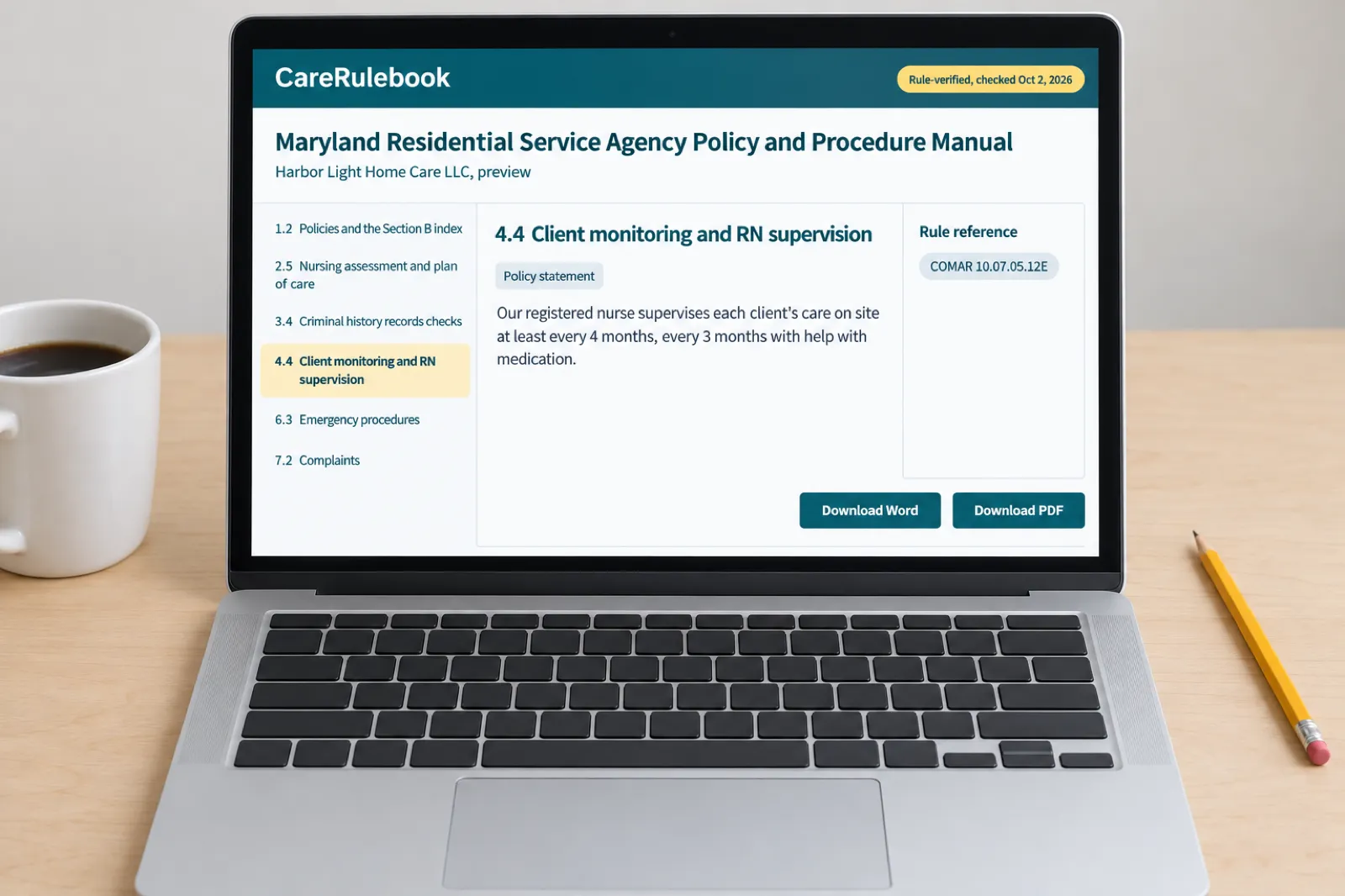
The CareRulebook Maryland manual preview on a laptop: policy 4.4 on client monitoring and RN supervision for a sample agency, citing COMAR 10.07.05.12E, with the manual’s contents listed beside it

CareRulebook

The clinical policies, written for your RN to adopt

CareRulebook’s Maryland manual covers the RN’s role in Policies 2.2, 2.5, 3.2, 3.6, 4.1 to 4.6 and 5.1, each built on COMAR 10.07.05.12 and the Board of Nursing’s COMAR 10.27.11, with the rule quoted under each policy and an adoption line for your registered nurse.

  • 33 policies, 102 requirements mapped to COMAR 10.07.05 and Health-General Title 19
  • Nursing assessment, plan of care, delegation record and RN supervisory visit record
  • A covering RN named alongside your RN, so deadlines and visits keep running
  • Editable Word and print-ready PDF, with a Section B index of your page numbers
Preview your manual

$199CareRulebook founding price for the first 50 Maryland agencies, then $249. Not an OHCQ fee.

Registered nurse myths, checked

Do I need a registered nurse to open a personal care agency in Maryland?

Yes. If you will help clients with activities of daily living. A registered nurse must assess new clients, oversee the care plan, delegation, supervision and training, and supervise care on site at least every 4 months (every 3 months with help with self-administered medication, every 45 days if staff give medication). The RSA rules do not say whether the RN must be an employee; Medicaid’s Community First Choice providers must employ one.

"For clients who require skilled services or assistance with the activities of daily living, an agency shall have a registered nurse to provide oversight for:"

Can a licensed practical nurse supervise my Maryland aides instead of an RN?

No. Not as the agency’s supervising nurse. For clients who need skilled services or help with activities of daily living, the RSA rules require a registered nurse to oversee the care plan, delegation, supervision and training, and to make the on-site supervision visits. OHCQ’s trainer checklist says the RN supervises LPNs, and that LPNs and assistants may not delegate care or supervise services. An LPN can still give care within their license, supervised by the RN.

"For clients who require skilled services or assistance with the activities of daily living, an agency shall have a registered nurse to provide oversight for:"

Does the Maryland RSA nurse only need to see each client once a year?

No. The RN reassesses each client at least once a year, but supervises care on site more often: at least every 4 months, every 3 months when staff help with self-administered medication, and every 45 days when staff administer medication, or more often if the RN decides. The Board of Nursing’s delegation rules can add visits every 45 days or every 2 weeks for delegated nursing tasks.

"The registered nurse shall provide periodic, on-site supervision of care:"

Frequently asked questions

Do I need a registered nurse to open a home care agency in Maryland?

Yes, if any client will get help with activities of daily living such as bathing, dressing, toileting or transfers. COMAR 10.07.05.12E(1) says that for clients who need skilled services or that help, the agency shall have a registered nurse to oversee the care plan, delegation, supervision and training. The RN assesses new clients, takes part in the plan of care, decides whether a certified nursing assistant is needed, and supervises care on site at least every 4 months. A business that gives only household or family support, such as housekeeping, meals and errands, does not need an RSA license at all.

Can my RN work for my agency as a contractor?

The RSA rules do not say whether the RN must be an employee. OHCQ’s archived 2020 slides asked agencies with nurses and aides to send the signed contract between the company and the RN it hired; that is old guidance we could not confirm for 2026. Medicaid’s Community First Choice program is stricter: its personal assistance providers must employ a registered nurse. If you plan to bill Medicaid, plan for an employed RN.

How often must the RN visit each client?

On site at least every 4 months if staff do not administer medication or help with self-administration, every 3 months if staff help with self-administration, and every 45 days if staff administer medication, or more often if the RN decides the client’s condition calls for it. The Board of Nursing’s delegation rules set their own visits for delegated nursing tasks: at least every 45 days for clients whose needs are chronic, stable, uncomplicated, routine and predictable, and every 2 weeks for others. The rules do not say which personal care tasks count as delegated nursing tasks; ask OHCQ how it reads them together.

Can a licensed practical nurse do the supervisory visits?

Not as the agency’s supervising nurse, by our reading. COMAR 10.07.05.12E names a registered nurse for oversight and on-site supervision, and OHCQ’s outside trainer checklist says LPNs and assistants of any discipline may not delegate care or supervise services. The Board of Nursing’s own law does let an LPN delegate some tasks, so ask OHCQ before you plan any delegation by an LPN. An LPN can give care within their license under the RN’s supervision.

Can the RN supervise by phone or video?

Not the supervisory visits: COMAR 10.07.05.12E(2) calls for periodic, on-site supervision of care. Between visits, the Board of Nursing’s rules let a delegating nurse outside hospitals and similar settings be readily available by telephone.

Can the owner be the agency’s RN?

We found nothing in COMAR 10.07.05 that stops an owner who is a registered nurse from also being the agency’s RN. A nurse practicing alone within their own license is not an RSA, but once you employ or contract with others to give care, by our reading you need the RSA license. Plan for cover: the assessment deadlines and supervision intervals keep running when the RN is away.

Does the RN have to answer the 24-hour on-call line?

The rule says clients can reach the agency at any time, that emergency inquiries are recognized and handled consistently with medical and nursing standards and directed to the right person, and that the person responds within 1 hour or sooner. It does not say the first person to answer must be a nurse. Whether a non-nurse may take the call and pass clinical questions to the RN within the hour is on our list of questions for OHCQ.

Get Maryland rule-change alerts

OHCQ has signalled a 2026 update to the RSA training rules, and the Board of Nursing has proposed criminal history checks for all its certificate holders (in force as emergency rules since August 25, 2026). Leave your email and we will tell you when a Maryland change affects your RN’s policies.

No spam. Only emails about Maryland home care rule changes. How we use your email.

Keep reading

Maryland

How to start a home care agency in Maryland

The RSA license, the 23 policy items, background checks and the fee question.

Maryland

Medication in a Maryland RSA

Reminders, help with self-administration, and administration by medication technicians under the RN’s delegation.

Maryland

Maryland caregiver training

The seven COMAR topics, the skills demonstration the RN watches, dementia hours and CNA-I and CNA-II.

Maryland

Maryland home health vs home care

When nursing at home needs a home health agency license and a Certificate of Need instead.

Manual

Build your Maryland policy manual

Including Policy 2.5 on assessment and delegation and Policy 4.4 on RN supervision.

Maryland

Maryland RSA policies and procedures

The 23 items OHCQ indexes in Section B, including clinical management and the frequency of client monitoring.

Maryland

The Maryland RSA application

The typed application, the five attachments and the Section B index.

Maryland

Maryland RSA inspections

OHCQ surveys, the records they read and plans of correction within 10 days.

Tennessee

Who runs a Tennessee PSSA

The person responsible, and when Tennessee asks for a registered nurse.

Virginia

Virginia home care administrator and RN requirements

Virginia’s administrator and the registered nurse who supervises personal care at least every 90 days.

Colorado

Colorado manager and supervisor

Who runs a Class B agency and who supervises the caregivers.

North Carolina

North Carolina agency director and RN

Director qualifications, the RN for aides and 90-day visits.

Sources

  1. COMAR 10.07.05, Residential Service Agencies (Regulations .01 to .28; last amended effective March 13, 2017) · Maryland Division of State Documents, Library of Maryland Regulations (Maryland Department of Health rules) · retrieved October 2, 2026
  2. Health Occupations Article, §§8-6A-01 and 8-6A-02 (certified nursing assistants and medication technicians) · Maryland General Assembly · retrieved October 2, 2026
  3. COMAR 10.09.84, Community First Choice (Medicaid; provider conditions for personal assistance) · Maryland Division of State Documents, Library of Maryland Regulations · retrieved October 2, 2026
  4. COMAR 10.27.11, Delegation of Nursing Functions (Board of Nursing) · Maryland Division of State Documents, Library of Maryland Regulations · retrieved October 2, 2026
  5. COMAR 10.39.01, Certified Nursing Assistants (revised effective June 8, 2026) · Maryland Division of State Documents, Library of Maryland Regulations · retrieved October 2, 2026
  6. Application for a Residential Service Agency License (rev. 06.26.2026) · Maryland Department of Health, Office of Health Care Quality · retrieved October 2, 2026
  7. OHCQ Review of Training Materials Provided by Outside Source: COMAR 10.07.05.11 Outside Trainer Checklist (revised 09.24.2026) · Maryland Department of Health, Office of Health Care Quality · retrieved October 2, 2026
  8. Residential Service Agencies licensee list (Excel, sheet "RSAs-EXCEL as of 10-02-26") · Maryland Department of Health, Office of Health Care Quality · retrieved October 2, 2026
  9. Understanding how Maryland’s employee protection laws apply to residential service agencies (RSAs) and personal care aides (PCAs) (Guidance Document, 11.01.2022) · Office of the Attorney General with the Maryland Department of Health and Maryland Department of Labor (posted by OHCQ) · retrieved October 2, 2026
  10. Residential Service Agencies: Initial License Process (OHCQ slides, 2020; Internet Archive copy of May 12, 2021) · Maryland Department of Health, Office of Health Care Quality · retrieved October 2, 2026
  11. Instructions for Completion of Residential Service Agency (RSA) Licensure Application (form approved May 2018; Internet Archive copy of November 28, 2020) · Maryland Department of Health, Office of Health Care Quality · retrieved October 2, 2026
Build your Maryland manualfrom $199