At least one office in Washington
Records are kept, secured and accessible there. This is the rule that requires an office at all.
"Maintain at least one in-state office location where records are kept, secured, and accessible;"
WAC 246-335-335(2)Where are you starting?
Washington · Office, records and counties · WAC 246-335-335, -450, -990
A Washington home care agency needs at least one office in the state where its records are kept, secured and accessible. Here is what DOH’s rules ask of that office, how DOH sees your records, how long to keep them, how counties and DOH’s county surcharge work, what happens when you add or move an office, and what the rules leave unsaid, including whether the office can be in your home.
Quick answer
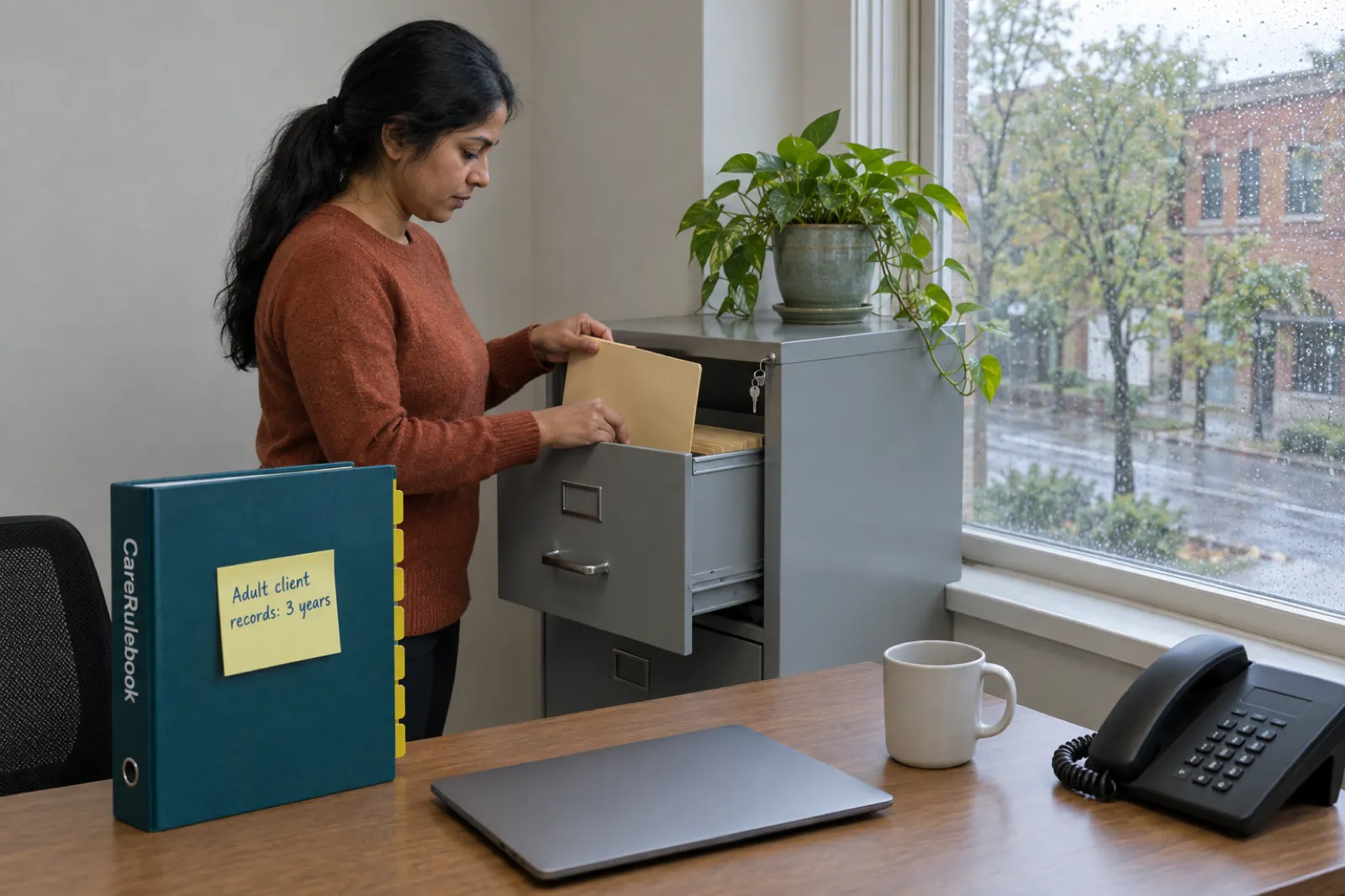
The rule says the agency must "maintain at least one in-state office location where records are kept, secured, and accessible" and display its license where the public can see it, in the main office and any branch office (WAC 246-335-335(2)-(3)). Client records must be accessible in that office to your staff and to DOH, on paper or electronically (WAC 246-335-450(2)), and DOH may survey all your records at any time (RCW 70.127.180(1)).
Keep adult client records three years after services end (WAC 246-335-450(7)). If your workers have occupational exposure to blood, the Department of Labor and Industries’ rules add a medical record for each of them, kept for as long as they work for you plus 30 years (WAC 296-802-20005(1)).
You pick the counties you will serve and DOH approves each one before you serve there. One county carries no surcharge; each additional county costs $500 if urban or $100 if rural. Those are DOH’s fees, not CareRulebook prices (WAC 246-335-990(3)).
Whether the office can be in your home: the rules do not say, and neither do DOH’s application materials. Ask DOH before you commit.
Chapter 246-335 WAC says little about the office itself. Most of what follows is about what the office must hold, show and allow. Each card says where it comes from.
Records are kept, secured and accessible there. This is the rule that requires an office at all.
"Maintain at least one in-state office location where records are kept, secured, and accessible;"
WAC 246-335-335(2)In the main office, where the public can see it, and at any branch office.
"Display the license issued by the department in an area within the main office that is visible to the public"
WAC 246-335-335(3)DOH’s application asks for the agency’s physical street location and county, with a separate mailing address if it differs.
"Physical Address: Enter the facility’s physical street location including city, state, zip code, and county."
DOH 505-053, item 1DOH’s license requirements sheet asks for copies of every current government business license for each office location.
"Copy of any and all current government issued business license(s) for each office location which may include state, county or city licenses."
DOH 505-109 (April 2026)Your plan of operation states the agency’s days and hours of operation, and the administrator makes sure current policies are accessible to staff during those hours.
"The days and hours of agency operation"
WAC 246-335-415(5), (11)(n)You cooperate with surveys, which may include reviewing your records and visiting clients at home with their consent.
"Cooperate with the department during surveys which may include reviewing licensee records and conducting on-site visits with client or patient consent;"
WAC 246-335-335(4)Client records must be "accessible in the licensee’s office location for review by appropriate direct care personnel, volunteers, contractors, and the department" (WAC 246-335-450(2)(a)). They may be "written legibly in permanent ink or retrievable by electronic means" (WAC 246-335-450(2)(b)), and must be on your standard forms or templates, confidential, in date order, fastened together if on paper, kept current, and stored "in a safe and secure manner to prevent loss of information, to maintain the integrity of the record, and to protect against unauthorized use" (WAC 246-335-450(8)(a)).
| Record | What it holds | Where and how | Source |
|---|---|---|---|
| Client records | A current record for each client: contact details, consent, payment source, plan of care, signed visit notes, supervision records. | Accessible in your office location to the staff who need them and to DOH. Paper in permanent ink, or retrievable electronically. | WAC 246-335-450(1)-(3) |
| Personnel, contractor and volunteer records | Credentials or exemptions, references, orientation, contracts, skills verification, background checks, training, food handling, testing and vaccination, evaluations. | Records on all staff and volunteers, and access to records on contractors. The rule does not say where, beyond the office rule. | WAC 246-335-430WAC 246-335-335(2) |
| Employee medical records | For workers with occupational exposure to blood: Hepatitis B vaccination status, any declination statement and post-exposure records. | Kept confidential, in any form that can be retrieved. | WAC 296-823-17005WAC 296-802-200 |
The rules do not say how quickly you must produce a record when a surveyor asks. Our suggestion: keep records where whoever is in the office can find them, and if they are electronic, make sure someone there can log in and print them. In CareRulebook’s manual, Policy 3.4 sets out how client records are kept, filed and released, and Policy 1.7 names the office where records are kept.
| Record | How long | Rule |
|---|---|---|
| Adult client | Three years after services end | WAC 246-335-450(7)(a) |
| Client under 18 | Three years after turning 18, or five years after discharge, whichever is longer | WAC 246-335-450(7)(b) |
| Client who died while receiving services | Three years after the last date or end of services | WAC 246-335-450(7)(c) |
| Clients under a DSHS or AAA contract | Longer, if the contract says so | WAC 246-335-450(7)(d) |
| Personnel, contractor and volunteer files | No period in chapter 246-335 WAC | WAC 246-335-430 |
| Bloodborne pathogens training records | Three years from the date of the training | WAC 296-823-12015(1) |
| Employee medical records | As long as the person works for you, plus 30 years | WAC 296-802-20005(1) |
This one comes from the Department of Labor and Industries (L&I), not DOH. L&I’s bloodborne pathogens chapter applies if any of your employees have occupational exposure to blood or other potentially infectious materials (WAC 296-823-100), and DOH’s rule has you offer the Hepatitis B vaccine when your risk assessment finds that exposure (WAC 246-335-425(12)(e)). Then:
CareRulebook’s manual applies the 30 years to the bloodborne pathogens records, kept in a confidential health section of the personnel file (Policy 3.5). Whether other health records an agency holds, such as TB test results from a clinic, also count as employee medical records under chapter 296-802 WAC is a question for L&I; we have not settled it.
Chapter 246-335 WAC sets no retention period for personnel files, complaint logs or quality improvement records. CareRulebook’s manual keeps personnel files for three years after the person leaves, and sets its own periods for other agency records, mostly three years. Those are the manual’s choices (Policy 3.5). Other laws, such as tax and payroll rules, may set their own periods for some records; we did not review them.
Your plan of operation must include "a plan for preserving records, including the process to preserve or dispose of records prior to ceasing operation according to WAC 246-335-450 (7) and (8)" (WAC 246-335-415(8)), and after closing the licensee must "retain or dispose of client records in a confidential manner" for the periods above (WAC 246-335-450(8)(c)). For employee medical records, L&I’s rule has you transfer them to any employer that continues the business, or, if none does, "notify affected current employees of their rights of access to records at least three months prior to the termination of your business" (WAC 296-802-60005).
DOH approves the area you serve as well as the agency. A service area "means the geographic area in which the department has given prior approval to a licensee to provide home health, hospice, or home care services" (WAC 246-335-310(39)), and the statute has every applicant "file with the department for approval a description of the service area in which the applicant will operate and a description of how the applicant intends to provide management and supervision of services throughout the service area." (RCW 70.127.080(1)(f)). DOH may not set service area criteria that "limit the number or type of agencies in any service area" (RCW 70.127.080(1)(f)(i)).
These are DOH’s fees under WAC 246-335-990, in force since June 1, 2026. They are paid to the state and are separate from any CareRulebook price.
| County of operation | DOH surcharge | Source |
|---|---|---|
| One county for each applicant or licensee | None | WAC 246-335-990(3) |
| Each additional urban county | $500 | WAC 246-335-990(3)(a) |
| Each additional rural county | $100 | WAC 246-335-990(3)(b) |
By our arithmetic, an applicant asking for three counties pays DOH’s $5,000 initial fee (WAC 246-335-990(1)) plus a surcharge on the two counties after the first: $6,000 in all if both are urban, $5,200 if both are rural. This is our example, not a DOH quote.
What the rule leaves open. It does not say which counties are urban and which are rural, and we did not find a DOH list. It charges the surcharge to "an applicant or licensee" without saying whether it is charged again at each renewal or only when a county is added. Ask DOH’s home care program (360-236-2957) before you budget (DOH, Contact Information).
Chapter 246-335 WAC mentions branch offices once, in the display rule: the license goes in the main office, "including branch office locations if applicable" (WAC 246-335-335(3)). The home care rules do not define a branch office or set a distance from the main office. What DOH asks for:
The rules do not say whether each office must hold its own records. The office rule asks for at least one office where records are kept, secured and accessible, and client records must be accessible "in the licensee’s office location" (WAC 246-335-450(2)(a)). Counties are approved for the agency: the application’s county table sits apart from the office section, which asks for categories but not counties (our reading of the form). CareRulebook’s manual lists each office with the counties it serves and its on-site manager or supervisor, and keeps every client’s record available at the office DOH has on file (Policy 1.1); ask DOH if you plan to keep records only at a second office.
The rule’s 30-day notice list covers a new administrator or supervisor, opening or closing any office, stopping home care, serving fewer counties and, for agencies approved through substantial equivalency, DSHS or AAA monitoring findings (WAC 246-335-335(5)). It does not say whether the notice goes before or after the change. Our suggestion: when a change can be planned, tell DOH before it happens.
Written notice to DOH within 30 days. DOH’s "Amended" application covers adding other office locations. Get the business licenses DOH asks for, display the license there, and update your plan of operation.
WAC 246-335-335(5)(b)DOH 505-053WAC 246-335-415(12)Written notice to DOH within 30 days. Make sure the records kept there stay secured and accessible at an office in Washington.
WAC 246-335-335(2), (5)(b)The rule does not use the word "move". By our reading a move is ceasing operation at one office location and beginning at another, both on the 30-day list. DOH’s "Amended" list does not name an address change, so ask DOH which form it wants.
WAC 246-335-335(5)(b)DOH 505-053An amended application listing every county you seek, and DOH’s approval before you serve anyone there. DOH’s county surcharge applies to each county after the first.
WAC 246-335-335(6)WAC 246-335-990(3)Written notice to DOH within 30 days.
WAC 246-335-335(5)(d)Both the current licensee and the new owner file with DOH at least 30 days before the change. DOH’s change of ownership fee is $500 for each licensed service category.
WAC 246-335-330(6)-(7)WAC 246-335-990(5)DOH’s application instructions describe an "Amended" application for these changes: "change Administrator, Clinical Director or Direct Supervisor information, add Other Office Locations", as well as service categories, services, accreditation, DSHS contracts and service areas (DOH 505-053, page 1). They do not mention a change of the agency’s name; ask DOH. CareRulebook’s manual keeps a DOH notice log for every change (Policy 1.7).
The rules do not say. We read chapter 70.127 RCW, chapter 246-335 WAC, DOH’s application packet (DOH 505-052, April 2026, with the 505-051 application, 505-053 instructions and 505-109 license requirements), and DOH’s home care pages: the program page, license requirements, survey program, updated rules and orientation class. None of them says whether the in-state office may be in a residence. None says it must be commercial premises, and none says a home is allowed. We are not reading an answer into that silence either way.
Ask DOH’s home care program on 360-236-2957 before you sign a lease or set up at home (DOH, Contact Information). Our suggestion: ask for the answer in writing and keep it with your license papers.
These are rule duties for any office. They are not an answer to the home office question, but they are what to plan for:
Your address may be published. DOH’s January 2025 list of licensed in-home services agencies in King, Kitsap, Pierce and Snohomish counties prints each agency’s site address, city, zip code and county (DOH list, January 2025). If your office is your home, plan on that address being public.
In the sources above we found nothing on:
For zoning, home business rules and local business licenses, ask your city or county. For how DOH applies its rules to your setup, ask DOH.
CareRulebook
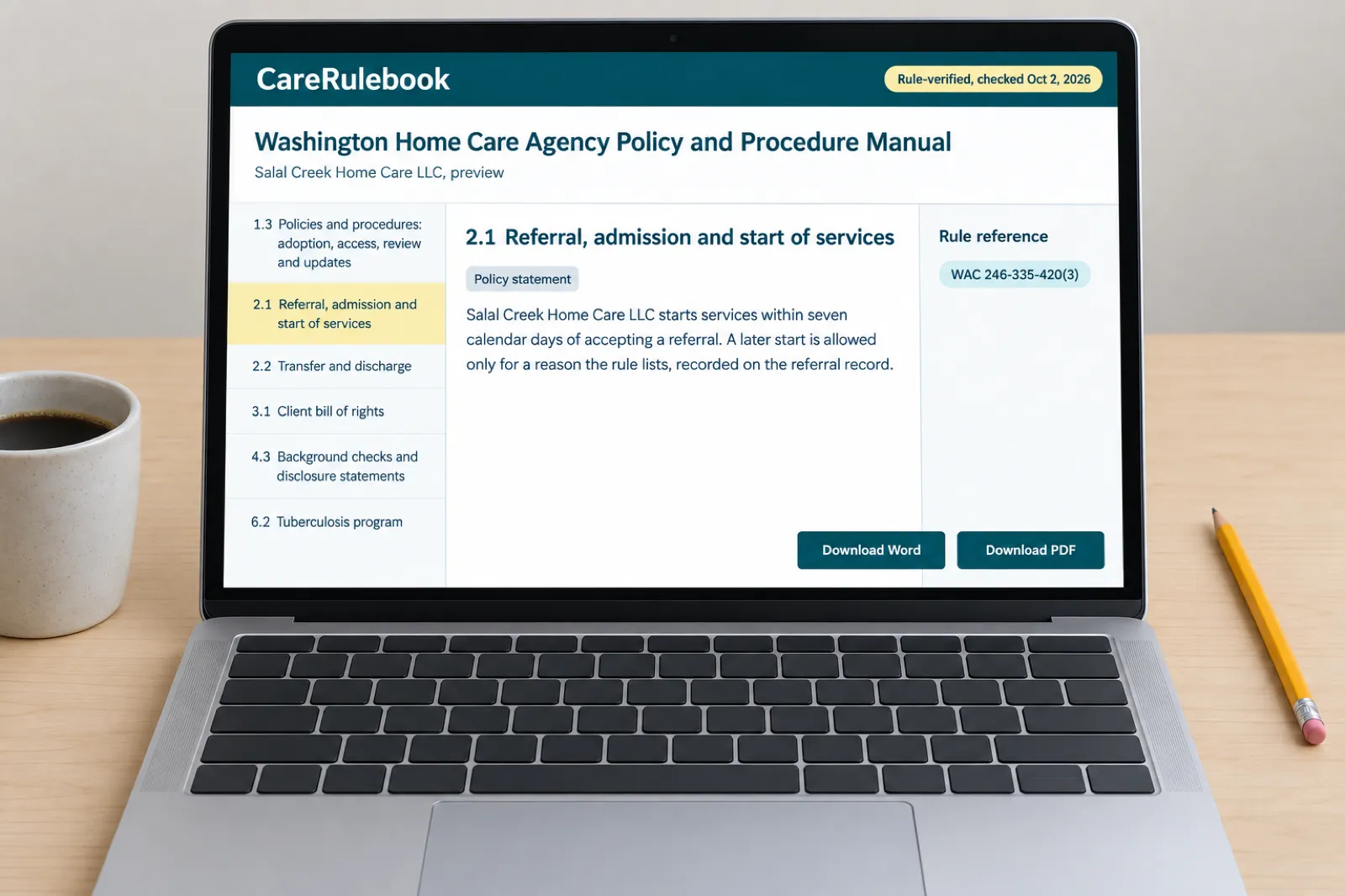
CareRulebook’s Washington manual includes Policy 1.7, license, office, insurance, renewal, changes and closing; Policy 3.4, client records: contents, filing, confidentiality and release; Policy 3.5, keeping and disposing of records, with the 30-year rule for employee medical records; and Policy 1.1, your plan of operation with a county table for every approved county.
$199CareRulebook founding price for the first 50 Washington agencies, then $249. Not a DOH fee.
It depends. The rules do not say. WAC 246-335-335 requires at least one office in Washington where records are kept, secured and accessible, with the license displayed where the public can see it. Neither chapter 70.127 RCW, chapter 246-335 WAC nor DOH’s application materials say whether that office may be in a residence. Our suggestion: ask DOH’s home care program (360-236-2957) before you commit to a home office.
"Maintain at least one in-state office location where records are kept, secured, and accessible;"
No. Client records may be written legibly in permanent ink or be retrievable by electronic means. Either way they must be accessible in your office location to the staff who need them and to DOH, kept confidential and stored securely, and paper records are fastened together.
"Written legibly in permanent ink or retrievable by electronic means;"
The rules do not say. WAC 246-335-335(2) requires at least one office in Washington where records are kept, secured and accessible, and the license must be displayed in the main office where the public can see it. We read chapter 70.127 RCW, chapter 246-335 WAC, DOH’s application packet (DOH 505-052, April 2026) and DOH’s home care pages, and none of them says whether that office may be in a residence, either way. Ask DOH’s home care program on 360-236-2957 before you commit, and ask your city or county about home business rules.
Yes. WAC 246-335-450(2) allows records written legibly in permanent ink or retrievable by electronic means. Either way they must be accessible in your office location to the staff who need them and to DOH, on your standard forms or templates, confidential, in date order, kept current, and stored securely against loss and unauthorized use.
For adults, three years after services end. For minors, three years after they turn 18 or five years after discharge, whichever is longer. For a client who died while receiving services, three years after the last date of services. Agencies under contract with DSHS or an Area Agency on Aging may keep them longer if the contract says so (WAC 246-335-450(7)).
It comes from the Department of Labor and Industries, not DOH. If your workers have occupational exposure to blood, L&I’s bloodborne pathogens rule requires a confidential medical record for each of them, including Hepatitis B vaccination status and any declination statement (WAC 296-823-17005), and L&I’s employee records rule requires medical records to be kept for at least as long as the person works for you plus 30 years (WAC 296-802-20005(1)). You need not keep them for someone who worked for you less than a year if you give them their records when they leave.
DOH’s rule includes one county of operation with no surcharge and charges $500 for each additional urban county and $100 for each additional rural county (WAC 246-335-990(3)). These are DOH’s fees, on top of its $5,000 initial fee, not CareRulebook prices. The rule does not say which counties are urban or rural, and we did not find a DOH list, so ask DOH when you apply.
The rule asks for written notice to DOH within 30 days of beginning or ceasing operation of any office location (WAC 246-335-335(5)(b)); it does not set an approval step for an office. DOH’s application instructions list an "Amended" application that covers adding other office locations, and its form asks for each office’s address, contact details and on-site manager or supervisor, so ask DOH how it handles that form before you open. Serving a new county is different: that needs DOH’s approval first.
Tell DOH in writing. The rule’s 30-day list covers beginning or ceasing operation of any office location; it does not mention a move or an address change as such, and DOH’s "Amended" application list does not name one either, so ask DOH which form to use. Our suggestion is to tell DOH before you move rather than after, and to update your business licenses, your plan of operation and where your license is displayed.
DOH asks for copies of any and all current government business licenses for each office location, which may include state, county or city licenses (DOH 505-109). Which local licenses apply depends on your city and county, so ask them. The state sources we read say nothing about zoning for a home care office.
DOH is considering changes to chapter 246-335 WAC (fines and background checks). Leave your email and we will tell you when a Washington change affects your office, your records or your policies.
No spam. Only emails about Washington home care rule changes. How we use your email.
Washington
How to start a home care agency in Washington
The DOH license, the orientation class, the policy manual DOH approves and the initial survey.
Washington
Washington administrator and supervisor
Qualifications you set, written alternates, the six-month contact and 10 hours of training.
Manual
Build your Washington policy manual
Office, records, retention and county policies, written for your agency.
Washington
The Washington license application
DOH’s paper packet form by form, the manual DOH reviews, the initial survey, renewal, changes and selling.
Washington
Washington license cost and timeline
DOH’s $5,000 initial fee, renewal bands, what is free and the nine-month limit.
Texas
Can you run a Texas home care agency from home?
How Texas compares: HHSC allows a home address, with four conditions.
Indiana
Indiana office and premises rules
IDOH’s letter allows a home address; records 7 years; branches within 120 miles.
Illinois
Illinois office and premises rules
Part 245 does not say where the office must be; what it does require.
North Carolina
North Carolina office and premises rules
Office hours, records and the 90-minute service area rule.
Georgia
Georgia office and premises rules
The office, records and the local business license DCH asks for.
Virginia
Virginia office and premises rules
What the rules in force say, and the withdrawn 2022 zoning draft.