Skip to content
CareRulebook

England · CQC registration · Business plan and forecast

CQC business plan and 12-month forecast for home care

A new home care agency must send CQC a business plan and a 12-month financial forecast. CQC wants eight sections, a clear pricing structure, and a forecast with income, itemised costs and your financial position for every month. Too little detail and the application may be rejected.

  • Rule-verified 30 September 2026
  • CQC guidance updated 30 September 2026
  • Free forecast template
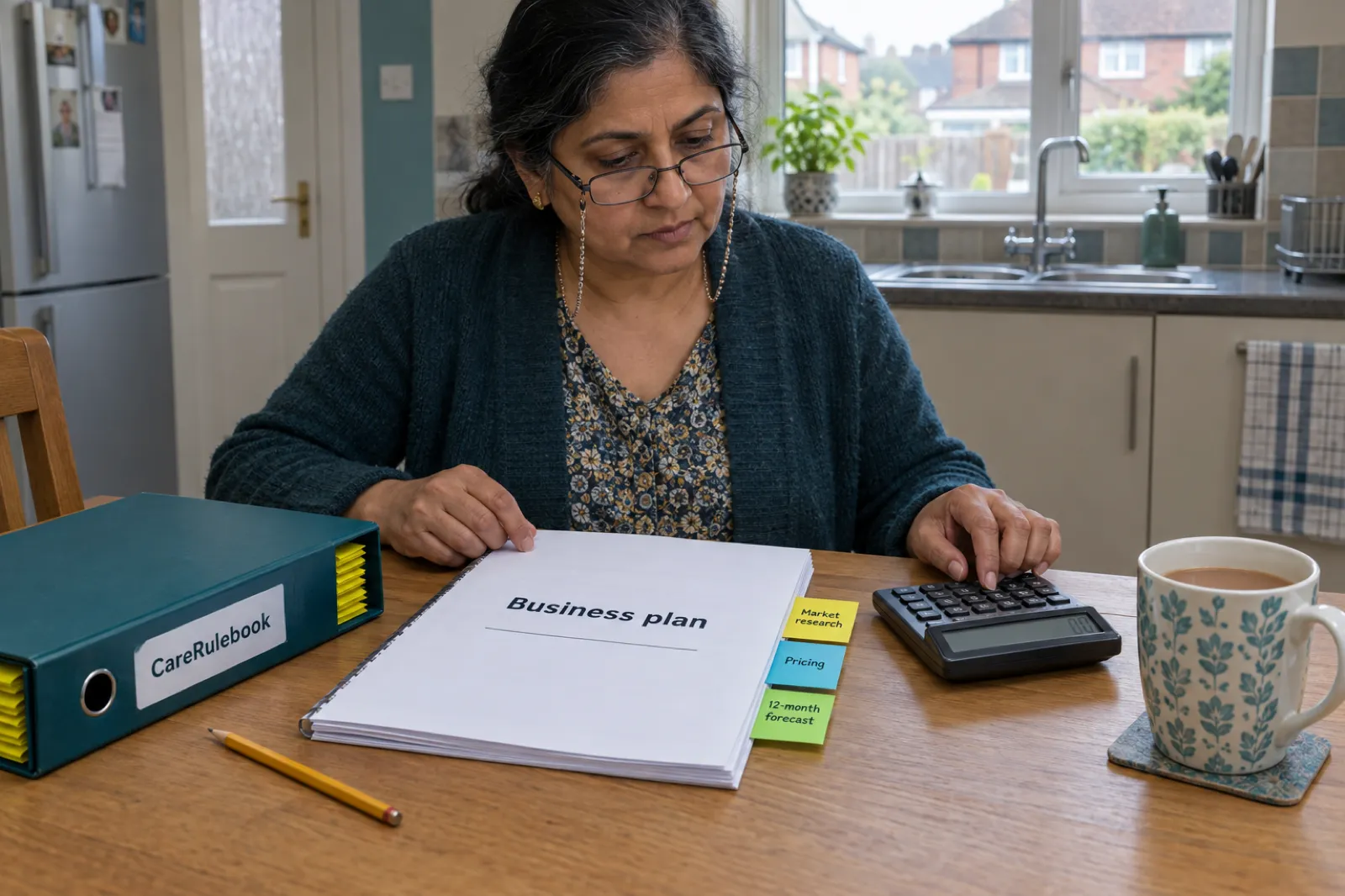
A home care founder at her kitchen table with a printed business plan tabbed for market research, pricing and 12-month forecast, and a calculator

Quick answer

CQC requires a business plan and financial forecast from every new home care (domiciliary care) agency. It says "Your business plan helps us check that your service will be financially stable and well-managed."

The plan covers your background, management team, service, local market research, a SWOT analysis, who is responsible for each task, your ownership structure and your pricing. The forecast must show projected income, projected expenses and the resulting financial position for each of your first 12 months, with operating costs itemised every month rather than given as one total.

Home care agencies do not send a financial viability statement; the business plan and forecast take its place.

The eight sections CQC wants

From CQC’s guidance on the business plan, updated 30 September 2026. "If your plan does not include enough detail your application may not be successful."

  1. Section 1

    Summary of your plan

    Your company’s background and experience with this type of service, and how that experience helps you meet people’s needs.

    CQC, Business plan and financial forecast
  2. Section 2

    About your company

    What you do and how you stand out, your management team’s relevant experience and qualifications, and why they suit this service. Tie it to the service user bands in your application form.

    CQC, Business plan and financial forecast
  3. Section 3

    Details of your service

    The services you will provide, how, who for, why the service is needed and why it will succeed in the local market.

    CQC, Business plan and financial forecast
  4. Section 4

    Market research

    Recent research in your area and how you did it, evidence of local demand, local competitors, markets you plan to target, and how you decided pricing and staff pay.

    CQC, Business plan and financial forecast
  5. Section 5

    SWOT analysis

    Strengths, weaknesses, opportunities and threats, or an equivalent structured analysis.

    CQC, Business plan and financial forecast
  6. Section 6

    Staff responsibilities

    Every main task and role, with a named person responsible. Every significant task needs someone specific.

    CQC, Business plan and financial forecast
  7. Section 7

    Company structure

    Your ownership, including investors, and your company structure, exactly as they are.

    CQC, Business plan and financial forecast
  8. Section 8

    Pricing structure

    How you will charge, down to call lengths, evenings, bank holidays and double-handed calls.

    CQC, Business plan and financial forecast

Keep it consistent. CQC asks you to make the management section relate to "the service user bands you’ve selected in your application form", and the market research to the same bands. Regulation 13 of the 2009 Registration Regulations links your finances to your statement of purpose: you must take all reasonable steps to stay financially viable so you can achieve the aims and objectives set out in it.

Your pricing structure

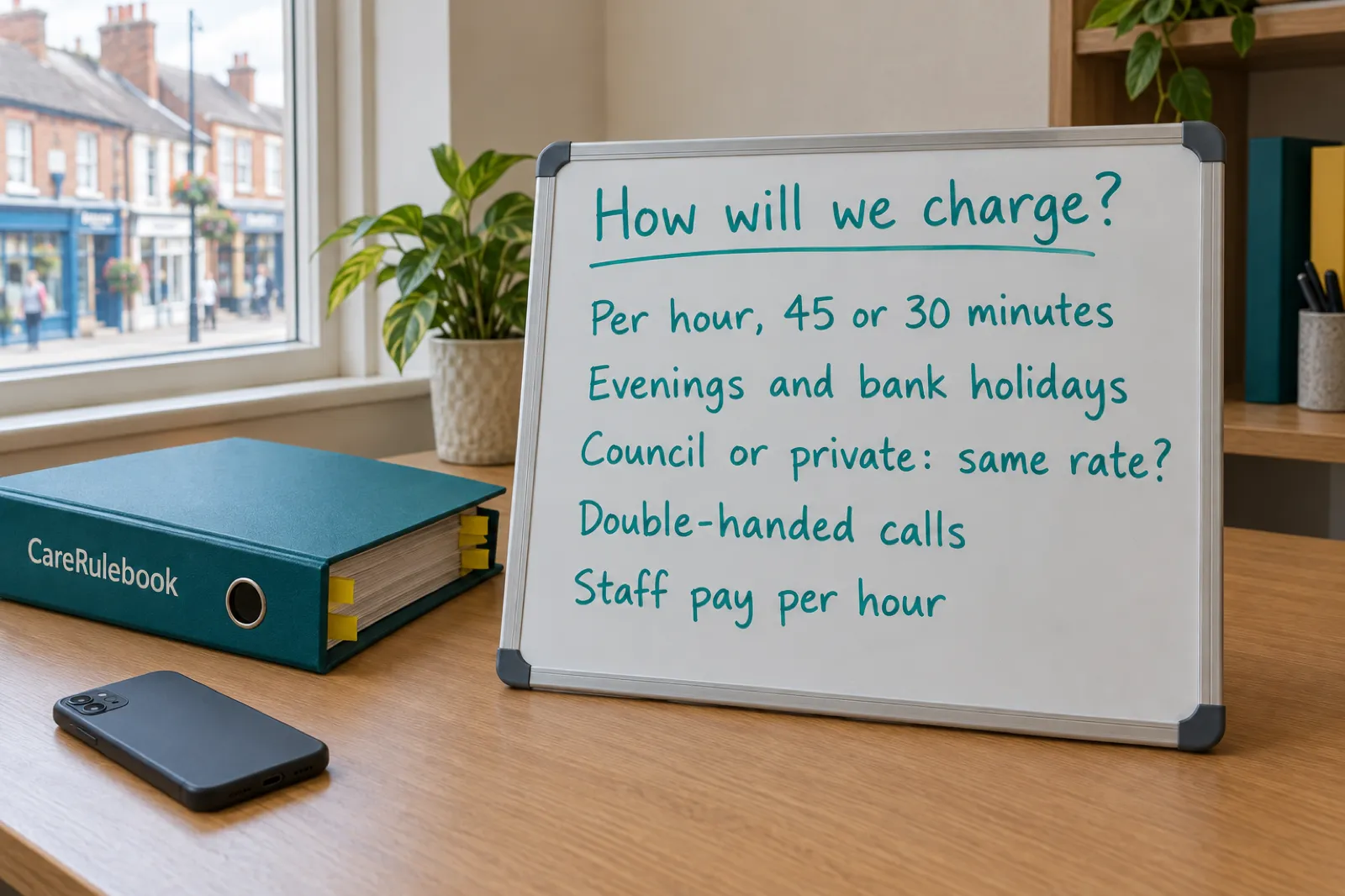
For a domiciliary care service CQC asks you to explain how you will charge, and gives four questions to answer:

  • Will you charge by the hour, 45 minutes or 30 minutes?
  • How will you charge for evenings and bank holidays?
  • Will you charge the same for local authority and private funding?
  • What will you charge for double-handed calls?

Your market research must also show "how you decided your pricing and staff pay, including how much you will pay staff". The two need to fit together: your rates have to cover what you pay care workers for each call, plus everything else in your forecast.

A whiteboard headed how will we charge, listing per hour, 45 or 30 minutes; evenings and bank holidays; council or private same rate; double-handed calls; staff pay per hour
CQC’s four pricing questions, plus the staff pay your market research must explain.

The 12-month financial forecast

CQC’s requirement is specific: "You must provide a 12-month financial forecast for your first year of business." For each month it must show projected income, projected expenses and the resulting financial position of the business, across the full 12 months.

CQC adds: "Your forecast must include a detailed breakdown of operational costs (for example, staff costs, technology costs and advertising) for each month, rather than a single monthly or annual expense total." And it explains why: "We ask for a month-by-month forecast because income and costs can change during the year." Your forecast should support what your business plan says.

Free download

Blank 12-month forecast

A month-by-month sheet with income, itemised staff and operating costs, monthly net income and a running cash position. Totals are calculated for you. Opens in Excel or Google Sheets. The rows are our suggestion; change them to fit your agency.

Download the forecast (CSV)
What is in the template
SectionRows
IncomeLocal authority funded care, privately funded care, other income
Staff costsCare worker wages, registered manager, office and coordinator wages, employer National Insurance, employer pension, holiday pay, mileage and travel, training, DBS checks and recruitment
Operating costsOffice rent and utilities, insurance, CQC annual fee, care planning and rostering software, phones and IT, advertising, PPE and equipment, accountancy and legal, loan repayments and bank charges, other
PositionTotal expenses, net income for the month, opening cash (your start-up funds in month 1), closing cash

CQC’s own examples of operating costs are staff costs, technology costs and advertising. The template gives each month a closing cash position, which is the "resulting financial position" CQC asks for.

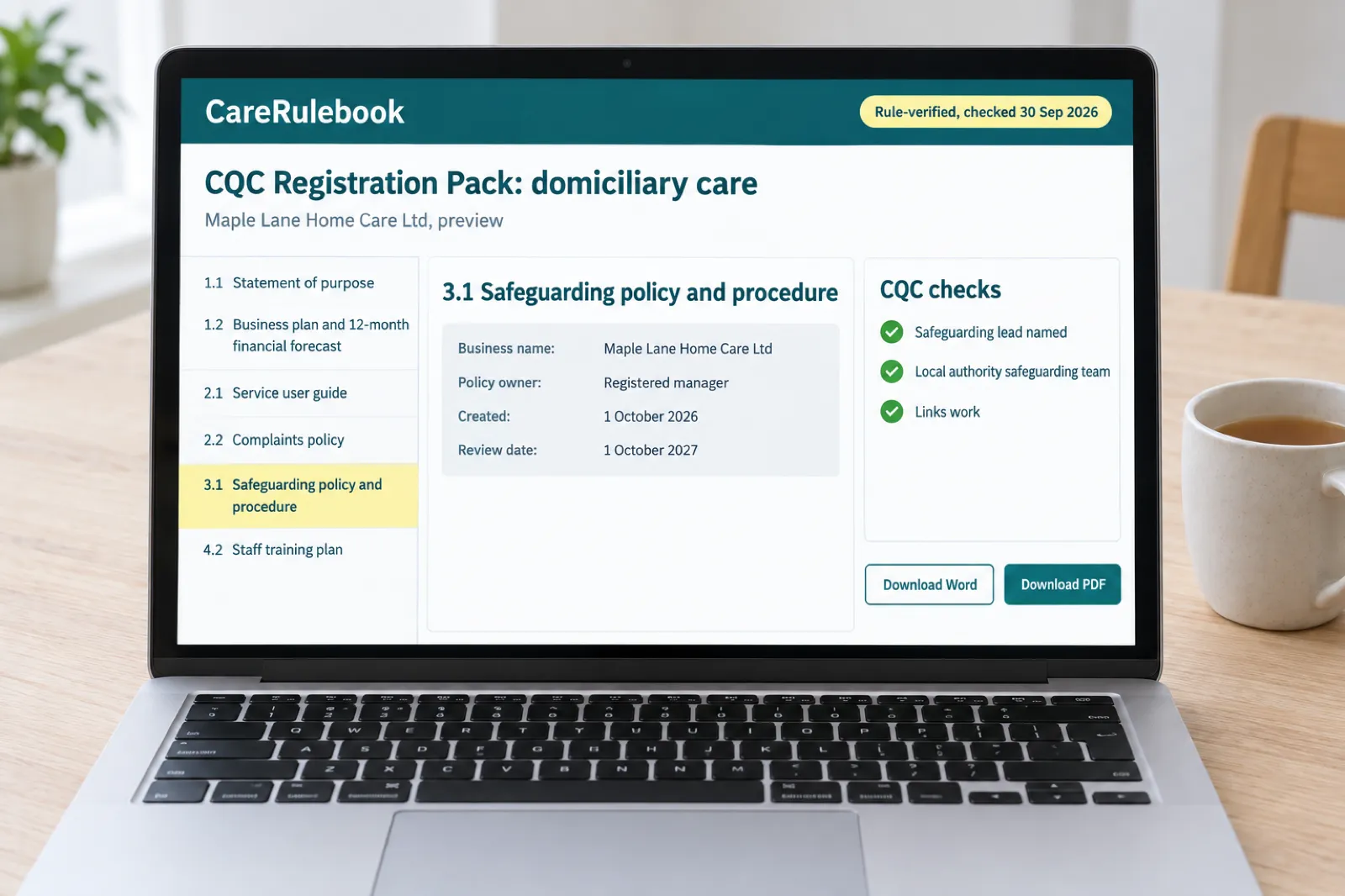
The CareRulebook CQC pack preview on a laptop

CareRulebook

A business plan that matches the rest of your application

CareRulebook builds your CQC documents from one set of answers, so your business plan, statement of purpose and policies describe the same service, for the same people, in the same area.

  • Business plan in CQC’s eight sections
  • Service user bands matched across every document
  • Your business name, owner and dates on every document
  • Editable Word and PDF

What CQC’s refused and registered applicants did differently

CQC publishes two worked examples of homecare applications. Money was one of the clearest differences.

Refused

"There was a small amount of money to start up the business but Mrs Smith could not tell us where this money had come from. ... She had not looked at what money she needed to break even and was unaware of the real costs of running the business. The business plan did not consider essentials needed to run the service."

CQC, Examples of personal care applications

Registered

"He could tell us where this money had come from and had evidence of his business account. The business finance was sound and allowed for contingencies, such as loss of income. Mr Jones had looked at the local market very carefully including discussions with the local council and other commissioners."

CQC, Examples of personal care applications

Three things to take from it: know where your start-up money comes from and be able to show it, work out what you need to break even, and allow for contingencies such as losing income. The same examples on policies →

What gets business plans rejected

A single cost total

CQC wants operating costs broken down each month, not one monthly or annual figure.

CQC

Too little detail in the forecast

"If your financial forecast does not contain enough detail for us to assess your service, your application may be rejected."

CQC

No evidence of local demand

You must show you understand the local market and that there is demand for your service.

CQC

Tasks with no named owner

Every significant task must have someone specific assigned to it.

CQC

A structure that is not accurate

Ownership and roles must reflect what is actually in place, including investors.

CQC

Sending it incomplete

Since 1 July 2025 CQC rejects homecare applications that are not complete or accurate on arrival, and a corrected resubmission counts as a new application.

CQC

Frequently asked questions

Does CQC need a business plan for a home care agency?

Yes. CQC lists a business plan and financial forecast among the extra documents homecare (domiciliary care) agencies must send with a registration application. It uses the plan to check the service will be financially stable and well managed.

What must the CQC financial forecast show?

Projected income, projected expenses and the resulting financial position for each of your first 12 months, with a detailed monthly breakdown of operating costs such as staff, technology and advertising, not a single total. CQC says a forecast without enough detail may get the application rejected.

Do homecare agencies need a financial viability statement?

No. CQC exempts home care (domiciliary care) agencies from the financial viability statement, but they must send the business plan and 12-month forecast instead.

What pricing does CQC want to see?

How you will charge: by the hour, 45 minutes or 30 minutes; for evenings and bank holidays; whether local authority and private clients pay the same; and what you charge for double-handed calls. Your market research should also show how you decided pricing and how much you will pay staff.

Is there a CQC business plan template?

CQC’s business plan guidance lists what the plan must cover but does not include a template. CareRulebook’s free blank 12-month forecast follows CQC’s requirements for the forecast part.

Why did CQC refuse an applicant over money?

In CQC’s published example, the refused applicant could not say where the start-up money came from, had not worked out what was needed to break even, and her business plan did not consider essentials needed to run the service.

Get your CQC registration pack at launch

Leave your email and we will send your CQC pack preview, including the business plan, as soon as it is ready.

No spam. One email when your guide's pack launches, and rule-change alerts if you want them. How we use your email.

Keep reading

Sources

  1. Care Quality Commission (Registration) Regulations 2009 · legislation.gov.uk · retrieved 30 September 2026
  2. Registering a homecare agency (personal care) · Care Quality Commission · retrieved 30 September 2026
  3. A better registration process for new homecare applications · Care Quality Commission · retrieved 30 September 2026
  4. Supporting documents for new provider registration applications · Care Quality Commission · retrieved 30 September 2026
Get your CQC registration pack