Skip to content
CareRulebook
MenuClose

What do you run?

Home care in the US19 states with a manual, 6 with a free guide
ColoradoManual
ConnecticutPack
DelawareManual
GeorgiaManual
IllinoisManual
IndianaManual
KansasManual
MaineManual
MarylandManual
MinnesotaManual
NevadaManual
North CarolinaManual
OklahomaManual
OregonManual
South CarolinaManual
TennesseeManual
TexasManual
VirginiaManual
WashingtonManual
CaliforniaGuideFloridaGuideNew JerseyGuideNew YorkGuideOhioGuidePennsylvaniaGuideAll US home care states →
Care homes in the USCalifornia, Michigan, Minnesota; more states coming
Home care in the UKEngland, Scotland, Wales
Free toolsChecklists, calculators and templates

England · CQC registration · Supporting documents

Domiciliary care policies for CQC: the list, and using templates

CQC asks a new homecare agency for eight policies with its application, and lists more documents to keep ready. Templates are allowed, but only if you tailor them and can explain them. CQC's own published examples show two applicants who bought policies online: one was refused, one was registered. One difference CQC describes is whether they had made the policies their own.

  • Rule-verified 30 September 2026
  • Quoted from CQC guidance
  • Reject-at-receipt since July 2025
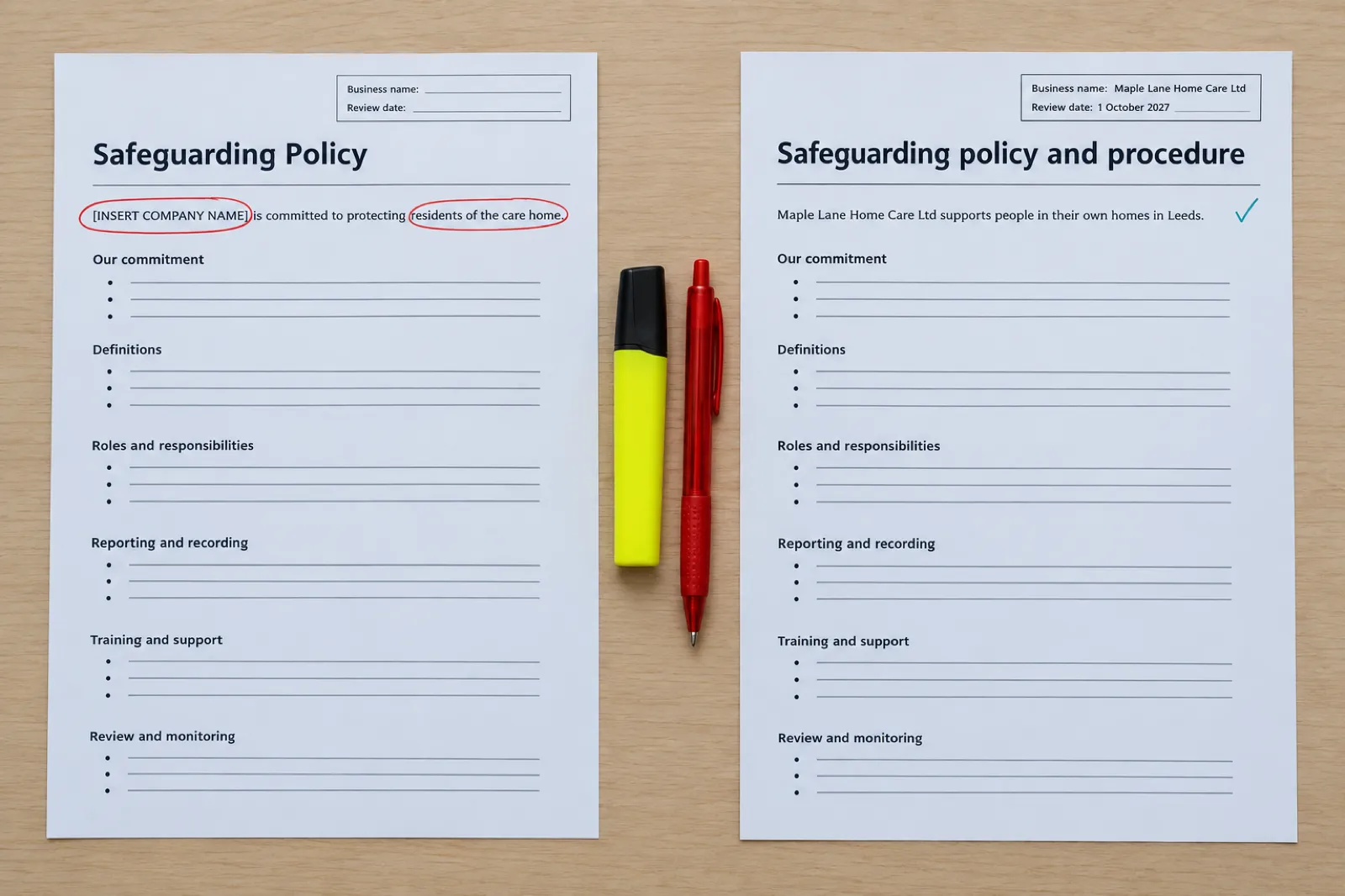
A generic safeguarding template with an unfilled company name and care home wording circled, next to a tailored homecare policy with the business name and review date

Quick answer

The list: CQC asks a new homecare agency to send eight policies with its application (safeguarding, medicines, infection prevention and control, complaints, consent, equality and human rights, recruitment, and governance), plus its statement of purpose, service user guide, training plan, business plan, insurance and legal occupancy evidence. CQC also lists nine items to keep ready in case it asks.

Templates: yes, if you make them your own. CQC says "If you choose to use a third-party template, make sure it suits your service type. For example, a template for residential care will not work for home care applicants." Every document must also carry your business name, the person responsible, the created date and the review date, have working legislation links, and be "unique and tailored to your business".

Since 1 July 2025, homecare applications with documents that are incomplete, inaccurate or not relevant are rejected on arrival, and a resubmission goes to the back of the queue.
Rule-verified, checked against official sources on 30 September 2026

Edited by . Built from the official text; every quoted rule is checked against the saved source before publishing.

The domiciliary care policies CQC asks for

CQC’s supporting documents guidance sets out what a new homecare agency sends with its application, and what it keeps ready. Each item links to CQC’s page for that document.

Send with your application

8 policies

  • Safeguarding policy and procedureCQC
  • Medicines management policyCQC
  • Infection prevention and control policyCQC
  • Complaints policyCQC
  • Consent policy and procedureCQC
  • Equality, diversity and human rights policyCQC
  • Recruitment policy and proceduresCQC
  • Governance and quality assurance policiesCQC

and 6 other documents

  • Statement of purposeCQC
  • Service user guideCQC
  • Staff training planCQC
  • Business plan and financial forecastCQC
  • Liability insuranceCQC
  • Evidence of legal occupancyCQC

Keep ready, do not send

CQC’s nine items, in 7 documents

  • Duty of candour
  • Freedom to speak up and whistleblowing
  • Risk management, with a list of risk assessments
  • Reportable incidents
  • Person-centred care planning
  • Sample care contract and care plan
  • Staffing structure and rotas

CQC: "Do not send these documents with your application. Keep them ready in case we request them. If you cannot provide them when asked, your application may be delayed." CQC

Only for specialist services

Learning disability and autism

If you provide a specialist service for autistic people or people with a learning disability, also send a positive behaviour support policy and a restraint policy. CQC

Policies are not a tick box. Since July 2025 CQC checks at receipt that each one is complete, accurate and relevant to your service, then may ask you to explain them at interview. What CQC asks about your policies at interview →

CQC’s own examples: one refused, one registered

CQC publishes real applications with the names changed. Both of these providers bought policies online.

Refused

Smith Care Limited

"Smith Care Limited had bought a set of policies and procedures online, but could not tell us about their content or how they applied to the agency."

CQC refused the application on several grounds, including money, the manager’s experience and knowledge of the policies.

Registered

Jones Care Limited

"Jones Care Limited had bought some policies and procedures online. Mr Jones had reviewed and adapted these to the service and written others himself. He could tell us in detail how they applied to the running of the service."

CQC does not list its reasons for registering Jones Care. The example also describes sound finances and an experienced manager, so in our reading the policies were one part of a strong application.

CQC, Examples of personal care applications

CQC adds a warning that applies to the whole team: "We will not register services where key people plan to get the training and experience they need after they are registered."

Side by side: a generic template with [INSERT COMPANY NAME] and care home wording circled, and a tailored homecare policy for Maple Lane Home Care Ltd
A care home template with placeholders, next to a tailored homecare policy. CQC says a residential care template will not work for home care. A real header also needs the person responsible and the date created.

What CQC checks in every document

CQC’s guidance lists what every supporting document must have: "your business name the name of the person responsible for the policy the date it was created the date it will be reviewed". Every document must also:

  • be complete and relevant to the service types and user bands you chose;
  • contain no personal information about people who use the service or members of the public;
  • be accessible to your staff, the people who will use your service and their representatives;
  • have up-to-date references to legislation or guidance, with working links;
  • be consistent with your other policies; and
  • be unique and tailored to your business.

Copying a link from guidance is not enough. When we mapped these requirements on 30 September 2026, two links on CQC’s own guidance pages pointed to the wrong legislation: a link labelled the Data Protection Act 2018 opened the 1998 Act, and a "Regulation 18: Staffing" link opened a different regulation 18. Open every link in your documents before you send them.

How to tailor a template for CQC

  1. Add the four header details

    Business name, the person responsible for the policy, the date created and the review date, on every document.

  2. Match your service type and user bands

    Remove anything written for care homes or other services. CQC says a residential care template will not work for home care.

  3. Name real people and local contacts

    For example, your safeguarding lead with out-of-hours contacts, and your local authority safeguarding team in the area you serve.

    CQC, Safeguarding policy
  4. Fix every legislation link

    Every document needs up-to-date references to legislation or guidance, with working links.

  5. Make the documents agree with each other

    CQC says every document must be consistent with your other policies. Check that your statement of purpose, service user guide and policies describe the same service.

  6. Be ready to explain them

    In CQC’s examples, the applicant who could explain how the policies applied was registered; the one who could not was refused.

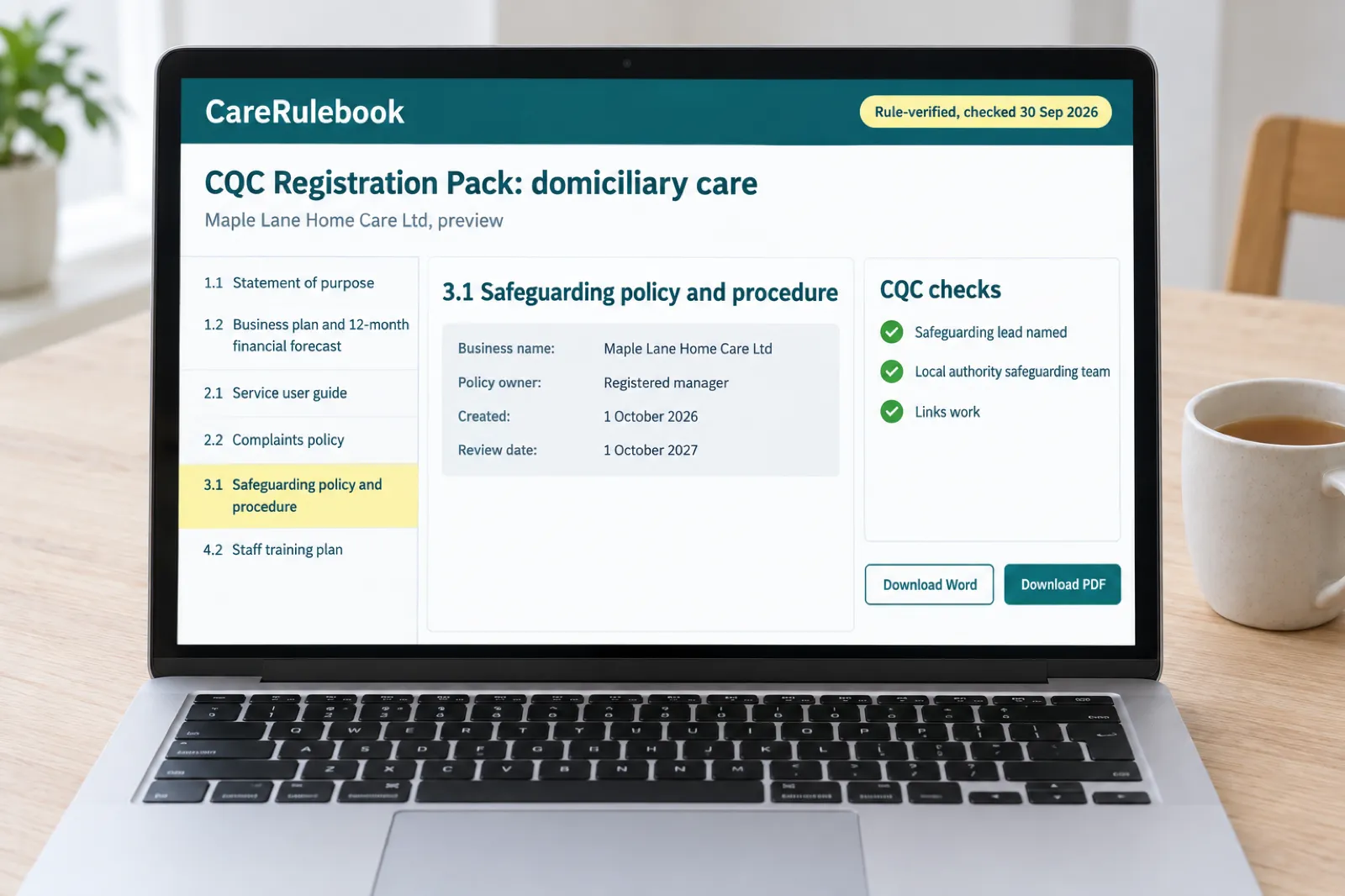
The CareRulebook CQC pack preview on a laptop

CareRulebook

Tailored from the first page

CareRulebook builds your CQC documents from your answers about your agency, area and services, so there is nothing generic to strip out. We check the legislation links the documents print against the live pages.

  • Every document CQC asks for with a homecare application
  • Your business name, the person responsible and dates on every document
  • Your safeguarding lead and local authority safeguarding team, from your answers
  • Editable Word and PDF

Related questions

Will CQC contact you to fix gaps in your application?

No. Not for homecare since 1 July 2025. CQC rejects the application and emails you why. A corrected resubmission counts as a new application and loses its place in the queue.

"You can correct and resend it, but this will count as a new application and will not keep its place in the queue."

Frequently asked questions

What policies does a domiciliary care agency need for CQC registration?

CQC asks a new homecare agency to send eight policies with its application: safeguarding, medicines management, infection prevention and control, complaints, consent, equality, diversity and human rights, recruitment, and governance and quality assurance. It also wants a statement of purpose, service user guide, staff training plan, business plan, insurance evidence and evidence of legal occupancy, plus CQC’s additional form for personal care providers. CQC also lists nine items to keep ready in case it asks, such as a duty of candour policy and a whistleblowing policy.

Are there free domiciliary care policy templates?

CQC publishes statement of purpose templates. For policies, its guidance sets out what each document must contain rather than giving a template. Free and paid templates are both allowed if they suit homecare and are tailored to your business. Whatever you start from, every document needs your business name, the person responsible, created and review dates and working legislation links, and you need to be able to explain it.

Will CQC reject bought policies?

Not because they were bought. CQC’s published examples include an applicant who bought policies online, adapted them, wrote others and could explain them, and was registered. The refused applicant had bought policies but could not say what was in them or how they applied.

What must every CQC document include?

Your business name, the name of the person responsible for the policy, the date it was created and the date it will be reviewed. It must also be complete and relevant, contain no personal information about people using the service or members of the public, have working legislation links, be consistent with your other policies, be accessible to your staff, the people who use your service and their representatives, and be tailored to your business.

Can I use a care home template for a homecare agency?

CQC says no: "a template for residential care will not work for home care applicants."

What happens if a document is not good enough?

For homecare applications since 1 July 2025, CQC rejects applications whose documents are incomplete, inaccurate or not relevant at the point of receipt. A corrected resubmission counts as a new application and loses its place in the queue.

Does CQC provide policy templates?

CQC publishes statement of purpose templates. For policies, it says that if you use a third-party template, it must suit your service type.

Get CQC rule-change alerts

CQC consulted in 2026 on new assessment frameworks for adult social care. Leave your email and we will tell you when a change affects your registration documents.

No spam. Only emails about rule changes that affect homecare in England. How we use your email.

Keep reading

Sources

  1. Registering a homecare agency (personal care) · Care Quality Commission · retrieved 30 September 2026
  2. A better registration process for new homecare applications · Care Quality Commission · retrieved 30 September 2026
  3. Supporting documents for new provider registration applications · Care Quality Commission · retrieved 6 November 2026

Free sample, no email needed

Read a full document before you buy

Document 3.1, Safeguarding policy and procedure, as it prints in the England CQC registration pack, filled in for a fictional agency. The rule text it rests on is quoted word for word under Rule basis.

PDF · 8 pages · 110 KB · Rule-verified 30 September 2026

Collecting answers for a care service or a client? The intake questionnaire lists all 50 questions the builder asks, what each decision changes in the pack, and a completed example: Word · PDF.How consultants use CareRulebook.

Download the sample (PDF)
Or email it to me

We send the link once. Nothing else unless you tick the box. Privacy notice.

Build your CQC registration pack