Training hours
No minimum hours for orientation, task training or later training.
Where are you starting?
Indiana · Caregivers · IC 16-27-4-16
Indiana sets no training hours for personal services agency caregivers. Instead, each worker is evaluated on each attendant care task you will have them do, trained where they need to improve, re-evaluated, and judged competent by your agency before doing that task without direct agency supervision. Here is what the statute says, what IDOH asks your training policy to cover, and where the choices are yours.
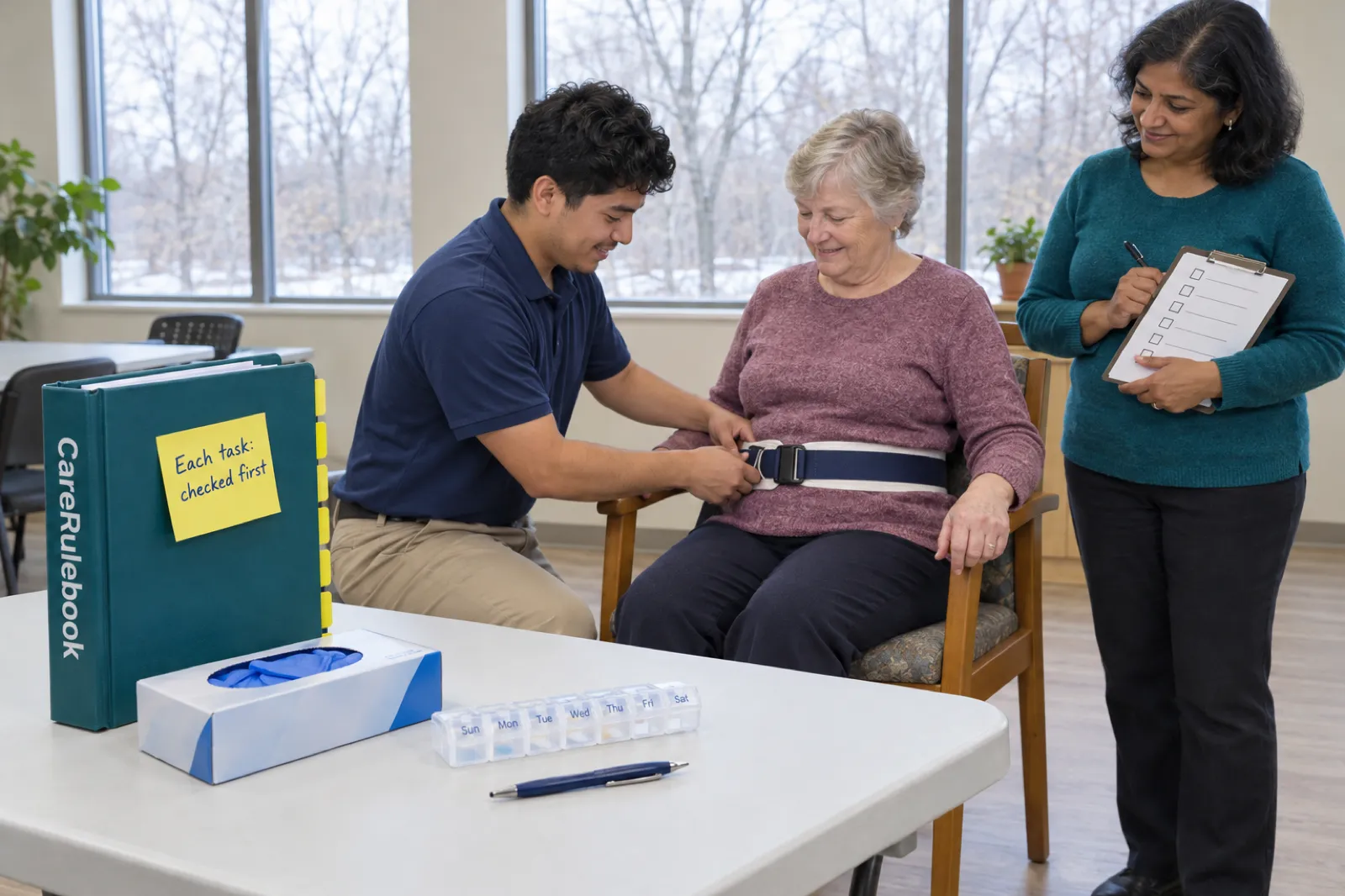
Quick answer
The competency of a worker who will give attendant care "must be evaluated by the agency or the agency’s designee for each attendant care services task" the agency chooses to have them perform, and "The agency has the sole discretion to determine if an employee or agent is competent to perform an attendant care services task." (IC 16-27-4-16(a)). The evaluation and that decision "must occur before the employee or agent performs that task for a client without direct agency supervision" (IC 16-27-4-16(b)).
The statute sets no hours, curriculum or certificate, and no qualifications for the trainer. It does require a record: the content, date and signature of the person evaluating and training, for each worker who performs personal services (IC 16-27-4-16(d)). IDOH’s application asks your training policy to answer seven questions and to come with a written test and a demonstration/observation skills test (State Form 53391, item 7).
The order of the first two steps is ours; the statute ties the check to the worker’s start in clients’ homes and the TB test to direct client contact. Tick steps off as you go; your progress is saved in this browser only.
No more than 3 business days after the worker starts providing services in a client’s home, and no more than 21 calendar days in clients’ homes without the result, unless the delay is the State Police’s, the FBI’s or the vendor’s. Background checks in detail.
Every employee or agent who will have direct client contact completes a TB test the way IDOH requires for home health staff, under 410 IAC 17-12-1(i). The TB steps on the Indiana guide.
The agency or its designee evaluates the worker’s competency for each attendant care task the agency chooses to have them perform.
Train the worker in the tasks the agency believes need improvement, and re-evaluate after any training.
The evaluation and the agency’s decision that the worker is competent must come before the worker performs that task for a client without direct agency supervision.
If you offer lift services: general lift standards, and the client’s own lift at the client’s home, following the manufacturer’s instructions and manual.
The content of each evaluation and training, with the date and the signature of the person who did it, for each worker who performs personal services. IDOH’s 2022 letter asks for the employee’s signature too, and for the record to go in the employee’s file.
The whole training duty sits in one section of four subsections:
The statute does not define "direct agency supervision". CareRulebook’s manual gives it a meaning (the evaluator is with the worker for the whole task and can step in at once); that definition is the manual’s, not the law’s.
Evaluation runs task by task, for the tasks you choose to have each worker perform (IC 16-27-4-16(a)). Indiana’s definition of attendant care includes:
By our reading, a worker cleared for bathing is not cleared for transfers: each task needs its own evaluation before the worker does it alone. By the same reading, a worker may still do a task they have not yet been cleared for under direct agency supervision, since the statute’s limit is on working without it.
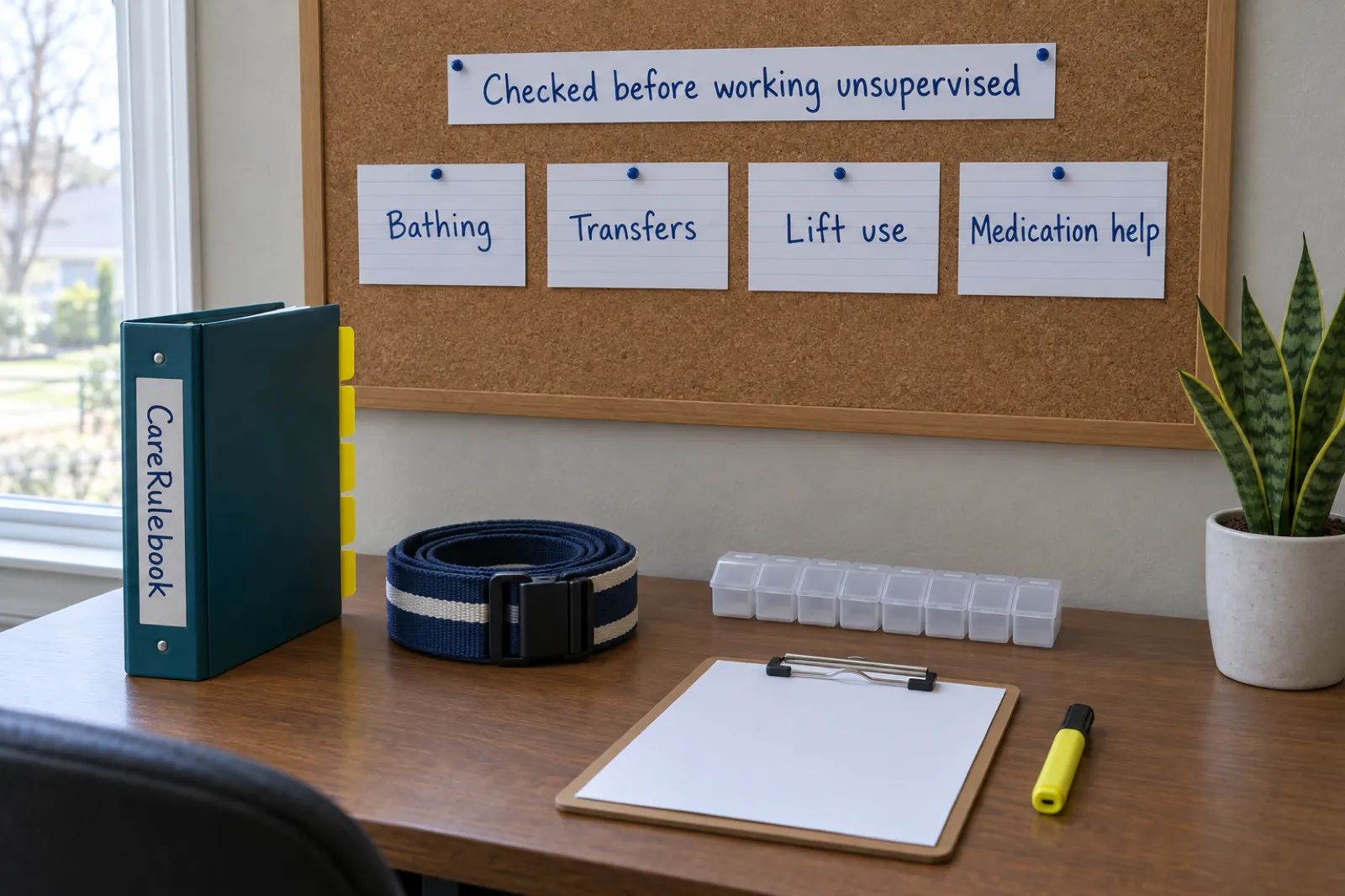
A worker’s competency "must be evaluated by the agency or the agency’s designee for each attendant care services task" (IC 16-27-4-16(a)). The section sets no qualifications for the evaluator or the trainer, and there is no nurse role in IC 16-27-4. The manager may designate people in writing to carry out any of the manager’s responsibilities (IC 16-27-4-9(b)). IC 16-27-4-16 does not say how the agency names its designee; a written designation, like the manager’s under IC 16-27-4-9(b), is the clearest record.
IDOH asks who. Its form asks: "Who will conduct the employee training and ensure the training is documented with signature and date of individual conducting the training and employee receiving the training?" (State Form 53391, item 7.a.vi). Its 2022 letter: "Explain how the employee will be re-evaluated on tasks that deem improvement. Indicate who will conduct the training and to ensure signature and date of the person conducting training and the employee." (IDOH letter (08.2022)).
Our suggestion: pick someone who has done the tasks well themselves and can explain each step, name them in the policy, and designate any second evaluator in writing. The manager and designees →
The statute asks for three things on each record: the content of the evaluation and training, the date, and the signature of the person conducting it, for each employee or agent who performs personal services, including lift services (IC 16-27-4-16(d)).
IDOH adds two: the employee’s signature and date as well as the trainer’s (IDOH letter), and "The training will be documented and placed in the employee's file." (IDOH letter (08.2022)). Records showing you comply with IC 16-27-4 are kept, or electronically accessible, at your Indiana office for at least 7 years (IC 16-27-4-18), and an IDOH surveyor can ask for them (the 24-hour rule).
Item 7 of IDOH’s application form asks the training policy and procedure to answer seven questions (State Form 53391, item 7.a). In our words:
Two tests. The form asks you to "Submit a copy of the written test" and to "Submit a copy of demonstration//observation skills test" (State Form 53391, item 7.b-c). IDOH’s 2022 letter puts it as "Submit a copy of the training (i.e., PSA attendant care written competency test and observation skills test)." (IDOH letter (08.2022)).
The pass mark is yours. The form gives 80% as an example (State Form 53391, item 7.a.iv). IDOH’s 2022 letter uses 85%: "Include how agency will determine competency (i.e., employee must pass written and observation skills test by 85% to determine competency)." (IDOH letter). Neither figure is in the statute, which leaves competency to the agency.
When IDOH looks at it. IDOH’s form says all documentation must be received and approved before it issues a license (State Form 53391). IDOH’s 2024 requirements document lists evaluation and training among the policies that "are not evaluated at the time of initial licensure however the agency is required to have those policies and procedures in place." (IDOH-HCBC/PSA-1, FAQs). We could not see which documents the Gateway asks you to upload, so have the policy and both tests ready either way.
Statute and form, kept apart. The statute does not name a written test, a skills test or a pass mark, and it says the application "may not require any information except as required under this chapter" (IC 16-27-4-6(d)). The tests are IDOH’s request, not the statute’s. Its 2018 form asks for them with the application, while its 2024 requirements document says the training policy is not evaluated at initial licensure but must be in place, so have the policy and both tests ready either way.
If you run a home health agency and want to add personal services, IDOH’s home health page asks for an attendant care job description and an updated training and evaluation policy with a method of determining competency and a passing score, and says the agency may not offer the service until IDOH approves it (IDOH home health program page).
The evaluation duty in IC 16-27-4-16(a)-(c) is written for attendant care tasks. The records rule in (d) covers "the evaluation and training conducted under this section" for each employee or agent "who performs personal services" (IC 16-27-4-16(d)), and personal services include homemaker and companion services (IC 16-27-4-4(a)).
By our reading, the statute does not make you test a homemaker-only or companion-only worker on attendant care tasks, and any evaluation or training you give a homemaker or companion worker is safest documented the same way. IDOH’s letter describes the tests as "PSA attendant care written competency test and observation skills test" (IDOH letter), and our sources do not say whether IDOH expects tests for other workers. CareRulebook’s manual gives every worker the written test and an observed skills checklist; that is the manual’s choice.
Other rules do reach every worker: criminal history checks cover personal services, not only hands-on care (IC 16-27-2-2.2(3)), and the TB test covers every employee or agent with direct client contact (IC 16-27-4-15).
If you offer lift services, you must train each worker who provides them on general standards for operating a lift, and must "train the employee or agent at the location where the client will need those services on the specific instructions on how to safely operate the client's lift in accordance with the manufacturer's instructions and manual" (IC 16-27-4-16(c)). Lift services training is an attendant care task, evaluated like the others, so the worker is judged competent on that client’s lift before using it without direct agency supervision.
CareRulebook’s manual covers lift services in Policy 2.3, with a two-part lift checklist in Policy 1.7.
Indiana’s definition of attendant care includes "the provision of assistance" "through providing reminders or cues to take medication, the opening of preset medication containers, and providing assistance in the handling or ingesting of medications, including controlled substances, prescription drugs, eye drops, herbs, supplements, and over-the-counter medications" (IC 16-18-2-28.5(b)(3)), for a client who cannot do it because of an impairment and who directs the help, or whose help is directed by a competent person who may consent to health care for them (IC 16-18-2-28.5(b)(3)(B)).
IC 16-27-4 sets no separate medication training and no nurse to give it. By our reading, each medication task you offer is an attendant care task like any other, so it is evaluated, trained and judged competent before the worker does it without direct agency supervision. Services that need a health care professional’s order are outside personal services (IC 16-27-4-4(b)), and IDOH’s letter says "A personal services agency is a not medical agency and may not provide medical care. Do not include medical language in policies and procedures." (IDOH letter (08.2022)).
CareRulebook’s manual lets you choose reminders only, or reminders plus hands-on help, and sets out the limits in Policy 2.2, with a matching checklist in Policy 1.7.
None is set: IC 16-27-4, IDOH’s form and its 2022 letter set no yearly, refresher or in-service training or hours for PSA workers.
What the statute does tie to later training: a worker is trained in tasks the agency believes need improvement and re-evaluated after any training (IC 16-27-4-16(b)), and a new task needs its own evaluation before unsupervised work (IC 16-27-4-16(b)). IDOH’s form asks how the agency will re-evaluate and train employees on services that require additional training (State Form 53391, item 7.a.ii).
Our suggestion, and what CareRulebook’s manual does: re-evaluate a worker on a task when a complaint, a satisfaction review or the worker suggests they need it, before they start a task they have not done before, and before they use a client lift they have not been trained on.
We read the whole chapter. For PSA workers it names none of these:
No minimum hours for orientation, task training or later training.
No state curriculum or approved training program. IDOH’s 2022 letter points applicants who need help reading the statute to the Indiana Association for Home & Hospice Care’s PSA 101 class, which is for agencies, not a caregiver requirement.
No CNA, home health aide or other certificate for PSA workers.
Not in IC 16-27-4. Medicaid waiver rules ask waiver providers for current CPR certification (below); our sources set no first aid requirement.
No nurse role anywhere in the chapter; the agency or its designee evaluates.
None set; see later training above.
Sources: IC 16-27-4 as saved (IC 16-27-4-16); the PSA 101 class (IDOH letter, page 2).
Context · Medicaid waiver providers · new enrollment paused
New waiver enrollment is paused. From August 1, 2026, Indiana stopped certifying and enrolling new providers for listed 1915(c) waiver services, including Attendant Care, for an initial six months, and the IHCP may extend it in six-month steps (IHCP Bulletin BT2026124; page 1). Existing waiver agencies cannot add those services or counties (page 2). This section is here so you know what a waiver provider is asked for later.
The waiver rules in 455 IAC 2 apply to waiver providers of HCBS funded through BAIHS, the state’s bureau of aging and in-home services, including the nursing facility level of care waivers (455 IAC 2-2-1). They ask those providers for more than IC 16-27-4 does:
How far these reach a PSA is unclear. 455 IAC 2-2-2 says "the approval of a provider for those services that are licensed and regulated by the Indiana department of health (IDOH) shall be deemed approved for those licensed services" (455 IAC 2-2-2), so how much of 455 IAC 2 binds a PSA’s licensed attendant care is not settled in our sources. FSSA’s Attendant Care service sheet, for its part, says the PSA licensing process evaluates a list of items including education and training (FSSA Attendant Care service definition); that is FSSA’s summary, not the statute’s wording. Waiver Attendant Care is "direct, hands-on care to individuals for the functional needs of activities of daily living (ADL)" (FSSA Attendant Care service definition).
CareRulebook
CareRulebook’s Indiana manual includes Policy 1.7, evaluation and training, with orientation topics, a written competency test and answer key, skills checklists for homemaker, companion and each attendant care task you offer, and a training and evaluation record; Policy 2.3 on lift services; Policy 2.2 on help with medications; Policy 1.4 on TB testing; and Policy 2.4 on criminal history checks.
$199CareRulebook founding price for the first 50 Indiana agencies, then $249. Not an IDOH fee.
No. IC 16-27-4 sets no training hours, curriculum or certificate. A worker who will give attendant care is evaluated on each attendant care task the agency has them do, trained where they need to improve and re-evaluated, and the agency decides they are competent before they do the task without direct agency supervision. The content, date and the signature of the person who evaluated and trained them are documented.
"The agency has the sole discretion to determine if an employee or agent is competent to perform an attendant care services task."
Yes. Within limits. Attendant care includes reminders or cues, opening preset containers and help handling or taking medications, for a client who directs it (or whose care is directed by someone who may consent for them). Services that legally need a health care professional's order are outside personal services, and the agency evaluates each worker's competency for the task first.
"the opening of preset medication containers"
No. The agency must employ a manager responsible for organization and daily operation, but IC 16-27-4 sets no license, degree or experience for the manager and no nurse role. A PSA may not manage medical conditions; nursing needs a home health agency license.
"The manager is responsible for the organization and daily operation of the personal services agency."
IC 16-27-4 sets no hours. Each worker who will give attendant care is evaluated on each attendant care task the agency has them do, trained in any task the agency believes needs improvement, re-evaluated after training, and judged competent by the agency before doing the task for a client without direct agency supervision. The statute says the agency has the sole discretion to decide competency.
IC 16-27-4 does not require a certificate, license or set course for personal services agency workers; we read the whole chapter. What it requires is a documented competency evaluation for each attendant care task. IDOH’s letter says a personal services agency is not a medical agency, and services that need a health care professional’s order are outside personal services.
None is set in the statute: the agency decides competency. IDOH’s application asks the training policy to say how the agency determines competency, giving 80% on the written and demonstration/observation skills tests as its example; IDOH’s 2022 instruction letter uses 85% ("i.e., employee must pass ... by 85%"). Neither figure is in the statute. Choose a mark, write it in the policy, and apply it to every worker.
The agency or the agency’s designee evaluates each worker’s competency. IC 16-27-4-16 sets no qualifications for the evaluator or trainer, and no nurse is required. IDOH’s form asks the policy to say who will conduct the training, and its letter asks for the trainer’s and the employee’s signatures and dates.
The statute’s evaluation duty in IC 16-27-4-16(a)-(c) is written for attendant care tasks. Its documentation rule in -16(d) covers the evaluation and training conducted under that section, for each employee who performs personal services. By our reading, any training you give homemaker or companion workers should be documented the same way. IDOH has not said, in our sources, whether it expects the written and skills tests for homemaker or companion workers. CareRulebook’s manual gives the written test and a skills checklist to every worker; that is the manual’s choice.
None is set: IC 16-27-4, IDOH’s form and its 2022 letter set no yearly, refresher or in-service training or hours. The statute ties retraining to the tasks the agency believes need improvement, followed by re-evaluation, and IDOH’s form asks how the agency will re-evaluate and train employees on services that require additional training. Medicaid waiver rules are different: they ask waiver providers for yearly job performance evaluations.
IC 16-27-4 does not say how training is delivered. IDOH’s application asks how the agency will observe employees demonstrating their skills before they provide services to clients, and training on each client’s own lift must take place at the location where the client will need lift services. By our reading, a course alone does not meet the duty: each attendant care task still needs an evaluation, and lifts need the in-home training.
Waiver rules (455 IAC 2, which cover HCBS funded through the state’s bureau of aging and in-home services) ask more of those waiver providers: direct care staff at least 18 and competent to provide services under the individual’s plan of care, a current CPR certification, training records showing content, length, trainers and dated signatures, and yearly job performance evaluations. How much of 455 IAC 2 applies to services IDOH licenses is unclear. Since August 1, 2026, Indiana has paused certifying and enrolling new providers of listed waiver services, including Attendant Care (IHCP Bulletin BT2026124).
Leave your email and we will tell you when an Indiana change affects caregiver training, competency or your policies.
No spam. Only emails about Indiana home care rule changes. How we use your email.
Indiana
How to start a home care agency in Indiana
The IDOH PSA license, the Gateway application and the nine policies and seven forms.
Indiana
Indiana caregiver background checks
The 3-day and 21-day rules, the current offense list and owner and manager reports.
Indiana
The Indiana PSA manager
The manager, written designees, and who evaluates and trains workers.
Indiana
Indiana home care policies and procedures
The training policy is item 7 of the nine IDOH asks for.
Indiana
Indiana PSA inspections
What an IDOH surveyor may check, complaints and the 24-hour document rule.
Manual
Build your Indiana policy manual
Including Policy 1.7 with both tests and the skills checklists.
Tennessee
Tennessee caregiver training
Competency in seven areas before work, then training every year.
Colorado
Colorado caregiver training
Training topics, competency checks and supervision for Class B caregivers.