Skip to content
CareRulebook
MenuClose

Where are you starting?

United StatesTexas, North Carolina, Georgia, Virginia, Indiana, Ohio, Illinois, Washington, Colorado, Tennessee, Maryland, Kansas, South Carolina
TexasManual
North CarolinaManual
GeorgiaManual
VirginiaManual
IndianaManual
OhioGuide
IllinoisManual
WashingtonManual
ColoradoManual
TennesseeManual
MarylandManual
KansasManual
South CarolinaGuideAll US states →
United KingdomEngland
Free toolsChecklists, calculators and templates

South Carolina · In-Home Care Provider license · R.60-122

How to start a home care agency in South Carolina (in-home care provider license, 2026 rule)

To start a non-medical home care agency in South Carolina, you need an In-Home Care Provider license from the Department of Public Health (DPH), which took over from DHEC in 2024. On May 22, 2026 a rewritten rule, R.60-122, came into force for every provider, new or already licensed: written policies for each section of the rule, a primary office in a commercially zoned or unzoned area, service agreements, care services plans, signed rights forms and incident reports to DPH within 24 hours or the next business day.

  • Rule-verified October 2, 2026
  • Quoted from R.60-122 and S.C. Code 44-70
  • 24 official sources
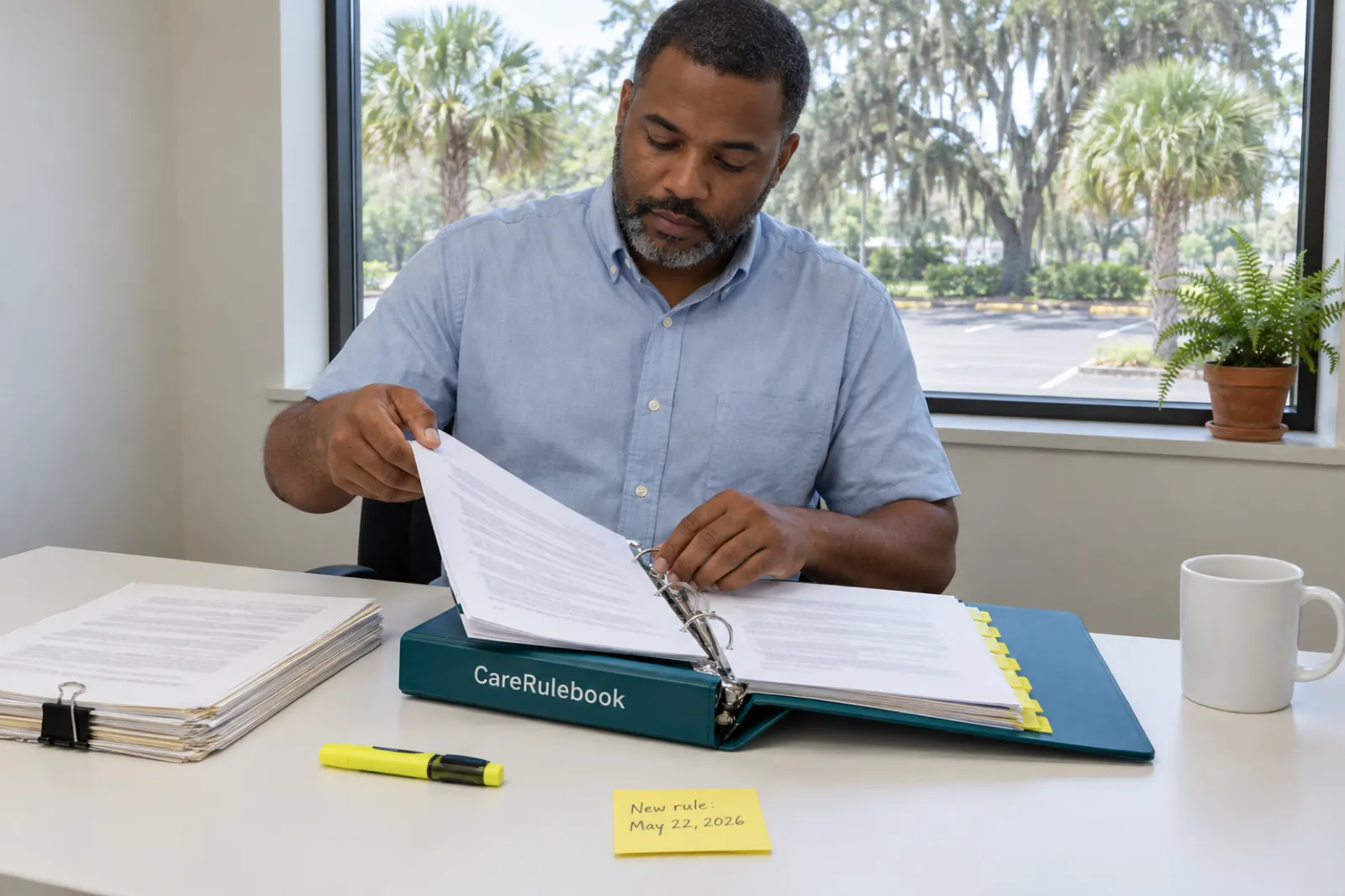
A man in a light blue shirt sits at a white desk clicking printed pages into an open teal CareRulebook binder with yellow tabs, beside a clipped stack of older pages, a yellow highlighter and a sticky note reading New rule: May 22, 2026, with palmetto trees and a moss-draped oak outside the window

Quick answer

In South Carolina, "no person, private or public organization, political subdivision, or governmental agency shall establish, operate, maintain, or represent itself (advertise and/or market) as an in-home care provider in South Carolina without first obtaining a license from the Department." (R.60-122 §103.A). The Department is the South Carolina Department of Public Health (DPH), and the license is the In-Home Care Provider license (R.60-122 §102.G). The rule was numbered 61-122 until May 23, 2025 (Document No. 5352), and DPH replaced it in its entirety from May 22, 2026 (Document No. 5407).

The new rule makes a policy manual compulsory: "Written policies and procedures addressing each section of this regulation regarding client care and operation of the provider shall be developed." Policies are reviewed at least every two years, with the administrator signing each review, and the section is marked as a Class II standard (R.60-122 §301). DPH’s application asks to see one of them: "A copy of your Random Drug Testing Policy", with initial and renewal applications (Form 1307-ENG-DPH).

The care is non-medical: "Care services provided by caregivers are strictly limited to non-medical tasks." (R.60-122 §700.B). No nurse is required. Already licensed? "This regulation will apply to all in-home care providers in South Carolina." (R.60-122 §101), and the 2026 text has no transition period (your to-do list).

$1,000

DPH’s fee for a first license (a state fee); renewal is $800 a year

R.60-122 §103.I

1,402

In-home care provider licenses in DPH’s facility data, 1,307 of them unexpired (our count, Oct 2, 2026)

DPH Find a Facility

24 hours

To report a fracture, hospital admission, death or suspected abuse by a caregiver to DPH (or by the next business day)

R.60-122 §501.B

2 years

The longest your policies may go between documented reviews signed by the administrator

R.60-122 §301.B

Direct answers

Who licenses non-medical home care in South Carolina?

The South Carolina Department of Public Health (DPH), through its Bureau of Health Facilities Licensing (IHCP@dph.sc.gov). DHEC licensed in-home care providers until 2023 Act No. 60 abolished it on July 1, 2024. The statute still says DHEC, but Act 60 says old references are read as references to the new agency, and DPH says licenses DHEC issued stayed valid.

2023 Act No. 60, Sections 1(3), 14(C); R.60-122 §102.G; DPH, DHEC Restructuring

How much is a South Carolina in-home care license?

DPH charges $1,000 for the first license and $800 a year to renew. A late renewal adds $200, an amended license is $50 and reinstating a suspended license is $400. These are DPH’s fees, not CareRulebook prices.

R.60-122 §103.I-L

Does the 2026 rule apply to agencies licensed before May 22, 2026?

Yes. The rule says it applies to all in-home care providers in South Carolina, and the rewrite has no transition period or grandfathering clause. Existing agencies took on the new duties on May 22, 2026: written policies for each section, service agreements, care services plans, signed rights forms, a disaster plan and incident reports within 24 hours or the next business day. The primary office must be in a commercially zoned or unzoned area; the zoning permit duty names the applicant, so by our reading existing licensees should hold one too (renewal is an application). Ask DPH.

R.60-122 §101; Document No. 5407

Does South Carolina require a policy and procedure manual?

Yes, since May 22, 2026. Written policies and procedures must address each section of R.60-122 on client care and operations, be followed, be available to staff at all times and be reviewed at least every two years, with the administrator signing each review. DPH’s application form asks only for the random drug testing policy.

R.60-122 §301; Form 1307-ENG-DPH

In force since May 22, 2026 · Document No. 5407 · errata June 26, 2026

What changed on May 22, 2026

DPH published the proposed rewrite in the State Register on September 26, 2025. It took effect on May 22, 2026, after the General Assembly’s 110-day review period expired on May 3, 2026, and its instruction was: "Replace R.60-122 in its entirety with this amendment." (R.60-122, Document No. 5407 history). DPH corrected one cross-reference in June: "The plan shall be revised whenever there are changes listed in Section 601.B.3.a through d." (State Register 50/6, errata). In its statement of need, DPH wrote that it "anticipates a cost to the regulated community associated with implementing client-focused safeguards and protections" (State Register 49/9).

The rule it replaced was the 2014 text, short and without a general policy duty, client record, rights, infection control or disaster sections (Code of Regulations, Chapter 60, pre-2026 text). Each change below quotes the new rule and, where there was one, the old rule it replaced.

R.60-122 §301 (new)

Written policies for every section

New general duty: written policies and procedures for each section of the rule, followed and accessible to staff, reviewed at least every two years and signed by the administrator. The only written policy the old rule required in its text was the random drug testing policy (its TB appendix also asked whether the provider had a written TB procedure).

The rule now
"Written policies and procedures addressing each section of this regulation regarding client care and operation of the provider shall be developed."
The old rule
"The provider’s policies and procedures must address random drug testing and describe the procedure chosen."

R.60-122 §103.D (new)

Primary office zoning

The primary office must be in a commercially zoned or unzoned area with a zoning permit or local letter. The old rule had no zoning requirement; it tied the license to a specific location and required the provider to be accessible in person, by phone or by page from 9 a.m. to 5 p.m., Monday to Friday, except state holidays.

The rule now
"The primary office must be in an office that is in a commercially zoned or unzoned area."
The old rule
"The in-home care provider shall ensure that it is accessible in person, by phone, or page during the hours of 9:00 A.M. to 5:00 P.M., Monday through Friday"

R.60-122 §601 (new)

Client records, service agreement and care services plan

New: an organized client record, visit documentation updated weekly, a signed service agreement (fees, refunds, termination; not for Medicaid clients) and a care services plan within seven business days. The old rule had no client record section.

The rule now
"The care services plan shall be completed by the provider within seven business days after care services are initially provided."

R.60-122 §900 (new)

Client rights and assurances

Five rights and assurances given in writing and signed before care starts.

The rule now
"The provider shall inform clients in writing of the rights and assurances in Section 900.A prior to the provider’s provision of in-home care."

R.60-122 §501

Incident reporting

Every incident documented and reviewed; listed incidents reported to the responsible party and DPH within 24 hours or the next business day via DPH’s electronic system, then a written investigation report within 5 calendar days. Before: phone the next of kin immediately and write to DHEC within 3 days.

The rule now
"The provider shall document every incident, and include an incident review, investigation, and evaluation as well as a corrective action taken, if any."
The old rule
"shall be notified in writing within three (3) days of the occurrence of a serious incident"

R.60-122 §1001-1002 (new)

Disaster plan and emergency numbers

A disaster plan given to every client, documented notifications when care cannot be given, and emergency numbers available to caregivers.

The rule now
"The provider shall provide its disaster plan to the client and/or responsible party."

R.60-122 §406

Health self-assessment replaces health assessment and TB screening

Staff complete a communicable disease self-assessment reviewed by a nurse, administrator or HR, and the provider adopts a communicable disease exclusion policy. The old health assessment within 12 months with TB screening and the annual TB risk assessment are gone.

The rule now
"All staff members and caregivers who have contact with clients shall complete a self-assessment prior to initial client contact."
The old rule
"shall have a health assessment within twelve (12) months prior to initial client contact"

R.60-122 §404

Training timing and topics

Training is now required before client contact and at least annually. Abuse prevention became its own topic; medication assistance training was removed.

The rule now
"prior to client contact and at least annually thereafter unless otherwise specified by certificate"
The old rule
"Medication assistance, if applicable;"

R.60-122 §700, §800 (new)

Non-medical task list; infection control

A list of 13 permitted non-medical tasks (medication reminders only; shopping with receipts) and an infection control standard.

The rule now
"Care services provided by caregivers are strictly limited to non-medical tasks."
8 more changes: drug test records, disqualifying offenses, owner checks, change of owner, late fees, inspections, penalties and reopening
  • Drug testing records (R.60-122 §402). Pre-employment tests within 30 days of the offer, reviewed by a nurse, administrator or HR, with detailed documentation for in-house kits; the same records for random tests.
  • Caregiver disqualifiers and registries (R.60-122 §405.F-G). Names the Sex Offender Registry and the Nurse Aide Registry (the old rule said only to coordinate with appropriate abuse-related registries) and adds any violent crime as a bar. The old bar for crimes related to theft, abuse, neglect or exploitation of a child or a vulnerable adult had no time limit; the new rule bars forgery, larceny, embezzlement and false pretenses offenses for ten years, and abuse, neglect or exploitation of a vulnerable adult with no time limit. Drug offenses stay barred for ten years. Child abuse convictions are no longer listed for caregivers (they still bar the people who sign the application, 103.G). Old rule: "crimes related to theft, abuse, neglect, or exploitation of a child or a vulnerable adult".
  • Owner checks (R.60-122 §103.G-H). Application signers need a SLED name-based check no older than 90 days and a 5-panel drug screen within 30 days of DPH’s receipt of the application, with listed disqualifying offenses and set documentation. Before: the initial or renewal application included criminal record checks and drug test results for the prospective licensee, with no time windows or listed offenses. Old rule: "Criminal record checks and drug test results for the prospective licensee; and".
  • Change of owner or legal entity (R.60-122 §103.M). A change in controlling interest or of the legal entity now needs a new license, applied for before the change. Before: a change of ownership needed an amended license. Old rule: "Change of ownership; and/or".
  • Late fee (R.60-122 §103.J). The late fee is now a fixed $200 that applies from the expiration date, and a provider not renewed within 30 days of expiry is unlicensed. Before: a late fee of up to 25% of the license fee ($200 on the $800 renewal) that applied only after 30 days. Old rule: "may result in a late fee of twenty-five (25) percent of the licensing fee amount".
  • Violation classes and penalty schedule (R.60-122 §205 (new)). New Class I, II and III violation classes and a penalty schedule by class and frequency. The $100 to $5,000 range per violation is unchanged; the old rule’s line treating each day a violation continues as a subsequent offense was dropped. Old rule: "Each day a violation continues will be considered a subsequent offense.".
  • Inspections and plans of correction (R.60-122 §202 (new)). Unannounced inspections, access to records, and signed plans of correction.
  • Reopening after a long closure (R.60-122 §502.A). After more than a year closed, DPH decides whether to inspect before reopening. Before: the provider had to reapply as a new provider. Old rule: "the provider shall re-apply to the Department for licensure".

What was dropped. The staff health assessment with tuberculosis screening and the annual TB risk assessment (replaced by a self-assessment), medication assistance as a training topic, the rule that the provider be accessible in person, by phone or by page from 9 a.m. to 5 p.m., Monday to Friday (except state holidays), and the rule that a provider closed for more than a year reapplies as new. The late fee is now a fixed $200 that applies from the expiration date (it was up to 25% of the license fee, $200 on the $800 renewal, and only after 30 days), and 30 days late leaves you unlicensed (pre-2026 R.60-122; R.60-122).

Nothing else is pending, as far as we found. We searched every State Register issue from Volume 48, Issue 8 (August 2024) to Volume 50, Issue 9 (September 2026), and found no proposal to amend R.60-122 after the rewrite. This is our own search, not a DPH statement.

Already licensed: your to-do list →All rule changes we track →

Already licensed? Your to-do list for the 2026 rule

DPH’s data lists 1,402 in-home care provider licenses, 1,307 of them unexpired on October 2, 2026 (DPH Find a Facility, our count). Every one of those 1,307 current licensees, whenever it was first licensed, has been under the rewritten rule since May 22, 2026. We found no DPH guidance on how it will apply the new duties to agencies licensed earlier: DPH’s in-home care page was last updated on November 10, 2025 and still links the old TB Risk Assessment form (DPH, In-Home Care Providers), and DPH’s monthly enforcement reports from January 2025 to July 2026 show two orders against in-home care providers, both $300 consent orders for late renewals, none citing the new rule (DPH enforcement actions). DPH inspects without notice, so it is worth working through the list now.

Check your agency against this list. Each item is a duty the old rule did not have, or did not have in this form.

  1. 01

    Written policies for each section of R.60-122

    Followed, available to staff in print or electronically at all times, with a review period of no more than two years and each review documented and signed by the administrator. Marked Class II.

    R.60-122 §301
  2. 02

    A primary office in a commercially zoned or unzoned area

    The rule requires every applicant or licensee to keep an in-state primary office in such an area. The zoning permit (or, in an unzoned area, the local letter) is a duty of "the applicant"; by our reading existing licensees should hold one too, since renewal is an application. Ask DPH. Register any other office with DPH before you use it.

    R.60-122 §103.D
  3. 03

    A signed service agreement for every client not served under a Medicaid program

    Services, fees and advance notice of fee changes, your refund policy and termination terms, signed by both sides before care. Not required for clients receiving care under a Medicaid program.

    R.60-122 §601.B.2
  4. 04

    A care services plan for every client

    Types of service, expected times and frequency, expected duration, goals and objectives, within seven business days of starting care and revised when any of these change.

    R.60-122 §601.B.3
  5. 05

    Visit notes for every visit

    What was done, significant changes in the client’s condition, the caregiver’s name and signature and the date, kept or updated weekly.

    R.60-122 §601.B.1
  6. 06

    Signed rights and assurances

    The five rights in writing before care starts, signed and dated by the agency and the client or responsible party.

    R.60-122 §900
  7. 07

    A disaster plan given to every client

    Which services, if any, you will give in a disaster and how you will tell clients if staff cannot come; document each notification or attempt.

    R.60-122 §1001
  8. 08

    The new incident process

    Document and review every incident; report the listed ones to the responsible party and to DPH within 24 hours or the next business day; file a written investigation report within five calendar days.

    R.60-122 §501
  9. 09

    Health self-assessments and a communicable disease policy

    For staff with client contact, reviewed and signed before client contact, plus a policy on reporting illness and excluding or restricting sick caregivers. No TB test or TB risk assessment is required any more.

    R.60-122 §406
  10. 10

    Training on eight topics, every year

    Including prevention of abuse, neglect and exploitation as its own topic, before client contact and at least annually, signed by trainer and trainee.

    R.60-122 §404
  11. 11

    Registry checks and the new disqualifying offenses

    No adverse findings on the Sex Offender Registry or Nurse Aide Registry, and no convictions in the listed categories, both Class I. Caregivers prove they are 18 with government ID or other valid documentation.

    R.60-122 §405.E-G
  12. 12

    Drug test records in the new detail

    Lab results, or for office kits the five listed items for every pre-employment and random test, reviewed by a nurse, the administrator or human resources or hiring staff.

    R.60-122 §402.B-C
  13. 13

    Infection control practices and emergency numbers

    Staff practices that prevent the spread of disease (Class I), and fire, police, ambulance, poison control and staff numbers available to every caregiver.

    R.60-122 §800, §1002
  14. 14

    Renewal on time

    A $200 late fee if the renewal or fee is not in by the expiration date, and unlicensed if it is not in within 30 days of it.

    R.60-122 §103.J

What the rule does not settle for existing agencies

  • Home offices. The zoning rule has no exception for agencies licensed before May 22, 2026. By our reading, an agency run from a home in a residential zone no longer meets it. You can ask DPH for a variance, which it considers case by case (R.60-122 §103.N); ask DPH before relying on one.
  • Clients who started before May 22, 2026. The rule ties the service agreement and rights form to the start of care. By our reading, the safe course is to put a signed service agreement in place now for every client not served under a Medicaid program, and a care services plan, the rights form and your disaster plan for every current client, and date them.
  • Current staff. The self-assessment is due before initial client contact. By our reading, having each current caregiver complete one now gives you the staff record §403 asks for (R.60-122 §403).

Interactive check

Which South Carolina license do you need?

What will your business do?

Pick the option closest to your plan.

How to start a South Carolina home care agency, step by step

Tick steps off as you go. Your progress is saved in this browser only.

  1. Check that in-home care is the right license

    Before applying

    In-home care is non-medical: help with daily living and personal needs, never skilled care. Skilled nursing needs a home health agency license and a Certificate of Need. Home care, home health or Medicaid?

  2. Form the business and pick a name

    Before applying

    DPH’s form asks for Secretary of State documents if they apply, a list of officers and everyone owning 5% or more. The name may not match or resemble another South Carolina licensee’s, and a franchise location adds its geographic area.

  3. Lease a primary office in a commercial or unzoned area

    Before applying

    Get a county or municipal zoning permit to operate the provider there, or, in an unzoned area, a letter from the county or municipality. All records are kept at the primary office. The primary office and zoning.

  4. Buy insurance

    Before applying

    Liability insurance or a surety bond of at least $100,000 per occurrence and $300,000 aggregate, indemnity coverage for clients’ injuries and losses, and workers’ compensation.

  5. Signers: SLED check and drug test

    Within 90 and 30 days of filing

    Everyone who signs the application gets a SLED name-based criminal records check (no older than 90 days when DPH receives it) and a 5-panel drug screen taken no earlier than 30 days before DPH receives the application, reviewed by someone unrelated to them.

    R.60-122 §103.G-H
  6. Write your policies, starting with random drug testing

    Before applying

    Written policies for each section of R.60-122. DPH’s form asks for a copy of the random drug testing policy with the application, so write that one to stand alone. Written policies for every section.

  7. Email the application and pay DPH’s fee

    Day 0

    Form 1307-ENG-DPH, signed under oath and notarized, with the attachments, to IHCP@dph.sc.gov (DPH’s preferred method) or by mail. Include proof of payment of DPH’s $1,000 fee.

  8. DPH decides on substantial compliance

    After you apply

    DPH will not issue a first license until you show substantial compliance with the standards. The rule lets DPH inspect a proposed provider, but it does not say whether every applicant gets a visit, and DPH publishes no processing time. How DPH licenses you.

  9. Screen every caregiver before client contact

    Every hire

    Criminal record check, Sex Offender and Nurse Aide Registry checks, a negative 5-panel drug test taken within 30 days before the job offer, a signed health self-assessment and training on eight topics. Checks, drug tests and health.

  10. Paperwork for every client

    Every client

    Before care starts: a signed service agreement (not needed for Medicaid clients) and the signed rights and assurances form. Within seven business days: the care services plan. Every visit documented, updated weekly. Give each client your disaster plan. Client records and rights.

  11. After licensing: post, renew and stay inspection-ready

    Ongoing

    Post the license or keep it readily available, renew before it expires ($800; a $200 late fee after expiry; unlicensed 30 days after), review policies at least every two years, and expect unannounced inspections.

Who needs a South Carolina in-home care provider license

The duty is in the statute: "An in-home care provider must apply for and obtain a license issued by the department that is effective for a specified time period following the date of issue as determined by the department." (S.C. Code 44-70-30). An in-home care provider is a business, for profit or not, that for compensation provides or arranges in-home care through its own employees or agents, through independent contractors, or "through referral of other persons to render in-home care services when the individual making the referral has a financial interest in the delivery of those services" (S.C. Code 44-70-20(3)). Registries and referral businesses are covered when the person referring has a financial interest in the delivery of the services. The license is needed to advertise or market as well as to operate (R.60-122 §103.A).

In-home care means care "primarily intended to assist an individual with an activity of daily living or in meeting a personal rather than a medical need, but not including skilled care or specific therapy for an illness or injury", such as help with walking, getting in and out of bed, bathing, dressing, feeding, using the toilet, preparing special diets and supervising self-administered medication (S.C. Code 44-70-20(2)). Private pay agencies need the license; nothing in the statute limits it to Medicaid work.

Homemaker and companion-only work: not settled

The only service-based exemption is "an individual or agency who provides only a house cleaning service" (S.C. Code 44-70-20(3)(b)). DPH’s rule lists cleaning, laundry, shopping, errands, transportation and help with communication among the care services a licensed provider gives (R.60-122 §700.B). Against that, the statute and the rule define in-home care with three parts joined by "and": care primarily to help with an activity of daily living or a personal need, given to help with an activity of daily living, and personal in nature (S.C. Code 44-70-20(2); R.60-122 §102.J). A service with no help with daily living may not be in-home care at all. Our reading: a business offering meals, laundry, errands, rides or companionship is not exempt and probably needs the license, but the definition leaves room to argue otherwise. DPH has not answered this in writing that we could find; ask DPH (IHCP@dph.sc.gov) before you operate without one.

Who is outside the Act

  • House cleaning only

    An individual or agency that provides only a house cleaning service.

    S.C. Code 44-70-20(3)(b)
  • People hired directly by the family

    An individual hired directly by the person receiving care or by their family.

    S.C. Code 44-70-20(3)(d)
  • Other providers and programs

    Home health agencies, hospices and facilities licensed under S.C. Code 44-7-260; residential programs run or contracted by the Office of Mental Health or the Office of Intellectual and Developmental Disabilities (44-7-2910(B)(1)(e)); a direct caregiver employed by or under contract with a direct care entity (44-7-2910(B)(2)(e)); and individuals providing services defined in 44-21-60. In-home care agencies are themselves direct care entities (44-7-2910(B)(1)(h)), so this does not exempt them.

    S.C. Code 44-70-20(3)(a), (c)
  • Churches giving care free

    A 501(c)(3) church or other religious institution giving care without compensation or for a nominal fee to cover incidental expenses.

    S.C. Code 44-70-20(3)(e)

Before the license. If DPH finds services being provided without a license, the owner must stop at once and make sure clients are safe, and past violations may count against any later license (R.60-122 §103.A, a Class I standard).

In-home care, home health, private duty nursing or Medicaid?

DPH issues one non-medical license, with no tiers inside it. The neighboring routes are different licenses or programs.

In-home care provider (this guide)Home health agencyMedicaid personal care
CoversNon-medical help with daily living and personal needs (44-70-20(2))Part-time or intermittent skilled nursing ordered by a physician or other authorized provider, plus at least one other service (44-69-20(5))Personal care paid by Medicaid through an SCDHHS contract (SCDHHS)
LicenseDPH In-Home Care Provider licenseDPH home health agency license, after a Certificate of Need (44-69-75(A))The DPH In-Home Care Provider license first: "Providers who are not licensed by the South Carolina Department of Public Health (SCDPH) will not be allowed to enroll as a Medicaid provider for these services." (Scope of Services, B.2)
NurseNone required (R.60-122)Services under a registered nurse (44-69-20)RN or LPN supervision, which may be contracted (Scope of Services, D.1)
OfficeCommercially zoned or unzoned (§103.D.1)Outside this guideCommercially zoned or unzoned (Scope of Services, B.3)

Private duty nursing. DHEC’s 2015 memo, still linked on DPH’s in-home care page, says the Department does not regulate private duty nursing and that an in-home care provider offering it "should maintain separate lines of business between its in-home care offerings and private duty nursing offerings" (DHEC memo, Aug 13, 2015). The 2026 rule turns that into a duty for any other service: "If the provider provides services or care other than in-home care services, the provider must maintain separate lines of business regarding such other services or care.", with separate marketing, caregiver records and client records (R.60-122 §103.C.6).

Medicaid adds more. SCDHHS says the owner or administrator of a Medicaid personal care agency "must have at least three (3) years of administrative experience in the health care field" (Scope of Services, B.1). Under R.60-122, Medicaid clients need no service agreement (§601.B.2). This guide and our manual cover the DPH license, not SCDHHS enrollment.

Non-medical only: what caregivers may do

"Care services provided by caregivers are strictly limited to non-medical tasks." The rule then says care services may include the following 13 (R.60-122 §700.B):

  1. 1Meal planning, preparation and limited help with eating
  2. 2Bathing, grooming and personal hygiene, including toileting
  3. 3Dressing
  4. 4Helping clients in and out of bed, chairs or vehicles, and repositioning them
  5. 5Help with walking, including walkers, rollators, canes and crutches
  6. 6Cleaning the client’s home
  7. 7Laundry
  8. 8Shopping for the client, with receipts and a written account of the client’s money
  9. 9Running errands
  10. 10Transportation to appointments, shopping and similar trips
  11. 11Addressing safety hazards found in the client’s home
  12. 12Help with communication
  13. 13Medication reminders

Care must be given "rendered effectively and safely in accordance with provider policies and procedures.", and you provide at least the services in the service agreement or care services plan (R.60-122 §700.A). The section as a whole is marked Class I.

Medication

The only medication service the rule lists is "Medication reminders." (R.60-122 §700.B.13). The definitions of in-home care, in the statute and in the rule, include "supervising self-administered medications" (R.60-122 §102.J; S.C. Code 44-70-20(2)(b)). Neither says what a caregiver may physically do. Our reading: caregivers remind and observe; they do not hand out doses, fill pill organizers or administer medication, which would move toward skilled care. Ask DPH where it draws the line before you allow more.

Skilled care is out

Skilled care is a service ordered by a physician or other authorized healthcare provider, furnished by or under licensed personnel, that "Requires the skills of technical or professional personnel such as registered nurses, licensed practical nurses, physical therapists, occupational therapists, and speech pathologists or audiologists" (R.60-122 §102.V). In-home care excludes it.

No nurse required

R.60-122 requires an administrator, not a nurse. A nurse appears only as one of the people who may review drug tests and health self-assessments: "Test results shall be received and reviewed by a nurse, the administrator, or human resources/hiring personnel." (R.60-122 §402.B). The rule sets no supervision schedule; caregivers must be able to follow the care services plan "with minimal supervision, if applicable" (R.60-122 §405.C).

Written policies for every section of R.60-122

Section 301 is new and short:

  • "Written policies and procedures addressing each section of this regulation regarding client care and operation of the provider shall be developed."
  • "The provider shall be in compliance with these policies and procedures."
  • "These policies and procedures shall be accessible to provider staff, in print or electronically, at all times."
  • "The provider shall establish a time period for review, not to exceed two (2) years, of all policies and procedures, and such reviews shall be documented and signed by the administrator." (R.60-122 §301.A-B)

Keep a copy of the rule itself where caregivers can reach it (R.60-122 §103.B). Our reading of "each section": one policy for every numbered section that sets a duty on client care or operations, from 103 to 1002, with a table showing which policy answers which section. DPH has not published a checklist.

SectionTitleWhat your policies need to address (our summary)Marked
§101-102Purpose, scope and definitionsApplies to all providers. Defines abuse, exploitation, neglect, incident, caregiver, primary office, skilled care and more.No duties
§103Requirements for licensureLicense before operating or advertising; posting; separate lines of business; primary office and multiple locations; name; application; signers’ checks and drug tests; fees; renewal; amendments; change of licensee; variances.103.A is (I)
§201-205EnforcementUnannounced inspections and investigations, access to records, plans of correction signed by the administrator, consultations, violation classes and penalties.202 is (I); 202.C is (II)
§301Policies and proceduresWritten policies for each section, followed, available to staff at all times, reviewed at least every two years and signed by the administrator.(II)
§302InsuranceLiability insurance or surety bond, indemnity coverage, workers’ compensation.(II)
§401AdministratorOne administrator responsible for overall management and operation.(II)
§402Background checks and drug testingCriminal background check before employment; pre-employment and random drug screens; what to record for in-house tests; the random testing policy.402.B is (I)
§403Staff recordsAddress, phone, training, all drug test results, background checks and self-assessments for every staff member.Unmarked (Class III)
§404TrainingEight topics before client contact and at least annually, with signed and dated records.(I)
§405Caregiver minimum qualificationsLiteracy, capability, drivers, age 18 with ID, registry checks and disqualifying offenses.(II); 405.F-G are (I)
§406Health statusSelf-assessment before client contact and a policy on reporting and excluding staff with communicable diseases.(I)
§501IncidentsDocument and review every incident; 24-hour reports; 5-day investigation reports; abuse allegations to APS or CPS.Unmarked (Class III)
§502Provider closureWritten notice to DPH, records and client transfer arrangements, 10 business days’ notice to clients.Unmarked (Class III)
§601Client record contentAn organized record per client, visit documentation, the service agreement and the care services plan.(II)
§602Record maintenanceStorage, completing records within 30 days of discharge, keeping them five years.Unmarked (Class III)
§700Client care servicesCare given safely under your policies; the non-medical limit and the 13 services listed; continuity if you close.(I)
§800Infection controlStaff practices that prevent the spread of disease, including screening and standard and transmission-based precautions.(I)
§900Rights and assurancesFive rights, given in writing and signed before care starts.(I)
§1001Disaster preparednessA disaster plan, documented notifications and a copy for every client.(II)
§1002Emergency call numbersFire, police, ambulance, poison control and staff contacts available to caregivers.Unmarked (Class III)

"Marked" is the rule’s own notation: standards marked (I) or (II) are Class I or II violations if not met, and unmarked standards are Class III (R.60-122 §205.D).

The policies the rule names

  • Random drug testing: "The provider’s policies and procedures must address random drug testing and describe the procedure chosen." (R.60-122 §402.C). It goes to DPH with the application (§103.F.5).
  • Communicable disease: caregivers report illness to the administrator, and the policies include "provisions for excluding and/or restricting caregivers with communicable diseases or symptoms of such diseases." (R.60-122 §406.C).
  • Care services given "in accordance with provider policies and procedures" (§700.A), and a disaster plan (§1001).
  • Forms the rule makes necessary: the service agreement, care services plan, visit record, rights and assurances acknowledgment, incident and investigation reports, drug test records, training records, self-assessment and plan of correction.

Where the rule is silent

  • Complaints. R.60-122 has no complaints section. DPH takes complaints about licensed providers online or on 1-800-922-6735 (DPH, File a Complaint). A written complaints procedure that names it is recommended practice, not a rule.
  • Supervision. No supervision visits or schedule. A supervision policy is recommended practice.
  • Administrator qualifications. The rule sets none (§401).
  • Training hours and curriculum. Topics only, no hours (§404).
All 84 requirements we mapped, with citations
SourceWhat it requires
R.60-122 §301.A

Written policies for every section of the rule

Develop written policies and procedures addressing each section of R.60-122 on client care and operations, follow them, and keep them available to staff in print or electronically at all times.

R.60-122 §301.A

Follow the policies; staff can reach them

Comply with the policies and keep them accessible to staff, in print or electronically, at all times.

R.60-122 §301.B

Review at least every two years

Set a review period of no more than two years for all policies; document each review and have the administrator sign it.

R.60-122 §103.B

Copy of R.60-122 available to caregivers

Keep a copy of the licensing standards at the provider, accessible to all caregivers, and comply with local, state and federal law.

R.60-122 §700.A

Care given according to policy

Render care effectively and safely according to the provider’s policies, and provide at least the services in the service agreement or care services plan.

R.60-122 §103.A

Licensed before operating or advertising

Do not operate, advertise or market as an in-home care provider before DPH issues the license.

R.60-122 §103.C.1

License posted

Post the license in a public area of the business office or keep it readily available.

R.60-122 §103.C.6

Separate lines of businessif the provider offers services other than in-home care

If the provider offers other services (for example private duty nursing), keep them separate: separate marketing, caregiver records and client records.

R.60-122 §103.D.1

In-state primary office, zoning permit

Keep at least one in-state primary office in a commercially zoned or unzoned area, with a county or municipal zoning permit, or a letter from the county or municipality if unzoned.

R.60-122 §103.D.2-4

Register additional locations firstif the provider operates from more than one office

Register each additional site with DPH and get approval before operating from it.

R.60-122 §103.E

Name rules

Use a name not the same as or similar to another licensee’s; franchises include their geographic area.

R.60-122 §103.F

Accurate, sworn application

Submit a complete and accurate application with the oath, signed by the owners (or two corporate officers), naming the persons in control; pay outstanding fees and penalties first.

R.60-122 §103.G.2

Signers report convictions

Anyone who signed the application reports disqualifying convictions to DPH immediately.

R.60-122 §103.J-K

Renew before expiry

File the renewal application with any required documentation and the $800 fee before the license expires; late filing adds $200, and 30 days late leaves the provider unlicensed.

R.60-122 §103.L

Amend the license before moving or renaming

Apply for an amended license before a change of location, or of name or postal address ($50 each).

R.60-122 §103.M

New license for a change of owner or entity

Apply for a new license before a change in controlling interest or legal entity.

R.60-122 §103.N

Variances by requestif the provider seeks an alternative to a standard

Request any variance from the rule in the format DPH sets; DPH decides case by case and may revoke it.

R.60-122 §202.A-B

Access for unannounced inspections

Allow inspections and investigations without notice; give access to all areas and records in a timely way; if staff are out, say when they will return.

R.60-122 §202.B; §601.A.2

Records produced promptly

Make all records readily accessible, in a timely manner, for DPH inspections and investigations.

R.60-122 §202.C

Plan of correction

For any noncompliance, return an acceptable written plan of correction signed by the administrator by the date on the report, covering corrective action, prevention of recurrence and completion dates.

R.60-122 §302.A

Liability insurance or surety bond

Keep liability insurance or a surety bond of at least $100,000 per occurrence and $300,000 aggregate.

R.60-122 §302.B

Indemnity coverage for clients

Keep indemnity coverage to compensate clients for injuries and losses from services.

R.60-122 §302.C

Workers’ compensation

Keep workers’ compensation insurance under S.C. Code 42-5-10 et seq.

R.60-122 §401; §102.A

Administrator

Designate an administrator with authority and responsibility for all functions and activities of the provider.

R.60-122 §402.A; S.C. Code 44-7-2910

Criminal background check before employment

Run a criminal background check under 44-70-60(B) and 44-7-2910 before employing or contracting any caregiver.

S.C. Code 44-7-2910(C)

Verify 12 months’ residency; federal check if needed

Have each applicant verify 12 months’ residency. SC residents: state check. Otherwise: state check before employment and a federal check started after, or the other state’s check if residency there is verified.

S.C. Code 44-7-2920

Checks through SLED or a SLED/FBI-based vendor

Use SLED, or a background check business using current SLED or FBI records; repeat the check after a year or more out of direct care work.

S.C. Code 44-7-2910(A)(2)

Agency staff checked tooif the provider uses an employment or staffing agency

Use staffing agencies only if they have run a criminal record check on each worker supplied.

R.60-122 §405.F

Sex Offender and Nurse Aide Registry checks

Confirm no adverse findings on the Sex Offender Registry or the Nurse Aide Registry before a caregiver starts (Class I).

R.60-122 §405.G

Disqualifying offenses

Do not use a caregiver with a conviction or no-contest plea for forgery, larceny, embezzlement or false pretenses (10 years), drug offenses (10 years), abuse, neglect or exploitation of a vulnerable adult, or any violent crime (Class I).

R.60-122 §402.B

Pre-employment drug screen

5-panel screen (cannabis, cocaine, amphetamines, opiates, phencyclidine) no more than 30 days before the offer, reviewed by a nurse, the administrator or HR; no caregiver work until negative (Class I).

R.60-122 §402.B.1-5, §402.C.1-5

Drug test documentation

Keep the lab result, or for in-house tests: name, date, time and signature of the person tested and of the reviewer, kit manufacturer and model, results, and kit lot number and expiry.

R.60-122 §402.C; §103.F.5; S.C. Code 44-70-70

Random drug testing policy

Write policies that address random drug testing of the application signers and caregivers and describe the method chosen (minimum 5-panel). Submitted with initial and renewal applications.

R.60-122 §402.C

Positive random test: off caregiving

A caregiver with a positive random test does no caregiving until a physician confirms a prescribed medication or a later test is negative.

R.60-122 §403

Staff records

Keep accurate information on all staff: current address, phone, training, all drug test results, criminal background checks and self-assessments.

DPH, Background Checks for Direct Caregivers

Keep DPH’s eligibility determinationif a fingerprint-based check is run through DPH

For fingerprint checks run through DPH, keep DPH’s eligibility determination in the caregiver’s file.

R.60-122 §404

Training for assigned duties

Caregivers receive or obtain the training needed for their duties, from appropriate resources (licensed or certified persons, books, electronic media).

R.60-122 §404

Signed training records

Trainer and trainee sign and date all in-service training records (trainer signature optional for computer-based training).

R.60-122 §404.A

Basic first aid

Basic first aid before client contact and at least annually (Class I).

R.60-122 §404.B

Condition-specific caredepending on the clients served (for example dementia)

Depending on clients, training in care for their physical or mental conditions, for example Alzheimer’s disease, other dementias or cognitive disabilities.

R.60-122 §404.C

Confidentiality

Training in confidentiality of client information and records.

R.60-122 §404.D

Documentation and recordkeeping

Training in documentation and recordkeeping procedures.

R.60-122 §404.E

Ethics and relationships

Training in ethics and interpersonal relationships.

R.60-122 §404.F

Lifting and transfersif caregivers help clients move or transfer

Training in proper lifting and transfer techniques, if caregivers help with transfers.

R.60-122 §404.G

Infection control

Training in infection control techniques.

R.60-122 §404.H

Preventing abuse, neglect and exploitation

Training in prevention of client abuse, neglect and exploitation.

R.60-122 §405.A-C

Literacy and capability

Caregivers can read, write and communicate effectively, complete assigned duties, and follow the care services plan with minimal supervision.

R.60-122 §405.E

Age 18, with ID

Caregivers are at least 18, shown by government ID or other valid documentation.

R.60-122 §405.D

Drivers: license, insurance, driving recordif caregivers transport clients

Caregivers who transport clients hold a valid license and proof of insurance; verify the official driving record and keep a copy.

R.60-122 §406.A-B

Health self-assessment before client contact

Staff with client contact complete a self-assessment disclosing communicable diseases, reviewed and signed by a nurse, the administrator or HR before first client contact (Class I).

R.60-122 §406.C

Communicable disease reporting and exclusion policy

Policies for caregivers to report communicable disease to the administrator, and for excluding or restricting caregivers with communicable diseases or symptoms.

R.60-122 §501.A

Document and review every incident

Document every incident with a review, investigation, evaluation and any corrective action; keep incident records five years after the client leaves.

R.60-122 §501.B

Report serious incidents within 24 hours

Report fractures, hospital admission or death from an incident, suspected crimes against a client by a caregiver, and suspected abuse, neglect or exploitation by a caregiver to the responsible party and to DPH’s electronic system within 24 hours or the next business day.

R.60-122 §501.C

Five-day investigation report

Submit a separate written investigation report to DPH within 5 calendar days with the listed contents (license number, date, client age and sex, witnesses, injury and treatment, cause, internal findings, agencies notified, reporter).

R.60-122 §501.D

Report abuse allegations to APS or CPS

Report any allegation of abuse, neglect or exploitation of clients to DSS Adult Protective Services under 43-35-25, or to Child Protective Services as appropriate.

S.C. Code 43-35-25(A), (C)-(D)

Caregivers are mandated reporters

Caregivers who have reason to believe a vulnerable adult has been or is likely to be abused, neglected or exploited must personally report within 24 hours or the next working day (APS for home settings).

S.C. Code 43-35-25(F)

Policy must not get in the way of reporting

Internal procedures (telling a supervisor first) may not interfere with the reporter’s own duty to report.

S.C. Code 43-35-25(G)

Police for emergencies and sexual assault

In an emergency, serious injury or suspected sexual assault, contact law enforcement immediately as well.

S.C. Code 43-35-75(B)

No retaliation against reporters

Do not change an employee’s status because they report or cooperate with an investigation.

S.C. Code 63-7-310(D)-(E)

Reporting suspected child abuseif the provider serves children or may observe children in clients’ homesRecommended practice

Where children are served or seen, report suspected abuse or neglect to county DSS or law enforcement. Caregivers are not on the mandated list, so this is recommended practice beyond R.60-122 §501.D.

R.60-122 §502.A-B

Notify DPH before closing

Give DPH written notice of intent and date; within 10 business days before closure, give records arrangements, clients needing transfer, and (permanent) refunds or (temporary) reopening date. Return the license on permanent closure; after more than a year closed, DPH decides whether to inspect before reopening.

R.60-122 §502.C; §700.C

Notify clients and help them move

Give all clients written notice at least 10 business days before closure, notify them promptly and give them a list of licensed providers for continued care.

R.60-122 §602.B

Preserve records on closure

Before closing, arrange for preservation of records and tell DPH in writing where they will be.

R.60-122 §601.A

An organized record for each client

Keep an organized record per client identifying the client and the person responsible for care; paper or electronic; legible, complete, signed and dated promptly (late signatures dated).

R.60-122 §601.A.3

Backup for electronic recordsif records are kept electronically

If records are electronic, provide for backup and retrieval in a shutdown or power outage.

R.60-122 §601.B.1

Visit notes, updated weekly

Document each visit: services provided, significant changes in physical or behavioral condition, caregiver name and signature or electronic verification, and date; maintain or update weekly.

R.60-122 §601.B.2

Service agreement signed before care

A service agreement with the services, fee disclosure and advance notice of fee changes, refund policy and timing, and termination terms, signed and dated by the provider and client or responsible party before care. Later changes recorded and agreed. Not required for Medicaid clients.

R.60-122 §601.B.2

Recording changes to the agreement

Changes in services may be handled by recording in the client record the specific change and that it was discussed and agreed with the person who signed, before the change.

R.60-122 §601.B.3

Care services plan

Within seven business days of starting care: types of services, expected times and frequency, expected duration, goals and objectives; revise when any of these change.

R.60-122 §602.A

Secure record storage

Provide space, supplies and equipment adequate to protect and store client records.

R.60-122 §602.B-C

Close records in 30 days; keep 5 years

Complete the record within 30 calendar days of discharge and keep it at least five years after services end.

R.60-122 §700.B

Non-medical tasks only

Caregivers do only non-medical tasks from the permitted list (Class I section).

R.60-122 §700.B.13

Medication remindersif the provider offers medication reminders

The rule lists medication reminders as the medication service. Our recommendation: the agency policy says what caregivers may and may not do, with no administering and no setting up doses (the rule does not mention setting up doses).

R.60-122 §700.B.8

Shopping: receipts and written accountingif caregivers shop for clients

For any shopping for a client, give the client receipts and account for the client’s money in writing.

R.60-122 §700.B.10

Transportationif caregivers transport clients

Transportation to appointments and shopping is a permitted service; the driver rules in 405.D apply.

R.60-122 §700.B.11

Home safety hazards

Caregivers may address safety hazards found in clients’ homes; the policy says how hazards are spotted, fixed or reported.

R.60-122 §800

Infection control practices

Maintain and implement staff practices that prevent the spread of infectious diseases, including screening, standard precautions and transmission-based precautions (Class I).

R.60-122 §900.A

Rights and assurances

Assure clients of: the agreed services; respect for property; freedom from abuse, neglect and exploitation; respect and dignity; and confidentiality of records, including privacy and disclosure (Class I).

R.60-122 §900.B

Rights in writing, signed before care

Give clients the rights in writing before care starts; the provider and client or responsible party sign and date it.

R.60-122 §1001

Disaster plan

Develop a disaster plan setting out the services, if any, provided in a disaster and how clients or responsible parties are notified if staff cannot come.

R.60-122 §1001

Document disaster notifications; give clients the plan

Document notification (or attempts) when services cannot be given in a disaster, and give the plan to each client or responsible party.

R.60-122 §1002

Emergency call numbers for caregivers

Keep readily available to caregivers: fire, police, ambulance and poison control numbers, and the staff to notify in an emergency.

DPH, File a Complaint (recommended practice)

Complaints procedureRecommended practice

Recommended: a written complaints procedure that also tells clients they can contact DPH (online form or 1-800-922-6735). R.60-122 has no complaints section.

R.60-122 §405.C (recommended practice)

Supervision of caregiversRecommended practice

Recommended: a supervision policy (who supervises, check-ins, visit spot checks). The rule expects caregivers to follow the plan with minimal supervision but sets no supervision schedule.

84 rows: 71 apply to every in-home care provider and 13 only in the situation shown. Rows citing a statute or a DPH page come from those sources, not from R.60-122. The 3 rows marked Recommended practice go beyond what the rules require.

How DPH licenses an in-home care provider

1. The application

DPH’s form is the Licensure Application for In-Home Care Provider, 1307-ENG-DPH (08/2026). It is signed under oath before a notary: by the owner or owners of an individual business, by "the head of the limited liability company" for an LLC, and by two officers for a corporation (Form 1307, Part D). The rule says owners sign for an individual or partnership and two officers for a corporation (R.60-122 §103.F). Corporations, partnerships and LLCs attach Secretary of State documents, a list of officers and the name, address and "percentage of all shareholders, partners, or members that possess 5% or more ownership" (Form 1307, Part B).

Send it with the attachments to IHCP@dph.sc.gov, DPH’s preferred method, or by mail to the Bureau of Health Facilities Licensing, P.O. Box 2046, West Columbia, SC 29171; questions to 803-545-4370 (Form 1307, p. 1). "Proof of payment is required for all applications submitted." (Form 1307, Instructions)

2. What goes with it

  • On the form, with initial and renewal applications: "A copy of your Random Drug Testing Policy", your liability insurance or surety bond and your workers’ compensation coverage (Form 1307, Additional Documents).
  • In the rule, with an initial application: evidence of the insurance or bond, indemnity coverage and workers’ compensation, the criminal record checks and drug test results for the people signing, and "The policies and procedures for the provider’s random drug testing program, pursuant to S.C. Code Section 44-70-70." (R.60-122 §103.F.1-5). The form does not list the signers’ checks and drug tests; by our reading, send them anyway, because the rule requires them.
  • The zoning permit or letter for the primary office (§103.D.1). The form does not ask for it; keep it ready.
  • Outstanding money. Applicants pay all outstanding fees and finally assessed penalties before DPH issues a license, and DPH may ask for more information, "including affirmative evidence of the applicant’s ability to comply with these regulations" (R.60-122 §103.F).

3. The signers’ checks

Each person who signs gets a SLED name-based criminal records check, and "evidence of this records check must be submitted to the Department by the applicant and the record check must not be older than ninety (90) calendar days upon receipt by the Department." (R.60-122 §103.G). A license must not be issued, and if issued may be revoked, if a signer must register as a sex offender or has a conviction or guilty or no contest plea for abuse, neglect or exploitation of a vulnerable adult, unlawful conduct toward a child or cruelty to children, any violent crime, any other drug-related felony, or forgery, embezzlement or breach of trust with fraudulent intent. "Person(s) signing the licensure application must immediately report to the Department any convictions for the above-referenced offenses." (R.60-122 §103.G.1-2)

Each signer also takes a 5-panel urine, hair, saliva or blood drug screen for cannabis, cocaine, amphetamines, opiates and phencyclidine. "The test must be taken not earlier than thirty (30) days before the Department’s receipt of the licensure application." The result is reviewed by someone who is not the person tested and is not related to them by blood or marriage, and a positive test means denial unless a physician states it came from a prescribed medication (R.60-122 §103.H).

4. DPH’s decision: a visit or not?

"An initial license shall not be issued to a proposed provider until the applicant has demonstrated to the Department that the proposed provider is in substantial compliance with the licensing standards." (R.60-122 §103.B) The rule defines an inspection as "A visit by individuals authorized by the Department to a proposed or licensed in-home care provider for the purpose of determining compliance with this regulation" (§102.L), and says DPH uses inspections, investigations, applications and other documents about a proposed or licensed provider to enforce it (§201). It does not say whether DPH visits every applicant before the first license, or what DPH looks at. We could not confirm DPH’s practice. Have the whole manual, staff files and client forms ready before you apply.

If you already hold another DPH license, that facility or service must be in substantial compliance before DPH licenses the new one (§103.B).

5. After licensing

  • Post the license in a public area of the business office, or keep it readily available to the public (R.60-122 §103.C.1). It covers the primary office and any registered multiple locations.
  • Renew every year before expiry, with any documentation DPH requires and the $800 fee (§103.K). DPH’s form adds that the current licensee renews before the expiration date even while changes such as an ownership change are pending (Form 1307, Notice). The statute says the department verifies your criminal record checks before it renews (S.C. Code 44-7-2940).
  • Amended license ($50) before a move to another site, or a change of name or postal address (§103.L).
  • A new license before a change in controlling interest or legal entity, for example a sole proprietorship becoming a corporation, even if the same people stay in control. Licenses are not transferable (§103.C.3, §103.M).
  • New administrator. Report it on DPH’s online change in administrator form (DPH, Submit Information).
  • Variances. You may ask DPH for a variance from any standard in the format it sets; DPH decides case by case and may revoke one (§103.N).
  • Closing. Tell DPH in writing before closing; within 10 business days before closure, give DPH the records arrangements, clients needing transfer and either the reopening date (temporary) or client refunds (permanent); give every client written notice at least 10 business days ahead and a list of licensed providers; return the license on the day of a permanent closure (§502, §700.C). After more than a year closed, DPH decides whether to inspect before you reopen (§502.A).

The primary office and zoning

This is the change most likely to catch a small agency. "An applicant or licensee must maintain at least one in-state office location that is its primary office." "The primary office must be in an office that is in a commercially zoned or unzoned area." "For the primary office, the applicant must obtain a county or municipal zoning permit to operate the provider." If the office is in an unzoned area, the applicant gets a letter from the county or municipality saying a provider may be operated there (R.60-122 §103.D.1). The office duty names "an applicant or licensee", but the permit and letter duties name only "the applicant"; by our reading existing licensees should hold the permit or letter too, since renewal is an application. Ask DPH.

The primary office is "The main office of an in-home care provider where all records are kept, secured, and accessible", and from which the provider oversees any multiple location (§102.S). Before the rewrite, the rule had no zoning requirement: it tied the license to a specific location and required the provider to be accessible "in person, by phone, or page" from 9 a.m. to 5 p.m., Monday to Friday, except state holidays (pre-2026 R.60-122, 103.J).

  • Home offices. A home can be the primary office only if it is in a commercially zoned area with a county or municipal zoning permit, or in an unzoned area with a local letter. By our reading, a home in a residential zone does not qualify.
  • Medicaid agencies already had this rule: "Provider agencies must be housed in an office that is in a commercially zoned or unzoned area." (SCDHHS Scope of Services, B.3).
  • Multiple locations. "A provider shall not establish, operate, or maintain a multiple location or represent itself as such without first registering the multiple location by application to the Department and receiving approval of the registration from the Department." Register on DPH’s form; the registration runs to the expiry of the license in force when it was approved (§103.D.2-4). DPH’s form asks you to affirm that all multiple locations provide the full scope of service (Form 1307, Part C, Section 3).
  • Records live here. All records must be readily accessible, in a timely manner, for DPH inspections and investigations (§601.A.2).

The rule does not say what evidence DPH wants, and Form 1307 does not ask for the zoning permit. Keep the permit or letter with your license papers.

South Carolina in-home care license fees, renewal and timeline

These are state fees: DPH’s, as R.60-122 §103 sets them and DPH’s FY2026 fees report repeats them. They are paid to the state and are separate from any CareRulebook price.

State feeAmountPerSource
DPH initial in-home care provider license fee$1,000initial application, non-refundable (state fee)R.60-122 §103.I
DPH annual license renewal fee$8001-year renewal (state fee)R.60-122 §103.I
DPH late renewal fee$200renewal filed after expiry (state fee)R.60-122 §103.J
DPH amended license fee$50each amendment (state fee)R.60-122 §103.L.3
DPH reinstatement of a suspended license$400reinstatement (state fee)R.60-122 §103.K.1

Paying. Fees are paid to DPH through a secured portal or specific website and are not refundable; if DPH denies the application, it may refund part of the fee based on the months left in the licensure year (R.60-122 §103.I). DPH’s FY2026 fees report lists the same in-home care fees (FY2026 Fees and Fines Report). A revoked license means applying again at the initial fee (§103.K.2).

Renewal. "Failure to submit the renewal application, licensing fee, and late fee within thirty (30) days of the license expiration date shall render the provider unlicensed." (§103.J) DPH’s two in-home care enforcement orders from January 2025 to July 2026 were both $300 consent orders for late renewals (DPH enforcement actions).

Other costs (not state license fees).

  • SLED CATCH name-based check: "A non-refundable fee of $25.00 will be charged for a South Carolina criminal records check.", plus an online service fee of $1.43 per report from July 1, 2026 (SLED CATCH, Fees & Payments).
  • State and FBI fingerprint checks through DPH, when needed: $30.25 for each employee, paid to the fingerprint vendor (FY2026 Fees and Fines Report).
  • Liability insurance or a surety bond of at least $100,000 per occurrence and $300,000 aggregate, indemnity coverage, workers’ compensation, drug screens and a commercially zoned or unzoned office: market prices, which we have not surveyed.

Timeline. Neither the rule nor DPH’s pages give a processing time. DPH’s form warns: "Application must be complete and legible. Any missing information may result in delays in processing this application." (Form 1307, Instructions). The signers’ SLED checks (90 days) and drug tests (30 days) are dated to DPH’s receipt of the application, so time them close to filing. We cannot give you a date; ask DPH.

South Carolina in-home care license key facts

License
In-Home Care Provider license from DPHS.C. Code 44-70-30; R.60-122 §103.A
DPH fee
$1,000 first license; $800 a year to renewR.60-122 §103.I
Rule
R.60-122, rewritten in full, in force May 22, 2026Document No. 5407
Written policies
For each section of the rule; reviewed at least every 2 yearsR.60-122 §301
Sent to DPH
Random drug testing policy, insurance and workers’ compensation, with initial and renewal applicationsForm 1307-ENG-DPH
Nurse
None required for the licenseR.60-122 §401, §402.B
Office
Commercially zoned or unzoned, with a zoning permit or local letterR.60-122 §103.D.1
Background checks
State check; federal fingerprints without 12 months’ South Carolina residencyS.C. Code 44-7-2910(C)
Training
Eight topics before client contact and at least every year; no set hoursR.60-122 §404
Records
Client records kept at least 5 years after services endR.60-122 §602.C

Checked against official sources on October 2, 2026.

Background checks, registries, drug tests and health

Criminal record checks

"Before being employed as an in-home caregiver by a licensed in-home care provider, a person shall undergo a criminal background check as provided by S.C. Code Sections 44-70-60(B) and 44-7-2910." (R.60-122 §402.A). The check law names in-home care providers as direct care entities (S.C. Code 44-7-2910(B)(1)(h)), and covers anyone whose duties include the possibility of client contact.

  • Residency decides the check. Each applicant verifies where they lived for the 12 months before applying. With 12 months of verified South Carolina residency (a South Carolina driver’s license or ID card, rent, mortgage or utility receipts, pay stubs from a South Carolina business, or South Carolina bank records), a state check is enough. Otherwise, "shall conduct a state criminal record check on the applicant prior to employment and shall commence a federal criminal record check after employment"; with 12 months of verified residency in another state, a check in that state may be used instead (S.C. Code 44-7-2910(C)).
  • Who may run it. SLED, or a private background check business that uses current SLED or FBI records (S.C. Code 44-7-2920). SLED’s online service is CATCH.
  • Fingerprints through DPH. You email DPH’s Verification of Application and Authorization for Background Check form to HQCBC@dph.sc.gov, DPH sends a service code, and the applicant is fingerprinted by an approved vendor such as IdentoGO. SLED requires a valid relationship first: "acceptable documentation includes an application for employment at the facility or proof of current employment at the facility" (SLED memo, Aug 23, 2023). DPH cannot send you the record; "SLED has directed the Department to make an eligibility determination regarding caregivers for these direct care entities and provide such determination to the applicable direct care entity." Keep it in the caregiver’s file (DPH, Background Checks for Direct Caregivers).
  • Re-checks. Not needed while the person stays in direct care work, but "the criminal record check must be repeated before resuming employment or contracting with a direct care entity" after a year or more out (S.C. Code 44-7-2920).
  • Staffing agencies. "An employment agency may not furnish employees to a direct care entity without conducting a criminal record check on each employee." (S.C. Code 44-7-2910(A)(2))
  • Fines. Breaking the check law brings a civil fine of $100 for the first violation and $500 for each one after, paid before renewal (S.C. Code 44-7-2950).

Registries and disqualifying offenses (Class I)

A caregiver must "not have adverse findings on the Sex Offender Registry or Nurse Aide Registry" and must not have convictions or no contest pleas for forgery, larceny, embezzlement, false pretenses and cheats (within ten years of providing care), drug offenses (within ten years), abuse, neglect or exploitation of a vulnerable adult, or any violent crime (R.60-122 §405.F-G). The rule does not say which registry searches DPH accepts, so confirm the registry lookups DPH accepts before you rely on one.

Other caregiver qualifications (Class II)

Caregivers can read, write and communicate effectively with the client and supervisor, can complete their duties and follow the care services plan with minimal supervision, and are "at least eighteen (18) years of age, as evidenced by a government-issued identification card or other valid documentation" (R.60-122 §405.A-C, E). Caregivers who drive clients hold a valid driver’s license and proof of insurance, and "A copy of the driving record must be maintained in the caregiver’s file" (§405.D).

Drug tests

  • Before hire (Class I). A 5-panel urine, hair, saliva or blood screen, taken no earlier than 30 days before your job offer, reviewed by a nurse, the administrator or human resources or hiring staff. "Persons shall not be eligible for employment as a caregiver unless and until they have a negative test." A positive test bars employment unless a physician states it came from a prescribed medication (R.60-122 §402.B).
  • Random testing. "A licensed in-home provider and an individual employed as an in-home caregiver by a licensed in-home care provider are subject to random drug testing." (S.C. Code 44-70-70). The rule adds the people who signed the application, lets you choose the method, and takes a caregiver with a positive random test off caregiving until a physician’s statement or a later negative test (R.60-122 §402.C).
  • Records. Keep the lab’s results, or for tests run in your office: the name, date, time and signature of the person tested and of the reviewer, the kit’s manufacturer and model, the date, time and result, and the "Lot number and expiration date, as displayed on the original screening kit" (§402.B.1-5, C.1-5).

Health self-assessment (Class I)

"All staff members and caregivers who have contact with clients shall complete a self-assessment prior to initial client contact." It discloses communicable diseases such as influenza, measles, mumps, chicken pox, strep throat, tuberculosis, HIV/AIDS and hepatitis, and a nurse, the administrator or human resources or hiring staff reviews and signs it before that first contact (R.60-122 §406.A-B). No TB test or TB risk assessment is required any more, though DPH’s page still links the old TB risk assessment form.

Staff records

"The provider shall maintain accurate information on all staff members including, but not limited to, current address, phone number, training, all drug test results, criminal background checks, and self-assessments." (R.60-122 §403)

Caregiver training (Class I)

"Caregivers shall receive or independently obtain necessary training to perform the duties for which they are responsible." The following training comes from appropriate resources (for example licensed, registered or certified people, books or electronic media) "prior to client contact and at least annually thereafter unless otherwise specified by certificate" (R.60-122 §404):

  1. Basic first aid.
  2. Depending on the clients, care specific to their physical or mental condition, for example Alzheimer’s disease, other dementias, cognitive disabilities or similar disabilities.
  3. Confidentiality of client information and records.
  4. Documentation and recordkeeping procedures.
  5. Ethics and interpersonal relationships.
  6. Proper lifting and transfer techniques, if applicable.
  7. Infection control techniques.
  8. Prevention of client abuse, neglect and exploitation.

"Documentation of all in-service training shall be signed and dated by both the individual providing the training and the individual receiving the training." The trainer’s signature may be left off for computer-based training (§404). The rule sets no hours, no curriculum and no certification. Medication assistance was a topic in the old rule and is gone (What changed).

Incidents and abuse: what to report, where and when

Every incident: document and review

An incident is "An unusual, unexpected adverse event that causes harm, injury, or death to clients." "The provider shall document every incident, and include an incident review, investigation, and evaluation as well as a corrective action taken, if any." Keep the records for five years after the client stops receiving services (R.60-122 §102.I, §501.A).

Within 24 hours: the responsible party and DPH

Report these to the client’s responsible party and to DPH within 24 hours or the next business day (R.60-122 §501.B):

  • a bone or joint fracture while in a caregiver’s care;
  • hospital admission or death resulting from an incident while in a caregiver’s care;
  • confirmed or suspected crimes against a client by a caregiver;
  • confirmed or suspected abuse, neglect or exploitation of a client by a caregiver.

The list is "not limited to" these. DPH’s report goes "via the Department’s electronic reporting system or as otherwise determined by the Department", with the type of incident, a brief description, the date, any witnesses and the reporter’s contact details. DPH’s page says: "Please complete the online accident/incident form" (DPH, Accident/Incident Reporting).

Within five calendar days: the investigation report

"The provider shall submit a separate written investigation report within five (5) calendar days of every incident required to be reported to the Department", with the provider name, license number, "the date the incident occurred, the client age and sex, witness names, extent and type of injury and how treated, cause of incident", internal investigation results, other agencies notified and the reporter’s contact details (R.60-122 §501.C).

Abuse, neglect and exploitation: Adult Protective Services

  • The rule. "The provider shall report any allegation of abuse, neglect, or exploitation of clients to the Adult Protective Services Program in the Department of Social Services in accordance with S.C. Code Section 43-35-25, or Child Protective Services, as appropriate." (R.60-122 §501.D) This is in addition to the DPH report.
  • Caregivers are mandated reporters. The Omnibus Adult Protection Act lists caregivers among the people who must report when they have reason to believe a vulnerable adult has been or is likely to be abused, neglected or exploited. "A person required to report under this section must report the incident within twenty-four hours or the next working day." For care in the client’s own home, the report goes to the Adult Protective Services Program (S.C. Code 43-35-25(A), (D)).
  • The number. DSS takes reports at 1-888-CARE4US (1-888-227-3487) or online (DSS, APS reports page, archived June 6, 2026).
  • Personally responsible. "A person required to report pursuant to this section is personally responsible for making the report", and "no facility may develop policies or procedures that interfere with the reporting requirements of this section." (S.C. Code 43-35-25(C), (F)). Telling a supervisor does not replace the caregiver’s own report.
  • Police. "In cases of an emergency, serious injury, or suspected sexual assault law enforcement must be contacted immediately" (S.C. Code 43-35-25(G)).
  • Incidents in a facility. For incidents occurring in facilities as the Act defines them (nursing care facilities, community residential care facilities and psychiatric hospitals), the report goes to the Long Term Care Ombudsman Program instead; incidents in residential programs run or contracted by the Office of Mental Health or the Office of Intellectual and Developmental Disabilities go to SLED’s Vulnerable Adults Investigations Unit (S.C. Code 43-35-25(D)(2); 43-35-10(4)).
  • Knowingly and wilfully failing to report is a misdemeanor, with a fine of up to $2,500 or up to a year in prison (S.C. Code 43-35-85(A)). "It is against the public policy of South Carolina to change an employee’s status solely because the employee reports or cooperates with an investigation" (S.C. Code 43-35-75(B)).

Children

Non-medical caregivers are not on the child abuse reporting statute’s list of mandated reporters (nurses and other medical professionals are), but anyone "may report, and is encouraged to report, in accordance with this section", to the county department of social services or law enforcement (S.C. Code 63-7-310(A), (D)-(E)). R.60-122 still requires the provider to report allegations involving clients to Child Protective Services as appropriate. Our reading: an agency that serves children makes reporting part of its policy for every staff member.

Client records, agreements, plans and rights

The client record (Class II)

  • One organized record per client, enough to identify the client and who is responsible for their care, on paper or electronically, legible and complete, signed and dated promptly by the person who gave the care; a late signature carries the date it was signed (R.60-122 §601.A). "Providers that use electronic systems must provide for data backup and retrieval in the event of a system shutdown or power outage." (§601.A.3)
  • Visit notes. "Each visit by a caregiver to a client’s residence shall be documented." Each note shows the care given, any significant change in the client’s physical or behavioral condition, the caregiver’s name and signature or electronic verification, and the date. "Documentation shall be maintained or updated on a weekly basis." (§601.B.1)
  • Storage and retention. Adequate space and equipment to protect records; the record completed within 30 calendar days after care ends; "Records of clients shall be maintained for at least five (5) years following the cessation of services to the client." (§602). Before closing for any reason, arrange to preserve the records and tell DPH in writing where they will be (§602.B).

The service agreement

Signed and dated by you and the client or responsible party before care starts, covering the services you agree to provide, "Disclosure of fees for all care services provided to include advance notice requirements to changes in fee amounts", a refund policy that says when money is returned when care ends, and the terms for ending the agreement, including when a client may be refused further care. Later changes can be recorded in the client record with a note that they were discussed and agreed before they took effect. "For clients receiving care services pursuant to a Medicaid program, a service agreement is not required." (R.60-122 §601.B.2)

The care services plan

Types of care services, expected times and frequency in the client’s home, expected duration, and goals and objectives. "The care services plan shall be completed by the provider within seven business days after care services are initially provided." It is revised whenever any of those four items change (§601.B.3, as corrected June 26, 2026). The rule does not say who writes it or require a nurse to.

Rights and assurances (Class I)

Every client is assured of: the care services in the service agreement or care services plan; respect for their property; freedom from abuse, neglect and exploitation; respect and dignity in receiving care; and "Confidentiality of client records, to include privacy and disclosure requirements." (R.60-122 §900.A). "The provider shall inform clients in writing of the rights and assurances in Section 900.A prior to the provider’s provision of in-home care." "The documentation of informed rights and assurances shall be signed and dated by the provider and the client and/or client’s responsible party." (§900.B)

The rights list has no complaint route. Adding DPH’s complaint line (1-800-922-6735) and the APS number to the client’s copy is our suggestion, not a rule; ask DPH whether it expects them.

Infection control, disasters and emergency numbers

  • Infection control (Class I). "The provider shall maintain and implement staff practices that prevent the spread of infectious, contagious, and communicable diseases, including but not limited to, screening, standard precautions, and transmission-based precautions." (R.60-122 §800). Infection control techniques are also a training topic, and your communicable disease policy covers excluding or restricting sick caregivers (§404.G, §406.C).
  • Disaster plan (Class II). "The provider shall develop a disaster plan that identifies the care services obligations, if any, of the provider to be provided to the client during a disaster event." It sets out how you will notify clients or responsible parties if staff cannot come because of a disaster, and "the provider’s notification (or attempted notification) to the client and/or responsible party shall be documented". "The provider shall provide its disaster plan to the client and/or responsible party." (R.60-122 §1001) The rule does not say when clients get it; by our reading, at the start of care, with the service agreement.
  • Emergency call numbers. "Emergency call data, including telephone numbers of fire and police departments, ambulance service, and poison control center, shall be readily available to the caregiver." Caregivers also need the names and phone numbers of staff to notify in an emergency (§1002).
  • Hazards in the home. Addressing safety hazards found in clients’ homes is one of the listed care services (§700.B.11).

Inspections, plans of correction and penalties

"All providers are subject to inspection and/or investigation without prior notice." If no staff are there, you tell DPH when they will be back, and inspectors get timely access to all areas and records (R.60-122 §202.A-B). DPH says "Inspectors are healthcare professionals", inspections are unannounced, and it leaves a report of visit after each one (DPH, How DPH Inspects).

Plans of correction. For any noncompliance, the administrator signs and returns an acceptable written plan by the date on the report, describing the actions taken to correct each deficiency, "The actions taken to prevent recurrences (actual and similar)" and the actual or expected completion dates (§202.C). DPH takes them online (DPH, Submit Information).

Classes. Class I violations present an imminent danger or a substantial probability of death or serious physical harm; Class II have a negative impact on clients’ health, safety or well-being; Class III are everything else, including practice against best practices as DPH interprets them (§205.A-D). DPH may impose a monetary penalty, or deny, suspend or revoke a license (§204).

Monetary penalty per violation, by how often it has happened (R.60-122 §205.F)
FrequencyClass IClass IIClass III
1st$500-1,500$300-800$100-300
2nd$1,000-3,000$500-1,500$300-800
3rd$2,000-5,000$1,000-3,000$500-1,500
4th$5,000$2,000-5,000$1,000-3,000
5th$5,000$5,000$2,000-5,000
6th$5,000$5,000$5,000

R.60-122 §205.F: "Monetary penalties assessed by the Department must be not less than one hundred dollars ($100) nor more than five thousand dollars ($5,000) for each violation of any of the provisions of this regulation."

How many in-home care providers does South Carolina have?

DPH’s facility data, exported on October 2, 2026, lists 1,402 in-home care provider licenses, of which 1,307 have an expiration date on or after that day. Counting unexpired licenses only, the largest counties are Greenville (211), Richland (202), Charleston (84), York (80) and Florence (79). License numbers run up to IHCP-2960; our inference is that many more have been issued over the years than are listed today (DPH Find a Facility, our count). The data does not say which agencies also hold Medicaid contracts.

South Carolina home care myths, checked against the source

Twelve about getting started and the 2026 rule, each with the rule or guidance it rests on.

My agency was licensed before May 2026. Do the new rules apply to me?

Yes. The rewritten R.60-122 applies to all in-home care providers from May 22, 2026, and the text has no transition period. Existing agencies need written policies for each section of the rule, a disaster plan given to clients, signed rights forms, service agreements, care services plans, the new incident reporting and a primary office in a commercially zoned or unzoned area (the zoning permit duty names the applicant; by our reading existing licensees should hold one too). DPH has not published guidance on how it will inspect existing agencies against the new rule.

"This regulation will apply to all in-home care providers in South Carolina."

Does South Carolina require a policy and procedure manual for in-home care?

Yes. Since May 22, 2026. The provider must develop written policies and procedures addressing each section of R.60-122 on client care and operations, follow them, keep them available to staff in print or electronically, and review them at least every two years with the administrator signing each review. Missing policies are a Class II violation.

"Written policies and procedures addressing each section of this regulation regarding client care and operation of the provider shall be developed."

Can I run a South Carolina in-home care agency from my house?

It depends. Only if it is in a commercially zoned area with a county or municipal zoning permit, or in an unzoned area with a letter from the county or municipality saying a provider may be operated there. That is the rule for the primary office since May 22, 2026. By our reading, a home in a residential zone does not qualify; ask DPH about your address. SCDHHS already required a commercially zoned or unzoned office for Medicaid agencies.

"The primary office must be in an office that is in a commercially zoned or unzoned area."

Do I need a license in South Carolina if I only offer companionship and homemaker services?

It depends. Not settled; by our reading, probably yes. The only service-based exemption is "an individual or agency who provides only a house cleaning service", and DPH’s rule lists laundry, shopping, errands, transportation and help with communication among the care services a licensed provider gives. Against that, the statute and the rule define in-home care as care that is primarily to help with an activity of daily living or a personal need, given to help with an activity of daily living, and personal in nature, joined by "and", so a service with no help with daily living may not be in-home care at all. Ask DPH (IHCP@dph.sc.gov) before operating without a license.

"an individual or agency who provides only a house cleaning service"

Do I need a registered nurse to open a non-medical home care agency in South Carolina?

No. Not for the DPH license. R.60-122 requires an administrator, not a nurse, and caregivers may do only non-medical tasks. If you want to bill Medicaid personal care through SCDHHS, the agency must have RN or LPN supervision (which may be contracted). Skilled nursing needs a home health agency license and a Certificate of Need.

"Each provider shall have an administrator who is responsible for the overall management and operation of the provider."

Is DHEC still the agency that licenses home care in South Carolina?

No. DHEC was abolished on July 1, 2024. Health care licensing moved to the South Carolina Department of Public Health (DPH), whose Bureau of Health Facilities Licensing handles in-home care provider licenses (IHCP@dph.sc.gov). The statute still says DHEC, but Act 60 reads that as DPH. Licenses DHEC issued stayed valid.

"The South Carolina Department of Health and Environmental Control and the South Carolina Board of Health and Environmental Control are abolished."

Is South Carolina’s in-home care regulation still 61-122?

No. R.61-122 was renumbered R.60-122 on May 23, 2025 when DPH’s health regulations moved to Chapter 60, without changing the text. The content was then rewritten from May 22, 2026. Anything citing 61-122 is quoting the old 2014 rule.

"Amend R.61-122 regulation number and move to Chapter 60 to read:"

Does DPH review my whole policy manual before licensing?

It depends. Not as a set submission. Only the random drug testing policy goes in with the application (and again at each renewal). But DPH may not issue an initial license until you show substantial compliance with the standards, and inspections are unannounced, so the full manual should be in place before you apply. Ask DPH whether it inspects before the first license.

"A copy of your Random Drug Testing Policy"

Can caregivers give medication in South Carolina non-medical home care?

No. Care is strictly limited to non-medical tasks, and the only medication service the rule lists is medication reminders. The definitions of in-home care in the statute and in R.60-122 §102.J also include supervising self-administered medications. Neither says caregivers may administer medication, and skilled care needs a home health agency. Whether caregivers may set up doses or fill pill organizers is not addressed; by our reading they should not, and DPH can confirm.

"Care services provided by caregivers are strictly limited to non-medical tasks."

Do South Carolina in-home caregivers need a TB test?

No. Not under the 2026 rule. The old health assessment with TB screening and the annual TB risk assessment were replaced by a self-assessment that discloses communicable diseases, including tuberculosis, reviewed and signed before first client contact. DPH’s page still links the old TB risk assessment form, and Medicaid contracts may ask for more, so check with your payers.

"All staff members and caregivers who have contact with clients shall complete a self-assessment prior to initial client contact."

Can a new caregiver start before the drug test result comes back?

No. A person is not eligible to work as a caregiver until they have a negative 5-panel test, taken no more than 30 days before the job offer. This is a Class I standard.

"Persons shall not be eligible for employment as a caregiver unless and until they have a negative test."

Do I need a Certificate of Need to open a home care agency in South Carolina?

It depends. Not for an in-home care provider. The In-Home Care Providers Act has no CON requirement. A home health agency (skilled nursing ordered by a physician, APRN or PA, under an RN) must get a Certificate of Need before licensure.

"A home health agency shall obtain a Certificate of Need before licensure."

Frequently asked questions

How much does it cost to get a home care license in South Carolina?

DPH’s fees are $1,000 for the first license and $800 a year to renew, paid through DPH’s secured portal or website and not refundable, although DPH may refund part of the fee if it denies the application. A SLED CATCH check for each signer costs $25 plus an online service fee. You also need liability insurance or a surety bond of at least $100,000 per occurrence and $300,000 aggregate, indemnity coverage, workers’ compensation, drug screens and an office in a commercially zoned or unzoned area; those are market prices. DPH’s fees are state fees, not CareRulebook prices.

How long does it take to get an in-home care license in South Carolina?

DPH does not publish a processing time, and the rule sets none. DPH’s form says missing information may delay processing, and DPH will not issue a first license until you show substantial compliance with the standards. Plan for the 90-day window on each signer’s SLED check and the 30-day window on their drug test, which both run to the day DPH receives the application. Ask DPH (803-545-4370) for a current estimate.

Can I run a South Carolina in-home care agency from my house?

Only if it is in a commercially zoned area with a county or municipal zoning permit, or in an unzoned area with a letter from the county or municipality saying a provider may be operated there. That has been the rule for the primary office since May 22, 2026. By our reading, a home in a residential zone does not qualify. The rule has no exception for agencies licensed before that date; ask DPH about yours.

We were licensed before May 2026. Do existing clients need new paperwork?

The rule does not say. It requires the service agreement and the rights form to be signed before the provider gives in-home care, and the care services plan within seven business days after care starts, and it applies to all providers from May 22, 2026. By our reading, the safe course is to put in place now a service agreement for every client not served under a Medicaid program, and a care services plan, the rights form and your disaster plan for every current client, and to record the date. Ask DPH whether it expects them for clients who started before May 22, 2026.

What does DPH need with a renewal?

The rule asks for a renewal application with any documentation DPH requires to show compliance, and the $800 fee. DPH’s form asks for your random drug testing policy, liability insurance and workers’ compensation coverage with renewal applications too. The statute also says the department verifies that you are running the required criminal record checks before it renews your license.

Where do I report an incident?

Fractures, hospital admissions or deaths from an incident, and confirmed or suspected crimes or abuse, neglect or exploitation by a caregiver go to the client’s responsible party and to DPH within 24 hours or the next business day, through DPH’s online accident and incident form, then a written investigation report within five calendar days. Abuse, neglect and exploitation also go to Adult Protective Services (1-888-227-3487), or to Child Protective Services for a child.

Can a South Carolina in-home care agency bill Medicaid?

Yes, with this license plus SCDHHS enrollment. SCDHHS says providers not licensed by DPH will not be allowed to enroll for personal care. Medicaid personal care must be supervised by a registered nurse or licensed practical nurse, the owner or administrator needs three years of health care administrative experience, and the office must be commercially zoned or unzoned. Medicaid clients do not need the R.60-122 service agreement.

Do caregivers who moved from another state need fingerprints?

If you cannot verify 12 months of South Carolina residency, run a state check before employment and start a federal fingerprint check after. If you can verify 12 months of residency in another state, a state check in that state may be used instead. For fingerprint checks, you email DPH’s authorization form to HQCBC@dph.sc.gov, the applicant is fingerprinted by an approved vendor such as IdentoGO, and DPH sends you an eligibility determination to keep in the caregiver’s file.

Get the South Carolina manual when it is ready

We are writing the South Carolina manual now. Get an email when it is ready.

No spam. Only emails about the South Carolina manual and South Carolina home care rule changes. How we use your email.

Keep reading

Sources

  1. Regulation 60-122, Standards for Licensing In-Home Care Providers (Document No. 5407, State Register Vol. 50, Issue 5, effective May 22, 2026, with the errata in Vol. 50, Issue 6, June 26, 2026) · South Carolina Department of Public Health; South Carolina Legislative Council (State Register) · retrieved October 2, 2026
  2. Regulation 60-122 (formerly 61-122) as in force before May 22, 2026: the 2014 text (Doc. No. 4433), from the S.C. Code of Regulations, Chapter 60, and DHEC’s unofficial copy of R.61-122 · South Carolina Legislative Council (Code of Regulations); S.C. Department of Health and Environmental Control · retrieved October 2, 2026
  3. Document No. 5407, R.60-122 rewrite: notice of proposed regulation (State Register Vol. 49, Issue 9, September 26, 2025), final regulation (Vol. 50, Issue 5, May 22, 2026), errata (Vol. 50, Issue 6), with the 2024 and 2025 drafting notices and the pre-2026 text · South Carolina Legislative Council, State Register (Department of Public Health filings) · retrieved October 2, 2026
  4. Document No. 5352, Transfer of DPH Regulations to New Chapter and Amendment to Department of Health and Environmental Control References (State Register Vol. 49, Issue 5, May 23, 2025) · South Carolina Legislative Council, State Register (Department of Public Health filing) · retrieved October 2, 2026
  5. S.C. Code 44-70-10 to 44-70-80, Licensure of In-Home Care Providers Act · South Carolina Legislative Services Agency · retrieved October 2, 2026
  6. S.C. Code 44-7-2910 to 44-7-2950, criminal record checks of direct caregivers · South Carolina Legislative Services Agency · retrieved October 2, 2026
  7. S.C. Code Title 43, Chapter 35, Omnibus Adult Protection Act · South Carolina Legislative Services Agency · retrieved October 2, 2026
  8. S.C. Code 63-7-310 to 63-7-440, reporting of child abuse or neglect · South Carolina Legislative Services Agency · retrieved October 2, 2026
  9. S.C. Code 44-69-10 et seq., Licensure of Home Health Agencies Act · South Carolina Legislative Services Agency · retrieved October 2, 2026
  10. 2023 Act No. 60 (S.399): Department of Public Health and Department of Environmental Services created, DHEC abolished, effective July 1, 2024 · South Carolina General Assembly · retrieved October 2, 2026
  11. In-Home Care Providers (regulations, forms, memos, map) · South Carolina Department of Public Health · retrieved October 2, 2026
  12. Licensure Application for In-Home Care Provider, form 1307-ENG-DPH (08/2026) · South Carolina Department of Public Health · retrieved October 2, 2026
  13. Distinctions between in-home care services and home health services (memo, August 13, 2015) · S.C. Department of Health and Environmental Control, Bureau of Health Facilities Licensing (linked by DPH) · retrieved October 2, 2026
  14. Background Checks for Direct Caregivers, with SLED’s August 23, 2023 memo on civil applicant fingerprint processing · South Carolina Department of Public Health · retrieved October 2, 2026
  15. How DPH Inspects and Certifies · South Carolina Department of Public Health · retrieved October 2, 2026
  16. Submit Information to Healthcare Quality (plan of correction, accident/incident reporting, change in administrator; updated March 30, 2026) · South Carolina Department of Public Health · retrieved October 2, 2026
  17. File a Complaint (health facility complaints) · South Carolina Department of Public Health · retrieved October 2, 2026
  18. FY2026 DPH Fees and Fines Report (Proviso 117.70), fee appendix · South Carolina Department of Public Health · retrieved October 2, 2026
  19. Healthcare Quality Enforcement Actions (monthly reports, January 2025 to July 2026) · South Carolina Department of Public Health · retrieved October 2, 2026
  20. DHEC Restructuring (Act 60), page kept for historical purposes (updated June 28, 2024) · South Carolina Department of Public Health · retrieved October 2, 2026
  21. Find a Facility: In-Home Care Providers (licensed provider list behind DPH’s facility map, exported October 2, 2026) · South Carolina Department of Public Health · retrieved October 2, 2026
  22. HCBS Provider Manual, Scope of Services for Personal Care, HASCI Agency Attendant Care and Respite (July 1, 2025) · South Carolina Department of Health and Human Services · retrieved October 2, 2026
  23. Adult Protective Services reports page, Internet Archive copy of June 6, 2026 · South Carolina Department of Social Services · retrieved October 2, 2026
  24. SLED CATCH (Citizens Access to Criminal Histories) · South Carolina Law Enforcement Division · retrieved October 2, 2026
South Carolina manual: get notifiedWe are writing it now