| COMAR 10.07.05.08A | Governing authority meets at least yearly Name the governing authority; it meets management at least annually to review and advise on policies and keeps minutes of participants, agenda items and actions. "Convene at least annually with management staff to review and advise the agency on policies; and" | 1.1 Governing authority: annual meeting and minutes1.2 Policies: adoption, the application index, waiver requests and revisions |
| COMAR 10.07.05.08A(2)(b) | Minutes of governing authority meetings Keep minutes listing participants, agenda items considered and actions taken. "Keep minutes, including:" | 1.1 Governing authority: annual meeting and minutes |
| COMAR 10.07.05.08B(1)(a)(i) | Scope of services A policy describing the services offered, the clients served and the area covered. "Administration, including: (i) Scope of services;" | 2.1 Scope of services and care coordination |
| COMAR 10.07.05.08B(1)(a)(ii) | Delineation of services when coordinating care Spell out which services the agency provides when it coordinates care within the agency or with another provider (for example a home health agency, hospice or therapy RSA). "Delineation of services provided by the agency when the agency coordinates care within the agency or with another provider;" | 2.1 Scope of services and care coordination |
| COMAR 10.07.05.08B(1)(a)(iii) | Telling clients about care coordination Tell the client or a representative with health care decision authority what the agency will do to coordinate care. "Notification to the client or client representative with legal authority to make health care decisions of the agency’s responsibilities to coordinate care when appropriate;" | 2.1 Scope of services and care coordination7.1 Client rights and responsibilities, disclosures and advance directives |
| COMAR 10.07.05.08B(1)(a)(iv) | Admission criteria Written criteria for accepting clients, including needs the agency cannot meet. "Admission criteria;" | 2.2 Admission criteria and assessment before acceptance |
| COMAR 10.07.05.08B(1)(a)(v) | Assessment before acceptance Assess potential clients before accepting them into service. "Assessment of potential clients before their acceptance into the program;" | 2.2 Admission criteria and assessment before acceptance2.5 Clinical management: nursing assessment, plan of care and delegation |
| COMAR 10.07.05.08B(1)(a)(vi) | Billing and service records Billing and service records and maintenance of charges, except where a managed care plan or third-party payer sets the record rules. "Billing and service records, maintenance of charges, and similar items" | 2.3 Billing, charges and service records |
| COMAR 10.07.05.08B(1)(a)(vii) | Quality assurance program A quality assurance program (its activities are among the files kept on site under .07C(2)). "Quality assurance program; and" | 2.4 Quality assurance program |
| COMAR 10.07.05.08B(1)(a)(viii) | Clinical management Clinical management covering assessment, care plans, delegation and supervision. "Clinical management, including assessment, plans, delegation, and supervision;" | 2.5 Clinical management: nursing assessment, plan of care and delegation4.4 Frequency of client monitoring and RN supervision |
| COMAR 10.07.05.08B(1)(b)(i) | Job descriptions and qualifications Job descriptions and educational qualifications for all employees and contractors. "Job descriptions and educational qualifications for all employees and contractors;" | 3.1 Job descriptions and educational qualifications |
| COMAR 10.07.05.08B(1)(b)(ii) | Skill assessments Skill assessments of all employees and contractors (before client referral under .10B(1)(i)). "Skill assessments of all employees and contractors; and" | 3.2 Skills assessment and demonstration |
| COMAR 10.07.05.08B(1)(b)(iii) | Health requirements for staff Health requirements for employees and contractors, including the basic health screening and TB screening in .10B(1)(c). "Health requirements for employees and contractors;" | 3.3 Staff health requirements and TB screening |
| COMAR 10.07.05.08B(1)(c)(i) | Provision of services and criteria for skilled services How services are provided and the criteria for deciding when a client needs skilled services (and therefore a referral or a different provider). "Provision of home health care services and criteria for determining the need for skilled services;" | 4.1 Provision of services and criteria for skilled services |
| COMAR 10.07.05.08B(1)(c)(ii) | Administration of drugs A medication policy: what staff may and may not do (reminders, help with self-administration under informed consent, administration only by licensed or certified staff on physician orders). "Administration of drugs;" | 4.2 Medication: reminders, help with self-administration and administration |
| COMAR 10.07.05.08B(1)(c)(iii) | Enteral and parenteral nutrition procedures Procedures for tube feeding and parenteral nutrition, or a written waiver request (.08B(2)) or "not provided" policy for agencies that do not offer them. "Enteral and parenteral nutrition procedures;" | 4.3 Enteral and parenteral nutrition |
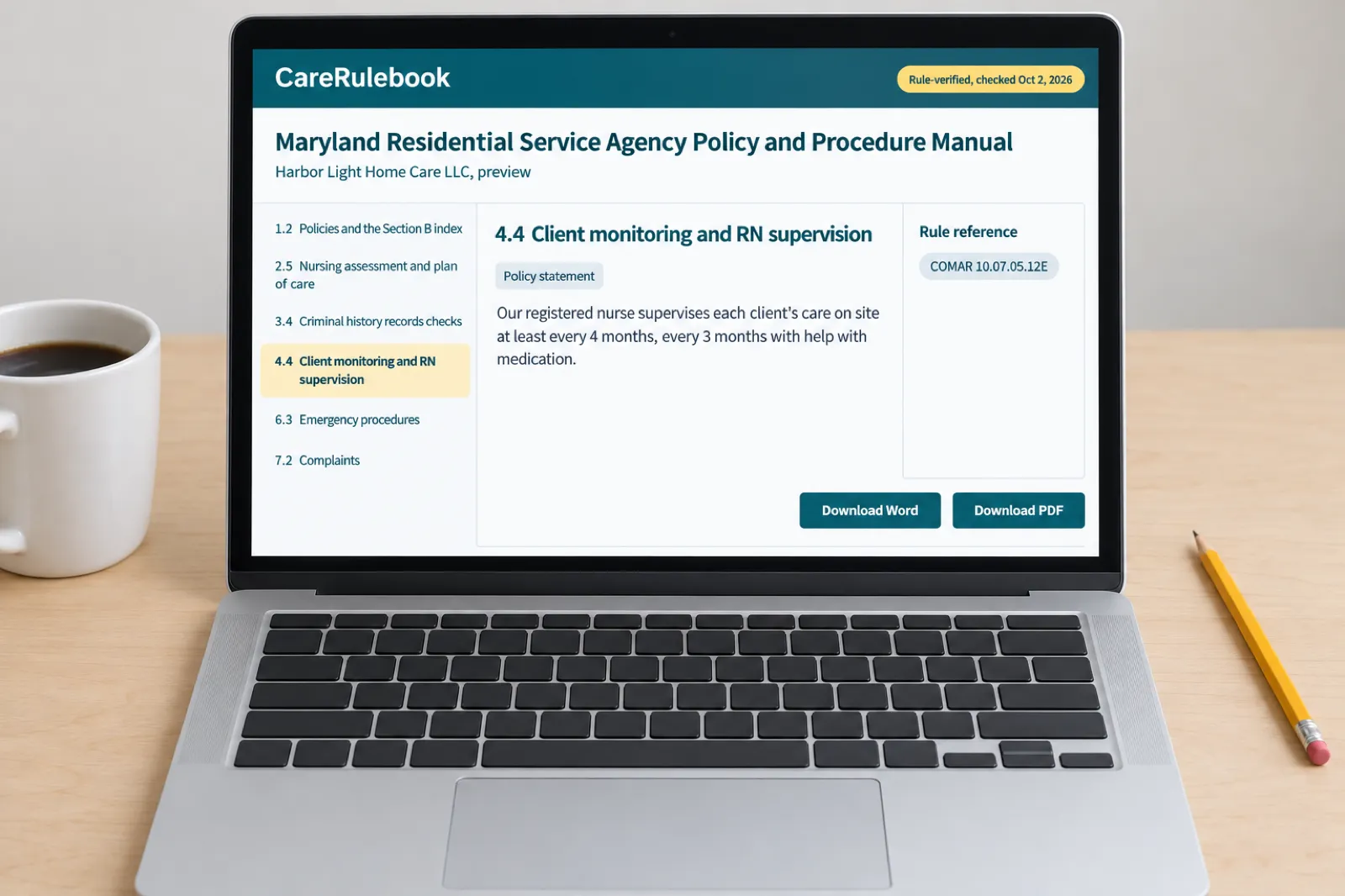
| COMAR 10.07.05.08B(1)(c)(iv) | Frequency of client monitoring How often clients are monitored (RN supervisory visits, care notes, reassessment). "Frequency of client monitoring; and" | 4.4 Frequency of client monitoring and RN supervision |
| COMAR 10.07.05.08B(1)(c)(v) | Training clients and families Training and retraining of clients or family members when indicated. "Training and retraining of clients or their family members, when indicated;" | 4.5 Training and retraining of clients and families |
| COMAR 10.07.05.08B(1)(d)(i) | Consent to changes in the recommended plan of care An informed consent form for a client or representative who changes the agency’s recommended plan of care. "signs an informed consent form consenting to changes to the agency’s recommended plan of care; or" | 5.1 Informed consent, waivers and client representatives |
| COMAR 10.07.05.08B(1)(d)(ii) | Consent to help from non-licensed staff An informed consent form for a client who agrees to help from a non-licensed person with routine treatments or self-administration of medication. "A client signs an informed consent form consenting to assistance by a nonlicensed individual with treatments of a routine nature, or with the self-administration of medications; and" | 5.1 Informed consent, waivers and client representatives4.2 Medication: reminders, help with self-administration and administration |
| COMAR 10.07.05.08B(1)(e)(i) | Preparation and storage of formulas, therapies, supplies and equipment How supplies and equipment are prepared and stored (for a non-medical agency: gloves, PPE and client equipment; enteral formulas and IV therapies only if offered). "Preparation and storage of enteral formulas, intravenous therapies, other supplies, equipment, and similar items;" | 6.1 Supplies and equipment: preparation, storage and maintenance |
| COMAR 10.07.05.08B(1)(e)(ii) | Infection control procedures Infection control procedures (standard precautions, hand hygiene, PPE, staff illness). "Infection control procedures;" | 6.2 Infection control and disposal of biomedical waste |
| COMAR 10.07.05.08B(1)(e)(iii) | Disposal of biomedical waste Disposal of biomedical waste (sharps and soiled materials met in clients’ homes). "Disposal of biomedical waste;" | 6.2 Infection control and disposal of biomedical waste |
| COMAR 10.07.05.08B(1)(e)(iv) | Maintenance of equipment Maintenance of equipment the agency uses or supplies, and reporting faults in client equipment. "Maintenance of equipment; and" | 6.1 Supplies and equipment: preparation, storage and maintenance |
| COMAR 10.07.05.08B(1)(e)(v) | Emergency procedures Emergency procedures for client emergencies, severe weather and disasters (the assessment timing rules do not apply in weather-related emergencies, natural disasters or declared emergencies, .12C(2)(f)). "Emergency procedures." | 6.3 Emergency procedures |
| COMAR 10.07.05.08B(3) | 24-hour equipment service for invasive equipmentif the agency provides invasive equipment or supplies An agency supplying invasive equipment or supplies (such as IV therapy) arranges 24-hour equipment maintenance service. "An agency that provides invasive equipment or supplies, such as intravenous therapy, shall arrange for 24-hour-a-day equipment maintenance service in case of equipment failure." | 6.1 Supplies and equipment: preparation, storage and maintenance |
| COMAR 10.07.05.08B(2) | Waiver requests for unneeded policiesif the agency asks OHCQ to waive any .08B policy Where a .08B policy does not fit the agency’s operation, ask OHCQ in writing to waive it and explain why; record waivers granted. "upon the agency’s written explanation as to why the policy and procedure is inappropriate or unnecessary to the agency’s specific operation." | 1.2 Policies: adoption, the application index, waiver requests and revisions |
| COMAR 10.07.05.04A(2)(i) | Policies filed with the application Send the .08B policies with the application and index each item by document name and page numbers in Section B. "Copies of the agency’s policies and procedures as specified in Regulation .08B of this chapter;" | 1.2 Policies: adoption, the application index, waiver requests and revisions1.3 License, worker classification certification, changes, branches and closure |
| COMAR 10.07.05.04A(2)(h) | Business plan A business plan with a 1-year operating budget, a marketing plan identifying the populations served and a detailed description of services. "which shall include at a minimum a business plan that contains a:" | 1.3 License, worker classification certification, changes, branches and closure2.1 Scope of services and care coordination |
| COMAR 10.07.05.04A(2)(j) | Workers’ compensation Proof of workers’ compensation for all employees, kept current. "Proof of Workers’ Compensation for all employees as required by the Maryland Workers’ Compensation Commission; and" | 1.3 License, worker classification certification, changes, branches and closure |
| COMAR 10.07.05.04I(3) | Re-sending substantively changed policies (rule text)if renewal still applies or OHCQ asks for changed policies The renewal rule asks for copies of policies changed substantively since OHCQ last reviewed them, especially complaint handling and client assessment. Renewal may no longer apply (Chapter 661 of 2018); keep a revision log so changed policies can be sent if OHCQ asks. "Copies of any policies and procedures that have changed substantively since they were previously reviewed by the Department" | 1.2 Policies: adoption, the application index, waiver requests and revisions |
| COMAR 10.07.05.03D | Display the license Display the current license conspicuously at or near the office entrance. "The licensee shall display the agency’s current license in a conspicuous place, at or near the entrance of the agency’s office." | 1.3 License, worker classification certification, changes, branches and closure |
| COMAR 10.07.05.02B(3), .03C | Branch officesif the agency opens a branch office A branch office shares owner tax ID, upper management, policies and service area, and may operate under the parent license; otherwise a separate license is needed. "Except as provided in §C(2) of this regulation, a separate license is required for each agency." | 1.3 License, worker classification certification, changes, branches and closure |
| COMAR 10.07.05.05A(1)-(2) | Only approved services; new services need approval Provide only the services the license approves; before adding a service, send a new application with policies for it. "Provide services for which it has not been approved to provide; or" | 1.3 License, worker classification certification, changes, branches and closure2.1 Scope of services and care coordination |
| COMAR 10.07.05.05A(1)(b), (3) | Name and address changes No change of business name without approval; a name or address change needs an amended license. "Change the name under which the program is doing business without the Department’s approval." | 1.3 License, worker classification certification, changes, branches and closure |
| COMAR 10.07.05.05B(1)-(3), (7) | Closure, sale or ownership change Written notice to the Department 45 days ahead (with how clients will be told and helped), written notice to clients 45 days ahead, and after closing notify the closure date and return all licenses by certified mail. "A licensee shall notify clients or client representatives, if applicable, of any proposed changes set forth in §B(1) of this regulation, in writing, at least 45 days before the effective date of the proposed change." | 1.3 License, worker classification certification, changes, branches and closure4.8 Discharge, transfer and ending services |
| COMAR 10.07.05.05C | Report changes in application information Notify the Department immediately of any change to information in the latest application (OHCQ’s change forms). "A licensee shall immediately notify the Department of any change in the information the licensee had submitted with the most recent application." | 1.3 License, worker classification certification, changes, branches and closure |
| COMAR 10.07.05.06A | License number and statement in all advertising Every advert and marketing item shows the license number and the required OHCQ statement. "An agency shall include the following information in all of the agency’s advertising and marketing materials:" | 1.4 Advertising and public representation |
| COMAR 10.07.05.06B | No misleading advertising Do not advertise services the agency is not licensed for, advertise misleadingly, or claim to be a hospice, home health agency or nursing referral service agency without that license. "A person may not advertise an agency in a misleading or fraudulent manner." | 1.4 Advertising and public representation |
| COMAR 10.07.05.26 | Notify clients of license actions Notify each competent client and representative within at least 30 days of a significant change in licensure status, surrender, denial, revocation or suspension. "the agency shall notify each competent client and each client representative within at least 30 days of:" | 1.3 License, worker classification certification, changes, branches and closure7.1 Client rights and responsibilities, disclosures and advance directives |
| COMAR 10.07.05.24D | If a license is suspended On emergency suspension, return the license, stop services and help clients make other arrangements. "The agency shall notify competent clients and client representatives about the suspension and make every reasonable effort to assist them in making other arrangements for services." | 1.3 License, worker classification certification, changes, branches and closure4.8 Discharge, transfer and ending services |
| Health-General §19-4A-11(b) | Worker classification certification Someone with authority over pay or employment practices reads the Attorney General’s guidance and certifies on OHCQ’s form, for the initial license and every 3 years. "shall certify to the Department, on a form developed by the Department and through the signature of an individual with authority over the residential service agency’s pay or employment practices" | 3.7 Employees, independent contractors and subcontracted agencies1.3 License, worker classification certification, changes, branches and closure |
| Health-General §19-4A-11(c) | Yearly aide classification report (Medicaid)if the agency receives Medicaid payment for personal care aide services By October 1 each year, report the number of personal care aides classified as employees and as independent contractors. "On or before October 1 each year, each residential service agency receiving Medicaid reimbursement for the provision of home care or similar services by a personal care aide shall report to the Department" | 3.7 Employees, independent contractors and subcontracted agencies |
| COMAR 10.07.05.07A-B | Open for inspection; help reach clients’ homes Be open for inspection in stated business hours, open the office at other times on request, and help OHCQ reach the homes where services are given. "The agency shall be open for inspection by the Department during all hours identified in the agency’s application as routine business hours." | 1.5 Inspections, surveys and plans of correction |
| COMAR 10.07.05.07C | Records open to inspection; what stays on site Keep records supporting compliance, give copies immediately on request, keep current and recent client and staff files and QA files on site, and produce off-site records within 24 hours. "A licensee shall maintain records and reports to support compliance with the regulations of this chapter. All records and reports shall be open to inspection by the Department." | 1.5 Inspections, surveys and plans of correction7.4 Clinical records, confidentiality and retention |
| COMAR 10.07.05.07D | Statements of deficiencies on request Make statements of deficiencies, reports and plans of correction available on request to clients, potential clients and regulators. "An agency shall make available upon request to clients, client representatives, potential clients, or federal, State, or local regulatory or law enforcement agencies any statements of deficiencies, reports, and plans of corrections." | 1.5 Inspections, surveys and plans of correction |
| COMAR 10.07.05.07E | Plan of correction within 10 days Send an acceptable plan of correction within 10 calendar days of a notice, with a completion date for each deficiency. "The plan of correction referred to in §E(1)(b) of this regulation shall include the date by which the licensee shall complete the correction of each deficiency." | 1.5 Inspections, surveys and plans of correction2.4 Quality assurance program |
| COMAR 10.07.05.09A | Internal complaint process Notice of the process to clients, investigation protocols, and timely investigation of written complaints without disrupting services. "A mechanism for the receipt and timely investigation of written complaints that ensures that the client’s services will not be disrupted due to the filing of a complaint." | 7.2 Complaints |
| COMAR 10.07.05.09B(1)-(2) | Complaint investigation reports Each report records time, date, place and people; the complaint; its disposition; follow-up and prevention. If no investigation is done, record why. "If the agency does not conduct a complaint investigation, the agency shall document in the complaint record the reason for not conducting an investigation." | 7.2 Complaints |
| COMAR 10.07.05.09B(3)-(4) | Telling people the outcome; complaint records Tell the client (or representative), the physician if needed, and licensing or law enforcement agencies when required by law; keep records of the process. "An agency shall provide notice to the following persons regarding the disposition of a complaint:" | 7.2 Complaints |
| COMAR 10.07.05.09C | OHCQ hotline notice Give clients OHCQ’s complaint hotline number, (800) 492-6005. "An agency shall provide notice to clients of the Department’s complaint hotline number for complaints about services provided by the agency or services that the agency failed to provide." | 7.2 Complaints7.1 Client rights and responsibilities, disclosures and advance directives |
| COMAR 10.07.05.09D | Complaint reports on request Give investigation reports to the Department immediately on request and a summary for public inspection on request, as the law allows. "The agency shall make investigation reports available to the Department immediately upon request." | 7.2 Complaints1.5 Inspections, surveys and plans of correction |
| COMAR 10.07.05.10A | Screening policy Policies and procedures to screen every prospective employee, independent contractor or contractual employee who will serve clients. "An agency shall develop and implement policies and procedures to screen a prospective employee, independent contractor, or contractual employee who will provide services to clients." | 3.4 Screening and criminal history records checks |
| COMAR 10.07.05.10B(1) | Nine screening steps Criminal history or private background check; license or certificate verification; health and TB screening; references; employment history; I-9; identity and work eligibility; in-person interview before referral; skills assessment and demonstration before referral. "Completion of a skills assessment and demonstration before client referral." | 3.4 Screening and criminal history records checks3.2 Skills assessment and demonstration3.3 Staff health requirements and TB screening |
| COMAR 10.07.05.10B(2), C | Personnel and training records at the business office Keep training records in the personnel file and screening records for each worker at the business office. "An agency shall maintain records of information described in §B of this regulation for each employee, independent contractor, or contractual employee and retain the information in the agency’s business office." | 3.4 Screening and criminal history records checks3.5 Training, including dementia training |
| COMAR 10.07.05.10D | When uncertified caregivers may serve Send an uncertified caregiver only to a client who needs no ADL help, who needs ADL help with no predictable adverse consequences in the supervising nurse’s judgment, or who signed a waiver of skilled services. "An agency may not knowingly provide or refer a caregiver who is not certified to provide services to a client unless the client:" | 3.6 Certified and uncertified caregivers5.1 Informed consent, waivers and client representatives |
| COMAR 10.07.05.10E | Certified caregivers where needed Provide or refer a certified caregiver to a client who needs one for ADLs or needs medication administration. "A certified caregiver to perform activities of daily living; or" | 3.6 Certified and uncertified caregivers |
| COMAR 10.07.05.10F | Report caregivers to the Board of Nursing and OHCQ Report immediately any action or condition of a referred caregiver that may be grounds for Board of Nursing action. "the agency shall report the action or condition to the Board of Nursing and the Office of Health Care Quality immediately when the action or condition is known by the agency." | 3.6 Certified and uncertified caregivers7.3 Abuse, neglect, self-neglect and exploitation: reporting |
| COMAR 10.07.05.10H | Subcontracted agencies verify screeningif the agency subcontracts with another licensed agency When subcontracting with another licensed agency, that agency verifies the .10B screening and gives evidence of it. "Submit evidence to the contracting agency that verification has occurred." | 3.7 Employees, independent contractors and subcontracted agencies3.4 Screening and criminal history records checks |
| COMAR 10.07.05.12A | Staff work within Maryland practice laws Take reasonable measures so everyone referred works within Maryland law, including the Nurse Practice Act. "An agency shall take reasonable measures to ensure that all individuals who are referred to provide services to clients do so in accordance with Maryland laws and regulations" | 3.6 Certified and uncertified caregivers4.4 Frequency of client monitoring and RN supervision |
| Health-General §19-1902(a)(1); COMAR 10.07.05.10B(1)(a) | Criminal history check before work Before an eligible employee starts work, apply for a State criminal history records check through CJIS (fingerprints and disclosure statement) or ask a licensed private agency for a background check; the agency pays. "Apply for a State criminal history records check; or" | 3.4 Screening and criminal history records checks |
| Health-General §19-1902(a)(2), (b) | Reference from the most recent employer Request a reference from the most recent employer that asks at least about any history of physical abuse. "Request a reference from the potential employee’s most recent employer." | 3.4 Screening and criminal history records checks |
| Health-General §§19-1902(d), 19-1906 | Private agency checks: states and FCRAif the agency uses a private agency background check instead of CJIS A private agency check covers every state the worker lived or worked in during the past 7 years; follow the Fair Credit Reporting Act, including telling the worker when adverse information prevents hiring. "The adult dependent care program shall comply with the federal Fair Credit Reporting Act" | 3.4 Screening and criminal history records checks |
| Health-General §19-1907(c)-(e) | Keep criminal history results confidential Use results only for the hiring decision, do not pass them on, and store them securely. "Information obtained from the Department or a private agency under this subtitle shall be confidential" | 3.4 Screening and criminal history records checks |
| COMAR 10.07.05.11A | Staff trained for the care clients need Ensure referred staff are trained for the care the agency’s clients need. "An agency shall ensure that individuals that are referred are trained appropriately to provide care that is needed by the agency’s clients." | 3.5 Training, including dementia training |
| COMAR 10.07.05.11B | Outside trainers approved by OHCQif training is given by someone other than the agency Use an outside training source only if OHCQ has approved it in writing. "Sources other than the agency may provide training, as approved in writing by the Office of Health Care Quality." | 3.5 Training, including dementia training |
| COMAR 10.07.05.11C | Seven training topics Supervised practice in personal care; when to refer to an RN; record keeping; ethics and confidentiality; CPR; standard precautions; prevention of abuse and neglect. "Identification of situations that require referral to a registered nurse, including significant changes in a client’s condition;" | 3.5 Training, including dementia training |
| Health-General §19-4A-03.1(c)(1)(i) | Dementia training within 45 days At least 3 hours of dementia training within 45 days of starting, for all direct care and supervisory staff, unless exempt. "Within 45 days after an individual’s start of employment as part of the residential service agency’s direct care or supervisory staff" | 3.5 Training, including dementia training |
| Health-General §19-4A-03.1(c)(1)(ii) | Two hours of dementia training each year 2 hours of Alzheimer’s and dementia continuing education every calendar year. "receives 2 hours of online or in–person continuing education training regarding Alzheimer’s disease and dementia each calendar year." | 3.5 Training, including dementia training |
| Health-General §19-4A-03.1(e)-(f) | Dementia training certificates and records Issue certificates of completion and keep records of the training each person received. "A person providing the training described under subsection (c) of this section shall issue a certificate of completion to each individual who completes the training." | 3.5 Training, including dementia training |
| COMAR 10.07.05.12B | RN assessment and RN role in care planning An RN assesses each new client who needs skilled services and ADL help, helps develop the care plan and assign staff, decides whether a CNA is needed, and helps train caregivers. "Determine whether the client requires the services of a certified nursing assistant, or whether services may be provided by an individual who is not certified; and" | 2.5 Clinical management: nursing assessment, plan of care and delegation3.6 Certified and uncertified caregivers |
| COMAR 10.07.05.12C(1) | Care plan based on assessment Base the plan of care on assessments of health, function and psychosocial condition. "A client’s plan of care shall be based on assessments of the client’s health, function, and psychosocial condition." | 2.5 Clinical management: nursing assessment, plan of care and delegation |
| COMAR 10.07.05.12C(2) | Assessment timing Assess when services are requested or needed, before services start (unless no skilled care is requested or indicated), within 48 hours for listed conditions or a change of level of care, on request, and at least annually. "Before the client receives services from the agency unless:" | 2.5 Clinical management: nursing assessment, plan of care and delegation2.2 Admission criteria and assessment before acceptance |
| COMAR 10.07.05.12C(3) | RN decides no 48-hour assessment is needed If the RN judges a 48-hour assessment after a significant change unnecessary, document it and assess within 7 calendar days. "Ensure that an assessment of the client is conducted within 7 calendar days." | 4.6 Changes in a client’s condition2.5 Clinical management: nursing assessment, plan of care and delegation |
| COMAR 10.07.05.12C(4)-(5) | Care plan contents and review The care plan covers services, frequency, how and by whom, long- and short-range goals and physical needs including safety; it is reviewed by an RN or other authorized practitioner when appropriate. "Physical needs, including safety measures to protect against injury." | 2.5 Clinical management: nursing assessment, plan of care and delegation |
| COMAR 10.07.05.12D(1)-(4) | Informed consent and waivers documented Changes to the recommended plan, waivers of certified care and waivers of skilled care follow a documented risk and benefit discussion on a signed, dated informed consent form; only a cognitively capable adult client may waive certified or skilled care. "This discussion shall be reflected in an informed consent form." | 5.1 Informed consent, waivers and client representatives |
| COMAR 10.07.05.12D(4)(c) | Signed waiver of skilled services A waiver of skilled services is signed by a cognitively capable adult client and kept in the record. "A form confirming a waiver of skilled services shall be signed by a cognitively capable adult client and maintained in the client’s record." | 5.1 Informed consent, waivers and client representatives7.4 Clinical records, confidentiality and retention |
| COMAR 10.07.05.12E(1) | RN oversight Have an RN overseeing care plan implementation, delegation, supervision and training for clients who need skilled services or ADL help. "For clients who require skilled services or assistance with the activities of daily living, an agency shall have a registered nurse to provide oversight for:" | 4.4 Frequency of client monitoring and RN supervision |
| COMAR 10.07.05.12E(2) | RN on-site supervision intervals On-site supervision at least every 45 days (staff administer medications), 3 months (staff assist with self-administration) or 4 months (neither), or more often as the RN sets. "The registered nurse shall provide periodic, on-site supervision of care:" | 4.4 Frequency of client monitoring and RN supervision |
| COMAR 10.07.05.12E(3) | Supervision documented Keep accurate documentation of RN supervision. "The agency shall maintain accurate documentation of the supervision that is provided by the registered nurse." | 4.4 Frequency of client monitoring and RN supervision |
| COMAR 10.07.05.12F | Medication administrationif agency staff administer medications If staff administer medications: only licensed or certified staff, consistent with the plan of care (unless informed consent), only as ordered by the physician, and record medications, errors and adverse reactions. "Provide for drugs and treatments to be administered only as ordered by the physician; and" | 4.2 Medication: reminders, help with self-administration and administration |
| COMAR 10.07.05.12G(1)-(4) | 24/7 on-call with 1-hour response Clients can reach the agency 24/7; emergency inquiries are recognized and routed to an appropriate person who responds within 1 hour. "Establish a procedure by which current clients or their representatives may contact a representative of the agency by communication device at any time, 24 hours a day and 7 days a week;" | 4.7 24-hour on-call service |
| COMAR 10.07.05.12G(5) | On-call log Log each inquiry with the responder, content and time. "Maintain a log of inquiries that includes the identity of the response personnel, content of the inquiry, and the time of each inquiry; and" | 4.7 24-hour on-call service |
| COMAR 10.07.05.12G(6) | Written on-call procedures for clients Give clients written on-call procedures and the on-call number. "Provide clients or the client representatives with written procedures and the phone number for on-call service." | 4.7 24-hour on-call service7.1 Client rights and responsibilities, disclosures and advance directives |
| COMAR 10.07.05.13 | Client representatives Recognize guardians, advance directive agents, surrogates, powers of attorney, representative payees and documented designees within their authority, and record who holds authority. "Document in the client’s record the name of the person, if any, with the authority identified in §A of this regulation; or" | 5.1 Informed consent, waivers and client representatives7.4 Clinical records, confidentiality and retention |
| COMAR 10.07.05.14A | Clinical record contents A secure, confidential clinical record with orders, nurse’s assessment, care plan, medications, allergies, nutrition, supplies and equipment, care notes, physician and representative contacts, and discharge documents. "an agency shall ensure that a clinical record is maintained for each client in a manner that ensures security and confidentiality, and includes at a minimum:" | 7.4 Clinical records, confidentiality and retention |
| COMAR 10.07.05.14B | Record for clients without certified or skilled care For clients assessed as not needing certified caregivers or skilled services: nursing assessment, plan of care, services provided, significant changes and other pertinent information. "An agency that provides care to clients who are assessed as not requiring certified caregivers or skilled services shall maintain a client record, including but not limited to:" | 7.4 Clinical records, confidentiality and retention2.5 Clinical management: nursing assessment, plan of care and delegation |
| COMAR 10.07.05.14C | Communicating changes in condition Policies so that changes in condition or preferences, including significant changes, are documented and told promptly to the client, representative and the care team. "is documented in the client’s record and communicated in a timely manner to:" | 4.6 Changes in a client’s condition |
| COMAR 10.07.05.14D | Care notes Care notes on admission and at least weekly, on significant changes and care plan changes; entries detailed, legible, chronological, dated and signed with name and title. "The agency shall ensure that all notes and reports that are entered in the clinical record, which may include an electronic record, are detailed, legible, chronological, dated, and signed with the name and title of the individual rendering the service." | 7.4 Clinical records, confidentiality and retention |
| COMAR 10.07.05.14A(12) | Discharge documents On discharge, directions for safe continuation of care, and a discharge summary with the reason if skilled services were given. "Directions for the safe continuation of care after discharge; and" | 4.8 Discharge, transfer and ending services7.4 Clinical records, confidentiality and retention |
| COMAR 10.07.05.15A-B | Record retention and closure Keep records 5 years after discharge (minors: to age 21 or 5 years, whichever is later); if the agency closes, return records to clients or keep them for that period. "If an agency ceases operation, the agency shall make arrangements to return the records to the client or client representative with legal authority to make health care decisions, or retain the records as required by §A of this regulation." | 7.4 Clinical records, confidentiality and retention |
| COMAR 10.07.05.15C | Confidentiality and release of records Keep medical records private; release them only with written consent or as the Maryland Confidentiality of Medical Records Act allows; maintain and dispose of them under Health-General Title 4. "Release medical records or medical information about a client only with the written consent of the client or client representative" | 7.4 Clinical records, confidentiality and retention |
| COMAR 10.07.05.15D | Record completion and safeguards Procedures so discharged clients’ records are completed within 30 days and records are protected against loss, destruction and unauthorized use. "Safeguards are in place to protect clinical record information against loss, destruction, or illegal or unauthorized use." | 7.4 Clinical records, confidentiality and retention |
| COMAR 10.07.05.16A-B | Client rights and responsibilities policy Written policies on client rights and responsibilities, available to clients and representatives. "The agency shall ensure that agency staff develops and implements written policies and procedures concerning clients’ rights and responsibilities." | 7.1 Client rights and responsibilities, disclosures and advance directives |
| COMAR 10.07.05.16C | Seven client disclosures Cost estimate; costs if not covered; itemized bills on request; caregiver names; supervisor contact; 24/7 number; subcontracting relationships. "Disclosure of any subcontractual relationship with any individual or agency to be assigned or referred to provide care to the client." | 7.1 Client rights and responsibilities, disclosures and advance directives2.3 Billing, charges and service records |
| COMAR 10.07.05.16D | Client rights Dignity, adequate care, participation in care planning, refusal after explanation, privacy, freedom from abuse and exploitation, confidentiality, complaints without retaliation, prompt responses, and access to OHCQ, APS and CPS. "Have access to the procedures for making a complaint to the Office of Health Care Quality, and to:" | 7.1 Client rights and responsibilities, disclosures and advance directives7.2 Complaints |
| COMAR 10.07.05.16E | Advance directives Give clients information about advance directives and the right to have one, and find out whether a client’s advance directive affects their care. "Provide information to a client about advance directives and the right to have an advance directive; and" | 7.1 Client rights and responsibilities, disclosures and advance directives |
| COMAR 10.07.05.16F-G | Refusals and informed decisions Honor refusals of planned treatment; let a cognitively capable adult choose an uncertified caregiver after a signed waiver; give enough information (purpose, alternatives, side effects, cost, right to withdraw) for informed decisions. "The agency shall provide sufficient information to the client or the client representative to allow the client or the client representative to make an informed decision regarding treatment" | 5.1 Informed consent, waivers and client representatives7.1 Client rights and responsibilities, disclosures and advance directives |
| COMAR 10.07.05.16H | Client may reject a caregiver Let the client or representative accept or reject any referred caregiver without retaliation. "to accept or reject, at the client’s or client representative’s discretion without fear of retaliation from the agency" | 7.1 Client rights and responsibilities, disclosures and advance directives |
| Family Law §14-302(a)-(b) | Report suspected abuse of vulnerable adults Staff who are health practitioners or human service workers report suspected abuse, neglect, self-neglect or exploitation of a vulnerable adult to the local department of social services (or the statewide hotline) as soon as possible. "shall make the report as soon as possible by telephone, by direct communication, or in writing to the local department or by calling the statewide reporting hotline." | 7.3 Abuse, neglect, self-neglect and exploitation: reporting |
| Family Law §§5-704, 5-705 | Report suspected child abuse or neglect Report suspected child abuse or neglect to the local department or police; mandated reporters report orally as soon as possible and in writing within 48 hours, with a copy to the State’s Attorney. "not later than 48 hours after the contact, examination, attention, or treatment that caused the individual to believe that the child had been subjected to abuse or neglect; and" | 7.3 Abuse, neglect, self-neglect and exploitation: reporting |
| OHCQ outside trainer checklist (rev. 09.24.2026), item (8) | Emergency preparedness plan in staff training (signalled) OHCQ’s trainer checklist adds an emergency preparedness plan to the training topics, marked as a 2026 rule update not yet proposed. Recommended practice until a rule is adopted. "Emergency Preparedness Plan 26 Reg Update" | 6.3 Emergency procedures3.5 Training, including dementia training |