Activities of daily living
Bed mobility, transfers, walking, dressing, eating, toileting, bathing and personal hygiene, by a CNA or a worker with PSS or other approved training.
Ch. 129 § 1; § 4(A)(1)What do you run?
Coming next: Maryland (assisted living), Georgia (personal care homes)
All care home guides →Maine · Home health vs home care · 22 M.R.S. § 1717 and chapter 419
Maine licenses non-medical home care and home health separately. A personal care agency (PCA) helps with daily living and household tasks and needs no nurse; a home health care provider gives nursing, therapies and supervised aide services, with a registered nurse as Director of Nurses. The State’s fee is $500 to apply for a PCA license and $300 a year for home health. Here is what each license covers, where a PCA has to stop, how MaineCare and Medicare fit, and what CMS’s 2026 home health moratorium does and does not touch.

Quick answer
In Maine, non-medical home care is a personal care agency (PCA), licensed by DHHS under 22 M.R.S. § 1717 and Chapter 129. "Personal Care Agencies provide non-medical services to individuals in their homes." DLC Home health is a separate license under 22 M.R.S. chapter 419 and Chapter 119, for nursing, therapies and supervised aide services: "The Director of Nurses is a registered nurse". Ch. 119
The two do not overlap: "“Personal care agency” does not include a home health care provider licensed under 22 MRS Ch. 419 or a Family Provider Agency as defined in 10-144 Ch. 101, MaineCare Benefits Manual, Ch. II Section 96." Ch. 129 § 1 A PCA may not advertise as a home health agency or offer health services that need a licensed medical professional. Ch. 129 § 2(A)(2)
The State’s fee is $500 to apply for a PCA license and $300 a year for home health under Chapter 119, a rule last amended in 2005. Ch. 119, 2.C.1 We found no certificate of need for either (our reading). Separately, CMS halted Medicare enrollment of new home health agencies nationwide from May 13, 2026. CMS QSO-26-11 On November 12, 2026, it extended the halt for six more months for agencies enrolling in Medicare as new providers, including after a change in majority ownership that requires a new enrollment. CMS, FR Doc. 2026-23241
"Personal care" means two things. The home health law lists "personal care services" among the therapeutic services a home health provider may give, and Chapter 119 defines them as services "provided in a patient’s/client’s residence by a home health aide or certified nursing assistant and which are delegated and supervised by a registered nurse". Ch. 119, Ch. 1 item 33 Our reading: personal care a registered nurse delegates and supervises is home health; non-medical help with daily living, under a PCA’s own supervisor, is a personal care agency.
The whole PCA route, from the online application to the first inspection, is on the Maine home care guide.
Each line is from Chapter 129, Chapter 119, the statutes, DLC or CMS, linked in the cell. Lines marked "our reading" or "our count" are ours. Chapter 119 took effect in 1984, and the last amendment in the Secretary of State copy we saved is dated January 10, 2005. Ch. 119, history note The statute leaves the home health fee to DHHS, so ask DLC for its current fee and forms before you apply. 22 M.R.S. § 2146
| Personal care agency (non-medical) | Home health care provider | |
|---|---|---|
| Law and rule | 22 M.R.S. § 1717 and 10-144 C.M.R. Chapter 129 (in force since August 20, 2024). 22 M.R.S. § 1717(1)(C) | 22 M.R.S. chapter 419 (§§ 2142 to 2147) and 10-144 C.M.R. Chapter 119. 22 M.R.S. § 2143 |
| What it covers | Help with activities of daily living and instrumental activities (meals, money, shopping, light housework, communication) where clients live. DLC calls these non-medical services. Ch. 129 § 1; DLC | Professional nursing, therapies, speech pathology, medical social work, nutritionist services, and supervised LPN, home health aide and CNA services for treatment and rehabilitation. Ch. 119, Ch. 1 item 22 |
| Nurse | No nurse role. A supervisor may be an LPN or RN, but equally a CNA, someone with the personal care course and a year’s experience, or five years of related education or experience. Ch. 129 § 5(D) | A Director of Nurses who is a Maine-licensed RN, and a registered nurse assigned to every client served by LPNs, aides or CNAs. Ch. 119, item 15; 7.D.2 |
| Caregivers | For hands-on care: an active CNA, or Personal Support Specialist (PSS) or other approved training, completed or begun within 60 days of hire. None needed for meals, money, shopping, light housework and communication only. Ch. 129 § 4(A) | Home health aides are CNAs who also meet the federal home health aide rules, with at least 12 hours of in-service training a year. Ch. 119, item 20; 6.A.2 |
| Supervision | On-site supervision of each new employee at least every 30 days for the first three months. Ch. 129 § 5(D) | RN supervision of aides at least every fourteen calendar days (the rule prints "fourteen (24)"), and an RN supervisory visit to the client’s home at least every 30 days; alternate visits may be by telephone. Ch. 119, 7.D.4 |
| Care plan | A written service plan before any service begins. Ch. 129 § 8(A)(1) | For clients needing nursing, an RN writes the plan of care after an initial home visit; it starts within three business days of admission. Ch. 119, 7.E.1, 7.E.3 |
| Physician orders | Chapter 129 has no physician order requirement (our reading). | Where the client’s payer requires physician orders, all treatment is under a licensed physician’s orders. Ch. 119, 7.A.3 |
| Medication | DLC lists medication reminders; Chapter 129 says nothing about giving medication (our reading: reminders only). DLC page | DLC’s PSS curriculum says home health aides assist with medication routines. PSS curriculum |
| Office | A physical site in Maine: a business-zoned non-residential building, or a separate, confidential space with locked records in a home. Ch. 129 § 2(A)(6) | Located in Maine with a commercial address (border exceptions apply). Ch. 119, item 22 |
| State fees | $500 to apply; renewal $200 to $2,000 by number of employees. No fee refunded. Ch. 129 § 2(E) | An annual fee of $300 with each application; licenses renewed annually. No fee refunded. The statute leaves the amount to DHHS. Ch. 119, 2.C; 22 M.R.S. § 2146 |
| License terms | Provisional, 3 to 12 months; then a full license for two years if the agency is in substantial compliance. Ch. 129 § 2(C) | Provisional, 3 to 12 consecutive months. The statute allows a full license of up to 24 months; Chapter 119 sets it at 12 months. 22 M.R.S. § 2144(3); Ch. 119, 2.J.1 |
| Before the first license | DLC may inspect, and its records show an on-site inspection for most new agencies (our count). DLC records | A preliminary conference with DLC at least 45 days before the initial survey. Ch. 119, 2.A.4 |
| Monitoring | At least every two years. 22 M.R.S. § 1717(13-A) | A survey at least every two years, except in a year with a Medicare certification survey. Ch. 119, 3.B.7 |
| Medicare | CMS’s 2026 moratorium memo covers home health agencies and hospices; it does not mention personal care agencies (our reading). QSO-26-11 | A Medicare-certified agency meeting all federal requirements is deemed to meet state licensure. New Medicare home health enrollment was halted from May 13, 2026; on November 12, 2026, CMS extended the halt for six more months for agencies enrolling in Medicare as new providers, including after a change in majority ownership that requires a new enrollment. Ch. 119, item 12 CMS, FR Doc. 2026-23241 |
| Licenses | 318 active licenses in October 2026 (our count of DLC’s license search). DLC records | Not counted on this page. |
Fees are the State of Maine’s, paid to DHHS and separate from any CareRulebook price. PCA costs and timings are on the Maine license cost and timeline page.
Chapter 129 does not list tasks one by one. It sets the line three ways: the services a PCA provides, the training each worker has, and a ban on health services and health care advertising.
Bed mobility, transfers, walking, dressing, eating, toileting, bathing and personal hygiene, by a CNA or a worker with PSS or other approved training.
Ch. 129 § 1; § 4(A)(1)Meals, managing money, shopping, light housework and communication. Workers who do only these need no PSS training.
Ch. 129 § 1; § 4(A)(2)DLC lists medication reminders among personal care services. Chapter 129 says nothing about any other medication task, so our reading is reminders only.
DLC pageEmployees providing direct care to clients may only complete duties which they have been trained to perform through a state-approved Certified Nursing Assistant program or a Department-approved program related to the provision of care.
Ch. 129 § 4(D)DLC’s PSS curriculum: "NEVER PERFORM MEDICAL/CLINICAL PROCEDURES OR INTERPRET MEDICAL CONDITIONS OR RESULTS."
PSS curriculumNo PCA may advertise that they are a home health agency or that they provide any type of “health” or “healthcare” services that require the services of a licensed medical professional.
Ch. 129 § 2(A)(2)What a home health aide does instead. DLC’s PSS curriculum, describing other team members: "HHAs work for Medicare certified Home Health Agencies. ... HHAs perform simple clinical evaluations such as pulse, temperature, and respiration; help with simple prescribed exercises; and assist with medication routines." PSS curriculum Under Chapter 119, "Duties of home health aides and certified nursing assistants shall be assigned in accordance with the rules and regulations of the Maine State Board of Nursing, Chapter 5, Section 1.A.1.", and may include "Helping with health care treatment as determined in patient's/client's plan of care". Ch. 119, 6.B
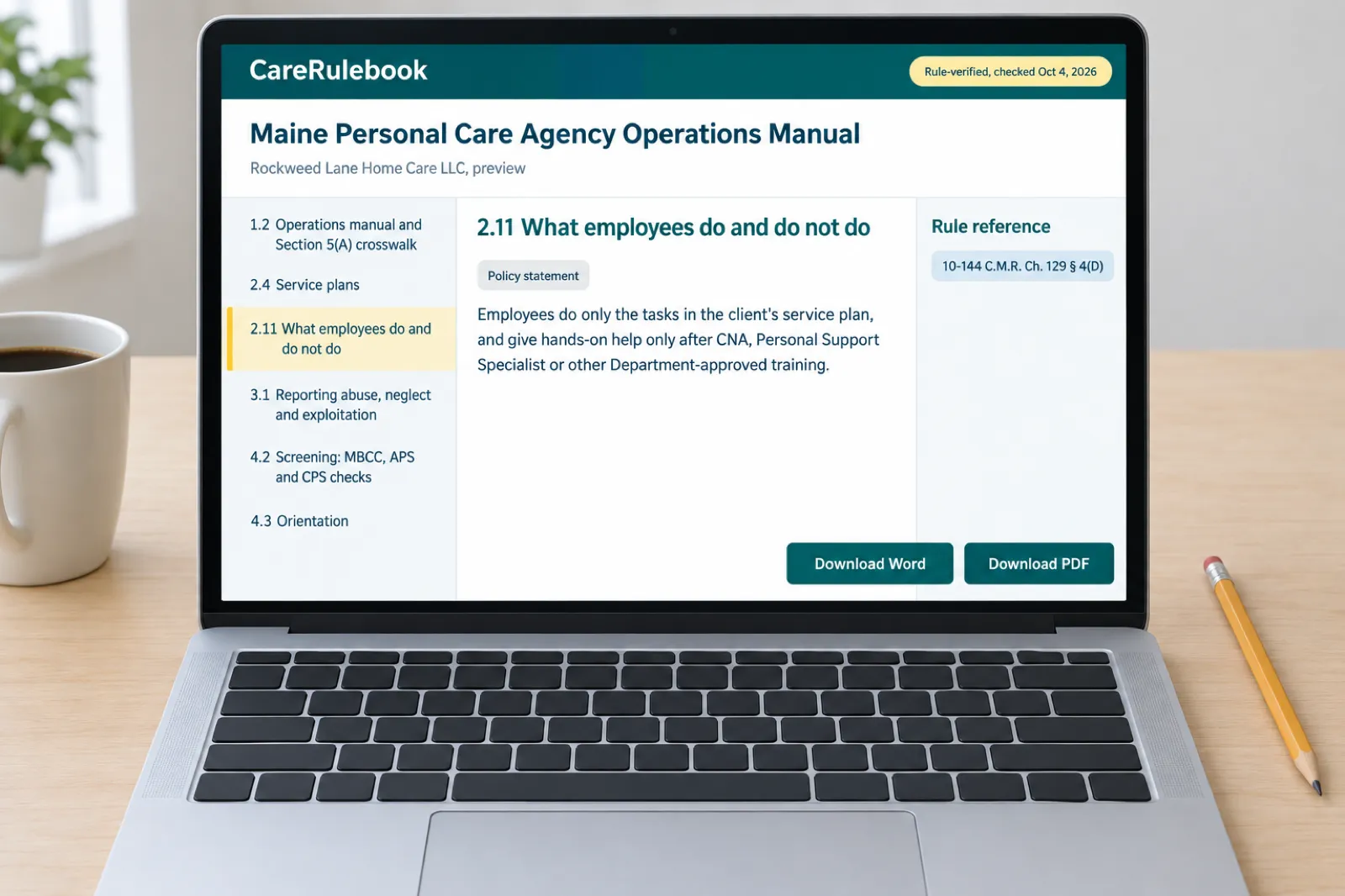
When a client needs more. Chapter 129 requires a policy on seeking a referral or reassessment when a client may need a higher level of care. Ch. 129 § 5(A)(1)(d)(ii) CareRulebook’s manual sets this out in Policy 2.7, and what employees do and do not do, with medication reminders only, in Policy 2.11. Who may give hands-on care is in Policy 4.1; the Maine caregiver training page covers the CNA and PSS routes.
DLC’s PSS curriculum allows extra training: "Your employer may train you to perform additional tasks that are not covered in this training. Each employer and their consultant Registered Nurse, who is training and educating the PSS beyond what is authorized in this curriculum and accompanying skills list, must determine, prior to that training, if the skills and tasks to be taught are within the scope of nursing delegation consistent with Chapter 5 of the Rules for Maine State Board of Nursing." PSS curriculum It also tells workers to "remain within your Scope of Training and only to perform the skills and procedures which are in your job description and which you have been taught". PSS curriculum
Chapter 129 itself says nothing about nurse delegation, and bars a PCA from health services that need a licensed medical professional. Our reading: Chapter 119 treats personal care that a registered nurse delegates and supervises as home health, so nurse-delegated tasks point to the home health license. If you want PCA workers trained in a task beyond their course, ask DLC first. CareRulebook’s manual does not include delegated nursing tasks.
Program rule · MaineCare Benefits Manual, Section 96
These are MaineCare payment rules, not licensing rules, from the Secretary of State copy of Section 96 we saved. It still says "registered personal care agency", the term used before the 2024 license, so check the current version with the Office of MaineCare Services.
A PCA application names its payment sources, which "may include, but is not limited to, private pay, MaineCare, or private insurance". Ch. 129 § 2(F)(1)
Maine’s certificate of need law says: "A certificate of need from the department is required for" transfers of ownership, major medical equipment, large capital expenditures, a new health service or a new health care facility. 22 M.R.S. § 329 Most of them turn on a health care facility, and even a new health service is defined by reference to one (or to new technology in a practitioner’s private office). 22 M.R.S. § 328(17-A) ""Health care facility" means a hospital, psychiatric hospital, nursing facility, kidney disease treatment center including a freestanding hemodialysis facility, rehabilitation facility, ambulatory surgical facility, independent radiological service center, independent cardiac catheterization center or cancer treatment center." 22 M.R.S. § 328(8)
Our reading: home health care providers and personal care agencies are not on that list, so neither needs a certificate of need to open. If your plan includes a facility on the list, ask DHHS.
National · from May 13, 2026, extended to about May 12, 2027 (our count)
Chapter 119 ties the two systems together: "A Medicare certified home health agency is deemed to meet the State licensure requirements if it meets all Federal certification requirements." Ch. 119, Ch. 1 item 12 Medicare enrollment itself is a federal step, and for new home health agencies CMS paused it from May 13, 2026: "Effective May 13, 2026, CMS will halt the enrollment of new Hospice and HHA providers or HHA branch or practice locations." CMS, QSO-26-11 On November 12, 2026, CMS extended the moratorium for six more months (to about May 12, 2027, by our count) and narrowed it to home health agencies and hospices enrolling in Medicare as new providers, including after a change in majority ownership that requires a new enrollment. New branches of home health agencies already enrolled, and new practice locations of enrolled hospices, are no longer covered. The notices appear in the Federal Register of November 16, 2026 (91 FR 73603 and 91 FR 73597); we last checked on November 15, 2026. Federal Register, FR Doc. 2026-23241 (home health) FR Doc. 2026-23242 (hospices)
What it does not do, by our reading: QSO-26-11 is about Medicare enrollment. It says nothing about state licensing, so it does not stop DHHS licensing a home health care provider, and it does not mention personal care agencies.
A PCA may not advertise as a home health agency or as providing "health" or "healthcare" services that need a licensed medical professional.
DHHS’s free operations manual template lists "Home Health Aide Services" and "Medication Management", which a PCA may not hold itself out as providing or which Chapter 129 does not cover (our reading).
DLC lists reminders; Chapter 129 names no other medication task. Setting up or giving medication without DLC’s say-so risks working outside the license (our reading).
A PCA may use a separate, confidential room in a home. Chapter 119 says licensed home health providers must be in Maine with a commercial address.
New home health agencies cannot enroll in Medicare during the CMS moratorium, and initial applications sent during it are denied.
A decision aid we built from the laws and rules cited in each row. It is our reading, not DHHS’s or DLC’s, and not legal advice. If a service sits near the line, ask DLC before you apply: its personal care agency forms send questions to AH-PCA.dlc@maine.gov. DLC waiver form
| If you plan to offer | What matches, by our reading | State fee | Source |
|---|---|---|---|
| Bathing, dressing, toileting, transfers or other hands-on help, with or without household help | Personal care agency license | $500 to apply (State) | 22 M.R.S. § 1717(1)(C)Ch. 129 § 1 |
| Meals, shopping, light housework or other household help only | Probably a personal care agency license (our reading; DLC has not said in writing) | $500 to apply (State) | Ch. 129 § 4(A)(2) |
| Nursing, therapy or aides doing tasks a nurse delegates | Home health care provider license (22 M.R.S. ch. 419) | $300 a year (State) | 22 M.R.S. § 2142(3)Ch. 119, item 33 |
| Mostly personal care, plus an occasional nursing task | A home health license: a personal care agency may not provide health services that need a licensed medical professional | $300 a year (State) | Ch. 129 § 2(A)(2)Ch. 129 § 4(D) |
| MaineCare private duty nursing | A licensed home health agency, or practice as an independent RN (Program rule) | $300 a year for the agency (State) | MaineCare § 96.04-1(D) |
| Billing Medicare for home health | Home health care provider license, then Medicare enrollment, which CMS halted for new agencies from May 13, 2026, and on November 12, 2026, extended for six more months for new enrollments, including after some changes of ownership | $300 a year (State); Medicare costs not covered here | Ch. 119, item 12QSO-26-11FR Doc. 2026-23241 |
| Working alone as a licensed nurse providing private duty nursing | Outside the home health definition | Not covered here | 22 M.R.S. § 2142(3) |
| Recruiting or matching caregivers for clients, without employing them | Possibly a personal care agency license (our reading; ask DLC) | $500 to apply (State), if licensed | 22 M.R.S. § 1717(1)(B) |
The license check on the Maine guide asks what your business will do and points you to the right route, and the Maine license application page walks through each PCA step.
CareRulebook
Chapter 129 requires an operations manual with set contents. CareRulebook writes it for the personal care agency license, policy by policy against Chapter 129 and Maine law, with the services and medication choice you make. It covers the PCA license only, not home health.
$199CareRulebook founding price for the first 50 Maine agencies, then $249. Not a DLC fee.
No. Chapter 129 says no personal care agency may advertise that it is a home health agency, or that it provides any "health" or "healthcare" services that need a licensed medical professional. Home health care providers hold a different license, under 22 M.R.S. chapter 419 and the home health rule (Ch. 119), with a Director of Nurses who is a registered nurse.
"No PCA may advertise that they are a home health agency or that they provide any type of “health” or “healthcare” services that require the services of a licensed medical professional."
No. A Maine personal care agency provides non-medical services and Chapter 129 has no nurse role. Your supervisor can be an LPN or RN, but can equally be a CNA, someone who completed the Personal Support Specialist course and has a year’s experience, or someone with five years of related education or experience. If you want to offer nursing or home health aide services, that is a different license (home health care, which needs a Director of Nurses who is an RN).
"Personal Care Agencies provide non-medical services to individuals in their homes."
No. Not on our reading. Maine’s certificate of need law turns mainly on a "health care facility", which it defines as a hospital, psychiatric hospital, nursing facility, kidney disease treatment center, rehabilitation facility, ambulatory surgical facility, independent radiological service center, independent cardiac catheterization center or cancer treatment center. Home health care providers and personal care agencies are not on that list. A home health agency still needs its DHHS license, and Medicare enrollment of new home health agencies has been halted nationwide since May 13, 2026.
""Health care facility" means a hospital, psychiatric hospital, nursing facility, kidney disease treatment center including a freestanding hemodialysis facility, rehabilitation facility, ambulatory surgical facility, independent radiological service center, independent cardiac catheterization center or cancer treatment center."
It depends. DLC lists medication reminders among personal care agency services, and Chapter 129 says nothing about medication administration. Caregivers may only do tasks their CNA or approved training covers. A non-medical agency should offer reminders only unless DLC confirms otherwise.
"Medication Reminders"
It depends. Probably yes, on our reading. The license covers "home care services", defined as help with activities of daily living and related tasks, and the rule defines a personal care agency by help with ADLs and IADLs (meals, money, shopping, light housework, communication). The rule then excuses staff who only do IADL work from Personal Support Specialist training, which suggests IADL-only agencies are licensed too. DLC has not said so in writing; check with DLC before relying on an exemption.
"Personal Support Specialist training is not required when the services provided are limited to meals, managing money, shopping, light housework, and communication."
Maine licenses them separately. A personal care agency (PCA), under 22 M.R.S. § 1717 and Chapter 129, provides non-medical help with daily living and household tasks and needs no nurse. A home health care provider, under 22 M.R.S. chapter 419 and Chapter 119, provides professional nursing, therapies and supervised aide services, with a Director of Nurses who is a registered nurse. A licensed home health care provider is not a personal care agency. The State’s fee is $500 to apply for a PCA license and, under Chapter 119 (last amended in 2005), $300 a year for a home health license.
No. Chapter 129 says a personal care agency may not advertise that it is a home health agency or provides any health services that need a licensed medical professional, and caregivers may only do duties their CNA or Department-approved training covers. DLC’s Personal Support Specialist curriculum tells workers never to perform medical or clinical procedures. Nursing, and personal care that a registered nurse delegates and supervises, belong to a home health license (our reading of Ch. 119).
Only the tasks the agency offers and the CNA was trained for. Chapter 129 lets a CNA give hands-on personal care, and limits every caregiver to duties their CNA or approved training covers. It also bars the agency from health services that need a licensed medical professional. By our reading, a CNA at a personal care agency stays within personal care, whatever a home health agency could have them do under a nurse.
Not on our reading. Maine’s certificate of need law turns mainly on a health care facility, which it defines as a hospital, psychiatric hospital, nursing facility, kidney disease treatment center, rehabilitation facility, ambulatory surgical facility, independent radiological service center, independent cardiac catheterization center or cancer treatment center. Home health care providers and personal care agencies are not on that list.
You can apply to DHHS for a home health license; the CMS memo is about Medicare enrollment, not state licensing. Medicare enrollment is a separate federal step, and CMS halted the enrollment of new home health agencies nationwide from May 13, 2026, with no exceptions for individual providers. On November 12, 2026, CMS extended the moratorium for six more months (to about May 12, 2027, by our count) and narrowed it to home health agencies and hospices enrolling in Medicare as new providers, including after a change in majority ownership that requires a new enrollment. New branches of home health agencies already enrolled, and new practice locations of enrolled hospices, are no longer covered. The notices appear in the Federal Register of November 16, 2026 (91 FR 73603 and 91 FR 73597); we last checked on November 15, 2026. Initial enrollment applications submitted during the moratorium are denied.
It may. The personal care agency license covers a business that "hires and employs" caregivers, and the statute defines that as recruits, selects, trains, declares competent, schedules, directs, defines the scope of the positions of, supervises or terminates them. By our reading, a business that recruits or selects caregivers for clients may fall within it. The Maine Background Check Center Act also lists placement agencies as mandatory users of its checks, which is a separate question from licensing. Ask DLC before you start.
No. It is written for the personal care agency license under Chapter 129 only. Policy 2.11 sets out what your employees do and do not do, with medication reminders only, and Policy 2.7 covers referral or reassessment when a client may need a higher level of care, such as help that needs a licensed medical professional. It has no nursing policies.
CMS’s home health moratorium began on May 13, 2026, and was extended on November 12, 2026, for agencies enrolling in Medicare as new providers, including after a change in majority ownership that requires a new enrollment, and DHHS plans to revise Chapter 129. We will email you when either changes, with what it means for your agency.
No spam. Only emails about Maine home care rules and the CMS moratorium. How we use your email.
Maine
How to start a home care agency in Maine
The personal care agency license, the online application, the site rules and the operations manual.
Manual
Maine policy manual
The operations manual Chapter 129 requires, policy by policy.
Maine
Maine caregiver training
CNA or PSS for hands-on care, 13 orientation topics, 7 yearly topics and supervision.
Maine
Maine license cost and timeline
State fees by headcount, insurance and DLC’s backlog.
Maine
Maine home care inspections
When DLC inspects, what it can look at, and the 10-day plan of correction.
Delaware
Delaware home health vs home care
A PASA license, and two home health licenses with an RN clinical director.
Maryland
Maryland home health vs home care
How Maryland separates residential service agencies from home health agencies.
Tennessee
Tennessee home health vs home care
A PSSA license, and a separate home health license that needs a certificate of need.
Free sample, no email needed
Policy 2.9, Grievances and complaints to DLC, as it prints in the Maine manual, filled in for a fictional agency. The rule text it rests on is quoted word for word under Rule basis.
PDF · 7 pages · 96 KB · Rule-verified October 4, 2026
Collecting answers for an agency or a client? The intake questionnaire lists all 39 questions the builder asks, what each decision changes in the manual, and a completed example: Word · PDF.How consultants use CareRulebook.