Skip to content
CareRulebook
MenuClose

Where are you starting?

United StatesTexas, North Carolina, Georgia, Virginia, Indiana, Ohio, Illinois, Washington, Colorado, Tennessee, Maryland
TexasManual
North CarolinaManual
GeorgiaManual
VirginiaManual
IndianaManual
OhioGuide
IllinoisManual
WashingtonManual
ColoradoManual
TennesseeManual
MarylandGuideAll US states →
United KingdomEngland
Free toolsChecklists, calculators and templates

Tennessee · Personal Support Services Agency license · 0940-05-38

How to start a home care agency in Tennessee (PSSA license, 2026)

To start a non-medical home care agency in Tennessee you need a Personal Support Services Agency (PSSA) license from the Tennessee Department of Mental Health and Substance Abuse Services (TDMHSAS), unless most of your clients have an intellectual or developmental disability. TDMHSAS’s fee is $810 per site a year. You send four forms to a regional office, pass an electronic desk audit that includes some of your written policies, and may not start services until the license is issued.

  • Rule-verified October 2, 2026
  • Quoted from Tenn. Comp. R. & Regs. 0940-05-38 and 0940-05-02
  • 39 official sources
A woman in a mustard cardigan highlights a printed page at a desk beside a CareRulebook binder and a laptop with a sticky note reading Policies ready for the desk audit, with green fields, trees and a wooden fence outside the window

Quick answer

If your business employs or subcontracts people to help clients at home with self-care, household tasks such as laundry, meals, shopping or bill paying, or getting to community activities, you need a license: "No person, partnership, association or corporation may begin delivering services until the Department issues a license. Providing mental health, substance abuse, developmental disability, intellectual disability, or personal support services without a license is unlawful and may result in civil and/or criminal sanctions" (0940-05-02-.03(1)). For an agency serving mainly older adults, or people with a mental illness or substance abuse diagnosis, that is the Personal Support Services Agency (PSSA) license from TDMHSAS (0940-05-38-.04(3)(a)). No nurse is required unless you offer medication assistance or nurse education services.

TDMHSAS’s fee is $810 per site, with each initial and yearly renewal application; that is the state’s fee, not a CareRulebook price. You send four forms to a TDMHSAS regional office and pay the invoice. There is no fire inspection. Instead, "Initial inspections for Personal Support Services Agencies (PSSAs), D.U.I. Schools, and Non-Residential Office-Based Opiate Treatment offices (OBOTs) are conducted via an electronic desk audit." (TDMHSAS, step 5). Deficiencies are corrected before TDMHSAS issues an initial license of up to one year.

The rules list 17 written policy items and 8 personnel-policy topics, and TDMHSAS says an agency should only be cited for policies its rules list (PSSA slides, slide 38). Every worker needs a criminal background check, with results back before any client contact in TDMHSAS’s reading, Abuse Registry and Sex Offender Registry checks before contact and every year, and documented competency in seven areas before working with clients.

$810

TDMHSAS fee per site, with each initial and yearly renewal application

0940-05-02-.05(1)

17 + 8

Written policy items and personnel-policy topics the PSSA rules list

0940-05-38-.06(1), .07(2)

Next business day

TDMHSAS’s deadline for reportable incidents today

TDMHSAS Incident Reporting Requirements

675

Licensed PSSA sites in TDMHSAS’s data on October 1, 2026 (our count)

TDMHSAS licensed sites data

Direct answers

Who licenses non-medical home care in Tennessee?

The Tennessee Department of Mental Health and Substance Abuse Services (TDMHSAS), Office of Licensure, licenses it as a Personal Support Services Agency (PSSA) when 50% or more of clients are aged or have a mental illness or substance abuse diagnosis. If 50% or more have an intellectual or developmental disability, the license comes from the Department of Disability and Aging instead.

0940-05-38-.04(3)

How much is a PSSA license in Tennessee?

TDMHSAS’s fee is $810 per site for one category, paid with every initial and renewal application, and it is non-refundable. That is the state’s fee, not a CareRulebook price.

0940-05-02-.05(1)

Does TDMHSAS review my policies before licensing?

In part. The initial inspection for a PSSA is an electronic desk audit, and TDMHSAS says initial inspections generally cover certain policies and procedures. It does not publish which ones, so have every policy the rules list written and adopted before you apply.

TDMHSAS, Become a Licensed Provider, step 5

Do I need a nurse to open a PSSA?

No. Tennessee’s PSSA rules set no administrator qualifications and require no supervising nurse. A registered nurse is needed only to train workers in medication assistance, or to give the optional education services.

0940-05-38-.08(1)(b); .01(6)

Interactive check

Which Tennessee license do you need?

What will your business do?

Pick the option closest to your plan.

How to start a Tennessee home care agency, step by step

Tick steps off as you go. Your progress is saved in this browser only.

  1. Check which department licenses you

    Before applying

    If 50% or more of your clients will be aged, or have a mental illness or substance abuse diagnosis, you apply to TDMHSAS. If 50% or more will have an intellectual or developmental disability, you apply to DDA. You attest to your client mix on the Fact Sheet with the application and again at every renewal.

    0940-05-38-.04(3)-(4)
  2. Set up the business and name who is responsible

    Before applying

    Register the business. The application names the person with overall responsibility for the company (for example the owner or chief executive) and asks for their proof of citizenship or legal immigration status, a TBI fingerprint check (or an FBI or licensed private investigator check), and three character references who are not relatives or business partners. The rules also ask you to designate an individual responsible for operating the agency; it can be the same person. A corporation sends its charter certified by the Secretary of State.

  3. Write and adopt your policies

    Before applying

    The rules list 17 policy items and 8 personnel-policy topics. TDMHSAS’s first inspection is an electronic desk audit that covers certain policies and procedures, so have them written, adopted and matched to how you will work before you apply. The written policies.

  4. Send four forms to the regional office

    Day 0

    The Initial Application, a Fact Sheet for each location, the Background Check and Privacy Statement form, and the Financial Statement, to the West, Middle or East regional office nearest the site. Include the counties you will serve and the address where you will keep records.

  5. Pay TDMHSAS’s $810 invoice

    TDMHSAS sends an invoice once it has your forms. The fee is per site, for one category of service, and non-refundable.

  6. Pass the electronic desk audit

    After the fee

    There is no fire or life safety inspection for a PSSA. The initial inspection is an electronic desk audit, and any deficiencies are corrected before a license is issued.

  7. Get your initial license, then start services

    After the desk audit

    TDMHSAS issues an initial license for up to one year. Post the certificate where the public can see it. Services may not begin before the license is issued.

  8. Check and train every worker before they meet a client

    Every hire

    Criminal background check results back, Abuse Registry and Sex Offender Registry checked, references and five-year work history verified, and documented competency in seven areas. Background checks and training.

  9. Expect an unannounced inspection, and renew every year

    Every year

    TDMHSAS makes at least one unannounced inspection of each licensed service a year. Before the license expires, it tells you what to send for renewal, with the fee by invoice and a new client-mix attestation.

Who needs a Tennessee PSSA license

TDMHSAS "is authorized to license facilities and services operated for the provision of mental health, substance abuse, and personal support services in the State of Tennessee by T.C.A. Title 33, Chapter 2, Part 4." (0940-05-02-.01(1)). Personal support services are one or more of four things, given in the client’s permanent or temporary home (0940-05-38-.01(1)):

  • Self-care: "assistance with tasks such as eating, dressing, toileting, bathing, mobility, transfer assistance and other services and supports to maintain health and wellness".
  • Household help: "assistance with tasks such as housekeeping, laundry, meal planning, meal preparation, shopping, bill paying, and use of telecommunication devices" (.01(1)(b)).
  • Community access: "Personal assistance to service recipients to access community activities such as transportation, social, recreational or other personal activities" (.01(1)(c)).
  • Education services, which only a registered nurse gives (.01(6)).

The clients are people with substantial limits in two or more major life activities, served at home, who depend on personal support to carry out major life activities but do not need nursing-level services for an acute illness or injury (0940-05-38-.01(2)). An agency is any business that provides these services, and the rule adds: "Agency includes all entities that employ or subcontract with individuals who provide personal support services to service recipients" (.01(3)). Providing personal support services without a license is unlawful and may bring civil or criminal sanctions (0940-05-02-.03(1)).

Who is outside the license

  • One client, not advertising

    A person serving only one client, with no arrangement to serve others, unless they hold themselves out to the public as being in the business for pay.

    0940-05-38-.03(2)(a)
  • Family only

    A person who serves only members of their own family.

    0940-05-38-.03(2)(b)
  • Housekeeping only

    Only housekeeping, with no other help with major life activities. Companionship is not named as an exemption.

    0940-05-38-.03(2)(c)
  • Transportation only

    Only transportation, with no other help with major life activities.

    0940-05-38-.03(2)(d)
  • Deliveries and homeless shelters

    Only delivery services (dry cleaning, food, medication, medical equipment), and services in homeless shelters.

    0940-05-38-.03(2)(e)-(f)
  • Licensed home care organizations

    A home care organization licensed by the Health Facilities Commission does not also need a PSSA license.

    0940-05-38-.03(2)(g)

TDMHSAS, DDA or the Health Facilities Commission?

Three state bodies license care in the home in Tennessee, and the PSSA license itself can come from either of two departments. "To provide personal support services, an agency needs a license from either the Department of Mental Health and Substance Abuse Services or the Department of Intellectual and Developmental Disabilities." (0940-05-38-.04(1)). The Department of Intellectual and Developmental Disabilities is now the Department of Disability and Aging (DDA).

LicenseForSource
PSSA license from TDMHSASNon-medical personal support where 50% or more of clients are aged, or have a mental illness or substance abuse diagnosis. Rules: 0940-05-38, 0940-05-02 and 0940-05-06-.03(1)-(6). This guide.0940-05-38-.04(3)(a)
PSSA license from DDAThe same services where 50% or more of clients have an intellectual or developmental disability. DDA’s own chapter adds rules on medication administration, assessments, Individual Support Plan teams and restrictive behavior management.0940-05-38-.04(3)(b); 0465-02-17
Home care organization license from the Health Facilities Commission (HFC)Home health, home medical equipment, professional support and hospice services. HFC’s "professional support services" are nursing and therapy for people with an intellectual or developmental disability under a state contract, not non-medical care.T.C.A. 68-11-201(22)(A) (Public Chapter 858); 0720-35-.01(49)

One license, not two. The statute, as rewritten by Public Chapter 110 in 2015, says an agency serving both groups "shall not be required to obtain a license from both departments"; the larger population decides, and for new applicants that is "the larger population anticipated to be served by the agency at the time of licensure application" (T.C.A. 33-2-403(c), Public Chapter 110 (2015)). Either department’s licensee may also serve people with physical or other disabilities (0940-05-38-.04(2)).

The attestation. You attest in writing to the category of the majority of your clients when you apply, on TDMHSAS’s Fact Sheet, and again with every renewal (0940-05-38-.04(3)-(4); Fact Sheet, item 4). You then serve only clients who will not take you outside that category (0940-05-38-.05(5)), and one of the 17 required policies covers how you categorize the majority of your clients. The rules do not say how the 50% is counted (people, hours, or at application only); ask your regional office if your client mix is close.

What PSSA workers may do, and what they may not

Clients do not need nursing-level care, and TDMHSAS’s PSSA slides list tasks a PSSA may not do. Some of the limits founders ask about:

Medication assistance, not administration

Reminders and opening packaging, such as loosening a cap or opening a pill box filled by the client, their representative or a licensed professional. No injections and no giving medication. Staff with a medication administration certificate may give some medications, but never intravenous, intramuscular or certain subcutaneous injectables.

0940-05-38-.01(9); Public Chapter 730 (2024)

Not allowed under the license

TDMHSAS lists tasks not allowed under a PSSA license, including blood pressure monitoring, blood sugar checks, insulin injections, giving oral medications, prescription topical creams or pain patches, catheter and feeding tube care, measuring intake and output, taking vital signs and filling medication planners.

PSSA slides, slide 25

More tasks not allowed

Also not allowed: putting drops in eyes or ears, adjusting oxygen settings or IVs, changing dressings, enemas, catheter irrigation, emptying indwelling catheter or ostomy bags, positioning bed-bound clients to prevent contractures, tube feeding, ventilator management and applying ointments of any kind. For staff certified in medication administration, TDMHSAS says to ask the certification program whether any of these are allowed.

PSSA slides, slides 26-27

Lifts and gait belts

A Hoyer lift or gait belt may be used, after training, to help a client into or out of bed, a chair, the toilet or the shower, but not as part of a therapy regimen.

0940-05-38-.06(1)(n)

Nebulizers

Putting a tube of medicine into a nebulizer counts as medication administration, because the worker would be determining the dose.

PSSA slides, slide 23

Creams, lotions and ointments

Applying non-prescription creams and lotions to the outside of the body is on the rule’s list of medication assistance. Prescription topical creams, pain patches and ointments of any kind are on TDMHSAS’s not-allowed list. Ask TDMHSAS if a product falls between the two.

0940-05-38-.01(9); slides 25-27

How TDMHSAS licenses a personal support services agency

1. The forms

TDMHSAS’s process page says: "Complete and submit the following forms ... to Regional Office of Licensure nearest the location to be licensed." (Become a Licensed Provider, step 2). The four forms are the Initial Application (MH-4385), the Fact Sheet (MH-4386), the Background Check and Privacy Statement Form, and the Financial Statement, in printable PDF or web form (TDMHSAS, Licensing Forms). What they ask for:

  • Who applies. The owner, chief executive, executive director or another governing body member responsible for the agency’s standards, policies and procedures (MH-4385, Instructions).
  • Background of the person responsible. For the person with overall responsibility (and any other applicants listed), TDMHSAS needs proof of citizenship or legal immigration, a Background Information Check form, a Non-Criminal Justice Privacy Rights Statement and a TBI fingerprint check (or FBI fingerprints or a licensed private investigator check covering current and previous states). The individual pays for it. (MH-4385, item 7)
  • Three character references who can vouch for that person: "Individuals providing a reference may not be related to the applicant by marriage, blood, or in a vested business venture." (MH-4385, item 9)
  • Company documents. A corporation’s charter certified by the Tennessee Secretary of State, and any contract with a management firm (MH-4385, items 3 and 6).
  • A written description of your services, and a Fact Sheet for each location (MH-4385, item 12). Fact Sheet items 6 to 22, about buildings, occupancy and food service, do not apply to PSSAs, so mark them N/A; item 5 asks about the site manager, including any felony conviction or pending charge (MH-4386).
  • Counties and records address. "The agency should submit to the licensing department a list of the counties in which they provide services and the address at which the agency maintains its employee and service recipient records." (0940-05-38-.04(6))
  • A signed certification that the application is true and that you "agree to comply with the rules promulgated under Tennessee Code Annotated, Title 33, Chapter 2, Part 4" (MH-4385).

The Financial Statement. Item 11 of the Initial Application (financial solvency) says it applies only to office-based opiate treatment applicants, although TDMHSAS’s process page lists the Financial Statement among the forms for everyone. Ask the regional office whether a PSSA must send one. (MH-4385, item 11) If you send one, it covers the assets, liabilities and funds available to run the service (Financial Statement form).

Applications go to the regional office: West (Memphis, 901-543-7442), Middle (Nashville, 615-532-6590) or East (Knoxville, 865-594-6551), open weekdays 8 a.m. to 4:30 p.m. (TDMHSAS regional contacts). TDMHSAS also takes documents and payments in person at its Middle Tennessee office on Tuesdays and Thursdays (TDMHSAS, Licensing). Accreditation is not required (MH-4385, item 10).

2. The invoice

"You will be sent an invoice once the above forms have been received by the Office of Licensure." (Become a Licensed Provider, step 3) The fees.

3. The electronic desk audit

"Personal Support Services Agencies (PSSAs), D.U.I. Schools, and Non-Residential Office-Based Opiate Treatment offices (OBOTs) currently do not require a life safety/fire inspection." (step 4) Instead, "Initial inspections for Personal Support Services Agencies (PSSAs), D.U.I. Schools, and Non-Residential Office-Based Opiate Treatment offices (OBOTs) are conducted via an electronic desk audit." (step 5). On what an initial inspection covers, TDMHSAS says: "Generally (with a few exceptions), life safety and environment/ancillary services are inspected as well as certain policies and procedures." (TDMHSAS). It does not publish which policies, or a desk audit checklist; it says a Regional Manager can explain the next steps. Ask the Regional Manager which policies the desk audit will look at.

Our suggestion: send the desk audit every policy the rules list, with a short index that shows where each of the 17 items and 8 personnel topics is met. TDMHSAS’s own list of common PSSA deficiencies is a good guide to what it reads closely (below).

4. Corrections, then the initial license

"If the review indicates deficiencies, the applicant will be notified and must correct deficiencies before a license is issued" (0940-05-02-.06(5)(b)). Then: "Once the inspection is conducted and deficiencies, if any, are corrected, an Initial License will be issued for up to 1 year." (step 6). A denied applicant may ask in writing, within 15 calendar days, for a hearing before the Licensure Review Panel (0940-05-02-.06(5)(c)).

TDMHSAS points new PSSA applicants to its PSSA Provider Information slides (step 7). Much of this guide quotes them.

5. After licensing

  • Inspections. "The Department shall make at least one (1) unannounced inspection of each licensed facility/service yearly." (0940-05-02-.22) TDMHSAS may enter with or without notice, talk to clients and others, and review and copy records (0940-05-02-.13).
  • Plans of Compliance. When TDMHSAS finds non-compliance it issues a Notice of Non-Compliance, and you send a written Plan of Compliance by the date given, describing each corrective action and its completion date (0940-05-02-.21(2)-(3)). Keep copies of the most recent plans in a central location (0940-05-02-.21(5)).
  • Full or provisional license. A full license is valid for up to 12 months and is issued when the licensee shows compliance with all applicable licensure laws and rules. (0940-05-02-.02(2)) TDMHSAS may issue a provisional license to an agency not meeting every requirement, if it is making a diligent effort, clients are not endangered, it has an acceptable compliance plan and it met last year’s plan. (0940-05-02-.02(3)) When the initial license comes up for renewal, TDMHSAS reviews the agency and issues a full license if it is in compliance, or may issue a provisional one (0940-05-02-.07(5)).
  • Civil penalties. TDMHSAS may impose, per violation, per day: $500 for a first Priority 1 or critical offense and $250 for other first offenses; for a second offense of the same type within 12 months, $2,500 to $5,000 (Priority 1 or critical) or $500 to $2,500 (other offenses) (0940-05-02-.25(4)). A Priority 1 offense is a substantiated investigation involving a client’s death, neglect or physical or sexual abuse by the licensee or staff, or serious injury (0940-05-02-.25(6)).

The written policies a Tennessee PSSA needs

"The licensee shall ensure that the agency is administered and operated in accordance with written policies and procedures including, but not limited to, those specified in Rule 0940-05-38-.06." (0940-05-38-.05(2)). Tennessee’s rules list them. Rule 0940-05-38-.06(1) begins "The licensee shall maintain written policies and procedures that include the following:" and gives 17 items, (a) to (q). Rule .07(2) adds: "The licensee shall have written personnel policies. The personnel policies shall, at a minimum address the following:", eight topics, (a) to (h) (0940-05-38-.07(2)).

TDMHSAS also says what it will not do: "an agency should only be cited for violation of policy rules that are listed in the applicable administrative rules for the agency." (PSSA slides, slide 38). Items marked Common deficiency are on TDMHSAS’s own list of common PSSA deficiencies (PSSA slides, slides 12-16).

The 17 policy items in 0940-05-38-.06(1)

ItemWhat the policy must cover
(a)

Description of services, with enrollment and termination criteria

A written description of the services the agency provides, including who can enroll and when services end.

(b)

Organizational chart

An organizational chart that clearly shows or describes lines of authority.

(c)

Worker absence plan

A policy and procedure for when the assigned worker is absent: notice to the client, the action taken and timeframes for action.

(d)

Schedule of fees

A schedule of the agency’s fees, when it charges fees.

(e)

Statement of rights and grievance procedureCommon deficiency

A statement of the client rights in 0940-05-38-.10 and the grievance procedure for reported suspected rights violations.

(f)

Confidentiality policy: workers follow confidentiality laws

A confidentiality policy requiring workers to comply with applicable confidentiality laws and regulations. Also: clients are never required to make public statements of gratitude, and identifiable photographs need written consent.

(g)

Emergency plans

Plans and procedures for emergencies, including at least fire evacuation and natural disasters.

(h)

Reporting and investigating abuse, neglect and critical incidents

Policy and procedures for reporting and investigating suspected or alleged abuse or neglect and other critical incidents, with corrective action and reporting to TDMHSAS’s Office of Licensure and any authority the law requires (APS, DCS, police).

(i)

Communicable disease procedures

Require workers to follow Tennessee Department of Health procedures for detecting and preventing communicable diseases.

(j)

Receipt and disbursement of client money

A policy on receiving and spending money on behalf of clients (shopping, bill paying).

(k)

TDMHSAS access to workers

A policy giving TDMHSAS licensure staff access to workers to discuss investigations of any service.

(l)

Medication assistance only with written authorization

Written medication assistance procedures, starting with written authorization from the client or authorized representative before any assistance. Also: training before assisting, documented, and procedures for collecting medication information. Only if you offer medication assistance.

(m)

Transportation: safe vehicles

If the agency or workers transport clients, all vehicles are maintained and operated safely. Also: drivers’ licenses and vehicle liability insurance on file. Only if workers transport clients.

(n)

Hoyer lifts and gait beltsCommon deficiency

Policies on using devices such as a Hoyer lift or gait belt, after training, for transfers into or out of bed, chair, toilet or shower, but not as therapy. Required for every agency, and on TDMHSAS’s list of common PSSA deficiencies.

(o)

Categorizing the majority of the client base

Policies on categorizing the majority (over 50%) of the agency’s client population, matching the attestation.

(p)

Cooperation with TDMHSAS investigationsCommon deficiency

A policy that the agency will cooperate with TDMHSAS investigating alleged abuse, neglect, mistreatment, misappropriation or exploitation.

(q)

Alternate staffing plan policy

A policy that an alternate staffing plan is prepared for each client in case the assigned worker is absent (the rule text reads "absence or the assigned" worker).

The 8 personnel-policy topics in 0940-05-38-.07(2)

TopicWhat the personnel policy must say
(a)

Workers 18 or older

Personnel policy: all workers are 18 or older.

(b)

Infection control and standard precautions

Personnel policy: all workers practice infection control and standard precautions to protect clients.

(c)

Criminal background check timing

Personnel policy: workers submit to a criminal background check within 10 days of employment, within 10 days of a change to duties with direct client contact or responsibility, and (by the rule’s words) every two years, which TDMHSAS has said it will not enforce. TDMHSAS reads the statute as needing results before any direct contact.

(d)

Abuse Registry check yearly and before contact

Personnel policy: check every worker on the Abuse Registry annually and before direct contact with clients; no listed employee or volunteer may work.

(e)

Sex Offender Registry check yearly and before contact

Personnel policy: check every worker on the Tennessee Sexual Offender Registry annually and before direct contact with clients.

(f)

Language skills and documented training before work

Personnel policy: before providing services, each worker shows language skills to read instructions, keep written records and communicate with the client, and has documented training in self-care, household management, community living and service methods.

(g)

Access to consultation

Personnel policy: workers have access to consultation for any service, for example a registered nurse, other agency staff or the primary family caregiver.

(h)

No borrowing or taking client money or property

Personnel policy: workers never borrow, receive or take money or other property from clients (by our reading this covers gifts too).

Beyond the two lists

Other rules need written documents too: a consumer notice before services begin, a worker notice in each personnel file, a signed fee agreement, a written rights acknowledgement, an evaluation form each client signs at least every six months, and an alternate staffing plan in every client record (0940-05-38-.09(1); .07(1)(h)). Three of these are on TDMHSAS’s common deficiency list: the consumer notice, the rights acknowledgement and the semi-annual evaluations (PSSA slides, slides 12-16).

Where the sources are silent

  • The desk audit checklist. We found no TDMHSAS list of the policies it reviews at the desk audit.
  • Templates and rule text. Nothing we saved stops a policy quoting the rule it meets or starting from a template. TDMHSAS itself points agencies to the Department of Disability and Aging’s sample Medication Safety Policy (PSSA slides, slide 22). The licensee must "exercise general direction over the agency and establish policies governing the operation of the agency and the welfare of service recipients" (0940-05-38-.05(3)), so our suggestion is to write your procedures in plain words and make sure they match how you actually work.
  • An older rule. A 2003 rule still in the Compilation, 0940-05-03-.26, says PSSAs follow all of 0940-05-06 and a "0940-05-36" PSSA chapter. The 2016 rule 0940-05-38-.02 and TDMHSAS’s 2025 PSSA slides apply only 0940-05-02, 0940-05-38 and 0940-05-06-.03(1)-(6). By our reading the later, specific rule controls; confirm with TDMHSAS. (0940-05-03-.26; PSSA slides, slide 6)
  • The Tennessee Code. We could not save the text of the Tennessee Code Annotated. Where this guide describes a statute (background checks, records retention, abuse reporting), it relies on the rules, Public Chapters and state agency documents that quote or summarise it, and names them.

Easy to miss

  • No required thank-yous. "The service recipient shall not be required to make public statements which acknowledge gratitude to the licensee or for the licensee’s services" (0940-05-38-.06(1)(f)2). By our reading, ask for testimonials only as a free choice, and never as a condition of service.
  • A roster with back-up workers. "The licensee shall maintain a current roster of all personal support workers at all times including workers kept on an on-call or back-up basis." (0940-05-38-.07(4))
  • Liability insurance. "The licensee shall have proof of liability insurance coverage for the agency, workers and others who provide personal support services." (0940-05-38-.07(3)) No minimum amount is set.
  • Client money. If the agency holds client funds: a separate account at a federally insured institution and a report of funds held and spent at least once a year (0940-05-06-.03(4), (6)).
  • Legal documents. A copy of any conservatorship or power of attorney in the client record (0940-05-38-.09(1)(q)).
All 107 requirements we mapped, with citations
SourceWhat it requires
Tenn. Comp. R. & Regs. 0940-05-38-.04(3)-(4)

Client-mix attestation at application and renewal

Submit a written attestation, on TDMHSAS’s form, of the category of the majority of the client base with the initial application and with every renewal.

Tenn. Comp. R. & Regs. 0940-05-38-.04(6)

Counties served and records address

Give TDMHSAS the list of counties served and the address where employee and client records are kept (the rule says "should"), and keep it current.

Tenn. Comp. R. & Regs. 0940-05-38-.05(1)

Comply with all laws

Comply with all federal, state and local laws, ordinances, rules and regulations.

Tenn. Comp. R. & Regs. 0940-05-38-.05(2)

Operate under written policies

Administer and operate the agency under written policies and procedures, including at least the 0940-05-38-.06 list.

Tenn. Comp. R. & Regs. 0940-05-38-.05(3)

General direction and operating policies

The licensee directs the agency and sets policies for its operation and for clients’ welfare.

Tenn. Comp. R. & Regs. 0940-05-38-.05(4)

Designate the person responsible

Designate one individual responsible for operating the agency.

Tenn. Comp. R. & Regs. 0940-05-38-.05(5)

Serve only clients the license allows

Accept only clients who will not put the agency outside its licensed category (no nursing-level care; client mix within the attestation).

Tenn. Comp. R. & Regs. 0940-05-38-.06(1)(a)

Description of services, with enrollment and termination criteria

A written description of the services the agency provides, including who can enroll and when services end.

Tenn. Comp. R. & Regs. 0940-05-38-.06(1)(b)

Organizational chart

An organizational chart that clearly shows or describes lines of authority.

Tenn. Comp. R. & Regs. 0940-05-38-.06(1)(c)

Worker absence plan

A policy and procedure for when the assigned worker is absent: notice to the client, the action taken and timeframes for action.

Tenn. Comp. R. & Regs. 0940-05-38-.06(1)(d)

Schedule of feesif the agency charges fees

A schedule of the agency’s fees, when it charges fees.

Tenn. Comp. R. & Regs. 0940-05-38-.06(1)(e)

Statement of rights and grievance procedure

A statement of the client rights in 0940-05-38-.10 and the grievance procedure for reported suspected rights violations. A common deficiency.

Tenn. Comp. R. & Regs. 0940-05-38-.06(1)(f)1

Confidentiality policy: workers follow confidentiality laws

A confidentiality policy requiring workers to comply with applicable confidentiality laws and regulations.

Tenn. Comp. R. & Regs. 0940-05-38-.06(1)(f)2

No required public thank-you statements

The confidentiality policy says clients are never required to make public statements of gratitude to the agency (for example testimonials).

Tenn. Comp. R. & Regs. 0940-05-38-.06(1)(f)3

Written consent for identifiable photos

No identifiable photographs of clients without written, signed consent from the client or their legal guardian or conservator.

Tenn. Comp. R. & Regs. 0940-05-38-.06(1)(g)

Emergency plans

Plans and procedures for emergencies, including at least fire evacuation and natural disasters.

Tenn. Comp. R. & Regs. 0940-05-38-.06(1)(h)

Reporting and investigating abuse, neglect and critical incidents

Policy and procedures for reporting and investigating suspected or alleged abuse or neglect and other critical incidents, with corrective action and reporting to TDMHSAS’s Office of Licensure and any authority the law requires (APS, DCS, police).

Tenn. Comp. R. & Regs. 0940-05-38-.06(1)(i)

Communicable disease procedures

Require workers to follow Tennessee Department of Health procedures for detecting and preventing communicable diseases.

Tenn. Comp. R. & Regs. 0940-05-38-.06(1)(j)

Receipt and disbursement of client money

A policy on receiving and spending money on behalf of clients (shopping, bill paying).

Tenn. Comp. R. & Regs. 0940-05-38-.06(1)(k)

TDMHSAS access to workers

A policy giving TDMHSAS licensure staff access to workers to discuss investigations of any service.

Tenn. Comp. R. & Regs. 0940-05-38-.06(1)(l)1

Medication assistance only with written authorizationif the agency provides medication assistance

Written medication assistance procedures, starting with written authorization from the client or authorized representative before any assistance.

Tenn. Comp. R. & Regs. 0940-05-38-.06(1)(l)2

Medication assistance training first, documentedif the agency provides medication assistance

Workers are trained in medication assistance before giving it, and the training is documented in their record.

Tenn. Comp. R. & Regs. 0940-05-38-.06(1)(l)3

Collecting medication informationif the agency provides medication assistance

Procedures for workers to collect information about the medications clients take.

Tenn. Comp. R. & Regs. 0940-05-38-.06(1)(m)1

Transportation: safe vehiclesif the agency or its workers transport clients

If the agency or workers transport clients, all vehicles are maintained and operated safely.

Tenn. Comp. R. & Regs. 0940-05-38-.06(1)(m)2

Transportation: driver’s license on fileif the agency or its workers transport clients

Drivers hold an appropriate Tennessee Department of Safety driver’s license, documented in the agency’s records.

Tenn. Comp. R. & Regs. 0940-05-38-.06(1)(m)3

Transportation: vehicle liability insurance on fileif the agency or its workers transport clients

Vehicles owned by the agency or worker and used for clients carry liability insurance covering injury to occupants, documented in the records.

Tenn. Comp. R. & Regs. 0940-05-38-.06(1)(n)

Hoyer lifts and gait belts

Policies on using devices such as a Hoyer lift or gait belt, after training, for transfers into or out of bed, chair, toilet or shower, but not as therapy. Required for every agency, and on TDMHSAS’s list of common PSSA deficiencies.

Tenn. Comp. R. & Regs. 0940-05-38-.06(1)(o)

Categorizing the majority of the client base

Policies on categorizing the majority (over 50%) of the agency’s client population, matching the attestation.

Tenn. Comp. R. & Regs. 0940-05-38-.06(1)(p)

Cooperation with TDMHSAS investigations

A policy that the agency will cooperate with TDMHSAS investigating alleged abuse, neglect, mistreatment, misappropriation or exploitation. A common deficiency.

Tenn. Comp. R. & Regs. 0940-05-38-.06(1)(q)

Alternate staffing plan policy

A policy that an alternate staffing plan is prepared for each client in case the assigned worker is absent (the rule text reads "absence or the assigned" worker).

Tenn. Comp. R. & Regs. 0940-05-38-.07(1)(a)

Signed, dated job description

Each worker’s file holds a written, signed and dated job description with the employment requirements and responsibilities for each position held.

Tenn. Comp. R. & Regs. 0940-05-38-.07(1)(b)

Verification of employment requirements

Proof the worker meets the employment requirements of each position held.

Tenn. Comp. R. & Regs. 0940-05-38-.07(1)(c)

Evidence of the criminal background check

Evidence of the criminal background check required by T.C.A. 33-2-1202.

Tenn. Comp. R. & Regs. 0940-05-38-.07(1)(d)

Abuse Registry check on file; no listed workers

Evidence the worker’s status on the Tennessee Abuse Registry was checked (T.C.A. 68-11-1004(b)). No employee or volunteer on the registry may be hired or allowed to provide services.

Tenn. Comp. R. & Regs. 0940-05-38-.07(1)(e)

Sex offender registry check on file; no listed workers

Evidence of the worker’s status on the state sex offender registry. No one listed may be hired or allowed to provide services.

Tenn. Comp. R. & Regs. 0940-05-38-.07(1)(f)

Date of birth

The worker’s date of birth (supports the 18-or-older rule).

Tenn. Comp. R. & Regs. 0940-05-38-.07(1)(g)

Annual performance evaluations

Annual performance evaluations that at least assess the worker’s ability to give daily supports to clients. A common deficiency.

Tenn. Comp. R. & Regs. 0940-05-38-.07(1)(h)

Worker notice

A worker notice setting out whether the agency is employer or contractor; its responsibility for wages, taxes, Social Security, workers’ compensation, unemployment and overtime over 40 hours a week; and the duties and liabilities of the agency and client, including insurance and personnel management.

Tenn. Comp. R. & Regs. 0940-05-38-.07(1)(i)

Five-year work history

A continuous description of the worker’s activities over the past five years.

Tenn. Comp. R. & Regs. 0940-05-38-.07(1)(j)

Three personal references

Personal references from at least three people, one of whom has known the applicant for at least five years.

Tenn. Comp. R. & Regs. 0940-05-38-.07(2)(a)

Workers 18 or older

Personnel policy: all workers are 18 or older.

Tenn. Comp. R. & Regs. 0940-05-38-.07(2)(b)

Infection control and standard precautions

Personnel policy: all workers practice infection control and standard precautions to protect clients.

Tenn. Comp. R. & Regs. 0940-05-38-.07(2)(c)

Criminal background check timing

Personnel policy: workers submit to a criminal background check within 10 days of employment, within 10 days of a change to duties with direct client contact or responsibility, and (by the rule’s words) every two years, which TDMHSAS has said it will not enforce. TDMHSAS reads the statute as needing results before any direct contact.

Tenn. Comp. R. & Regs. 0940-05-38-.07(2)(d)

Abuse Registry check yearly and before contact

Personnel policy: check every worker on the Abuse Registry annually and before direct contact with clients; no listed employee or volunteer may work.

Tenn. Comp. R. & Regs. 0940-05-38-.07(2)(e)

Sex Offender Registry check yearly and before contact

Personnel policy: check every worker on the Tennessee Sexual Offender Registry annually and before direct contact with clients.

Tenn. Comp. R. & Regs. 0940-05-38-.07(2)(f)

Language skills and documented training before work

Personnel policy: before providing services, each worker shows language skills to read instructions, keep written records and communicate with the client, and has documented training in self-care, household management, community living and service methods.

Tenn. Comp. R. & Regs. 0940-05-38-.07(2)(g)

Access to consultation

Personnel policy: workers have access to consultation for any service, for example a registered nurse, other agency staff or the primary family caregiver.

Tenn. Comp. R. & Regs. 0940-05-38-.07(2)(h)

No borrowing or taking client money or property

Personnel policy: workers never borrow, receive or take money or other property from clients (by our reading this covers gifts too).

Tenn. Comp. R. & Regs. 0940-05-38-.07(3)

Proof of liability insurance

Keep proof of liability insurance covering the agency, its workers and others who provide services. No minimum amount is set.

Tenn. Comp. R. & Regs. 0940-05-38-.07(4)

Current roster of all workers

Keep a current roster of all workers at all times, including on-call and back-up workers.

Tenn. Comp. R. & Regs. 0940-05-38-.08(1)(a)

Basic competency in seven areas before work

Ensure and document that workers show basic competency before working with clients in: observing, reporting and documenting changes; abuse, neglect and exploitation; client rights; universal precautions and infection control; personal hygiene help; client safety; and emergency and disaster procedures (including emergency transportation, emergency medical care and staff coverage). A common deficiency.

Tenn. Comp. R. & Regs. 0940-05-38-.08(1)(a)7

Emergency training covers transport, medical care and coverage

The emergency topic covers at least emergency transportation, emergency medical care and staff coverage in emergencies.

Tenn. Comp. R. & Regs. 0940-05-38-.08(1)(b)

RN-supervised medication assistance trainingif the agency provides medication assistance

Workers who give medication assistance get documented training by, or under the general supervision of, a registered nurse, consistent with T.C.A. 63-7-102. A common deficiency.

Tenn. Comp. R. & Regs. 0940-05-38-.08(1)(c)

Annual job-related training

Workers receive training on job-related topics at least annually, documented. No hour minimum is set.

Tenn. Comp. R. & Regs. 0940-05-38-.08(1)(d)

Client-specific training, documented

Documented training specific to each client’s needs in self-care, household management, community living and service methods.

Tenn. Comp. R. & Regs. 0940-05-38-.09(1)(a)

Client identity details

Name, address, telephone number, gender and date of birth.

Tenn. Comp. R. & Regs. 0940-05-38-.09(1)(b)

Date of enrollment

The date of service enrollment.

Tenn. Comp. R. & Regs. 0940-05-38-.09(1)(c)

Emergency contact

Name, address and telephone number of an emergency contact. A common deficiency.

Tenn. Comp. R. & Regs. 0940-05-38-.09(1)(d)

Signed fee agreement before servicesif the agency charges fees

If the agency charges fees, a written agreement dated and signed by the client, legal representative or payer before services start, stating the fees, the services they cover and any extra charges.

Tenn. Comp. R. & Regs. 0940-05-38-.09(1)(e)

Rights acknowledgement

Written acknowledgement that the client or legal representative was told the client’s rights and responsibilities and the agency’s rules affecting clients. A common deficiency.

Tenn. Comp. R. & Regs. 0940-05-38-.09(1)(f)

Service plan from a needs assessment

A written service plan based on a needs assessment, stating the type, frequency, duration and amount of services.

Tenn. Comp. R. & Regs. 0940-05-38-.09(1)(g)

Consent for services

Consent for services from the client or legal representative, surrogate decision maker (T.C.A. 33-3-219) or health care attorney-in-fact, when applicable.

Tenn. Comp. R. & Regs. 0940-05-38-.09(1)(h)

Legal representative’s contact detailsif the client has a legal representative, surrogate or attorney-in-fact

If applicable, the address, phone or email of the client’s legal representative, surrogate or health care attorney-in-fact.

Tenn. Comp. R. & Regs. 0940-05-38-.09(1)(i)

Who pays

Documentation of the party responsible for payment.

Tenn. Comp. R. & Regs. 0940-05-38-.09(1)(j)

Record of services delivered

A record of services actually delivered, with dates and times (visit notes and timesheets).

Tenn. Comp. R. & Regs. 0940-05-38-.09(1)(k)

Medical problems and incidents

Documentation of medical problems, illnesses and treatments, accidents, seizures, adverse incidents and follow-up while receiving services.

Tenn. Comp. R. & Regs. 0940-05-38-.09(1)(l)

Client funds received and spentif the agency handles client money

Documentation of all funds received and disbursed on the client’s behalf.

Tenn. Comp. R. & Regs. 0940-05-38-.09(1)(m)

Alternate staffing plan in each record

Each client record holds an alternate staffing plan in case the worker is absent.

Tenn. Comp. R. & Regs. 0940-05-38-.09(1)(n)

Medication assistance authorization in the recordif the agency provides medication assistance

Written authorization from the client or authorized representative if the agency gives medication assistance. TDMHSAS lists it first among common deficiencies.

Tenn. Comp. R. & Regs. 0940-05-38-.09(1)(o)

Client evaluation of quality every six months

The agency develops an evaluation form; the client or legal representative evaluates service quality at least every six months and signs it. A common deficiency.

Tenn. Comp. R. & Regs. 0940-05-38-.09(1)(p)

Consumer notice before services

A written consumer notice given before services start: the duties, responsibilities, obligations and legal liabilities of the agency, worker and client, the agency’s role as employer or contractor, and the client’s responsibility (if any) for supervising, assigning duties, hiring, firing and discipline, equipment, background checks, references and credentials. A common deficiency.

Tenn. Comp. R. & Regs. 0940-05-38-.09(1)(q)

Copies of legal authority documentsif someone holds legal authority for the client

A copy of any document giving someone authority to act for the client (conservatorship, power of attorney, durable power of attorney for health care or mental health care).

Tenn. Comp. R. & Regs. 0940-05-38-.10(1)(a)

Rights information before services

Before services start, give oral and/or written rights information: the specific rights under the rules and state law, the grievance procedure, a list of advocacy services and a copy of agency rules affecting the client, in an understandable way with a chance to ask questions.

Tenn. Comp. R. & Regs. 0940-05-38-.10(1)(a)4

Clients who cannot understand at admission

If the client cannot understand the information at admission, present it when they can; if they are likely never to understand it, promptly give it to a guardian, other appropriate person or rights protection agency.

Tenn. Comp. R. & Regs. 0940-05-38-.10(1)(b)

Right to voice grievances without reprisal

Clients may voice grievances to the agency and outside representatives free from restraint, interference, coercion, discrimination or reprisal.

Tenn. Comp. R. & Regs. 0940-05-38-.10(1)(c)

Right to dignity and respect

Clients are treated with consideration, respect and full recognition of their dignity and individuality.

Tenn. Comp. R. & Regs. 0940-05-38-.10(1)(d)

Protection from abuse, neglect and exploitation

The agency protects clients from neglect, physical, verbal and emotional abuse (including corporal punishment), misappropriation and exploitation.

Tenn. Comp. R. & Regs. 0940-05-38-.10(1)(e)

Help exercising civil rights

The agency assists clients in exercising their civil rights.

Tenn. Comp. R. & Regs. 0940-05-06-.03(1)

Trustee or representative payee duties; no retaliationif the agency holds client funds or property as trustee or representative payee

If the agency holds funds as trustee or representative payee, follow the laws on that fiduciary role; never retaliate against anyone who reports a breach.

Tenn. Comp. R. & Regs. 0940-05-06-.03(2)

Prohibit soliciting or borrowing from clients

Prohibit staff, volunteers and owners from soliciting or borrowing money or property from clients.

Tenn. Comp. R. & Regs. 0940-05-06-.03(3)

Client money only for the clientif the agency handles client money

All money received, held or spent for a client is for the client’s strict personal benefit.

Tenn. Comp. R. & Regs. 0940-05-06-.03(4)

No mixing; separate insured accountif the agency holds client money

Do not mix client funds with agency funds; keep a separate account at a federally insured institution for client funds.

Tenn. Comp. R. & Regs. 0940-05-06-.03(5)

Never take client funds or property

The licensee never takes client funds or property for personal or organizational use or gain.

Tenn. Comp. R. & Regs. 0940-05-06-.03(6)

Written account and annual report to the clientif the agency handles client money

Keep a written account of all money received or spent for a client and give the client or legal representative a report of funds held and spent at least once a year.

Tenn. Comp. R. & Regs. 0940-05-02-.03(1)

No services before the license

Do not begin delivering services until TDMHSAS issues the license.

Tenn. Comp. R. & Regs. 0940-05-02-.04(2)

Complete, legible applications

Submit applications in writing, legible, with all the requested information.

Tenn. Comp. R. & Regs. 0940-05-02-.07(2)

Renewal application with the fee invoice

Submit the renewal application, fee invoice and other information TDMHSAS requires; send a copy of the invoice with every payment.

Tenn. Comp. R. & Regs. 0940-05-02-.10

New license for a new owner or location

Apply for and receive a new license before providing services after a change of ownership or location.

Tenn. Comp. R. & Regs. 0940-05-02-.13

Give TDMHSAS access and records

Comply with TDMHSAS’s reasonable requests, let it talk to clients and others, and let it review and copy records, with or without notice.

Tenn. Comp. R. & Regs. 0940-05-02-.14(1)(d)

Never give TDMHSAS false information

Submitting false information is a ground for denial, suspension or revocation.

Tenn. Comp. R. & Regs. 0940-05-02-.16

Post the license

Post the license certificate for public viewing in a conspicuous place.

Tenn. Comp. R. & Regs. 0940-05-02-.17

Surrender the license when required

Return the license certificate on revocation, suspension, transfer of ownership or closure.

Tenn. Comp. R. & Regs. 0940-05-02-.20(2)

Complaint number sign

Post a sign with TDMHSAS’s toll-free number telling clients, families and the public they may complain to TDMHSAS (TDMHSAS decides exemptions). For a home-based agency, by our reading, also give the number in the client’s rights information.

Tenn. Comp. R. & Regs. 0940-05-02-.20(3)

Report serious allegations to TDMHSAS

Report any serious allegation or suspicion of abuse, dereliction or deficiency in operation to TDMHSAS.

Tenn. Comp. R. & Regs. 0940-05-02-.20(4)

Report significant occurrences

Report significant occurrences involving the service, clients and staff to TDMHSAS (the rule text runs words together: "staffires").

TDMHSAS Incident Reporting Requirements (under 0940-05-02-.20)

Incident report by the next business day

Send the Reportable Incident Form and supporting documents to the TDMHSAS Licensure Investigation Unit by close of the next business day after the event or after learning of it.

TDMHSAS Incident Reporting Requirements

Document non-reportable medical incidents too

Keep documentation of how each non-reportable medical incident not caused by injury (such as an ER visit for a fever) was handled. Documenting the other non-reportable events is good practice.

Tenn. Comp. R. & Regs. 0940-05-02-.21(2)-(3)

Plan of Compliance by the deadline

Answer each Notice of Non-Compliance with a written Plan of Compliance by the date given, describing each corrective action and its completion date.

Tenn. Comp. R. & Regs. 0940-05-02-.21(5)

Keep compliance plans together

Keep copies of the most recent compliance plans in a central location.

Tenn. Comp. R. & Regs. 0940-05-02-.23(2)

Pay inspection invoices within 30 days

Pay any inspection fee within 30 days of the invoice, or before the license expires if sooner.

T.C.A. 33-2-1202 (as summarised by TDMHSAS, PSSA slides 11 and 34)

Background check results before direct contact

Have the criminal background check completed, with results in hand, before a worker has any direct contact with or direct responsibility for clients.

T.C.A. 33-2-1202(c)(1) (as quoted and read by TDMHSAS, PSSA slides 35-36)

Check references and employers before employment

Before employment, communicate directly (or document attempts) with at least two of the three references, the most recent employer and each employer of more than 6 months in the past five years; ask about gaps.

T.C.A. 33-3-101(d) (as quoted by TDMHSAS, PSSA slide 30)

Keep records 10 years after service ends

Keep records of services and supports for each client for at least 10 years after service ends.

Tennessee Adult Protection Act, T.C.A. 71-6-101 ff (as stated by DHS)

Report suspected adult abuse to APS

Report suspected abuse, neglect or financial exploitation of a vulnerable adult to Adult Protective Services (1-888-277-8366 or online), as well as to TDMHSAS.

T.C.A. 37-1-403(i)(1) (as quoted by DCS)

Report suspected child abuse to DCS

Everyone must report suspected child abuse or neglect, immediately, to the DCS hotline (1-877-237-0004) or online.

TDMHSAS PSSA slides, slide 31 (reading of 0940-05-38-.06(1)(c) and (q))

Back-up plan cannot leave coverage to the client

Implement the back-up plan for every missed or called-off visit; TDMHSAS says it is not appropriate for coverage to fall back on the client, and it may substantiate the agency and the aware supervisor.

TDMHSAS PSSA slides, slide 22 (Public Chapter 730 of 2024)

Medication Safety Policy if staff will administer medicationif the agency will use medication-administration-certified unlicensed staffRecommended practice

Before certified unlicensed staff administer medication: notify the assigned TDMHSAS surveyor, keep each certificate in the personnel file, and develop and implement a Medication Safety Policy. TDMHSAS says "should"; rules are promised but not yet filed.

107 rows: 89 apply to every PSSA and 18 only in the situation shown. The one row marked Recommended practice is what TDMHSAS asks for in its slides while its rules are still to come. Rows that cite a statute rely on the TDMHSAS, DHS or DCS document named, because we could not save the Tennessee Code itself.

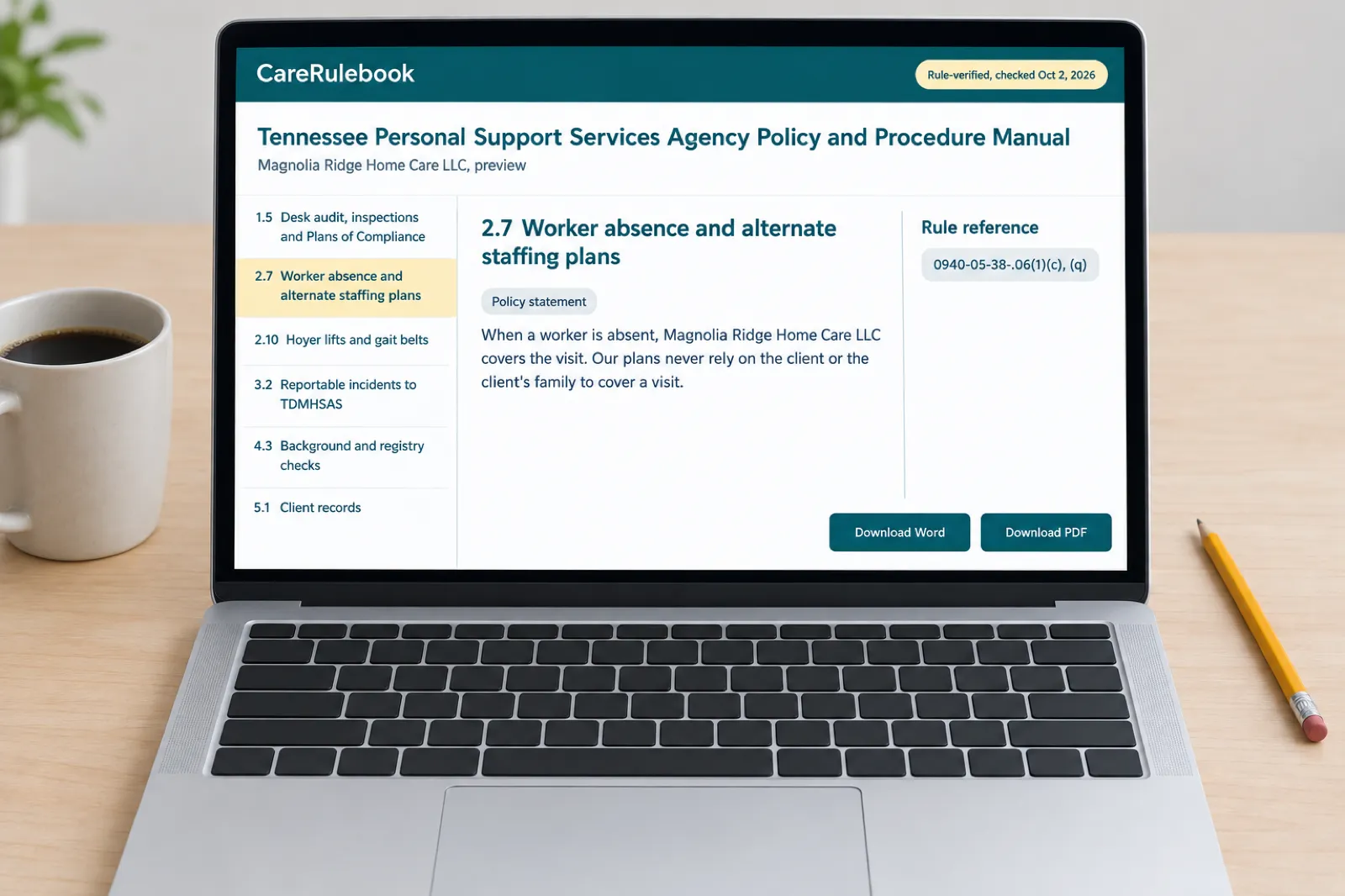
The CareRulebook Tennessee manual preview on a laptop: policy 2.7 on worker absence and alternate staffing plans for a sample agency, citing 0940-05-38-.06(1)(c), (q), with the manual’s contents listed beside it

CareRulebook

TDMHSAS’s desk audit covers certain policies before the first license.

CareRulebook’s Tennessee manual is built on the 17 policy items, the 8 personnel topics and every other requirement on this page, with your agency’s details and the rule quoted under each policy, and a crosswalk that shows the desk audit where each item is met.

  • 32 policies, 107 requirements mapped to 0940-05-38, 0940-05-02 and 0940-05-06
  • Rights and grievances, lifts and gait belts, and cooperation with investigations: the policy items on TDMHSAS’s list of common deficiencies
  • Editable Word and print-ready PDF, with the rule quoted under each policy
Preview your manual

$199CareRulebook founding price for the first 50 Tennessee agencies, then $249. Not a TDMHSAS fee.

Who runs the agency: the licensee, the person responsible and nurses

The licensee

Complies with all federal, state and local laws, directs the agency and sets its policies for the operation of the agency and the welfare of clients.

0940-05-38-.05(1), (3)

One person responsible

The licensee designates an individual responsible for the operation of the agency. The rules set no qualifications, training or experience for this role.

0940-05-38-.05(4)

Organizational chart

An organizational chart that clearly shows or describes the lines of authority. It is item (b) of the 17.

0940-05-38-.06(1)(b)

No nurse required

A registered nurse is needed only to give or supervise medication assistance training, or to give education services. A physician assistant cannot approve medication assistance training.

0940-05-38-.08(1)(b); PSSA slides, slide 24

Consultation for workers

Workers have access to consultation for any service: a registered nurse, other agency staff or the primary family caregiver.

0940-05-38-.07(2)(g)

Changes of leadership

A new chief executive or executive director is reported on TDMHSAS’s Change of Status form, with background forms and fingerprinting.

MH-4454

Two definitions disagree: the 2003 definitions chapter says education services are given by a "licensed nurse"; the 2016 PSSA chapter says a registered nurse. By our reading the PSSA chapter controls. (0940-05-01-.15(4); 0940-05-38-.01(6))

The office and your records

We found no office or premises standard for a PSSA in Chapter 0940-05-38, and TDMHSAS says a PSSA needs no fire or life safety inspection (TDMHSAS, step 4). Fact Sheet items 6 to 22, about buildings and occupancy, do not apply to PSSAs (MH-4386). What the rules do tie to a place:

  • The license is for an address. "Licenses are address-specific requiring a new license before a relocation may occur." (TDMHSAS Provider FAQs) "Each licensee will be issued one license for each site at which the licensee is operating a facility or service." (0940-05-02-.09)
  • Posting. "The license certificate shall be posted for public viewing in a conspicuous place at the facility or service." (0940-05-02-.16)
  • A complaint sign. "The licensee shall post a sign in the facility or service displaying the Department’s regional toll-free telephone number which informs service recipients, families, and the public that they may file a complaint with the Department." (0940-05-02-.20(2)) The rule was written with premises in mind and asks for a regional number; TDMHSAS publishes one statewide complaint line, 866-797-9470 (TDMHSAS Provider FAQs). Our suggestion: post it at your office and print it in every client’s rights information.
  • Where records are kept. You tell TDMHSAS the counties you serve and the address where you keep employee and client records (0940-05-38-.04(6)). Records may be paper or electronic: "“Written” means, as applied to licensee’s records, any generally accepted format, including electronic or paper, used for retaining business or client records." (0940-05-38-.01(11))

Whether the licensed site can be your home, and whether the records address must be in Tennessee, is not stated in the rules we saved. Ask your regional office before you sign a lease or apply from a home address, and check local zoning separately.

Caregiver training and competency

Tennessee sets topics, not hours. Workers must be 18 or older (0940-05-38-.07(2)(a)), and the agency ensures and documents that "Individuals who provide personal support services demonstrate basic competency in the following skill/knowledge areas prior to beginning work with service recipients" (0940-05-38-.08(1)(a)):

  1. Observing, reporting and documenting changes in a client’s daily living skills.
  2. Detecting, reporting and preventing abuse, neglect and exploitation.
  3. Client rights.
  4. Universal precautions and infection control.
  5. Helping with personal hygiene.
  6. Client safety.
  7. Emergency and disaster procedures, including at least emergency transportation, emergency medical care and staff coverage (.08(1)(a)7).
  • Before work, too: the language skills to read instructions, keep written records and communicate with the client, and documented training in self-care, household management, community living and service methods (0940-05-38-.07(2)(f)).
  • Client-specific training, documented, for each client’s needs (.08(1)(d)).
  • Every year: "Individuals who provide personal support services receive training on job related topics at least annually", with no hour minimum (.08(1)(c)), and an annual performance evaluation that at least assesses the worker’s ability to give daily supports (.07(1)(g)). Both competency before work and annual evaluations are on TDMHSAS’s common deficiency list.
  • Medication assistance: documented training by, or under the general supervision of, a registered nurse before a worker assists (.08(1)(b)).
  • Lifts and gait belts: used only after training (.06(1)(n)).

TDMHSAS says neither a TB skin test nor CPR certification is a licensure requirement, though a contract may require them (PSSA slides, slides 28-29).

Background checks and references for every worker

  • Criminal background check, results before contact. The personnel policy follows the rule: "all personal support services workers shall submit to a criminal background check every two (2) years or within ten (10) days of employment or within ten (10) days of a change of responsibilities that includes direct contact with or direct responsibility for service recipients, as required by T.C.A. § 33-2-1202" (0940-05-38-.07(2)(c)). TDMHSAS summarises the statute: "The background check shall be completed before allowing the person to have any direct contact with or direct responsibility for service recipients", and adds: "TDMHSAS has the interpretation that the background results shall be back and in the possession of the employer prior to employee direct contact with, or direct responsibility for, service recipients." (PSSA slides, slides 11 and 34)
  • The two-year re-check is not enforced. "Because of the verbiage of this rule concerning every 2 years, Licensure will not be enforcing this part of the rule." (PSSA slides, slide 8) The checks at hiring and on a move into direct-contact duties still apply. Our suggestion: repeating the check every two years is still sensible, and if you put it in your policy, follow it.
  • How. Fingerprints through the Tennessee Bureau of Investigation or the FBI, or "from a state licensed private investigation company without the use of a fingerprint sample" (PSSA slides, slide 11).
  • Abuse Registry, before contact and every year. No employee or volunteer on the registry may work (0940-05-38-.07(1)(d), .07(2)(d)). The rule says the Department of Health keeps it; the Health Facilities Commission now does, with the search at internet.health.tn.gov/AbuseRegistry (HFC, Abuse Registry).
  • Sex Offender Registry, before contact and every year. No one listed may work (0940-05-38-.07(1)(e), .07(2)(e)). The Tennessee Bureau of Investigation runs the registry (TBI).
  • References and work history, before employment. Each file holds a continuous five-year work history and personal references from three people, one of whom has known the applicant five years (0940-05-38-.07(1)(i)-(j)). TDMHSAS reads the statute as requiring you to check them before hiring: "Agency must directly communicate with at least two (2) of the three (3) required references listed." "Agency is required to communicate with the most recent employer. There is no requirement to check with ALL places listed, only employers where the applicant has worked for more than 6 months." (PSSA slides, slides 35-36). Documented attempts, such as a voicemail or an email, count, and "relatives can qualify as personal references" (slide 39).

Each personnel file also holds a signed and dated job description, proof the worker meets its requirements, the date of birth, annual performance evaluations and the worker notice (0940-05-38-.07(1)). The worker notice says whether the agency is an employer or a contractor, and who is responsible for wages, taxes, Social Security, workers’ compensation, unemployment and overtime (.07(1)(h)).

We could not save the statute TDMHSAS relies on here, T.C.A. 33-2-1202, so this section quotes TDMHSAS’s own summary. Ask TDMHSAS or a Tennessee lawyer before relying on anything beyond it.

Reporting abuse, neglect and incidents

Item (h) of the 17 is a policy on "reporting and investigation of suspected or alleged abuse or neglect of a service recipient, or other critical incidents", with corrective action and reporting to TDMHSAS’s Office of Licensure and any authority the law requires (0940-05-38-.06(1)(h)). Item (p) is a policy that you will cooperate with TDMHSAS’s investigations (.06(1)(p)).

To TDMHSAS

  • The rule. "The licensee must report to the Department any serious allegations or suspicion of abuse, dereliction, or deficiency in the operation of the facility or service." (0940-05-02-.20(3)) The licensee also reports significant occurrences involving the service, clients and staff (0940-05-02-.20(4)).
  • The deadline today. TDMHSAS’s instructions: "Report incidents to TDMHSAS Licensure Investigation Unit by the close of the next business day after the event or the next business day after the agency was made aware of the event." Use the Reportable Incident Form with supporting documents (TDMHSAS Incident Reporting Requirements; MH-5375).
  • What is reportable. Reportable incidents include a client’s death or suicide attempt while in the agency’s care, self-harm, abuse or neglect by staff (including withholding or negligently failing to provide services), sexual contact between staff and clients, theft by staff or misuse of client funds or cards, and injuries needing an ER or walk-in clinic or more than basic first aid. (TDMHSAS)
  • What is not reportable. Quality-of-service grievances (handle through the grievance procedure), staff-only injuries, routine medical appointments, and medical incidents not caused by injury need not be reported. For medical incidents not caused by injury, TDMHSAS says the agency must still document how each was handled. (TDMHSAS) Deaths when the agency is not providing or scheduled to provide services are not reportable unless abuse or neglect by the caregiver is suspected to have contributed. (TDMHSAS PSSA reporting documentation)
  • Missed visits. They are among the most common PSSA reports; TDMHSAS asks for your back-up staffing policy and the client’s alternate staffing plan (TDMHSAS PSSA reporting documentation), and says: "TDMHSAS feels it is not appropriate for care coverage to fall back on the client." If a worker calls in and the visit is not covered, the agency may be substantiated for not carrying out its back-up plan (PSSA slides, slide 31).

To Adult Protective Services, and for children

  • Adults. The Department of Human Services says anyone who suspects a vulnerable adult is being abused, neglected or financially exploited has a "legal obligation to notify APS": 1-888-APS-TENN (1-888-277-8366), 24/7, or online, and 911 in an emergency (DHS, APS brochure 2026; DHS, Adult Protective Services). We have not saved the Adult Protection Act itself.
  • Children. The PSSA client definition has no age limit. The Department of Children’s Services says: "Everyone in Tennessee is a mandated reporter. Tennessee Code Annotated 37-1-403(i) (1) requires all persons to report suspected cases of child abuse or neglect." Reports go to 1-877-237-0004 or online, and failure to report is a Class A misdemeanor (DCS, Report Child Abuse).
  • Complaints. TDMHSAS investigates licensed and unlicensed providers after reports of inadequate care or rule violations (TDMHSAS, Licensing); its complaint line is 866-797-9470 (TDMHSAS Provider FAQs).

Proposed: 48 hours. The proposed rewrite of 0940-05-02 would say "reportable incidents shall be reported to the Department as soon as possible, but no later than within forty-eight (48) hours of knowledge of the event", and that reporting only to other agencies or the police does not count (proposed 0940-05-02-.20(4)). It is not in force. Until TDMHSAS says otherwise, by our reading the next-business-day instruction is the one in force; reporting as soon as you can meets both.

Medication: assistance, and administration by certified staff

Medication assistance means "providing medication reminders and opening medication packaging, but does not mean giving the service recipient injections or any form of medication or medication administration" reserved for licensed nurses and others authorized under Title 63, Chapter 7 (0940-05-38-.01(9)). If you offer it, you need written authorization from the client or their representative first, documented RN-supervised training before any worker assists, and procedures for collecting information about each client’s medications (0940-05-38-.06(1)(l); .08(1)(b)). The written authorization in the client record is first on TDMHSAS’s common deficiency list (PSSA slides, slides 12-16). TDMHSAS lists filling medication planners as not allowed (slide 25).

Medication administration became possible in 2024. Public Chapter 730 says "An unlicensed person who is employed by a personal support service agency (PSSA) licensed under title 33 may administer medications to an individual who is incapable of self-administration in the individual’s place of residence after the unlicensed person satisfactorily completes a competency-based training program approved by the department of mental health and substance abuse services" (T.C.A. 68-1-904(c)(3), Public Chapter 730 (2024)). Certified staff still may not give intravenous, intramuscular or certain subcutaneous injectable medications (Public Chapter 730, section 3).

  • The training. TDMHSAS has approved the Department of Disability and Aging’s Medication Administration classes. For PSSAs not serving people with IDD, DDA charges $50 per participant for the 20-hour class and $25 for the Test-Out renewal; certification is valid for 3 years. That is DDA’s fee, not ours (PSSA slides, slide 21). Participants pass a written test with 80% or better and show competency in at least three skills (DDA agency guidelines).
  • What TDMHSAS asks of the agency. Notify the assigned TDMHSAS surveyor; keep each worker’s certificate in the personnel file; develop and implement a Medication Safety Policy (DDA has a sample); make sure staff understand the certification and its expectations. (PSSA slides, slide 22)
  • Rules are promised, not filed. TDMHSAS says it intends to make PSSA-specific rules on medication administration, mostly requiring policies and procedures, and will notify licensed PSSAs when they are filed. None was filed as of October 2, 2026. (slide 22; Secretary of State pending rules)
  • DDA’s sample policy. DDA’s sample covers medication prohibitions, security, program requirements, storage and labeling, MAR editing, refusals, the MAR, controlled substances, variances, disposal, family visits and self-administration. It is written for DDA providers; by our reading it needs adapting to home care. It also says: "Administration of medications to persons under the age of 18 is not covered under the exemption." (DDA sample Medication Safety Policy)

DDA’s rules for certified unlicensed personnel allow medication by oral, rectal, vaginal, eye, ear, nasal and topical routes, and subcutaneous routine insulin (with extra training) and injectable epinephrine. By our reading these rules govern PSSA staff certified through DDA’s classes; TDMHSAS has not said so in a rule. (0465-01-03-.06(1))

Tennessee PSSA license fees, renewal and timeline

These are state fees from TDMHSAS’s rules, and the Department of Disability and Aging’s fees for its optional medication administration class. They are paid to the state and are separate from any CareRulebook price.

State feeAmountPerSource
TDMHSAS license fee, one category (PSSA), per site$810initial or renewal application, per site (license up to 12 months; non-refundable)0940-05-02-.05(1)
TDMHSAS license fee, two categories at one site$1,010initial or renewal application, per site0940-05-02-.05(1)
TDMHSAS fee for an extra onsite inspection (maximum)$50onsite inspection other than initial or annual0940-05-02-.23(1)
DDA medication administration class (optional; DDA’s fee)$50participant, 20-hour class (certification valid 3 years)Slide 21
DDA medication administration Test-Out renewal (DDA’s fee)$25participantSlide 21
  • Non-refundable. "Each initial and renewal application for licensure must be submitted with the appropriate fees. All fees submitted are non-refundable." (0940-05-02-.05(1))
  • Extra inspections. Up to $50 for an onsite inspection other than the initial or annual one, invoiced and due within 30 days; TDMHSAS may withhold or suspend a license until fees are paid (0940-05-02-.23).
  • Background checks. The person responsible for the agency, and any other applicants, pay for their own checks; TDMHSAS does not publish the amount (MH-4385, item 7).
  • Insurance. Proof of liability insurance for the agency, workers and others who provide services; no minimum is set (0940-05-38-.07(3)). If workers drive clients, vehicle liability insurance too (.06(1)(m)3).

Renewal. Before the license expires, TDMHSAS tells you what to send, with fees by invoice; "All payments must be accompanied by a copy of the fee invoice before the fee will be credited to the appropriate agency or service." (0940-05-02-.07). If you file a timely, complete renewal, "the existing license does not expire until the status of the application has been determined by the Department" (0940-05-02-.15). Each renewal includes a new client-mix attestation (0940-05-38-.04(4)).

Changes, selling and closing. Licenses cannot be transferred. A new application and license are needed before services are provided after a change of ownership or location. (0940-05-02-.10) A new chief executive or executive director, a name change or a closure goes on the Change of Status form; for a closure it asks for the date, the reason and the arrangements for clients (MH-4454). The certificate is surrendered when the service closes or changes owner (0940-05-02-.17).

Timeline. Neither the rules nor TDMHSAS’s pages give a processing time from application to license (checked October 2, 2026). The waits come at the invoice, the scheduling of the desk audit and any corrections. We cannot give you a date.

Tennessee PSSA key facts

License
Personal Support Services Agency (PSSA) license from TDMHSAS0940-05-02-.01(1); 0940-05-38-.04
State fee
$810 per site, each year, paid to TDMHSAS0940-05-02-.05(1)
Apply
Four forms to the regional office; fee by invoiceBecome a Licensed Provider, steps 2-3
First inspection
Electronic desk audit, including certain policiesBecome a Licensed Provider, step 5
License issued
Initial license for up to one year, after any deficiencies are corrected0940-05-02-.02(1), .06(5)(b)
Written policies
17 policy items and 8 personnel-policy topics0940-05-38-.06(1), .07(2)
Nurse
Not required, except for medication assistance training or education services0940-05-38-.08(1)(b); .01(6)
Fire inspection
None for a PSSABecome a Licensed Provider, step 4
Caregivers
18 or older, competency in seven areas before work, yearly training; no hour minimum0940-05-38-.07(2)(a), .08(1)
Records
10 years after service ends, as TDMHSAS reads the statutePSSA slides, slide 30

Checked against official sources on October 2, 2026.

Proposed · not in force · hearing November 18, 2026

Rule changes: the licensing procedure rules are being rewritten

On September 24, 2026 TDMHSAS filed proposed amendments rewriting every rule in Chapter 0940-05-02, the licensure procedures that apply to PSSAs. The PSSA program rules in 0940-05-38 are not part of it, and the $810 fee stays the same (proposed 0940-05-02-.05). The changes that matter most to a PSSA:

  • Incident reporting deadline. Reportable incidents to TDMHSAS as soon as possible and within 48 hours of knowledge; reporting only to other agencies or police would not count. Staff-on-client incidents are named. (Proposed 0940-05-02-.20(3)-(4))
  • Review before the initial license. TDMHSAS may review policies, procedures, personnel files, client records, attestations and virtual review materials before issuing an initial license; no license until deficiencies are corrected. (Proposed 0940-05-02-.06(5))
  • Remote unannounced inspections. For services without an in-person site, the yearly unannounced inspection may be remote (video, telephone, secure document submission, record and policy review, interviews). (Proposed 0940-05-02-.22(3)-(4))
  • License types. A site not yet serving clients would renew to another initial license; a full license needs substantial compliance; a provisional license lasts up to 12 months and has the same force as a full license. (Proposed 0940-05-02-.02(1)-(3))

Other changes: records access in an approved format; fees before the initial inspection; overdue plans of compliance block renewal; renewal extensions; change of ownership defined; civil penalty notice in writing; complaint sign; surrendering the license certificate.

What it means for a new agency. By our reading, the biggest change is that the rule itself would say TDMHSAS may review policies, personnel files and client records before an initial license, which matches what its desk audit already does. Report incidents promptly either way, and, if the rewrite is adopted, expect yearly inspections that may be done by video, phone and document upload.

To comment: Attend the hearing on November 18, 2026, 10:00 a.m. Central, Ground Floor Hearing Room, Andrew Jackson Building, 500 Deaderick Street, Nashville (sign up to speak at the start; state-issued ID needed), or email written comments to Krysten.Velloff@tn.gov by 4:30 p.m. CDT on Friday, December 4, 2026. Contact: Krysten Velloff, 615-881-5280. (Secretary of State hearings list)

Medication administration rules: promised, not filed

Public Chapter 730 (2024) lets unlicensed PSSA staff administer medication after a TDMHSAS-approved competency program (TDMHSAS has approved DDA’s classes). TDMHSAS’s PSSA slides (file dated November 2025) say it intends to make PSSA-specific rules, mostly requiring medication administration policies and procedures, and will notify licensed PSSAs when they are filed. Until then it asks agencies using certified staff to notify their surveyor, keep certificates on file and develop and implement a Medication Safety Policy. No draft text, hearing or comment deadline exists; the Secretary of State’s pending rules list showed nothing for 0940-05-38 on October 2, 2026.

All rule changes we track →Notice 09-31-26

How many personal support services agencies does Tennessee have?

TDMHSAS publishes its licensed sites as data that it says is updated daily (TDMHSAS Fast Facts). In the export we downloaded on October 1, 2026 we counted 675 Personal Support Services Agency sites under 624 distinct agency names. The largest counties were Shelby (191 sites), Davidson (98), Knox (58) and Hamilton (53) (TDMHSAS licensed sites data, our count). PSSAs licensed by the Department of Disability and Aging are not in this data.

TDMHSAS also links a searchable database of licensed providers; it refused our requests, so we could not check it (TDMHSAS, Find a Licensed Facility).

Already licensed?

The manual is for existing Tennessee agencies too

If your agency already holds its TDMHSAS license, answer the same questions with the details you use today. CareRulebook builds the manual around your agency as it runs now.

What you get

  • Your agency’s own details filled in throughout, from your answers.
  • The written policies the Tennessee rules require, with the rule quoted under each one.
  • A crosswalk from each rule to the policy that meets it, so you can show TDMHSAS where each requirement is covered.
  • For 12 months after you buy, every download is built from our current policy library, so the corrections and rule updates we make in that time are in your next download.

Why it matters

  • TDMHSAS must make at least one unannounced inspection of each licensed service each year. 0940-05-02-.22
  • TDMHSAS says an agency should only be cited for policy rules listed in its applicable administrative rules, not for policies the rules do not require. TDMHSAS PSSA slides, slide 38
  • When a rule changes, the written policies built on it need to change with it.
  • If your policies came from a generic template or an older version of the rules, the rule crosswalk in the free preview lets you check each rule against what you have now.

Changes we are tracking for Tennessee

The manual follows the rules in force. Where a change touches a policy, that policy explains it in a Proposed changes section.

Tennessee home care myths, checked against the source

Eight about getting started, each with the rule or guidance it rests on.

Do I need a home care license from the Health Facilities Commission or Department of Health to start a non-medical home care agency in Tennessee?

No. Non-medical home care (self-care help, household help and community access) is licensed as a Personal Support Services Agency by TDMHSAS, or by the Department of Disability and Aging if most clients have an intellectual or developmental disability. The Health Facilities Commission’s home care organization license is for home health, home medical equipment, professional support and hospice services.

"The Tennessee Department of Mental Health and Substance Abuse Services is authorized to license facilities and services operated for the provision of mental health, substance abuse, and personal support services in the State of Tennessee by T.C.A. Title 33, Chapter 2, Part 4."

Do I need a nurse to open a PSSA in Tennessee?

No. The PSSA rules require no administrator qualifications and no supervising nurse. A registered nurse is needed only if you offer medication assistance (the training must be given by or under the general supervision of an RN) or the optional "education services". Workers must have access to consultation, which can be a nurse, other agency staff or the main family caregiver.

"Consultation may include providing the personal support service worker access to or consultation with a registered nurse, other agency staff or the primary family caregiver to assist the staff in providing personal support services; and"

Can I start serving private-pay clients while my PSSA application is pending?

No. No one may begin delivering services until TDMHSAS issues the license, and providing personal support services without a license is unlawful. TDMHSAS issues an initial license (up to one year) after its desk audit and after any deficiencies are corrected.

"No person, partnership, association or corporation may begin delivering services until the Department issues a license."

Does my PSSA office need a fire marshal inspection?

No. Not for the license. TDMHSAS says PSSAs currently do not need a life safety or fire inspection, and the initial inspection is an electronic desk audit. Check local zoning and business rules separately.

"Personal Support Services Agencies (PSSAs), D.U.I. Schools, and Non-Residential Office-Based Opiate Treatment offices (OBOTs) currently do not require a life safety/fire inspection."

Can my PSSA caregivers fill pill organizers or give medication?

No. Not under the basic license. Medication assistance is limited to reminders and opening packaging, such as opening a pill box filled by the client, their representative or a licensed professional; TDMHSAS lists filling medication planners as not allowed. Since 2024, staff who complete a TDMHSAS-approved medication administration certification (DDA’s 20-hour class) may administer medication in the client’s home to a client who cannot self-administer, and TDMHSAS then asks for a Medication Safety Policy.

"Opening pill reminder box if the box is filled by the service recipient or authorized representative or licensed medical personnel practicing within the scope of their license;"

Do Tennessee PSSA caregivers need a TB test or CPR certification?

No. Not for the TDMHSAS license. TDMHSAS says neither a TB skin test nor CPR certification is a licensure requirement, though a contract (for example with a Medicaid managed care organization) may require them. The rules do require competency in seven areas before work, including infection control, client safety and emergency procedures, and yearly job-related training.

"Are PSSA workers/caregivers required to have a TB skin test? No. This is not a Licensure requirement."

Can TDMHSAS cite my agency for missing a policy the rules don’t require?

No. TDMHSAS says it should not: an agency should only be cited for policy rules listed in its applicable administrative rules. For a PSSA that means the 17 items in 0940-05-38-.06(1), the eight personnel-policy topics in .07(2), and the other written duties in 0940-05-38, 0940-05-02 and 0940-05-06-.03(1)-(6).

"No, an agency should only be cited for violation of policy rules that are listed in the applicable administrative rules for the agency."

Do I have to re-run every caregiver’s criminal background check every two years?

It depends. The rule says "every two (2) years", but TDMHSAS says it will not enforce that part because of the wording. You must still run the check within 10 days of employment or of a move into direct-contact duties (with results back before any direct contact, in TDMHSAS’s reading), and check the Abuse Registry and the Sex Offender Registry every year and before contact.

"Because of the verbiage of this rule concerning every 2 years, Licensure will not be enforcing this part of the rule."

Frequently asked questions

How much does a home care license cost in Tennessee?

TDMHSAS’s fee for a Personal Support Services Agency is $810 per site for one category of service, paid with the initial application and again with every yearly renewal. A site licensed for two categories pays $1,010. TDMHSAS may also charge up to $50 for an extra onsite inspection. These are TDMHSAS’s fees, not CareRulebook prices, and they are non-refundable. The person responsible for the agency pays for their own background check, and you need liability insurance; the rules set no minimum amount.

How long does it take to get a PSSA license in Tennessee?

TDMHSAS does not publish a processing time, and neither do the rules. The steps are: forms to the regional office, an invoice for the fee, an electronic desk audit once the paperwork is in and the fee is paid, corrections if the audit finds deficiencies, then an initial license for up to one year. We cannot give you a date; TDMHSAS says a Regional Manager can explain the next steps.

Do I need a license for companion or homemaker care in Tennessee?

Usually, yes. Household help such as laundry, meal preparation, shopping and bill paying is itself a personal support service under the rules, and the matching exemptions cover only housekeeping, transportation or delivery services provided alone. Companionship is not named either as a service or as an exemption. By our reading, a companion service that also helps with household tasks or outings needs the license; ask TDMHSAS if you plan companionship alone.

Do I send my policies with the PSSA application?

TDMHSAS lists four forms for the application, and the Initial Application asks for a written description of your services. It does not list policies among the forms. But the initial inspection for a PSSA is an electronic desk audit covering certain policies and procedures, and deficiencies must be corrected before a license is issued, so by our reading you need every required policy written and adopted when you apply.

Can I run a Tennessee PSSA from home?

We found no office or premises rule for PSSAs in Chapter 0940-05-38, and TDMHSAS says PSSAs do not need a fire or life safety inspection. But licenses are tied to an address, the certificate is posted at the licensed site, and you tell TDMHSAS where you keep employee and client records. Whether a home address is acceptable is not stated in the rules we saved; ask your regional office, and check local zoning.

What is the difference between a TDMHSAS PSSA and a DDA PSSA?

The same kind of agency, licensed by different departments depending on who most of the clients are. If 50% or more are aged or have a mental illness or substance abuse diagnosis, TDMHSAS licenses it under 0940-05-38. If 50% or more have an intellectual or developmental disability, DDA licenses it under 0465-02-17, which adds rules on medication administration, assessments, Individual Support Plans and restrictive behavior management. An agency serving both groups needs only one license.

How often does TDMHSAS inspect a PSSA?

TDMHSAS must make at least one unannounced inspection of each licensed service a year, and its staff may enter, interview clients and review and copy records with or without notice. A proposed rewrite of the licensing procedure rules would let TDMHSAS do the yearly unannounced inspection remotely for services without an in-person site.

Can a PSSA serve TennCare clients?

This guide covers the TDMHSAS license. TennCare managed care contracts, credentialing and electronic visit verification are separate from the license and we have not reviewed them. TDMHSAS notes that some contracts require things the license does not, such as a TB test or CPR certification.

Get Tennessee rule-change alerts

TDMHSAS has proposed a rewrite of its licensure procedure rules, Chapter 0940-05-02 (hearing November 18, 2026), and has said PSSA medication administration rules are coming. Leave your email and we will tell you when a Tennessee change affects your policies.

No spam. Only emails about Tennessee home care rule changes. How we use your email.

Keep reading

North Carolina

How to start a home care agency in North Carolina

The DHSR license and the 32-item policy checklist, also reviewed before licensing.

Georgia

How to start a home care agency in Georgia

Companion care is licensed there too, and DCH requires an RN.

Virginia

How to start a home care agency in Virginia

The HCO license, RN supervision at least every 90 days and the 35 policy topics.

Indiana

How to start a home care agency in Indiana

The IDOH personal services agency license, IDOH’s $250 fee and the nine policies IDOH asks for.

Illinois

How to start a home care agency in Illinois

The IDPH home services license, policies mailed with the application and a 240-day provisional license.

Texas

How to start a home care agency in Texas

The HCSSA license, the $2,625 fee and every Chapter 558 policy.

Colorado

How to start a home care agency in Colorado

The CDPHE Class B license, policies ready for the initial survey and a license only after zero deficiencies.

Washington

How to start a home care agency in Washington

The DOH in-home services license, the orientation class and the policy manual DOH approves.

Maryland

How to start a home care agency in Maryland

The OHCQ residential service agency license, an RN overseeing hands-on care, and the 23 policy items indexed in the application.

US

All US states

Which states we cover and how each licenses home care.

Tracker

Rule change tracker

Every proposed and adopted change we follow, by state and nation.

Trust

How we verify rules

Every quote is checked against the official text, dated, and linked.

Sources

  1. Tenn. Comp. R. & Regs. 0940-05-38, Minimum Program Requirements for Personal Support Services Agencies (rules effective June 2, 2016; December 2022 revised edition) · Tennessee Secretary of State, Publications Division (TDMHSAS rules) · retrieved October 1, 2026
  2. Tenn. Comp. R. & Regs. 0940-05-02, Licensure Administration and Procedures (December 2022 revised edition) · Tennessee Secretary of State, Publications Division (TDMHSAS rules) · retrieved October 1, 2026
  3. Tenn. Comp. R. & Regs. 0940-05-06, Minimum Program Requirements for All Services and Facilities (May 2026 revised edition; 0940-05-06-.03(1)-(6) applies to PSSAs) · Tennessee Secretary of State, Publications Division (TDMHSAS rules) · retrieved October 1, 2026
  4. Tenn. Comp. R. & Regs. 0940-05-01, Definitions (February 2025 revised edition) · Tennessee Secretary of State, Publications Division (TDMHSAS rules) · retrieved October 1, 2026
  5. Tenn. Comp. R. & Regs. 0940-05-03, Application of Rules (February 2025 revised edition; includes the 2003 rule 0940-05-03-.26 for PSSAs) · Tennessee Secretary of State, Publications Division (TDMHSAS rules) · retrieved October 1, 2026
  6. Tenn. Comp. R. & Regs. 0465-02-17, Minimum Program Requirements for Intellectual and Developmental Disabilities Personal Support Services Agencies (October 2016) · Tennessee Secretary of State, Publications Division (DIDD, now DDA, rules) · retrieved October 1, 2026
  7. Tenn. Comp. R. & Regs. 0465-01-03, Administration of Medication by Unlicensed Personnel (as posted by DDA) · Tennessee Department of Disability and Aging · retrieved October 2, 2026
  8. Tenn. Comp. R. & Regs. 0720-35, Standards for Home Care Organizations Providing Professional Support Services (July 2022) · Tennessee Secretary of State, Publications Division (Health Facilities Commission rules) · retrieved October 1, 2026
  9. Tenn. Comp. R. & Regs. 0720-39, Registry of Persons Who Have Abused, Neglected, Misappropriated or Exploited the Property of Vulnerable Individuals (August 2025) · Tennessee Secretary of State, Publications Division (Health Facilities Commission rules) · retrieved October 2, 2026
  10. Notice of Rulemaking Hearing 09-31-26: TDMHSAS amendments to Chapter 0940-05-02, Licensure Administration and Procedures (filed September 24, 2026; hearing November 18, 2026) · Tennessee Secretary of State; Tennessee Department of Mental Health and Substance Abuse Services · retrieved October 1, 2026
  11. Rulemaking Hearings list (0940-05-02 entry, notice 4392) · Tennessee Secretary of State · retrieved October 2, 2026
  12. Pending Rules list · Tennessee Secretary of State · retrieved October 2, 2026
  13. Public Chapter No. 110 (2015), amending T.C.A. 33-2-403(a) and (c), licensing of personal support services agencies · Tennessee Secretary of State (Public Acts) · retrieved October 2, 2026
  14. Public Chapter No. 730 (2024), amending T.C.A. 68-1-904, medication administration by unlicensed PSSA staff · Tennessee Secretary of State (Public Acts) · retrieved October 1, 2026
  15. Public Chapter No. 858 (2024), amending T.C.A. 68-11-201(22), definition of home care organization (effective July 1, 2024) · Tennessee Secretary of State (Public Acts) · retrieved October 1, 2026
  16. Staff Determination on Public Chapter 858 (2024), April 29, 2025 · Tennessee Health Facilities Commission · retrieved October 1, 2026
  17. HFC Rules and Laws · Tennessee Health Facilities Commission · retrieved October 1, 2026
  18. Become a Licensed Provider · Tennessee Department of Mental Health and Substance Abuse Services, Office of Licensure · retrieved October 1, 2026
  19. Licensing Forms · Tennessee Department of Mental Health and Substance Abuse Services, Office of Licensure · retrieved October 1, 2026
  20. Licensed Provider Frequently Asked Questions · Tennessee Department of Mental Health and Substance Abuse Services, Office of Licensure · retrieved October 1, 2026
  21. Find a Licensed Facility or Service · Tennessee Department of Mental Health and Substance Abuse Services, Office of Licensure · retrieved October 1, 2026
  22. Fast Facts: TDMHSAS Licensed Sites · Tennessee Department of Mental Health and Substance Abuse Services · retrieved October 1, 2026
  23. Licensing (Office of Licensure) · Tennessee Department of Mental Health and Substance Abuse Services · retrieved October 2, 2026
  24. Personal Support Services Agency (PSSA) Provider Information (2025 slide deck; file modified November 2025) · Tennessee Department of Mental Health and Substance Abuse Services, Office of Licensure · retrieved October 1, 2026
  25. Initial Application for License, MH-4385 (rev. 05/15/2020) · Tennessee Department of Mental Health and Substance Abuse Services, Office of Licensure · retrieved October 2, 2026
  26. Licensure Application Addendum: Fact Sheet Form, MH-4386 (rev. 10/27/2025) · Tennessee Department of Mental Health and Substance Abuse Services, Office of Licensure · retrieved October 2, 2026
  27. Licensure Application Addendum: Financial Statement Form · Tennessee Department of Mental Health and Substance Abuse Services, Office of Licensure · retrieved October 2, 2026
  28. Agency/Service Change of Status Form, MH-4454 (rev. 5/15/2020) · Tennessee Department of Mental Health and Substance Abuse Services, Office of Licensure · retrieved October 2, 2026
  29. Incident Reporting Requirements · Tennessee Department of Mental Health and Substance Abuse Services, Office of Licensure · retrieved October 2, 2026
  30. Documentation Required for the Most Common Incidents Reported by Personal Support Service Agencies · Tennessee Department of Mental Health and Substance Abuse Services, Office of Licensure · retrieved October 2, 2026
  31. Reportable Incident Form, MH-5375 (revised 12/12/22) · Tennessee Department of Mental Health and Substance Abuse Services, Office of Licensure · retrieved October 2, 2026
  32. TDMHSAS licensed sites dashboard, CSV export (one row per site and category), downloaded October 1, 2026 · Tennessee Department of Mental Health and Substance Abuse Services (data.tn.gov Tableau) · retrieved October 1, 2026
  33. Nursing: Medication Administration (classes, rules, forms, Medication Safety Policy Sample) · Tennessee Department of Disability and Aging · retrieved October 2, 2026
  34. Sample Medication Safety Policy (revised 10/15/25) · Tennessee Department of Disability and Aging · retrieved October 2, 2026
  35. Medication Administration Agency Guidelines and Medication Administration Standards · Tennessee Department of Disability and Aging · retrieved October 2, 2026
  36. Abuse Registry · Tennessee Health Facilities Commission · retrieved October 2, 2026
  37. Adult Protective Services page and APS brochure (2026) · Tennessee Department of Human Services · retrieved October 2, 2026
  38. Report Child Abuse: 877-237-0004 · Tennessee Department of Children’s Services · retrieved October 2, 2026
  39. Tennessee Sex Offender Registry · Tennessee Bureau of Investigation · retrieved October 2, 2026
Build your Tennessee manualfrom $199