Skip to content
CareRulebook
MenuClose

What do you run?

Home care in the US19 states with a manual, 6 with a free guide
ColoradoManual
ConnecticutPack
DelawareManual
GeorgiaManual
IllinoisManual
IndianaManual
KansasManual
MaineManual
MarylandManual
MinnesotaManual
NevadaManual
North CarolinaManual
OklahomaManual
OregonManual
South CarolinaManual
TennesseeManual
TexasManual
VirginiaManual
WashingtonManual
CaliforniaGuideFloridaGuideNew JerseyGuideNew YorkGuideOhioGuidePennsylvaniaGuideAll US home care states →
Care homes in the USCalifornia, Michigan, Minnesota; more states coming
Home care in the UKEngland, Scotland, Wales
Free toolsChecklists, calculators and templates

Minnesota · Caregivers · Minn. Stat. 144A.4795-144A.4797

Minnesota caregiver training: 15 topics, then eight hours a year

For a basic home care license, Minnesota sets topics and competency for new caregivers, then hours every year. Before serving clients, staff complete an orientation on eight topics. Caregivers then complete a training and competency evaluation on 15 topics, or pass a written or oral test and a practical skills test. Trainers need home care experience, not a nursing license. After that, at least eight hours of training every 12 months.

  • Rule-verified October 8, 2026
  • Quoted from Minn. Stat. 144A.4795 to 144A.4797
  • And MDH’s survey forms
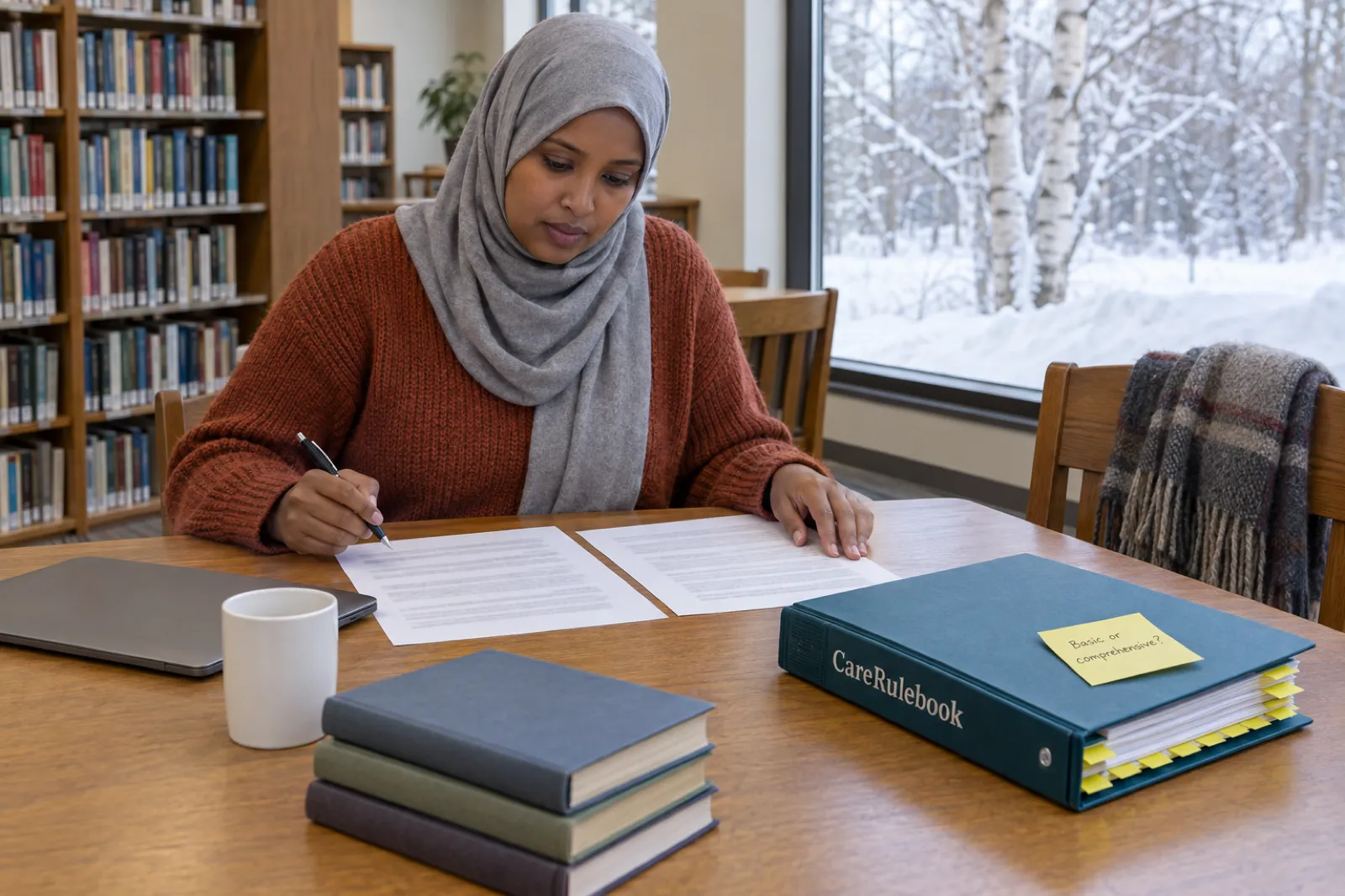
A woman in a grey hijab and a rust sweater writes on one of two printed pages at a library table, beside a teal CareRulebook binder with a sticky note reading Basic or comprehensive?, a stack of books, a white mug and a closed laptop, with snow and birch trees outside the window

Quick answer

First, orientation. "All staff providing and supervising direct home care services must complete an orientation to home care licensing requirements and regulations before providing home care services to clients." (Minn. Stat. 144A.4796, subd. 1)

Then competency. Unlicensed staff providing basic home care services must have "successfully completed a training and competency evaluation appropriate to the services provided by the home care provider and the topics listed in subdivision 7, paragraph (b)", or pass a written or oral test on their tasks and those topics plus a practical skills test on hygiene and grooming, standby assistance and reminders (144A.4795, subd. 3(a)). We found no hour count for this training.

Then every year. "All staff that perform direct home care services must complete at least eight hours of annual training for each 12 months of employment." (144A.4796, subd. 6(a))

8 topics

in orientation, before serving any client

144A.4796, subd. 2(a)

15 topics

in every unlicensed caregiver’s training and competency evaluation

144A.4795, subd. 7(b)

8 hours

of training for each 12 months of employment

144A.4796, subd. 6(a)

3 years

to keep each employee record after the person leaves

144A.479, subd. 7

Basic license only. This page covers the basic home care license, which CareRulebook’s Minnesota manual is written for. Basic staff "may not perform delegated nursing or therapy tasks" (144A.4795, subd. 3(a)). The comprehensive license adds RN-led training, set out as a contrast below; the manual does not cover it. Which license you need: basic or comprehensive.

From hire to first visit, and every year after

The duties in the order a new caregiver meets them. Tick steps off as you go; progress is saved in this browser only.

  1. Background study, in parallel

    Before direct contact

    Until DHS issues one of the listed notices, the person may not provide direct contact services unless under continuous direct supervision. Background studies.

  2. Orientation to home care licensing

    Before serving clients

    Everyone who provides or supervises direct home care services completes an orientation on eight topics before providing services to clients. The eight topics.

  3. Training and competency on 15 topics

    Before giving basic services

    Unlicensed staff either complete a training and competency evaluation on the 15 topics, or pass a written or oral test on their tasks and the topics plus a practical skills test on hygiene and grooming, standby assistance and reminders. The 15 topics.

  4. TB screening and training at hire

    At hire (MDH guidance)

    MDH’s 2013 TB manual says TB training is required at hire for all health care workers, MDH’s FAQ says baseline TB screening is required at hire, and MDH’s TB survey form (5051) checks that each worker’s baseline TB results are kept in their employee file. Dementia and TB training.

  5. Orientation to each client

    Before each new client (our timing)

    Staff are oriented specifically to each client and the services to be provided, in person, orally, in writing or electronically. CareRulebook’s manual does this before the first visit to each client.

  6. Supervision where services are given

    Periodically

    A supervisor observes the caregiver at work periodically, at a frequency based on the person’s competency and performance. The statute sets no number of days. Supervision.

  7. Eight hours of training every 12 months

    Each 12 months

    At least eight hours for each 12 months of employment, including maltreatment reporting, the bill of rights, infection control and a review of your policies.

  8. Annual performance review

    Every year

    Employee records hold documentation of annual performance reviews which identify areas of improvement needed and training needs.

Emergency preparedness too. "The licensee must provide adequate orientation and training of staff on emergency preparedness." (144A.4791, subd. 12) Contracted staff. Individual contractors and temporary staffing agency workers meet the same training and competency rules as your own staff (144A.4795, subds. 5-6); CareRulebook’s manual covers them in Policy 4.3.

Orientation: eight topics before any client

The orientation must contain these topics (Minn. Stat. 144A.4796, subd. 2(a)):

  1. An overview of Minn. Stat. 144A.43 to 144A.4798
  2. The provider’s policies and procedures for the person’s services
  3. Handling emergencies and using emergency services
  4. Reporting maltreatment of minors or vulnerable adults (626.557, chapter 260E)
  5. The home care bill of rights (144A.44)
  6. Handling and reporting complaints, including the Office of Health Facility Complaints and the Common Entry Point
  7. Consumer advocacy services, such as the ombudsman offices
  8. The services the employee will provide and the provider’s scope of licensure

Summarized from the statute. 144A.4796, subd. 2(a)

  • Once, and not transferable. "The orientation need only be completed once for each staff person and is not transferable to another home care provider." So a new hire oriented by another provider still completes yours (subd. 1).
  • It can count as training. "The orientation may be incorporated into the training required under subdivision 6." On our reading, orientation hours in a person’s first 12 months count toward that period’s eight hours; CareRulebook’s manual counts them that way.
  • Hearing loss, optional. Orientation and annual training may also include training on serving clients with hearing loss, which must be high quality and research-based (subds. 2(b), 6(b)). The manual asks whether you want it.
  • Orientation to each client. "Staff providing home care services must be oriented specifically to each individual client and the services to be provided." "This orientation may be provided in person, orally, in writing, or electronically." (subd. 4) The statute does not say when; CareRulebook’s manual does it before the first visit to each client, every time, and records it on a client orientation record.
  • The bill of rights. All staff must be informed of the home care bill of rights (144A.4795, subd. 1); it is orientation topic 5 and an annual topic.

Policy 2.4 (Orientation to home care and to each client) in CareRulebook’s manual has an orientation checklist, a curriculum outline that maps each topic to the policies taught, and the client orientation record. MDH’s entrance conference asks you to "Describe who trains staff on home care licensing requirements and regulations and how that training is done." (MDH form 5065b)

Training and competency: the 15 topics

"Training and competency evaluations for all unlicensed personnel must include the following" these 15 (Minn. Stat. 144A.4795, subd. 7(b)). On the test route, the topics marked "practical" also need a practical skills test (subd. 3(a)(2)).

ClauseTopicPractical skills test on the test route
(1)Documentation requirements for all services
(2)Reporting changes in the client’s condition to the designated supervisor
(3)Basic infection control, including blood-borne pathogens
(4)A clean and safe environment
(5)Personal hygiene and grooming: hair care and bathing; teeth, gums and oral prosthetic devices; hearing aids; dressing and help with toiletingPractical
(6)Preventing falls, for those working with older people or anyone at risk of falls
(7)Standby assistance techniquesPractical
(8)Medication, exercise and treatment remindersPractical
(9)Basic nutrition, meal preparation, food safety and help with eating
(10)Preparing modified diets ordered by a licensed health professional
(11)Communication that preserves dignity and respects the client’s preferences, culture and family
(12)Confidentiality and privacy
(13)Boundaries between staff and clients and their families
(14)Handling emergency situations
(15)Commonly used health technology equipment and assistive devices

Summarized from the statute. 144A.4795, subd. 7(b); subd. 7(b)(5)

The two routes

  1. Training and competency evaluation appropriate to your services and the 15 topics.
  2. Test only: a written or oral test on the tasks the person will perform and the 15 topics, and a practical skills test on clauses (5), (7) and (8) (144A.4795, subd. 3(a)).

MDH: "A practical skills test focuses on the person’s “hands-on” ability to perform the task via observation by evaluating performance in simulated real-life scenarios rather than just knowledge recall." (MDH training FAQ) MDH’s basic employee record review says: "Indicate evidence in the employee record to support training and competency in the following topics. For underlined topics, indicate evidence the ULP completed a practical skills test of the task." (MDH form 5021b)

  • Every topic, even unused ones. The statute lists the topics for all unlicensed personnel, so CareRulebook’s manual trains every caregiver on all 15, including modified diets and reminders you may not offer (our reading).
  • Within a basic license. Standby assistance means "the presence of another person to assist a client with an assistive task by providing cues, oversight, and minimal physical assistance" (144A.43); reminders are verbal or visual reminders, including bringing medication already set up or in its original containers (144A.471, subd. 6). "Medication management services may not be provided by a home care provider who has a basic home care license." (144A.4792, subd. 1(a))
  • Nursing assistants. "ULPs currently listed on the MDH nursing assistant registry (NAR) are assumed to be competent in these requirements." (MDH form 5021b) This is MDH survey practice, not statute text.

The statute sets no pass mark. In Policy 2.5 (Training and competency evaluation of unlicensed personnel), CareRulebook’s manual asks you to choose either route or both, sets a pass mark of at least 80 percent on the written or oral test (the manual’s choice), runs the practical skills checks in a simulated scenario before any client visit, and retrains anyone not yet competent before they do that task.

Who trains and evaluates

  • Basic license. Training and competency evaluations are conducted by "individuals with work experience and training in providing home care services listed in section 144A.471, subdivisions 6 and 7" (144A.4795, subd. 7(a)(1)). MDH’s toolkit: "RN involvement is not required." (MDH toolkit 2.1)
  • What surveyors check. For an employee who trains unlicensed staff, MDH’s record review verifies their training and experience in home care services delivery (MDH form 5021b). CareRulebook’s manual records each trainer’s experience on a trainer and evaluator qualification record.
  • Supervisors who train. "The supervision of the unlicensed personnel must be done by staff of the home care provider having the authority, skills, and ability to provide the supervision of unlicensed personnel and who can implement changes as needed, and train staff." (144A.4797, subd. 2(a))
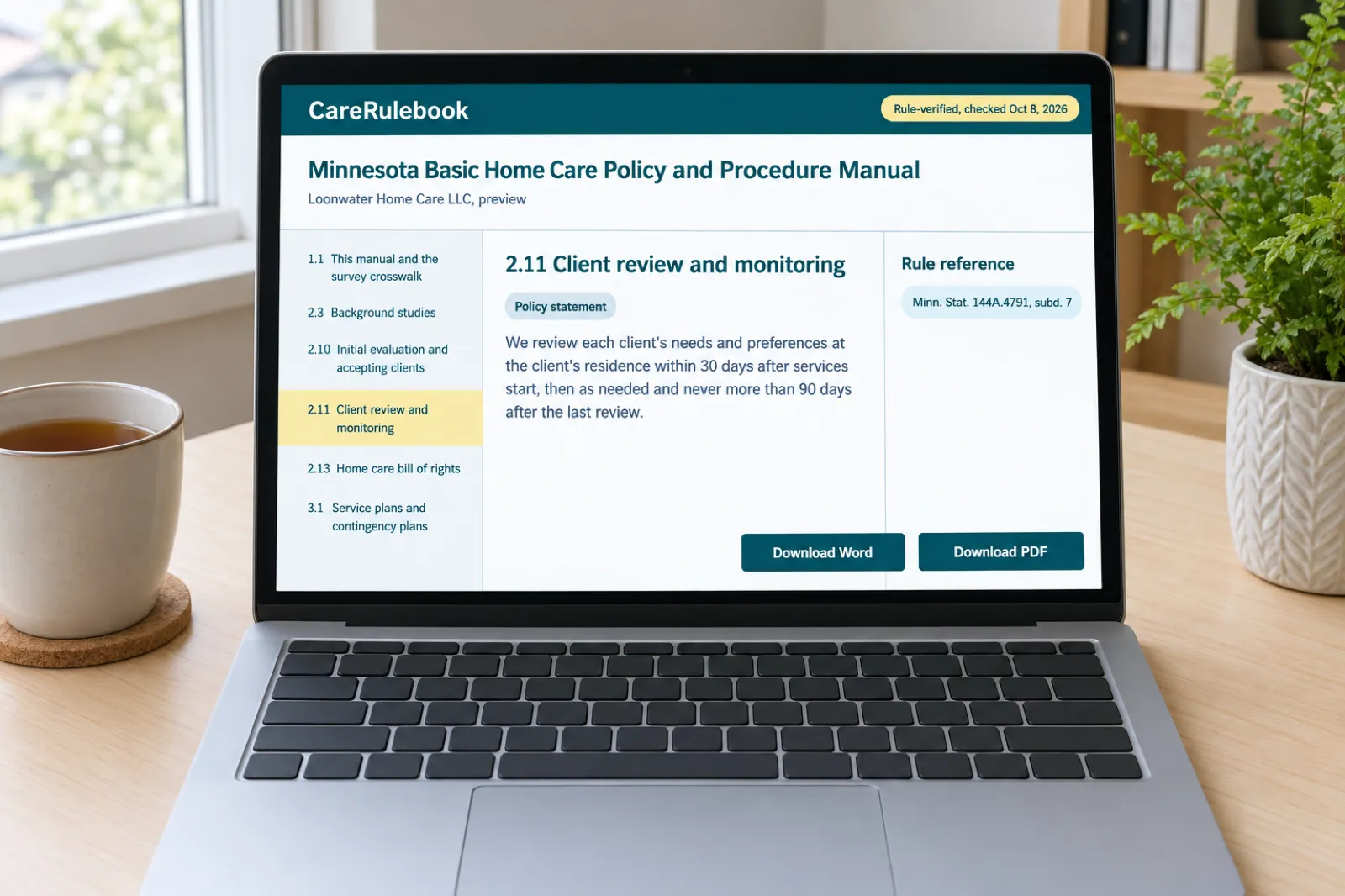
The CareRulebook Minnesota manual preview on a laptop: policy 2.11 on client review and monitoring for a sample agency, citing Minn. Stat. 144A.4791, subd. 7, with six of the manual’s policies listed beside it

CareRulebook

Training records written for your basic agency

CareRulebook’s Minnesota manual includes Policy 2.4 (Orientation to home care and to each client), Policy 2.5 (Training and competency evaluation of unlicensed personnel) with the 15-topic training and competency record, Policy 2.7 with a dementia training record and the written training description, Policy 2.6 with the annual training record and calendar, and Policy 4.1 with the supervisory visit record.

  • 31 policies for the basic license, with the ten application policies in the statute’s order
  • Your choice of competency route and supervision schedule, written into the policies
  • Editable Word and PDF; download again free for 12 months
Preview your manual

$199CareRulebook founding price for the first 50 Minnesota agencies, then $249. Not an MDH fee.

Dementia and TB training

Dementia

"For home care providers that provide services for persons with Alzheimer’s or related disorders, all direct care staff and supervisors working with those clients must receive training that includes a current explanation of Alzheimer’s disease and related disorders, effective approaches to use to problem-solve when working with a client’s challenging behaviors, and how to communicate with clients who have Alzheimer’s or related disorders." (144A.4796, subd. 5)

  • MDH’s survey form goes wider. "Initial Dementia training required for all direct care staff and supervisors" (MDH form 5021b), and the entrance conference asks for your system for completing it "at hire date and annually" (form 5065b). Our reading: the statute sets no frequency, but expect surveyors to look for initial and yearly training, and train everyone if you may serve clients with dementia.
  • A written description. "The home care provider that provides services to clients with dementia shall provide in written or electronic form, to clients and families or other persons who request it, a description of the training program and related training it provides" (144A.4791, subd. 2)
  • In the manual. Policy 2.7 (Dementia training and the training description) trains every direct care staff member and supervisor on the three topics before their first client and again every 12 months, and includes a ready description of the program to hand out. That timing is the manual’s choice.

Tuberculosis

  • At hire. MDH’s TB manual (July 2013): "TB training is required at time of hire for all HCWs." (MDH TB manual, p. 7)
  • Every year. MDH’s FAQ: "All Minnesota health care personnel should receive TB education annually." (MDH TB FAQ) This is MDH guidance under the infection control statute, not statute text.
  • Why it matters. TB infection control was among the most cited correction orders for basic providers in MDH’s FY 2021-2022 report (MDH legislative report). CareRulebook’s manual keeps a TB education record in Policy 2.16 (Tuberculosis infection control program and staff screening), and counts the yearly session toward the eight hours.

Eight hours of training every 12 months

"All staff that perform direct home care services must complete at least eight hours of annual training for each 12 months of employment." "The training may be obtained from the home care provider or another source and must include topics relevant to the provision of home care services." (Minn. Stat. 144A.4796, subd. 6(a)) It must include (subd. 6(a)(1)-(4)):

  1. reporting of maltreatment of minors under chapter 260E and of vulnerable adults under 626.557, whichever applies to your services;
  2. a review of the home care bill of rights;
  3. a review of infection control techniques used in the home, including hand-washing, gloves, gowns and masks, disposal of contaminated materials, disinfecting equipment and surfaces, and reporting communicable diseases; and
  4. a review of your policies and procedures and how to implement them.
  • Which 12 months. The statute says "each 12 months of employment". MDH’s entrance conference gives "monthly, yearly, or anniversary hire date" as examples of an annual training system (form 5065b). CareRulebook’s manual counts from each person’s hire date (our reading).
  • Surveyors check it. MDH’s basic employee record review records the last annual training dates and checks at least eight hours for every 12 months of employment in the required topics (form 5021b).
  • In the manual. Policy 2.6 (Annual training) adds the dementia refresher and TB education to the four set topics, keeps a training calendar checked every month, and does not schedule anyone for client visits once a 12-month period ends short until the hours and topics are done. Those are the manual’s choices.

Supervision: periodic, on site

  • What the statute asks. "Staff who perform basic home care services must be supervised periodically where the services are being provided to verify that the work is being performed competently and to identify problems and solutions to address issues relating to the staff's ability to provide the services." "Supervision includes direct observation of unlicensed personnel while the unlicensed personnel are providing the services and may also include indirect methods of gaining input such as gathering feedback from the client." "Supervisory review of staff must be provided at a frequency based on the staff person's competency and performance." (144A.4797, subd. 2)
  • Someone to call. A basic licensee has a person available to staff for consultation whenever they are providing services, in person, by telephone or by other means (144A.4797, subd. 1).
  • No number of days. The statute sets no interval (our reading). CareRulebook’s manual, in Policy 4.1, has the supervisor observe each caregiver within 30 days of first working alone, then at least every six months, every three months or once a year, as you choose. The supervisor decides whether to observe sooner after a complaint, a new task, a performance concern or a long absence, and records the reason.
  • Records. "A home care provider must retain documentation of supervision activities in the personnel records." (subd. 4) Annual performance reviews identify training needs (144A.479, subd. 7(4)); the manual’s review form is in Policy 2.8.

Training records to keep

  • In each employee record. "records of orientation, required annual training and infection control training, and competency evaluations" (Minn. Stat. 144A.479, subd. 7(2)), with evidence of each person’s orientation (144A.4796, subd. 3) and of everyone who has satisfied the orientation and training requirements (subd. 7).
  • For three years after they leave. "Each employee record must be retained for at least three years after a paid employee, home care volunteer, or contractor ceases to be employed by or under contract with the home care provider." (144A.479, subd. 7)
  • What MDH asks at the start of a survey. The entrance conference asks for policies on the training of unlicensed personnel and on "Orientation and annual training (including curriculum)" (form 5065b), and asks you to describe how staff orientation and training are documented and tracked (form 5065b).
  • Where agencies slip. Employee records were among the most cited correction orders for basic providers in MDH’s FY 2021-2022 report (MDH legislative report).

CareRulebook’s manual keeps an employee record checklist in Policy 4.2 (Employee records and retention), and each training form above files into it.

What a comprehensive license adds (contrast)

CareRulebook’s manual covers the basic license only. For context, a comprehensive licensee’s unlicensed staff who perform delegated nursing tasks either complete training and pass a written or oral test on seven more topics plus a practical skills test on set tasks and every delegated task, or meet Medicare’s home health aide or nursing assistant training rules (or completed an approved nursing assistant course before April 19, 1993), and "training and competency evaluations of unlicensed personnel providing comprehensive home care services must be conducted by a registered nurse, or another instructor may provide training in conjunction with the registered nurse" (144A.4795, subds. 3(b), 7(a)(2), 7(c)). Those duties do not apply under a basic license, where staff may not perform delegated tasks at all.

CFSS and PCA worker training: program rules

Medical Assistance programs set their own worker training. These are program rules under Minn. Stat. chapter 256B, not the home care license.

  • PCA. Personal care assistants complete DHS’s standardized training, including basic first aid, before enrolling, and training on the recipient’s needs (256B.0659, subd. 11(8)-(9)). Organizations providing Medical Assistance PCA are exempt from the MDH license (144A.471, subd. 8(b)(1)).
  • CFSS. CFSS support workers complete DHS’s basic standardized CFSS training, including basic first aid, before enrolling, pass a certification test, and complete employer-directed training on the participant’s needs (256B.85, subd. 16(a)(4)-(5)). The CFSS statute says CFSS will replace the PCA program upon federal approval (256B.85, subd. 1(d)). The license exemptions name PCA, not CFSS, so whether CFSS-only work needs an MDH license is not settled; our reading is on who needs a license.

If you run both, a caregiver may need the program training for Medical Assistance clients and your 144A training for licensed clients. CareRulebook’s manual covers the 144A training only.

What the statute does not set

Each of these is our reading of Minn. Stat. 144A.4795 to 144A.4797.

  • Hours for the competency training. Topics and a way to show competency, but no hours (144A.4795, subd. 3(a)). Only the annual training has hours.
  • A pass mark or a state test. The statute speaks of "satisfactorily completing a written or oral test" and names no score (144A.4795, subd. 3(a)(2)).
  • CPR or first aid certification. Not named for licensed basic providers. The 15 topics include "procedures to utilize in handling various emergency situations" (subd. 7(b)(14)). Basic first aid appears in the PCA and CFSS program training above.
  • A nurse. Not for training or supervising basic staff (MDH toolkit).
  • A supervision interval. Frequency follows each person’s competency and performance (144A.4797, subd. 2(b)).

Myths about Minnesota caregiver training

How much training do Minnesota basic home care caregivers need?

It depends. The statute sets topics and competency, not hours, for new caregivers: an orientation on licensing rules before they serve anyone, then a training and competency evaluation on 15 topics, or a written or oral test plus a practical skills test on hygiene, standby assistance and reminders. MDH’s survey form for basic providers says nursing assistants on the MDH registry are assumed competent in those topics. After that, every direct care worker needs at least eight hours of training each year.

"All staff that perform direct home care services must complete at least eight hours of annual training for each 12 months of employment."

Do I need a nurse to open a basic home care agency in Minnesota?

No. Not for a basic license. Basic services are assistive tasks such as help with bathing, dressing and toileting, standby assistance and reminders, and basic staff may not perform delegated nursing tasks. MDH says no nursing assessment is needed under a basic license; instead someone reviews each client’s needs at home within 30 days, then at least every 90 days. Staff are trained by people with home care experience, not necessarily an RN. A comprehensive license is different: it needs an RN for assessments, delegation and supervision.

"No. There can be no delegated nursing tasks under a basic license, therefore no nursing assessment is required."

Can a basic home care license help clients with transfers?

It depends. Not hands-on. Hands-on help with transfers and mobility is a comprehensive service. "Hands-on" means physical help without which the client cannot do the activity. A basic licensee can give standby assistance: being present with cues, oversight and minimal physical help. On our reading, if clients need someone to lift or bear their weight, you need the comprehensive license. Where minimal help ends is MDH’s call, so describe it carefully in your statement of services.

"hands-on assistance with transfers and mobility;"

Do Medicaid PCA or CFSS agencies need an MDH home care license?

It depends. Organizations providing Medical Assistance personal care assistance are exempt from the MDH license. The license exemptions name PCA, not CFSS, but the CFSS statute says that, for the purposes of that section, supports bought under Community First Services and Supports (CFSS, which replaces PCA) are not considered home care services. On our reading, CFSS work therefore sits outside the MDH license; ask MDH to confirm. Exempt providers still follow the home care bill of rights. Private-pay personal care needs the MDH license.

"an individual or organization that offers, provides, or arranges for personal care assistance services under the medical assistance program as authorized under sections 256B.0625, subdivision 19a, and 256B.0659;"

Frequently asked questions

How many hours of training do Minnesota home care caregivers need?

The statute sets no hours for a new caregiver’s training and competency evaluation; it sets 15 topics and a way to show competency. After that, every staff member who performs direct home care services completes at least eight hours of annual training for each 12 months of employment, including four set topics. Orientation may be incorporated into that annual training.

What are the two ways to show competency under a basic license?

Either a training and competency evaluation appropriate to your services and the 15 topics in Minn. Stat. 144A.4795, subd. 7(b), or a written or oral test on the tasks the person will perform and the 15 topics, plus a practical skills test on personal hygiene and grooming, standby assistance, and medication, exercise and treatment reminders. MDH describes a practical skills test as observing hands-on performance in simulated real-life scenarios.

Does a registered nurse have to train caregivers for a basic license?

No. For basic services, training and competency evaluations are conducted by people with work experience and training in providing home care services, and MDH’s toolkit says RN involvement is not required. For a comprehensive license, an RN conducts them, or another instructor trains together with the RN.

Do CNAs need training to work for a Minnesota basic agency?

MDH’s basic employee record review says unlicensed staff currently listed on the MDH nursing assistant registry are assumed to be competent in the 15 topics. They still complete orientation and annual training. CareRulebook’s manual also checks standby assistance and reminders in a practical skills check before the first visit, because nursing assistant training covers hands-on tasks a basic license does not allow; that check is the manual’s own practice.

Is dementia training required for Minnesota home care staff?

The statute requires it for providers serving people with Alzheimer’s disease or related disorders, for all direct care staff and supervisors working with those clients, covering the disease, challenging behaviors and communication. MDH’s basic employee record review lists initial dementia training for all direct care staff and supervisors. On our reading, train everyone if you may serve clients with dementia. A provider serving clients with dementia must also give a written or electronic description of its training to clients, families and others who ask.

Can annual training be online or from another provider?

From another provider, yes: the statute says the annual training may be obtained from the home care provider or another source and must include topics relevant to home care. It says nothing about format, so on our reading an online course can count if it covers the required topics; the statute mentions online training only for the optional hearing loss topic. Keep a record of each session in the employee record, because MDH’s record review checks the training dates, the eight hours and each required topic.

Is the CFSS or PCA training the same as the license training?

No. DHS’s standardized PCA and CFSS worker training, which includes basic first aid and a certification test for CFSS, is a Medical Assistance program rule for workers enrolling in those programs. Organizations providing Medical Assistance PCA are exempt from the MDH license. Private-pay home care under an MDH license follows Minn. Stat. 144A.4795 and 144A.4796.

Get Minnesota rule-change alerts

The 2026 session amended Minnesota’s home care, vulnerable adult and background study statutes. Leave your email and we will tell you when a change affects your training or your policies.

No spam. Only emails about Minnesota home care rules. How we use your email.

Keep reading

Sources

  1. Minn. Stat. 144A.43, Definitions · Minnesota Office of the Revisor of Statutes · retrieved October 8, 2026
  2. Minn. Stat. 144A.471, Home care provider and home care services (license required; basic and comprehensive levels; exemptions and exclusions) · Minnesota Office of the Revisor of Statutes · retrieved October 8, 2026
  3. Minn. Stat. 144A.479, Home care provider responsibilities; business operation · Minnesota Office of the Revisor of Statutes · retrieved October 8, 2026
  4. Minn. Stat. 144A.4791, Home care provider responsibilities with respect to clients · Minnesota Office of the Revisor of Statutes · retrieved October 8, 2026
  5. Minn. Stat. 144A.4792, Medication management, and 144A.4793, Treatment and therapy management · Minnesota Office of the Revisor of Statutes · retrieved October 8, 2026
  6. Minn. Stat. 144A.4795, Home care provider responsibilities; staff · Minnesota Office of the Revisor of Statutes · retrieved October 8, 2026
  7. Minn. Stat. 144A.4796, Orientation and annual training requirements · Minnesota Office of the Revisor of Statutes · retrieved October 8, 2026
  8. Minn. Stat. 144A.4797, Provision of services (contact person and supervision) · Minnesota Office of the Revisor of Statutes · retrieved October 8, 2026
  9. Minn. Stat. 256B.85, Community first services and supports, and 256B.0659, Personal care assistance program · Minnesota Office of the Revisor of Statutes · retrieved October 8, 2026
  10. State Licensed Home Care Frequently Asked Questions (assessments, background studies, individual abuse prevention plans, integrated licensure (HCBS designation), medication management, notice of providing services, on-call RN, scope and level, statement of services, survey process, training, tuberculosis) · Minnesota Department of Health, Health Regulation Division · retrieved October 8, 2026
  11. Licensed home care provider survey forms (guide to the survey process, entrance conference, client and employee record reviews, statements of home care services, records request, current and discharged client rosters (5060b, 5061), employee list, TB prevention and control (5051)) · Minnesota Department of Health, Health Regulation Division · retrieved October 8, 2026
  12. Assisted Living and Home Care Provider Licensing and Regulation Support Toolkit (prepared by Stratis Health under contract with MDH) · Minnesota Department of Health and Stratis Health · retrieved October 8, 2026
  13. Annual Legislative Report: Minnesota Home Care Licensing, FY 2021-2022, FY 2023 and FY 2024 · Minnesota Department of Health, Health Regulation Division (Legislative Reference Library copies) · retrieved October 8, 2026
  14. Regulations for Tuberculosis Control in Minnesota Health Care Settings (July 2013), with MDH’s TB rules page for health care settings, Baseline TB Screening Tool, Facility TB Risk Assessment Worksheet and TST protocol for health care workers · Minnesota Department of Health, Tuberculosis Prevention and Control Program · retrieved October 9, 2026

Free sample, no email needed

Read a full policy before you buy

Policy 2.9, Client complaints and the complaint notice, as it prints in the Minnesota manual, filled in for a fictional agency. The rule text it rests on is quoted word for word under Rule basis.

PDF · 13 pages · 142 KB · Rule-verified October 8, 2026

Collecting answers for an agency or a client? The intake questionnaire lists all 49 questions the builder asks, what each decision changes in the manual, and a completed example: Word · PDF.How consultants use CareRulebook.

Download the sample (PDF)
Or email it to me

We send the link once. Nothing else unless you tick the box. Privacy notice.

Build your Minnesota manualfrom $199