Owners and managerial officials, first
All owners, managerial officials and any named RN or licensed health professional must complete and pass studies before MDH issues the temporary license.
What do you run?
Coming next: Maryland (assisted living), Georgia (personal care homes)
All care home guides →Minnesota · Hiring · Minn. Stat. 144.057, 144A.476 and chapter 245C
Minnesota’s Department of Human Services runs the background studies for MDH-licensed home care providers, through NETStudy 2.0. Owners and managerial officials pass theirs before the temporary license; after it, every employee, contractor and volunteer is studied, with fingerprints and a photo, and works with clients only under continuous direct supervision until DHS’s notice arrives.

Quick answer
DHS runs them. "Background study requests are submitted through NETStudy 2.0." (DHS background studies page, archived copy) "Employees, contractors, and volunteers of a home care provider are subject to the background study required by section 144.057, and may be disqualified under chapter 245C." (Minn. Stat. 144A.476, subd. 2(a))
Owners first. "All owners, managerial officials and the named RN or other licensed health professional on home care license applications must complete and pass background studies, as required by 144A.476, prior to MDH issuing a temporary license." (MDH temporary basic application)
Supervised until the notice. Until DHS issues one of the listed notices, a study subject may not be "providing direct contact services to persons served by a program unless the subject is under continuous direct supervision" (Minn. Stat. 245C.13, subd. 2).
All owners, managerial officials and any named RN or licensed health professional must complete and pass studies before MDH issues the temporary license.
After the temporary license, every person seeking employment, paid or volunteer, needs a study under 144.057.
Employees, contractors and volunteers of a home care provider are subject to the study and may be disqualified under chapter 245C. Individual contractors and staffing agency workers meet the same requirements as your own staff. Policy 4.3 covers contracted staff in the CareRulebook manual.
Minn. Stat. 144A.476, subd. 2(a)Minn. Stat. 144A.4795, subds. 5-6
For direct care staff who live in another state, the study includes that state’s substantiated maltreatment findings where available and a check of the National Crime Information Center database.
The commissioner of health contracts with DHS to study people with direct contact in settings that include home care agencies licensed under chapter 144A (Minn. Stat. 144.057, subd. 1(a)(1)). Board-licensed professionals are treated differently: see board-licensed staff.
Tick steps off as you go. Your progress is saved in this browser only.
The statute does not stop a home care provider from requiring self-disclosure of criminal conviction information. It is a choice, not a substitute for the study.
Requests go to DHS through NETStudy 2.0. Chapter 245C has licensees of other state agencies submit the study before the person begins a position allowing direct contact; by our reading that includes MDH home care licensees.
Every study subject, with exceptions in the statute, gives fingerprints and a photograph, which DHS sends to the Bureau of Criminal Apprehension and, when specifically required by law, to the FBI. DHS’s vendor IDEMIA charges $13.50 per person from March 30, 2026.
Until DHS issues one of the listed notices, the person may not provide direct contact services, or have access to clients, unless under continuous direct supervision. The four notices.
The study is one of several things before a first visit: orientation to home care licensing requirements, caregiver training and competency, and baseline TB screening at hire.
By our reading of 245C.14, which 144.057 applies to MDH licensees, a disqualified person may not stay in a direct contact position unless DHS’s notice allows it while they may ask for reconsideration, or the disqualification is set aside or a variance granted. Disqualifications.
Keep the study documentation in the person’s employee record, kept at least three years after they leave. Policy 4.2 covers employee records in the CareRulebook manual.
"The subject of a background study may not perform any activity requiring a background study under paragraph (c) until the commissioner has issued one of the notices under paragraph (a)." (Minn. Stat. 245C.13, subd. 2) In plain terms, the notices that let a person start are: that they are not disqualified; that more time is needed but they need not be removed from direct contact (the notice says whether supervision is required); that a disqualification has been set aside; or that a variance has been granted. Until then, no direct contact unless under continuous direct supervision, and, because home care staff are studied under 144.057, subd. 1, no access to clients either unless under continuous direct supervision (245C.13, subd. 2(c)(3)-(4)).
In the CareRulebook manual, Policy 2.3 follows your answer in the builder: either no one works with clients before the notice, or they do so only under continuous direct supervision, with conditions the agency sets and a supervision record. If you choose supervised work, that policy labels its definition of continuous direct supervision in a client’s home as the agency’s reading, because MDH has not said how the term applies there.
The application side, step by step: the Minnesota license application.
MDH says: "As of August 1, 2022, providers holding a valid license from a health-related licensing board (HLB) who has also undergone a background check under Minnesota Statutes, section 214.075, shall not have a background study completed by the commissioner of human services (a NETStudy 2.0 background study)." (MDH application materials) "An entity that is affiliated with individuals who meet the requirements of this paragraph must separate those individuals from the entity's roster for NETStudy 2.0." (Minn. Stat. 144.057, subd. 1(b))
By our reading, this does not cover owners and managerial officials: the statute’s exception applies to paragraph (a), clauses (1) to (5), and license applicants, owners, managerial officials and controlling individuals are clause (6) (144.057, subd. 1(a)(6), (b)). If a nurse does your client reviews, keep that person’s license verification in their employee record.
"The applicant or license holder is responsible for paying to the Department of Human Services all fees associated with the preparation of the fingerprints, the criminal records check consent form, and, through a fee of no more than $44 per study, the criminal background check." (Minn. Stat. 245C.10, subd. 18) "Beginning March 30, 2026, IDEMIA’s fingerprint and photo service fee will increase from $10.50 to $13.50. This fingerprint and photo service fee is paid directly to IDEMIA and is separate from the fee paid by providers in NETStudy 2.0 for DHS to complete a background study application." (DHS background studies page, archived copy)
We have not confirmed what DHS currently charges for a home care study; DHS’s site blocks our tools. These are DHS’s and its vendor’s fees, not CareRulebook prices. MDH’s license fees are on Minnesota license cost and timeline.
"The home care provider must maintain current records of each paid employee, regularly scheduled volunteers providing home care services, and of each individual contractor providing home care services." Those records include the background study, alongside licensure, orientation and training, competency, the job description, annual reviews and health screenings (Minn. Stat. 144A.479, subd. 7). "Each employee record must be retained for at least three years after a paid employee, home care volunteer, or contractor ceases to be employed by or under contract with the home care provider." (same subdivision) MDH’s entrance conference form asks for a list of employees, including contracted staff, with titles and hire dates, at the start of the survey (MDH survey forms).
Laws 2026, chapter 121, article 4 amended the background study chapter. We quote the session law; the revisor has since published the 2026 Minnesota Statutes with these amendments (checked November 6, 2026):
The 2026 edition also shows later amendments to 245C.15, subdivisions 2 to 4, by Laws 2026, chapter 127, which we have not yet reviewed. By our reading they do not change what an agency does, because DHS, not the agency, decides whether a study subject is disqualified. Policy 2.3 of the CareRulebook manual cites the amended sections and names the periods without listing offenses. All 2026 changes: law changes in 2026, on the Minnesota guide.
CareRulebook
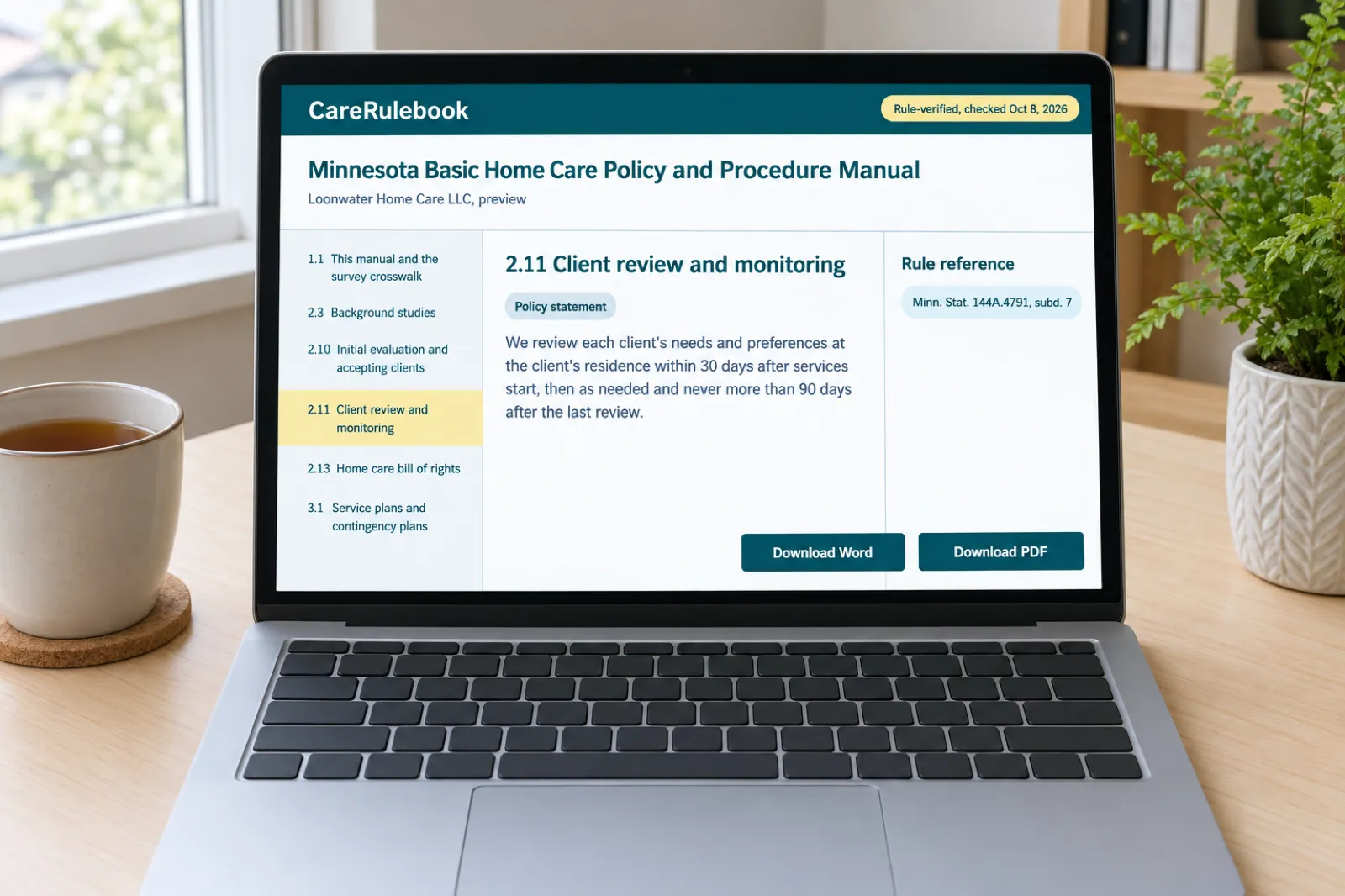
Background studies are the second of the ten policies your managerial official initials on MDH’s application. CareRulebook’s Minnesota manual includes Policy 2.3, written to Minn. Stat. 144.057, 144A.476 and chapter 245C as amended by Laws 2026, chapter 121, with your agency’s details, a study log and an owner and managerial official study record, plus Policy 4.2 on employee records. It is written for the basic license only.
$199CareRulebook founding price for the first 50 Minnesota agencies, then $249. Not an MDH or DHS fee.
It depends. Not alone with clients. Until DHS issues a notice that the person is not disqualified (or that more time is needed but they need not be removed, or another notice the statute lists), they may not provide direct contact services unless under continuous direct supervision. The DHS notice says whether supervision is required.
"providing direct contact services to persons served by a program unless the subject is under continuous direct supervision;"
It depends. The statute sets topics and competency, not hours, for new caregivers: an orientation on licensing rules before they serve anyone, then a training and competency evaluation on 15 topics, or a written or oral test plus a practical skills test on hygiene, standby assistance and reminders. MDH’s survey form for basic providers says nursing assistants on the MDH registry are assumed competent in those topics. After that, every direct care worker needs at least eight hours of training each year.
"All staff that perform direct home care services must complete at least eight hours of annual training for each 12 months of employment."
The Minnesota Department of Human Services (DHS), not MDH. The commissioner of health contracts with DHS to study people with direct contact in home care agencies licensed under chapter 144A, and requests go through NETStudy 2.0. DHS notifies the agency and the person of a disqualification; MDH decides reconsideration requests and variances for its licensees.
Not alone with clients. Until DHS issues one of the notices the statute lists (that the person is not disqualified, that more time is needed but they need not be removed, that a disqualification is set aside, or that a variance is granted), the person may not provide direct contact services unless under continuous direct supervision. Laws 2026, chapter 121 amended that subdivision and kept the rule.
Before the temporary license. MDH’s application says information about starting the studies comes when MDH confirms receipt of the application, and its FAQ says that once MDH receives the license fee, DHS is notified and sends the authorized agent the NETStudy 2.0 onboarding email. All owners and managerial officials must complete and pass studies before MDH issues the temporary license, and MDH will not issue a license if one of them has been unsuccessful in having a disqualification set aside.
MDH says that since August 1, 2022, people holding a valid license from a health-related licensing board who completed the board’s check under 214.075 do not get a NETStudy 2.0 study, and the statute has them taken off the agency’s NETStudy 2.0 roster. By our reading, that exception does not cover owners and managerial officials, who are studied under a separate clause.
MDH says no new study is needed for anyone with a current eligible study affiliated with the license being renewed; recently added owners or managerial officials with direct contact need one. The statute ties owner and managerial official studies to each renewal, so check MDH’s current instructions when you renew.
DHS charges a study fee through NETStudy 2.0. The statute caps the criminal background check part at $44 per study, on top of DHS’s fees for fingerprint preparation and the consent form, and DHS’s vendor IDEMIA charges $13.50 per person for fingerprints and a photo. The license holder pays DHS. We have not confirmed DHS’s current study fee.
The 2026 session amended Minnesota’s background study law. Leave your email and we will tell you when a change to background studies or the home care statutes affects your agency.
No spam. Only emails about Minnesota home care rules. How we use your email.
Minnesota
How to start a home care agency in Minnesota
The license, basic vs comprehensive, training and maltreatment reporting.
Minnesota
Minnesota policies and procedures
The ten application policies, including background studies, and how MDH checks them.
Minnesota
Minnesota caregiver training
What runs alongside the study: orientation, competency, dementia and TB training.
Minnesota
The Minnesota license application
Owners’ studies, the temporary license and the survey.
Tool
Minnesota license checklist
Every step to an MDH license, tailored to your agency.
Manual
Build your Minnesota policy manual
The background studies policy and the rest, written for your basic agency.
Compare
Background checks by state
How Minnesota’s DHS studies compare with other states’ checks.
Nevada
Nevada caregiver background checks
Fingerprints within 10 days through NABS.
Free sample, no email needed
Policy 2.9, Client complaints and the complaint notice, as it prints in the Minnesota manual, filled in for a fictional agency. The rule text it rests on is quoted word for word under Rule basis.
PDF · 13 pages · 142 KB · Rule-verified October 8, 2026
Collecting answers for an agency or a client? The intake questionnaire lists all 49 questions the builder asks, what each decision changes in the manual, and a completed example: Word · PDF.How consultants use CareRulebook.