Skip to content
CareRulebook
MenuClose

Where are you starting?

United StatesTexas, North Carolina, Georgia, Virginia, Indiana, Ohio, Illinois, Washington, Colorado, Tennessee, Maryland
TexasManual
North CarolinaManual
GeorgiaManual
VirginiaManual
IndianaManual
OhioGuide
IllinoisManual
WashingtonManual
ColoradoManual
TennesseeManual
MarylandGuideAll US states →
United KingdomEngland
Free toolsChecklists, calculators and templates

Colorado · Home care agency license, Class B · CDPHE’s application

Colorado home care license application: CDPHE’s seven steps

You apply for a Colorado home care agency license online, in CDPHE’s COHFI system, after a letter of intent. Here are CDPHE’s seven steps, every document on its checklist, the $2,720.30 CDPHE fee, what must be ready for the initial survey, what "zero deficiencies" means, and how renewal, changes, a sale and closing work.

  • Rule-verified October 2, 2026
  • Quoted from 6 CCR 1011-1 Chapters 26 and 2
  • From CDPHE’s July 2026 checklist
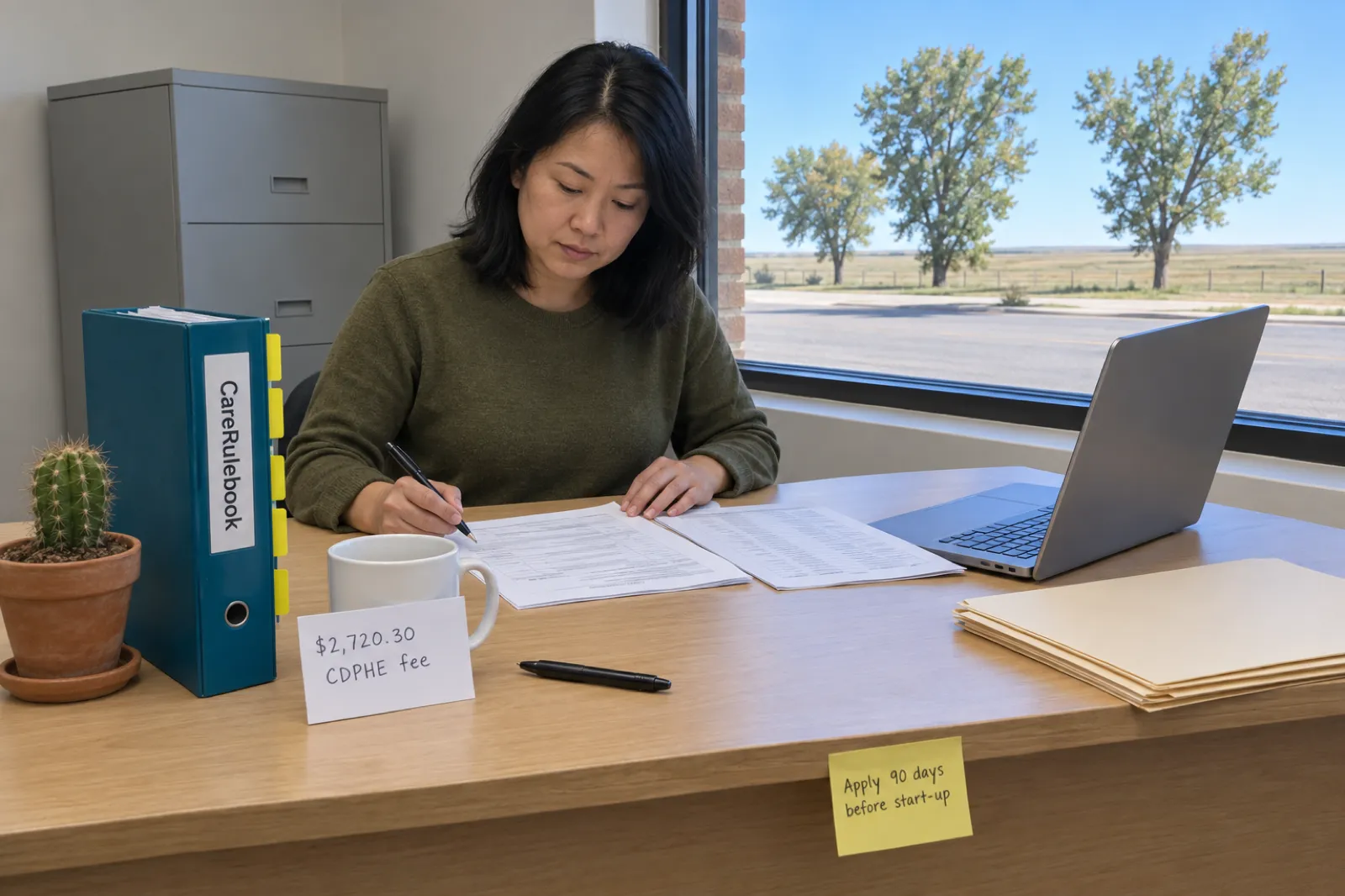
A woman in an olive green sweater checks a printed form at a desk in a small office, beside a CareRulebook binder, an index card reading $2,720.30 CDPHE fee and a sticky note reading Apply 90 days before start-up, with cottonwood trees and flat grassland outside the window

Quick answer

Colorado’s home care agency license comes from the Colorado Department of Public Health and Environment (CDPHE). For non-medical care it is the Class B license. You first send CDPHE a letter of intent (Ch. 2, 2.3.1), then apply in COHFI, CDPHE’s online system, at least 90 calendar days before your planned start-up date (Ch. 2, 2.3.2), with $2,720.30, CDPHE’s Class B initial fee on its 2026/27 schedule, not a CareRulebook price (CDPHE fee schedule).

CDPHE reviews the documents, runs a fitness review and requests a scheduled initial survey, where it expects "All required policies and procedures ready for review" (CDPHE guidance, step 6). It issues the license when that survey is completed with zero deficiencies (CDPHE guidance, step 7). CDPHE says a typical initial application, for any license type, may take 3 to 12 months, and that home care applications are currently taking additional time (CDPHE guidance).

"Rule requires" means 6 CCR 1011-1 Chapter 26 (home care agencies) or Chapter 2 (general licensure standards), and "Statute requires" C.R.S. 25-27.5. "CDPHE asks" rests on CDPHE’s initial licensing guidance (updated September 11, 2025) or its Home Care Agencies initial application checklist (updated July 23, 2026). Where we add our own reading or advice, we say so.

CDPHE’s seven steps

CDPHE’s guidance sets out seven steps for every initial license (CDPHE initial licensing guidance). Tick them off as you go; progress is saved in this browser only.

  1. 1. Letter of intent

    First

    Submit CDPHE’s letter of intent form through the link on its website. It asks who will be your COHFI account manager, the person who can add other users. CDPHE then sends instructions for COHFI, its online system for applications, survey reports, plans of correction and occurrence reports.

  2. 2. Application and fees in COHFI

    At least 90 days before start-up

    You create the application in COHFI, complete it, pay and submit it, at least 90 calendar days before your planned start-up date. $2,720.30 is CDPHE’s Class B initial fee on its 2026/27 schedule. CDPHE does not review an application until both the complete application and the fees have arrived.

  3. 3. Application and document review

    Applications are reviewed in the order received, and wait as "Technician Pending" until a licensing technician is assigned. The technician checks that every section is complete, the fees are in and the application matches the documents. Answer any written defect notice within 14 calendar days.

  4. 4. Fitness review

    CDPHE reviews your fitness to run a licensed agency, by on-site inspection or other appropriate investigation, and may look at your finances, compliance history, policies and procedures, quality plans and staff credentials. CDPHE says any change to the application after this step triggers a new fitness review.

  5. 5. Final document review

    The technician collects any documents still outstanding and confirms every required, fully executed document has been submitted, reviewed and approved.

    CDPHE guidance, step 5
  6. 6. Initial survey

    Once the fitness review is approved and the application is complete, CDPHE requests the survey. There is usually a queue; a surveyor calls to schedule it, and it is usually on site at the address on your application. What must be ready.

    CDPHE guidance, step 6
  7. 7. License issued

    When the initial survey has been completed with zero deficiencies, the licensing technician issues the license as a PDF in COHFI. You display it where clients who come to the address on the license can see it. What zero deficiencies means.

    CDPHE guidance, step 7

What to have ready before you apply

Each card says whether the item comes from the rules, the statute or CDPHE’s own guidance and checklist.

CDPHE asks

A registered business, with one exact name

The business is registered with the Colorado Secretary of State, and the registered name matches the application exactly, with no deviation and no "dba" form. A trade name, including your name without "LLC" or "Inc", is registered as a trade name too.

CDPHE checklist

Rule requires

An HCA manager

At least 21, with a high school diploma or GED and one year of documented supervisory experience in personal care, or a degree plus health care work instead. The manager completes an 8-hour manager course, or shows equivalent experience or education, and CDPHE asks for proof of the manager’s training and qualifications at the initial survey.

Ch. 26, 7.2(B)The manager and supervisors →

Rule requires; CDPHE asks (lease)

A fixed office in Colorado

A physical business office in Colorado able to run the agency day to day, that protects consumer confidentiality and is a safe place to work. If the agency does not own the space, CDPHE asks for a lease, which must be in effect before the initial survey.

Ch. 26, 5.1, 7.1(C)(7); CDPHE checklistCan it be in your home? →

CDPHE asks

The zoning sign-off

Your city or county zoning authority signs CDPHE’s HCA zoning form. CDPHE does not sign it, and needs written evidence of zoning compliance before it issues the license.

CDPHE zoning form

Rule requires; CDPHE asks (certificate)

Insurance or a surety bond

At least $100,000 per occurrence and $300,000 aggregate for Class B, kept for the whole license period, with CDPHE-HFEMSD as certificate holder.

Ch. 26, 4.2(B); CDPHE checklist

Rule requires

Your counties

A list of the contiguous counties you plan to serve. You must assure adequate staffing, supervision and care across them.

Ch. 26, 4.2(C)

CDPHE asks (chart); Rule requires (statement)

Owners and their history

An ownership chart naming every direct and indirect owner of 5% or more, and a signed statement about the past ten years of anyone with a controlling interest: convictions, judgments for substandard care or fraud, and licensing or Medicaid and Medicare sanctions.

CDPHE checklist; Ch. 2, 2.3.3(K)

CDPHE asks

Your policies, before the survey

Not on CDPHE’s upload checklist, but CDPHE’s guidance says all required policies and procedures must be ready for review at the initial survey, and the fitness review may look at them. Our suggestion: have them written and adopted before you apply.

CDPHE guidance, step 6; Ch. 2, 2.7.1(D)The written policies →

The documents, one by one

CDPHE’s Home Care Agencies checklist (updated July 23, 2026) lists what goes with the application, and is uploaded with it: "Complete YOUR copy of this checklist and submit the completed form as an attachment in the Required Documents section of the Initial Application in COHFI." (CDPHE checklist) Chapter 2 adds the ten-year history statement, and Chapter 26 the list of counties you plan to serve (Ch. 26, 4.2(C)).

DocumentWhat it must showSource
Your copy of CDPHE’s checklistCDPHE asksYou make a copy of CDPHE’s checklist, complete it and attach it in the Required Documents section of the application.CDPHE checklist
The signed application and the feeRule requires; CDPHE asksEvery required section completed, with an authorized signature. Chapter 2 says the application is signed under penalty of perjury by an authorized individual such as a corporate officer, general partner, administrator or sole proprietor, and CDPHE accepts only fully executed documents with verified or wet signatures.Ch. 2, 2.3.4; CDPHE guidance, step 2
Secretary of State registrationCDPHE asksThe business entity’s registration, with the name exactly as on the application, and a registered trade name if you use one. A trade name goes in the Facility Name field and the business entity in the Ownership section; an application that enters "Business Entity LLC dba Trade Name" is returned for correction.CDPHE checklist
Organizing documentsCDPHE asksFully executed, signed and dated: for an LLC, the articles of organization and a signed operating agreement; for a corporation, the articles of incorporation and signed bylaws; for a partnership, the statement of partnership authority and a signed partnership agreement.CDPHE checklist
Certificate of insuranceCDPHE asksGeneral or professional liability insurance, or a surety bond, at the Class B minimums, listing your physical address, effective for the license period and naming CDPHE-HFEMSD, 4300 Cherry Creek Drive South, Denver, CO 80246, as certificate holder.CDPHE checklist
HCA zoning formCDPHE asksIn the Preparing to Apply/Forms and Instructions phase of the COHFI application, signed at the bottom by your local zoning authority before you submit it.CDPHE checklist
HCA Form 1CDPHE asksSigned with full legal names by the administrator and every owner with 50% or more direct ownership. It starts their background checks; CDPHE sends further details once it has matched the form to the application.CDPHE checklist
Ownership organizational chartCDPHE asksLegal names and ownership percentages for every direct and indirect owner of 5% or more. CDPHE says not to send a staff organizational chart.CDPHE checklist
Ten-year history statementRule requiresA signed and dated statement, on your letterhead if you have one, on whether anyone with a controlling interest has, in the past ten years, been the subject of the convictions, judgments or sanctions Chapter 2 lists.Ch. 2, 2.3.3(K)
LeaseIf it appliesIf the agency does not own the office: fully signed by the agency and the building owner, with start and end dates and the leased address, active during the license period, and saying which party is responsible for the property’s physical condition. With a sublease, the master lease too.CDPHE checklist
Management agreementIf it appliesIf a management company will run the agency’s day-to-day operations: an agreement naming both parties, signed by both, with its dates.CDPHE checklist
Branch and workstation applicationsIf it appliesFor each branch or workstation applied for at the start: an entry in the Additional Locations section and CDPHE’s separate application, with its fee ($247.30 per branch, $61.83 per workstation, CDPHE’s fees).CDPHE checklist
Medicaid HCBS certification applicationIf it appliesOnly if you want Medicaid certification (Personal Care/Homemaker under CFC, specialty 666, or In-Home Support Services, 656). Send it with the license application to combine the initial surveys, and be ready to be surveyed for those services.CDPHE checklist
  • Fingerprints wait for CDPHE. CDPHE says: "Please do not complete your fingerprint background check prior to submitting the Form 1, or prior to receiving the background check instructions directly from CDPHE." Each owner and manager then submits fingerprints to the Colorado Bureau of Investigation and pays its fee (Ch. 26, 4.2(D)). For these rules an owner holds at least 50% (Ch. 26, 2.17).
  • Future-dated documents. Some documents may carry a future date when you apply. Insurance may be future-dated but must be updated before the license is issued, and the certificate cannot list only "TBD" as the effective date. A management company agreement may be future-dated but must be active before the initial survey. A lease must be effective before the survey. (CDPHE guidance)
  • Insurance wording. Chapter 26 sets the home care amounts and allows a surety bond instead of liability insurance (Ch. 26, 4.2(B)). Chapter 2 asks every applicant for proof of professional liability insurance as required by the Colorado Health Care Availability Act, and for notice to CDPHE of any change in its amount, type or provider (Ch. 2, 2.3.3(D)). CDPHE’s checklist accepts general or professional liability insurance (CDPHE checklist). Our suggestion: ask your insurer and CDPHE which cover fits your agency.
  • Your name. The applicant submits a distinctive license name that does not mislead or confuse the public about the license or the services, and may not duplicate an existing licensee’s name unless the two are affiliated through ownership or controlling interest. (Ch. 2, 2.3.3(A)) If an agency shares another licensee’s name because of a franchise agreement, CDPHE’s checklist asks for a copy of the franchise agreement. (CDPHE checklist)
  • CDPHE’s examples are not templates. CDPHE links example application documents but says "DO NOT use these example documents as templates, they are for informational purposes only." (CDPHE checklist)
  • No building reviews. CDPHE’s guidance lists home care agencies among the license types that skip the fire safety and FGI plan reviews (CDPHE guidance, step 2), and Chapter 2 does not require a fire safety certificate for them (Ch. 2, 2.8.1(A)).
  • CAPS checks. Applicants, and licensees at each renewal, must show compliance with the CAPS check requirements in C.R.S. 26-3.1-111. (Ch. 2, 2.3.6) Background checks for caregivers.

CDPHE’s fees

These are CDPHE’s fees from its home care fee schedule for July 1, 2026 to June 30, 2027, and the CDHS fee for a CAPS check. They are paid to the state and are not CareRulebook prices.

State feeAmountSource
Initial license, Class B$2,720.30CDPHE fee schedule
Initial license, Class A (for comparison)$3,709.49CDPHE fee schedule
Each branch or workstation added$247.30 / $61.83CDPHE fee schedule
Provisional license, each term15% of the initial feeCDPHE fee schedule
Conditional license (an enforcement action)$1,938.29CDPHE fee schedule
Renewal, Class B base fee (each year)$1,638.36CDPHE fee schedule
Change of name or address, each$92.74CDPHE fee schedule
Change of ownership, Class B$2,720.30CDPHE fee schedule
Second and later revisit for the same deficiency100% of the initial or renewal feeCDPHE fee schedule
CAPS check, per worker (CDHS)$9.00 plus processingCDHS CAPS Check FAQ
  • Non-refundable. "All fees shall be non-refundable, unless otherwise specified." (Ch. 2, 2.12.1(B)) CDPHE’s guidance says a refund can be asked for only through the State Regulation Waiver Application process, with no guarantee, and that overpayments are refunded.
  • Paying. CDPHE’s fee is paid online through the link in the Payment section of the COHFI application, or by check or money order mailed to CDPHE - HFEMSD Licensing, 4300 Cherry Creek Drive South, Denver, CO 80246-1530. The online portal adds its own charge, which CDPHE does not receive: a flat $1.00 for an electronic check, more for a card. CDPHE says mailed checks may take weeks to arrive. (CDPHE guidance)
  • Which year’s fee. CDPHE publishes a new schedule by March 1 for July 1 (Ch. 2, 2.12.1(A)), and its guidance says the previous schedule stays in effect for initial applications submitted on or before June 30 (CDPHE guidance). The statute raises home care fees 6% in each of the fiscal years 2026-27, 2027-28 and 2028-29 (C.R.S. 25-27.5-104(1)(g)(II)), so two more 6% rises are due on that wording; this is the 2024 printed statute, and we have not checked 2025 or 2026 bills.
  • Provisional license. 15% of $2,720.30 is about $408 for each term, by our arithmetic.

The full cost and timeline →

CDPHE’s review and the fitness review

  • Acknowledgement. Once CDPHE has the application and fee, it sends an acknowledgement through COHFI’s messaging system. If it can see documents are missing before a full review, it returns the Required Documents section and asks the applicant to check the checklist and provide them. (CDPHE guidance)
  • The queue. "Your application is not actively being reviewed until a licensing technician has been assigned to it." (CDPHE guidance) Applications are reviewed in the order received. A licensing technician checks that every section is complete, the fees are received and the application matches the documents; sections that need corrections are returned through COHFI with a message. (CDPHE guidance, step 3)
  • 14 days to answer. "The applicant shall respond within fourteen (14) calendar days to written notice of any application defect." (Ch. 2, 2.3.5(A))
  • Twelve months. An application not completed within 12 months, where the applicant stops responding, may be treated as abandoned and closed, and a new one needs a new initial fee (Ch. 2, 2.3.2(A)-(B)). CDPHE says applications taking longer than 12 months are not closed while the applicant stays in touch, and that it always sends notice and a final chance to respond before closing one. (CDPHE guidance)

The fitness review

Chapter 2 says: "The Department shall determine by on-site inspection or other appropriate investigation the applicant’s compliance with applicable statutes and regulations." CDPHE may consider your legal status, whether your finances appear adequate to staff and run the agency (including, if warranted, your credit report), your compliance history, your policies and procedures, quality improvement plans, a physical inspection, staff credentials, staff interviews and other documents (Ch. 2, 2.7.1).

CDPHE’s guidance says that, if applicable, the fire safety Certificate of Compliance, FGI approval and proof of insurance are not required before the fitness review, and that any change to the application after the fitness review triggers a new fitness review, full or limited in scope depending on the change. (CDPHE guidance, step 4) Our suggestion: settle your owners, manager, office and counties before you apply, since a change after this step means another review.

The final document review

After the fitness review is approved, the technician collects any documents still outstanding and confirms that every required, fully executed document has been submitted, reviewed and approved. (CDPHE guidance, step 5) Insurance, if future-dated, must be updated before the license is issued (CDPHE guidance).

The initial survey, and what must be ready

"The initial survey is a scheduled survey, typically onsite. A representative from the HFEMSD survey team will call the applicant to schedule a time for the survey." "There is typically a queue for surveys, and the wait time can vary depending on facility/agency type." (CDPHE guidance, step 6). The survey is held at the physical address on your application, so CDPHE says any lease must be in effect before it (CDPHE guidance). CDPHE’s guidance lists what the agency must have ready:

  1. Proof of the manager’s training and qualifications: "Proof of administrator/manager training and qualifications, as applicable" (CDPHE guidance).
  2. Background checks: "Employee background checks in personnel files" (CDPHE guidance).
  3. Policies: "All required policies and procedures ready for review" (CDPHE guidance).
  4. Medical malpractice loss information: CDPHE explains that C.R.S. 13-64-303 requires any final judgment, settlement or arbitration award for medical malpractice against a health care institution to be reported to CDPHE within 14 days, by the insurer or the institution (CDPHE guidance).
  5. A quality management plan under Chapter 2, Part 4: "Each health care entity shall develop a quality management plan that shall be available for Department review during the licensure survey and each re-licensure survey." (CDPHE guidance).

If you also applied for Medicaid certification, CDPHE’s checklist says you must be ready to be surveyed for those services too (CDPHE checklist).

What the guidance does not say

  • A survey tool. We did not find a CDPHE survey tool or policy checklist for home care agencies.
  • Records from an agency with no clients. CDPHE’s guidance does not say what a new agency should show for consumer records, or whether caregivers must already be hired. By our reading, the surveyor also looks at the records the rules require, since "No license shall be issued until the applicant conforms to all applicable statutes and regulations." (Ch. 2, 2.8.1). Our suggestion: complete the personnel file of everyone already hired, have your blank client forms ready, and ask the surveyor what they will want to see when they call to schedule.
  • How fast you must produce records. Chapter 26’s inspection rules say consumer files and administrative records "shall be provided to the inspector commencing within thirty (30) minutes of request" (Ch. 26, 4.6(A)(1)(b)). Our suggestion: keep a short index of where each kind of record is.

The Colorado CDPHE survey in detail, and the written policies CDPHE checks.

Step 7

Zero deficiencies, and the isolated-event rule

CDPHE’s guidance: "When the initial survey has been completed with zero deficiencies, the survey team will notify the licensing team that the applicant has successfully completed the initial survey." (CDPHE guidance, step 7)

Chapter 2 defines the word: "“Deficiency” means a failure to fully comply with any statutory and/or regulatory requirements applicable to a licensee." (Ch. 2, 1.15). By our reading, zero deficiencies means the survey cited no unmet requirement of any kind, not just no serious one. The statute also says CDPHE determines an applicant’s compliance with the statute and rules before it issues a license (C.R.S. 25-27.5-106(2)(a)(I)).

The isolated-event rule, and its limits. A Colorado statute says: "The department shall not cite as a deficiency in a report resulting from a survey or inspection of a licensed health facility any deficiency from an isolated event identified by the department that can be effectively remedied during the survey or inspection of the health facility, unless the deficiency caused harm or a potential for harm, created a life- or limb-threatening emergency, or was due to abuse or neglect." (C.R.S. 25-1.5-103(1)(a)(I)(E)). It speaks of a licensed health facility, and nothing we found says whether it applies to an applicant’s initial survey. It covers only an isolated event that can be fixed during the survey, and not one that caused harm or a potential for harm, created a life- or limb-threatening emergency, or came from abuse or neglect. Our suggestion: do not plan around it. Prepare as if every problem would be cited, and if a surveyor points one out, fix it there and then where you can and record what you did.

If the survey does find a deficiency

CDPHE has not said what happens next: its guidance does not describe this path. What the rules and statute say:

  • After any review, CDPHE may ask a licensee for a plan of correction or direct one; the rule speaks of a licensee, not an applicant (Ch. 2, 2.10.4(B)). It is signed by the manager and due within 10 calendar days of CDPHE’s written notice of deficiencies, with corrections completed within 30 days unless CDPHE allows otherwise (Ch. 2, 2.10.4(B)(1)(c), (2)).
  • The statute requires a home care agency to submit, in CDPHE’s form, a written plan to correct any violations CDPHE finds in the inspections it makes under C.R.S. 25-27.5-106(2), the subsection that also covers CDPHE’s review of original applications (C.R.S. 25-27.5-106(2)(a)(II)). By our reading that wording could reach an initial survey, but CDPHE has not said whether it uses a plan of correction and revisit, a provisional license, a new survey or a denial before a first license; ask CDPHE.
  • CDPHE charges a revisit fee, 100% of the initial or renewal fee, for the second and each later on-site inspection about the same deficiency that caused harm or could have (Ch. 26, 4.5(E)). Whether it applies to an initial survey is not stated.
  • CDPHE may also impose conditions on a license before issuing an initial license. If it does, the applicant pays the initial fee plus CDPHE’s $1,938.29 conditional license fee (Ch. 2, 2.8.3(A)).
  • If CDPHE denies the application, you may petition CDPHE for a hearing within 30 days of receiving the denial notice (C.R.S. 25-27.5-108(1)).

The provisional license

The statute says "The department may issue a provisional license to an applicant for the purpose of operating a home care agency for a period of ninety days if the applicant is temporarily unable to conform to all of the minimum standards required under this article 27.5", and goes on: "no license shall be issued to an applicant if the operation of the applicant’s home care agency will adversely affect the health, safety, or welfare of the home care consumers of such home care agency. As a condition of obtaining a provisional license, the applicant shall show proof to the department that attempts are being made to conform and comply with applicable standards." (C.R.S. 25-27.5-106(6)).

  • Chapter 2’s version. Where an applicant does not fully conform but CDPHE determines it is making a substantial good faith attempt to comply, CDPHE may refuse to issue an initial license and instead grant a 90-day provisional license on payment of the non-refundable provisional fee. A second may follow if substantial progress continues, and no entity is provisionally licensed for more than 180 calendar days. (Ch. 2, 2.4.1)
  • Checks first. "No provisional license shall be granted before completion of a criminal background check and finding in accordance with Part 4.2 of this chapter." (Ch. 26, 4.3(A)(2))
  • Then a regular license. If CDPHE determines before the provisional license expires that the applicant has achieved reasonable compliance, it issues a regular one-year license on payment of the applicable license fee. (Ch. 2, 2.4.1(E)) The rule does not say whether "the applicable license fee" means paying the initial fee again; ask CDPHE.
  • CDPHE’s fee. 15% of the initial fee for each provisional term, about $408 for Class B by our arithmetic (CDPHE fee schedule).

What we cannot tell you. CDPHE’s licensing guidance describes the license being issued after a survey with zero deficiencies and does not mention provisional licenses for new home care agencies, so we cannot say when, or whether, CDPHE uses one. Plan for a survey with zero deficiencies.

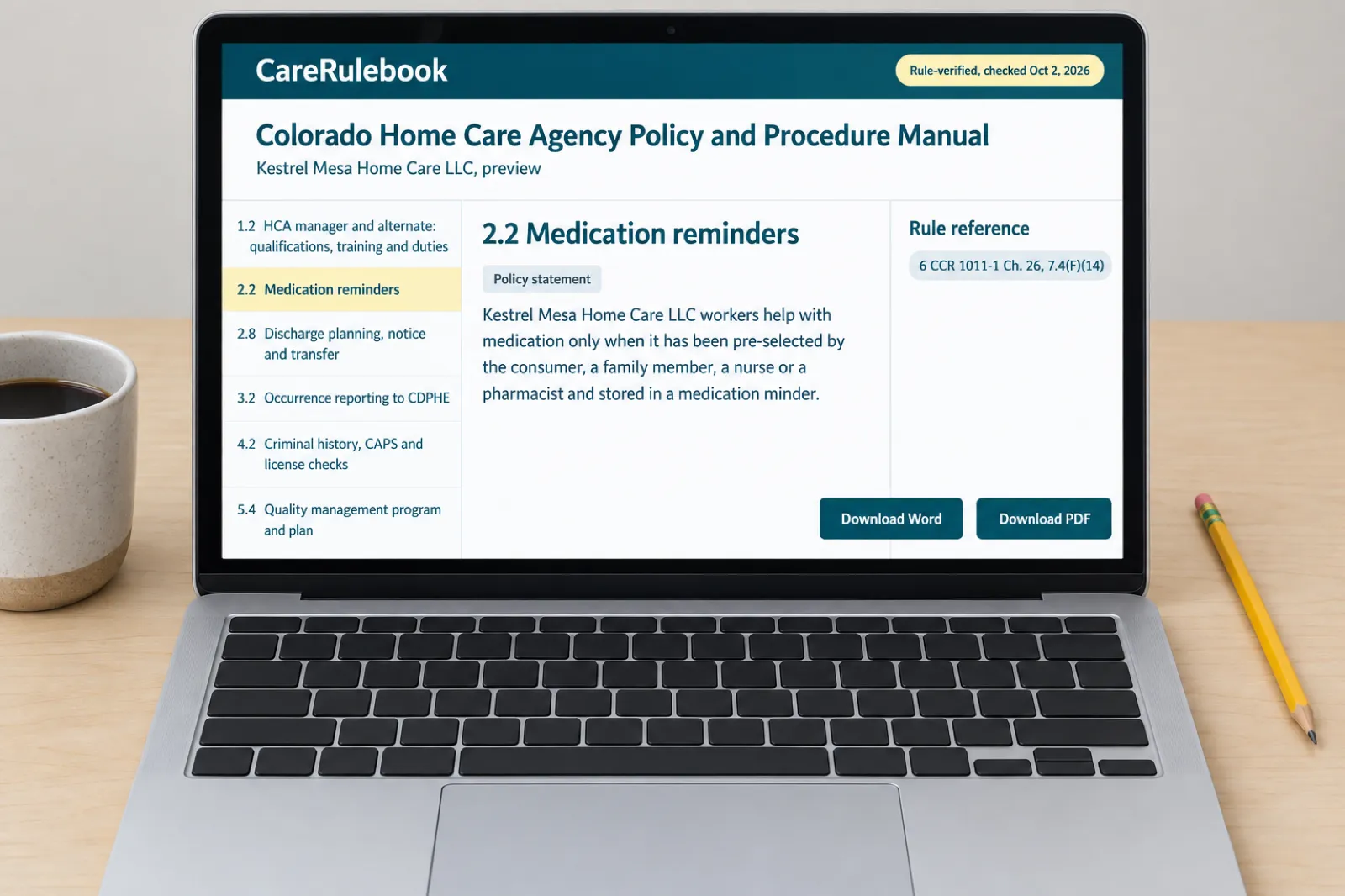
A laptop showing a preview of the Colorado Home Care Agency Policy and Procedure Manual for a sample agency, open at policy 2.2, Medication reminders, citing 6 CCR 1011-1 Ch. 26, 7.4(F)(14).

CareRulebook

The policies CDPHE expects at the initial survey, written for your agency

CareRulebook’s Colorado manual is built on the Class B requirements in Chapters 26 and 2 and the Colorado statutes they rest on, written from your answers, with the rule each policy meets quoted under it and the forms the policies use. It includes a survey-day checklist and a plan of correction worksheet. Recommended practice is added only if you choose it. Read every policy and adopt it before the survey.

  • 33 policies, 155 requirements mapped
  • Free preview before you pay
  • Editable Word and PDF
  • 12 months of updates: download again after a rule change
Preview your manual

$199CareRulebook founding price for the first 50 Colorado agencies, then $249. Not a CDPHE fee.

Renewal

"All licenses shall expire one year from the date of issuance" (Ch. 2, 2.1). The renewal application and CDPHE’s fee are due at least 60 calendar days before the license expires (Ch. 2, 2.5.1), or at least 90 days if your insurance has any self-insured retention or alternate form of security (Ch. 2, 2.5.1(A)).

  • What it includes. Any application information that has changed (Ch. 2, 2.5.1), last year’s admissions for the volume fee (Ch. 26, 4.5(B)(1)), evidence your insurance continues (Ch. 26, 4.2(B)) and proof of CAPS compliance (Ch. 2, 2.5.4(B)).
  • CDPHE’s fee. $1,638.36 base for Class B on the 2026/27 schedule, plus branch, workstation and volume fees. Medicaid or Medicare certified agencies take $100 off the base renewal fee; accredited agencies with deeming status get 10% off. Neither applies to volume, branch or workstation fees. (CDPHE fee schedule)
  • Late. Late renewal adds 10% of the total renewal fee (6 to 29 days late), 50% (30 to 59 days) or 75% (60 to 89 days); at day 90 the license is invalid. (CDPHE fee schedule) If the renewal and fees have not arrived by day 90 after expiry, the agency must stop operating and apply as new (Ch. 2, 2.5.3).
  • Surveys after licensing. Besides announced surveys, CDPHE may inspect without notice, between 7 a.m. and 7 p.m., and investigate complaints at any time. (Ch. 2, 2.10.1(A); Ch. 26, 4.6(A)(1)) Neither chapter states how often CDPHE re-surveys a home care agency.

Proposed, not in force. Chapter 26 applies Chapter 2’s survey cycle rule to home care agencies (Ch. 26, 4.6(A)). On September 21, 2026 a notice was filed for amendments to Chapter 2 (eDocket 2026-00434), with a Board of Health hearing on November 18, 2026. They would schedule a licensee meeting every listed criterion for a three-year extended survey cycle; the criteria include three years of licensure and, in the three years before the survey, timely license documents and fees and no failure to report occurrences (eDocket 2026-00434). The proposal in full.

Changes between renewals

Any information on the license application that changes during the license term must be reported to CDPHE within the time frames in the rules. (CDPHE guidance) Notices and requests go through COHFI.

Services, area, category, name or management company

Rule requires

A letter of intent at least 30 calendar days ahead, and CDPHE’s approval before the change, for a new management company, license category, scope of services, service area or legal name.

Ch. 2, 2.9.6(B)

Moving the office

Rule requires; CDPHE fee

Tell CDPHE 30 days before. The license carries over only if the new office is in your existing service area with the same governing body and administrator; otherwise you apply for a new license. CDPHE’s fee for a change of address is $92.74, requested in COHFI at least 30 days ahead.

Ch. 26, 4.2(E); CDPHE fee schedule

A new owner or manager

Rule requires

Changes to the information in your last application, such as the manager’s name and contact details, go to CDPHE as soon as practicable. A new owner or manager submits fingerprints to the Colorado Bureau of Investigation within 10 calendar days of the change.

Ch. 2, 2.9.6(A); Ch. 26, 4.2(D)

Opening a branch

Rule requires

CDPHE is told in advance, and its branch fee ($247.30 on the 2026/27 schedule) goes with the notice. A branch provides the same services as the parent, inside its service area, under daily supervision from the parent. Changes to a branch’s address or organization need 30 days’ notice.

Ch. 26, 4.5(C)(2), 5.2, 4.2(F)

Adding skilled care

Rule requires

A Class B agency that wants to become Class A files a new initial application and pays the Class A initial fee ($3,709.49 on the 2026/27 schedule).

Ch. 26, 4.5(A)(2)

An owner’s conviction

Rule requires

Each owner, applicant or licensee must tell CDPHE about a conviction for a felony, or a misdemeanor involving moral turpitude or conduct CDPHE decides could put consumers at risk. Not telling CDPHE can lead to non-renewal or other sanctions.

Ch. 26, 4.2(D)(4)

No clients for a while

Rule requires

Chapter 2 counts any time with zero clients as a temporary closure. To keep the license, CDPHE gets a detailed written notice 30 days ahead for a planned closure, or within 7 calendar days of the event for an unplanned one, and a temporary closure is limited to 90 days.

Ch. 2, 2.14.4

Whether the time between a first license and the first client counts as a zero census is not stated in the rules; ask CDPHE in writing when the license is issued (Ch. 2, 2.14.4(A)).

Selling or buying an agency

  • No transfer. "The license is only valid while in the possession of the licensee to whom it is issued and shall not be subject to sale, assignment, or other transfer" (Ch. 2, 2.9.3)
  • What counts. A change of ownership includes a transfer of at least 50% of the direct or indirect ownership, whether in one transaction or a series over five years. For an LLC, transfers between existing members, with no new member, are not a change of ownership. (Ch. 2, 2.6.5)
  • Both sides file 60 days ahead. The seller sends CDPHE a letter of intent, and the buyer sends a change of ownership application with its documents and CDPHE’s fee, at least 60 calendar days before the change (Ch. 2, 2.6.2). CDPHE’s Class B change of ownership fee is $2,720.30 on the 2026/27 schedule (CDPHE fee schedule).
  • The seller’s duties. The current licensee runs the agency until CDPHE issues the new owner’s license, and must correct all rule violations and deficiencies in any current plan of correction before the change takes effect. Anything not corrected in time becomes the buyer’s responsibility, as does any enforcement action not fully resolved. (Ch. 2, 2.6.1, 2.6.7)
  • The new license. CDPHE finalizes a change of ownership only when the complete application, attachments and any information it asked for are in and all its reviews are done. When it issues the new owner’s license, the old license is destroyed and the new one displayed. (Ch. 2, 2.6.4, 2.6.8) For a change of ownership, the new owner either prepares a new quality management plan or a letter, signed by the administrator and the president of the governing body, accepting the existing plan as written. (CDPHE guidance)
  • Clients and records. The new owner sends every client a written notice listing the new owners and offering the choice to stay or get help moving to another agency (Ch. 26, 5.3(A)(7)), and the seller hands over all client records (Ch. 26, 5.15(D)).

Closing an agency

  • The license ends. A license becomes invalid when the licensee fails to renew on time, ceases operation (including permanently stopping services, suspending operation longer than the 90 days allowed for a temporary closure, or dropping to zero clients without the temporary closure notice), or on final agency action suspending or revoking it. An invalid license may not be displayed. (Ch. 2, 2.14.1, 2.14.3)
  • Clients first. Before discharging a client who needs and wants continuing paid care with no transfer arranged, the agency notifies CDPHE (Ch. 26, 5.5(E)).
  • Records. A licensee surrendering its license tells CDPHE its records storage plan within 10 days before closing, tells every client in writing how to get their records within 10 days of closing, and stores the records securely. (Ch. 2, 2.14.6) Client records are kept for five years after discharge, even if the agency stops operating (Ch. 26, 5.15(D)).

Chapter 26 points permanent closures to Chapter 2 "Part 2.14.4", which is the temporary closure rule; the permanent closure steps are in 2.14.6. If in doubt, ask CDPHE before you close (CDPHE licensing).

Myths about applying

Does CDPHE decide a home care application within 90 days?

No. The 90 days is how early you must apply: at least 90 calendar days before your planned start-up date. CDPHE says that is a submission deadline and does not reflect how long it takes to process an application. It gives 3 to 12 months as the typical range for initial applications of any license type, and says home care applications are currently taking additional time.

"PLEASE NOTE: This is a submission timeline requirement and in no way reflects the amount of time it will take for CDPHE staff to process your application."

Should owners and the manager get fingerprinted before applying, to save time?

No. CDPHE’s checklist says HCA Form 1, signed by the administrator and every owner with 50% or more direct ownership, starts the background check process, and asks applicants not to be fingerprinted before submitting Form 1 or before receiving CDPHE’s instructions, because they may have to repeat it. After that, each owner and manager is fingerprinted for the Colorado Bureau of Investigation and pays its fee.

"Please do not complete your fingerprint background check prior to submitting the Form 1, or prior to receiving the background check instructions directly from CDPHE."

Do I upload my policy manual with the COHFI application?

It depends. Not as a listed document: CDPHE’s initial application checklist does not include policies. But CDPHE may review your policies and procedures in the fitness review, and its guidance says all required policies and procedures must be ready for review at the initial survey. Our suggestion: have them written and adopted before you apply, so you can send them if CDPHE asks.

"Review of the applicant’s policies and procedures,"

If I buy an existing Colorado agency, does its license come with it?

No. A Colorado license cannot be sold, assigned or transferred. For a change of ownership the seller sends CDPHE a letter of intent and the buyer files a change of ownership application with CDPHE’s fee, both at least 60 calendar days before the change, and CDPHE issues a license to the new owner. The seller stays responsible for running the agency until then.

"The license is only valid while in the possession of the licensee to whom it is issued and shall not be subject to sale, assignment, or other transfer"

Frequently asked questions

How do I apply for a home care license in Colorado?

Send CDPHE its letter of intent form first. CDPHE replies with instructions for COHFI, its online licensing system, where you create the application, upload the documents on CDPHE’s Home Care Agencies checklist and pay CDPHE’s $2,720.30 Class B initial fee (2026/27 schedule), at least 90 calendar days before you plan to start. CDPHE then reviews the documents, runs a fitness review and a final document review, and requests a scheduled initial survey. It issues the license when that survey is completed with zero deficiencies.

How long does a Colorado home care license take?

CDPHE says typical initial applications, for any license type, may take 3 to 12 months from submission to license, shorter for complete applications and responsive applicants, and that home care agency applications are currently taking additional time because of the number coming in. In February 2025 HCPF estimated about 8 months for licensing and Medicaid provider enrollment together. We found no CDPHE figure for home care applications alone.

Can I serve clients while my application is pending?

No. Running a home care agency that provides in-home personal care without a license is a misdemeanor, and CDPHE may also assess a civil penalty of up to $10,000 for each violation. The statute does allow a 90-day provisional license "for the purpose of operating a home care agency" to an applicant temporarily unable to meet every standard, but CDPHE’s guidance describes the license being issued after a survey with zero deficiencies and does not say when it uses provisional licenses.

Do I send my policies with the COHFI application?

They are not on CDPHE’s initial application checklist. But Chapter 2 lets CDPHE review your policies and procedures in the fitness review, and CDPHE’s guidance says all required policies and procedures must be ready for review at the initial survey. Our suggestion: have them written and adopted before you apply, so you can send them if CDPHE asks.

What happens if the initial survey finds a deficiency?

CDPHE has not said. Its guidance describes the license being issued after a survey completed with zero deficiencies, and no license is issued until the applicant conforms to all applicable statutes and rules. Chapter 2 lets CDPHE ask a licensee for a plan of correction after any review, due within 10 calendar days of its written notice of deficiencies, and the statute requires a home care agency to submit a written plan to correct violations CDPHE finds in its inspections. By our reading those could be used before a first license, but whether CDPHE uses a plan of correction and revisit, a provisional license, a new survey or a denial is a question for CDPHE. Ask when the surveyor calls.

Is CDPHE’s fee refundable?

No. CDPHE’s fees are non-refundable. Its guidance says an applicant who feels a refund is warranted can ask through the State Regulation Waiver Application process, with no guarantee, and that overpayments are refunded by check.

Can I trade under a different name from my LLC?

Yes, if you register it with the Secretary of State as a trade name linked to your business entity. CDPHE’s checklist says that is needed even when you only drop "LLC" or "Inc", that the trade name goes in the application’s Facility Name field, and that the names must match the registration exactly.

Do I need the fire safety or building plan reviews?

No. CDPHE’s guidance lists home care agencies, Class A and Class B, among the license types exempt from the fire safety plan review and the FGI design review, and Chapter 2 says the fire safety certificate requirement does not apply to home care agencies because they do not serve clients on their own premises.

Get Colorado rule-change alerts

CDPHE has proposed changes to Chapter 2 (comments due November 12, 2026), and the home care law is due for review before September 1, 2028. Leave your email and we will tell you when a Colorado change affects your application or your policies.

No spam. Only emails about Colorado home care rule changes. How we use your email.

Keep reading

Colorado

How to start a home care agency in Colorado

Who needs the license, Class A vs Class B, training, background checks and fees.

Tool

Colorado license checklist

Every step, tailored to your agency, emailed to you.

Manual

Colorado policy manual

Every written policy Colorado’s Class B rules require. Preview free.

Colorado

Colorado license cost and timeline

CDPHE’s fees, the other costs, and how long licensing takes.

Colorado

The Colorado CDPHE survey

The initial survey, re-licensure surveys, plans of correction and fines.

Colorado

Colorado policies and procedures

The written policies CDPHE checks at the initial survey.

Colorado

Colorado office and premises rules

Home offices, the zoning form, branches and workstations.

Washington

The Washington license application

How Washington does it: DOH’s orientation class, a paper packet and a manual DOH approves.

Indiana

The Indiana license application

How Indiana does it: the IDOH Gateway, nine policies with seven forms, and IDOH’s $250 fee each year.

Illinois

The Illinois license application

How Illinois does it: a paper form, your policies in the envelope and a 240-day provisional license.

North Carolina

The North Carolina license application

DHSR also reviews your policies before it licenses you.

Georgia

The Georgia license application

GAHLES and a three-month provisional license.

Virginia

The Virginia license application

The VDH OLC Portal, 60 days before opening.

Texas

Applying in TULIP, step by step

How Texas does it: an online HCSSA application.

Sources

  1. 6 CCR 1011-1 Chapter 26, Home Care Agencies (effective July 1, 2025) · Colorado Secretary of State, Code of Colorado Regulations · retrieved October 2, 2026
  2. 6 CCR 1011-1 Chapter 2, General Licensure Standards (effective September 14, 2025) · Colorado Secretary of State, Code of Colorado Regulations · retrieved October 2, 2026
  3. C.R.S. Title 25, Article 27.5, Home Care Agencies (sections 25-27.5-101 to -110; Colorado Revised Statutes 2024) · Colorado General Assembly, Office of Legislative Legal Services · retrieved October 2, 2026
  4. C.R.S. 25-1.5-103, Health facilities: powers and duties of the department (Colorado Revised Statutes 2024) · Colorado General Assembly, Office of Legislative Legal Services · retrieved October 2, 2026
  5. Initial Health Facility/Agency Licensure: Guidance and Instructions (All License Types), updated September 11, 2025 · Colorado Department of Public Health and Environment, HFEMSD · retrieved October 2, 2026
  6. Home Care Agencies (HCA/HHA): Initial Application Checklist, updated July 23, 2026 · Colorado Department of Public Health and Environment, HFEMSD · retrieved October 2, 2026
  7. Home Care Agencies: 7/1/2026 to 6/30/2027 Fee Schedule · Colorado Department of Public Health and Environment, HFEMSD · retrieved October 2, 2026
  8. Home Care Agency Zoning Department sign-off form (rev. 10-19-2022) · Colorado Department of Public Health and Environment, HFEMSD · retrieved October 2, 2026
  9. eDocket 2026-00434: proposed amendments to 6 CCR 1011-1 Chapter 2 (notice filed September 21, 2026; hearing November 18, 2026) · Colorado Secretary of State; Colorado Board of Health · retrieved October 2, 2026
  10. CAPS Check Unit: home page and Frequently Asked Questions · Colorado Department of Human Services, CAPS Check Unit · retrieved October 2, 2026
Build your Colorado manualfrom $199