Skip to content
CareRulebook
MenuClose

What do you run?

Home care in the US19 states with a manual, 6 with a free guide
ColoradoManual
ConnecticutPack
DelawareManual
GeorgiaManual
IllinoisManual
IndianaManual
KansasManual
MaineManual
MarylandManual
MinnesotaManual
NevadaManual
North CarolinaManual
OklahomaManual
OregonManual
South CarolinaManual
TennesseeManual
TexasManual
VirginiaManual
WashingtonManual
CaliforniaGuideFloridaGuideNew JerseyGuideNew YorkGuideOhioGuidePennsylvaniaGuideAll US home care states →
Care homes in the USCalifornia, Michigan, Minnesota; more states coming
Home care in the UKEngland, Scotland, Wales
Free toolsChecklists, calculators and templates

Delaware · Hiring · 16 Del. C. §§ 1145-1146 · 16 DE Admin. Code 3110 and 3101

Delaware caregiver background checks: the Background Check Center, drug screens and registries

A Delaware personal assistance services agency gets a criminal history through the Background Check Center before anyone works in a consumer’s home, or hires conditionally for up to 60 days once the State Bureau of Identification has fingerprinted them. The drug screen result, the Adult Abuse Registry and child abuse registry checks and service letters come before hire too, for every member of staff, owners included.

  • Rule-verified October 4, 2026
  • Quoted from 16 Del. C. §§ 1145-1146 and rule 3110
  • And DHCQ’s FAQ and slides
A woman in a rust cardigan writes a page number on a printed page in an open white binder with colored tabs at a wooden table by a window, beside a closed teal CareRulebook binder, a yellow highlighter, a white mug and a sticky note reading Number every page, with brick row houses and a yellow-leafed tree outside

Quick answer

Criminal history first. "An employer may not employ an applicant for work in a private residence before obtaining a criminal history." (16 Del. C. § 1145(c)) The one exception is a conditional hire for up to 60 days, and "Before an employer may offer conditional employment, the employer must receive verification that the applicant has been fingerprinted by the SBI for purposes of the criminal history." (§ 1145(e))

Drug screen before employment. "An employer may not employ any applicant without first obtaining the results of that applicant’s mandatory drug screening." (16 Del. C. § 1146(b)) Add the Adult Abuse Registry, the child abuse registry and service letters, for all staff including owners.

For a new agency, after the binder. DHCQ: "Fingerprinting must be done by Delaware State Bureau of Investigation (SBI) after you pass your binder review." (DHCQ FAQ)

60 days

Longest conditional hire, and only after SBI fingerprint verification

16 Del. C. § 1145(e)

15 years

Look-back for abuse, neglect or mistreatment convictions (2 years for theft misdemeanors, 10 for theft felonies)

3110-8.2

1 year

A BCC criminal history stays valid for a new employer, from the last fingerprinting

16 Del. C. § 1145(c)

$1,000+

Civil penalty for each hire without a criminal history, up to $5,000

16 Del. C. § 1145(g)

Who is screened

All staff, not only caregivers

DHCQ’s acknowledgement form says screening covers all staff, including office and support staff and administrative positions, as a condition of hire.

DHCQ receipt form

Owners and directors too

DHCQ’s FAQ: all employees and owners have the same pre-screening, physicals, drug tests and service letters.

DHCQ FAQ

Contract workers

Individuals providing services under contract must meet the same requirements as the agency’s own direct care workers.

3345-3.8

Everyone on the Master List

All persons working for agencies must be on the Background Check Center’s Master List, and the employer removes people promptly when they leave.

3110-4.1; 10.5

An owner working shifts. DHCQ’s FAQ says an owner or director may work as a direct care worker while establishing the business (DHCQ FAQ). By our reading, they need the same checks, orientation and competency test as any other worker before they serve a consumer.

Each new hire, step by step

The statute’s steps, rule 3110 and DHCQ’s guidance in order. Tick steps off as you go; progress is saved in this browser only.

  1. The applicant signs the BCC consent form

    At application

    Every employee signs a Background Check Center consent form as a condition of employment. Keep signed consent forms in a separate file, ready for the Department.

    3110-6.1; 10.3
  2. Enter the applicant in the BCC and send them for fingerprints

    Before work in a home

    The criminal history is the Department’s review of the applicant’s FBI record and Delaware State Bureau of Identification record, from SBI fingerprints. How the BCC works.

    16 Del. C. § 1145(b)(4)
  3. Conditional hire only after fingerprint verification

    Up to 60 days

    You may employ the applicant conditionally for up to 60 days from hire, but only once you have verification that the SBI has fingerprinted them. Hiring conditionally before that carries the same penalty as hiring with no check.

  4. Drug screen result before employment

    Before hire

    No applicant is employed before the result of the mandatory drug screen is in. Results from a laboratory in the Delaware Health Information Network come through the BCC. The drug screen.

  5. Adult Abuse Registry check

    Before hire

    Check the online Adult Abuse Registry before hiring anyone or retaining a contractor, and keep a copy of the result.

    3101-2.1
  6. Child abuse registry check

    Before hire

    DHCQ requires a child abuse registry check for every hire, even in an agency that serves only adults.

    DHCQ FAQ
  7. Service letters

    Before hire

    From the current or most recent employer, and from every health-care or child-serving employer in the past 5 years. Service letters.

    19 Del. C. § 708(b)(1)a
  8. TB test and physical before care

    Before care

    Pre-employment TB testing per CDC, and a physical before the person provides care. TB and the physical.

    3345-4.4.2.6
  9. Finish the BCC entry within 30 days

    Within 30 days

    An applicant whose status (withdrawn or hired) is not completed in the BCC within 30 days is dropped from the system.

    3110-10.7
  10. Orientation and the competency test, then the first consumer

    Before the first consumer

    Every direct care worker completes orientation before serving a consumer and passes the competency test before providing care. DHCQ’s FAQ says pre-hire information must be in place before an employee cares for anyone. Caregiver training.

    3345-4.5.1; DHCQ FAQ

The Background Check Center

DHCQ’s page says: "The BCC electronic system gathers information from a variety of sources and makes the information available through a single portal". It lists the sources: the State Bureau of Identification (state and federal criminal background checks), the Adult Abuse Registry, the Nurse Aide Registry, the Public Sex Offender Registry, Professional Regulation (license checks), the Office of the Inspector General, the Department of Labor (service letters), the Child Protection Registry and the Delaware Health Information Network (drug tests) (DHCQ Background Checks page, Internet Archive copy).

  • Only after the binder passes. DHCQ sends the BCC paperwork with the Part 2 checklist (DHCQ FAQ). The Background Check Center forms come with the Part 2 checklist and go to the BCC mailbox; forms filled in wrongly are denied and everything must be sent again (DHCQ FAQ).
  • Before the license. "For this reason, you will not get your license until you have access." DHCQ explains that the initial license lasts only 90 days, and that sending it before BCC access could leave too little time to get a client, so the license could expire (DHCQ FAQ). DHCQ’s older slides put the order the other way round; see where the sources disagree.
  • Your BCC administrators. The BCC Provider Verification Form names 1 or 2 people as the agency’s BCC administrators (DHCQ slides, slide 30).
  • Questions. "Please use DHSS_DLTCRP_BCC@delaware.gov for all Background Check Center inquiries or call 302 421 7405." (DHCQ slides, slide 31)
  • What the history shows. "The criminal history shall not include arrests that did not result in a conviction. It shall be limited to convictions and arrests for which no disposition is available." (3110-3.0)
  • Open charges. No criminal history is issued if the applicant does not tell the Department the status of an open arrest within 45 days of notice (the Department may extend this for good cause) (16 Del. C. § 1145(e)(2)).

The application side of the BCC, and what else comes in Part 2: the Delaware license application.

Disqualifying convictions

"No agency shall employ a person who has, within the past 15 years, been convicted of abusing, neglecting or mistreating a resident of a facility, or an adult who is impaired, or of a theft-related misdemeanor within the past 2 years, or of a theft-related felony within the past 10 years." (3110-8.2) The statute adds: "An employer, other than a private person, may not employ or continue to employ an individual with a conviction deemed disqualifying by the Department’s regulations." (16 Del. C. § 1145(f))

Disqualifying convictions under 16 DE Admin. Code 3110-8.2
ConvictionLook-back
Abusing, neglecting or mistreating a resident of a facility, or an adult who is impaired15 years
A theft-related misdemeanor2 years
A theft-related felony10 years

3110-8.2

  • Weighing other records. DHSS adopts the EEOC’s 2012 guidance on using arrest and conviction records in employment decisions (3110-8.3). By our reading, a conviction not listed in 8.2 is not an automatic bar under the rule, so weigh it case by case.
  • The applicant’s own review. An applicant can ask the Department in writing to review their BCC disclosures on site, and the Division helps with a challenge (3110-11.5).
  • A different look-back in 8.1. Section 8.1 of the same rule mentions a theft-related misdemeanor within the past 18 months; 8.2, the disqualifying convictions section, says 2 years (3110-8.1). Our reading: follow 8.2, the section headed "Disqualifying convictions", and its longer 2-year period.

After hire: Rap-back, re-checks and the Master List

  • Rap-back. "The BCC automatically conducts a Rap-back on all employees listed on the Master List." The rule has the Division of Long Term Care Residents Protection (DLTCRP, the division it names) decide whether to tell the employer of a new Delaware arrest, and tell the employer the outcome once there is a disposition (3110-5.2).
  • FBI records. Rap-back does not cover FBI records, so an applicant whose last check is 3 years old or older is checked again (3110-5.3).
  • Moving between employers. "An applicant’s criminal history report obtained through the BCC’s criminal history screening process is valid for any prospective employer for a period of 1 year from the date of the applicant’s last fingerprinting." (16 Del. C. § 1145(c)) Rule 3110 has a longer, 3-year window for people on a Master List retention form; see where the sources disagree.
  • Leaving and coming back. A departing employee may stay on the Master List for up to 3 years from their last fingerprinting, to make rehiring easier (3110-10.6).
  • Keeping the list right. "The employer must maintain an accurate Master List by promptly reflecting the termination of any person no longer working in the agency." (3110-10.5)
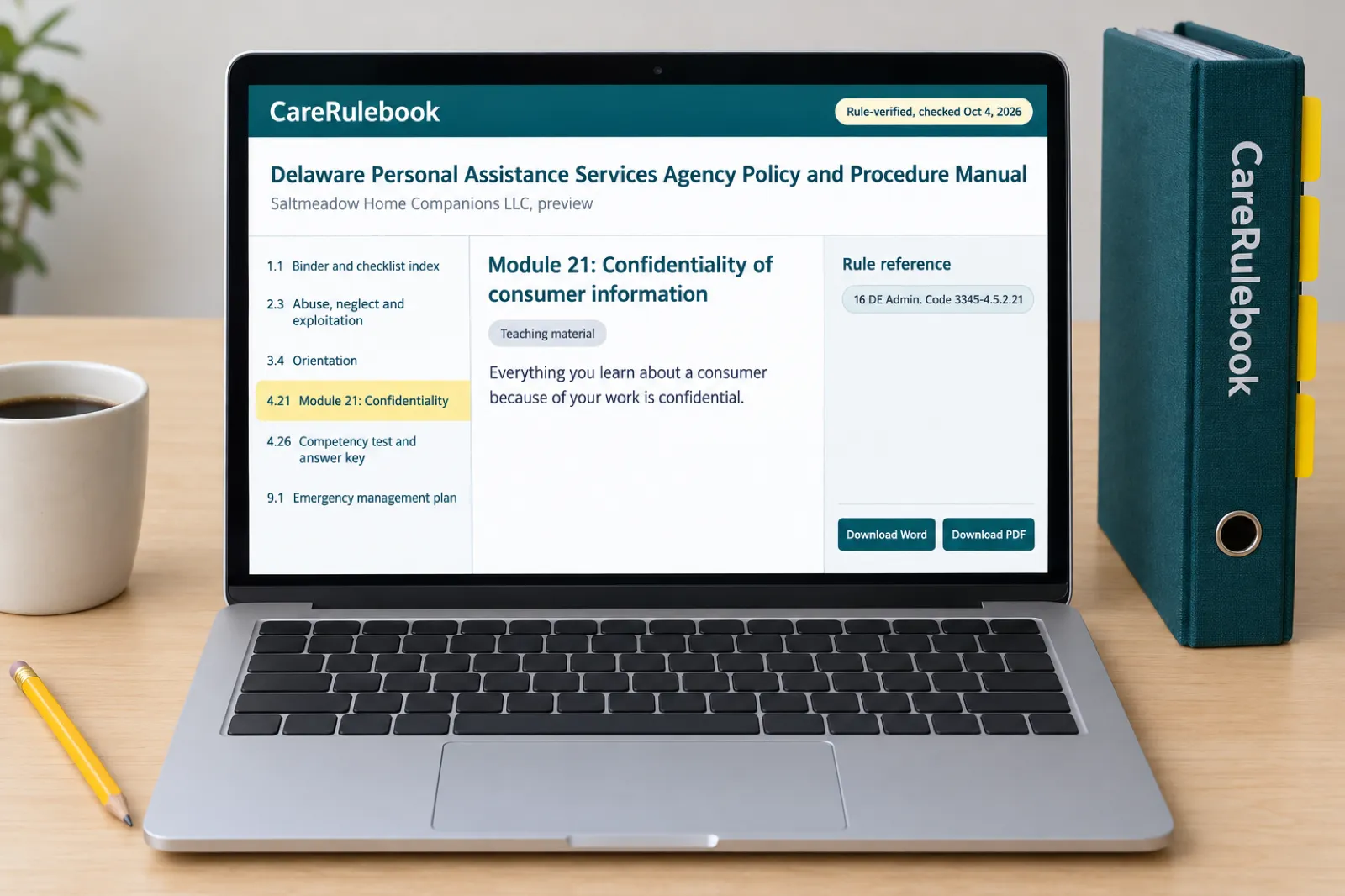
The CareRulebook Delaware manual preview on a laptop: orientation module 21 on confidentiality of consumer information for a sample agency, citing 16 DE Admin. Code 3345-4.5.2.21, with six of the manual’s sections listed beside it and a CareRulebook binder on the desk

CareRulebook

Every check, in one written policy

CareRulebook’s Delaware binder includes Policy 3.2, the pre-employment requirements DHCQ’s checklist asks for in row 4.3.2.1, with a pre-employment checklist, and Policy 3.3 on personnel records, written to 16 DE Admin. Code 3345 with rules 3110 and 3101 and the statutes quoted. The orientation modules and competency test are training material, not reviewed by a nurse, trainer or DHCQ.

  • 38 policies, 25 orientation modules and an 80-question competency test
  • 116 requirements mapped
  • In the row order of DHCQ’s 57-row checklist, with a page index
  • Editable Word and PDF; download again free for 12 months
Preview your binder

$199CareRulebook founding price for the first 50 Delaware agencies, then $249. Not a DHCQ fee.

The drug screen

  • Before employment. "The employer must ensure that no Applicant is employed without first receiving the results of the Applicant's mandatory drug test." (3110-10.4) The statute names marijuana, cocaine, opiates, PCP and amphetamines, and any other illegal drug the Department specifies in its rules (16 Del. C. § 1146(d)).
  • How results arrive. Results from a DHIN-participating lab come through the BCC; otherwise the employer ticks a box in the BCC certifying a compliant test and keeps the evidence in a separate file (3110-9.1-9.2).
  • The consumer can ask. On request, the drug screen result goes to the consumer or their representative when the worker starts (16 Del. C. § 1146(e)).
  • Penalty. $1,000 to $5,000 for each violation of the drug screening law (16 Del. C. § 1146(g)).

DHCQ’s background check page reads differently on timing; see where the sources disagree.

The Adult Abuse Registry and the child abuse registry

  • Adult Abuse Registry. "No health care service provider, to include nursing and similar facilities, or child care facility shall hire any person seeking employment or retain any contractors without conducting a check of the person through the on-line Adult Abuse Registry available at the Division's website." "The provider shall maintain a copy of the results of the check to demonstrate compliance with this requirement." (3101-2.1)
  • When you must fill a post. "When exigent circumstances exist which require an employer to fill a position in order to maintain the required or desired level of service, the employer may hire a person seeking employment on a conditional basis after the employer has requested an Adult Abuse Registry check." (3101-2.1.1) "The person shall be informed in writing, and shall acknowledge in writing, that his or her employment is conditional, and contingent upon receipt of the Adult Abuse Registry check." (3101-2.1.2)
  • What a listing means. "The listing of a person’s name on the Registry is based on a civil finding of abuse, neglect, mistreatment, financial exploitation, or a combination of those findings. It is not a criminal finding." (DHCQ Adult Abuse Registry page, Internet Archive copy)
  • Child abuse registry. DHCQ’s FAQ: "Are we required to do a child abuse check if we only work with adults? Yes" (DHCQ FAQ) The renewal application asks the director to attest to child and adult abuse checks for all employees and contractors (renewal application, p. 3).

Service letters

  • Which employers. One from the current or most recent employer, and "if a person seeking employment was employed in a health-care facility or by a child-serving entity within the past 5 years, the employer must obtain a service letter from all such employers." (19 Del. C. § 708(b)(1)a)
  • Never employed, or self-employed. The statute asks for letters of reference from 2 adults who know the person and are not relatives (19 Del. C. § 708(b)(1)a), and DHCQ’s slides say the same (DHCQ slides, slide 36).
  • No reply. "If the prospective employer attempts to obtain a service letter from a previous employer and the previous employer fails to respond, the previous employer’s failure to respond must be documented and reported to the Department of Labor." (19 Del. C. § 708(b)(1)b) DHCQ’s slides ask for more attempts when service letters are not returned, with evidence of each (fax, email, certified mail receipts) (DHCQ slides, slide 36).
  • When someone leaves you. The employer promptly completes a service letter in the BCC for the next employer; it expires after 5 years (3110-7.2).

TB and the physical

  • TB. "Minimum requirements for pre-employment/referral and annual tuberculosis (TB) testing are those currently recommended by the Centers for Disease Control and Prevention of the U.S. Department of Health and Human Services." (3345-4.4.2.6.1) "No person, including volunteers, found to have active tuberculosis in an infectious stage shall be permitted to give care or service to consumers." (3345-4.4.2.6.2) DHCQ’s slides say a TB test in the past 12 months done for another healthcare agency may be acceptable if you have a copy of the results (DHCQ slides, slide 33).
  • The physical. "All new personnel, including direct care workers shall be required to have a physical examination prior to providing care." (3345-4.4.2.6.5) DHCQ’s slides: before hire and before care, by a physician or other qualified licensed practitioner, and a complete physical, not a sick visit (DHCQ slides, slide 35).
  • How recent. The rule says within 12 months before hire; DHCQ’s FAQ says three months. Our reading below.
  • Fit for duty. Relieve anyone who cannot do the work safely, including with a temporary infection, until resolved. (3345-4.4.2.6.6)

Sharing results with consumers, and privacy

  • On request. "Upon request, the criminal history must be provided to the person for whom the services are to be provided, or to the person’s authorized representative upon the applicant’s commencement of work." (16 Del. C. § 1145(c))
  • Otherwise confidential. "The criminal history provided to the employer is strictly confidential. It may be used solely to determine the suitability of an applicant for employment or continued employment." (§ 1145(h))
  • The applicant’s part. On request, the applicant gives accurate information and signs full releases; an applicant who does not comply faces a $1,000 to $5,000 civil penalty (§ 1145(j)-(k)).

What goes in the files, and the penalties

  • At the initial survey. DHCQ’s slides list each personnel file’s contents: application, service letters, criminal check, adult and child abuse checks, physical, drug test, orientation, competency, signed job description, TB (DHCQ slides, slide 29). How the survey works.
  • Separate files. "The employer shall ensure that copies of all BCC consent forms signed by Applicants are maintained in a discrete file which is immediately available, upon request, from any agent of the Department." (3110-10.3) Evidence of drug tests not sent through the BCC goes in its own file too (3110-9.2).
  • At every renewal. The director attests that all staff had background checks, drug tests, child and adult abuse checks and service letters (renewal application, p. 3).
  • Penalties. "Any employer, other than a private person, who employs an applicant and fails to secure a criminal history is subject to a civil penalty of not less than $1,000 nor more than $5,000 for each violation." (16 Del. C. § 1145(g)) "An employer is also subject to this penalty if that employer conditionally employs an applicant before receiving verification that the applicant has been fingerprinted for purposes of the criminal history." (§ 1145(g))

Policy 3.2 in the CareRulebook binder carries a pre-employment checklist for each hire, and Policy 3.3 sets out what each personnel file holds and the letter of appointment the rule asks for (3345-4.4).

Where the sources disagree, and our readings

  • Drug test timing. The statute: "An employer may not employ any applicant without first obtaining the results of that applicant’s mandatory drug screening." (§ 1146(b)). But DHCQ’s background check page says: "Employers may hire an applicant on a conditional basis pending receipt of the drug test results, after the employers obtain proof that the applicant submitted to the testing." (DHCQ page, Internet Archive copy) Our reading: the statute and rule 3110-10.4 govern, so wait for the drug screen result before anyone starts.
  • How long a check lasts for a new employer. The statute says a BCC criminal history is valid for any prospective employer for 1 year from the last fingerprinting (§ 1145(c)). Rule 3110 says someone who signs a Master List retention form when they leave can be rehired within 3 years of their last fingerprinting without repeat fingerprinting, and re-checks an applicant whose last check is 3 years old or older (3110-6.1; 10.6; 3110-5.3). Our reading: the statute’s 1 year is the safer limit, so for a new hire last fingerprinted more than a year ago, expect new fingerprints unless the BCC confirms a retention form covers them. Staff already working for you are covered by Rap-back, not yearly fingerprints.
  • The physical. The rule: "The physical examination must have been completed within 12 months prior to employment/referral." (3345-4.4.2.6.5.1). DHCQ’s FAQ, revised October 22, 2025, still says three months (DHCQ FAQ). Our reading: the rule governs, but a physical within three months before hire satisfies both.
  • Theft misdemeanors. 3110-8.1 says 18 months and 8.2 says 2 years (3110-8.1). Our reading: follow 8.2.
  • When BCC access comes. DHCQ’s FAQ (Rev. 10/22/2025) says the initial license comes only once you have BCC access (DHCQ FAQ). Its 2024 slides say: "The Background Check Center (BCC) contact info will be supplied after you have passed your binder review and receive your initial license." (DHCQ slides, slide 30) Our reading: follow the newer FAQ, and send the BCC forms as soon as they arrive with Part 2.
  • Which division. Rule 3110 refers to the Division of Long Term Care Residents Protection (DLTCRP) (3110-5.2), and DHCQ’s slides give a DLTCRP email address for BCC questions (DHCQ slides, slide 31). Use the contact details DHCQ sends you with Part 2.

Myths about Delaware hiring checks

Can a new Delaware caregiver start before the background check is back?

It depends. Only conditionally. The law lets an employer hire conditionally for up to 60 days, but only after receiving verification that the applicant has been fingerprinted by the State Bureau of Identification. The drug screen result must be in before anyone is employed. The Adult Abuse Registry check comes before hiring too; only when exigent circumstances require filling a position may you hire conditionally after requesting it, telling the person in writing that the job depends on the result.

"Before an employer may offer conditional employment, the employer must receive verification that the applicant has been fingerprinted by the SBI for purposes of the criminal history."

Can I run Delaware background checks on my staff while my binder is under review?

No. Not through the Background Check Center. DHCQ says you get the BCC sign-up paperwork with the Part 2 checklist after your binder passes, and fingerprinting by the State Bureau of Identification comes only after the binder review. DHCQ also says it will not send the initial license until you have BCC access.

"Once you have passed your Document Compliance Review, then you will be given the ok to sign up for access within the BCC."

Does a Delaware agency that serves only adults still need child abuse registry checks?

Yes. DHCQ’s FAQ answers that question with a plain yes, its acknowledgement form lists the child abuse registry among the checks, and the renewal application asks the director to attest to child and adult abuse checks for all employees and contractors.

"Are we required to do a child abuse check if we only work with adults? Yes"

How recent must a Delaware caregiver’s physical exam be?

It depends. The rule says the physical must be completed within 12 months before hire (changed from three months in July 2023). DHCQ’s FAQ, revised October 2025, still says three months. Our reading: until DHCQ clarifies, a physical within three months satisfies both.

"The physical examination must have been completed within 12 months prior to employment/referral; and"

Frequently asked questions

Can a new Delaware caregiver start before the background check is back?

Only conditionally. The law lets an employer hire conditionally for up to 60 days from hire, but only after receiving verification that the applicant has been fingerprinted by the State Bureau of Identification. The drug screen result must be in before anyone is employed, and the Adult Abuse Registry check comes before hiring too; only when exigent circumstances require filling a position may you hire conditionally after requesting it, telling the person in writing.

What convictions disqualify someone from working for a Delaware PASA?

Rule 3110-8.2 says no agency may employ a person convicted within the past 15 years of abusing, neglecting or mistreating a resident of a facility or an impaired adult, of a theft-related misdemeanor within the past 2 years, or of a theft-related felony within the past 10 years. The statute adds that an employer may not employ or continue to employ anyone with a conviction the Department’s rules treat as disqualifying.

When can a new Delaware agency start using the Background Check Center?

After the binder passes. DHCQ says the BCC sign-up paperwork comes with the Part 2 checklist, fingerprinting by the State Bureau of Identification comes only after the binder review, and DHCQ will not send the initial license until the agency has BCC access.

Do I need a child abuse check if I only serve adults?

Yes. DHCQ’s FAQ answers that question with a plain yes, and the renewal application asks the director to attest to child and adult abuse checks for all employees and contractors.

How long is a Delaware background check good for?

The statute says a criminal history from the BCC is valid for any new employer for 1 year from the applicant’s last fingerprinting. Rule 3110 lets someone who leaves sign a Master List retention form and stay on the Master List for up to 3 years from their last fingerprinting, so they can be rehired without repeat fingerprinting, and it re-checks an applicant whose last check is 3 years old or older because Rap-back does not cover FBI records. While someone works for you, the BCC runs a Rap-back for new Delaware arrests and convictions instead of repeat checks. Our reading: for a new hire last fingerprinted more than a year ago, expect new fingerprints unless the BCC confirms a Master List retention covers them.

Must I show the background check to the consumer?

If asked. On request, the criminal history and the drug screen result go to the consumer, or their authorized representative, when the worker starts. Otherwise the criminal history is strictly confidential and used only to decide whether the person is suitable for the job.

Who do I call about the Background Check Center?

DHCQ’s slides give DHSS_DLTCRP_BCC@delaware.gov and 302-421-7405 for all Background Check Center questions.

Get Delaware rule-change alerts

We will email you when Delaware changes its background check, drug testing or home care rules, or DHCQ updates its guidance, with what it means for your hiring.

No spam. Only emails about Delaware home care rules. How we use your email.

Keep reading

Sources

  1. 16 DE Admin. Code 3345, Personal Assistance Services Agencies (official text) · Delaware Department of Health and Social Services, Division of Health Care Quality (Delaware Administrative Code) · retrieved October 4, 2026
  2. 16 DE Admin. Code 3110, Background Checks and Drug Testing for Programs and Home Care Agencies · Delaware Department of Health and Social Services, Division of Health Care Quality (Delaware Administrative Code) · retrieved October 4, 2026
  3. 16 Del. C. §§ 1145 and 1146, criminal background checks and mandatory drug screening for home-care agencies · Delaware General Assembly (Delaware Code Online) · retrieved October 4, 2026
  4. 16 DE Admin. Code 3101, Adult Abuse Registry · Delaware Department of Health and Social Services, Division of Health Care Quality (Delaware Administrative Code) · retrieved October 4, 2026
  5. 19 Del. C. § 708, special employment practices relating to health-care and child-care facilities (service letters) · Delaware General Assembly (Delaware Code Online) · retrieved October 4, 2026
  6. Licensure Renewal Application for 3345 Personal Assistance Services Agencies (Rev 11182022) · DHCQ Office of Health Facilities Licensing and Certification (Internet Archive copy) · retrieved October 4, 2026
  7. Interested Provider Meeting Frequently Asked Questions (Rev. 10/22/2025) · DHCQ Office of Health Facilities Licensing and Certification (Internet Archive copy) · retrieved October 4, 2026
  8. Interested Provider Meeting slides (2-21-24) and Interested Provider Receipt of Acknowledgement (Rev. 2025) · DHCQ Office of Health Facilities Licensing and Certification (Internet Archive copies) · retrieved October 4, 2026
  9. Office of Health Facilities Licensing and Certification, Licensing and Certification, Background Checks, Adult Abuse Registry and Report Abuse pages · Delaware Health and Social Services, Division of Health Care Quality (Internet Archive copies) · retrieved October 4, 2026
  10. 27 DE Reg. 43 (07/01/23), final order, 3345 Personal Assistance Services Agencies · Delaware Register of Regulations · retrieved October 4, 2026

Free sample, no email needed

Read a full policy before you buy

Policy 2.3, Abuse, neglect, mistreatment and financial exploitation: prevention and reporting, as it prints in the Delaware manual, filled in for a fictional agency. The rule text it rests on is quoted word for word under Rule basis.

PDF · 8 pages · 110 KB · Rule-verified October 4, 2026

Collecting answers for an agency or a client? The intake questionnaire lists all 48 questions the builder asks, what each decision changes in the manual, and a completed example: Word · PDF.How consultants use CareRulebook.

Download the sample (PDF)
Or email it to me

We send the link once. Nothing else unless you tick the box. Privacy notice.

Build your Delaware binderfrom $199