
Skip to content
CareRulebook
MenuClose

What do you run?

Home care in the US19 states with a manual, 6 with a free guide
ColoradoManual
ConnecticutPack
DelawareManual
GeorgiaManual
IllinoisManual
IndianaManual
KansasManual
MaineManual
MarylandManual
MinnesotaManual
NevadaManual
North CarolinaManual
OklahomaManual
OregonManual
South CarolinaManual
TennesseeManual
TexasManual
VirginiaManual
WashingtonManual
CaliforniaGuideFloridaGuideNew JerseyGuideNew YorkGuideOhioGuidePennsylvaniaGuideAll US home care states →
Care homes in the USCalifornia, Michigan, Minnesota; more states coming
Home care in the UKEngland, Scotland, Wales
Free toolsChecklists, calculators and templates

Maine · Caregivers · Ch. 129 §§ 4(A), 5(B)-(D)

Maine caregiver training: CNA or PSS, orientation, then every year

Hands-on caregivers at a Maine personal care agency must be active CNAs, or have completed the state’s Personal Support Specialist course or another approved program, or have enrolled in one within 60 days of hire and finish within nine months. For your own agency training, Chapter 129 lists topics and, on our reading, sets no hours. Every direct care employee completes your orientation on 13 topics before working alone, every employee gets training on 7 topics each year, and a supervisor watches each new caregiver at work every 30 days for their first three months.

  • Rule-verified October 4, 2026
  • Quoted from 10-144 C.M.R. Ch. 129
  • And DLC’s PSS curriculum
A grey-haired man in a navy sweater slides a printed page into a teal CareRulebook binder at a pine desk in a farmhouse office, beside a locked grey filing cabinet and a sticky note reading Lock the records, with autumn maples and a stone wall outside the window

Quick answer

Hands-on care needs a credential. An agency may not let anyone give hands-on personal care unless they are an active CNA, have completed Personal Support Specialist (PSS) training or another Department-approved program, or enrolled in one within 60 calendar days of hire (Ch. 129 § 4(A)(1)). "The employee must complete the training within nine months of hire." Staff who only help with meals, managing money, shopping, light housework and communication do not need the PSS course (§ 4(A)(2)).

Then your own training. "All employees providing direct care to clients must receive agency orientation prior to working independently with any client." (§ 5(B)(1)) "Each employee must receive annual training, including but not limited to" seven topics (§ 5(C)). Chapter 129 sets no hours for either; that is our reading of the rule text, which lists topics only.

60 days

from hire to enroll in PSS or an approved program, if not already a CNA or trained

Ch. 129 § 4(A)(1)

9 months

from hire to complete it, or stop giving personal care

Ch. 129 § 4(A)(1)

13 topics

in orientation, before working alone with a client

Ch. 129 § 5(B)(2)

7 topics

in every employee’s annual training

Ch. 129 § 5(C)

Who needs which training

Hands-on caregivers

Anyone giving direct care involving bodily functions, such as bed mobility, transfers, dressing, eating, toileting, bathing or personal hygiene, must be an active CNA or meet the PSS route below. They also need orientation, annual training and supervision.

Ch. 129 § 4(A)
Household help only

Staff whose work is limited to meals, managing money, shopping, light housework and communication do not need the PSS course. On our reading they still give direct care, so they still get orientation and supervision; annual training applies to every employee.

Ch. 129 § 4(A)(2)

Every employee

Annual training applies to "each employee", so on our reading office staff are included. Orientation is required for employees who provide direct care, before they work independently with a client.

Ch. 129 § 5(B)(1), § 5(C)

Supervisors

A supervisor is an LPN or RN in good standing, someone who completed the Department-approved personal care course and has a year’s experience, a registered CNA, or someone with five years of related education or experience. No nurse is required.

Ch. 129 § 5(D)

Our reading on household-only staff. Chapter 129 ties orientation to "All employees providing direct care to clients" (§ 5(B)(1)), and defines direct care as "direct contact assistance with personal care or activities of daily living", with personal care services covering both activities of daily living and instrumental ones such as meals, shopping and light housework (§ 1). We read household help as direct care, so CareRulebook’s manual orients and supervises those staff like hands-on caregivers. DLC has not said so in writing.

From hire to working alone, and every year after

The training duties in the order a new caregiver meets them. Background checks run alongside: Maine caregiver background checks. Tick steps off as you go; progress is saved in this browser only.

  1. Verify qualifications before the first day

    Before employment

    Your policies must cover verification of qualifications prior to employment. CareRulebook’s manual checks the CNA registry listing, a PSS or other approved certificate, or written proof of enrollment, and records each check.

  2. Not a CNA or PSS? Enroll within 60 days

    Within 60 days of hire

    A worker who is neither an active CNA nor already trained may give hands-on care once enrolled in PSS training or another Department-approved program, if they enrolled within 60 calendar days of hire. The CNA or PSS rule.

    Ch. 129 § 4(A)(1)
  3. Orientation before working alone

    Before working alone

    Every employee providing direct care completes your orientation, covering at least 13 topics, before working independently with any client. The 13 topics.

    Ch. 129 § 5(B)
  4. Mandated reporter training

    Every 4 years

    Maine law requires DHHS-approved mandated reporter training at least every four years for listed reporters. The law sets no deadline after hire; CareRulebook’s manual has staff complete it before working alone (the manual’s timing). Details.

  5. On-site supervision every 30 days

    First 3 months

    A supervisor watches each new direct care employee at work in a client’s home at least once every 30 days for the first three months, and documents the visit.

    Ch. 129 § 5(D)
  6. Finish the PSS course within nine months

    By 9 months after hire

    An enrolled worker must complete the training within nine months of hire. If they do not, they may not provide personal care services until they have completed the program.

    Ch. 129 § 4(A)(1)
  7. Annual training and the annual review

    Every year

    Each employee receives annual training on at least 7 topics, and the supervisor completes an annual performance review based on the employee’s date of hire.

    Ch. 129 § 5(C), § 5(D)

The CNA or PSS rule for hands-on care

The training is required for anyone "providing direct care involving the maintenance of bodily functions, including, but not limited to, bed mobility; transfers between surfaces; locomotion; dressing; eating; toileting; bathing; and personal hygiene assistance" (Ch. 129 § 4(A)(2)). For that work, the person must meet at least one of three routes (§ 4(A)(1)):

  1. listed as an active CNA on the Maine Registry of Certified Nursing Assistants and Direct Care Workers;
  2. completed Personal Support Specialist training or a Department-approved program related to the provision of personal care; or
  3. enrolled in one within 60 calendar days of hire, and then "The employee must complete the training within nine months of hire".

Missing the nine months. "If an individual does not complete the program within nine months of hire, they will no longer meet the qualifications to provide direct care and may not provide personal care services until they have completed the program." (§ 4(A)(1)) Chapter 129 defines personal care services to include household help (§ 1), so on our reading the worker does no client work at all until they finish; CareRulebook’s manual allows household help in that gap only if DLC confirms it in writing.

Before enrolling (our reading). A new worker who is not a CNA and has not completed approved training meets the rule only once enrolled. Until then, CareRulebook’s manual has them give household help only, and if they have not enrolled within 60 days, no hands-on help until they complete the training.

The PSS course

  • Who it is for. "The Personal Support Specialist (PSS) training is designed for unlicensed entry-level workers." DLC’s curriculum says "This training includes 14 modules" and "This training requires that you be present during all course sessions." (DLC PSS training page and curriculum).
  • Skills shown, not just taught. The curriculum ends with a "PSS Procedure Demonstration Checklist" (Appendix C).
  • Not clinical staff. "PSSs, unlike Certified Nursing Assistants (CNAs), work under the direction of the administrator of your facility and are not part of the clinical staff." (PSS curriculum)
  • Hours. Chapter 129 names the course but, on our reading, sets no hours. MaineCare Section 19, in the Secretary of State copy we saved, describes a PSS as someone who "has completed a Department approved training course of at least fifty (50) hours" (MaineCare Ch. II § 19.01-27), and Section 96 says the course must include at least 50 hours of instruction, demonstration, return demonstration and examination (§ 96.07-6(G)(2)(d)). Those are MaineCare program rules, and the copies may be older than the current MaineCare manual.
  • Not in our sources. Where courses run and what they cost. DLC’s page links a "PSS Instructor Attestation Form" (DLC PSS Training page), which we have not saved, so we do not state instructor qualifications here.

DLC’s rollout guidelines gave existing staff time: "Existing staff will have one (1) year to come into compliance." (Rollout Guidelines). They do not say from which date. The rule took effect on August 20, 2024 (DLC), so on our reading that year has passed and every hands-on caregiver must now meet one of the three routes.

Only the duties they were trained for

"Employees providing direct care to clients may only complete duties which they have been trained to perform through a state-approved Certified Nursing Assistant program or a Department-approved program related to the provision of care" (Ch. 129 § 4(D)). DLC’s curriculum tells students the same thing: "You are legally obligated to remain within your Scope of Training and only to perform the skills and procedures which are in your job description and which you have been taught." (PSS curriculum)

  • Tasks beyond the course. DLC’s curriculum says an employer may train a PSS in extra tasks, but the employer and its consultant RN must first decide whether those tasks fall within nursing delegation under the Board of Nursing’s Chapter 5 rules (PSS curriculum). That is DLC course guidance. Chapter 129 § 4(D) itself limits duties to what a state-approved CNA program or a Department-approved program trained, and has no nurse role; whether an employer’s own training of an extra task meets § 4(D) is not settled (our reading), so ask DLC before relying on it. CareRulebook’s manual does not add tasks this way. No PCA may advertise health services that need a licensed medical professional (§ 2(A)(2)).
  • Medication. DLC lists "Medication Reminders" among personal care services, and Chapter 129 says nothing about giving medication (DLC). On our reading, a non-medical agency should offer reminders only. CareRulebook’s manual covers reminders only, in Policy 2.11 (What our employees do and do not do, and medication reminders).
  • While a worker is enrolled (our reading). CareRulebook’s manual lets an employee in training give only the hands-on tasks the course has already trained them in, cleared task by task on a PSS progress tracker in Policy 4.1.

Orientation: 13 topics before working alone

"All employees providing direct care to clients must receive agency orientation prior to working independently with any client." (Ch. 129 § 5(B)(1)) The operations manual must include "A description of the orientation program, including but not limited to mandated reporting requirements" (§ 5(A)(1)(c)). The orientation covers, at a minimum (§ 5(B)(2)):

  1. Mandated reporting under 22 M.R.S. § 3477 and § 4011-A
  2. Agency policy on abuse, neglect and misappropriation of client property
  3. The agency expectations in § 7(A)
  4. Grievance policy
  5. Job duties and responsibilities
  6. Performance management, discipline and annual reviews
  7. Client service plans
  8. Documentation requirements
  9. Contingency planning practices
  10. Infection control
  11. Training requirements
  12. Emergency procedures related to the client
  13. Confidentiality under state and federal law

Summarized from the rule’s list. Ch. 129 § 5(B)(2)

What the rule leaves to you

No hours, no trainer qualification, no test and no form (our reading of § 5(B)). CareRulebook’s manual, in Policy 4.3 (Orientation and the description of our orientation program), has the administrator or a chosen supervisor teach each topic from the policy it comes from, has the employee explain the main steps back, practises hand hygiene and gloves, and records every topic on an orientation checklist signed by the employee and the administrator. Experience elsewhere does not replace it, because the orientation teaches your own policies. That method is the manual’s, not DLC’s.

The agency expectations taught in orientation and every year are the duties to clients listed in § 7(A). "The client must be given a copy of these agency expectations at the time of signing a contract with the agency." (§ 7(A)(2))

Annual training: 7 topics for every employee

"Each employee must receive annual training, including but not limited to" these seven topics (Ch. 129 § 5(C)):

  1. Maine’s mandated reporting statutes
  2. Agency policy on abuse, neglect and misappropriation of client property
  3. Grievance policy
  4. The agency expectations in § 7(A)
  5. Infection control
  6. Emergency and disaster policies
  7. Confidentiality under state and federal law

Summarized from the rule’s list. Ch. 129 § 5(C)

  • No hours, no date. The rule says "annual" and lists topics; it sets no hours and does not say when in the year (our reading). CareRulebook’s manual reads "annual" as at least once in every 12 months and completes it before each anniversary of hire, the date the annual performance review is based on.
  • In-service training is a separate policy. The operations manual needs a policy on "In-service training, including confidentiality and service planning for clients" (§ 5(A)(1)(d)(vi)). The rule sets no schedule for it; the manual gives both topics every 12 months, recorded on an in-service log, plus sessions when a policy change needs more than a written notice or a supervisory visit finds a competency issue that training would resolve.

The manual’s Policy 4.4 (Annual training, in-service training and mandated reporter training) holds the annual training record, the in-service log and the mandated reporter training tracker.

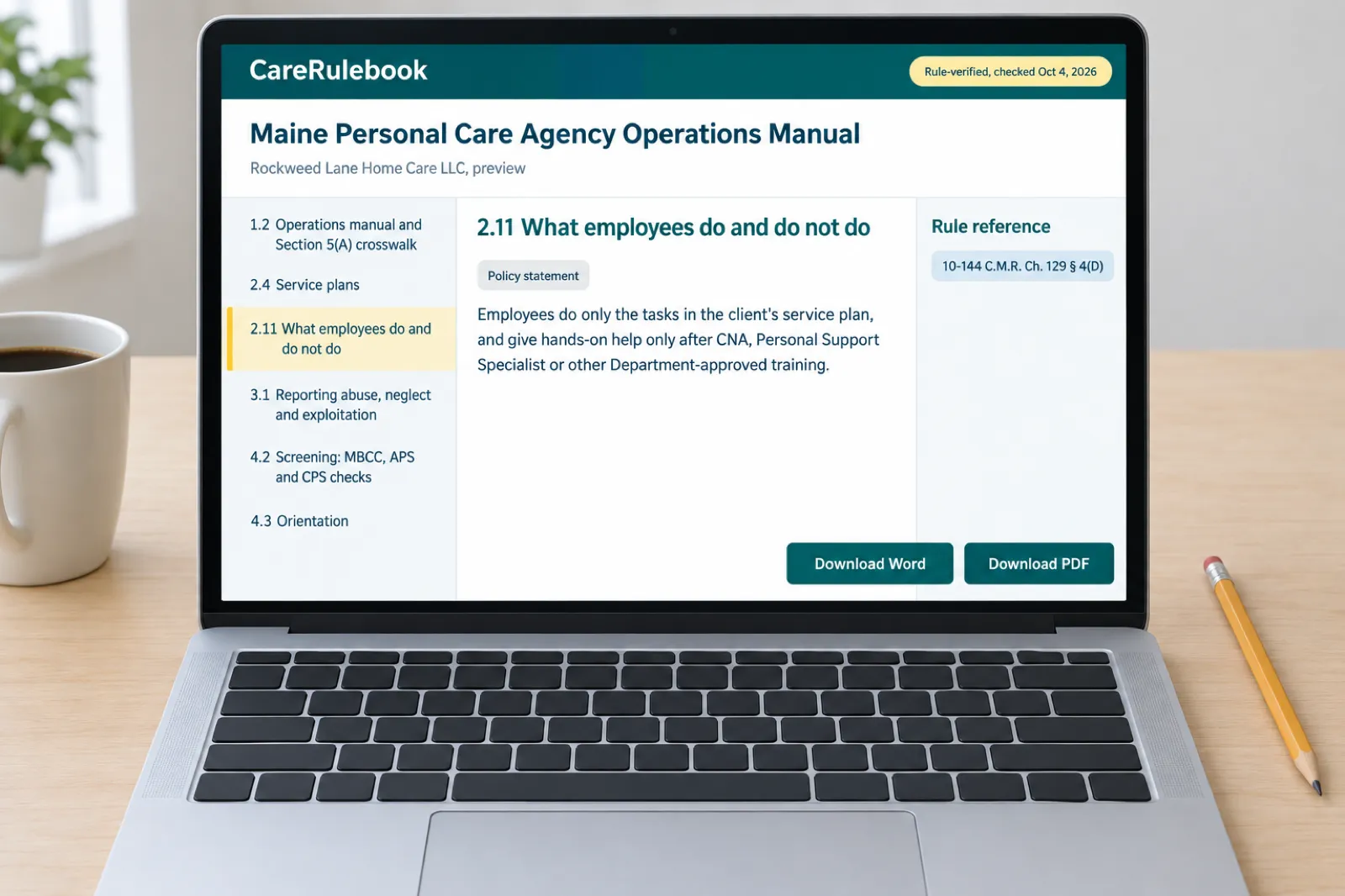
The CareRulebook Maine manual preview on a laptop: policy 2.11 on what employees do and do not do for a sample agency, citing 10-144 C.M.R. Ch. 129 § 4(D), with six of the manual’s policies listed beside it

CareRulebook

Training records written for your agency

CareRulebook’s Maine manual includes Policy 4.1 (Direct care qualifications and verifying them before hire) with a qualification verification record and a PSS progress tracker, Policy 4.3 with the 13-topic orientation checklist, Policy 4.4 with the annual training record, in-service log and mandated reporter tracker, and Policy 4.5 with the supervisory visit record.

  • 33 policies, 102 requirements mapped
  • Written for hands-on care or household help only, as you choose
  • Editable Word and print-ready PDF, with the rule quoted under each policy
Preview your manual

$199CareRulebook founding price for the first 50 Maine agencies, then $249. Not a DLC fee.

Mandated reporter training every four years

This is a state course under two statutes, separate from your orientation and annual training.

  • Adults. "A person required to make a report under subsection 1, paragraph A shall complete at least once every 4 years mandated reporter training approved by the department." (22 M.R.S. § 3477(8)) That list includes "Unlicensed assistive personnel" (§ 3477(1)(A)(21)). Our reading: personal care agency caregivers fall in that group.
  • Children. "A person required to make a report under subsection 1 shall complete at least once every 4 years mandated reporter training approved by the department." (22 M.R.S. § 4011-A(9)) Subsection 1 lists homemakers and home health aides (§ 4011-A(1)), so on our reading caregivers need it even if you serve only adults.
  • The courses. OADS runs the APS course online: "If you pass with an 80% or better, your certificate will be sent to the email you designated." OCFS: "The Mandated Reporting training is available virtually, self-paced." OADS adds: "If you are a mandated reporter for both adults and children, you should take training in both to understand your responsibilities." (OADS; OCFS)
  • Certificates. "It is your responsibility to maintain your certificates and complete the training as often as required by law and your place of employment." (OADS)

The statutes set no deadline after hire. CareRulebook’s manual has every direct care employee, supervisor and the administrator complete both courses before working independently with a client, unless they bring certificates dated within the last four years, and tracks each certificate’s four-year date. That timing is the manual’s choice. Mandated reporting is also the first orientation topic and the first annual topic (§ 5(B)(2); § 5(C)). How to report: abuse reporting in Maine.

Supervision and the annual review

  • The first three months. "The supervisor must provide on-site supervision at least once every 30 days to each employee assigned direct care duties, for the first three months of employment." "The on-site supervision must occur while the employee is providing personal care services." (Ch. 129 § 5(D)(1)(b))
  • What each visit records. The services observed, any competency issues noted, the action plan to resolve them, and an interview with the client and/or legal representative about their satisfaction with the services and whether the service plan is being followed (§ 5(D)(1)(c)). In CareRulebook’s manual, retraining is one of the actions a visit’s action plan can set.
  • The annual review. "The supervisor must complete an annual performance review, based on the employee’s date of hire." (§ 5(D)(1)(d))
  • After three months. The rule names no visit frequency (our reading). CareRulebook’s manual asks you to choose once a year, every six months or every three months, with a visit before each annual review, in Policy 4.5; the review form is in Policy 4.6.

DLC’s rollout guidelines applied the 30-day visits to every new hire from the date the rule was adopted (Rollout Guidelines).

Training records to keep

"An individualized record must be kept at the agency for owners and all employees." For training, each employee record holds (Ch. 129 § 9(C)(3)):

  • the first date the employee provided direct care to a client;
  • evidence of the completion of a CNA program or a Department-approved training program related to provision of direct care, or, if not completed at hire, the date the employee enrolled;
  • documentation of completion of the required orientation program and all required trainings;
  • each annual performance review; and
  • documentation of all required supervisory visits.

A state sample. OADS publishes a sample Personal Care Agency Training and Competency Verification form, which says it does not replace ongoing education, training and supervision (OADS sample templates). OADS says its samples may go beyond the rule (OADS). CareRulebook’s manual keeps an employee record checklist in Policy 4.7 (Owner and employee records), and each training form above files into it.

MaineCare Section 96: program rules on top

If you serve MaineCare members under Section 96 (Private Duty Nursing and Personal Care Services), its PSS rules apply as well. These are program rules, not Chapter 129. We quote the Secretary of State copy we saved: its file name carries the date 02.11.2019, and it still speaks of a registered personal care agency, so it may be older than the current MaineCare manual. Check the current text with MaineCare before relying on any row.

PointWhat Section 96 saysSource
Training deadlinesUnder Section 96, a PSS without the required training may be hired and reimbursed for personal care services if they enroll in a certified training program within 60 days of hire and complete training and the examination within nine months of employment.§ 96.07-6(G)(2)
Course lengthAt least 50 hours of formal classroom instruction, demonstration, return demonstration and examination.§ 96.07-6(G)(2)(d)
Orientation while untrainedUnder Section 96, a newly hired PSS who has not yet met the training and examination requirements (other than under the family provider service option) has an 8-hour orientation on the PSS role, responsibilities and tasks (up to 2 hours of job shadowing) before delivering services.§ 96.07-6(G)(3)(b)
Competency firstIn the same paragraph on newly hired PSSs not yet trained, Section 96 says the PSS shows the agency competency in all required tasks before being assigned to a member’s home (health maintenance activities may be shown on the job).§ 96.07-6(G)(3)(b)
Supervisory visitsUnder Section 96, outside the family provider service option, on-site supervision at least quarterly for Level III, IV and V members, and at least every 6 months with quarterly phone calls for Level I and II members.§ 96.07-6(G)(4)(b)(ii)

MaineCare Section 19 describes the PSS course as including "instruction in basic personal support procedures, first aid, handling of emergencies, and review of the mandatory reporting requirement under the Adult Protective Services Act" (§ 19.01-27). CareRulebook’s manual covers the licensing rule; it does not cover MaineCare program duties, so check the current MaineCare manual before you enroll.

What Chapter 129 does not set

Each of these is our reading of the rule text, which is silent on them.

  • Hours for orientation or annual training. The rule lists topics only (§ 5(B)(2); § 5(C)).
  • CPR or first aid certification. Not mentioned. DLC’s curriculum says "Your facility will inform you of any BLS, First Aid, and/or CPR requirements you will need to be certified in for your job." (PSS curriculum, Module 13) CareRulebook’s manual suggests a first aid and CPR course as Recommended practice in Policy 2.8, labelled as not a DLC requirement.
  • Dementia training. Chapter 129 names none. DLC’s PSS curriculum includes "Caring for a Person with Dementia" (Module 8), so staff who took that course have covered it; a CNA program or another approved program may differ.
  • A nurse. Chapter 129 has no nurse role; a supervisor can be a CNA, PSS-trained with a year’s experience, or have five years of related education or experience (§ 5(D)).

Myths about Maine caregiver training

Do Maine caregivers need training before they start?

It depends. For hands-on care (bathing, dressing, toileting, transfers and other ADLs), a caregiver must be an active CNA or have completed, or enrolled within 60 days of hire in, the state’s Personal Support Specialist course or another approved program, and finish within nine months. Everyone who gives direct care also needs your agency orientation before working alone with a client. Staff who only help with meals, money, shopping, light housework and communication do not need the PSS course.

"The employee must complete the training within nine months of hire."

How often must a Maine caregiver be supervised?

It depends. For the first three months of employment, a qualified supervisor must watch each direct care employee at work in a client’s home at least every 30 days, document what they saw and ask the client about the care. After that the rule requires an annual performance review and names no visit frequency; on our reading, your supervision policy sets it. Ask DLC what it expects.

"The supervisor must provide on-site supervision at least once every 30 days to each employee assigned direct care duties, for the first three months of employment."

Do I need a nurse to open a personal care agency in Maine?

No. A Maine personal care agency provides non-medical services and Chapter 129 has no nurse role. Your supervisor can be an LPN or RN, but can equally be a CNA, someone who completed the Personal Support Specialist course and has a year’s experience, or someone with five years of related education or experience. If you want to offer nursing or home health aide services, that is a different license (home health care, which needs a Director of Nurses who is an RN).

"Personal Care Agencies provide non-medical services to individuals in their homes."

Can Maine personal care agency caregivers give medications?

It depends. DLC lists medication reminders among personal care agency services, and Chapter 129 says nothing about medication administration. Caregivers may only do tasks their CNA or approved training covers. A non-medical agency should offer reminders only unless DLC confirms otherwise.

"Medication Reminders"

Frequently asked questions

How many hours of training do Maine personal care agency caregivers need?

On our reading of the rule text, Chapter 129 sets no hours for orientation or annual training; it sets topics. For hands-on care, a caregiver must be an active CNA or have completed, or enrolled within 60 days of hire in, the Personal Support Specialist (PSS) course or another Department-approved program, and finish within nine months of hire. DLC’s 2019 PSS curriculum has 14 modules. MaineCare Sections 19 and 96, in the Secretary of State copies we saved, describe the PSS course as at least 50 hours; those are MaineCare program rules.

Can a new caregiver start work before finishing the PSS course?

Yes, if they enrolled in PSS training or another Department-approved program within 60 calendar days of hire, and they must complete it within nine months of hire. If they miss the nine months, they may not provide personal care services until they finish. On our reading, a worker who has not yet enrolled does not meet any route, so gives no hands-on help until enrolled. They still complete your orientation before working alone with a client.

Do homemaker and companion staff need PSS training in Maine?

No. Chapter 129 says PSS training is not required when the services provided are limited to meals, managing money, shopping, light housework and communication. On our reading those staff still give direct care, so they still complete orientation and are supervised, and every employee receives annual training.

Is CPR or first aid certification required for Maine caregivers?

We found no mention of CPR or first aid certification in Chapter 129. DLC’s PSS curriculum says the employer will tell the student about any basic life support, first aid or CPR certification the job needs, and MaineCare Section 19 describes the PSS course as including first aid instruction. CareRulebook’s manual suggests a first aid and CPR course in its optional Recommended practice, not as a DLC requirement.

Who can give orientation and annual training?

Chapter 129 names no qualification for the person who gives orientation or annual training. CareRulebook’s manual has the administrator, or a supervisor the administrator chooses, give both, and records each topic with the trainer’s and the employee’s initials. The PSS course itself is a separate, Department-approved program.

How often is mandated reporter training in Maine?

At least once every four years. 22 M.R.S. § 3477(8) requires it of the professional reporters listed for adults, which include unlicensed assistive personnel, and § 4011-A(9) requires it of everyone who must report suspected child abuse, which includes homemakers. OADS runs the online adult course, with a certificate after a quiz passed with 80% or better; OCFS offers the child course online and self-paced. OADS says someone who reports for both adults and children should take both.

Does MaineCare add training rules?

Yes, for agencies serving MaineCare members. Section 96 (Private Duty Nursing and Personal Care Services), in the Secretary of State copy we saved (its file name is dated 2019), gives a newly hired PSS who has not yet met the training and examination requirements, outside the family provider service option, an 8-hour orientation before delivering services, and asks for competency in all required tasks before the PSS is assigned to a member’s home. These are program rules, not Chapter 129, and CareRulebook’s manual covers the licensing rule, not MaineCare duties.

Get Maine rule-change alerts

DHHS plans to revise Chapter 129 to clarify some provisions; no text was published in the weekly notices we checked, to October 7, 2026. Leave your email and we will tell you when a Maine change affects your training or your policies.

No spam. Only emails about Maine home care rules. How we use your email.

Keep reading

Sources

  1. 10-144 C.M.R. Chapter 129, Personal Care Agency Licensing Rule (effective August 20, 2024) · Maine Department of Health and Human Services, Division of Licensing and Certification (identical to the Secretary of State filing 2024-188) · retrieved October 2, 2026
  2. 22 M.R.S. chapter 958-A, Adult Protective Services Act (§§ 3472, 3477, 3479-A) · Maine Legislature, Office of the Revisor of Statutes · retrieved October 4, 2026
  3. 22 M.R.S. chapter 1071, Child and Family Services and Child Protection Act (§§ 4002, 4011-A) · Maine Legislature, Office of the Revisor of Statutes · retrieved October 4, 2026
  4. Personal Care Agencies (licensing page) · Maine DHHS Division of Licensing and Certification · retrieved October 4, 2026
  5. Personal Care Agency Licensing Rule Rollout Guidelines · Maine DHHS Division of Licensing and Certification · retrieved October 2, 2026
  6. PCA Licensing Initiative (resources and sample templates) · Maine DHHS Office of Aging and Disability Services · retrieved October 4, 2026
  7. PCA sample templates: service plan, referral, HIPAA authorization, abuse reporting, organization chart, emergency preparedness plan, infection control log, discharge, training and competency verification, assessment · Maine DHHS Office of Aging and Disability Services · retrieved October 4, 2026
  8. Adult Protective Services and APS Mandated Reporters pages · Maine DHHS Office of Aging and Disability Services · retrieved October 4, 2026
  9. Reporting Suspected Child Abuse and Neglect and Mandated Reporter Information pages · Maine DHHS Office of Child and Family Services · retrieved October 4, 2026
  10. Personal Support Specialist (PSS) Training page and PSS Training Program Curriculum (v2019/02/01) · Maine DHHS Division of Licensing and Certification · retrieved October 4, 2026
  11. MaineCare Benefits Manual, Chapter II, Section 19, Home and Community Benefits for the Elderly and Adults with Disabilities (Secretary of State copy) · Maine DHHS Office of MaineCare Services · retrieved October 4, 2026
  12. MaineCare Benefits Manual, Chapter II, Section 96, Private Duty Nursing and Personal Care Services (Secretary of State copy) · Maine DHHS Office of MaineCare Services · retrieved October 4, 2026

Free sample, no email needed

Read a full policy before you buy

Policy 2.9, Grievances and complaints to DLC, as it prints in the Maine manual, filled in for a fictional agency. The rule text it rests on is quoted word for word under Rule basis.

PDF · 7 pages · 96 KB · Rule-verified October 4, 2026

Collecting answers for an agency or a client? The intake questionnaire lists all 39 questions the builder asks, what each decision changes in the manual, and a completed example: Word · PDF.How consultants use CareRulebook.

Download the sample (PDF)
Or email it to me

We send the link once. Nothing else unless you tick the box. Privacy notice.

Build your Maine manualfrom $199