Skip to content
CareRulebook
MenuClose

What do you run?

Home care in the US19 states with a manual, 6 with a free guide
ColoradoManual
ConnecticutPack
DelawareManual
GeorgiaManual
IllinoisManual
IndianaManual
KansasManual
MaineManual
MarylandManual
MinnesotaManual
NevadaManual
North CarolinaManual
OklahomaManual
OregonManual
South CarolinaManual
TennesseeManual
TexasManual
VirginiaManual
WashingtonManual
CaliforniaGuideFloridaGuideNew JerseyGuideNew YorkGuideOhioGuidePennsylvaniaGuideAll US home care states →
Care homes in the USCalifornia, Michigan, Minnesota; more states coming
Home care in the UKEngland, Scotland, Wales
Free toolsChecklists, calculators and templates

Georgia · Private home care · 2026

How to start a home care agency in Georgia (2026)

To start a home care agency in Georgia you need a private home care provider license from the Department of Community Health, even for companion-only care. DCH requires a registered nurse on every application, and once approved you have three months on a provisional license to admit three clients and request your survey.

  • Rule-verified September 30, 2026
  • 54 rules mapped to policies
  • 22 official sources
Two co-founders of a new Georgia home care agency, one a registered nurse, work at a desk in a small office with a CareRulebook binder

Quick answer

To start a home care agency in Georgia, you need a private home care provider (PHCP) license from the Georgia Department of Community Health (DCH). Unlike Texas, this includes companion and sitter services. It costs $300 to apply plus $250 a year for each service category, and the license has no expiry date.

DCH requires a registered nurse on every initial application. With the application you confirm, in a notarized affidavit, that the policies the rules require already exist. Once approved, you get a provisional license for three months, in which you must admit at least three clients and email DCH to request your initial survey, or the license is voided.

$300

DCH application processing fee

111-8-25-.03(8)

$250

DCH fee per service category a year, up to $750

111-8-25-.03(8)

3 months

On a provisional license to admit 3 clients

DCH checklist

30 days

Initial review, in business days

DCH checklist

Direct answers

Do I need a license to start a home care agency in Georgia?

Yes, including for companion or sitter services only. Georgia licenses three categories: companion or sitter tasks, personal care tasks and nursing. The only exemption that fits most founders is a caregiver working alone, with no employees, contractors or referral business.

Ga. Comp. R. & Regs. 111-8-65-.03(o), .07(1)(a)

How much does a Georgia home care license cost?

A $300 application processing fee, plus $250 a year for each service category, up to $750. The first year's license fee is paid with the application, so a companion-only agency pays $550 to apply. CareRulebook lists every fee with its rule citation below.

111-8-25-.03(8)

Do I need a nurse to open a home care agency in Georgia?

Yes, to apply. DCH’s current checklist says an RN is required for the initial application whatever services you offer. The RN can also be the owner or the administrator.

DCH Application Checklist, p. 2

What policies does a Georgia home care agency need?

The requirements are spread through Chapter 111-8-65 and the background check rules. CareRulebook maps 54 rule requirements to the policies that cover them, in the table on this page. You confirm they exist in a notarized affidavit when you apply.

DCH Affidavit of Compliance

Interactive check

Which Georgia license do you need?

Will anyone other than you deliver the care?

Employees, contractors, or caregivers you refer clients to when you have a financial interest in their services.

How to start a Georgia home care agency, step by step

Tick steps off as you go. Your progress is saved in this browser only.

  1. Choose your service categories

    Companion or sitter tasks, personal care tasks, nursing, or a mix. Each category adds to the annual fee and brings its own staff training and supervision rules.

    111-8-65-.10(1)
  2. Line up your administrator and an RN

    The governing body appoints an administrator with full authority. DCH also requires a registered nurse for every initial application. One person can hold both roles.

  3. Register the business and get a local business license

    DCH asks for proof of registration with the Georgia Secretary of State, if it applies to your business type, and a current city or county business license with the agency’s name and address. Check that your city or county will license the address you plan to use, especially a home office. Office, records and premises rules.

  4. Run fingerprint checks through GCHEXS

    Every administrator and every owner of 10% or more needs a satisfactory determination letter dated within 12 months of the application.

  5. Write every policy the rules require

    Before applying

    You file a notarized Affidavit of Compliance saying the required policies already exist. DCH checks them at inspection, not at application.

  6. Complete the administrator’s orientation

    Before applying

    The application includes evidence that the administrator completed the orientation training set out in the rules, signed and dated.

  7. Apply in GAHLES and pay $300 plus the first license fee

    Upload every document on the checklist. Missing documents mean denial. DCH reviews applications in order, with an initial review time of 30 business days. Fees are not refundable. Every document, step by step.

  8. Admit three clients on the provisional license

    Within 3 months

    Once approved you get a provisional license for three months. In that time you must become operational and admit at least three clients.

  9. Email DCH to request your initial survey

    Before month 3 ends

    Before the three months end, email the Private Home Care Unit. Miss it and the license is automatically voided and you must apply again.

  10. Pass the survey and pay the annual fee each year

    Ongoing

    After a successful survey DCH issues the permanent permit. It has no expiry date, but the annual fee is due October 1 to December 31, with a $150 late fee from January 1.

Georgia home care license fees and timeline

Georgia charges per service category, not per staff member. The fee rule sets a $300 application processing fee and an annual license fee of $250 for each service you offer, up to $750 for all three. The first license fee is the same as the annual fee and is paid with the application, so a companion-only agency pays $550 to apply and an agency offering all three categories pays $1,050. Application fees are not refundable.

Georgia PHCP key facts

License
Private home care provider (PHCP).05(1)
Regulator
Department of Community Health (DCH).05(1)
State fees
$300 to apply, then $250 per service a year111-8-25-.03
RN
Required on every applicationDCH checklist
Provisional
3 months, at least 3 clientsDCH checklist
Review
30 business daysDCH checklist
License term
No expiry; annual fee each fallDCH fees

Checked against official sources on September 30, 2026.

DCH says licenses "have issue dates and no expiration date". What recurs is the annual fee, collected from October 1 to December 31 without penalty. A $150 late fee is added on January 1. The first license fee covers the rest of the calendar year in which you pay it.

Every DCH fee, totals by service category and the timeline to a permanent permit →

Do you need a registered nurse?

Yes, to apply. DCH’s current application checklist is direct: "Regardless of the service level provided, an RN is required for the initial application." The checklist asks for a copy of a current Georgia RN license, and says the RN can also be the administrator or the owner.

This is a DCH application requirement, not a line in the rules. Chapter 111-8-65 requires a Georgia RN to supervise nursing services, and an RN or LPN to supervise personal care for medically frail clients. For companion and sitter work, the rule lets "the administrator, or any other staff member assigned responsibility for supervision of the delivery of care" supervise. DCH’s 2022 application packet asked only for an administrator and one other employee, so older guides may not mention the RN.

The administrator, the RN and supervisors for each service →

The provisional license and your initial survey

The rules allow a provisional license for "a reasonable, but limited, time". DCH’s checklist sets that time: three months. In that window you must become operational, admit at least three clients and, before the three months end, email the Private Home Care Unit to request your initial survey.

If you do not, DCH says the license is automatically voided and "a new application and full review process will be required". Extensions need prior written approval with documented justification, sent before the deadline. After a successful survey, DCH issues the permanent permit.

After that, DCH says re-licensure surveys come roughly every 18 to 24 months. If you have had no client for three months when a survey is scheduled, you get 30 days to admit one, or the permit is treated as void. When a survey cites violations, you have 10 days to send a written plan of correction.

The initial survey, re-licensure surveys and how to be ready →

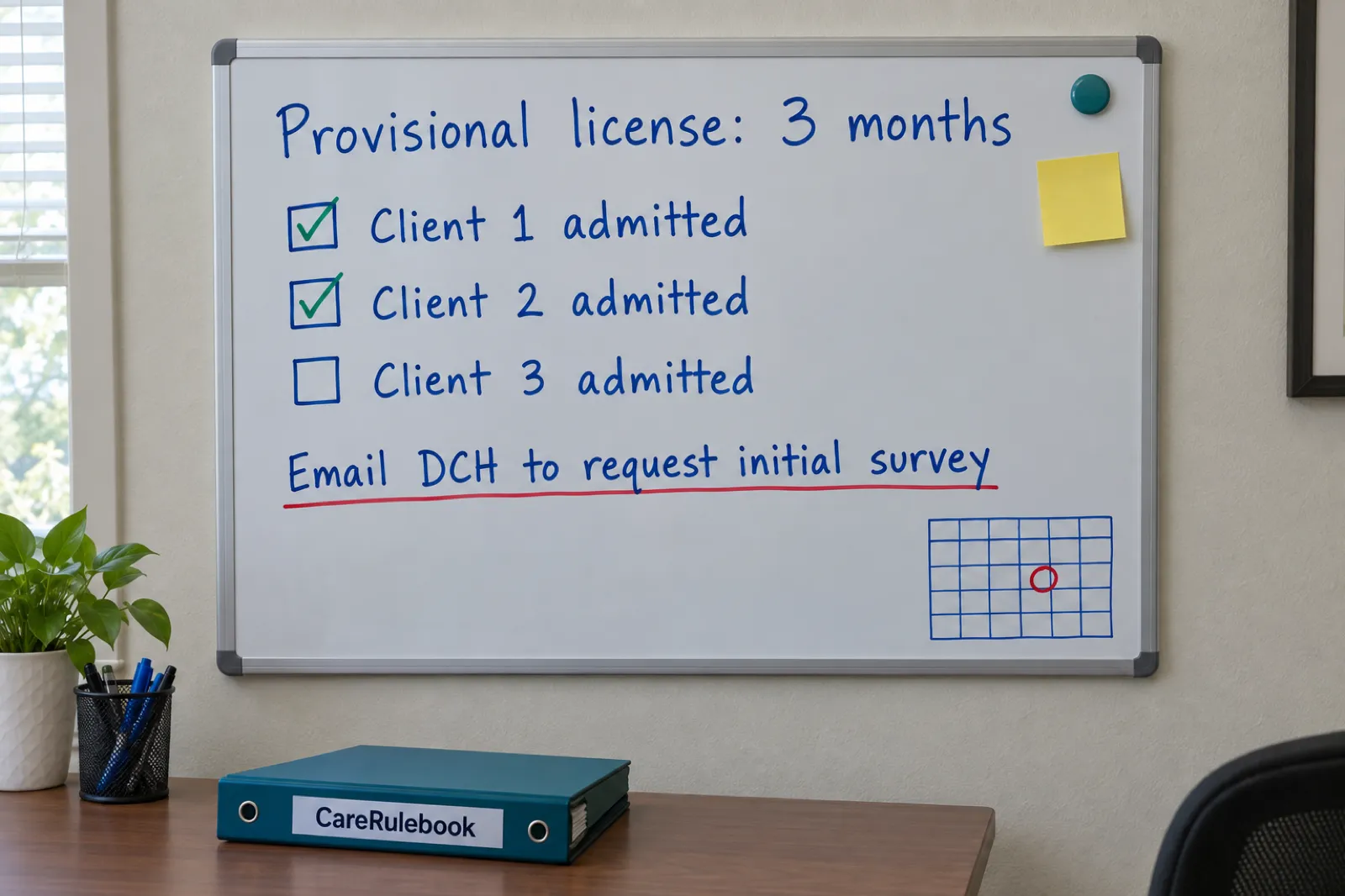
An office whiteboard tracking a Georgia provisional license: three months, two of three clients admitted, and a reminder to email DCH to request the initial survey
Three months, three clients, then email DCH to request the survey (DCH Application Checklist, p. 2).

Every policy Chapter 111-8-65 requires

DCH does not ask you to upload policies with the application. Instead, the owner signs a notarized Affidavit of Compliance saying the agency "has developed policies and procedures mandated under the rules", and DCH checks them at unannounced inspections. The same form warns: "Deficient policies and procedures may subject the facility to sanctions".

We read every section of Chapter 111-8-65 and the background check rules and mapped 54 requirements to the policies that cover them. 6 of them expressly require you to establish policies and procedures; the rest are records, notices and processes a surveyor will look for. Filter the table by topic or manual section.

54 rows

RuleWhat it requiresPolicy in your manual
111-8-65-.04

Governing body sets policy

A governing body that adopts every policy and procedure and is responsible for compliance.

"Each private home care provider shall have a governing body empowered and responsible to determine all policies and procedures and to ensure compliance with these rules."

Policy in your manual1.1 Governing body, administrator and license
111-8-65-.09(3)

Administrator appointment

Appoint an administrator with full authority. DCH checks the signed job description at application.

"The governing body shall appoint an administrator who shall have full authority and responsibility for the operation of the private home care provider."

Policy in your manual1.1 Governing body, administrator and license1.2 Organizational structure and lines of authority
111-8-65-.09(3)(a)

Administrator qualifications

Every administrator obtains a satisfactory fingerprint records check determination under Chapter 111-8-12, takes part in the required orientation and training, and makes no material false statements about qualifications.

"Any administrator employed by the provider must meet the following minimum qualifications"

Policy in your manual1.1 Governing body, administrator and license3.3 Criminal history checks and registry searches
111-8-65-.05(2)(b)

License display

Display the license at the licensed location.

"The license shall be prominently and appropriately displayed at the private home care providers licensed location."

Policy in your manual1.1 Governing body, administrator and license
111-8-65-.05(2)(c)

Changes of location

Give DCH 15 days’ notice before moving. Changes of name, location or ownership return the license.

"The department shall be provided 15 days notice in advance of any providers change in location."

Policy in your manual1.1 Governing body, administrator and license
111-8-65-.08(3)

Inspection cooperation

All staff cooperate with inspections and hand over documents without delay.

"All provider staff shall cooperate with any inspection conducted by the department and shall provide, without unreasonable delay, any documents to which the department is entitled hereunder."

Policy in your manual1.3 Surveyor entry and survey cooperation
111-8-65-.08(4)

Plan of correction

after an inspection cites a violation

A written plan of correction within 10 days of an inspection report that cites violations.

"The provider must submit a written plan of correction (improvement) in response to the inspection report"

Policy in your manual1.3 Surveyor entry and survey cooperation9.1 Quality improvement program
111-8-65-.09(7)

Contracted services

if the agency uses contractors

Put every arrangement with contractors in writing, detailing the services.

"such arrangements shall be set forth in writing detailing the services to be provided."

Policy in your manual1.4 Independent contractors and arranged services
111-8-65-.09(1)

Scope of services

Written policies defining the services you offer and the clients you serve.

"A provider shall establish and implement written policies and procedures that define the scope of private home care services it offers and the types of clients it serves."

Policy in your manual2.1 Scope of services and clients served
111-8-65-.09(2)

Only offer what you can deliver

Do not offer services you cannot reasonably expect to deliver under the rules.

"No provider shall offer to provide a client any private home care services that it cannot reasonably expect to deliver in accordance with these rules."

Policy in your manual2.1 Scope of services and clients served
111-8-65-.09(2)(a)

Service agreements

Written policies for service agreements. Every service is based on a written agreement with ten required elements.

"A provider shall establish and implement policies and procedures for service agreements. All services provided to a client shall be based on a written service agreement"

Policy in your manual2.4 Client service agreement and disclosure
111-8-65-.09(2)(b)

Late agreements

If the agreement cannot be completed on time for good cause, document why in the client file.

"If the provider is unable to complete the service agreement for good cause, the provider will document such reason(s) in the client's file."

Policy in your manual2.4 Client service agreement and disclosure
111-8-65-.09(2)(c)

Cancellation

Clients may cancel at any time and pay only for services already given.

"A client has the right to cancel any service agreement at any time and shall only be charged for services actually rendered"

Policy in your manual2.4 Client service agreement and disclosure
111-8-65-.12(1)

Client rights and complaints

Written policies on client rights and responsibilities and on handling complaints.

"A provider shall establish and implement written policies and procedures regarding the rights and responsibilities of clients, and the handling and resolution of complaints."

Policy in your manual2.2 Client rights, conduct and responsibilities2.3 Complaints, grievances and investigations
111-8-65-.12(2)

Written notice of rights

A written notice of 11 rights and responsibilities, given when the service agreement is completed.

"Such policies and procedures shall include a written notice of rights and responsibilities which shall be provided to each client or responsible party"

Policy in your manual2.2 Client rights, conduct and responsibilities
111-8-65-.12(3)

Complaint procedure

Clients and others can complain orally or in writing and have complaints resolved in a timely way.

"Such policies shall also include procedures for clients and others to present complaints, either orally or in writing"

Policy in your manual2.3 Complaints, grievances and investigations
111-8-65-.12(4)

Provider phone number

Give every client the agency’s phone number for questions and complaints.

"A provider shall supply all clients and responsible parties, if applicable, with the specific telephone number of the provider"

Policy in your manual2.3 Complaints, grievances and investigations2.2 Client rights, conduct and responsibilities
111-8-65-.09(4)(d)

Complaint files

Keep files documenting every complaint.

"The provider shall maintain files of all documentation of complaints submitted pursuant to rule .12(2)."

Policy in your manual2.3 Complaints, grievances and investigations
111-8-65-.10(1)(b)

Following the service plan

if personal care is offered

Aides follow the service plan and report changes in the client’s condition and any problems.

"In addition to following the service plan, a PCA must report on the personal care needs of the client, on changes in the client's condition, and on any observed problems that affect the client."

Policy in your manual2.5 Client care practices
111-8-65-.09(2)(a)9

Access to client funds

if staff handle client funds

Written authorization before staff access a client’s money for home management.

"Authorization from client or responsible party, if applicable, for access to client's personal funds when home management services are to be provided"

Policy in your manual2.6 Client funds, vehicles and transportation2.4 Client service agreement and disclosure
111-8-65-.03(g); .09(4)(c)9

Bonding

if staff have unlimited access to client funds

Bond any employee with unlimited access to a client’s funds.

"any employee that is authorized unlimited access to a client's personal funds for home management shall be bonded through the provider"

Policy in your manual2.6 Client funds, vehicles and transportation3.2 Personnel records
111-8-65-.03(s)

Transporting clients

if staff drive clients

Get a signed waiver or check motor insurance when staff drive clients in a vehicle that is not the client’s.

"the provider shall either obtain a signed waiver by the client of any claims for damages arising out of the operation of the vehicle or make reasonable efforts to insure that there is current motor vehicle insurance"

Policy in your manual2.6 Client funds, vehicles and transportation
111-8-65-.09(5)

Staffing and shortages

Enough qualified staff for every service agreement. Tell clients and offer a referral if you cannot deliver.

"the provider shall advise the client and refer the client to another provider if the client so desires."

Policy in your manual3.1 Staffing policies5.3 Backup services
111-8-65-.09(4)(c)

Personnel records

A separate record for each employee with nine required items.

"A provider shall maintain separate written records for each employee and the records shall include the following"

Policy in your manual3.2 Personnel records
111-8-65-.09(4)(c)4

TB and health screening

Since July 29, 2026, a health screening program (initial, routine and targeted screenings of employees and contractors who interact with clients or carry out other activities with environmental impact) and TB screening before starting work, following CDC guidance. The annual TB test the rule required before then is no longer in the rule.

"Each provider shall have in place a health screening program designed to identify conditions that may place clients at risk for infection, injury, or improper care."

Policy in your manual3.4 Employee health and TB screening3.2 Personnel records
111-8-65-.09(5)(a)

Competency evaluation

A written evaluation showing a supervisor observed each employee perform their job tasks competently.

"The written evaluation must reflect that the employee's performance of required job tasks was observed personally by a supervisor either by demonstration or observation"

Policy in your manual4.1 Orientation, job training and competency5.2 Supervision of personnel
111-8-65-.09(5)(b)

Nursing staff

if nursing services are offered

Anyone giving nursing services holds a Georgia license.

"Any persons employed by the provider to provide nursing services shall be licensed in Georgia"

Policy in your manual3.1 Staffing policies
111-8-65-.09(5)(c)

Aide qualification and training

if personal care is offered

Aides qualify through one of four routes, including a 40-hour agency course directed by an RN or a health care professional with similar education and experience.

"A training program described in rule .09(5)(c)1. (iv) must be conducted under the direction of a licensed registered professional nurse, or a health care professional with commensurate education and experience."

Policy in your manual4.1 Orientation, job training and competency
111-8-65-.09(5)(d)

Companion training

if companion or sitter tasks are offered

Companions complete training or show competency in seven areas.

"Successfully complete training or demonstrate understanding and practical competency in the following areas"

Policy in your manual4.1 Orientation, job training and competency
111-8-65-.09(6)(a)

Orientation

Orientation before client work, covering your policies, duties, reporting and emergencies, and exposure reporting.

"Prior to working with clients, all employees hired or used on or after the effective date of these rules and who provide services to clients shall be oriented in accordance with these rules"

Policy in your manual4.1 Orientation, job training and competency
111-8-65-.09(6)(b)

Annual training

At least 8 hours of training a year after the first year.

"a minimum of eight clock hours of training or instruction shall be provided annually for each employee after the first year of employment."

Policy in your manual4.1 Orientation, job training and competency
111-8-12-.04(1)

Registry checks

Check the registries for owners, administrators and employees before the fingerprint check.

"Prior to a criminal background check required by these rules, the facility shall perform a registry check of the owner, administrator, onsite manager, director, and employees."

Policy in your manual3.3 Criminal history checks and registry searches
111-8-12-.06(4)

Background check evidence

Keep each employee’s determination, registry check and license check in the personnel file.

"evidence of each employee's satisfactory determination, registry check, and licensure check, if applicable."

Policy in your manual3.3 Criminal history checks and registry searches3.2 Personnel records
111-8-12-.06(5)

Employment application notice

Print the required background check notice on job applications.

"FOR THIS TYPE OF EMPLOYMENT, STATE LAW REQUIRES A NATIONAL AND STATE BACKGROUND CHECK AS A CONDITION OF EMPLOYMENT."

Policy in your manual3.3 Criminal history checks and registry searches
111-8-65-.09(5)(a)1

Fingerprints before direct access

Staff obtain a satisfactory fingerprint records check determination under Chapter 111-8-12 before serving as a direct access employee.

"Prior to serving as a direct access employee, obtain a satisfactory fingerprint records check determination in compliance with the Rules and Regulations for Criminal Background Checks, Chapter 111-8-12"

Policy in your manual3.3 Criminal history checks and registry searches3.1 Staffing policies
111-8-65-.10(2)

Annual written evaluation

Supervisors evaluate each staff member in writing every year.

"Each staff member providing services to a client shall be evaluated in writing by his or her supervisor, at least annually"

Policy in your manual5.2 Supervision of personnel
111-8-65-.10(2)

TB and hepatitis exposure

Keep exposed or diagnosed staff away from clients until they are known not to be contagious.

"No supervisor shall knowingly permit an employee who has been exposed to tuberculosis or hepatitis or diagnosed with the same to provide services to clients until it is determined that the employee is not contagious."

Policy in your manual3.4 Employee health and TB screening7.1 Infection control
111-8-65-.10(2)(a)

RN supervision of nursing

if nursing services are offered

A Georgia RN supervises nursing services and the staff who give them.

"it shall employ fully licensed Georgia registered professional nurse to supervise the provision of such services"

Policy in your manual5.2 Supervision of personnel
111-8-65-.10(2)(b)

Nurse supervision for frail clients

if personal care is offered to medically frail clients

An RN or LPN supervises personal care for medically frail clients, and an RN writes their first service plan.

"A licensed registered professional or practical nurse shall supervise the provision of personal care tasks for clients determined to be medically frail or medically compromised."

Policy in your manual5.2 Supervision of personnel
111-8-65-.10(2)(b)2

Supervisory visits (personal care)

if personal care is offered

A supervisory home visit at least every 92 days, with a check of condition, vital signs and satisfaction.

"The appropriate supervisor shall make a supervisory home visit to each client's residence at least every 92 days"

Policy in your manual5.2 Supervision of personnel
111-8-65-.10(2)(c)2

Supervisory visits (companion)

if companion or sitter tasks are offered

A supervisory home visit at least every 122 days, or after a serious complaint.

"at least every 122 days starting from date of initial service in the residence or when the provider receives a complaint concerning services"

Policy in your manual5.2 Supervision of personnel
111-8-65-.10(2)(d)

On-call nurse access

if personal care is offered to medically frail clients

Someone on call who can reach a nurse supervisor when aides serve medically frail clients.

"the provider shall have a representative on call and accessible who shall be able to contact a nurse supervisor by telephone or other means"

Policy in your manual5.2 Supervision of personnel5.3 Backup services
111-8-65-.10(3)

Daily service documentation

Written policies for documenting the services actually performed each day.

"A provider shall establish and implement written policies and procedures for documenting the services actually performed for its clients each day."

Policy in your manual5.4 Daily service documentation
111-8-65-.10(4)

Quality improvement

A documented quality improvement program, including complaints, care problems and corrective action.

"The provider must have and maintain documentation reflecting that there is an effective quality improvement program that continuously monitors the performance of the program itself and client outcomes"

Policy in your manual9.1 Quality improvement program
111-8-65-.11(1)

Service planning

Written policies for service planning. Each plan is made with the client and covers limitations, services, frequency, goals and discharge.

"A provider shall establish and implement written policies and procedures for service planning. A written plan of service shall be established in collaboration with the client"

Policy in your manual5.1 Individualized service plan
111-8-65-.11(2)

Service plan timing

Plans done within 7 working days. Nursing plans reviewed every 62 days; others at each supervisory visit.

"Service plans shall be completed by the service supervisor within seven working days after services are initially provided in the residence."

Policy in your manual5.1 Individualized service plan
111-8-65-.09(4)(a)

Client records

A separate file for each client with nine required items.

"A provider shall maintain a separate file containing all written records pertaining to the services provided for each client that it serves"

Policy in your manual10.1 Client records: use, removal and release
111-8-65-.09(4)(b)

Records security, release and retention

Written policies on who keeps records, who can see them and how long they are kept (at least five years).

"Written policies and procedures shall be established and implemented for the maintenance and security of client records specifying who shall supervise the maintenance of records, who shall have custody of records, to whom records may be released and for what purposes and how long the records will be retained."

Policy in your manual10.1 Client records: use, removal and release10.2 Records retention
111-8-65-.09(4)(b)2

Confidentiality

Staff disclose client information only to appropriate agency staff or as allowed.

"Employees of the provider shall not disclose or knowingly permit the disclosure of any information in a client record except to appropriate provider staff"

Policy in your manual10.1 Client records: use, removal and release
O.C.G.A. §30-5-4(a)(1)(A)(ix)

Mandated reporting of abuse

Employees of an agency giving health-related services to older people or adults with disabilities must report suspected abuse, neglect or exploitation.

"employees of a public or private agency engaged in professional health-related services to elder persons or adults with disabilities"

Policy in your manual6.1 Reporting abuse, neglect and exploitation
O.C.G.A. §30-5-4(b)(1)(A)

Where abuse reports go

Report to Adult Protective Services and to law enforcement or the prosecuting attorney, orally or in writing.

"shall be made to an adult protection agency providing protective services as designated by the department and to an appropriate law enforcement agency or prosecuting attorney"

Policy in your manual6.1 Reporting abuse, neglect and exploitation
O.C.G.A. §31-8-82(a)-(b)

Clients living in a long-term care facility

For a client who lives in a personal care home or other long-term care facility, report abuse or exploitation immediately by phone or in person to DCH and to law enforcement, then in writing to DCH within 24 hours.

"shall also make a written report to the department within 24 hours after making the initial report"

Policy in your manual6.1 Reporting abuse, neglect and exploitation
111-8-65-.09(6)(a)3

Medical emergencies

Orientation covers reporting progress and problems and the procedures for handling medical emergencies or other incidents.

"procedures for handling medical emergencies or other incidents that affect the delivery of services in accordance with the client's services plan"

Policy in your manual8.1 Emergency preparedness and response plan4.1 Orientation, job training and competency
111-8-65-.09(4)(d)

Incident reports

Keep incident reports for at least five years.

"A provider shall also maintain on file for a minimum of five years all incident reports or reports of unusual occurrences"

Policy in your manual10.2 Records retention9.1 Quality improvement program

Policies by manual section, what the rules do not require, and how to judge a Georgia manual →

Conditional rows apply only if your agency offers that service or does that activity. Quotes are verbatim from Ga. Comp. R. & Regs. 111-8-65 or 111-8-12; follow each citation to the rule text.

What Georgia’s home care rules do not require. We found no rule in Chapter 111-8-65 requiring a written disaster plan, a medication policy or drug testing. Infection control and handling medical emergencies appear as training and orientation topics rather than stand-alone policies. Abuse reporting comes from Georgia statute rather than the licensing rules: agency staff who give health-related services to older people or adults with disabilities are mandated reporters (O.C.G.A. §30-5-4). The CareRulebook Georgia manual builds those policies on what the rules and statutes actually say, and labels anything more, such as a disaster plan, as recommended practice.

A person signs an Affidavit of Compliance at a notary counter next to an open CareRulebook policy binder
You confirm the required policies exist before DCH sees them (DCH Affidavit of Compliance).
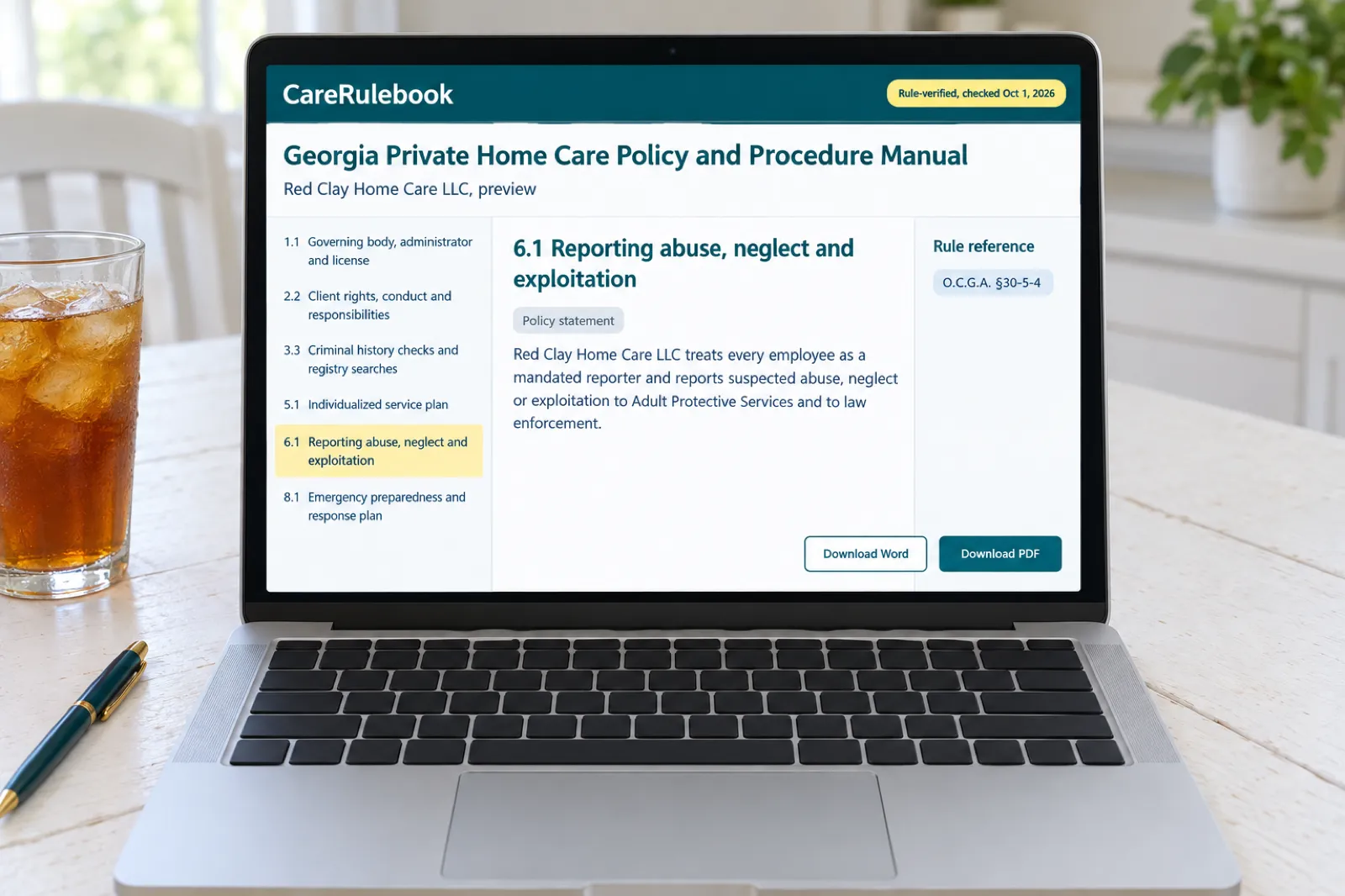
The CareRulebook Georgia manual preview on a laptop, showing the table of contents, policy 6.1 on reporting abuse, neglect and exploitation and its O.C.G.A. §30-5-4 citation

CareRulebook

Your Georgia manual, built from this table

Answer a few questions about your agency and the services you will offer, and CareRulebook builds a policy and procedure manual with your agency name and the Georgia rule behind every policy. Preview it free before you pay.

  • 25 policies, with a rule-to-policy crosswalk appendix
  • Only the categories you offer: companion, personal care, nursing
  • Editable Word and PDF, delivered instantly
  • 12 months of updates, including Georgia rule changes made in that time
Preview your manual

$199CareRulebook founding price for the first 50 Georgia agencies, then $249. Not a DCH fee.

Free sample, no email needed

Read a full policy before you buy

Policy 6.1, Reporting abuse, neglect and exploitation, as it prints in the Georgia manual, filled in for a fictional agency. The rule text it rests on is quoted word for word under Rule basis.

PDF · 12 pages · 132 KB · Rule-verified September 30, 2026

Collecting answers for an agency or a client? The intake questionnaire lists all 22 questions the builder asks, what each decision changes in the manual, and a completed example: Word · PDF.How consultants use CareRulebook.

Download the sample (PDF)
Or email it to me

We send the link once. Nothing else unless you tick the box. Privacy notice.

Staff qualifications and training

Every employee who works with clients is oriented first, in your policies on scope of services and client rights, their duties, how to report problems and emergencies, and their duty to report exposure to tuberculosis and hepatitis. Each staff member is evaluated in writing by a supervisor at least once a year, through observation or demonstration, and after the first year each employee gets at least 8 hours of training a year.

  • Personal care aides qualify through one of four routes: a federal nurse aide program, a recognized nurse aide competency exam, a DCH-approved credentialing program, or a 40-hour agency course directed by an RN or a health care professional with commensurate education and experience. On the agency route, 20 hours come before serving clients and the other 20 within six months.
  • Companions and sitters must be able to read, write and follow instructions, and complete training or show competency in seven areas, including home safety, medical emergencies and infection control.
  • Nursing staff must hold a Georgia license.
  • Contractors must be licensed health care professionals. Unlicensed aides are employees.

Georgia caregiver training in full: orientation, the 40-hour aide course, companion competency and yearly hours →

Service agreements, care plans and supervision

Georgia sets short deadlines once care starts:

  • Service agreement: by the second visit, or within 7 calendar days of starting services, whichever is earlier. It has ten required elements, including charges and DCH’s phone number. Clients can cancel at any time.
  • Service plan: completed by the supervisor within 7 working days of starting services. Nursing plans are reviewed at least every 62 days; others at each supervisory visit.
  • Supervisory home visits: at least every 92 days for personal care clients, and every 122 days for companion clients, or sooner after a serious complaint.
  • Medically frail clients: an RN or LPN supervises their personal care, an RN writes the first service plan, and someone on call must be able to reach a nurse supervisor.

Client records are kept at least five years from the last service, and incident reports for at least five years.

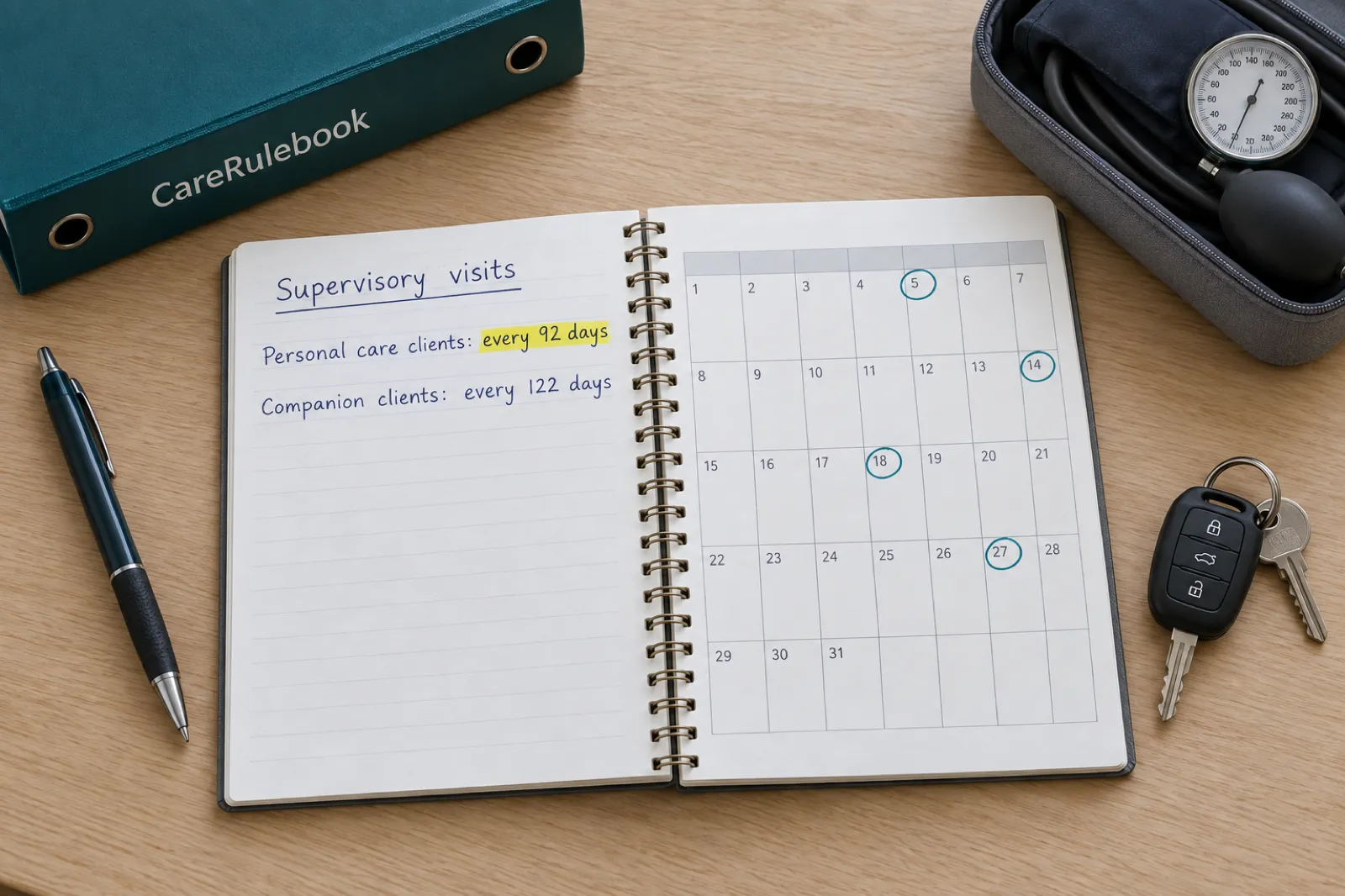
A desk planner noting supervisory visits every 92 days for personal care clients and every 122 days for companion clients
Supervisory visit intervals by service (111-8-65-.10(2)(b)-(c)).

Background checks

Georgia’s background check rules (Chapter 111-8-12) apply to private home care providers. Check the registries first, for owners, administrators and employees, then run the fingerprint check through DCH’s Georgia Criminal History Check System (GCHEXS). Keep the determination, registry check and any license check in each personnel file, and print the required notice on your employment application: "FOR THIS TYPE OF EMPLOYMENT, STATE LAW REQUIRES A NATIONAL AND STATE BACKGROUND CHECK AS A CONDITION OF EMPLOYMENT."

Since July 29, 2026, Chapter 111-8-65 says staff must get a satisfactory fingerprint result "Prior to serving as a direct access employee" (111-8-65-.09(5)(a)1). Chapter 111-8-12 still allows up to 30 days of client contact under direct supervision while a check is pending, never for administrators. DCH has not said how the two fit together for private home care, so by our reading the safe course is no client contact before a satisfactory result.

Georgia background checks, step by step: registries, GCHEXS and the grace period →

In force since July 29, 2026

2026 changes to Chapter 111-8-65

The Board of Community Health gave final adoption on July 9, 2026 to changes in rules .03, .05 and .09, which took effect on July 29, 2026 (official rule history). Background check rules move into Chapter 111-8-12, staff need a satisfactory fingerprint result before direct access, and the annual TB test is replaced by a health screening program with TB screening before work starts.

  • 111-8-65-.09(5)(a)1

    Fingerprints before client contact

    Staff must have a satisfactory fingerprint determination before serving as a direct access employee.

  • 111-8-65-.09(4)(c)4

    Health and TB screening

    A health screening program replaces the annual TB test. TB screening happens before work starts, following CDC guidance.

  • 111-8-65-.09(3)(a)

    Administrator checks

    Administrators need a satisfactory fingerprint determination under Chapter 111-8-12, replacing the misconduct statement.

  • 111-8-65-.05(1)(b)

    Owner checks

    Owners applying for a license follow Chapter 111-8-12.

DCH told the Board that "no substantive changes were being made to the requirements" for background checks. The official rule history reads "Amended: F. July 9, 2026; eff. July 29, 2026."

Secretary of State, Chapter 111-8-65 rule historyThe 2026 rule changes, old and current text side by side →

Already licensed?

The manual is for existing Georgia agencies too

If your agency already holds its DCH license, answer the same questions with the details you use today. CareRulebook builds the manual around your agency as it runs now.

What you get

  • Your agency’s own details filled in throughout, from your answers.
  • The written policies the Georgia rules require, with the rule quoted under each one.
  • A crosswalk from each rule to the policy that meets it, so you can show DCH where each requirement is covered.
  • For 12 months after you buy, every download is built from our current policy library, so the corrections and rule updates we make in that time are in your next download.

Why it matters

  • Policies are checked at unannounced inspections. Deficient policies can bring sanctions. DCH application checklist, Affidavit of Compliance
  • Re-licensure surveys roughly every 18 to 24 months. DCH application checklist, pp. 2-3
  • When a rule changes, the written policies built on it need to change with it.
  • If your policies came from a generic template or an older version of the rules, the rule crosswalk in the free preview lets you check each rule against what you have now.

Georgia home care myths, checked against the source

Do companion or sitter services need a Georgia license?

Yes. Unlike Texas, Georgia licenses companion and sitter tasks as one of three service categories. The only exemption that fits most founders is a caregiver working alone, with no employees, contractors or referral business.

"its own employees who provide nursing services, personal care tasks or companion or sitter tasks"

Does a companion-only agency in Georgia need a registered nurse?

Yes. To apply. DCH’s current application checklist requires an RN for every initial application, whatever services you offer. The RN can also be the owner or administrator. The rules themselves let the administrator supervise companion work, so this is a DCH application requirement rather than rule text.

"Regardless of the service level provided, an RN is required for the initial application."

Can you stay on a Georgia provisional license while you find clients?

No. Only for three months. In that time you must admit at least three clients and email DCH to request your initial survey, or the license is automatically voided and you start again.

"The Private Home Care Provisional license will be active for three (3) months by which you must become operational and have admitted at least 3 clients."

Can you write your Georgia policies after you are licensed?

No. With the application you file a notarized Affidavit of Compliance confirming the required policies are already in place. DCH does not ask you to upload them; it checks them at inspection, and deficient policies can bring sanctions.

"hereby attest that in furtherance of its application ... for licensure, said entity has developed policies and procedures mandated under the rules and regulations indicated below."

Are Georgia home care license fees based on staff numbers?

No. Not any more. Older DCH material set fees by staff count. The current fee rule charges $250 a year per service category, up to $750, plus a $300 application processing fee.

"Private Home Care Providers ** Annually For each service offered: Companion Sitter, Personal Care and/or Nursing Maximum of $750 $250 (per service) Annually"

Can Georgia caregivers be 1099 independent contractors?

No. Not unlicensed aides. The rules define a provider as acting through its own employees or through contractors who are licensed health care professionals. DCH’s 2022 packet says only RNs and LPNs can be contractors.

"contractual arrangements with independent contractors who are health care professionals licensed pursuant to the applicable chapter of Title 43"

Do Georgia caregivers need an annual TB test?

No. Not under Chapter 111-8-65 since July 29, 2026. The amendment in force from that date replaced the annual test with a health screening program and TB screening before work starts, following CDC guidance for health care personnel. Routine and targeted screening then follow your own health screening program, so check the CDC guidance and any payer or contract terms you work under before you set the interval.

"Prior to starting work, all employees must be screened for TB in accordance with CDC guidance for baseline screening and testing for health care personnel."

Are supervisory visits quarterly for every Georgia client?

No. It depends on the service. Personal care clients need a supervisory home visit at least every 92 days. Companion and sitter clients need one at least every 122 days, or sooner after a serious complaint. Nursing service plans are reviewed every 62 days.

"The appropriate supervisor shall make a supervisory home visit to each client's residence at least every 92 days"

Frequently asked questions

How long does it take to get a Georgia home care license?

DCH’s checklist gives an initial review time of 30 business days from submission, with applications reviewed in the order received. After approval you have three months on a provisional license before your initial survey.

Can I take clients before my license is approved?

No. No private home care provider may operate without a license or provisional license from DCH (111-8-65-.05(1)). You admit clients once the provisional license is issued.

Can I run a Georgia home care agency from home?

Neither Chapter 111-8-65 nor DCH’s application checklist addresses a home address. DCH does ask for a current local business license with the agency’s name and address, so check whether your city or county will license a home-based business.

Does the administrator need a degree or license?

The rules set no education or license requirement for the administrator. They must be appointed by the governing body with full authority, complete orientation and pass the background check. DCH separately requires an RN on the application, and the RN can be the administrator.

What happens if I do not find three clients in three months?

DCH says the provisional license is automatically voided if you do not request your initial survey within three months, and you must file a new application. Extensions need prior written approval, requested before the deadline.

Do I renew a Georgia license every year?

No renewal application is needed. DCH says licenses have no expiration date and remain valid until surrendered or revoked. You pay the annual fee between October 1 and December 31 each year.

How often will DCH inspect my agency?

DCH’s checklist says re-licensure surveys happen roughly every 18 to 24 months. If a survey cites violations, you have 10 days to submit a written plan of correction.

Can caregivers be independent contractors?

Only licensed health care professionals. The rules define contractors as professionals licensed under Title 43, and DCH’s 2022 packet says only RNs and LPNs can be contractors. Unlicensed aides need to be employees.

Is there a required list of policies?

DCH does not publish one. We map 54 requirements from Chapter 111-8-65 and the background check rules, of which 6 expressly require you to establish policies and procedures.

How long must I keep records?

Client records for at least five years from the last service, and incident reports for at least five years. The rules set no retention period for personnel records.

Get Georgia rule-change alerts

Changes to Chapter 111-8-65 covering fingerprint checks and TB screening took effect on July 29, 2026. Leave your email and we will tell you when the next Georgia change affects your policies.

No spam. Only emails about Georgia home care rule changes. How we use your email.

Keep reading

Georgia

Georgia home health vs home care 

Private home care or a home health agency, and why a new home health agency faces a Certificate of Need and, from May 13, 2026, a Medicare moratorium.

Georgia

Georgia home care policies and procedures 

Every rule that asks for a written policy, mapped to the policy that meets it.

Georgia

The Georgia license application 

Every document DCH asks for, applying in GAHLES, fees and changes of ownership.

Tool

Georgia license checklist 

Every step, tailored to your agency, emailed to you.

Georgia

The Georgia home care survey 

The initial survey on the provisional license, re-licensure surveys and plans of correction.

Georgia

Georgia caregiver background checks 

Registry checks, GCHEXS fingerprints, the 30-day grace period and the 2026 change.

Georgia

Georgia caregiver training 

Orientation in four items, the 40-hour aide course, companion competency and 8 hours a year after the first.

Georgia

Georgia administrator and RN requirements 

The governing body, the administrator, the RN on your application and supervisory visits.

Georgia

Can you run a Georgia home care agency from home? 

Office, records and premises rules: one license per office, 15 days’ notice of a move, five-year records.

Georgia

Georgia license cost and timeline 

Every DCH fee, totals by service category and each step to a permanent permit.

Georgia

Georgia’s 2026 rule changes 

The Chapter 111-8-65 amendment: fingerprints before client contact and new TB screening.

North Carolina

How to start a home care agency in North Carolina 

The $510 DHSR license and the 32-item policy checklist.

Virginia

How to start a home care agency in Virginia 

The HCO license, RN supervision at least every 90 days and the 35 policy topics.

South Carolina

How to start a home care agency in South Carolina 

The DPH in-home care provider license and the rule rewritten on May 22, 2026: written policies for every section, a zoned office and 24-hour incident reports.

US

All US states 

Which states we cover and how each licenses home care.

US

Home care licensing requirements by state 

Every state we cover side by side: state fees, companion-only care, when policies are checked, surveys and nurse rules.

Ohio

How to start a home care agency in Ohio 

The ODH license, ODA certification and the Medicaid enrollment pause.

Texas

How to start a home care agency in Texas 

Companion-only care is exempt there. The HCSSA license, fees and policies.

Tracker

Rule change tracker 

Every proposed and adopted change we follow, by state and nation.

Trust

How we verify rules 

Every quote is checked against the official text, dated, and linked.

Trust

Corrections log 

Every fix we make, dated and sourced.

Sources

  1. Ga. Comp. R. & Regs. Chapter 111-8-65, Rules and Regulations for Private Home Care Providers (official text, current through rules filed through October 21, 2026) · Georgia Secretary of State, Rules and Regulations of the State of Georgia · retrieved November 6, 2026
  2. Ga. Comp. R. & Regs. Chapter 111-8-65 as in force before July 29, 2026 (Secretary of State text captured July 3, 2025; Cornell LII copy) · Georgia Secretary of State (Internet Archive copy); Cornell LII · retrieved September 30, 2026
  3. Private Home Care Providers, Chapter 111-8-65, final adoption (2026 amendment to rules .03, .05 and .09) · Georgia Department of Community Health · retrieved September 30, 2026
  4. Board of Community Health meeting minutes and summaries, May 14 and July 9, 2026 · Georgia Department of Community Health · retrieved September 30, 2026
  5. Ga. Comp. R. & Regs. Chapter 111-8-25, General Licensing and Enforcement Requirements (incl. 111-8-25-.03 fees) · Georgia DCH (text via Cornell LII, checked against the Secretary of State text) · retrieved September 30, 2026
  6. Ga. Comp. R. & Regs. Chapter 111-8-12, Rules and Regulations for Criminal Background Checks · Georgia DCH (text via Cornell LII) · retrieved September 30, 2026
  7. GaMap2Care: Find a Facility · Georgia Department of Community Health, Healthcare Facility Regulation · retrieved September 30, 2026
  8. Healthcare Facility and Medical Service Provider Change of Ownership (CHOW): Frequently Asked Questions · Georgia Department of Community Health, Healthcare Facility Regulation · retrieved September 30, 2026
  9. Ga. Comp. R. & Regs. 111-2-2-.32, Specific Review Considerations for Home Health Services (Certificate of Need) · Georgia DCH (text via Cornell LII) · retrieved September 30, 2026
  10. Home Health and Hospice Programs · Georgia Department of Community Health, Healthcare Facility Regulation · retrieved September 30, 2026
  11. Home Health Agency Services Need Projection Summary for Horizon Year 2028 (March 27, 2026) · Georgia Department of Community Health, Office of Health Planning · retrieved September 30, 2026
  12. QSO-26-11-HHA & Hospice: Six-Month National Moratoria on Hospice and Home Health Agency Enrollment (May 20, 2026) · Centers for Medicare & Medicaid Services · retrieved September 30, 2026
  13. Announcement of the Extension and Modification of the Nationwide Temporary Moratorium on Enrollment of Home Health Agencies (HHAs), CMS-6101-N2, FR Doc. 2026-23241, 91 FR 73603 (Federal Register, November 16, 2026) · Centers for Medicare & Medicaid Services (Federal Register) · retrieved November 15, 2026
  14. Announcement of the Extension and Modification of the Nationwide Temporary Moratorium on Enrollment of Hospices, CMS-6102-N2, FR Doc. 2026-23242, 91 FR 73597 (Federal Register, November 16, 2026) · Centers for Medicare & Medicaid Services (Federal Register) · retrieved November 15, 2026
  15. Report Elder Abuse, Neglect, or Exploitation (Adult Protective Services) · Georgia Department of Human Services, Division of Aging Services · retrieved September 30, 2026
  16. O.C.G.A. §30-5-4, Reporting of need for protective services (unofficial copy, last modified 2016) · Georgia General Assembly (text via onecle) · retrieved September 30, 2026
  17. O.C.G.A. §§31-8-80 to 31-8-82, Reporting abuse or exploitation of long-term care facility residents (unofficial copy) · Georgia General Assembly (text via onecle) · retrieved September 30, 2026
  18. O.C.G.A. §§31-7-300 to 31-7-308, Private Home Care Providers (unofficial copy) · Georgia General Assembly (text via onecle) · retrieved September 30, 2026
  19. Private Home Care Providers Application Checklist (July 2026) · Georgia Department of Community Health · retrieved September 30, 2026
  20. Private Home Care Providers Application Packet (posted March 2022) · Georgia Department of Community Health · retrieved September 30, 2026
  21. Private Home Care Program · Georgia Department of Community Health · retrieved September 30, 2026
  22. Annual License Fee Payments and Schedule of Licensure Activity Fees (October 2024) · Georgia Department of Community Health · retrieved September 30, 2026
Build your Georgia manualfrom $199