Skip to content
CareRulebook
MenuClose

Where are you starting?

United StatesTexas, North Carolina, Georgia, Virginia, Indiana, Ohio, Illinois, Washington, Colorado, Tennessee, Maryland
TexasManual
North CarolinaManual
GeorgiaManual
VirginiaManual
IndianaManual
OhioGuide
IllinoisManual
WashingtonManual
ColoradoManual
TennesseeManual
MarylandGuideAll US states →
United KingdomEngland
Free toolsChecklists, calculators and templates

Colorado · Home care agency survey · 6 CCR 1011-1 Ch. 26, 4.6-4.8 and Ch. 2, 2.10

Colorado home care agency survey: zero deficiencies, plans of correction and fines

CDPHE surveys every new Colorado home care agency before it issues the license, and its guidance describes issuing the license once that survey is completed with zero deficiencies. After licensing, it can survey again for re-licensure, inspect unannounced and investigate complaints. Here is what must be ready, what a deficiency is, when the provisional license and the isolated-event rule might matter, how plans of correction and disputes work, and what CDPHE can do beyond them.

  • Rule-verified October 2, 2026
  • Quoted from 6 CCR 1011-1 Chapters 26 and 2 and C.R.S. 25-27.5
  • With CDPHE’s licensing guidance and IDR policy
An agency owner in a rust-red sweater lifts a folder from a filing cabinet drawer with tabs labelled Personnel files, Consumer records and Complaint log, beside a CareRulebook binder and a sticky note reading Records within 30 minutes, with flat grassland outside the window

Quick answer

After its fitness review, CDPHE holds a scheduled initial survey, typically on site at the address on your application, where you must have your manager’s training proof, background checks in personnel files, all required policies and procedures, malpractice loss information and your quality management plan ready. CDPHE guidance, step 6 The license is issued when the survey is completed with zero deficiencies, and Chapter 2 defines a deficiency as any failure to fully comply with a statute or rule. Ch. 2, 1.15

After licensing, CDPHE may inspect unannounced between 7 a.m. and 7 p.m. and investigate complaints at any time. Ch. 2, 2.10.1(A) If it cites deficiencies, your manager signs and sends a plan of correction within 10 calendar days of CDPHE’s notice, with corrections due within 30 days of the deficiency list unless CDPHE sets another date. Ch. 2, 2.10.4(B) CDPHE may also fine up to $10,000 per calendar year for all violations. Ch. 26, 4.8

CDPHE surveys

Who surveys
CDPHE’s Health Facilities and Emergency Medical Services Division survey teamCDPHE guidance, step 6
First survey
Scheduled, usually on site, after the fitness reviewCDPHE guidance, step 6
License issued
After an initial survey completed with zero deficienciesCDPHE guidance, step 7
Records
Start reaching the surveyor within 30 minutes of a requestCh. 26, 4.6(A)(1)(b)
Plan of correction
Within 10 calendar days after the date of CDPHE’s noticeCh. 2, 2.10.4(B)(2)

Checked against official sources on October 2, 2026.

The initial survey, before the license

The statute says CDPHE "shall determine an applicant’s compliance with this article and the rules adopted pursuant to section 25-27.5-104 before the department issues a license or registration." C.R.S. 25-27.5-106(2)(a)(I) CDPHE’s guidance: "The initial survey is a scheduled survey, typically onsite. A representative from the HFEMSD survey team will call the applicant to schedule a time for the survey." "There is typically a queue for surveys, and the wait time can vary depending on facility/agency type." CDPHE guidance, step 6

What must be ready. CDPHE lists five items:

  • "Proof of administrator/manager training and qualifications, as applicable" CDPHE guidance, step 6
  • "Employee background checks in personnel files": for caregivers, a criminal history check, a CAPS check and any DORA license check (background checks on the guide).
  • "All required policies and procedures ready for review". The written policies on the guide.
  • Medical malpractice loss information: any final judgment, settlement or arbitration award for medical malpractice is reported to CDPHE within 14 days, by the insurer or the agency. C.R.S. 13-64-303, as CDPHE describes it
  • The quality management plan, which "shall be available for Department review during the licensure survey and each re-licensure survey". CDPHE guidance, step 6

What CDPHE has not published. We found no CDPHE survey tool or checklist for home care, and its guidance does not say what an applicant with no clients should show for consumer records, or whether caregivers must already be hired. Ask when the surveyor calls to schedule.

Where it happens. The survey is held at the physical address on your application, so CDPHE says any lease must be in effect before it. CDPHE guidance If you add the Medicaid certification with your initial application, CDPHE can combine the licensing and Medicaid surveys. CDPHE checklist

  1. Fitness review approved, application complete

    CDPHE then requests the initial survey. There is usually a queue, and the wait varies by agency type. CDPHE publishes no wait time for home care.

    CDPHE guidance, step 6
  2. A surveyor calls to schedule it

    The initial survey is scheduled and typically on site, at the physical address on your application, so any office lease must be in effect before it.

    CDPHE guidance, step 6
  3. The survey

    Scheduled with you

    Have ready: proof of the manager’s training and qualifications, employee background checks in personnel files, all required policies and procedures, malpractice loss information and your quality management plan.

    CDPHE guidance, step 6
  4. Zero deficiencies: the license is issued

    The survey team tells the licensing team, and the licensing technician issues the license as a PDF in COHFI. Display it where clients who come to your office can see it.

    CDPHE guidance, step 7
  5. If anything is cited

    CDPHE has not said; its guidance does not describe this path. Chapter 2 lets CDPHE ask a licensee (the rule does not say an applicant) for a plan of correction after any review, and by our reading the statute’s written correction plan could also reach an initial survey. Whether CDPHE uses a plan of correction and revisit, a provisional license, a new survey or a denial before a first license is a question for CDPHE.

Every licensing step, from the letter of intent to the license →

What "zero deficiencies" means

CDPHE’s guidance: "When the initial survey has been completed with zero deficiencies, the survey team will notify the licensing team that the applicant has successfully completed the initial survey." CDPHE guidance, step 7 Chapter 2 defines the word: "“Deficiency” means a failure to fully comply with any statutory and/or regulatory requirements applicable to a licensee." Ch. 2, 1.15 And: "No license shall be issued until the applicant conforms to all applicable statutes and regulations." Ch. 2, 2.8.1

By our reading, zero deficiencies means the survey cited no unmet requirement of any kind, not only no serious one. So everything the rules require should already be in place and in use at the survey, not just written down.

Open question

The isolated-event rule

The statute says: "The department shall not cite as a deficiency in a report resulting from a survey or inspection of a licensed health facility any deficiency from an isolated event identified by the department that can be effectively remedied during the survey or inspection of the health facility, unless the deficiency caused harm or a potential for harm, created a life- or limb-threatening emergency, or was due to abuse or neglect." C.R.S. 25-1.5-103(1)(a)(I)(E)

It speaks of a licensed health facility. Nothing we found says whether it applies at an applicant’s initial survey, before there is a license. Our suggestion: fix anything a surveyor raises at once and record what you did, but do not count on the rule; prepare as if every gap would be cited.

If the initial survey finds a deficiency. CDPHE has not said; its guidance does not describe what happens next. Chapter 2 lets CDPHE ask a licensee for a plan of correction after any review, and the rule speaks of a licensee, not an applicant (Ch. 2, 2.10.4(B)). The statute requires a home care agency to submit a written plan to correct violations CDPHE finds in the inspections it makes under the subsection that also covers its review of original applications, so by our reading that correction plan is one possible route after a failed initial survey (C.R.S. 25-27.5-106(2)(a)(II); more on the application page). A revisit fee applies to the second and each later on-site inspection about the same harmful deficiency (Ch. 26, 4.5(E)). Whether CDPHE uses a plan of correction and revisit, a provisional license, a new survey or a denial before a first license is not stated. Ask CDPHE.

The provisional license

The statute says "The department may issue a provisional license to an applicant for the purpose of operating a home care agency for a period of ninety days if the applicant is temporarily unable to conform to all of the minimum standards required under this article 27.5", but not if operating the agency would adversely affect its consumers, and "As a condition of obtaining a provisional license, the applicant shall show proof to the department that attempts are being made to conform and comply with applicable standards." C.R.S. 25-27.5-106(6) Chapter 2 frames it as CDPHE’s choice, where an applicant is making a substantial good faith attempt to comply: "the Department may refuse to issue an initial license and instead grant the applicant a provisional license upon payment of the non-refundable provisional license fee." Ch. 2, 2.4.1

  • How long. A provisional license lasts 90 days; a second may follow if progress continues, but no entity is provisionally licensed for more than 180 calendar days in all. Ch. 2, 2.4.1(A)-(C)
  • Then. During the provisional term CDPHE reviews as it sees fit; if the applicant reaches reasonable compliance before expiry, CDPHE issues a regular one-year license on payment of the license fee. Ch. 2, 2.4.1(D)-(E)
  • Background checks first. No provisional license is granted before the owner and manager fingerprint checks and CDPHE’s finding on them. Ch. 26, 4.3(A)(2); 4.2(D)
  • At HCPF’s request. If HCPF asks, CDPHE may issue a 90-day provisional license to an agency that has applied to be a certified home care agency. Ch. 26, 4.3(A)(1)
  • Fee. CDPHE’s schedule sets it at 15% of the initial fee for each term, about $408 for Class B by our arithmetic. This is CDPHE’s fee, not a CareRulebook price. CDPHE fee schedule

CDPHE’s licensing guidance does not mention provisional licenses for new home care agencies, so we cannot say when it uses one. It is not a route an applicant chooses: plan for a survey with zero deficiencies.

Re-licensure surveys

The license lasts one year and is renewed every year. Ch. 2, 2.1 Neither Chapter 26 nor Chapter 2 says how often a home care agency is surveyed for re-licensure. What they do say:

  • The extended cycle. "For each licensee that is eligible, the Department will either extend the standard licensure survey cycle up to three (3) years or utilize a tiered licensure inspection system." Eligible means licensed at least three years, with no enforcement activity, no pattern of deficient practice and no substantiated complaint finding significant deficiencies in the three years before the survey. Ch. 2, 2.10.2 Chapter 26 applies this to home care. Ch. 26, 4.6(A)
  • The statute. It says that, "in addition to the required announced inspections, the department shall, within available appropriations, make additional inspections without prior notice to the health facility". C.R.S. 25-1.5-103(1)(a)(I)(B) And it says the annual home care fee "must include a component that reflects whether a survey is planned for the year based on the agency’s compliance history." C.R.S. 25-27.5-104(1)(g)(I) By our reading, that means CDPHE plans surveys agency by agency, not on a fixed annual cycle.
  • Enforcement counts against you. The statute defines enforcement activity to include "remedies such as civil money penalties; appointment of a receiver or temporary manager; conditional licensure; suspension or revocation of a license; a directed plan of correction" and intermediate restrictions or conditions. C.R.S. 25-1.5-103(2)(b.5)
  • Medicaid and Medicare surveys. The cycle rule does not limit surveys CDPHE must do as the state survey agency for CMS or HCPF. Ch. 2, 2.10.2(C)
  • A clean re-licensure survey pays. An agency whose re-licensure survey finds no significant harmful deficiencies, with full cooperation and timely corrections, can receive an incentive payment of 10% of its renewal fee. Ch. 2, 2.13

Your quality management plan must be available at every re-licensure survey. CDPHE guidance, step 6

Proposed · not in force · comments by November 12, 2026 · hearing November 18, 2026

The proposed three-year survey cycle (eDocket 2026-00434)

On September 21, 2026 a notice was filed with the Secretary of State for amendments to Chapter 2, which the Board of Health will hear on November 18, 2026. eDocket 2026-00434

  • Today. "For each licensee that is eligible, the Department will either extend the standard licensure survey cycle up to three (3) years or utilize a tiered licensure inspection system."
  • Proposed. Each licensee meeting all of the listed criteria "shall be scheduled for an extended state licensing survey cycle of three (3) years", and the tiered inspection option would go. The criteria include three years of licensure and, in the three years before the survey, no enforcement action, no pattern of deficient practice, no deficiency that caused actual harm, immediate jeopardy or a serious threat to consumers, no more than one revisit per survey, no failure to report occurrences, timely license documents and fees, and no substantiated complaint finding significant deficiencies.
  • Why. CDPHE’s statement of basis: "While the Division has been operating with extended survey cycles for years, the Audit found that more explicit rule language was necessary." eDocket 2026-00434 It also says the changes are not expected to affect facilities financially.

What it means for a new agency, by our reading. Nothing changes before your first survey, since the cycle needs three years of licensure. From your first client, occurrence reports and license paperwork would count toward it. The proposal, like the current rule, does not say how often an agency that does not qualify is surveyed.

To comment: Email written testimony to cdphe.bohrequests@state.co.us or mail it to the Colorado Board of Health, ATTN: Board of Health Program Assistant, 4300 Cherry Creek Drive South EDO-A5, Denver, CO 80246-1530, by 5 p.m. on Thursday, November 12, 2026. Remote oral testimony sign-up closes November 17, 2026 on the Board’s website. Contact: Alexandra Haas, 303-691-4934, alexandra.haas@state.co.us.

All Colorado rule changes →Rule change tracker

Complaint investigations and occurrence reports

Complaints to CDPHE

"In addition to licensure inspections, the Department may conduct supplemental inspections at any time in response to complaints alleging noncompliance with the regulations contained in this chapter." Ch. 26, 4.6(A)(1) CDPHE may review a licensee unscheduled or unannounced for reasons including a routine compliance inspection, reasonable cause to question its fitness, a complaint, newly discovered information about owners, managers or staff, or omitted or false information. Ch. 2, 2.10.4(A)

CDPHE’s consumer rights form gives 303-692-2910 or 1-800-842-8826 for complaints. CDPHE rights notice You post a notice that complaints may be made to you, CDPHE and the relevant DORA board, Ch. 2, 7.1.4 and keep a complaint log for at least two years, available for inspection. Ch. 26, 5.7(A)(5) A plan of correction can follow any review, including a complaint investigation, Ch. 2, 2.10.4(B) and a substantiated complaint that finds significant deficiencies would count against the extended survey cycle for the next three years. Ch. 2, 2.10.2(A)(4) We did not find a published CDPHE description of how it runs home care complaint investigations; its complaint page did not load for us.

Occurrence reports in COHFI

  • By the next business day. "The following occurrences shall be reported to the Department within one business day after the occurrence or when the licensee becomes aware of the occurrence", in the format CDPHE requires. Ch. 2, 4.2.2 COHFI is CDPHE’s system for "license applications, survey reports and POCs, and occurrence reporting functions". CDPHE guidance
  • Final report. CDPHE’s manual says the final occurrence report is due 5 calendar days after the initial report, and the agency gets 7 days to comment on CDPHE’s summary before it is public. CDPHE Occurrence Reporting Manual
  • Home care scope. "If the staff member is not working during a physical abuse, but is informed later, it is not reportable as a physical abuse occurrence." It may still need a report to law enforcement or protective services. CDPHE Occurrence Reporting Manual
  • Your own investigation. "A report with the investigation findings shall be available for review by the Department within five (5) working days of the occurrence." Ch. 26, 5.8(B)(2)(a)
  • CDPHE’s side. CDPHE’s manual says that after the final report its occurrence investigators investigate off site and may ask for more; occurrences may prompt an on-site investigation, for example potential immediate jeopardy or a pattern of similar events. CDPHE Occurrence Reporting Manual CDPHE writes a summary of each occurrence investigation; the agency has 7 days to comment, then the summary, without names of clients or professionals, becomes public. Ch. 2, 4.2.8

The Colorado guide covers abuse reporting to law enforcement and protective services, which is separate. CareRulebook’s manual covers complaints in Policy 3.1 and occurrence reports in Policy 3.2.

What happens during a survey

  • Entry. CDPHE’s representatives "shall have the right to enter upon and into the premises of any licensee or applicant in order to determine the state of compliance with the statutes and regulations", and identify themselves to the person in charge. Ch. 2, 2.10.1
  • Records within 30 minutes. Consumer files and administrative records, including census and demographic information, complaint and incident reports, meeting minutes, quality assurance and annual program review documents, "shall be provided to the inspector commencing within thirty (30) minutes of request". Ch. 26, 4.6(A)(1)(b)
  • Records kept in the home. Documents kept in the consumer’s home and not in the agency file must reach CDPHE within 2 hours of a request if the last visit was 14 or more days earlier. Ch. 26, 4.6(A)(1)(a) CDPHE may allow more time for either.
  • Consumers’ homes. "Inspections shall not be conducted in a home care consumer’s home without the consumer’s consent." Ch. 26, 4.6(A)(2)
  • Honesty. "The licensee shall provide accurate and truthful information to the Department during inspections, investigations, and licensing activities." Ch. 2, 2.9.4 Refusing any part of an inspection is a ground to deny an application, and impeding CDPHE’s work or falsifying records a ground to revoke or suspend a license. Ch. 2, 2.11.1 2.11.2

Plans of correction

Chapter 26 defines a plan of correction as "a written plan prepared by the home care agency or home care placement agency and submitted to the Department for approval that specifies the measures the agency shall take to correct all cited deficiencies." Ch. 26, 2.23 The statute requires one, in CDPHE’s form, for violations found at inspections. C.R.S. 25-27.5-106(2)(a)(II) Chapter 26 applies Chapter 2’s rule. Ch. 26, 4.7

What goes in it. How you will correct each deficiency (where it was cited for particular consumers, the measures or systemic changes that stop it recurring for them and others), how you will monitor the correction, and a completion date. Ch. 2, 2.10.4(B)(1) CDPHE may approve, impose, modify or reject a plan of correction. It sends a written notice of acceptance, or says in writing that a plan is unacceptable and sets a time to resubmit. Ch. 2, 2.10.4(B)(3) Missing plan requirements or deadlines, not sending requested changes, or not carrying out the actions by the approved correction date can lead CDPHE to reject the plan and impose disciplinary sanctions. Ch. 2, 2.10.4(B)(3)(c)-(d)

WhatDeadlineCounted fromSource
Plan of correction, signed by the manager10 calendar daysThe date of CDPHE’s written notice of deficienciesCh. 2, 2.10.4(B)(2)
Request for more time on the planBefore the plan is due, in writingCDPHE may grant itCh. 2, 2.10.4(B)(2)(b)(i)
Corrections completedNo more than 30 calendar days, unless CDPHE requires or approves otherwiseThe issuance of the deficiency listCh. 2, 2.10.4(B)(1)(c)
Informal dispute resolution request10 calendar days; an extension of no more than 7 calendar days from the plan due date, if asked for on or before itYour receipt of the statement of deficienciesCDPHE IDR policy
Written plan for an intermediate restriction or conditionNo later than 10 daysYour receipt of CDPHE’s noticeCh. 26, 4.8(B)
A serious and immediate threatImmediatelyNotice in writing, by phone or in personCh. 26, 4.8(C)
Hearing on a denied applicationPetition within 30 daysReceiving the notice of denialC.R.S. 25-27.5-108(1)

Two different starting points. The plan counts from the date of CDPHE’s notice, the IDR request from the day you receive the statement of deficiencies. Our suggestion: diary both from the notice date.

Disputing a finding: informal dispute resolution

"Informal dispute resolution (IDR) is the right and opportunity to dispute survey findings." IDR is a desk review of the provider’s written argument and documents, the surveyor’s response and the disputed deficiency; it is not an evidentiary hearing, and it cannot challenge the survey process or the survey team’s professional judgment. CDPHE IDR policy (October 2024)

"The IDR request and all documentation supporting the facility’s dispute must be received within 10 calendar days from the provider’s receipt of the Statement of Deficiencies." An extension must be asked for on or before the plan of correction due date and is at most 7 calendar days from it. CDPHE IDR policy

Statements of deficiencies are public. The policy says that if IDR changes a finding, "the original Statement of Deficiencies will be amended to reflect the change and reposted to the Internet." By our reading, CDPHE publishes statements of deficiencies online. CDPHE IDR policy

Our suggestion: unless CDPHE tells you otherwise, send the plan of correction on time even while you ask for IDR.

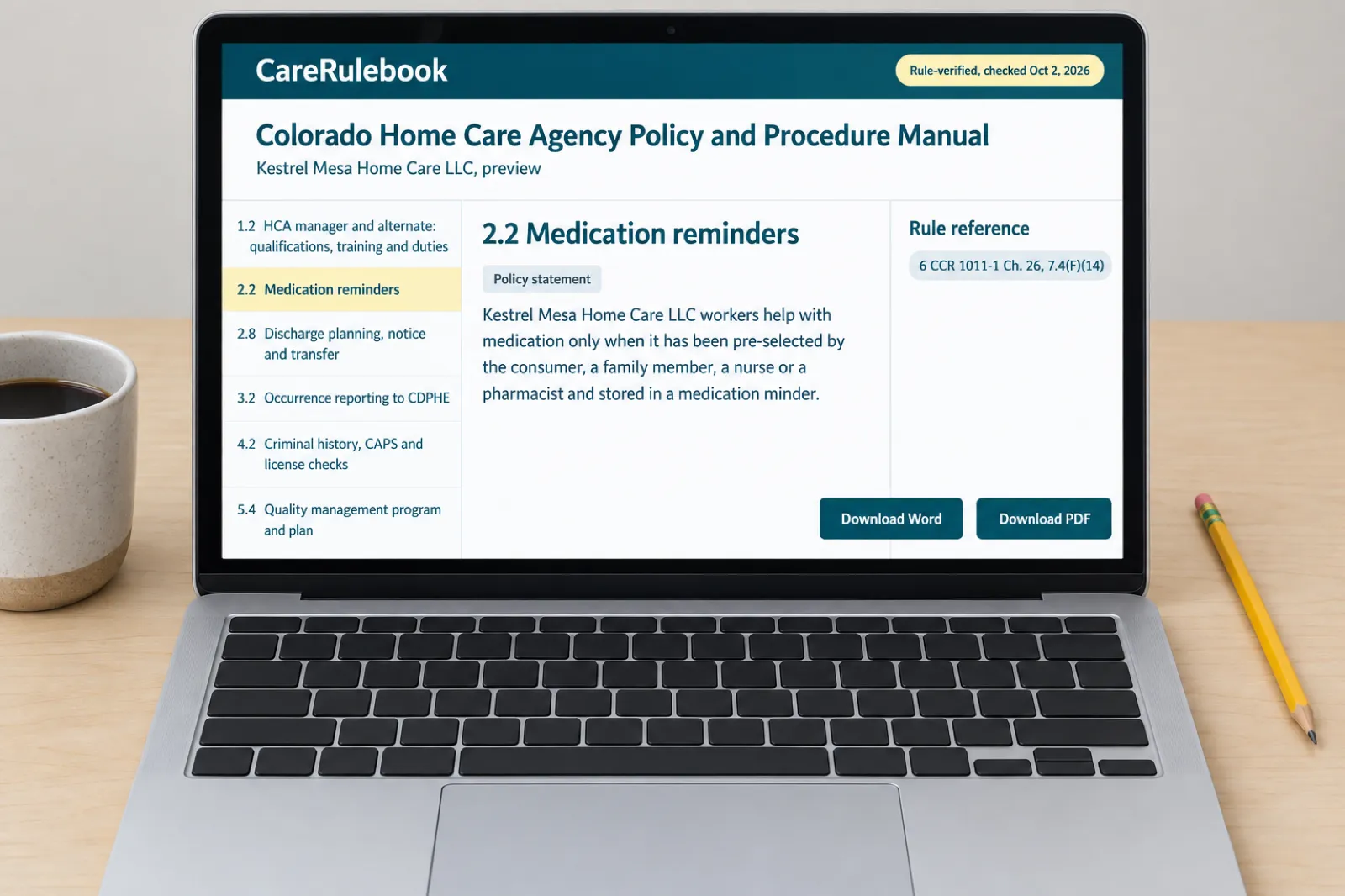
The CareRulebook Colorado manual preview on a laptop: policy 2.2 on medication reminders for a sample agency, citing 6 CCR 1011-1 Ch. 26, 7.4(F)(14), with the manual’s contents listed beside it

CareRulebook

A written process for every CDPHE survey

CareRulebook’s Colorado manual includes Policy 1.6, CDPHE surveys, inspections and plans of correction: what to have ready for the initial survey, producing records within 30 minutes, home visits with consent, plans of correction and informal dispute resolution, with a survey-day checklist and a plan of correction worksheet. Every other policy CDPHE expects at the survey comes with it.

  • 33 policies, 155 requirements mapped to Chapter 26, Chapter 2 and Colorado statutes
  • A quality management plan, occurrence reporting and complaints policies ready for review
  • Editable Word and print-ready PDF, with the rule quoted under each policy
Preview your manual

$199CareRulebook founding price for the first 50 Colorado agencies, then $249. Not a CDPHE fee.

Fines and enforcement

A plan of correction is the usual answer to a deficiency. For completeness, here is what the statute and rules allow beyond it.

Intermediate restrictions or conditions

Retaining a consultant, monitoring by CDPHE for a set period, extra training, a directed written plan of correction, or a civil fine of up to $10,000 per calendar year for all violations. Fines are CDPHE penalties, not CareRulebook charges.

Ch. 26, 4.8(A); C.R.S. 25-27.5-108(2)(b)

Challenging one

After an approved written plan, you may appeal through CDPHE’s informal review; you may ask for a stay of a fine until final disposition, which CDPHE must grant; and no restriction is imposed until you have had the chance of a hearing if you skip or disagree with the informal review.

Ch. 26, 4.8(D)-(F)

Conditions on the license

CDPHE may put conditions on a license before issuing it or during its term. You comply at once, post the conditions where the public can see them, and pay CDPHE’s conditional license fee, $1,938.29 on the 2026/27 schedule.

Ch. 2, 2.8.3; CDPHE fee schedule

Revisit fees

If a deficiency cited at a licensure inspection or substantiated complaint investigation caused harm, or could have, and is not shown corrected at the first revisit, CDPHE charges a revisit fee for the second and each later on-site inspection about it: 100% of the initial or renewal fee on its schedule.

Ch. 26, 4.5(E); CDPHE fee schedule

Denial

Grounds include not complying with applicable laws and rules, false statements, slow responses, refusing any part of an inspection, and failing to complete an acceptable plan of correction. A denied applicant may petition for a hearing within 30 days.

Ch. 2, 2.11.1; C.R.S. 25-27.5-108(1)

Suspension, revocation and summary suspension

For good cause, including impeding CDPHE’s work, late or incomplete reports, not completing a plan of correction in the time or manner specified, or falsifying records. Summary suspension is for deliberate or willful violations or emergencies.

Ch. 2, 2.11.2-2.11.3

Serious and immediate threats: Ch. 26, 4.8(C); summary suspension: Ch. 2, 2.11.3(A); revisit fee amount: CDPHE fee schedule. Operating without a license is separate: a misdemeanor and a CDPHE civil penalty of up to $10,000 per violation. C.R.S. 25-27.5-103(1) Chapter 26, 4.10 refers to civil fines "pursuant to Part 4.7", the plan of correction rule; the fines themselves are in 4.8.

How to be ready

Our practical suggestions, not rule text. Each card links the source it helps you meet and the manual policy that covers it.

Finish and adopt the manual before you apply

The fitness review, before the survey, may already look at your policies and procedures, and the survey expects all of them ready for review.

Ch. 2, 2.7.1(D)Manual: Policy 1.3

Build a complete file for everyone already hired

Criminal history check, CAPS check, any DORA license check, training and competency records, job description. CDPHE names background checks in personnel files for the survey.

CDPHE guidance, step 6Manual: Policy 4.8

Put the manager’s proof in their file

The course certificate (or the documented equivalent) and evidence of the experience route that qualifies them.

CDPHE guidance, step 6; Ch. 26, 7.2(B)Manual: Policy 1.2

Approve the quality management plan

Have the governing body (or designee) approve it before the survey; CDPHE asks for it at the initial survey and every re-licensure survey.

CDPHE guidance, step 6Manual: Policy 5.4

Keep a malpractice loss statement on file

A dated statement of whether there has been any malpractice judgment, settlement or award, so you have something to show for this item even when the answer is none.

CDPHE guidance, step 6Manual: Policy 1.6

Have every consumer form ready to use

CDPHE has not said what an agency with no clients should show for consumer records. A complete set of blank forms is our suggestion; ask the surveyor when they call.

Ch. 2, 2.8.1Manual: Policy 5.1

Practise the 30-minute rule

Keep a short index of where each record lives, paper or electronic, so whoever is in the office can start producing records within 30 minutes.

Ch. 26, 4.6(A)(1)(b)Manual: Policy 1.6

Diary deadlines from the earlier date

The plan of correction counts from the date of CDPHE’s notice, and an IDR request from the day you receive the statement of deficiencies. Count both from the notice date.

Ch. 2, 2.10.4(B)(2); CDPHE IDR policyManual: Policy 1.6

Report occurrences on time from day one

Late or missed occurrence reports would count against the proposed three-year survey cycle, and the occurrence rules apply from your first client.

Ch. 2, 4.2.2Manual: Policy 3.2

File license documents and fees on time

Renew at least 60 days before expiry. Timely license documents and fees are among the proposed criteria for the three-year cycle.

Ch. 2, 2.5.1Manual: Policy 1.5

Myths about CDPHE surveys

Can I get my license and fix survey deficiencies afterwards?

It depends. Not on the path CDPHE’s guidance describes. It says the license is issued when the initial survey is completed with zero deficiencies, and Chapter 2 bars issuing a license until the applicant conforms to all applicable statutes and rules. The statute does let CDPHE issue a 90-day provisional license to an applicant temporarily unable to meet every standard, but CDPHE’s guidance does not say when it uses one for new agencies. Plan to have every required policy, the personnel files and background checks, and your quality management plan ready before the survey.

"When the initial survey has been completed with zero deficiencies, the survey team will notify the licensing team that the applicant has successfully completed the initial survey."

If the surveyor spots a small problem and I fix it on the spot, is it still a deficiency?

It depends. Sometimes not. The statute says CDPHE does not cite an isolated event that can be effectively remedied during the survey or inspection, unless it caused harm or a potential for harm, created a life- or limb-threatening emergency, or was due to abuse or neglect. It speaks of a licensed health facility, and nothing we found says whether it applies at an applicant’s initial survey, where CDPHE’s guidance asks for zero deficiencies. Fix anything raised at once, but prepare as if every gap would be cited.

"The department shall not cite as a deficiency in a report resulting from a survey or inspection of a licensed health facility any deficiency from an isolated event identified by the department that can be effectively remedied during the survey or inspection of the health facility"

Will CDPHE survey my Class B agency every year?

It depends. The rules do not say. Chapter 2 sets no standard re-licensure survey frequency for home care. It says that, for licensees with three years of licensure and a clean record, CDPHE will extend the survey cycle up to three years or use a tiered inspection, and the statute says the annual fee reflects whether a survey is planned for the year based on compliance history. A proposed amendment (hearing November 18, 2026) would schedule eligible licensees on a three-year cycle. CDPHE can still inspect at any time in response to a complaint.

"For each licensee that is eligible, the Department will either extend the standard licensure survey cycle up to three (3) years or utilize a tiered licensure inspection system."

Do I have 30 days to send CDPHE a plan of correction?

No. The plan, signed by your manager, is due within 10 calendar days after the date of CDPHE’s written notice of deficiencies; ask in writing before the due date if you need more time. The 30 days is the latest completion date for the corrections themselves, counted from the issuance of the deficiency list, unless CDPHE requires or approves another date.

"Submitted to the Department within ten (10) calendar days after the date of the Department’s written notice of deficiencies."

Frequently asked questions

When does CDPHE survey a new Colorado home care agency?

After its fitness review is approved and your application is complete. CDPHE then requests the initial survey; there is usually a queue, and a member of the survey team calls you to schedule it. It is typically on site at the address on your application. CDPHE issues the license once the survey is completed with zero deficiencies. CDPHE does not publish a waiting time for home care surveys.

What does CDPHE check at the initial survey?

CDPHE’s licensing guidance says the agency must have ready: proof of the administrator or manager’s training and qualifications, employee background checks in personnel files, all required policies and procedures ready for review, medical malpractice loss information, and the quality management plan. Chapter 2 also bars issuing a license until the applicant conforms to all applicable statutes and rules, so by our reading the surveyor can look at anything the rules require. CDPHE publishes no survey checklist for home care.

What happens if the initial survey finds a deficiency?

CDPHE has not said. Its guidance describes the license being issued after a survey completed with zero deficiencies, and Chapter 2 defines a deficiency as any failure to fully comply with a statute or rule. Chapter 2 lets CDPHE ask a licensee for a plan of correction after any review, due within 10 calendar days of its written notice; the statute requires a home care agency to submit a written plan to correct violations CDPHE finds in its inspections; and the statute lets CDPHE issue a 90-day provisional license to an applicant temporarily unable to conform. By our reading those could be used before a first license, but whether CDPHE uses a plan of correction and revisit, a provisional license, a new survey or a denial is a question for CDPHE. Ask when the surveyor calls.

Will an isolated problem I fix during the survey count against me?

Possibly not. The statute says CDPHE does not cite an isolated event that can be effectively remedied during the survey, unless it caused harm or a potential for harm, created a life- or limb-threatening emergency, or was due to abuse or neglect. It speaks of a licensed health facility, and nothing we found says whether it applies at an applicant’s initial survey. Fix anything raised straight away, and prepare as if every gap would be cited.

How often does CDPHE survey a licensed Class B agency?

The rules do not set a standard frequency for home care. Chapter 2 says that for an eligible licensee (licensed three years, with no enforcement, no pattern of deficient practice and no substantiated complaint finding significant deficiencies in three years) CDPHE will extend the survey cycle up to three years or use a tiered inspection. A proposal heard on November 18, 2026 would schedule eligible licensees on a three-year cycle. CDPHE can also inspect unannounced between 7 a.m. and 7 p.m., and at any time in response to a complaint.

How long do I have to send CDPHE a plan of correction?

Ten calendar days after the date of CDPHE’s written notice of deficiencies, signed by your manager. If you need more time, ask in writing before the due date. The corrections themselves must be completed within 30 calendar days of the deficiency list being issued, unless CDPHE requires or approves another date. To dispute a finding, an informal dispute resolution request must reach CDPHE within 10 calendar days of your receiving the statement of deficiencies.

Can CDPHE fine a Colorado home care agency?

Yes, as an intermediate restriction or condition: a civil fine of up to $10,000 per calendar year for all violations. You may ask for a stay of the fine until the matter is finally decided, and CDPHE must grant it. CDPHE can also impose conditions on a license (with a $1,938.29 conditional license fee on its 2026/27 schedule) and charge revisit fees. Operating without a license is separate: a misdemeanor and a civil penalty of up to $10,000 per violation. These are CDPHE’s fines and fees, not CareRulebook charges.

Does the CareRulebook manual cover CDPHE surveys?

Yes. Policy 1.6, CDPHE surveys, inspections and plans of correction, covers the initial survey and what must be ready, zero deficiencies, the isolated-event rule, later inspections, records within 30 minutes and 2 hours, home visits with consent, plans of correction, informal dispute resolution, revisit fees and intermediate restrictions, with a survey-day checklist and a plan of correction worksheet.

Get Colorado rule-change alerts

CDPHE has proposed a three-year survey cycle for eligible licensees in Chapter 2 (written comments due November 12, 2026; hearing November 18, 2026). Leave your email and we will tell you when a Colorado change affects your surveys or your policies.

No spam. Only emails about Colorado home care rule changes. How we use your email.

Keep reading

Sources

  1. 6 CCR 1011-1 Chapter 26, Home Care Agencies (effective July 1, 2025) · Colorado Secretary of State, Code of Colorado Regulations · retrieved October 2, 2026
  2. 6 CCR 1011-1 Chapter 2, General Licensure Standards (effective September 14, 2025) · Colorado Secretary of State, Code of Colorado Regulations · retrieved October 2, 2026
  3. C.R.S. Title 25, Article 27.5, Home Care Agencies (sections 25-27.5-101 to -110; Colorado Revised Statutes 2024) · Colorado General Assembly, Office of Legislative Legal Services · retrieved October 2, 2026
  4. C.R.S. 25-1.5-103, Health facilities: powers and duties of the department (Colorado Revised Statutes 2024) · Colorado General Assembly, Office of Legislative Legal Services · retrieved October 2, 2026
  5. Initial Health Facility/Agency Licensure: Guidance and Instructions (All License Types), updated September 11, 2025 · Colorado Department of Public Health and Environment, HFEMSD · retrieved October 2, 2026
  6. Home Care Agencies (HCA/HHA): Initial Application Checklist, updated July 23, 2026 · Colorado Department of Public Health and Environment, HFEMSD · retrieved October 2, 2026
  7. Home Care Agencies: 7/1/2026 to 6/30/2027 Fee Schedule · Colorado Department of Public Health and Environment, HFEMSD · retrieved October 2, 2026
  8. Written Notice of Home Care Consumer Rights (CDPHE form) · Colorado Department of Public Health and Environment · retrieved October 2, 2026
  9. Occurrence Reporting Manual (revised May 2018, contacts updated December 2021) and Occurrences page · Colorado Department of Public Health and Environment, HFEMSD · retrieved October 2, 2026
  10. Informal Dispute Resolution policy (revised October 2024) and instructions · Colorado Department of Public Health and Environment, HFEMSD · retrieved October 2, 2026
  11. eDocket 2026-00434: proposed amendments to 6 CCR 1011-1 Chapter 2 (notice filed September 21, 2026; hearing November 18, 2026) · Colorado Secretary of State; Colorado Board of Health · retrieved October 2, 2026
Build your Colorado manualfrom $199