
Skip to content
CareRulebook

Texas · HCSSA staffing · 26 TAC §558.247 · HSC Chapter 250

Texas caregiver background checks and SEMARC

Every Texas home care agency must check caregivers before they meet a client: a criminal history check, then registry searches, and the same searches every year. Since August 3, 2026 the registry search runs through SEMARC, and HHSC starts surveying for it on October 6, 2026.

  • Rule-verified September 30, 2026
  • Quoted from §558.247 and HSC Chapter 250
  • SEMARC dates from HHSC PL 2026-10
A Texas home care office filing cabinet with personnel files ready for the surveyor

Quick answer

For every unlicensed caregiver who will have face-to-face contact with clients, a Texas HCSSA must: run a criminal history check under Health and Safety Code Chapter 250; refuse anyone with a conviction that bars employment; and search the registries before hire or first client contact, then at least every 12 months.

The registry search changed in 2026. HHSC says HCSSAs "will be required to use SEMARC, in addition to the Nurse Aide Registry (NAR), to determine a person’s employability beginning August 3, 2026." SEMARC searches HHSC’s Employee Misconduct Registry and three other state agencies’ records in one go, through TULIP. "HHSC will not survey for compliance for SEMARC requirements until October 6, 2026."

In force since August 3, 2026 · surveyed from October 6, 2026

SEMARC: what changed

SEMARC, the Search Engine for Multi-Agency Reportable Conduct, comes from Senate Bill 1849 (2023), which created Health and Safety Code Chapter 810. HHSC’s provider letter says "The requirement to search EMR will be replaced with the requirement to search SEMARC." Rule amendments are still in process, so §558.247 still names the EMR, and HHSC reminds providers they "must continue to comply with all existing rules and regulations". Until the rule changes, the safe course is to search both. PL 2026-10

One SEMARC search returns results from:

  • HHSC’s Employee Misconduct Registry (EMR);
  • DFPS confirmed cases of child abuse, neglect and exploitation;
  • TEA’s Do Not Hire Registry for public schools;
  • TJJD’s registry of people barred from juvenile justice work.

You still search the Nurse Aide Registry separately. Log in to SEMARC through TULIP, under Other Actions. If the option is missing, "Contact your facility security authority to request access to SEMARC." PL 2026-10 §2.1 How TULIP security authorities work →

The checks, step by step

For each unlicensed employee whose duties include face-to-face contact with clients.

  1. Run the criminal history check

    Before hire

    For every unlicensed applicant whose duties include face-to-face client contact, a criminal history check under Health and Safety Code Chapter 250.

    26 TAC §558.247(a)(1)
  2. Decide on any conviction

    Before hire

    Do not employ anyone with a conviction on the statutory list. For any other conviction, write down your review and whether it is a contraindication to the job.

    §558.247(a)(2); HSC §250.006
  3. Search the registries and SEMARC

    Before first contact

    Before hiring, or before the first face-to-face client contact: the Nurse Aide Registry and the Employee Misconduct Registry, which §558.247 still names, and SEMARC through TULIP, which HHSC has required since August 3, 2026. Keep a printed copy of each result.

    §558.247(a)(3); PL 2026-10
  4. Give the registry information

    At hire

    Give each unlicensed employee written information about the misconduct registry.

    §558.247(a)(4)
  5. Keep the proof

    Always

    Keep a record of every check and search. HHSC can ask for documentation of compliance, and surveyors check personnel files.

    §558.247(c)
  6. Re-check every 12 months

    Every 12 months

    Search the registries and SEMARC again for each employee at least every 12 months. Missing this was the second most-cited violation for Texas home health agencies in FY 2025.

    §558.247(a)(5)(B)
  7. Discharge immediately if needed

    Any time

    If an employee turns up as unemployable on a registry, or with a barring conviction, discharge them at once.

    §558.247(a)(6)

Convictions that bar employment

Health and Safety Code §250.006 sets two lists. These are summaries; the statute names each Penal Code section.

Bars employment, no time limit (main offenses)

  • Criminal homicide
  • Kidnapping and unlawful restraint
  • Sexual assault and aggravated sexual assault
  • Aggravated assault
  • Injury to a child, elderly or disabled individual
  • Abandoning or endangering a child, elderly or disabled individual
  • Exploitation of a child, elderly or disabled individual
  • Robbery and aggravated robbery
  • Arson
  • Health care fraud and money laundering
  • Terroristic threat and deadly conduct
  • Similar offenses under other states’ or federal law
HSC §250.006(a)

Bars direct-contact work for 5 years from conviction

  • Assault, if a Class A misdemeanor or felony
  • Burglary
  • Theft, if a felony
  • Misapplication of fiduciary property (Class A or felony)
  • Fraudulent securing of document execution (Class A or felony)
  • False identification as a peace officer
  • Some disorderly conduct offenses
HSC §250.006(b)

For a conviction on neither list, the decision is yours, but "the agency must document its review of the conviction and its determination of whether the conviction is a contraindication to employment." §558.247(a)(2)

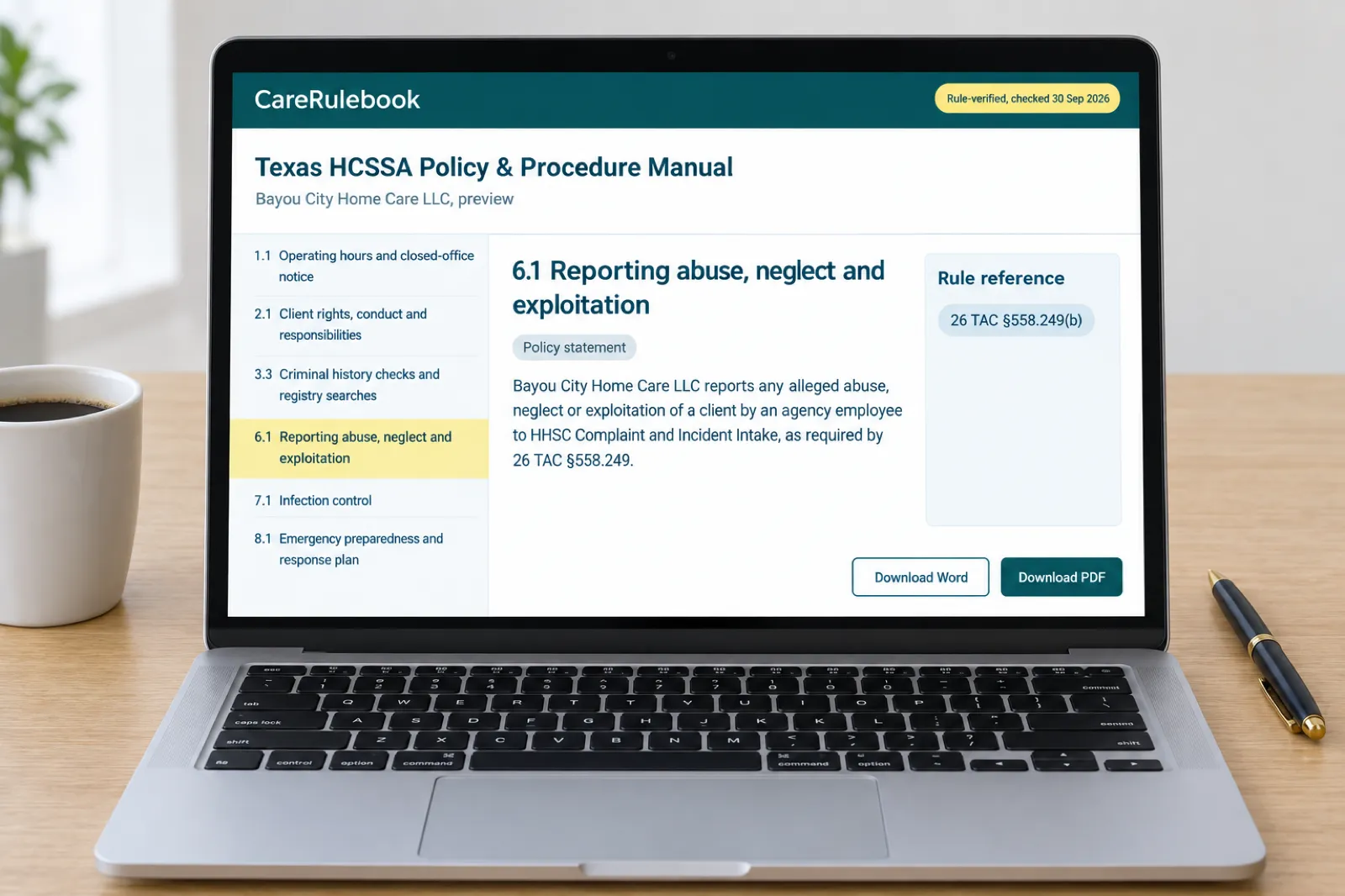
The CareRulebook Texas manual preview on a laptop

CareRulebook

Surveyors check this in your personnel files

CareRulebook's Texas manual includes a criminal history checks and registry searches policy built on §558.247, with the yearly re-check and discharge rules, and your agency's details filled in.

  • 35 policies, 48 rule requirements mapped
  • 12 months of updates when Texas changes the rules
  • Editable Word and PDF, delivered instantly
Preview your manual

$199CareRulebook founding price for the first 50 Texas agencies, then $249. Not an HHSC fee.

Emergency hires, volunteers and nurses

Emergency hires

In an emergency you may hire someone not listed in the registry while the criminal history check is pending, if you request it within 72 hours. They must have no direct contact with clients until the check is back.

HSC §250.003(a-2), (b)

Volunteers

Volunteers with face-to-face client contact get the same criminal history check and registry searches before their first contact, registry information within five working days, and a yearly re-check.

§558.247(b)

Licensed staff

Chapter 250 exempts people licensed under another Texas law, such as nurses, at a home care agency, and §558.247 covers unlicensed staff.

HSC §250.003(a-1)

Proposed · not in force

What the proposed 2026 rules change

  • A SEMARC search before hiring or contracting with any person who may have direct contact with a client, licensed or unlicensed, employee or contractor, and every 12 months after. Proposed §558.247(c)
  • Suspending a person found to have engaged in reportable conduct while they appeal. 51 TexReg 6429
  • Personnel files holding a copy of the initial and annual SEMARC search results.

Comments close on October 19, 2026. Read the full rule-change guide →

Myths

Can a new caregiver start visits while the background check is pending?

No. You can hire in an emergency while the criminal history check is pending, but the person must have no direct contact with clients until the check is back, and the registry searches come first.

"If a facility employs a person pending a criminal history check, the facility shall ensure that the person has no direct contact with a consumer until the facility obtains the person's criminal history record information"

Frequently asked questions

What background checks does a Texas home care agency need?

For each unlicensed caregiver with client contact: a criminal history check under Health and Safety Code Chapter 250, then searches of the Nurse Aide Registry, the Employee Misconduct Registry (still named in the rule) and SEMARC before hire or first client contact, repeated at least every 12 months. You must not employ anyone with a conviction that bars employment or anyone listed as unemployable.

What is SEMARC?

The Search Engine for Multi-Agency Reportable Conduct, created by Texas Health and Safety Code Chapter 810. One search covers HHSC’s Employee Misconduct Registry, DFPS confirmed abuse and neglect cases, TEA’s Do Not Hire Registry and TJJD’s registry. HCSSAs must use it, with the Nurse Aide Registry, from August 3, 2026.

When does HHSC start checking SEMARC at surveys?

October 6, 2026. HHSC gave providers a hold-harmless period from August 3 to October 5, 2026, but says providers must keep complying with all existing rules.

How do I get into SEMARC?

Through TULIP: choose SEMARC under Other Actions and use your TULIP login. If you do not see the option, your agency’s TULIP security authority has to grant you access. For data or search problems call the SEMARC helpdesk on (877) 798-1077; for access problems, the TULIP helpdesk on (512) 438-2584.

Which convictions stop someone working in home care in Texas?

Health and Safety Code §250.006 lists offenses that bar employment outright, such as criminal homicide, sexual assault, aggravated assault, robbery, arson and exploitation of a child, elderly or disabled person. Others, such as felony theft, burglary and some assaults, bar direct-contact work for five years from the conviction. For anything else, the agency decides and documents whether it is a contraindication.

Can I hire someone before the background check comes back?

Only in an emergency, and only if they are not listed in the registry. You must request the criminal history check within 72 hours, and the person must have no direct contact with clients until the check is back.

Do licensed nurses need a criminal history check?

Chapter 250 exempts people licensed under another Texas law, such as nurses, at a home care agency, and §558.247 covers unlicensed staff. The proposed 2026 rules would require a SEMARC search for every person who may have direct client contact, licensed or not.

Do volunteers need background checks?

Yes, if they have face-to-face contact with clients: a criminal history check and registry searches before their first contact, written registry information within five working days, and a yearly re-check.

Get your Texas manual when it launches

Leave your email and we will send the Texas manual preview as soon as it is ready, plus a note when HHSC adopts the new rules.

No spam. One email when your guide's pack launches, and rule-change alerts if you want them. How we use your email.

Keep reading

Sources

  1. 26 TAC Chapter 558, Licensing Standards for Home and Community Support Services Agencies · Texas HHSC (text via Cornell LII) · retrieved September 30, 2026
  2. Provider Letter PL 2026-10: Search Engine for Multi-Agency Reportable Conduct (SEMARC) · Texas HHSC · retrieved September 30, 2026
  3. Regulatory Services Annual Report FY 2025 · Texas HHSC · retrieved September 30, 2026
  4. Texas Health and Safety Code Chapter 250 (nurse aide registry and criminal history checks) · Texas Legislature · retrieved September 30, 2026
  5. Proposed Rules, 26 TAC Chapter 558 (rule project 22R045), 51 TexReg 6429, September 18, 2026 · Texas Register · retrieved September 30, 2026
Build your Texas manualfrom $199