Skip to content
CareRulebook
MenuClose

What do you run?

Home care in the US19 states with a manual, 6 with a free guide
ColoradoManual
ConnecticutPack
DelawareManual
GeorgiaManual
IllinoisManual
IndianaManual
KansasManual
MaineManual
MarylandManual
MinnesotaManual
NevadaManual
North CarolinaManual
OklahomaManual
OregonManual
South CarolinaManual
TennesseeManual
TexasManual
VirginiaManual
WashingtonManual
CaliforniaGuideFloridaGuideNew JerseyGuideNew YorkGuideOhioGuidePennsylvaniaGuideAll US home care states →
Care homes in the USCalifornia, Michigan, Minnesota; more states coming
Home care in the UKEngland, Scotland, Wales
Free toolsChecklists, calculators and templates

Minnesota · Assisted living · Minn. Stat. 144G and Minn. R. 4659

How to open an assisted living facility in Minnesota (the MDH license, 2026)

To open an assisted living facility in Minnesota, even for one resident, you need a license from the Minnesota Department of Health (MDH). Every new facility starts with a provisional license. You attest that your written policies are in place, and MDH surveys you, unannounced, after your first resident moves in. You need a licensed assisted living director and a registered nurse as clinical nurse supervisor. This guide walks through each step, quoted from chapter 144G, the rules and MDH’s own forms.

  • Rule-verified November 17, 2026
  • Quoted from Minn. Stat. 144G and Minn. R. 4659
  • 20 sources
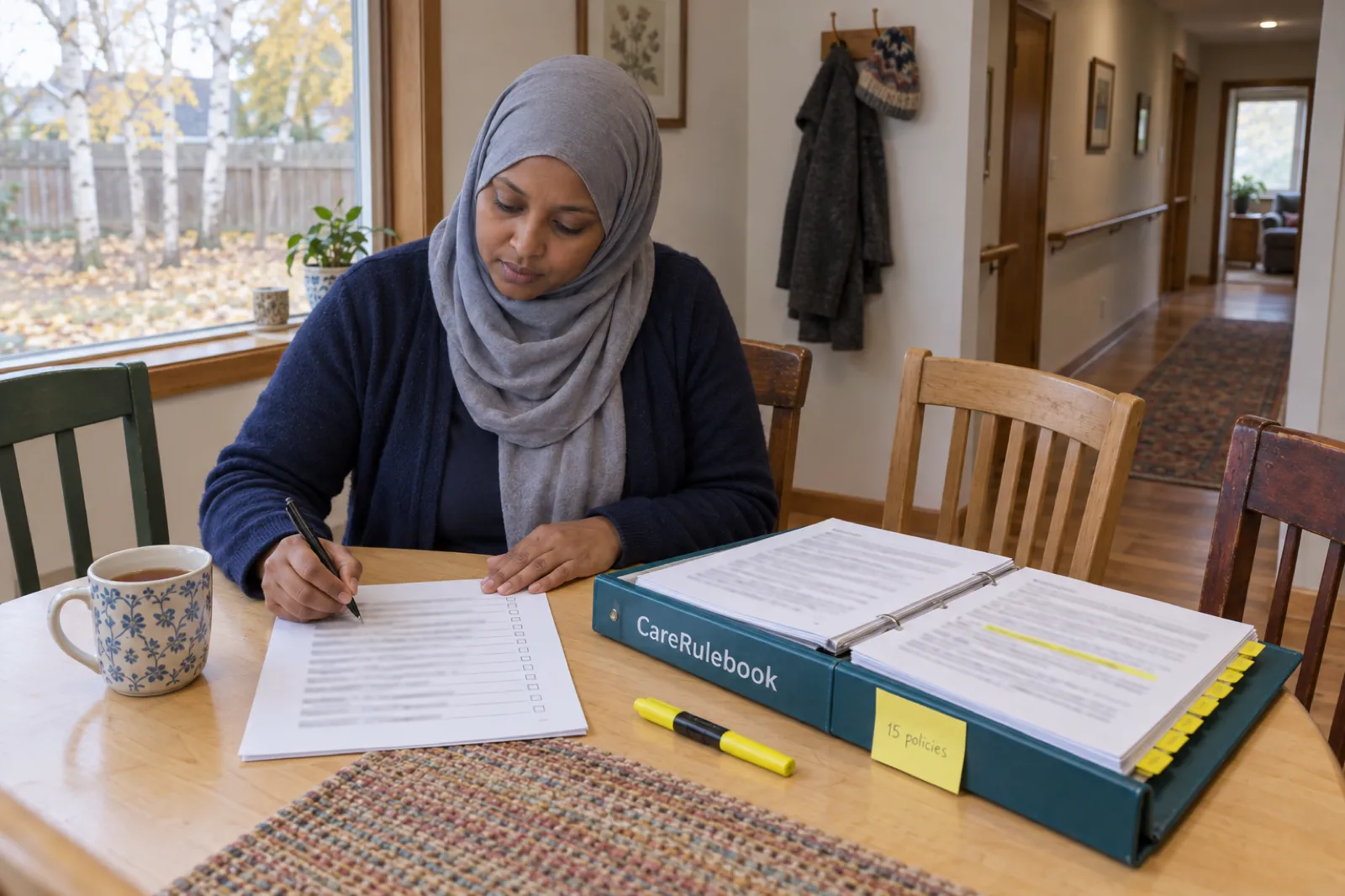
A woman in a grey hijab and navy cardigan at a maple dining table in a Minnesota house ticks off a printed list beside an open teal CareRulebook binder with yellow tabs, a sticky note reading 15 policies, a mug of tea and a highlighter, with birch trees and autumn leaves through the window

Running a home care agency instead? Minnesota licenses home care separately: read the Minnesota home care guide or build the Minnesota policy manual.

Quick answer

The law is plain: "Beginning August 1, 2021, no assisted living facility may operate in Minnesota unless it is licensed under this chapter." (Minn. Stat. 144G.10, subd. 1(a)(1)). MDH issues two licenses, one for assisted living and one for assisted living with dementia care, and every new facility starts with a provisional license "effective for up to one year" (144G.16, subd. 1).

MDH’s fee is $2,000 plus $125 per resident for an assisted living facility (Minn. Stat. 144.122(d)). MDH’s application asks you to attest that your policies will be "in place upon licensure" rather than to attach them (MDH provisional application; our reading of its checklist), and MDH checks them at an unannounced survey after your first resident moves in (MDH survey guide).

1,965

Assisted living licenses in MDH’s directory, March 13, 2026 (our sum of its four rows)

MDH directory 2026

310

Of them provisional assisted living facility licenses, with 1,678 places (plus 6 provisional with dementia care)

MDH directory 2026

$2,000

MDH’s base fee, plus $125 per resident (a state fee, not our price)

Minn. Stat. 144.122(d)

15

Named policy topics in force, with 2 more from August 1, 2027

Minn. Stat. 144G.41, subd. 2

Direct answers

Who licenses assisted living facilities in Minnesota?

The Minnesota Department of Health (MDH), Health Regulation Division, under Minnesota Statutes chapter 144G and Minnesota Rules chapter 4659. Since August 1, 2021, no assisted living facility may operate in Minnesota without a license under chapter 144G.

Minn. Stat. 144G.10, subd. 1(a)(1)

How much does an assisted living license cost in Minnesota?

MDH’s license fee is $2,000 plus $125 per resident for an assisted living facility, and $3,000 plus $150 per resident for an assisted living facility with dementia care. The fee is due for the provisional license and each renewal (MDH asks for it once your application is complete), and it is non-refundable. These are state fees set in statute, not CareRulebook prices.

Minn. Stat. 144.122(d); 144G.12

Do I send my policies to MDH with the application?

Not as far as MDH’s checklist shows (our reading: it lists no policy attachments). You attest on the provisional application that every policy and procedure chapter 144G and chapter 4659 require will be in place on licensure. MDH looks at them during the unannounced initial survey after your first resident moves in.

MDH provisional application (6 or fewer), p. 22

Does an assisted living facility need a nurse?

Yes. Every facility needs a clinical nurse supervisor who is a registered nurse licensed in Minnesota, and staff need access to an on-call registered nurse around the clock. MDH’s staff FAQ says the director and the clinical nurse supervisor can be the same person if they hold both licenses.

Minn. Stat. 144G.41, subds. 1(13), 4

Interactive check

Do you need a Minnesota assisted living license?

Where will the adults you serve live?

Pick the option closest to your plan.

Who needs an assisted living license

The license turns on two things together, a bed and services: "Assisted living facility" means a facility that provides sleeping accommodations and assisted living services to one or more adults. (144G.08, subd. 7). There is no lower size limit.

Assisted living services are a listed set: help with dressing, eating, grooming, toileting and bathing; standby assistance; reminders to take medication or do treatments and exercises; specialized diets; nursing and therapy services; tasks delegated by a registered nurse; medication management; help with transfers and mobility; treatments and therapies; and other complex health care (144G.08, subd. 9).

  • Customized living needs it too. MDH answers the question for waiver providers: "Yes. The new assisted living licensure law impacts all customized living services funded by Elderly Waiver (EW), Brain Injury Waiver (BI) and Community Access for Disability Inclusion (CADI) Waivers." (MDH application FAQ). DHS runs the waiver service and its own enrollment.
  • Operating without a license. "Operating an assisted living facility without a license is a misdemeanor, and the commissioner may also impose a fine." (144G.10, subd. 4(a))
  • A management company does not change who is responsible. "The licensee is legally responsible for the management, control, and operation of the facility, regardless of the existence of a management agreement or subcontract." (144G.10, subd. 1(b))
  • The name “assisted living” becomes protected on January 1, 2027. See what changes in 2027.

What is not an assisted living facility

The definition lists settings that are not assisted living facilities, among them nursing homes, hospitals, boarding care and supervised living facilities, shelters, certain subsidized rental housing, and settings serving members of a religious denomination only through spiritual means or prayer (144G.08, subd. 7). Two matter most to new operators:

  • A family home. "a private home in which the residents are related by kinship, law, or affinity with the provider of services" (144G.08, subd. 7(6)).
  • DHS-licensed settings. "services and residential settings licensed under chapter 245A, including adult foster care and services and settings governed under the standards in chapter 245D" (144G.08, subd. 7(5)). DHS licenses those, not MDH.

Care in people’s own homes is a different MDH license, under chapter 144A: see our Minnesota home care guide.

Assisted living facility or assisted living with dementia care

"The assisted living facility category is for assisted living facilities that only provide assisted living services." The second category adds dementia care services, which may include a secured dementia care unit (144G.10, subd. 2(a)). The dementia care license is required in two cases: "Assisted living facility with dementia care" means a licensed assisted living facility that is advertised, marketed, or otherwise promoted as providing specialized care for individuals with Alzheimer's disease or other dementias. An assisted living facility with a secured dementia care unit must be licensed as an assisted living facility with dementia care. (144G.08, subd. 8)

  • A secured unit is "a designated area or setting designed for individuals with dementia that is locked or secured to prevent a resident from exiting, or to limit a resident's ability to exit, the secured area or setting" (144G.08, subd. 62).
  • One license per building. MDH’s FAQ: "Facilities are required to license to the highest denominator as there is only one license allowed per building." So a building with a secured unit holds the dementia care license for the whole building (MDH application FAQ).
  • Marketing alone counts. Unlocked doors do not let you promote specialized dementia care (memory care, for example) on the basic license; see the myths.
Minnesota assisted living licenses compared: assisted living facility and assisted living facility with dementia care
RuleAssisted living facilityWith dementia careSource
MDH fee$2,000 plus $125 per resident$3,000 plus $150 per resident144.122(d)
Before the licenseMDH building plan review and inspectionThe same, plus an on-site inspection of the physical environmentMDH application 144G.80, subd. 2(c)
Leaders new to dementiaNo extra stepA consultant for at least the first six months if the director and nurse lack dementia experience144G.80, subd. 2(b)
Written policiesThe 15 named topics and the other written dutiesThe same, plus 10 dementia care policies given at move-in144G.41 144G.82, subd. 3
Dementia training, direct-care staff8 hours, plus 2 on mental illness and de-escalation, within 160 working hours8 hours within 80 working hours144G.64(a)(2) (a)(3)
Dementia trainersNo extra rule in 144G.83Two years of related work experience, equivalent training and a test MDH requires144G.83, subd. 3
Secured unit staffingNot applicableAn awake person physically in the unit 24 hours a day, 7 days a week144G.81, subd. 4
Director education30 hours every two yearsThe same, with at least 10 hours of the yearly requirement on dementia care144A.20, subd. 4(c) 144G.82, subd. 2(b)
SprinklersUnder the state and local fire safety and building codes that applyAn approved supervised automatic sprinkler system throughout by August 1, 2029144G.45, subd. 3(a) 144G.81, subd. 1(2)

Fees are MDH’s, set in statute, for the provisional license and each renewal, not CareRulebook prices. The statute lets MDH adjust renewal fees by up to 10 percent; see MDH’s fees.

The provisional license, the attestation and the first survey

MDH checks your policies after licensing, not before. In order:

  1. The attestation. MDH’s provisional application ends with this statement: "I attest to have all required policies and procedures of Minnesota, Statutes, section 144G (https://www.revisor.mn.gov/statutes/cite/144G) and Minnesota Rules, chapter 4659 (https://www.revisor.mn.gov/rules/4659/), in place upon licensure and to keep them current as applicable." (MDH provisional application (6 or fewer), p. 22). Our reading of MDH’s checklist: the policies themselves are not uploaded. The resident-facing document you do attach is your UDALSA: "Attach a copy of the UDALSA the facility intends to use with prospective residents." (MDH checklist, p. 2).
  2. The building. "MDH engineers will review the proposed assisted living facility building plans and conduct an inspection." (MDH provisional application, p. 3)
  3. Background studies. Owners who are individuals with a direct ownership interest, and managerial officials who have direct contact, are studied before MDH issues the provisional license (144G.13, subd. 1(a)), through DHS once MDH has your fee (MDH application FAQ).
  4. The provisional license, for up to one year (144G.16, subd. 1). If you serve no one in that time, it expires and you must reapply (144G.16, subd. 2(c)).
  5. Notice of your first resident. "Within two days of beginning to provide assisted living services, the provisional licensee must provide notice to the commissioner that it is providing assisted living services by sending an email to the email address provided by the commissioner." (144G.16, subd. 2(b))
  6. The unannounced survey. "An unannounced survey will occur after MDH is notified or has evidence that services have started." "The survey may take two or more days." (MDH Guide to the Survey Process, pp. 1 and 3) Among the things surveyors look at, in MDH’s words: "Following the provider's own policies and procedures". They also review your marketing, admission packet and contract, and resident and personnel records (MDH survey guide, pp. 2-3).
  7. The outcome. "If the provisional licensee is in substantial compliance with the survey, the commissioner shall issue a facility license." Otherwise MDH ends the provisional license or extends it for up to 90 days with conditions (144G.16, subd. 3(a)-(b)). If the license is denied, the owners and managerial officials cannot apply again for one year after the facility closes (144G.16, subd. 3(c)).

What surveyors ask for at the entrance conference

MDH’s Entrance Conference form (dated 12/21/2022) lists required documents with the instruction "Provide these at the start of the survey." Its policy headings cover training of unlicensed personnel, employee and resident record contents, infection control, the disaster and emergency plan (Appendix Z), quality management, orientation and annual training, maltreatment reporting, complaints, medication management, treatment and therapy, and service plans (MDH Entrance Conference, pp. 6-7).

Practice first. MDH publishes its survey forms and says: "These are the same forms MDH staff use when conducting a survey." (MDH Forms and Self-Audit Tools) After licensing, MDH surveys each facility at least once every two years (144G.30, subd. 1).

CareRulebook

You attest that your policies are in place on licensure, and MDH’s surveyors check that you follow them.

CareRulebook’s Minnesota assisted living manual answers the policies Minn. Stat. 144G.41, subd. 2 names, in the statute’s order, and the other written duties of chapter 144G and Minnesota Rules chapter 4659. Your facility’s details go in throughout, and the rule each part meets is quoted under it.

  • The named policies in the statute’s order, with medical emergencies and falls and lift assistance dated from August 1, 2027, and a restraints policy for January 1, 2027
  • A contract content checklist and termination steps, not a contract template. Have a Minnesota lawyer review your contract and termination notices before you use them
  • Your clinical nurse supervisor reviews, directs and adopts the clinical policies before you use them
  • Holding the dementia care license? Section 5 adds the ten dementia care policies and the safety risk assessment
  • An MDH Entrance Conference index with the pages in your manual for each of its 34 items, and a resident move-in packet
  • 48 policies and documents (48 with dementia care) mapped to 167 requirements, in Word and PDF, with 12 months of updates
Preview your manual

$299CareRulebook founding price for the first 50 Minnesota facilities, then $349. Not an MDH fee.

Free sample, no email needed

Read a full policy before you buy

Policy 3.6, Restraints (from January 1, 2027), as it prints in the Minnesota assisted living manual, filled in for a fictional facility. The rule text it rests on is quoted word for word under Rule basis.

PDF · 13 pages · 148 KB · Rule-verified November 17, 2026

Collecting answers for a facility or a client? The intake questionnaire lists all 94 questions the builder asks, what each decision changes in the manual, and a completed example: Word · PDF.How consultants use CareRulebook.

Download the sample (PDF)
Or email it to me

We send the link once. Nothing else unless you tick the box. Privacy notice.

How a new assisted living facility gets licensed, step by step

Tick steps off as you go. Your progress is saved in this browser only.

  1. Choose the license category and capacity

    Before applying

    An assisted living facility, or an assisted living facility with dementia care, and the number of residents you will be licensed for. The capacity sets the fee, and 6 or fewer adds siting steps. Compare the two licenses.

  2. Hire a licensed director and an RN

    Before applying

    A director licensed or permitted by the Board of Executives for Long Term Services and Supports (BELTSS) and affiliated as director of record, and a clinical nurse supervisor who is a Minnesota-licensed registered nurse. Who they must be.

  3. Secure the building

    Before applying

    MDH engineers review the building plans and inspect. Facilities with six or more residents meet the 2018 FGI guidelines and the 2018 Life Safety Code for new licenses or new construction. For 6 or fewer, find the local land use plan. Six or fewer.

  4. Apply online and sign the attestation

    Day 0

    MDH has one provisional application for 6 or fewer residents and one for 7 or more. Upload it with the addendum forms and your Uniform Disclosure of Assisted Living Services and Amenities (UDALSA) to MDH’s Facility and Provider Licensing System, and attest that your policies will be in place on licensure.

  5. MDH reviews the application

    After applying

    MDH checks that the application is complete. Once it has all the information, signatures and attachments, MDH asks for the license fee. MDH engineers review the building plans and inspect, and for 6 or fewer MDH cannot issue the license until DHS has cleared the location.

  6. Pay the fee and start background studies

    After review

    MDH’s fee is $2,000 plus $125 per resident, or $3,000 plus $150 per resident with dementia care (state fees). Once MDH has the fee, DHS is notified, and owners with a direct ownership interest and managerial officials who have direct contact go through background studies in NETStudy 2.0 before the provisional license.

  7. Provisional license, for up to one year

    License day

    A new facility’s first license is provisional. For 6 or fewer residents, MDH sends the city or other local government your details within five days, excluding weekends and holidays.

    Minn. Stat. 144G.16
  8. Your first resident

    Provisional year

    A registered nurse assesses the prospective resident before the contract is signed or the move-in, whichever is earlier. Give the UDALSA disclosure before the contract, sign a written contract, and give the bill of rights.

  9. Tell MDH within two days

    Within 2 days of services

    Email MDH within two days of beginning to provide assisted living services, at the address MDH gives you.

  10. Unannounced initial survey

    During the provisional year

    MDH surveys once it knows you serve at least one resident. The survey is unannounced and may take two or more days. What surveyors ask for.

  11. Full license, renewed each year

    After the survey

    Substantial compliance at the survey earns a facility license. Renew at least 60 days before it expires, with the fee each time. MDH surveys at least every two years.

How long it takes. We found no average processing time published by MDH. The steps that wait on others are the building review, the background studies after the fee and, for 6 or fewer residents, the DHS location review. Then the initial survey normally falls inside your provisional year (MDH can extend the provisional license by up to 60 days if you start services in its last 45 days).

Buying an existing facility? "An assisted living facility license may not be transferred to another party." The buyer applies for its own license before operating, gives MDH 60 calendar days’ written notice, gets a license that "shall not be a provisional license" if approved, and is surveyed within six months (144G.19, subds. 1-3).

The director, the clinical nurse supervisor and staff

Licensed assisted living director

  • Licensed or permitted by BELTSS and affiliated as director of record
  • A board-approved course and exam covering Minnesota assisted living law, or a Minnesota nursing home administrator license (or NAB health services executive validation) with core knowledge of the law
  • Applies to BELTSS within 30 days of hire
  • 30 hours of continuing education every two years
144G.10, subd. 1a 144A.20, subd. 4

Clinical nurse supervisor

  • A registered nurse licensed in Minnesota, in every facility
  • Writes the staffing plan and the 24-hour daily staffing schedule
  • Staff can reach an on-call registered nurse 24 hours a day, 7 days a week
  • MDH says the director and nurse can be one person holding both licenses
144G.41, subd. 4 subd. 1(13) Minn. R. 4659.0180 MDH staff FAQ
  • Awake staff, always. MDH’s staff FAQ: "Under what circumstances can an assisted living facility have asleep staff? None." Someone awake must be able to respond to residents around the clock, in the same building, an attached building or a contiguous campus (MDH staff FAQ).
  • No fixed ratio. "Under the statute it does NOT give staff ratios that the facility must follow." (MDH staff FAQ) The staffing plan must be one that "includes an evaluation, to be conducted at least twice a year, of the appropriateness of staffing levels in the facility" (144G.41, subd. 1(11)(i)).
  • Orientation first. Staff who provide or supervise direct services complete an orientation before providing services, including a review of your policies and procedures (144G.63, subds. 1-2), then at least eight hours of training each year (144G.63, subd. 5).
  • An RN trains staff who do more than basic help. Staff who only help with daily living tasks, standby assistance, reminders and special diets can be trained and evaluated by someone with work experience and training in those services (144G.61, subd. 1(1)). For everyone else, "training and competency evaluations of unlicensed personnel providing assisted living services must be conducted by a registered nurse, or another instructor may provide training in conjunction with the registered nurse" (144G.61, subd. 1(2)).
  • Dementia and mental illness training in every facility. Direct-care staff complete eight hours on dementia and two on mental illness and de-escalation within 160 working hours, and supervisors within 120 (144G.64(a)). In a facility with the dementia care license, people providing or overseeing staff training need two years of related work experience and must pass a test MDH requires (144G.83, subd. 3); MDH’s staff FAQ says: "MDH recommends the essentiALZ® Exam from Alzheimer's Association." (MDH staff FAQ)
  • Background studies. "Employees, contractors, and regularly scheduled volunteers of the facility are subject to the background study required by section 144.057 and may be disqualified under chapter 245C." (144G.60, subd. 1(a))
  • Tuberculosis. MDH says "Baseline TB screening is required at the time of hire for all health care personnel in Minnesota", and that each MDH-licensed provider completes a TB risk assessment every year (MDH staff FAQ).

The written policies Minnesota requires

Section 144G.41, subdivision 2 names the core list: "Each assisted living facility must have policies and procedures in place to address the following:" Fifteen topics are in force now (144G.41, subd. 2(a)):

The 15 policy topics in Minnesota Statutes 144G.41, subdivision 2(a), in force now
#TopicWhat the policies coverClause
1Maltreatment reportingPolicies and procedures for reporting maltreatment of vulnerable adults under 626.557.(1)
2Background studiesPolicies and procedures for conducting and handling background studies on employees.(2)
3Orientation, training, competency and performancePolicies for staff orientation, training and competency evaluation, and a process for evaluating staff performance.(3)
4Complaints about staff or servicesPolicies for handling complaints about staff or the services staff provide.(4)
5Initial evaluation of needsPolicies for the initial evaluation of a resident's needs and the facility's ability to meet them.(5)
6Assessments and changes in conditionPolicies for initial and ongoing assessments (including by an RN or other licensed health professional) and for identifying, managing and communicating changes in condition.(6)
7Bill of rightsPolicies for orientation to and implementation of the assisted living bill of rights.(7)
8Infection control practicesPolicies on infection control practices.(8)
9RemindersPolicies for reminders for medications, treatments or exercises, if the facility gives them.(9)
10TB screeningPolicies for staff TB screening (or documentation of prior screening) consistent with current CDC standards.(10)
11License verificationPolicies for ensuring nurses and licensed health professionals hold current, valid licenses.(11)
12Medication and treatment managementPolicies on medication and treatment management.(12)
13DelegationPolicies for delegation of tasks by registered nurses or licensed health professionals.(13)
14Supervision of nurses and licensed professionalsPolicies for supervising registered nurses and licensed health professionals.(14)
15Supervision of unlicensed personnelPolicies for supervising unlicensed personnel performing delegated tasks.(15)

Summarized from the statute; reminders apply only if you give them. If you provide medication management, those policies are developed under the supervision and direction of a registered nurse, licensed health professional or pharmacist (144G.71, subd. 1); treatment and therapy policies, if you provide those services, under a registered nurse or appropriate licensed health professional (144G.72, subd. 2).

From August 1, 2027

  • Medical emergencies. "emergency procedures to be initiated by facility staff when a resident experiences a medical emergency due to falling, a heart event, difficulty breathing, or choking, and to be followed until emergency personnel arrive, if summoned" (144G.41, subd. 2(a)(16))
  • Falls and lift assistance. Once a fall is not a medical emergency, procedures to meet the resident’s non-emergency needs, including lift assistance (144G.41, subd. 2(a)(17)).
  • Current and shared. "Beginning August 1, 2027, each assisted living facility must keep all policies and procedures current and make them available to a resident or the resident's representative upon request." The medical emergency policies also go to prospective residents after the nurse’s pre-move-in assessment and before they sign the contract, and to current residents when they change (144G.41, subd. 2(b)). MDH’s attestation already asks you to keep policies current.

Other written policies, plans and procedures

The named list is not everything. Chapter 144G and chapter 4659 also ask for:

  • Infection control and tuberculosis. An infection control program (144G.41, subd. 3), the state communicable disease rules (144G.42, subd. 9a) and a TB infection control program with a plan covering paid and unpaid staff, contractors, students and regular volunteers (144G.42, subd. 9).
  • Staffing. A written staffing plan and a posted 24-hour daily staffing schedule, both from the clinical nurse supervisor (Minn. R. 4659.0180, subps. 3-4).
  • Abuse prevention. A written maltreatment reporting procedure (144G.42, subd. 6(a)) and an individual abuse prevention plan for each vulnerable adult (144G.42, subd. 6(b)).
  • Emergencies. A written emergency disaster plan, posted, with exit diagrams (144G.42, subd. 10(a)); the federal long-term care emergency preparedness rule, 42 CFR 483.73 (Minn. R. 4659.0100); a missing resident policy and plan, reviewed at least quarterly by the director and nurse (144G.42, subd. 10(a)(5); Minn. R. 4659.0110); and fire safety and evacuation plans, with staff trained at hire and at least twice a year (144G.45, subd. 2).
  • Admission and services. Admission policies (Minn. R. 4659.0140), a uniform assessment tool (Minn. R. 4659.0150), a written service plan within 14 days (144G.70, subd. 4), medication policies for time away and for lost or spilled controlled substances if you manage medications (144G.71, subds. 10, 23), and, beside these written duties, the meals and other services every facility must offer (144G.41, subds. 1a-1b).
  • Staff. A training policy with retraining steps and training records (Minn. R. 4659.0190), staff records kept three years after someone leaves (144G.42, subd. 8), a system keeping the delegating nurse informed about staff competency (144G.62, subd. 2) and a description of your dementia and mental illness training for consumers (144G.64(c)).
  • Residents’ rights and records. The bill of rights given before services, with the resident’s written acknowledgment (144G.90, subd. 1), a posted grievance procedure (144G.41, subd. 7), advocacy contacts (subd. 8), support for resident and family councils (subds. 5-6) and written resident records procedures (144G.43, subd. 1(b)).
  • Disclosure, contract and moves. The UDALSA before the contract and an updated copy to MDH within 30 days of a change in services (144G.40, subd. 2; Minn. R. 4659.0090); a written contract that sets out your policy on transfers within the facility (144G.50); termination and relocation notices, evaluations and plans (Minn. R. 4659.0120); and, only if you plan to close, a closure plan (Minn. R. 4659.0130).
  • Quality and money. Quality management suited to your size, documented for two years (144G.42, subd. 2), and, if you hold or manage residents’ funds, records, monthly accounting and a bond or insurance (144G.42, subd. 4).

Ten more policies for a dementia care license

A facility with dementia care has these in addition to the policies every facility needs (144G.82, subd. 3(a)):

  1. Philosophy of care. How services are provided based on the licensee's values, mission and person-centered care, and how that is implemented.
  2. Behavioral symptoms. Evaluating behavioral symptoms and designing supports for intervention plans, including person-centered, evidence-informed non-drug practices.
  3. Wandering and egress. Wandering and egress prevention with detailed instructions to staff if a resident elopes.
  4. Medication and psychotropics. Medication management, including assessing residents for the use and effects of medications, including psychotropics.
  5. Staff training. Staff training specific to dementia care.
  6. Life enrichment. Life enrichment programs and how activities are implemented.
  7. Family support. Family support programs and efforts to keep the family engaged.
  8. Public address systems. Limiting public address and intercom systems to emergencies and evacuation drills.
  9. Transport to appointments. Coordinating and helping with transport to and from outside medical appointments.
  10. Residents' possessions. Safekeeping of residents' possessions.

"The policies and procedures must be provided to residents and the residents' legal and designated representatives at the time of move-in." (144G.82, subd. 3(b)) The license also needs a documented safety risk assessment on and around the property (144G.81, subd. 1(1)) and an individualized activity plan for each resident (144G.84).

MDH’s toolkit helps you check, not write. MDH’s licensing support toolkit, prepared by Stratis Health, has self-audits, guides and record templates. MDH says: "Use of this tool is not mandated by MDH, nor does its completion ensure regulatory compliance." (MDH toolkit page)

MDH’s license fees

MDH’s assisted living license fees
MDH fee (state fee)AmountWhen
Assisted living facility license (MDH fee, base)$2,000provisional or yearly renewal application, plus $125 per licensed resident 144.122(d)
Assisted living facility license (MDH fee, per resident)$125licensed resident, each application 144.122(d)
Assisted living facility with dementia care license (MDH fee, base)$3,000provisional or yearly renewal application, plus $150 per licensed resident 144.122(d)
Assisted living facility with dementia care license (MDH fee, per resident)$150licensed resident, each application 144.122(d)
License relocation (MDH fee, five or fewer residents)$3,905relocation request 144G.195, subd. 1(c)
Late renewal (state penalty)$200renewal filed less than 30 days before expiry, or after; then $250 a day for operating after expiry until the renewal license is issued 144G.12, subd. 4(a)

These are the State of Minnesota’s fees, set in statute, not CareRulebook prices. "All fees are nonrefundable." (144G.12, subd. 3(b))

  • Every application. The fee comes with every license application, including provisional and renewal applications (144G.12, subd. 1(5)). The license is valid for one year (MDH Application Materials).
  • Renewals may differ. For renewals, the statute lets MDH set the fee up to 10 percent lower or higher than the figures above, depending on whether waiver residents made up more or less than half of capacity in the previous year (144.122(f)). We did not find MDH guidance on how it applies this when we checked on November 17, 2026.
  • “Per resident” means licensed capacity. MDH: "It is the number of residents a facility chooses to be licensed for." (MDH application FAQ)
  • Two examples (our arithmetic from the statute’s figures): a 5-resident assisted living facility pays $2,625; a 20-resident facility with dementia care pays $6,000.

MDH’s FAQ prints a different dementia care fee

Answering a question about a building that holds every option, MDH’s application FAQ says: "Referring to the top then, the fee would be the $3,000 plus $100 per planned resident capacity." (MDH application FAQ). The statute says "Assisted living facilities with dementia care $3,000 plus $150 per resident" (Minn. Stat. 144.122(d)). Our reading: the statute sets the fee, so we show $150 and budget on it. For a 20-resident dementia care facility that is $6,000 under the statute, against $5,000 at the FAQ’s figure (our arithmetic). Ask MDH which figure it will invoice.

We did not price the other costs: BELTSS director licensure and its course, the nurse, background study fees, building work and plan review, sprinklers for dementia care, or dementia trainer tests.

Six or fewer residents: siting, colocation and the city

New Minnesota facilities are mostly small: in February 2024, 234 of 259 provisional licenses were for 10 beds or fewer (MDH small provider report, p. iv), and MDH’s March 2026 directory lists 310 provisional assisted living facilities with 1,678 places, about five each (our arithmetic). The 2026 session added steps for licenses of six or fewer, in force since July 1, 2026, the date MDH gives (MDH 2026 legislative update; Laws 2026, ch. 121):

  1. Local factors. "Before issuing a provisional license for an assisted living facility with a licensed resident capacity of six or fewer, the commissioner shall also consider the population, size, land use plan, availability of community services, and the number and size of existing licensed assisted living facilities in the town, municipality, or county in which the applicant seeks to operate an assisted living facility." (144G.15, subd. 1(c)) MDH’s 6-or-fewer application says: "Please provide a copy of the local jurisdiction’s (city, township, or county) land use plan, or similar planning document that addresses how land within the community is intended to be used and developed as an attachment." If none can be found, you tick a box and explain what you tried (MDH application, p. 9).
  2. The DHS colocation check. "The commissioner must not grant a provisional license for an assisted living facility with a licensed resident capacity of six or fewer" until DHS determines the location meets the colocation standard in section 245A.042 (144G.15, subd. 2). A newly licensed small facility may not be on the same property as, or an adjoining property to, an existing community residential setting, adult foster care home, setting giving family residential services to an adult, customized living setting of six or fewer, or assisted living facility of six or fewer (245A.042, subd. 8(b)). "The requirements of this paragraph apply regardless of who owns or controls the existing setting." (245A.042, subd. 8(b)) "Adjoining property also includes properties that meet at a common corner point." A street, alley or other right-of-way between two properties does not stop them adjoining (245A.042, subd. 8(c)).
  3. MDH coordinates with DHS. "MDH cannot issue a license until DHS has completed its review and provided its determination." MDH coordinates directly with DHS, which may contact you for more information (MDH application, p. 3).
  4. The city is told. Within five days of a provisional license for six or fewer, excluding weekends and holidays, MDH sends the municipality the licensee’s name, address, category, capacity and authorized agent contact. This applies to provisional licenses issued on or after July 1, 2026 (Laws 2026, c 121, art 2, s 5).
  • Local laws. Fire, building and zoning laws apply to every facility, "except a facility with a licensed resident capacity of six or fewer is exempt from rental licensing regulations imposed by any town, municipality, or county" (144G.45, subd. 3(a)).
  • Local inspections from January 1, 2027. At a county or city’s request, MDH may delegate to it the inspection of existing facilities of six or fewer for physical plant licensing requirements and zoning (144G.45, subd. 3(b)). MDH covers the cost and the local body may not charge you extra fees. The paragraphs take effect on January 1, 2027 (Laws 2026, c 121, art 2, s 7).
  • Moving. A facility with a licensed resident capacity of five or fewer may move under its current license with MDH’s approval. You notify MDH and pay its non-refundable relocation fee of $3,905, a state fee (144G.195, subd. 1(a), (c)). The new building needs plan review approval and a certificate of occupancy, DHS must find the new location meets the colocation standard, metro facilities stay in the seven-county metro and others move no more than two hours or 120 miles and not into the metro, and you may move only once in three years unless MDH approves an extenuating circumstance (144G.195, subd. 1(d)-(f)). MDH’s relocation page lists the conditions, including "The facility is not provisionally licensed." (MDH License Relocation).
  • Six exactly. The design rules apply to facilities with "six or more residents": the 2018 FGI guidelines and the 2018 Life Safety Code, Residential Board and Care chapter, for all new licenses or new construction (144G.45, subd. 4(a); subd. 5(a)). Our reading: a facility licensed for exactly six is “six or fewer” for the siting steps and “six or more” for these codes. Check with MDH’s engineers before you design.

A numbering note: section 144G.15, subdivision 2 refers to section 245A.042, subdivision 7, but the colocation text is printed in subdivision 8, which MDH’s application cites only as section 245A.042.

What changes in 2027 for Minnesota assisted living

Two waves of change are already law and printed in the 2026 Minnesota Statutes. Every licensed facility, not just new ones, will need to update its policies.

January 1, 2027

  • Protected title. "Effective January 1, 2027, no person or entity may use the phrase "assisted living," whether alone or in combination with other words and whether orally or in writing, to: advertise; market; or otherwise describe, offer, or promote itself, or any housing, service, service package, or program that it provides within this state, unless the person or entity is a licensed assisted living facility that meets the requirements of this chapter." (144G.10, subd. 5(a)) "Effective January 1, 2027, the licensee's name for an assisted living facility may not include the terms "home care" or "nursing home."" (144G.10, subd. 5(b))
  • Restraints. "Restraints are prohibited except as described in subdivisions 2 and 4." The exceptions are an emergency manual restraint when immediate intervention is needed to protect someone from imminent risk of physical harm, and a restraint used as an ordered treatment under section 144G.72 (144G.85). MDH’s July 30, 2026 update: "Effective January 1, 2027, Chapter 144G establishes a framework governing restraints in assisted living facilities" (MDH 2026 legislative update).
    • The legal representative is told within 24 hours, and the notice is documented (144G.85, subd. 3(a)).
    • MDH and the ombudsman for long-term care are told within seven days, on a form MDH develops (144G.85, subd. 3(b)).
    • Staff authorized to restrain complete four hours of training first and two hours each year (144G.65, subds. 1-2), but "This section does not apply to licensees who have a policy prohibiting the use of restraints." (144G.65, subd. 5).
    • A resident may still choose a bed rail after being told of your policy prohibiting restraints, and you document that they got information on the policy and the risks of the device, and chose it (144G.85, subd. 2(b)).
  • Local inspections of existing facilities of six or fewer may be delegated (see six or fewer).

August 1, 2027

  • Medical emergency procedures. New required procedures for medical emergencies until emergency personnel arrive. (144G.41, subd. 2(a)(16))
  • Non-emergency falls and lift assistance. New required procedures for non-emergency fall needs, including lift assistance. (144G.41, subd. 2(a)(17))
  • Policies current and available. Keep policies current, give them to residents or representatives on request, and give the medical emergency policy to prospective residents before the contract. (144G.41, subd. 2(b))
  • Trained responders 24/7. The 24/7 awake responders must be trained under 144G.61, subd. 2. (144G.41, subd. 1(14))
  • Plans for medical emergencies and falls. A plan for staff to attend to residents in a medical emergency until any emergency personnel arrive, and a plan for non-emergency fall needs, including lift assistance. (144G.41, subd. 1(15)-(16))
  • New unlicensed staff training topics. Handling medical and nonmedical emergencies, plus airway, breathing and circulation; bleeding; emergency movement; log roll and spinal precautions. (144G.61, subd. 2(a)(15), (17)-(20))
  • Disclosure: plan of correction and report card. The uniform checklist must also say the latest plan of correction is available and give the DHS and Board on Aging report card website. (144G.40, subd. 2(a)(2))

Already licensed?

Your named policy list grows from 15 topics to 17, and you will want a written position on restraints: the training exemption and the bed rail rule both turn on "a policy prohibiting the use of restraints" (144G.65, subd. 5). Our suggestion: decide now whether your policy prohibits restraints, since that removes the restraint training duty, and write how you will document a resident’s bed rail choice. Then write the medical emergency and falls procedures, and plan how you will give the medical emergency policy to prospective residents before they sign. When we checked on November 17, 2026, Minnesota Rules chapter 4659 had not changed since 2021: "Published Electronically: August 11, 2021" is the history on every part (Minn. R. ch. 4659).

Every change we track

  • In force: Small facility siting, colocation and city notice (2026 c 121). Before a provisional license for six or fewer residents, MDH must weigh local population, land use and existing facilities and wait for DHS to clear the location under the 245A.042 colocation standard; MDH then notifies the municipality within five days. From January 1, 2027 MDH may delegate inspections of existing small facilities to counties or cities. When we checked on November 17, 2026, the siting sections were printed in the 2026 Minnesota Statutes, and MDH’s 6-or-fewer application (dated 10/12/2026) already asked for the land use plan and described the DHS review. The delegated inspection paragraphs take effect on January 1, 2027. Laws 2026, ch. 121
  • Adopted: Restraint framework for assisted living (2026 c 95). From January 1, 2027 chapter 144G defines imminent risk and prone, chemical, manual and mechanical restraint, bans restraints except emergency manual restraint for imminent risk or an ordered treatment, requires 24-hour notice to the legal representative and a report to MDH and the ombudsman within seven days, and requires four hours of training (two yearly) for staff who may restrain, unless the licensee has a policy prohibiting restraints. When we checked on November 17, 2026, the restraint sections were printed in the 2026 Minnesota Statutes, and MDH’s July 30, 2026 update gave January 1, 2027 as the start date. We did not find MDH’s restraint report form on its Forms and Self-Audit Tools page. Minn. Stat. ch. 144G
  • Adopted: Protected title "assisted living" (2025 c 38). From January 1, 2027 only licensed assisted living facilities may use the phrase "assisted living" in advertising or to describe their services, and a licensee's facility name may not include "home care" or "nursing home". When we checked on November 17, 2026, section 144G.10, subdivision 5 printed “Effective January 1, 2027” in the 2026 Minnesota Statutes. Minn. Stat. ch. 144G
  • Adopted: Medical emergency and fall response duties (2026 c 95). From August 1, 2027 every facility needs policies for medical emergencies (falls, heart events, breathing difficulty, choking) and for non-emergency falls and lift assistance, trained responders available 24/7, new unlicensed staff training topics, policies kept current and given to residents on request, and a UDALSA notice about the latest plan of correction and the assisted living report card. When we checked on November 17, 2026, the new duties were printed in the 2026 Minnesota Statutes with “effective August 1, 2027” in the text. Minn. Stat. ch. 144G
  • Under consideration, no draft yet: New license category for facilities of five or fewer (MDH work group). Laws 2026, chapter 121, article 2, section 8 has MDH convene a work group on a new license category for assisted living facilities with a licensed resident capacity of five or fewer, taking account of small facilities that mostly serve customized living waiver residents, and has MDH send draft legislation to the legislature by January 1, 2028. Any change would need a later law (our reading). When we checked on November 17, 2026, MDH’s work group page (last updated 11/13/2026) had agendas and presentations for October 29 and November 5, 2026, and no draft language. MDH work group

All states’ open changes are on our rule changes page, and you can get Minnesota assisted living alerts by email.

The work group on a license for five or fewer

MDH: "The 2026 Minnesota legislative session passed Chapter 121, Article 2, section 8, which requires the Commissioner of Health to convene a work group to develop a new licensing category that is applicable to assisted living facilities (ALFs) with a licensed resident capacity of five or fewer." (MDH work group page) The new license must account for health and safety and the "practical realities of operating small ALFs that predominantly serve individuals receiving customized living services" under the Brain Injury, CADI and Elderly Waiver plans (MDH work group page).

  • The deadline. "The commissioner must submit the draft legislation to the chairs and ranking minority members of the legislative committees with jurisdiction over health and human services policy and finance by January 1, 2028." (Laws 2026, c 121, art 2, s 8(c)) Our reading: a new license category would need a later law, so the rules on this page apply to small facilities until the legislature acts.
  • Who is at the table. MDH’s member list includes two members listed as "Small assisted living provider", LeadingAge Minnesota, Care Providers of Minnesota, the Residential Providers Association of Minnesota, the long-term care and mental health ombudsman offices, BELTSS, the Board of Nursing, counties, cities and advocacy groups, with MDH and DHS staff (MDH work group page).
  • When. MDH lists meeting dates from October 29, 2026 to June 17, 2027, "dates subject to change" (MDH work group page).
  • You can take part. Anyone may listen on Microsoft Teams, and "The public is welcome to provide feedback on the work group's efforts by emailing smallassistedlivinglicensing.mdh@state.mn.us." (MDH work group page)

When we checked on November 17, 2026, MDH’s work group page (last updated 11/13/2026) had agendas and presentations for October 29 and November 5, 2026, and no draft language.

How many assisted living facilities does Minnesota have?

  • By license, March 13, 2026. MDH’s directory counts 1,083 assisted living facilities (17,871 capacity), 566 with dementia care (40,042), 310 provisional assisted living facilities (1,678) and 6 provisional with dementia care (91): 1,965 in all, our sum (MDH directory 2026, Table 1).
  • Small facilities. "As of February 12, 2024, there are 2,222 licensed assisted living facilities in Minnesota. This number includes 1,337 facilities that are licensed for 10 beds or fewer." (MDH small provider report, p. iv) In MDH and DHS’s survey of small providers, "Most respondents operate only one facility (169 licensees, or 62.4%)" (MDH small provider report, p. viii).
  • Small with dementia care. MDH's small-facility work group data (current as of November 3, 2026) show 9 small assisted living providers with dementia care, all in the seven-county metro area. (MDH work group presentation, slide 13)

The provisional count gives a rough sense of new entrants: a provisional license lasts up to a year, and 310 assisted living facilities held one in March 2026 (our inference from the directory).

The CareRulebook manual for Minnesota assisted living

CareRulebook’s Minnesota assisted living policy and procedure manual is written for an assisted living facility or an assisted living facility with dementia care, to chapter 144G and Minnesota Rules chapter 4659. It has 48 policies and documents in four sections, or 48 in five with the dementia care license: the manual, the license and leadership; the policies 144G.41, subd. 2 names, in the statute’s order; disclosure, the contract, daily living, records and moving out; staffing and emergencies; and, for the dementia care license, the ten dementia care policies and the safety risk assessment. Your facility’s details go in throughout, and the rule each one meets is quoted under it.

With it come an MDH Entrance Conference index (the 34 documents and policies on MDH’s Entrance Conference form, each with its pages in your manual; MDH has not approved it) and a resident move-in packet, the policies you give residents and their representatives at move-in or on request. Every buyer gets the dated changes for 2027 and later, and if you are already licensed or buying a facility, Policy 1.1 adds a What to check now table.

Every quote in it is checked against the official text we saved (Rule-verified). Your clinical nurse supervisor reviews, directs and adopts the clinical policies before you use them. The contract checklist and termination steps were written from the laws and rules they cite and are not legal advice: have a Minnesota lawyer review your assisted living contract and your termination notices before you use them. The manual does not cover DHS customized living requirements, such as enrollment, rates and billing or your residents’ support plans. For 12 months after you buy, you can download it again after a rule change.

Writing your own instead? Work through the 15 named topics and the other written duties, add the ten dementia care policies if you will hold that license, have a registered nurse (usually your clinical nurse supervisor) direct the medication and treatment policies, and use MDH’s published survey forms to audit yourself before the unannounced survey.

Preview your manual

$299 CareRulebook founding price for the first 50 Minnesota facilities, then $349. Not an MDH fee.

Minnesota assisted living myths, checked against the source

Nine common questions, each with the law or guidance it rests on.

Is a small home for a few residents exempt from the assisted living license?

No. A facility that provides sleeping accommodations and assisted living services to even one adult needs the license, unless an exclusion applies (for example residents related to the provider, or a DHS-licensed adult foster care setting).

""Assisted living facility" means a facility that provides sleeping accommodations and assisted living services to one or more adults."

Do I upload my policies with the MDH application?

No. You attest on the application that all required policies will be in place on licensure. MDH reviews them at the unannounced initial survey after your first resident moves in.

"I attest to have all required policies and procedures of Minnesota, Statutes, section 144G"

Can I run an assisted living facility without a nurse?

No. Every facility needs a Minnesota-licensed RN as clinical nurse supervisor, and staff need access to an on-call RN around the clock. The director and nurse can be the same person if they hold both licenses.

"All assisted living facilities must have a clinical nurse supervisor who is a registered nurse licensed in Minnesota."

Does Minnesota set a staff-to-resident ratio for assisted living?

No. There is no fixed ratio. The RN clinical nurse supervisor writes a staffing plan that meets each resident's scheduled and reasonably foreseeable needs, reviewed at least twice a year.

"Under the statute it does NOT give staff ratios that the facility must follow."

If my doors are not locked, can I advertise memory care on the basic license?

No. Advertising, marketing or promoting specialized dementia care needs the dementia care license even without a secured unit.

"Based on the above definition, if the plan is to market the facility as "providing specialized care for individuals" with dementias, then yes."

Can I hold a provisional license and open later?

No. Only for the provisional period. If you serve no residents during it, the license expires and you must reapply, with a new application and fee (every license application carries the fee under 144G.12, subd. 1(5)).

"If the provisional licensee does not provide services during the provisional license period, the provisional license shall expire at the end of the period and the applicant must reapply."

Frequently asked questions

How long does it take to get an assisted living license in Minnesota?

We found no average processing time published by MDH. MDH asks for the fee once the application is complete, background studies follow, and for 6 or fewer residents MDH also waits for DHS to clear the location. The provisional license lasts up to one year, and the initial survey comes after your first resident moves in, so plan for the survey within your first year.

Can I open an assisted living facility in a house?

Many Minnesota facilities are small: MDH counted 1,337 of 2,222 licensed facilities with 10 beds or fewer in February 2024. A house still needs the license, MDH’s building review and inspection, and local fire, building and zoning compliance. For 6 or fewer residents, you attach the local land use plan (or explain why you could not find one), DHS must clear the location under the colocation rule, and local rental licensing does not apply.

Do I send my policies to MDH with the application?

No. You attest on the application that all required policies and procedures will be in place on licensure and kept current. The resident-facing document you attach is your UDALSA disclosure. Surveyors ask for the policies at the unannounced initial survey and check that you follow them.

Does MDH give free policy templates?

MDH publishes its survey forms for self-audits, and a licensing support toolkit prepared by Stratis Health with self-audits, guides, record templates and fire evacuation plan workbooks. MDH says the toolkit is not mandated and completing it does not ensure compliance. Neither writes your policies for you.

What is the difference between an assisted living license and a home care license?

Both come from MDH. An assisted living facility provides sleeping accommodations and assisted living services, under chapter 144G. A home care license covers services in people’s own homes, under chapter 144A. Our Minnesota home care guide covers that license.

Do I need the license to serve customized living (waiver) residents?

Yes. MDH says the assisted living license covers customized living funded by the Elderly Waiver, Brain Injury and CADI waivers. DHS runs the waiver service and its own provider enrollment. MDH also says a customized living provider operational on or after January 11, 2021 that serves people on the CADI or BI waiver may serve only people aged 55 and older.

I already have an assisted living license. What changes in 2027?

From January 1, 2027: only licensed facilities may use the phrase “assisted living”, and a restraint framework applies (decide whether your policy prohibits restraints, which removes the restraint training duty). From August 1, 2027: two new named policies on medical emergencies and on falls and lift assistance, keeping all policies current and giving them to residents on request, the medical emergency policy before the contract, trained responders around the clock, new training topics for unlicensed staff and a new UDALSA notice.

Does CareRulebook sell a Minnesota assisted living manual?

Yes. The Minnesota assisted living policy and procedure manual is written for an assisted living facility or an assisted living facility with dementia care, whether you are applying, buying a licensed facility or already licensed: the policies Minn. Stat. 144G.41, subd. 2 names, in the statute’s order, with the two that apply from August 1, 2027 dated, and the other written policies, plans and procedures of chapter 144G and Minnesota Rules chapter 4659, with your facility’s details throughout and the rule quoted under each one. The dementia care license adds a section of its own. It comes with a page-numbered MDH Entrance Conference index and a resident move-in packet. Your clinical nurse supervisor reviews, directs and adopts the clinical policies before you use them. The contract checklist and termination steps are not legal advice: have a Minnesota lawyer review your contract and termination notices. You can preview it free before you buy, and this guide stays free.

Get Minnesota assisted living rule-change alerts

We will email you when Minnesota’s assisted living law, MDH’s assisted living rules or MDH’s forms change, with what it means for your facility.

No spam. Only emails about Minnesota assisted living rules. How we use your email.

Keep reading

Sources

  1. Minnesota Statutes, chapter 144G, Assisted Living (2026 Minnesota Statutes, full chapter with history notes) · Minnesota Office of the Revisor of Statutes · retrieved November 17, 2026
  2. Minnesota Rules, chapter 4659, Assisted Living Facilities (46 SR 33, published electronically August 11, 2021) · Minnesota Office of the Revisor of Statutes (rules of the Minnesota Department of Health) · retrieved November 17, 2026
  3. Minnesota Statutes, section 144.122, License, permit, and survey fees · Minnesota Office of the Revisor of Statutes · retrieved November 17, 2026
  4. Minnesota Statutes, section 245A.042, Home and community-based services; additional standards and procedures (subd. 8, colocation) · Minnesota Office of the Revisor of Statutes · retrieved November 17, 2026
  5. Minnesota Statutes, section 144A.20, Administrator qualifications (subd. 4, assisted living director qualifications) · Minnesota Office of the Revisor of Statutes · retrieved November 17, 2026
  6. Minnesota Statutes, sections 626.557 and 626.5572 (Vulnerable Adults Act) · Minnesota Office of the Revisor of Statutes · retrieved October 8, 2026
  7. Laws of Minnesota 2026, chapter 121 (article 2, sections 4 to 8: small assisted living facilities) · Minnesota Office of the Revisor of Statutes · retrieved October 8, 2026
  8. MDH Assisted Living Licensure web pages: home, application materials, application FAQ, forms and self-audit tools, renewal, relocation, laws, staff FAQ, survey FAQ, contracts FAQ and others · Minnesota Department of Health · retrieved November 17, 2026
  9. Application for Assisted Living Provisional License (6 or fewer residents; 7 or more residents; both dated 10/12/2026) and Provisional Assisted Living Licensure Application Checklist (July 1, 2026) · Minnesota Department of Health · retrieved November 17, 2026
  10. MDH assisted living survey forms (144G): Entrance Conference, Guide to the Survey Process for Provisional Assisted Living Providers, Pre-Survey Checklist, Required Postings, record review and observation forms · Minnesota Department of Health · retrieved November 17, 2026
  11. Assisted Living and Home Care Provider Licensing and Regulation Support Toolkit (Stratis Health for MDH, 2026) · Minnesota Department of Health; Stratis Health · retrieved November 17, 2026
  12. Assisted Living Small Provider Survey Results Report (February 2024) · Minnesota Department of Health; Minnesota Department of Human Services · retrieved November 13, 2026
  13. Directory of Registered, Licensed, and Certified Health Care Facilities and Services 2026 (counts as of March 13, 2026) · Minnesota Department of Health · retrieved October 8, 2026
  14. Small Assisted Living Licensure Work Group: page, agendas and presentations of October 29 and November 5, 2026 · Minnesota Department of Health · retrieved November 17, 2026
  15. 2026 Assisted Living Legislative Update (teleconference presentation, July 30, 2026) · Minnesota Department of Health · retrieved November 17, 2026
  16. Minnesota Statutes, section 325F.72, Disclosure of special care status required · Minnesota Office of the Revisor of Statutes · retrieved November 17, 2026
  17. Minnesota Statutes, section 144.6502, Electronic monitoring in certain facilities (subd. 8, notice to visitors; 2025 Minnesota Statutes) · Minnesota Office of the Revisor of Statutes · retrieved October 8, 2026
  18. 42 CFR 483.73, Emergency preparedness (long-term care facilities; adopted for assisted living by Minn. R. 4659.0100) · Electronic Code of Federal Regulations (as of November 13, 2026) · retrieved November 17, 2026
  19. Board of Executives for Long-Term Services and Supports: Assisted Living Directors pages (Steps to Licensure, Temporary Permit, Shared Director Assignment, Continuing Education, Application Process, Assisted Living Director in Residence) · Minnesota Board of Executives for Long-Term Services and Supports · retrieved November 17, 2026
  20. LeadingAge Minnesota: Essential Guide to Assisted Living in Minnesota (pre-order notice and 2026 assisted living conference brochure), bill of rights news (October 9, 2025) · LeadingAge Minnesota · retrieved November 17, 2026
Build your Minnesota assisted living manualfrom $299