Every worker
A personal support services worker is the licensee itself, or an employee or individual subcontracted by the agency, who gives personal support services. The checks below apply to each of them.
0940-05-38-.01(4); .07(1)-(2)Where are you starting?
Tennessee · Hiring · 0940-05-38-.07
A Tennessee Personal Support Services Agency checks every worker three ways: a criminal background check, submitted within 10 days of employment, with the results back before any client contact in TDMHSAS’s reading; the Abuse Registry; and the Sex Offender Registry. Both registries are searched again every year. Each worker also gives a five-year work history and three references, which TDMHSAS says you check before you hire.

Quick answer
Your written personnel policies must say "all personal support services workers shall submit to a criminal background check every two (2) years or within ten (10) days of employment or within ten (10) days of a change of responsibilities that includes direct contact with or direct responsibility for service recipients, as required by T.C.A. § 33-2-1202" (0940-05-38-.07(2)(c)). TDMHSAS says it will not enforce the two-year part (PSSA slide 8), and reads the statute as needing the results back before any client contact (slide 34).
Every worker is also checked on the Abuse Registry and the Tennessee Sexual Offender Registry before any client contact and every year, and no one listed may be hired or allowed to provide services (0940-05-38-.07(1)(d)-(e), (2)(d)-(e)). Each file holds a five-year work history and three personal references (.07(1)(i)-(j)), which TDMHSAS says you check before employment (slides 35-36).
Before contact
both registry searches (the rule) and the criminal results (TDMHSAS’s reading)
PSSA slide 34; .07(2)(d)-(e)A personal support services worker is the licensee itself, or an employee or individual subcontracted by the agency, who gives personal support services. The checks below apply to each of them.
0940-05-38-.01(4); .07(1)-(2)The criminal check is also due within 10 days of a change of responsibilities that includes direct contact with, or direct responsibility for, clients: for example an office scheduler who starts covering visits.
0940-05-38-.07(2)(c)No volunteer who is listed on the Abuse Registry or the Sex Offender Registry may provide services. The criminal check rule speaks of workers only; whether a volunteer who helps clients needs one is not stated. Our suggestion: run it for them too, as CareRulebook’s manual does.
0940-05-38-.07(1)(d)-(e)TDMHSAS runs its own check of the person with overall responsibility when you apply: a TBI fingerprint check (or an FBI or licensed private investigator check) and three character references. How that differs.
MH-4385, items 7 and 9Subcontractors are workers too. The definition of a personal support services worker "means a person licensed as a personal support services agency, or an employee or an individual subcontracted by a personal support services agency" (0940-05-38-.01(4)). By our reading, a subcontracted caregiver has exactly the same checks as an employee, and CareRulebook’s manual says so.
The rule duties and TDMHSAS’s readings in hiring order. Tick steps off as you go; progress is saved in this browser only.
A continuous description of the applicant’s activities over the past five years, and personal references from at least three people, one of whom has known them for at least five years.
TDMHSAS reads the statute as requiring direct contact with at least two of the three references and the most recent employer, plus each employer of more than six months, before employment. Documented attempts count. What counts.
The Abuse Registry, now kept by the Health Facilities Commission, and the Tennessee Sex Offender Registry kept by TBI. No one listed may be hired or permitted to provide services.
The worker submits to the check within 10 days of employment. Fingerprints through TBI or the FBI, or a Tennessee-licensed private investigation company without fingerprints. The three ways.
In TDMHSAS’s reading, the results must be back and in your possession before the worker has any direct contact with, or direct responsibility for, a client. Office paperwork and training can happen first.
Basic competency in seven areas, language skills and documented service training, all before work with clients. Caregiver training.
Evidence of the criminal check, the Abuse Registry check and the Sex Offender Registry status goes in the worker’s personnel file.
Both registry checks are repeated annually for every worker. The rule does not say whether that means within 12 months or once a calendar year; CareRulebook’s manual counts 12 months from the last search.
Two parts of 0940-05-38-.07 work together. Each personnel file holds "Evidence of a criminal background check, as required by T.C.A. § 33-2-1202." (0940-05-38-.07(1)(c)), and your written personnel policy sets the timing: within 10 days of employment, or within 10 days of a change of responsibilities that includes direct contact with or direct responsibility for clients (.07(2)(c)).
TDMHSAS summarises the statute this way: "The background check shall be completed before allowing the person to have any direct contact with or direct responsibility for service recipients." (PSSA slide 11). And it explains what it expects: "TDMHSAS has the interpretation that the background results shall be back and in the possession of the employer prior to employee direct contact with, or direct responsibility for, service recipients." (slide 34).
That leaves room to hire first. TDMHSAS says "Agencies should not be cited for having the check done after employment, if no direct contact with or direct responsibility for, service recipients has yet to commence." (slide 34). So a new worker can sign the paperwork and do classroom training while the check runs, but cannot visit a client, be alone with one, or take responsibility for one until the results are in your hands.
What "submit to" means. The rule says the worker shall submit to a check within 10 days. By our reading that means the check is started (fingerprints taken, or the company check ordered) within 10 days, and TDMHSAS’s reading then keeps the worker away from clients until the results arrive. TDMHSAS has not said this in writing, so it is on our list of questions for TDMHSAS.
We could not save the statute itself, T.C.A. 33-2-1202, so this page quotes TDMHSAS’s summary of it. Ask TDMHSAS or a Tennessee lawyer before relying on anything beyond that summary.
TDMHSAS’s summary of the statute gives the routes: "Fingerprint samples must be submitted for a criminal history records check if the Tennessee Bureau of investigation or the Federal Bureau of investigation conducts the background checks." "Background checks can be obtained from a state licensed private investigation company without the use of a fingerprint sample." (PSSA slide 11)
| Route | How it works | Source |
|---|---|---|
| TBI fingerprint check (Tennessee and FBI) | Through TBI’s contractor, IdentoGO, not law enforcement. TBI lists $37.15 per applicant and $33.15 per volunteer for qualified organizations (TBI’s fees, not ours). TBI links its ORI number instructions from this option; by our reading, your agency needs an ORI number to use it. | PSSA slide 11; TBI, Background Checks |
| FBI fingerprint check | TBI says individuals buy fingerprint-based checks through the same contractor. TBI lists an FBI-only nationwide check for the general public at $50 (TBI’s listed fee, not ours). | PSSA slide 11; TBI, Background Checks |
| Licensed private investigation company | No fingerprints. TDMHSAS says to verify the company’s Tennessee license on the state’s search at search.cloud.commerce.tn.gov ("P.I. Companies"). The company sets its own price. | PSSA slide 11 |
Getting an ORI number from TBI. TBI says "Qualified agencies, such as those who serve children, the elderly, and the vulnerable population may request an ORI number." (TBI, Obtaining an ORI Number). You send a letter of purpose on your letterhead naming your services and the Tennessee Code or federal statute that authorizes you to fingerprint prospective employees, and "include a copy of your license issued by a state agency (E.g. Dept. of Education, Mental Health, DCS, or DHS) unless you are a non-profit agency (5010)." (item c). TBI then sends the User Agreement, waivers and privacy rights forms. By our reading, a TDMHSAS-licensed PSSA serving older adults fits TBI’s description. The statute the PSSA rule cites for the check is T.C.A. 33-2-1202; whether TBI accepts it for an ORI number is TBI’s decision. Because TBI asks for a copy of your state license, by our reading you can request an ORI number only once TDMHSAS has licensed you; until then, use the FBI route or a licensed private investigation company. The owner’s own licensing check is separate and goes through TDMHSAS (see below).
TBI’s name-only search. TBI also sells a name-based search: "TBI allows the general public to obtain a Tennessee adult criminal history on any individual.", for $29 (TBI’s fee) with no fingerprints (TBI, Background Checks). TDMHSAS’s summary does not list it: when TBI runs the check, it says fingerprints must be submitted. By our reading, do not rely on the name search alone for a caregiver unless TDMHSAS tells you it is enough.
Who pays. The PSSA rules do not say. Your agency can pay or ask the applicant to, as long as your policy says which and applies it to everyone. CareRulebook’s manual asks you to choose.
A private investigation company. A report bought from a company may count as a consumer report under the federal Fair Credit Reporting Act, which has its own notice and authorization steps. Our suggestion: ask the company and an employment lawyer which steps apply before your first order.
Under your personnel policy, every worker’s status on the Abuse Registry "shall be checked annually and prior to direct contact with service recipients", and "No employee or volunteer who is listed on the Abuse Registry may be hired or otherwise permitted to provider services" (0940-05-38-.07(2)(d)). The same goes for the sex offender registry: "evidence of the status of every personal support services worker on the Tennessee Sexual Offender Registry shall be checked annually and prior to direct contact with service recipients" (.07(2)(e)), and "No individual or volunteer who is listed on the state’s sexual offender registry may be hired or otherwise permitted to provide services" (.07(1)(e)).
The rule says the registry is "maintained by the Department of Health". The Tennessee abuse registry (named in the rule as the Department of Health’s) is now maintained by the Health Facilities Commission, which runs the online search. (HFC, Abuse Registry). The registry rules were "Transferred from chapter 1200-08-38 pursuant to Public Chapter 1119 of 2022 effective July 1, 2022" (0720-39, history), after the PSSA rules were last rewritten in 2016 (0940-05-38, history). By our reading, a search of the Commission’s registry meets the rule; confirming that is on our list of questions for TDMHSAS.
The Tennessee Sex Offender Registry is run by the Tennessee Bureau of Investigation at sor.tbi.tn.gov. (TBI). The rule says "Tennessee Sexual Offender Registry" for the yearly check and "the state’s sexual offender registry" for the file; by our reading both mean the same TBI registry.
The rule asks for evidence of each check but does not say what form it takes, and TDMHSAS has not published one. CareRulebook’s manual files a dated printout or screenshot of each search showing the name searched, the date and the result, including "no records found", initialed by the person who searched. That is the manual’s practice; what evidence TDMHSAS accepts is on our list of questions for TDMHSAS.
Each personnel file holds "The personal support service worker’s work history containing a continuous description of activities over the past five (5) years" and "Personal references from at least three (3) individuals, one of whom shall have known the personal support service worker/applicant for at least five (5) years" (0940-05-38-.07(1)(i)-(j)). TDMHSAS reads T.C.A. 33-2-1202 as requiring you to check them, before employment (PSSA slide 36):
Each file also holds a signed and dated job description, proof the worker meets its requirements, their date of birth, annual performance evaluations and the worker notice (0940-05-38-.07(1)). CareRulebook’s manual has a personnel file checklist in that order (Policy 4.4).
CareRulebook
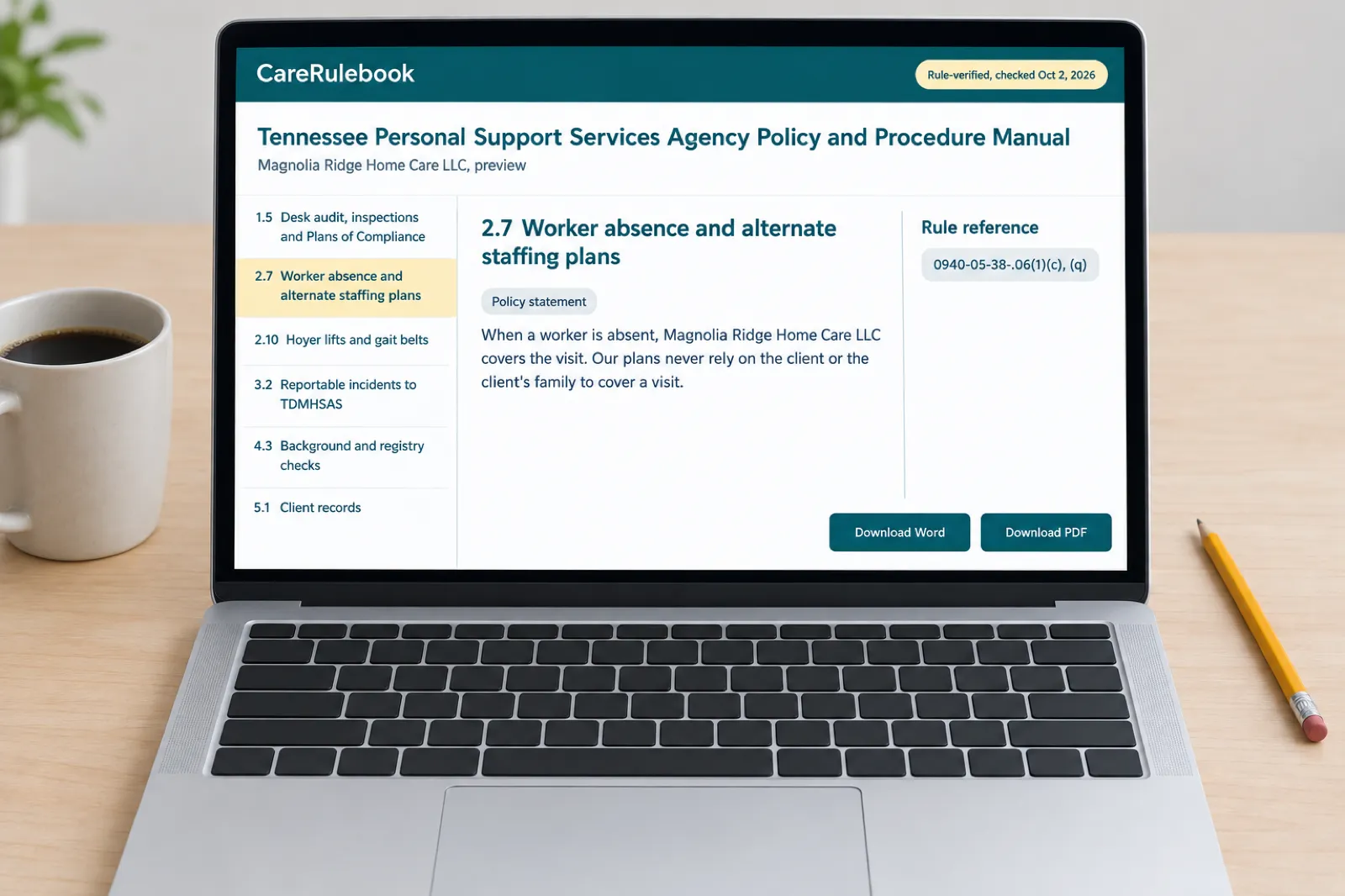
CareRulebook’s Tennessee manual includes Policy 4.3 (Criminal background, Abuse Registry and Sex Offender Registry checks): your choice of TBI, FBI or private investigator checks, who pays, whether to re-check every two years, results before any client contact, both registries before contact and every year, a background check log, a yearly registry re-check worksheet and a criminal record assessment record. Policy 4.2 covers the work history, references and employer checks.
$199CareRulebook founding price for the first 50 Tennessee agencies, then $249. Not a TDMHSAS fee.
Chapter 0940-05-38 names two bars: no one listed on the Abuse Registry and no one listed on the Sex Offender Registry may be hired or permitted to provide services (0940-05-38-.07(1)(d)-(e)). It lists no other offenses, and it sets no factors for weighing a conviction. We could not save T.C.A. 33-2-1202, so we cannot say whether the statute lists any; that is on our list of questions for a Tennessee lawyer.
CareRulebook’s manual does not invent a list. It has the individual responsible for the agency review every result personally and weigh the nature and seriousness of the offense, how it relates to the job, how long ago it was, and what the person says about it, and, for a pending charge, whether to wait for the outcome before any client contact. Before deciding not to hire, the person is told which record is the concern and given a chance to explain. These are the manual’s own steps (Policy 4.3), not TDMHSAS’s. Our suggestion: take employment law advice before withdrawing an offer because of a record.
The rule’s wording is "every two (2) years or within ten (10) days of employment or within ten (10) days of a change of responsibilities" (0940-05-38-.07(2)(c)). TDMHSAS’s note on it: "Because of the verbiage of this rule concerning every 2 years, Licensure will not be enforcing this part of the rule." (PSSA slide 8).
The note appears in TDMHSAS’s 2025 PSSA slides. We have not found it anywhere else in writing; whether it still holds is on our list of questions for TDMHSAS.
The checks above are your agency’s checks of its workers. Separately, TDMHSAS checks the people running the agency when you apply. For the person with overall responsibility (and any other applicants listed), TDMHSAS needs proof of citizenship or legal immigration, a Background Information Check form, a Non-Criminal Justice Privacy Rights Statement and a TBI fingerprint check (or FBI fingerprints or a licensed private investigator check covering current and previous states). The individual pays for it. (MH-4385, item 7) The application asks for three references who can vouch for the responsible person’s character and ability; they may not be related by marriage, blood or a shared business venture. (item 9)
When the chief executive officer or executive director changes later, the Change of Status form reports it to TDMHSAS, with background forms and fingerprinting (MH-4454). If the owner or the individual responsible also visits clients, CareRulebook’s manual gives them the worker checks as well, like anyone else who gives services. The application itself is covered in the Tennessee license application, and the roles in who runs a Tennessee PSSA.
No. Not in TDMHSAS’s reading. TDMHSAS says the results must be back and in the employer’s hands before the worker has any direct contact with, or direct responsibility for, clients. The worker can be hired, fill in paperwork and train in the office first: TDMHSAS says an agency should not be cited for a check done after employment if no direct contact has started.
"TDMHSAS has the interpretation that the background results shall be back and in the possession of the employer prior to employee direct contact with, or direct responsibility for, service recipients."
It depends. The rule says "every two (2) years", but TDMHSAS says it will not enforce that part because of the wording. You must still run the check within 10 days of employment or of a move into direct-contact duties (with results back before any direct contact, in TDMHSAS’s reading), and check the Abuse Registry and the Sex Offender Registry every year and before contact.
"Because of the verbiage of this rule concerning every 2 years, Licensure will not be enforcing this part of the rule."
No. TDMHSAS says no. It reads T.C.A. 33-2-1202(c)(1) as requiring past work and personal references to be checked before employment, and says the statute leaves no real flexibility even when the applicant fears losing their current job. A documented attempt (a call, fax or email) counts.
"We fully understand the concern here; however, there is no real flexibility in the statute."
No. Not for the TDMHSAS license. TDMHSAS says neither a TB skin test nor CPR certification is a licensure requirement, though a contract (for example with a Medicaid managed care organization) may require them. The rules do require competency in seven areas before work, including infection control, client safety and emergency procedures, and yearly job-related training.
"Are PSSA workers/caregivers required to have a TB skin test? No. This is not a Licensure requirement."
Not always. TDMHSAS’s summary of T.C.A. 33-2-1202 says fingerprints must be submitted when the Tennessee Bureau of Investigation or the FBI runs the check, and that a Tennessee-licensed private investigation company can run it without fingerprints. Either route works; pick one and write it into your policy.
The personnel policy rule says each worker submits to a criminal background check within 10 days of employment, or within 10 days of moving into duties with direct client contact. TDMHSAS adds that the results must be back and in your possession before the worker has any direct contact with, or direct responsibility for, a client. Both registries are searched before any client contact too.
The PSSA rules (Chapter 0940-05-38) bar anyone listed on the Abuse Registry or the Sex Offender Registry. They list no other offenses. We could not save the statute TDMHSAS relies on, T.C.A. 33-2-1202, so we cannot tell you whether it lists any; ask TDMHSAS or a Tennessee lawyer before turning someone away for a conviction.
The rule mentions a criminal check every two years, but TDMHSAS says it will not enforce that part because of the rule’s wording. The checks at hire and on a move into client work still apply, and both registries must be searched every year.
At internet.health.tn.gov/AbuseRegistry, run by the Health Facilities Commission, which now keeps the registry. Questions go to HFC.AbuseRegistry@tn.gov or 1-800-778-4504. The PSSA rule, written in 2016, still says the Department of Health keeps it; the registry rules moved to the Commission in 2022.
Yes. TDMHSAS says relatives can be personal references for workers. That is different from the owner’s licensing application, where the three character references may not be related by marriage, blood or a shared business.
Yes, as long as they do not start client work. TDMHSAS says an agency should not be cited for running the check after the hire date if no direct contact with, or direct responsibility for, clients has started. The results must be in your hands before that start date.
TDMHSAS has proposed a rewrite of its licensure procedure rules, Chapter 0940-05-02 (hearing November 18, 2026). Leave your email and we will tell you when a Tennessee change affects your hiring checks or your policies.
No spam. Only emails about Tennessee home care rule changes. How we use your email.
Tennessee
How to start a home care agency in Tennessee
The PSSA license, TDMHSAS’s fee, the four forms and the electronic desk audit.
Tennessee
Tennessee caregiver training
Competency in seven areas before work, client-specific training and training every year.
Manual
Build your Tennessee policy manual
Including Policy 4.3 on the criminal check and both registries.
Tennessee
The Tennessee PSSA license application
The four forms, and the owner’s own TBI fingerprint check and references.
Tennessee
Tennessee PSSA inspections
The desk audit, unannounced inspections and Plans of Compliance.
Tennessee
Tennessee PSSA policies and procedures
The 17 policy items and the 8 personnel topics.
Tool
Tennessee license checklist
Every step to a PSSA license, tailored to your agency, emailed to you.
Colorado
Colorado background checks
The 90-day criminal check, CAPS and the DORA license check.
Washington
Washington background checks
BCCU fingerprint checks, the 120-day provisional period and two-year rechecks.
Indiana
Indiana background checks
The 3-day and 21-day rules and the offense list widened in 2025.
Georgia
Georgia background checks
GCHEXS fingerprints, registries and the 2026 rule change.
North Carolina
North Carolina background checks
Criminal history checks and the Health Care Personnel Registry.