Resume
HCQC asks for the administrator’s resume, which must list and match the administrator name on the application.
HCQC Licensing Checklist, Resume for the AdministratorWhere are you starting?
Nevada · Who runs the agency · NAC 449.3973 as amended by R089-24
A Nevada personal care agency needs an administrator who meets five qualifications and a designee who takes charge, with access to all records, whenever the administrator is away. No nurse is required. Here are the qualifications (including the 2026 long-term care administrator route), the duties, what HCQC asks you to upload, elder abuse training, and what to do when the administrator changes.
Quick answer
The administrator of a Nevada personal care agency must be at least 18, have a high school diploma or its equivalent "or be licensed by the Board of Examiners for Long-Term Care Administrators pursuant to chapter 654 of NRS", be responsible and mature, understand the rules and the statute, and "demonstrate the ability to read, write, speak and understand the English language." (NAC 449.3973(1), as amended by R089-24). The long-term care administrator route is new since February 27, 2026.
The administrator "shall represent the licensee in the daily operation of the agency" and appoints a designee for absences, who "must have access to all records kept at the agency" (NAC 449.3973(2)-(3)).
There is no nurse requirement. A new administrator is reported to the Division within 30 days (NAC 449.0114(4), as amended).
2 routes
A diploma or equivalent, or a long-term care administrator license
NAC 449.3973(1)(b), as amended4 tags
On HCQC’s checklist for the administrator and designee (P0015 to P0030)
HCQC workbook (12.2024)Nevada’s personal care rules name two posts, the administrator and the person the administrator appoints for absences. The statute and the general licensing rules add the person in charge named on the application and the person named on the license. By our reading, in a small agency these can be the same person (see below).
| Role | Who it is | What the rules ask | Source |
|---|---|---|---|
| Administrator | Represents the licensee in the daily operation of the agency (NAC 449.3973(2)) | At least 18; a high school diploma or equivalent, or a Nevada long-term care administrator license; responsible and mature; understands the rules and statute; reads, writes, speaks and understands English | NAC 449.3973(1), as amended by R089-24 |
| Designee | One or more employees in charge whenever the administrator is absent (NAC 449.3973(2)(g)) | No qualifications set in the rule. Must have access to all records kept at the agency | NAC 449.3973(3) |
| Person named on the license | The person designated as responsible for the conduct of the agency | Named on the face of the license. The rule does not say whether this is the administrator or an owner | NAC 449.3972(2) |
| Person in charge (company applicants) | Named on the application; gives evidence of reputable and responsible character | Receives elder abuse training before the license is issued and before each renewal | NRS 449B.155(4), (6); 449B.225(3) |
| Nurse | None required | Clinicians appear only as trainers for optional health-related tasks | NAC 449.39775(7) |
NAC 449.3973(1), as amended by R089-24 (filed February 27, 2026), says the administrator must:
HCQC’s licensing checklist lists the items an initial or change of ownership application uploads (HCQC Licensing Checklist). Four are about the administrator:
HCQC asks for the administrator’s resume, which must list and match the administrator name on the application.
HCQC Licensing Checklist, Resume for the AdministratorHCQC asks for a United States high school diploma or equivalent (such as a GED); a foreign diploma must go through NACES first. Proof of age can be a driver’s license or state ID.
HCQC Licensing Checklist, High School Diploma or EquivalentProof that the administrator is 18 years old, such as a government-issued driver’s license or state ID card.
HCQC Licensing Checklist, Proof that the Administrator is 18 Years OldThe application must include a copy of the administrator’s current elder abuse, neglect and exploitation training.
HCQC Licensing Checklist, Elder Abuse, Neglect, and Exploitation TrainingNot settled: the license route. HCQC’s checklist lists the diploma and does not mention the long-term care administrator license. HCQC has not said what it wants from an administrator who qualifies by license. Our suggestion: upload a copy of the license with a short note citing NAC 449.3973(1)(b) as amended by R089-24, plus the diploma if the administrator has one, and ask HCQC at (702) 486-6515 (HCQC).
Your policies are not uploaded. HCQC reviews them, with the administrator’s file, at the prelicensure survey (NAC 449.0112(1)). Every upload, with the fees and bond, is on the Nevada license application guide, and how the survey works is on the Nevada survey guide.
The administrator "shall represent the licensee in the daily operation of the agency", and the responsibilities include, without limitation (NAC 449.3973(2), as amended by R089-24):
| Rule | Duty | HCQC or related rule |
|---|---|---|
| (a) | Employ qualified personnel and make sure they receive all the required training. The agency provides or arranges that training and pays for it, including wages for training time. | NAC 449.39735 |
| (b) | "Ensuring that only trained attendants are providing services to a client of the agency", following each client’s functional assessment, service plan and the agency’s policies. | NAC 449.3973(2)(b) |
| (c) | An accounting and reporting system that shows the agency’s finances. | NAC 449.3973(2)(c) |
| (d) | Negotiate contracted services lawfully and under the agency’s policies. | NAC 449.3973(2)(d) |
| (e) | "Providing oversight and direction for attendants and other members of the staff of the agency as necessary to ensure that the clients of the agency receive needed services". | NAC 449.3973(2)(e) |
| (f) | Develop and implement the agency’s policies and procedures, including on ending a client’s services. | NAC 449.3973(2)(f) |
| (g) | Designate one or more employees to be in charge when the administrator is absent. | NAC 449.3973(2)(g); HCQC P0020 |
| (h) | The administrator must be able to show the Division that the agency has the resources and capability to meet each client’s service plan. | NAC 449.3973(2)(h) |
| (4) | The administrator ensures clients are not abused, neglected or exploited by staff or visitors while staff are present, and that suspected abuse, neglect, exploitation, isolation or abandonment is reported under NRS 200.5093 and 632.472. Isolation and abandonment were added by R089-24. | NAC 449.3973(4), as amended; HCQC P0030 |
If attendants help with medication. The administrator of an agency whose attendants assist with medication must "develop a program to ensure that attendants receive the training required by subsection 2" and make sure a medication record is kept for each client (R089-24 section 14(3)). What attendants may do is on our Nevada attendant tasks guide.
Where to write the duties. HCQC’s checklist asks for a job description and qualifications under tag P0015, and job descriptions for each position under P0035 (HCQC workbook, P0015; P0035). All 13 policy topics and 55 tags: Nevada policies and procedures.
The administrator "shall appoint a person to exercise his or her authority in the administrator’s absence" (NAC 449.3973(2)), and the duty list repeats it: "Designating one or more employees of the agency to be in charge of the agency during those times when the administrator is absent" ((2)(g)).
Jobs the rules give to "the administrator or designee". Several rules let either one act, not only when the administrator is away:
If the administrator or designee gives care. HCQC’s workbook notes beside the attendant training rule: "Note: Also required for Administrator and/or Admin. Designee if will provide direct care to Clients." (HCQC workbook, tag P0152). By our reading, anyone who gives personal care is working as an attendant and meets the attendant rules for that work.
Two more people appear in the licensing rules:
Not settled: whether the person designated as responsible for the conduct of the agency should be the administrator or an owner. The rule does not say. By our reading the administrator, who represents the licensee in daily operation, fits best, and in a small agency the owner may also be the administrator. Ask HCQC when you apply.
Can the owner be the administrator? The rules do not stop it, if the owner meets the qualifications. The owner still needs a designee. Separately, each owner of 10% or more completes a fingerprint background check (HCQC Licensing Checklist; NRS 449B.300(1)).
NRS 449B.225 sets training to recognize and prevent the abuse of older persons at several points:
Every training course attendants need, and when: Nevada caregiver training.
Not settled: the designee. The statute covers the administrator "or other person in charge". Whether HCQC expects the designee to complete the training before care and every year is not stated. By our reading, train the designee too: they are in charge whenever the administrator is absent.
Cultural competency. Staff who give care or support with direct client contact at least weekly on average, and their supervisors, complete an approved cultural competency course within 90 days of hire and at least 2 hours every two years. Staff who take such a course for their own license renewal are exempt. By our reading that includes an administrator who supervises attendants (NAC 449.011931; NRS 449B.280(2)-(3)).
Nevada’s personal care rules name no separate supervisor or manager post. The administrator or designee does the supervising:
By our reading, an administrator who is away often needs a designee who can do these jobs, not only hold the keys. Our manual sets supervision frequency in Policy 2.7 and on-call cover in Policy 2.8; those frequencies are the manual’s choices, not the rule’s.
The administrator needs a diploma or equivalent, or a long-term care administrator license, and nothing in NAC 449.3973 asks for a nurse (NAC 449.3973(1)). Attendants need no certification such as CNA (NAC 449.3975).
Clinicians appear in the rules only as trainers for optional health-related tasks: trainers are a physician, PA, licensed nurse, pharmacist (insulin and glucose) or an experienced trained employee. (NAC 449.39775(7)). Each attendant also needs a health care provider’s certificate and a TB test (NAC 441A.375; 449.3976(1)(c)). Skilled nursing at home is a different license; see when a client needs a nursing agency.
Tick steps off as you go. Your progress is saved in this browser only.
At least 18, with a high school diploma or equivalent or a Nevada long-term care administrator license, responsible and mature, who understands the rules and statute and can read, write, speak and understand English.
The applicant (for a company, the person in charge) before the license is issued; the administrator before the agency provides care. Training in the year before the application counts if the application includes evidence of it.
HCQC asks for a resume that matches the name on the application, the diploma or equivalent (a foreign diploma through NACES), proof of age and a copy of current elder abuse, neglect and exploitation training.
The rule requires an appointment; writing it down is how you show HCQC’s surveyor (tag P0020). Give the designee access to all records kept at the agency (tag P0025).
HCQC’s checklist asks for a job description and qualifications for the administrator (tag P0015), and a policy on abuse, neglect and exploitation (tag P0030).
The application names the person in charge of the agency, and the license shows the person designated as responsible for its conduct.
At the prelicensure survey and after, the administrator must be able to show the Division that the agency has the resources and capability to meet each client’s service plan.
The whole licensing process, from the online application to the prelicensure survey: our Nevada guide.
The rule: “If there is a change in the administrator of the facility, the licensee shall notify the Division of the change within 30 days.” It was 10 days before R089-24.
NAC 449.0114(4), as amended by R089-24 section 17When the administrator changes, the notice must, where applicable, include evidence that the new administrator holds a current Nevada long-term care administrator license.
NAC 449.0114(4), as amendedHCQC says an existing licensee uses the online licensing system to apply for changes, and lists Change of Administrator first.
HCQC Licensing ChecklistIf the licensee fails to notify the Division and submit an application for a new license within 30 days, it pays the new-license application fee plus 50% of that fee. Before R089-24 the rule set one fee of 150% of the application fee, so the total is the same; what changed is the 30 days.
NAC 449.0114(4), as amendedThe rule’s late fee speaks of an "application for a new license", while HCQC’s system treats a change of administrator as a change to an existing license. Whether any fee is due when you report on time is not stated. Ask HCQC and keep the answer.
NAC 449.0114(4); HCQC Licensing ChecklistNo rule we found requires a notice to HCQC when the designee changes. By our reading, sign a new appointment letter, give the new designee access to all records, and update the disclosure statement’s contact details if they change.
NAC 449.3973(2)(g), (3); 449.3979(2)(f)Changes of ownership, location or services are reported immediately (NAC 449.0114(5)), and a change of ownership needs a new license (NRS 449B.200(2)).
CareRulebook
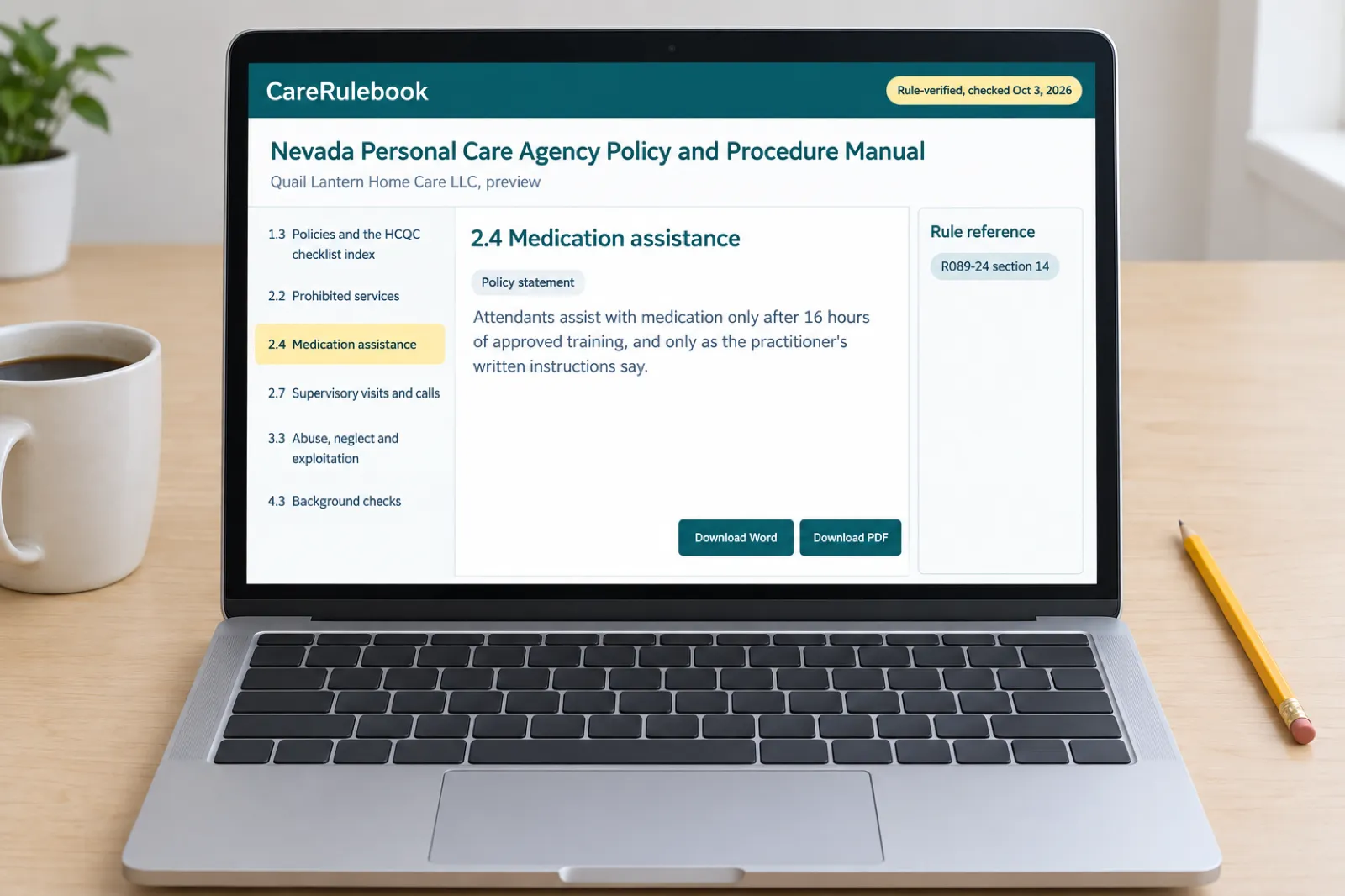
CareRulebook’s Nevada manual includes Policy 1.2, administrator and designee; Policy 1.1, license, ownership, surety bond, changes and renewal; Policy 2.7, assigning and supervising attendants: supervisory visits and calls; Policy 3.3, abuse, neglect, exploitation, isolation and abandonment: prevention and reporting; and Policy 4.8, annual and required training.
$199CareRulebook founding price for the first 50 Nevada agencies, then $249. Not an HCQC fee.
No. The administrator must be at least 18, have a high school diploma or equivalent, be responsible and mature, understand the rules and statute, and be able to read, write, speak and understand English. Since R089-24 (February 27, 2026), a Nevada long-term care administrator license can stand in for the diploma, but no license is required.
"Demonstrate the ability to read, write, speak and understand the English language."
No. Every administrator must appoint a person to act in their absence and designate one or more employees to be in charge when they are away, and that person must have access to all records kept at the agency. HCQC’s checklist looks for the appointment (tag P0020) and the designee’s access to records (tag P0025).
"Designating one or more employees of the agency to be in charge of the agency during those times when the administrator is absent"
Under NAC 449.3973(1), as amended by R089-24 on February 27, 2026, the administrator must be at least 18, have a high school diploma or its equivalent or be licensed by the Nevada Board of Examiners for Long-Term Care Administrators, be responsible and mature with the personal qualities to understand the problems of elderly persons and persons with disabilities, understand the personal care rules and the statute (now NRS chapter 449B), and demonstrate the ability to read, write, speak and understand English. No nursing license, degree or set years of experience are required.
Yes, since R089-24 took effect on February 27, 2026. The rule now reads "a high school diploma or its equivalent or be licensed by the Board of Examiners for Long-Term Care Administrators pursuant to chapter 654 of NRS". HCQC’s licensing checklist still lists only the diploma, and its 12.2024 workbook still prints the old rule. HCQC has not said what to upload for the license route; uploading the license, and the diploma if you have one, is our suggestion. Ask HCQC.
Yes. The administrator must appoint a person to exercise the administrator’s authority in their absence, and designate one or more employees to be in charge when the administrator is absent. That employee must have access to all records kept at the agency, although confidential information may be kept separately by the administrator. HCQC’s checklist looks for the designee’s appointment (P0020) and access to records (P0025).
The rule does not say. NAC 449.3973 sets qualifications only for the administrator and says the designee is an employee who must have access to all records. By our reading, choose someone who could meet the administrator’s qualifications, because the designee exercises the administrator’s authority while in charge, and give them the same elder abuse training. If the designee will give care, HCQC’s workbook notes that the attendant training topics apply to them too.
Within 30 days of the change (it was 10 before R089-24). Where applicable, the notice includes evidence that the new administrator holds a current Nevada long-term care administrator license. HCQC says existing licensees apply for changes, including Change of Administrator, through the online licensing system. If the licensee fails to notify the Division and submit an application for a new license within 30 days, it pays the new-license application fee plus 50%.
The applicant, or for an LLC or corporation, the person in charge of the agency, before the license is issued and then every year before renewal. The administrator or other person in charge completes it before the agency provides care to anyone, then yearly, and every employee who provides care completes it before their first client, then yearly. The agency pays. HCQC asks for a copy of the administrator’s current training with the application.
The rules do not stop it. An owner who meets the administrator’s qualifications can hold the post. The owner then also needs a designee for absences, and HCQC asks for each owner of 10% or more to complete a fingerprint background check with the application.
R089-24 changed the administrator rules on February 27, 2026, and the Division has proposed R164-26 on appeals of disciplinary actions. Leave your email and we will tell you when a Nevada change affects who runs your agency.
No spam. Only emails about Nevada home care rule changes. How we use your email.
Nevada
How to start a home care agency in Nevada
The personal care agency license, the 2026 rule changes and HCQC’s 55-tag checklist.
Nevada
What Nevada attendants may and may not do
The prohibited list as amended in 2026, nail care, exercise, appointments, insulin pens and medication help.
Nevada
Nevada caregiver training
What attendants need before their first client and every year, including elder abuse training.
Nevada
The Nevada license application
HCQC’s uploads, including the administrator’s documents, fees and bond.
Nevada
Nevada personal care agency surveys
The prelicensure survey, HCQC’s 55 tags and the 10-day plan of correction.
Manual
Build your Nevada policy manual
Including Policy 1.2 on the administrator and designee.
Kansas
Kansas administrator and manager
An administrator and alternate aged 21, a manager who supervises, and no nurse.
Tennessee
Who runs a Tennessee PSSA
No set qualifications for the person responsible, and what is checked instead.
Washington
Washington administrator and supervisor
Qualifications your policies set, written alternates and 10 hours of training.
Texas
Texas home care administrator requirements
An administrator, an alternate and 24 hours of training.