Skip to content
CareRulebook
MenuClose

Where are you starting?

United StatesTexas, North Carolina, Georgia, Virginia, Indiana, Ohio, New York, Illinois, Washington, Colorado, Tennessee, Maryland, Kansas, South Carolina, Nevada
TexasManual
North CarolinaManual
GeorgiaManual
VirginiaManual
IndianaManual
OhioGuideNew YorkGuide
IllinoisManual
WashingtonManual
ColoradoManual
TennesseeManual
MarylandManual
KansasManual
South CarolinaManual
NevadaManual
All US states →
United KingdomEngland
Free toolsChecklists, calculators and templates

South Carolina · Caregivers · R.60-122 §404-406

South Carolina caregiver training: eight topics before client contact, then every year

South Carolina sets training topics, not hours. Since May 22, 2026, every in-home caregiver is trained in the eight topics that apply to them before client contact and at least once a year, with each record signed and dated by trainer and trainee. A health self-assessment, reviewed and signed before the first visit, replaced the old TB screening.

  • Rule-verified October 2, 2026
  • Quoted from R.60-122 §404 to §406 and §800
  • Compared with the rule in force before May 22, 2026
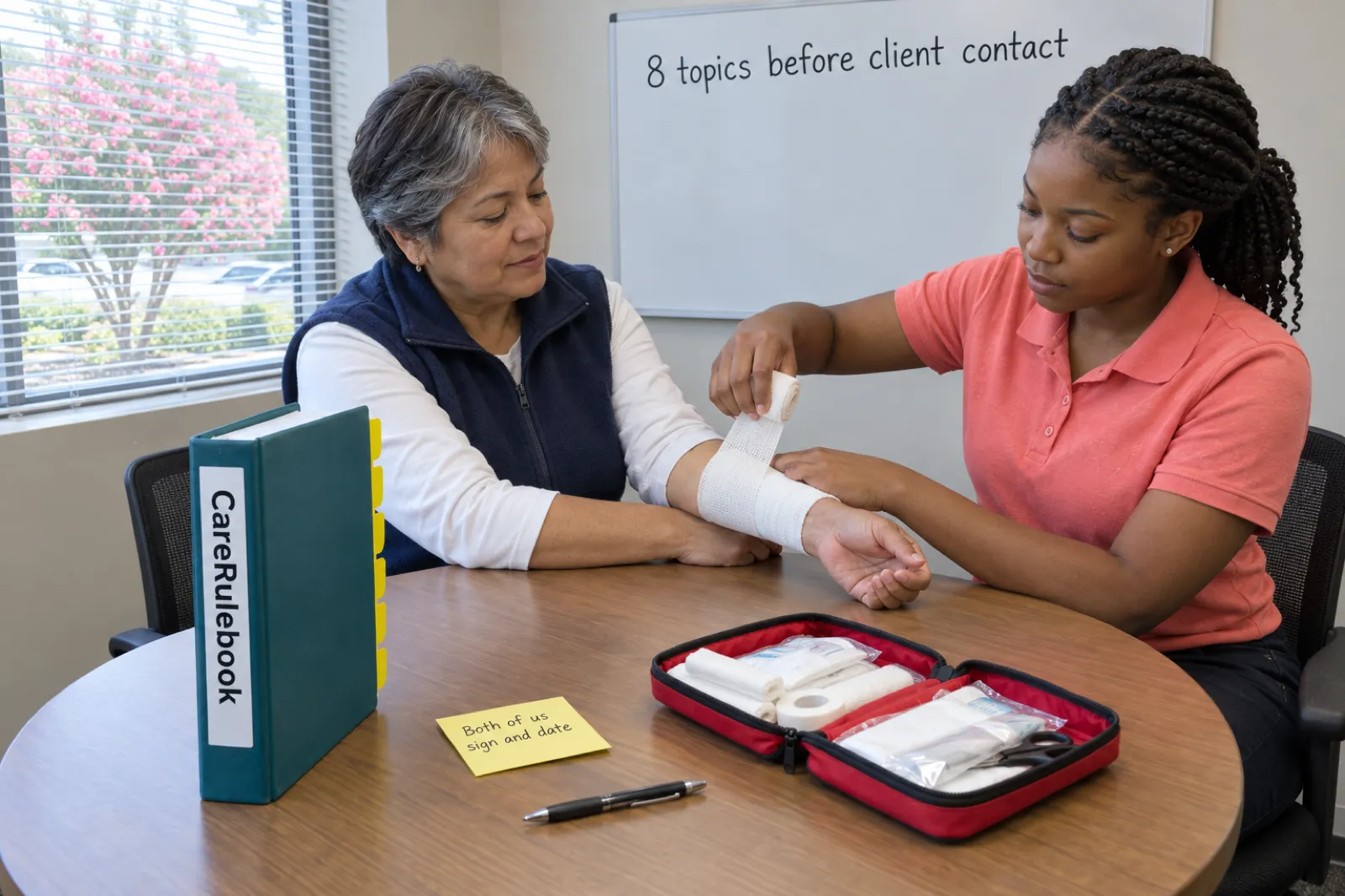
A young woman in a coral polo shirt wraps a white bandage around the forearm of an older woman in a navy vest at a round table, under a whiteboard reading 8 topics before client contact, beside a CareRulebook binder, an open first aid kit and a sticky note reading Both of us sign and date

Quick answer

"Caregivers shall receive or independently obtain necessary training to perform the duties for which they are responsible." Eight topics, A to H, are provided by appropriate resources "prior to client contact and at least annually thereafter unless otherwise specified by certificate" (R.60-122 §404). Section 404 is a Class I standard (§404). "Documentation of all in-service training shall be signed and dated by both the individual providing the training and the individual receiving the training." (§404)

There is no hour minimum, no state curriculum and no certification for the DPH license. Before the first visit, staff with client contact also complete a health self-assessment, reviewed and signed by a nurse, the administrator or human resources or hiring staff (§406.A). It replaced the health assessment with TB screening that the rule required before May 22, 2026 (2014 text §400).

8 topics

before client contact, two of them only where they apply

R.60-122 §404.A-H

Yearly

repeat, unless a certificate sets its own period

R.60-122 §404

0 hours

set by the rule; Medicaid asks for 10 a year

§404; SCDHHS scope D.1.b.viii

Class I

for training and for the health self-assessment

R.60-122 §404, §406

From hire to first visit, and every year after

The training and health duties in the order a new caregiver meets them. Tick steps off as you go; progress is saved in this browser only.

  1. Check the minimum qualifications

    At hire

    At least 18 with government ID or other valid documentation; able to read, write and communicate effectively with the client and supervisor; capable of the assigned duties. The full list.

    R.60-122 §405.A-E
  2. Run the background checks and drug test

    Before employment

    Criminal record check, the two registries and a negative 5-panel drug test before employment. Caregiver background checks.

  3. Have the health self-assessment reviewed and signed

    Before first client contact

    The caregiver discloses communicable diseases; a nurse, the administrator or human resources or hiring staff reviews and signs it (Class I).

    R.60-122 §406.A-B
  4. Train on the eight topics

    Before client contact

    Basic first aid, condition-specific care where clients need it, confidentiality, documentation, ethics, lifting and transfers if applicable, infection control, and preventing abuse, neglect and exploitation (Class I). The topics.

    R.60-122 §404
  5. Sign and date every training record

    Each session

    Trainer and trainee both sign; the trainer’s signature may be left off for computer-based training. File it in the staff record.

    R.60-122 §404, §403
  6. Teach the communicable disease policy

    Before client contact (our timing)

    Caregivers report their health to the administrator as it relates to communicable disease, and know when they will be excluded or restricted.

    R.60-122 §406.C
  7. Repeat the topics every year

    Every year

    At least annually, unless a certificate says otherwise. The rule sets no hours.

    R.60-122 §404

The eight topics, A to H

Each topic is given before client contact and at least annually after (R.60-122 §404). Two apply only in some agencies: B depends on the type of clients, and F applies "if applicable".

§404TopicWho needs it
ABasic first aidEvery caregiver. First aid and CPR
BCare specific to clients’ physical or mental conditions, for example Alzheimer’s disease, other dementias or cognitive disabilitiesDepending on the type of clients
CConfidentiality of client information and recordsEvery caregiver
DDocumentation and recordkeeping proceduresEvery caregiver
EEthics and interpersonal relationshipsEvery caregiver
FProper lifting and transfer techniquesIf applicable: caregivers who help with transfers or repositioning
GInfection control techniquesEvery caregiver; ties to §800 and §406
HPrevention of client abuse, neglect and exploitationEvery caregiver; its own topic since May 22, 2026

Training for the duties, too. The topic list is not the whole duty: caregivers get the training "to perform the duties for which they are responsible" (§404). Care must follow your policies (§700.A), so by our reading caregivers should also learn the policies on their own work: what tasks they may do under the non-medical list, medication reminders, incidents and the disaster plan. That is how CareRulebook’s manual builds Policy 2.5.

Infection control in practice. Topic G sits beside a Class I duty: The provider maintains and implements staff practices that prevent the spread of infectious, contagious and communicable diseases, including screening, standard precautions and transmission-based precautions (Class I). (R.60-122 §800). CareRulebook’s manual covers it in Policy 6.1.

Basic first aid, and CPR

"Basic first aid" is topic A, before client contact and at least annually, Class I (R.60-122 §404.A). The rule does not mention CPR.

The annual repeat applies "unless otherwise specified by certificate" (§404). The rule does not explain those words. By our reading, when a caregiver holds a current first aid certificate that states how long it is valid, the topic is renewed when the certificate expires rather than every year. That reading is on our list of questions for DPH. A recognized first aid course with a certificate, plus CPR, is a sensible choice; CareRulebook’s manual lists both as Recommended practice, labelled as going beyond the rule.

Who gives the training

  • Appropriate resources. Training is provided by appropriate resources, for example licensed, registered or certified persons, books or electronic media. The rule names no approved trainer or course. (R.60-122 §404)
  • The caregiver’s own training. Caregivers "receive or independently obtain" the training they need (§404). The rule does not say what evidence of outside training you must accept. CareRulebook’s manual counts it when there is a signed and dated record, it covers the topic, and it is less than 12 months old or the certificate is current.
  • Online courses. "A signature for the individual providing the training may be omitted for computer-based training." (§404)
  • No nurse needed. R.60-122 does not require a nurse, for training or anything else; a nurse is named only as one of the people who may review drug tests and self-assessments (§402.B, §406.A).

Before client contact, and every year

The rule ties the first round to "client contact", not to the hire date, so a new caregiver can do paperwork and training before their first visit. By our reading, going along on another caregiver’s visit to watch is client contact, so it comes after the training; that point is on our list of questions for DPH.

"At least annually" is not defined. CareRulebook’s manual reads it as no more than 12 months between trainings in any topic, and keeps a training calendar so no caregiver goes past their date. A caregiver whose yearly training is overdue does not work with clients until it is done: that is the manual’s rule, chosen because §404 is Class I (§404).

Signed training records

"Documentation of all in-service training shall be signed and dated by both the individual providing the training and the individual receiving the training." (R.60-122 §404). Training is also part of the staff record: "The provider shall maintain accurate information on all staff members including, but not limited to, current address, phone number, training, all drug test results, criminal background checks, and self-assessments." (§403).

The rule speaks of "in-service training" records. By our reading the signature duty also covers the training before client contact, so CareRulebook’s manual records every session the same way: topic, date, method, trainer and length, signed by both. Inspections are unannounced (§202; how DPH inspects), so keep the records filed in each staff record (Staff records, Policy 2.4).

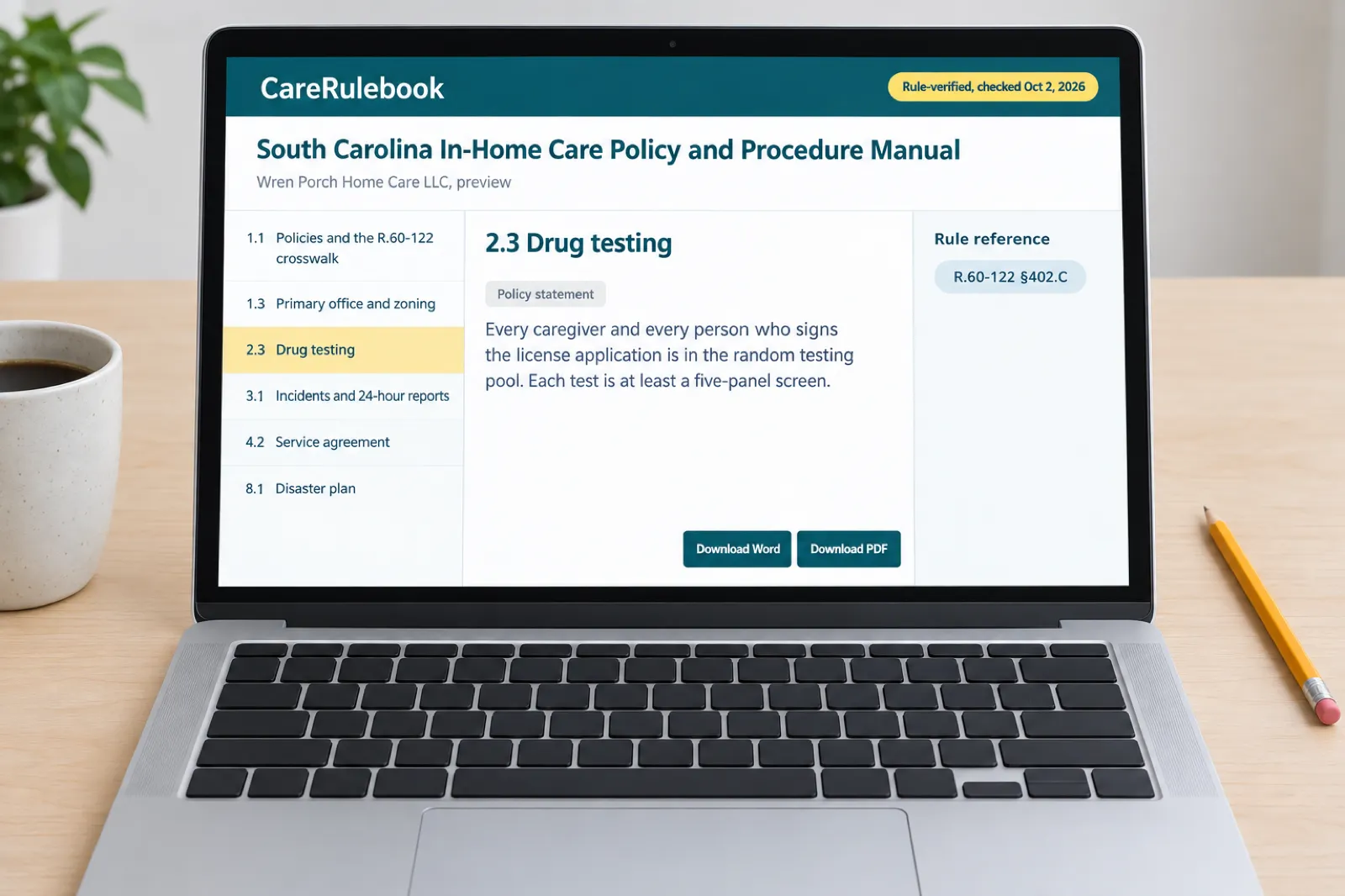
The CareRulebook South Carolina manual preview on a laptop: policy 2.3 on drug testing for a sample agency, citing R.60-122 §402.C, with six of the manual’s policies listed beside it

CareRulebook

Training and health records written for your agency

CareRulebook’s South Carolina manual includes Policy 2.5 (Training before client contact and every year) with a topic outline for A to H, a training calendar and a signed session record; Policy 2.8 (Health self-assessment and communicable disease) with the self-assessment form and an exclusion and restriction table; and Policy 2.6 on the minimum qualifications.

  • 29 policies, 84 requirements mapped to R.60-122 and S.C. Code 44-70
  • Already licensed? What changed on May 22, 2026, and a plan for current caregivers’ training and self-assessments
  • Editable Word and print-ready PDF, with the rule quoted under each policy
Preview your manual

$199CareRulebook founding price for the first 50 South Carolina agencies, then $249. Not a DPH fee.

The health self-assessment, not TB tests (Class I)

  • Before first contact. "All staff members and caregivers who have contact with clients shall complete a self-assessment prior to initial client contact." "The self-assessment shall be reviewed and signed by a nurse, the administrator, or human resources/hiring personnel prior to the staff member or caregiver’s initial client contact." (R.60-122 §406.A)
  • What it discloses. At a minimum the self-assessment discloses communicable diseases such as influenza, measles, mumps, chicken pox, strep throat, tuberculosis, HIV/AIDS and hepatitis. (§406.B). We found no DPH form for it, so CareRulebook’s manual includes its own.
  • A reporting and exclusion policy. You write policies for caregivers to report their health to the administrator as it relates to communicable disease while providing care. "The policies and procedures shall further include provisions for excluding and/or restricting caregivers with communicable diseases or symptoms of such diseases." (§406.C). The rule gives no exclusion periods; CareRulebook’s manual sets its own table, for example 48 hours after the last episode of vomiting or diarrhea, labelled as the manual’s procedure.

TB. Before May 22, 2026, staff with client contact needed a health assessment within 12 months before first client contact, including tuberculosis screening, and every provider ran an annual tuberculosis risk assessment. (R.60-122, 2014 text §400). The 2026 rule has neither. DPH’s in-home care page (updated November 10, 2025) still links the TB Risk Assessment (Short Form) and the 2015 memo, although the 2026 rule no longer requires TB screening. (DPH In-Home Care Providers page). Medicaid contracts may still ask for a TB test (below).

The self-assessment holds health information, so by our reading it should be kept in a closed section of the staff record that only the reviewer and the administrator see; the rule does not say this. CareRulebook’s manual does it in Policy 2.8.

Caregiver minimum qualifications

Section 405 is marked (II); its registry and conviction standards are (I) (R.60-122 §405). A caregiver must:

  1. "be able to read, write, and communicate effectively with client and supervisor" (§405.A);
  2. be capable of completing assigned job duties (§405.B);
  3. "be capable of providing care as provided in the care services plan with minimal supervision, if applicable" (§405.C);
  4. "have a valid driver’s license and proof of insurance if transportation is a part of the caregiver’s duties"; you verify the official driving record, and "A copy of the driving record must be maintained in the caregiver’s file" (§405.D);
  5. "be at least eighteen (18) years of age, as evidenced by a government-issued identification card or other valid documentation" (§405.E);
  6. have no adverse registry findings and no barred convictions (§405.F-G): see caregiver background checks.

The rule sets no supervision schedule. CareRulebook’s manual includes a supervision policy (Policy 2.7) on who supervises and when caregivers call; supervisory visits or check-ins are offered as Recommended practice, labelled as beyond the rule.

What changed on May 22, 2026

TopicBefore May 22, 2026Since May 22, 2026
When training happensTopics listed, with no timing 2014 textBefore client contact and at least annually, unless a certificate says otherwise R.60-122
Medication assistanceA training topic, if applicable 2014 textDropped; caregivers give medication reminders only R.60-122
Abuse and neglectPart of the confidentiality and client rights topic 2014 textPrevention of client abuse, neglect and exploitation is its own topic (404.H) R.60-122
Staff healthHealth assessment within 12 months before first client contact, with TB screening, and a yearly TB risk assessment 2014 textA communicable disease self-assessment, reviewed and signed before first client contact, and a reporting and exclusion policy R.60-122

The old rule listed the topics after "The following training shall be provided by appropriate resources", with nothing on when (2014 text §300.D). It included "Medication assistance, if applicable" (§300.D.2), and folded abuse into "Confidentiality of client information and records and the protecting of client rights, including prevention of abuse and neglect" (§300.D.4). The 2026 rule allows medication reminders only (§700.B.13). Every change in the rewrite is on the South Carolina home care guide.

Already licensed: your current caregivers

The 2026 rule applies to every provider from May 22, 2026 and has no transition period (R.60-122 §101). By our reading that means:

  • Training. Any current caregiver without a signed record in the last 12 months for a topic that applies to them completes it as soon as it can be arranged. Prevention of abuse, neglect and exploitation is new as a separate topic, so every current caregiver gets it.
  • Self-assessments. §406.A ties the self-assessment to "initial client contact", which current caregivers have already had. Having each one complete a self-assessment now still gives you the staff record §403 asks for (§403).
  • Old TB records stay in the staff files as part of the record; you do not need to repeat TB screening for the license.

DPH has not published guidance on how it will inspect existing agencies against the new rule.

What Medicaid adds

If you serve Medicaid waiver participants, SCDHHS’s scope of services (July 1, 2025) asks for more than DPH’s license. These are SCDHHS’s rules for its contracts, and SCDHHS’s manual predates the 2026 rewrite of R.60-122.

TopicWhat SCDHHS asksSource
CompetencyEach aide, CNAs included, passes competency testing or a competency training and evaluation program by an RN or LPN before serving waiver participants, recorded on SCDHHS’s Competency Documentation Form.Personal Care scope, D.1.b.vii
Yearly hoursAt least 10 hours of relevant in-service training per calendar year, pro-rated in the first year, under the nurse supervisor; no more than 6 of the 10 from self-study.D.1.b.viii
TB testA PPD tuberculin test heading that refers providers to DPH for the requirements.D.3
Driving recordChecked at hire and every two years for aides who transport participants.D.1.b.v
NurseMedicaid personal care must be supervised by an RN or LPN (which may be contracted), who visits before care starts and writes the task list.SCDHHS scope

Whether SCDHHS’s TB heading still means a test for in-home care staff, now that R.60-122 has dropped TB screening, is not settled; ask SCDHHS if you hold a Medicaid contract.

What the DPH license does not require

  • Set hours, a curriculum or a certification. Topics only (R.60-122 §404).
  • CPR. Basic first aid only (§404.A).
  • A TB test or TB risk assessment. Replaced by the self-assessment (2014 text §400; §406).
  • Medication training. Dropped with medication assistance (2014 text §300.D.2).
  • A nurse to train or supervise. The rule names a nurse only as one possible reviewer of drug tests and self-assessments (§402.B, §406.A)

Not settled yet

Points the rule leaves open, each on our list of questions for DPH. CareRulebook’s manual states its own reading until DPH answers:

  • Whether a certificate’s own validity period (for example a two-year first aid certificate) replaces the yearly repeat.
  • Whether the signature duty for "in-service training" covers the training before client contact, and whether shadowing another caregiver’s visit is client contact.
  • What training obtained elsewhere DPH accepts.
  • Whether DPH has a self-assessment form, and whether it still expects any TB screening (DPH’s page still links a TB form).

Myths about South Carolina caregiver training

Do South Carolina in-home caregivers need a set number of training hours?

No. Not for the DPH license. R.60-122 §404 lists eight topics, given before client contact and at least annually, with records signed by trainer and trainee, but sets no hours, curriculum or certification. Medicaid is different: SCDHHS requires an RN or LPN competency evaluation and at least 10 hours of in-service training a year for aides serving waiver participants.

"prior to client contact and at least annually thereafter unless otherwise specified by certificate"

Do South Carolina in-home caregivers need CPR certification?

No. R.60-122 requires basic first aid training before client contact and every year, not CPR. The rule lets a certificate set its own repeat period ("unless otherwise specified by certificate") without explaining how, so a first aid certificate valid for two years may, by our reading, be renewed when it expires. CPR is a sensible addition, and a contract or payer may ask for it.

"Basic first aid;"

Do South Carolina in-home caregivers need a TB test?

No. Not under the 2026 rule. The old health assessment with TB screening and the annual TB risk assessment were replaced by a self-assessment that discloses communicable diseases, including tuberculosis, reviewed and signed before first client contact. DPH’s page still links the old TB risk assessment form, and Medicaid contracts may ask for more, so check with your payers.

"All staff members and caregivers who have contact with clients shall complete a self-assessment prior to initial client contact."

Can caregivers give medication in South Carolina non-medical home care?

No. Care is strictly limited to non-medical tasks, and the only medication service the rule lists is medication reminders. The definitions of in-home care in the statute and in R.60-122 §102.J also include supervising self-administered medications. Neither says caregivers may administer medication, and skilled care needs a home health agency. Whether caregivers may set up doses or fill pill organizers is not addressed; by our reading they should not, and DPH can confirm.

"Care services provided by caregivers are strictly limited to non-medical tasks."

Frequently asked questions

How many hours of training do South Carolina in-home caregivers need?

R.60-122 sets no hours. It lists eight topics (A to H), given before client contact and at least annually, with records signed by trainer and trainee. Only Medicaid sets hours: SCDHHS asks for at least 10 hours of in-service training a year for aides serving waiver participants, with no more than 6 from self-study.

What training topics does South Carolina require for home care caregivers?

Basic first aid; care specific to clients’ physical or mental conditions, depending on the clients (for example dementia); confidentiality of client information and records; documentation and recordkeeping; ethics and interpersonal relationships; proper lifting and transfers, if applicable; infection control; and prevention of client abuse, neglect and exploitation.

Do South Carolina caregivers need a TB test?

Not under the 2026 rule. The old health assessment with TB screening and the yearly TB risk assessment were replaced by a self-assessment that discloses communicable diseases, tuberculosis included, reviewed and signed before first client contact. DPH’s page still links the old TB risk assessment form, and SCDHHS’s Medicaid scope of services still has a TB test heading that refers to DPH, so check with your payers.

Can caregiver training be online in South Carolina?

Yes. The rule names books and electronic media among appropriate resources, and for computer-based training the trainer’s signature may be left off the record. The caregiver still signs and dates it, and the course still has to cover the topic.

Do South Carolina caregivers need to be CNAs?

No. The DPH license asks for the eight training topics and the minimum qualifications in §405, not a certification. A Nurse Aide Registry search is still required, to check for adverse findings. Medicaid requires an RN or LPN competency evaluation for every aide, CNAs included.

Who can train South Carolina in-home caregivers?

The rule says "appropriate resources", for example licensed, registered or certified persons, books or electronic media. It names no approved trainer, and caregivers may also obtain the training themselves. Keep a signed and dated record either way.

Does medication training still apply?

Medication assistance was a training topic before May 22, 2026 and was dropped. Caregivers may give medication reminders only, so CareRulebook’s manual teaches its medication reminder policy as part of training for their duties.

Get South Carolina rule-change alerts

The rewritten R.60-122 took effect on May 22, 2026, and we found no proposal to amend it since. DPH may still publish guidance, a self-assessment form or new training expectations. Leave your email and we will tell you when a South Carolina change affects your training or your policies.

No spam. Only emails about South Carolina home care rule changes. How we use your email.

Keep reading

Sources

  1. Regulation 60-122, Standards for Licensing In-Home Care Providers (Document No. 5407, State Register Vol. 50, Issue 5, effective May 22, 2026, with the errata in Vol. 50, Issue 6, June 26, 2026) · South Carolina Department of Public Health; South Carolina Legislative Council (State Register) · retrieved October 2, 2026
  2. Regulation 60-122 (formerly 61-122) as in force before May 22, 2026: the 2014 text (Doc. No. 4433), from the S.C. Code of Regulations, Chapter 60, and DHEC’s unofficial copy of R.61-122 · South Carolina Legislative Council (Code of Regulations); S.C. Department of Health and Environmental Control · retrieved October 2, 2026
  3. In-Home Care Providers (regulations, forms, memos, map) · South Carolina Department of Public Health · retrieved October 2, 2026
  4. HCBS Provider Manual, Scope of Services for Personal Care, HASCI Agency Attendant Care and Respite (July 1, 2025) · South Carolina Department of Health and Human Services · retrieved October 2, 2026
Build your South Carolina manualfrom $199