Cannula or mask: yes
Any supportive care worker may temporarily remove and replace a cannula or mask from a client’s face for the purposes of shaving or washing the client’s face.
K.A.R. 28-51-117(g)(16)Where are you starting?
Kansas · Assigned duties · K.A.R. 28-51-117(g)
Kansas sets out, task by task, what a supportive care worker may do: 16 areas from medication reminders to oxygen tanks, each with a limit. Here is the full list, what is allowed and what is not, the training some tasks need, the walking rule nobody can quite apply, and which clients need a Skilled Services agency instead.
Quick answer
Kansas supportive care is help with activities of daily living "that the consumer could perform if such consumer were physically capable", given without supervision by a healthcare professional (K.S.A. 65-5101(k)). K.A.R. 28-51-117(g) turns that into 16 task areas that every agency must write into its policies, each with limits (K.A.R. 28-51-117(g)).
The main lines: medication reminders only, from containers someone else has filled ((g)(1)); no transfer for a client who cannot assist with it, with or without a lift ((g)(14)); lift transfers and oxygen tank changes only after training and demonstrated competency ((g)(14); (g)(16)); no nail trimming, wound care or respiratory care ((g)(10); (g)(2); (g)(15)).
Anything beyond these needs an agency with the Skilled Services license, because "A person that applies for a license to provide only supportive care services shall not provide nursing services." (K.A.R. 28-51-105(e))
2
Tasks that need specific training and demonstrated competency: lift transfers and oxygen flow
K.A.R. 28-51-117(g)(14), (16)Four rules work together:
Every applicant also attests that "the provision of any services that are not within the scope of the HHA level of licensure obtained, are grounds for but not limited to, termination or loss of all or any HHA State License" (Attestation Form, p. 1). And KDHE says supportive care workers "are not able to work as Home Health Aides or Certified Nursing Assistants due to no nursing services under the Non-Medical Supportive Care Services license" (Letter of Introduction, Option 2). A CNA can work for you, but only within these 16 areas (Attestation Form, p. 2).
Our plain-English summary of K.A.R. 28-51-117(g)(1) to (16). Each paragraph number links to the rule text; read it in full before you write your policy.
| (g) | Task | A worker may | A worker may not |
|---|---|---|---|
| (1) | Medication | Ask whether medications were taken, prompt, hand over a marked reminder container, and open it if the client physically cannot. Only for medications preselected by the client, a family member, a nurse or a pharmacist into containers marked with the day and time. | Medication administration or setting up medications. Report to the manager at once when doses are taken too often, not often enough or at the wrong time. |
| (2) | Skin care | Skin care on unbroken skin, for a client with no active chronic skin problems. | Applying medication, wound care or dressing changes. |
| (3) | Ambulation | Help a client walk who can balance and bear weight, if a qualified health professional has found the client independent with an assistive device. | Help a client who is not independent with the device. KDHE says that means a client who needs help with the device itself. |
| (4) | Bathing | Help with bathing. | A client with wounds needing bandage changes before, during or after bathing belongs with an agency licensed for home health services. |
| (5) | Dressing | Ordinary clothing, and over-the-counter support stockings bought without a prescription. | Elastic bandage wraps, or anti-embolic or pressure stockings sold only on prescription. |
| (6) | Exercise | Normal bodily movement as the client tolerates it, and encouraging the client to follow a prescribed program. | Help with exercise prescribed by a qualified health professional, such as a physical or occupational therapist. |
| (7) | Feeding | Help a client who can chew and swallow without difficulty and stay upright. | Syringe, tube or intravenous feeding. A client at high risk of choking or aspiration belongs with an agency licensed for home health services. |
| (8) | Hair care | Shampoo that needs no prescription, drying, combing and styling. | By our reading, prescription shampoos, since the rule allows only shampoo that does not need one. |
| (9) | Mouth care | Denture care and basic oral hygiene. | Mouth care for a client who is unconscious, has difficulty swallowing, is at risk of choking or aspiration, or has had recent mouth surgery: that is for an agency licensed for home health services. |
| (10) | Nail care | Soaking nails, pushing back cuticles without utensils, and filing. | Nail trimming, which is only for workers of an agency licensed for home health services. |
| (11) | Positioning | Simple alignment in a bed, wheelchair or other furniture, if the client can show, in words, without words or through others, when a change is needed. | Positioning when skin care is needed with it. |
| (12) | Shaving | An electric or a safety razor. | Any other kind of razor: the rule says only an electric or a safety razor. |
| (13) | Toileting | To and from the bathroom; bedpans, urinals and commodes; incontinence hygiene, clothing and pads; emptying catheter bags and ostomy bags. | Inserting or removing catheters, care of external catheters, suppositories and enemas. |
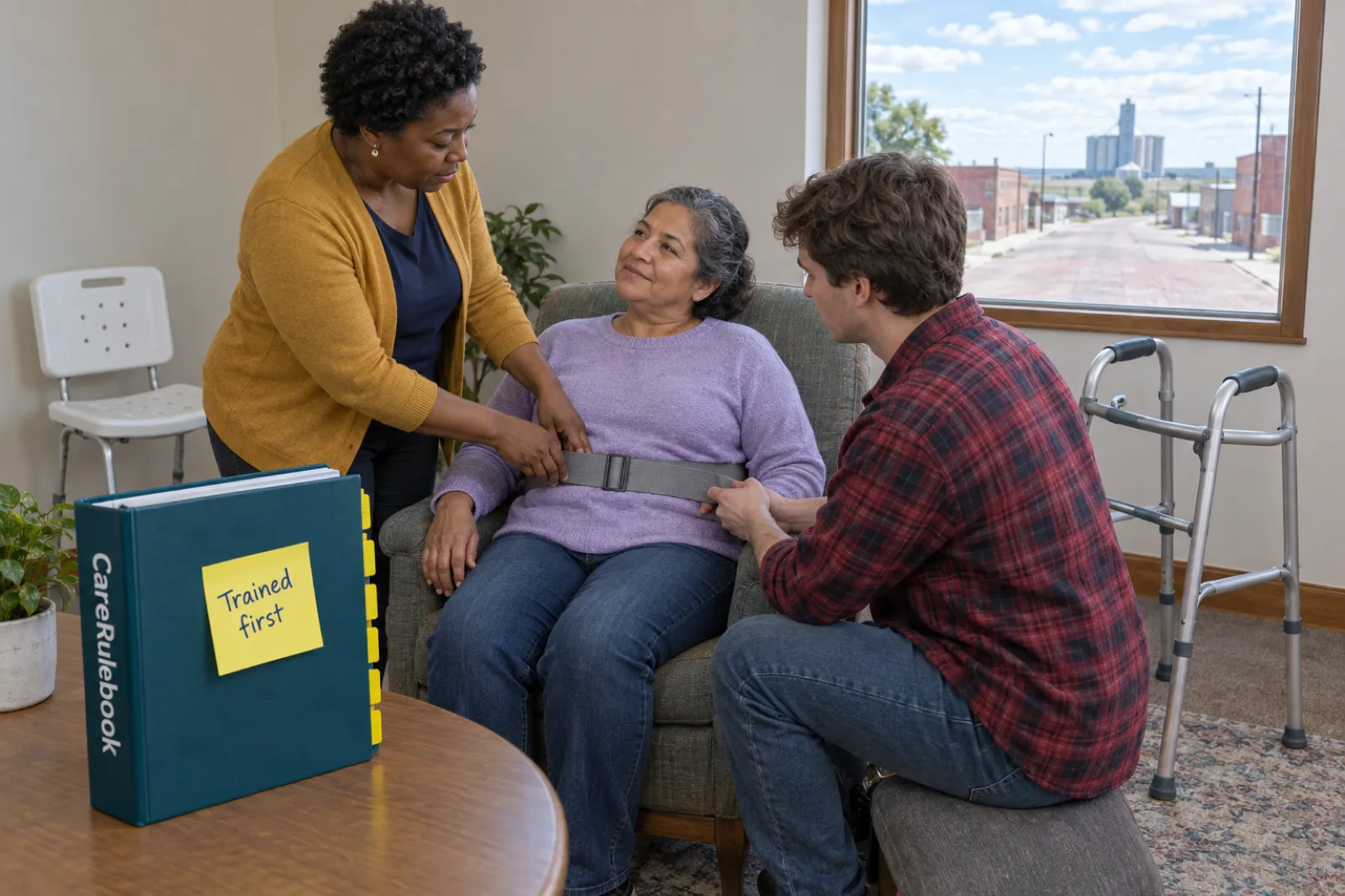
| (14) | Transfers | By written assignment, for a client with the balance and strength to stand, pivot and assist; helping a family member transfer the client; adaptive equipment, gait belts and lift devices with the training the rule sets. | Any transfer, with or without equipment, for a client who is unable to assist with it. |
| (15) | Respiratory care | Nothing. It is a skilled care service. | Respiratory care of any kind. |
| (16) | Masks and oxygen flow | Briefly remove and replace a cannula or mask to shave or wash the face; set oxygen flow by written instructions when changing tanks, after specific training and demonstrated competency. | Respiratory care, which (15) treats as skilled. |
Row 8 adds a limit by our reading where the rule allows one thing and is silent on the rest. KDHE’s view of row 3 is from its April 2026 answers to providers (Questions and Feedback, p. 33).
A worker may help with medication "only if the medications have been preselected by the client, a family member, a nurse, or a pharmacist and are stored in containers other than the prescription bottles", and each reminder container must be clearly marked with the day and time of the dose (K.A.R. 28-51-117(g)(1)(A)). The help is limited to four things:
CareRulebook’s manual puts these in Policy 4.8, with a medication reminder log that records any dose problem reported to the manager, and the insulin rule in Policy 4.9.
Paragraph (g)(14) is the longest of the 16, and the one agencies ask about most:
A Hoyer lift for a client who cannot bear weight? The rule allows lift transfers in one sentence and forbids any transfer for a client unable to assist in another. By our reading, a lift transfer is allowed only for a client who can still assist with it in some way; a client who cannot assist at all is outside supportive care for transfers. KDHE has not answered this in writing, and it is on our list of questions for KDHE.
What KDHE expects of lift training. In April 2026 KDHE said: "KDHE maintains that training is required to use a lift and must be conducted by an individual with knowledge of the device, beyond reading the user manual." It added that training on one lift does not carry over to another (KDHE Questions and Feedback, p. 34). KDHE said this while reviewing its draft, which would remove lift transfers from supportive care.
CareRulebook’s manual lets you choose whether your agency offers lift transfers at all (Policy 4.5); if it does, the lift goes on the written assignment and the worker is trained and checked on the client’s own lift (Policy 2.6). How competency is shown and re-checked every year: Kansas caregiver training.
"Any supportive care worker may assist a client with ambulation who can balance and bear weight if a qualified health professional determines that the client is independent with an assistive device." (K.A.R. 28-51-117(g)(3))
The catch. A supportive care agency may not use nursing of any kind (Attestation Form, p. 2), so it has no professional of its own to make the finding. KDHE itself said that because a qualified "health professional is considered a provider of skilled services, the inclusion of this requirement in a supportive care service agency is not appropriate", which is why its draft rewords the rule (p. 45). Until the rule changes, the current text still applies.
By our reading, the finding comes from the client’s own physician, physical therapist or other qualified health professional, in writing, and is kept in the client record before walking help goes on the assignment. The rules do not say what form the finding takes, or whether it is needed for a client who walks without any device. Both are open questions for KDHE.
Any supportive care worker may temporarily remove and replace a cannula or mask from a client’s face for the purposes of shaving or washing the client’s face.
K.A.R. 28-51-117(g)(16)Any supportive care worker may set a client’s oxygen flow according to written instructions when changing tanks, if the worker has been specifically trained and has demonstrated competency for setting it.
K.A.R. 28-51-117(g)(16)Respiratory care shall be considered a skilled care service and shall not be performed by a supportive care worker.
K.A.R. 28-51-117(g)(15)The rule does not say whose "written instructions" count. By our reading, the flow on the client’s prescription or the oxygen supplier’s written instructions, copied onto the worker’s written assignment. CareRulebook’s manual lets you choose whether workers change oxygen tanks at all (Policy 4.5).
"Any supportive care worker may assist a client with nail care, including soaking nails, pushing back cuticles without utensils, and filing nails." But "nail trimming for clients shall be performed only by a supportive care worker of a home health agency that indicated in the home health agency’s initial application or renewal application that it intends to provide home health services." (K.A.R. 28-51-117(g)(10)) A supportive-care-only agency has not applied to provide home health services, so by our reading its workers do not trim nails, including toenails. Clients who need trimming can be referred to a podiatrist or a skilled agency.
These tasks are outside supportive care. If a client needs one, the client needs a provider licensed for it, at least for that task:
| Not allowed under a supportive care license | Rule |
|---|---|
| Giving or setting up medication | K.A.R. 28-51-117(g)(1)(B); 104(c)(3)(H) |
| Prefilling insulin syringes (a misdemeanor for any unlicensed agency employee) | K.S.A. 65-5116(b)-(c) |
| Wound care, dressing changes and applying medication | K.A.R. 28-51-117(g)(2) |
| Bathing a client whose wounds need bandage changes | K.A.R. 28-51-117(g)(4) |
| Feeding a client at high risk of choking or aspiration, and any tube, syringe or IV feeding | K.A.R. 28-51-117(g)(7) |
| Mouth care for a client who is unconscious, has trouble swallowing or had recent mouth surgery | K.A.R. 28-51-117(g)(9) |
| Nail trimming | K.A.R. 28-51-117(g)(10) |
| Inserting or removing catheters, external catheter care, suppositories and enemas | K.A.R. 28-51-117(g)(13) |
| Respiratory care | K.A.R. 28-51-117(g)(15) |
| Exercise prescribed by a therapist, and prescription stockings or bandage wraps | K.A.R. 28-51-117(g)(5)-(6) |
What the Skilled Services license involves. KDHE says it "encompasses all home health services allowable by law in Kansas" (KDHE Skilled Services page). In return, for each patient the agency needs an order from the patient’s physician, nurse practitioner, clinical nurse specialist or physician assistant (K.A.R. 28-51-104(c)(1)(A)) and a registered nurse available or on call during all hours home health services are provided ((c)(1)(J)). Its home health aides must be Kansas-certified nurse aides who complete a 20-hour home health aide course (K.A.R. 28-51-113(a)). KDHE’s fees are higher too: Skilled Services or HCBS: $500 initial (under 100) or $750 (100 or more); renewal $350 or $600. (K.A.R. 28-51-101; KDHE fees).
The same license is needed for Medicaid HCBS waiver work (Letter of Introduction) and, KDHE warns, for many payers including Veterans Affairs (Option 2). Which license fits your plans: Kansas home health vs home care.
The 16 areas are all hands-on help. KDHE’s letter says the license also covers "chore and/or companionship services as well as Activities of Daily Living (ADLs)" (Letter of Introduction, Option 2), and the rules set no limits on housekeeping, errands or company.
Whether a business that offers only those, with no hands-on help, needs a license at all is not settled. KDHE told providers in April 2026 that such tasks "do not require hands-on care and many of these are available by businesses (cleaning agencies, grocery store delivery services, ride share companies, etc.) not required to be licensed as a home health agency." (KDHE Questions and Feedback, p. 36). Its 2024 letter says every agency needs a license. Our reading and the full picture: who needs a Kansas license.
Tick steps off as you go. Your progress is saved in this browser only.
Your written admission criteria must match the statutory definition of supportive care and K.A.R. 28-51-117. Screen for the conditions the rule sends to a skilled agency: wounds needing bandage changes, choking or aspiration risk, tube feeding.
The manager assesses the client and writes the plan of care from the client’s needs. No physician order is needed for supportive care.
For every task on the plan, find its area in K.A.R. 28-51-117(g) and check the limits. If a task is outside them, the client needs another provider for that task.
Help with walking needs a qualified health professional to have found the client independent with an assistive device. Record who made the finding and when.
Lift transfers and setting oxygen flow need specific training and demonstrated competency; gait belts and adaptive equipment need training too. Competency includes appropriate use of any equipment.
The manager writes the assignment from the plan of care: the procedures to use, when to report to the supervisor, and documenting each visit.
The manager reviews written assignments every three months or more often as the client’s status and needs change.
Who writes and reviews the assignments, and how often the manager visits: the Kansas administrator and manager.
KDHE has drafted a rewrite of K.A.R. 28-51. For supportive care tasks, the draft would mean: clients who need cues to use an assistive device would need a skilled agency; tub or shower help only if the client can balance and bear weight; no passive range of motion; no nail care; positioning limited to alignment; no ostomy bag changes; no lift-device transfers; no setting or adjusting oxygen flow. In April 2026 KDHE said over-the-counter compression stockings would stay allowed with training, the lift change was under further review and turning would be clarified. (KDHE Summary of Changes, 2025; Questions and Feedback, 2026, p. 37)
KDHE’s draft rewrite of K.A.R. 28-51 must still go through formal public comment; KDHE says it will tell agencies when the Notice of Public Hearing appears in the Kansas Register. None was found by October 2, 2026. (Summary of Changes, Introduction) We could not search the new official regulations site, rules.ks.gov, which asks for a captcha, so we also check KDHE’s pages and the Secretary of State’s list of adopted regulations waiting to take effect, which showed nothing from KDHE (Future Effective Regulations). Until a change is adopted, the 16 areas above are the rule.
CareRulebook
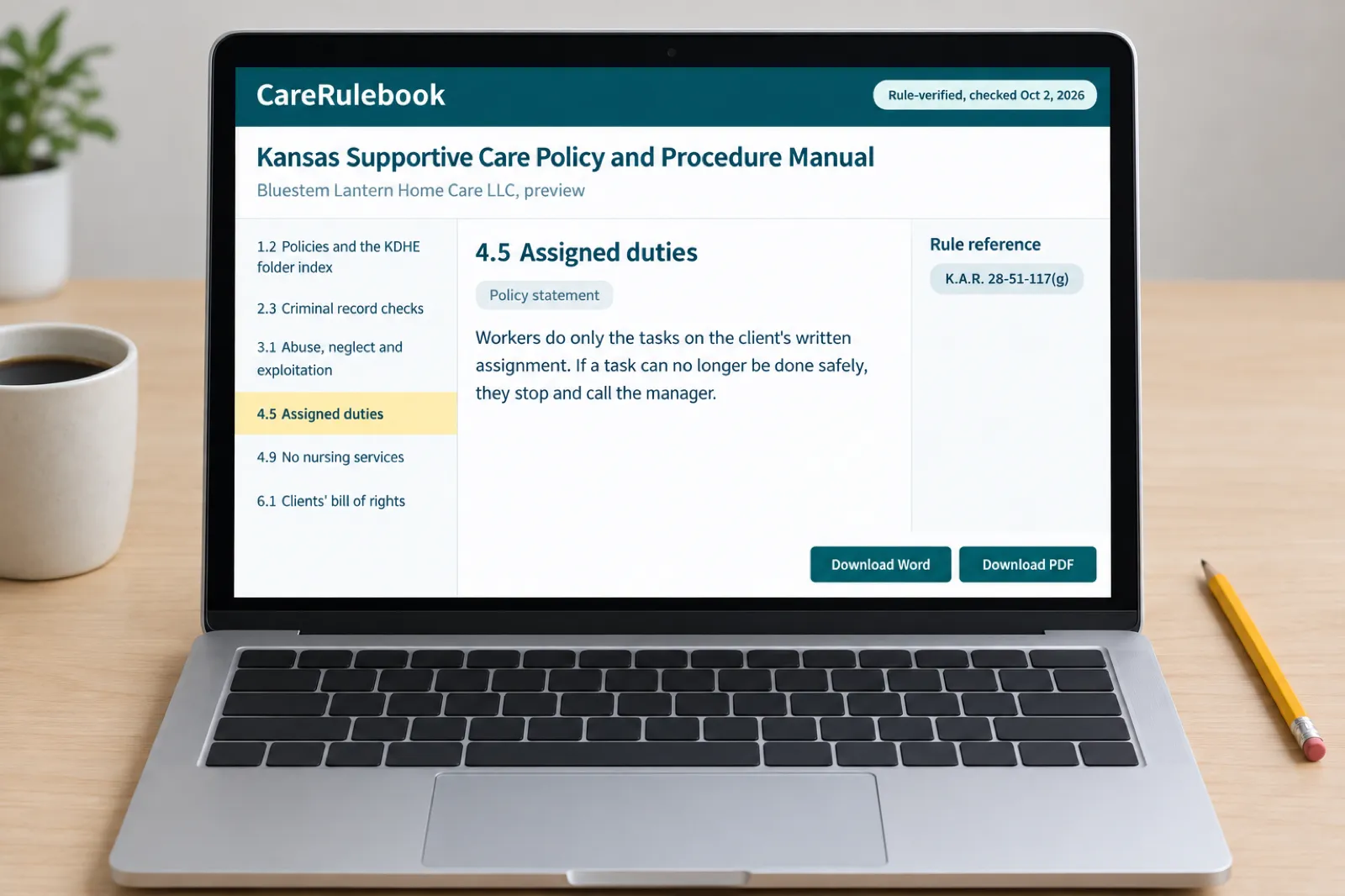
CareRulebook’s Kansas manual includes Policy 4.5, assigned duties: the 16 task areas; Policy 4.8, medications: reminders only, no set-up or administration; and Policy 4.9, nursing services (not provided) and no prefilling of insulin syringes.
$199CareRulebook founding price for the first 50 Kansas agencies, then $249. Not a KDHE fee.
No. Supportive care workers may not set up medications or take part in medication administration. They may help only with medicines that the client, family, a nurse or a pharmacist has already sorted into marked reminder containers: asking whether they were taken, prompting, handing over the container and opening it. They may not prefill insulin syringes.
"policies and procedures indicating that medications shall not be set up by supportive care workers"
It depends. Yes under the current rule, if the worker has training and demonstrated competency with the lift. The same rule says a worker shall not help with a transfer if the client is unable to assist with it, so our reading is that a lift transfer is allowed only for a client who can still assist. KDHE’s draft rewrite would remove lift transfers from supportive care, but in April 2026 KDHE said it was reviewing that change after provider feedback. Nothing has been formally proposed yet.
"Any supportive care worker with training and demonstrated competency may assist a client in a transfer involving a lift device."
It depends. Yes, for a client who can balance and bear weight, if a qualified health professional has found the client independent with an assistive device. KDHE says that means the client does not need help with the device itself, though workers may remind the client to use a walker or cane. A supportive care agency cannot use its own nurse for that finding, so by our reading it comes from the client’s own physician or therapist. KDHE has not said so in writing.
"Any supportive care worker may assist a client with ambulation who can balance and bear weight if a qualified health professional determines that the client is independent with an assistive device."
No. Not under a supportive-care-only license. Workers may soak nails, push back cuticles without utensils and file nails. Nail trimming is only for a supportive care worker of an agency whose application says it intends to provide home health services, which means the Skilled Services license.
"Nail trimming for clients shall be performed only by a supportive care worker of a home health agency that indicated in the home health agency’s initial application or renewal application that it intends to provide home health services."
Under a supportive care license, caregivers may help in 16 task areas within the limits of K.A.R. 28-51-117(g): medication reminders from preselected containers, skin care on unbroken skin, walking help for clients found independent with an assistive device, bathing, dressing, exercise as tolerated, feeding, hair care, mouth care, nail care without trimming, positioning, shaving with an electric or safety razor, toileting including emptying catheter and ostomy bags, transfers for clients who can assist, and changing oxygen tanks by written instructions after training. Respiratory care, wound care and medication administration are not allowed.
No. Supportive care workers and other employees of a supportive care agency shall not participate in medication administration, and the agency’s policies must say workers do not set up medications. Workers may only ask whether medications were taken, prompt, hand over a reminder container marked with the day and time, and open it if the client physically cannot. The client, a family member, a nurse or a pharmacist fills the container. This applies to prescription and nonprescription medications.
Yes under the current rule, if the worker has training and demonstrated competency with the lift. The same paragraph says a worker shall not assist with a transfer if the client is unable to assist, so by our reading a lift transfer is only for a client who can still assist. KDHE said in April 2026 that lift training must be given by someone with knowledge of the device, beyond reading the user manual, and that training on one lift does not carry over to another. KDHE’s draft rewrite would remove lift transfers, and KDHE said it is reviewing that change.
A qualified health professional: a physician, registered nurse, physical, occupational, respiratory or speech therapist, dietitian or social worker. The rule lets a worker help a client walk who can balance and bear weight if such a professional has found the client independent with an assistive device. A supportive care agency may not use nursing of any kind, so by our reading the finding comes from the client’s own physician or therapist and is kept in the client record. KDHE has not said this in writing, and in April 2026 it said the requirement is not appropriate for a supportive care agency, which is why its draft rewords it.
Yes, if the worker has been specifically trained and has demonstrated competency in setting the client’s oxygen flow. The worker sets the flow according to written instructions when changing tanks. Any worker may briefly remove and replace a cannula or mask to shave or wash the client’s face. Respiratory care is a skilled service and is not allowed. KDHE’s draft rewrite would stop supportive care workers setting or adjusting oxygen flow; it is not in force.
Yes. The toileting paragraph lets any supportive care worker empty urinary collection devices, including catheter bags, and empty ostomy bags. Inserting or removing catheters and caring for external catheters is a skilled care service, and workers may not insert suppositories or give an enema.
Not medication. The skin care paragraph says a supportive care worker shall not apply medication, and allows skin care only on unbroken skin for a client with no active chronic skin problems. KDHE said in April 2026 that a worker holding skin folds while the client applies a medication is acceptable. The rules do not list which creams count as medication; by our reading anything prescribed or sold as a treatment does. Ask KDHE about a specific product.
Every applicant signs KDHE’s attestation, which says that providing services outside the scope of the license obtained is grounds for terminating or losing the license. The agency also offers only the services on its application. If a client needs a task outside the 16 areas, refer them to an agency with the Skilled Services license for that care.
KDHE’s draft rewrite of K.A.R. 28-51 would narrow the supportive care task list, including lift transfers, nail care and oxygen flow. No official text has been published yet. Leave your email and we will tell you when a Kansas change affects what your caregivers may do.
No spam. Only emails about Kansas home care rule changes. How we use your email.
Kansas
How to start a home care agency in Kansas
The KDHE supportive care license, why no nursing is allowed, and the 13 folders KDHE reviews.
Kansas
Kansas administrator and manager
Qualifications, residence, and the manager who writes assignments and visits every three months.
Kansas
The Kansas license application
KDHE’s form, the attestation on scope, the fee and the upload folders.
Kansas
Kansas caregiver training
Competency in 10 areas before working alone, yearly re-checks, and training for lifts and oxygen.
Kansas
Kansas home health vs home care
The Supportive Care and Skilled Services licenses side by side.
Kansas
Kansas home health agency surveys
KDHE’s 36-month survey cycle, records within 30 minutes and plans of correction.
Manual
Build your Kansas policy manual
Including Policy 4.5 on the 16 assigned duties.
Tennessee
Medication in a Tennessee PSSA
Medication assistance with RN-supervised training, and administration by certified staff.
Maryland
Medication in a Maryland RSA
Reminders, help with self-administration after signed consent, and administration by licensed or certified staff.
Nevada
What Nevada attendants may and may not do
Toenails, exercise, appointments and medication help allowed since 2026, with conditions.
Colorado
Colorado manager and supervisor
An HCA manager with set qualifications, an 8-hour course and quarterly supervision.