Skip to content
CareRulebook
MenuClose

What do you run?

Home care in the US19 states with a manual, 6 with a free guide
ColoradoManual
ConnecticutPack
DelawareManual
GeorgiaManual
IllinoisManual
IndianaManual
KansasManual
MaineManual
MarylandManual
MinnesotaManual
NevadaManual
North CarolinaManual
OklahomaManual
OregonManual
South CarolinaManual
TennesseeManual
TexasManual
VirginiaManual
WashingtonManual
CaliforniaGuideFloridaGuideNew JerseyGuideNew YorkGuideOhioGuidePennsylvaniaGuideAll US home care states →
Care homes in the USCalifornia, Michigan, Minnesota; more states coming
Home care in the UKEngland, Scotland, Wales
Free toolsChecklists, calculators and templates

Illinois · Caregivers · 77 Ill. Adm. Code 245.71 and 973.140

Illinois caregiver training: 10 hours to start, 10 hours every year

An Illinois home services agency gives each worker at least 10 hours of training: 5 before the first assignment, with a competency evaluation the worker must pass first, and 5 within 30 days. Then at least 10 hours every year. Tasks such as bathing, transfers and oxygen switching each need training and a competency check before the worker does them, and staff who work with clients with dementia add dementia training.

  • Rule-verified October 1, 2026
  • Quoted from 77 Ill. Adm. Code 245.71 and 973.140
  • And IDPH’s deficiency guidance (archived copy)
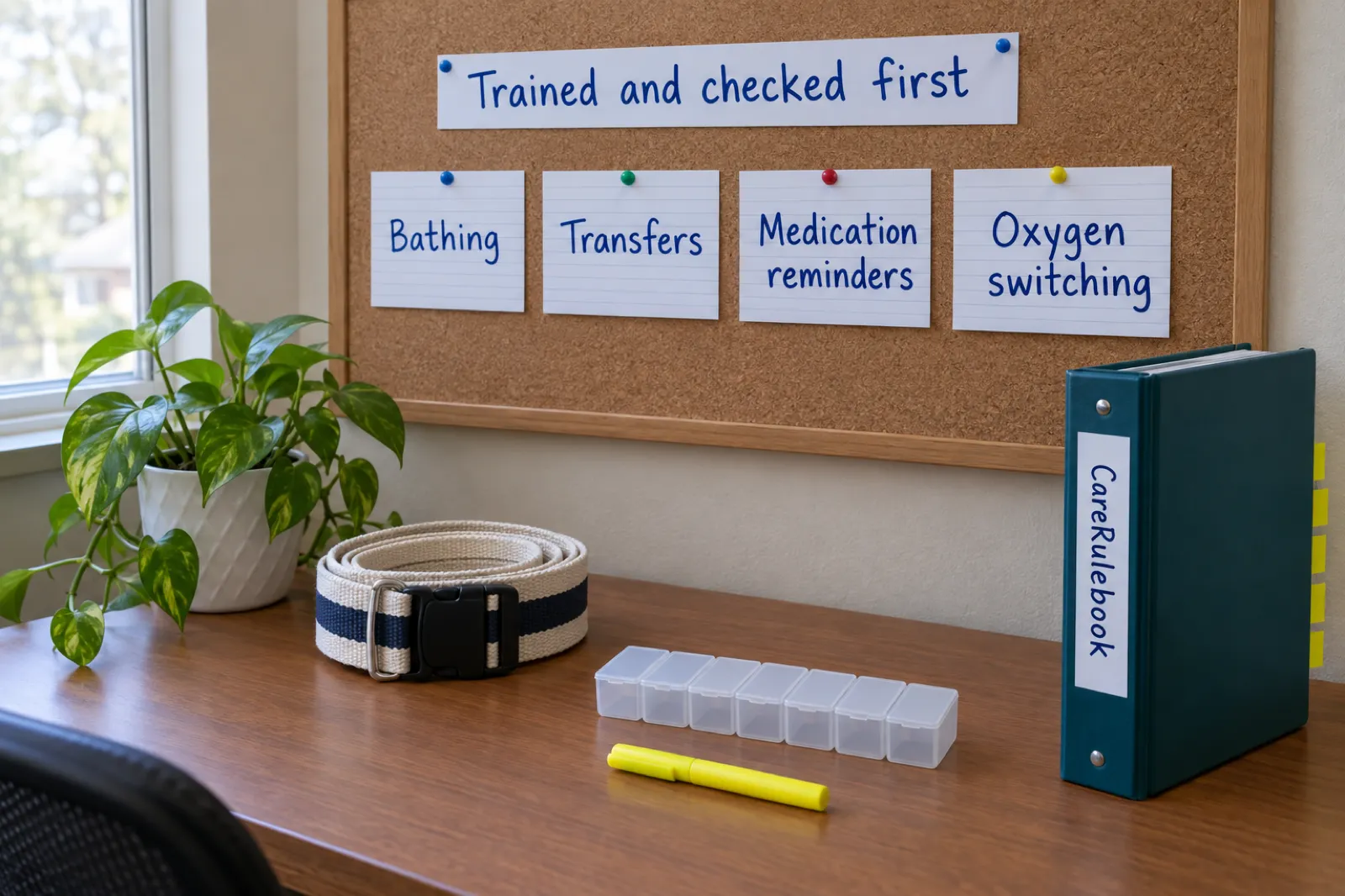
A cork board with index cards reading Bathing, Transfers, Medication reminders and Oxygen switching under a strip reading Trained and checked first, above a desk with a gait belt, a pill organizer and a CareRulebook binder

Quick answer

"Each home services agency shall provide or arrange for a minimum of ten hours of training for each home services worker. Five hours of training shall be provided prior to the home services worker's first assignment, and the remaining five hours shall be provided within the worker's first 30 days after the start of employment." (77 Ill. Adm. Code 245.71(c))

Training alone does not clear a worker to start: "The home services agency shall not give a worker an assignment until the worker has first passed a competency evaluation given by the agency of the topics included in the first five hours of training." They are tested again after the second five hours (245.71(c)). After that, "All home services workers shall complete a minimum of ten hours of training during each year of employment", by calendar year or hire anniversary (245.71(f)).

These are the rules for home services agencies. Home health and home nursing agencies, placement agencies and the Community Care Program each have their own training rules, compared below.

5 hours

of training, and a passed competency evaluation, before the first assignment

245.71(c)

30 days

to finish the remaining 5 hours, then a second evaluation

245.71(c)

10 hours

of training in every year of employment

245.71(f)

14 subjects

every worker’s initial training addresses

245.71(e)

Which training rule applies to your workers

Illinois licenses home health, home nursing and home services agencies (245.10(c)), and home services placement agencies too, and Part 245 sets different training for each (which license fits). The Department on Aging’s Community Care Program adds its own rule for the agencies it contracts with. This page covers the first row.

Training rules for each kind of Illinois in-home worker
WorkerTrainingKind of rule
Worker at a home services agencyAt least 10 hours of initial training (5 before the first assignment, 5 within 30 days), competency evaluations, then at least 10 hours a year. This page. 77 Ill. Adm. Code 245.71(c), (f)License rule
Worker placed by a home services placement agencyProof of at least 8 hours of training before the first placement, and at least 8 hours of in-service training a year after that. 245.71(b); 245.214(e)License rule
Aide at a home health or home nursing agencyOn the Health Care Worker Registry, a training program approved under 77 Ill. Adm. Code 395, or a listed equivalent. A different license; shown only for contrast. 245.70(a)Contrast
Homecare aide for the Department on Aging’s Community Care Program24 hours of pre-service training, with a competency evaluation, before serving a participant without a supervisor or trainer present, then at least 12 hours a year, 2 of them on dementia. 89 Ill. Adm. Code 240.1535(b)(3)Program rule

Program rule means a Department on Aging rule for its Community Care Program, not an IDPH licensing rule. It applies to homecare aides serving Community Care Program participants. A new CCP homecare aide may be exempt from the pre-service training, though not from the dementia training, for example with a valid RN, LPN, MD or physician assistant license or a CNA certification and work in the field in the past two years (240.1535(b)(3)(B)). IDPH says Medicaid in-home clients come through the Community Care Program or DHS, which approve providers separately (IDPH FAQ, archived copy).

From hire to the first year

The training duties in the order a new worker meets them. The background checks run alongside: Illinois caregiver background checks. Tick steps off as you go; progress is saved in this browser only.

  1. Orient every new staff member

    At hire

    Orientation of new staff, and familiarizing every employee, and every contracted provider, with the Licensing Act and IDPH’s rules, with copies available to them. Your personnel policies cover orientation to the agency and continuing education (245.30(c)(1)(C)).

    245.40(a)(2)-(3), (10)
  2. Part 1: at least 5 hours of training

    Before the first assignment

    Five hours of the 10 come before the worker’s first assignment. The subjects.

    245.71(c)
  3. Competency evaluation on the Part 1 topics

    Before the first assignment

    No assignment until the worker passes a competency evaluation given by your agency on the first five hours. It must show the worker can provide the services their first assignment needs.

    245.71(c)
  4. Task training and a check before listed tasks

    Before the task

    Bathing, transfers, positioning, oxygen switching and the other tasks in the table below each need training and a competency evaluation before the worker does them. The task table.

    245.40(c)(4)
  5. Part 2: the remaining 5 hours, then a second evaluation

    Within 30 days

    The rest of the 10 hours within the worker’s first 30 days after the start of employment. The worker is then tested again.

    245.71(c)
  6. Dementia training, for staff who work with clients with dementia

    Within 60 days

    At least 6 hours within the first 60 days for staff with direct access to clients with Alzheimer’s disease or a related dementia. Dementia training.

    973.140(c)
  7. Observed at work at least once a year

    Every year

    A supervisor visits a client’s home to observe and assess each worker while they give care, checking among other things that they show competency with assigned tasks.

    245.40(c)(6)(B)
  8. At least 10 hours every year

    Every year

    By calendar year or hire anniversary, whichever your agency picks. The initial 10 hours count for the first year. The annual subjects.

    245.71(f)

The 14 subjects of initial training

"Training for the home services worker shall address each of the following subjects below, in addition to the training requirements included in Section 245.40(c)(4)(A) through (P)" (245.71(e)):

  1. The employee’s job responsibilities and limitations
  2. Communication skills relating to persons who are hard of hearing, have dementia, or have other special needs
  3. Observing, reporting and documenting client status and the care or service provided, including changes in functional ability and mental status demonstrated by the client
  4. Performing personal care tasks for clients, including: bathing; skin care; hair care; nail care; mouth care; shaving; dressing; feeding; assistance with ambulation; exercise and transfers; positioning; toileting; and medication reminding
  5. Assisting in the use of specific adaptive equipment, such as a mechanical lifting device, if the worker will be working with clients who use the device
  6. Basic hygiene and basic infection prevention and control practices
  7. Maintaining a clean, safe and healthy environment
  8. Basic personal and environmental safety precautions
  9. Recognizing emergencies and initiating emergency procedures, including basic first aid and implementation of a client’s emergency preparedness plan
  10. Confidentiality of client’s personal, financial and health information
  11. Understanding dementia
  12. Problem solving skills to care for patients with dementia who exhibit challenging behavior
  13. Behaviors that would constitute abuse or neglect and the legal prohibitions against these behaviors, as well as knowledge and understanding of abuse and neglect prevention and reporting requirements
  14. Any other task that the agency may choose to have the worker perform

In the rule’s words. 77 Ill. Adm. Code 245.71(e)(1)-(14)

  • How the 10 hours split. The rule says only that the training includes these subjects and that 5 hours come before the first assignment. Because the first competency evaluation must show the worker can provide the services their first assignment needs (245.71(c)), by our reading the first 5 hours should cover what every worker needs from the first visit.
  • IDPH’s list. IDPH’s Guidance for Common Deficiency Findings restates the 10 hours and the documentation, and lists the Part 973 dementia topics alongside these 14 as required initial topics (IDPH guidance, archived copy). Part 973 itself applies to staff with direct access to clients with dementia; see dementia training.
  • Companion-only agencies. The 14 subjects are listed for every home services worker, including personal care tasks. Whether an agency whose workers give no hands-on care may leave some out is not stated (our reading: teach them all, so workers know the limits of their role).

CareRulebook’s manual splits the subjects into a Part 1 taught before the first assignment (job limits, observing and reporting, the personal care tasks the first assignment needs, infection control, safety, emergencies and first aid, confidentiality, and abuse and neglect) and a Part 2 within 30 days, in Policy 4.1. That split is the manual’s, not IDPH’s.

Competency evaluations

  • Before the first assignment. "The home services agency shall not give a worker an assignment until the worker has first passed a competency evaluation given by the agency of the topics included in the first five hours of training." "The competency evaluation shall ensure that the home services worker is competent to provide the services required for the worker's first assignment." (245.71(c))
  • After the second five hours. "The worker shall be similarly tested following the remaining five hours of training." (245.71(c))
  • CNAs and workers with recent training. You may accept proof of training at or through another licensed home services agency in the previous 365 days, including a CNA approved on the Health Care Worker Registry, in place of the training. "The agency shall give the home services worker, with proof of prior training within the prior year, and the CNA a competency evaluation prior to the worker's first assignment." (245.71(c))
  • Every year, at work. The supervisor observes and assesses each worker giving care at a client’s home at least once a year, including whether they demonstrate competency with assigned tasks (245.40(c)(6)(B)). CareRulebook’s Policy 5.5 (Supervisory visits: clients and workers) covers these visits; what IDPH’s own surveyors check is on the Illinois survey page.

Part 245 does not say how competency is evaluated, sets no pass mark and has no state test (our reading). CareRulebook’s manual, in Policy 4.2 (Competency evaluations and task skills checklists), checks knowledge by spoken or written questions and skills by watching the worker perform the whole task; a written test alone never passes a skill. Client-specific skills, such as each client’s bath or transfer equipment, are shown on that client’s equipment in their home before the worker does the task alone. That method is the manual’s.

Tasks that need training and a check first

On top of the 14 subjects, Part 245 lists home services tasks one by one, with limits, and for many of them the worker must be trained and the agency must have checked their competency before the worker does the task (245.40(c)(4)). Some also need a health care professional’s order or a client who can give feedback; the full conditions are on Illinois policies and procedures.

Home services tasks that need training and a competency evaluation first, under 77 Ill. Adm. Code 245.40(c)(4)
TaskBefore the worker does itAgain
Simple bandages as first aidTraining in first aid for a lay person, and a competency evaluation of the worker’s first aid methods. 245.40(c)(4)(A)Not stated
Ambulation with walkers, canes or wheelchairsTraining in the methods for assisting clients with adaptive equipment for ambulation, and a competency evaluation. While a client is still being trained to use the equipment, a home health or home nursing agency supervises. 245.40(c)(4)(B)Not stated
BathingTraining in the methods for each client’s bath, including watching for signs of potential harm or discomfort, and a competency evaluation. 245.40(c)(4)(C)Every year, for all types of bathing
Prescription compression devicesTraining in applying the device, including watching for signs of potential harm or discomfort, and a competency evaluation. 245.40(c)(4)(D)Not stated
Pre-measured thickening productsTraining in the indications, precautions and methods, and a competency evaluation. 245.40(c)(4)(F)Not stated
Prescription shampooTraining in applying it, including watching for open skin lesions and documenting and reporting them, and a competency evaluation. 245.40(c)(4)(G)Every year
Nail filing for clients with circulatory problems or loss of sensationTraining in nail care, including watching for and reporting signs of injury, and a competency evaluation. Nail trimming is not allowed. 245.40(c)(4)(I)Not stated
PositioningTraining in the cues that repositioning is needed and the procedures for it, and a competency evaluation. 245.40(c)(4)(J)Not stated
Transfers, including gait belts and mechanical or electrical liftsTraining in transfer techniques and each client’s adaptive equipment, safety equipment and transfer devices, and a competency evaluation. 245.40(c)(4)(M)Not stated
Switching oxygen from stationary to portableTraining in switching each client’s system and the risks of improper flow rates, and a competency evaluation. The agency keeps a trained staff member who can train and evaluate workers on it. 245.40(c)(4)(O)Not stated

"Not stated" means Part 245 sets no repeat check for that task; the annual subjects still include most of these activities (below). Medication help stops at reminding: "A home services worker may assist a client with medication reminding only when medications have been pre-selected by the client, a family member, a nurse, or a pharmacist and are stored in containers other than the prescription bottles, such as medication minders." (245.40(c)(4)(N)) Workers must not set up medications (245.40(c)(5)), so Part 245 has no medication administration training for home services workers; medication reminding is part of initial subject 4.

CareRulebook’s manual turns each task into a checklist in Policy 4.2, from first aid for every worker to oxygen switching, and the builder asks which tasks your agency offers so only those checklists are printed. Policy 5.2 (Home services tasks: what workers may and may not do) sets out the limits, and Policy 5.3 covers medication reminding.

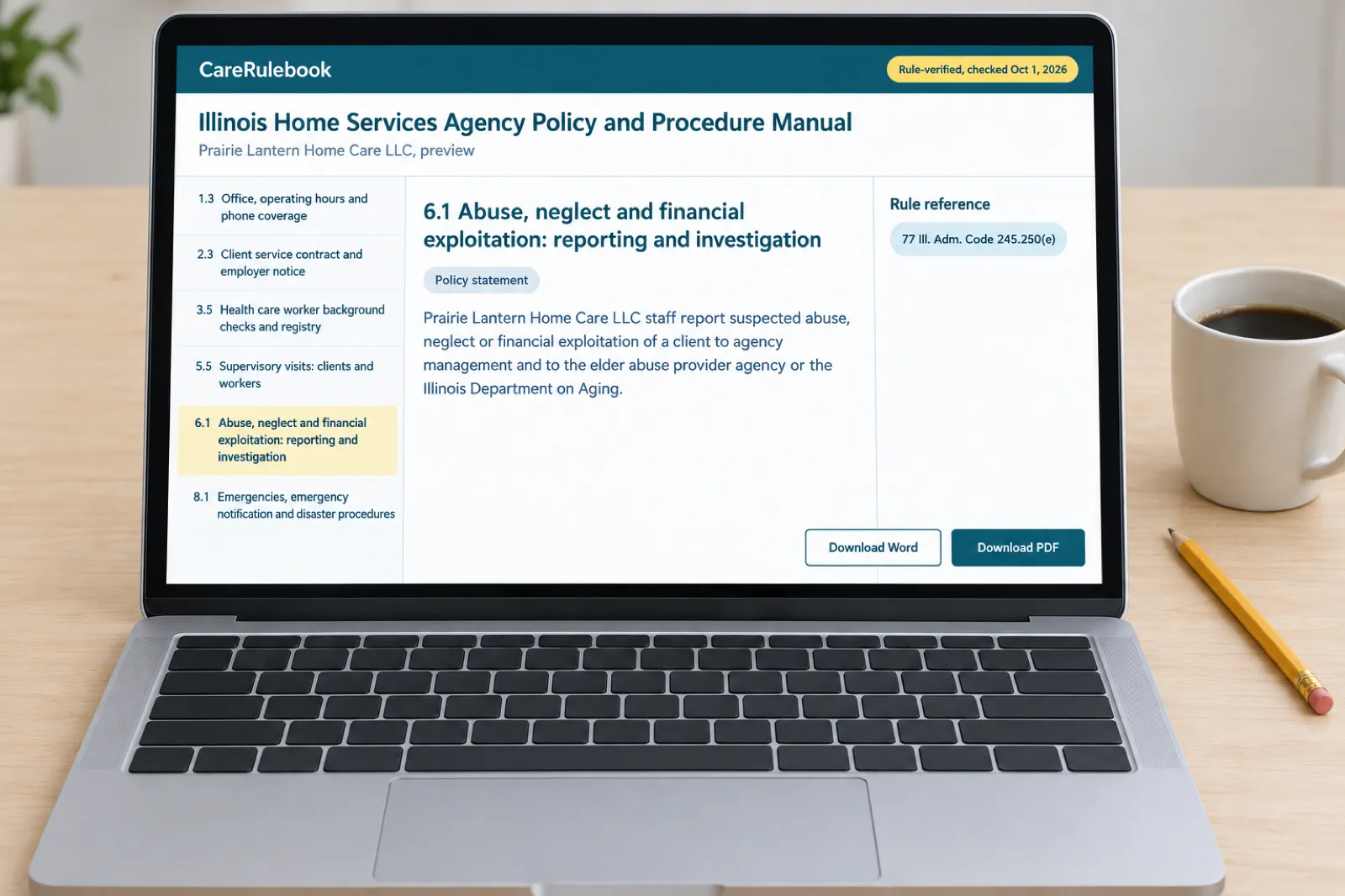
The CareRulebook Illinois manual preview on a laptop, showing the table of contents, policy 6.1 on reporting abuse, neglect and financial exploitation and its 77 Ill. Adm. Code 245.250(e) citation

CareRulebook

Training and competency, written for your agency

CareRulebook’s Illinois manual includes Policy 4.1 (Orientation, initial and annual training) with a training record form, Policy 4.2 (Competency evaluations and task skills checklists) with two initial evaluation forms and a checklist for each task you offer, and Policy 5.4 on dementia services.

  • 37 policies, 113 requirements mapped
  • Policy 4.1 is the employee training procedure IDPH asks first-time applicants to send
  • Editable Word and print-ready PDF, with the rule quoted under each policy
Preview your manual

$199CareRulebook founding price for the first 50 Illinois agencies, then $249. Not an IDPH fee.

10 hours every year

"All home services workers shall complete a minimum of ten hours of training during each year of employment", "based on either a calendar year or an anniversary date basis, whichever is selected by the agency" (245.71(f)). "The initial ten hours of training required in subsection (c) shall satisfy the annual training requirement for the home services worker's first year of employment."

The annual training includes (245.71(f)(1)-(5)):

  1. Promoting client dignity, independence, self-determination, privacy, choice and rights.
  2. Disaster procedures.
  3. Hygiene and infection control.
  4. Abuse and neglect prevention and reporting requirements.
  5. Activities of daily living related to simple bandages, ambulation, bathing, compression stockings, feeding, prescription shampoo, nail care, client positioning, transfers and, for workers assigned to clients who need oxygen delivery support, oxygen delivery systems.
  • Self-study counts, with a demonstration. "The annual training can include self-study courses with demonstration of learned concepts that are applicable to the employee's responsibilities." (245.71(f))
  • A common survey finding. IDPH’s deficiency guidance covers annual education under the heading “Common Survey Deficiencies” (IDPH guidance, archived copy), and says: "After the first 365 days of employment, each employee will be required to minimally cover the required annual topics, but still meet the 10 total hours of training." (IDPH guidance) Its list of annual topics adds the Part 973 dementia topics; by our reading those apply to staff with direct access to clients with dementia (below).
  • In-service education. The agency manager provides orientation of new staff, regularly scheduled in-service education programs and opportunities for continuing education (245.40(a)(10)).

Part 245 does not say what happens to a worker who falls short. The rule ties the hours to keeping the worker available for placement; CareRulebook’s manual gives a worker who has not completed the annual 10 hours no new assignments until the missing hours are done and recorded, and the builder asks whether you count the year by calendar year or hire anniversary.

Dementia training

"A home health, home nursing and home services agency that provides any and all Alzheimer's disease or related dementias services shall comply with the Alzheimer's Disease and Related Dementias Services Act and this Part." (245.211) Part 973’s training duties fall on staff with direct access to clients with Alzheimer’s disease or a related dementia, so they apply whenever you serve such clients:

  • 6 hours in the first 60 days. "Staff with direct access to clients with Alzheimer's disease or a related dementia hired after June 2, 2019 shall complete a minimum of 6 hours of initial training in the first 60 days of employment" (973.140(c)), on a curriculum covering at least: understanding dementia (for example hoarding, paranoia, hallucinations and Sundown syndrome); communicating effectively; helping with activities of daily living; problem solving with challenging behavior; fundamentals of dementia care; safe environments (for example wandering); and managing activities (973.140(e)).
  • Who has direct access. Part 973’s definition includes "assisting with feeding, dressing, movement, bathing, toileting or other personal needs, with the exception of infrequent or unusual occasions", as well as nursing care, therapy care or social services (973.100).
  • Earlier training. A staff member who had at least 6 hours of comparable dementia training in the 365 days before being hired does not repeat the initial 6 hours (973.140(d)(1)).
  • 3 hours every year. "staff with direct access to clients with dementia shall receive 3 hours of advanced training on caring for individuals with Alzheimer's disease and related dementias each year", covering at least dignity, independence, individuality, privacy and choice; rights and self-determination; care of elderly persons with physical, cognitive, behavioral and social disabilities; and communicating with individuals with dementia (973.140(f)). The initial 6 dementia hours count as the 3 annual hours for the first year of employment.
  • The Alzheimer’s services supervisor. An agency providing dementia services designates an Alzheimer's services supervisor, who completes 8 hours of dementia training a year and holds a recognized dementia certification or two years' dementia experience (one in management) plus ability-centered care training. (973.130(b); 973.140(b))
  • What surveyors ask for. IDPH’s survey checklist lists the "Alzheimer’s and dementia training curriculum or description of each class" (IDPH checklist, archived copy).

Neither Part 245 nor Part 973 says whether the dementia hours may count toward the 10 hours a year. CareRulebook’s manual counts them in addition, which means doing more, not less (our reading). If your agency will not serve clients with dementia, every worker still covers understanding dementia and challenging behavior in initial training (245.71(e)(11)-(12)), and the manual keeps a written description of those classes for surveyors. Policy 5.4 covers the supervisor, care plans and the disclosure form.

Who can train

"The agency shall have home services supervisors or trainers that provide initial training and supervision on an ongoing basis to home service workers" (245.71(g)). Each supervisor or trainer must either:

  • within the last five years, have at least two years’ experience in a home health, home services, facility-based healthcare or home nursing setting performing the tasks Part 245 allows home services workers to do, including help with activities of daily living (245.71(g)(1)); or
  • be in a current supervisor or trainer position with a home services agency and have had training in the past year on those tasks. "The training provided to the home services supervisors or trainers shall, at a minimum, demonstrate the general standards of care for each topic in Section 245.40(c)(4)(A) through (P), and be provided by or developed by someone qualified (e.g., licensed or certified) in their respective field." (245.71(g)(2))

Supervisors and trainers stay available to workers for updated and continuing education on those tasks (245.71(h)). If your workers switch clients’ oxygen, you keep on staff someone trained to train and evaluate them on it (245.40(c)(4)(O)). No nurse is required. More on the people who run the agency: the Illinois agency manager and supervisors.

Training records and what IDPH sees

"All training shall be documented with the date of the training; the length of time spent on each training topic; instructors and their qualifications; short description of content; and staff member's signature or electronic certificate with a date and time stamp indicating completion." "Upon request, the agency shall provide the home services worker with a copy of their training certificate in a hard copy or electronic format." (245.71(i))

  • With the application. IDPH’s form asks first-time applicants for their "Employee training procedures (245.71)" (form 445104, archived copy). What else goes in the envelope: the Illinois license application.
  • At the survey. IDPH’s survey checklist asks for "Employee training files" and the dementia training curriculum (IDPH checklist, archived copy).
  • A common finding. Initial and annual education are both under IDPH’s common survey deficiencies, and its guidance repeats the documentation it expects: "All training must be documented with the following: date of training, length of time spent on each topic, instructors and their qualifications, short description of content, and participating worker signature." (IDPH guidance, archived copy)

CareRulebook’s training record form in Policy 4.1 has a line for each item the rule lists, plus the training type (Part 1, Part 2, task, annual, in-service or dementia) and the method, and every competency form goes in the personnel file.

What Illinois does not require of home services workers

  • A certification or a state course. Part 245 sets hours, subjects and competency evaluations that your agency provides or arranges, not a state-approved course or a certificate for home services workers (our reading). Home health aides are different (245.70).
  • CPR. Part 245 does not mention CPR for home services workers (our reading of the saved text). It does require basic first aid in initial training, and first aid training for a lay person, with a competency check, before simple bandages (245.40(c)(4)(A)).
  • A nurse. Trainers qualify by experience or recent training, not by license (245.71(g)).
  • A TB test. Part 245 does not name one for home services workers; the initial health evaluation is "as specified by the governing body" (245.30(c)(1)(B)).

Our suggestion: a recognized lay first aid course covers the first aid training, and CareRulebook’s manual recommends one, labelled as Recommended practice rather than a rule.

Myths about Illinois caregiver training

Can an Illinois home services agency skip training and the competency check for a CNA?

It depends. You can skip the training, not the check. Part 245 lets an agency accept a CNA approved on the Health Care Worker Registry, or proof of training at another licensed home services agency in the past 365 days, in place of the 10 hours of initial training. The agency still gives that worker a competency evaluation before their first assignment, and before bathing, transfers or another listed task the worker still needs that task's training and the agency's competency check.

"The agency shall give the home services worker, with proof of prior training within the prior year, and the CNA a competency evaluation prior to the worker's first assignment."

Can Illinois home care workers do their annual training as self-study?

It depends. In part. Part 245 says the 10 hours of annual training can include self-study courses, with a demonstration of the concepts learned that apply to the worker's job, and an electronic certificate with a date and time stamp can document completion. It says nothing either way about self-study for the initial 10 hours, and the competency evaluation before the first assignment is given by your agency.

"The annual training can include self-study courses with demonstration of learned concepts that are applicable to the employee's responsibilities."

Can an Illinois home services worker give or set up medications?

No. A home services worker may only remind: ask whether medications were taken, prompt, hand over or open a medication minder that the client, family, a nurse or a pharmacist has already filled and marked by day and time. Setting up medications is prohibited, and irregularities must be reported to the supervisor at once.

"A home services worker may assist a client with medication reminding only when medications have been pre-selected by the client, a family member, a nurse, or a pharmacist and are stored in containers other than the prescription bottles, such as medication minders."

Can Illinois home services workers do nursing tasks an RN delegates to them?

No. A home services license allows no skilled services, even when the worker is licensed or certified. The 2025 proposal on RN delegation was about home health and home nursing agencies, and IDPH removed it before adopting the January 2026 amendment, saying delegation will be addressed in a future rulemaking.

"As a non-medical service license, this license does not allow for any skilled services to be provided regardless of whether an individual is licensed or certified in their respective discipline."

Frequently asked questions

How many hours of training do Illinois home care workers need?

At least 10 hours of initial training for each home services worker: 5 before the first assignment and the other 5 within the first 30 days of employment. Then at least 10 hours during each year of employment, by calendar year or hire anniversary. Staff with direct access to clients with Alzheimer’s disease or a related dementia also complete 6 hours of dementia training in their first 60 days and 3 hours a year after that.

Can a caregiver start work before finishing the 10 hours?

Yes, after the first 5 hours and a passed competency evaluation on those topics. The remaining 5 hours come within the first 30 days, followed by a second evaluation. Before the worker does a task such as bathing, transfers or oxygen switching, they also need that task’s training and competency check.

Does a CNA need the 10 hours of training?

Not necessarily. An agency may accept a CNA approved on the Health Care Worker Registry, or proof of training at another licensed home services agency in the past 365 days, in place of the initial training. It must still give that worker a competency evaluation before the first assignment.

What topics must the annual training cover?

Promoting client dignity, independence, self-determination, privacy, choice and rights; disaster procedures; hygiene and infection control; abuse and neglect prevention and reporting requirements; and activities of daily living such as simple bandages, ambulation, bathing, compression stockings, feeding, prescription shampoo, nail care, positioning, transfers and, for workers with clients on oxygen, oxygen delivery systems. IDPH’s deficiency guidance says the topics must be covered while still meeting the 10 total hours.

Who can train Illinois home services workers?

A home services supervisor or trainer who has, within the last five years, at least two years’ experience performing home services tasks in a home health, home services, facility-based healthcare or home nursing setting; or who is in a current supervisor or trainer role with a home services agency and has had training on those tasks in the past year. The rule does not require a nurse.

Do Illinois caregivers need CPR certification?

Part 245 does not mention CPR for home services workers (our reading of the saved rule text). It does require recognizing emergencies and basic first aid in initial training, and training in first aid for a lay person, with a competency check, before a worker applies simple bandages.

What training records does IDPH check?

Each session’s date, the time spent on each topic, the instructors and their qualifications, a short description of the content, and the worker’s signature or a time-stamped electronic certificate. IDPH’s survey checklist asks for employee training files and, for dementia, the training curriculum or a description of each class.

Get Illinois rule-change alerts

When IDPH adopted its January 2026 amendment to Part 245, it said RN delegation will be addressed in a future rulemaking. Leave your email and we will tell you when an Illinois rule change affects your training or your policies.

No spam. Only emails about Illinois home care rule changes. How we use your email.

Keep reading

Sources

  1. 77 Ill. Adm. Code 245, Home Health, Home Services, and Home Nursing Agency Code (current through 50 Ill. Reg. 2147, effective January 30, 2026) · Illinois Department of Public Health (Illinois Administrative Code, Joint Committee on Administrative Rules, ilga.gov) · retrieved October 1, 2026
  2. 77 Ill. Adm. Code 973, Alzheimer's Disease and Related Dementias Services Code · Illinois Department of Public Health (Illinois Administrative Code, ilga.gov) · retrieved October 1, 2026
  3. 89 Ill. Adm. Code 240, Community Care Program · Illinois Department on Aging (Illinois Administrative Code, ilga.gov) · retrieved October 1, 2026
  4. Home Services Agencies Frequently Asked Questions (archived copy of March 21, 2026) · Illinois Department of Public Health · retrieved October 1, 2026
  5. Home Services Application, Form 445104 (Initial, Renewal and Change of Ownership; archived copy of March 21, 2026) · Illinois Department of Public Health · retrieved October 1, 2026
  6. Surveillance Nurse Visit Checklist (Home Services) (archived copy of August 30, 2025) · Illinois Department of Public Health · retrieved October 1, 2026
  7. Guidance for Common Deficiency Findings (archived copy of March 21, 2026) · Illinois Department of Public Health · retrieved October 1, 2026

Free sample, no email needed

Read a full policy before you buy

Policy 2.4, Complaint resolution, as it prints in the Illinois manual, filled in for a fictional agency. The rule text it rests on is quoted word for word under Rule basis.

PDF · 7 pages · 98 KB · Rule-verified October 1, 2026

Collecting answers for an agency or a client? The intake questionnaire lists all 38 questions the builder asks, what each decision changes in the manual, and a completed example: Word · PDF.How consultants use CareRulebook.

Download the sample (PDF)
Or email it to me

We send the link once. Nothing else unless you tick the box. Privacy notice.

Build your Illinois manualfrom $199