OHCQ asks
The business, registered and in good standing
Attachment 4 is an official letter of good standing from the State Department of Assessments and Taxation (SDAT) Business Express. Search for the business, click its name, then Order Documents.
Where are you starting?
Maryland · Residential Service Agency license · OHCQ’s application
You apply for a Maryland Residential Service Agency (RSA) license on OHCQ’s typed application, uploaded online with five attachments, your written policies among them. Here is the form section by section, the Section B policy index and waiver requests, the online RSA Certification, how OHCQ reviews and decides, what OHCQ described after approval in 2020, the fee question, and how changes, branches, a sale and closing work.

Quick answer
A Maryland Residential Service Agency (RSA) license comes from the Maryland Department of Health’s Office of Health Care Quality (OHCQ) (OHCQ, RSA page). You download OHCQ’s application, type it, and upload it with five attachments through OHCQ’s online form: "The application must be typed. Handwritten applications are not accepted and will be returned to the applicant." (application, Instructions) "There is no fee to apply for a license." (application)
Your written policies are one of the attachments, and for each of the 23 policy items in COMAR 10.07.05.08B, Section B asks you to "list the name of the attached document that includes the specific policy or procedure, as well as the page numbers", or to ask for a waiver and enter N/A (application, Section B). Someone with authority over pay also completes OHCQ’s online RSA Certification (application, Instructions).
OHCQ then reviews the application, may inspect on site before deciding, and approves it, with or without conditions, or denies it with appeal rights (COMAR 10.07.05.04D-E). You may not operate or advertise as an RSA until you are licensed (Health-General §19-4A-07).
"Rule requires" means COMAR 10.07.05 or the Health-General Article. "OHCQ asks" or "OHCQ says" rests on OHCQ’s application (rev. 06.26.2026) or its RSA page. OHCQ’s 2018 application instructions and 2020 initial license slides are no longer on its site; we cite Internet Archive copies and label them as archived guidance. Where we add our own reading or advice, we say so.
23
Policy items indexed in Section B by document and page, or N/A with a waiver
Application, Section BOHCQ’s RSA page says to complete the application and submit it with all supporting documents through its online form (OHCQ, RSA page). Here is the whole path. Tick steps off as you go; your progress is saved in this browser only.
An RSA employs or contracts with people to give at least one home health care service for pay to an unrelated sick or disabled person at home. A business that gives only household or family support needs no license, and an agency that gives skilled nursing, aide services and one other service, centrally administered, is a home health agency. The form tells applicants unsure of the difference to contact the RSA Team. Home health vs home care in Maryland.
A business plan, an organizational chart, your policies and procedures as specified in COMAR 10.07.05.08B, an official SDAT letter of good standing, and workers’ compensation proof. The five attachments.
Someone with authority over the agency’s pay or employment practices reads the Attorney General’s guidance on employees and independent contractors, then completes OHCQ’s online RSA Certification form. Every applicant does this, even one that will not hire personal care aides. The RSA Certification.
Download OHCQ’s PDF and fill it in on a computer: general information, services and business hours, the Section B policy index, any branches, ownership, eight disclosures and the signed attestation. Handwritten applications are returned. The form, section by section.
For each of the 23 items in COMAR 10.07.05.08B, give the name of the attached document and the page numbers, or ask for a waiver and enter N/A. Section B, item by item.
Submit the application and all attachments through the “Submit a License Application” link on OHCQ’s RSA page. OHCQ’s application says there is no fee to apply.
The Department reviews whether you can give appropriate care at home and meet COMAR 10.07.05, may inspect on site before deciding, and then approves (with or without conditions) or denies with a letter giving the reasons and appeal rights. OHCQ holds an incomplete application for 180 days. The review and decision.
In 2020, OHCQ described a 90-day provisional license for agencies with nurses and aides: three clients within 45 days, then an unannounced on-site survey before the regular license. That guidance is archived and we could not confirm it for 2026. The 2020 process.
Each card says whether the item comes from the rules, from OHCQ’s form, or from our own suggestion.
OHCQ asks
Attachment 4 is an official letter of good standing from the State Department of Assessments and Taxation (SDAT) Business Express. Search for the business, click its name, then Order Documents.
Rule requires; OHCQ asks
The declaration page of your policy. Corporations and LLCs not required to carry cover send a Certificate of Compliance; sole proprietors and partnerships with no employees send a Letter of Exemption. The rule asks for proof of workers’ compensation for all employees.
Rule requires
For clients who need help with activities of daily living, the agency must have a registered nurse overseeing the care plan, delegation, supervision and training. The form has no field for the nurse, but your policies say who does that work. The rules do not say whether the nurse must be an employee.
Rule requires; our suggestion
Policies and procedures as specified in COMAR 10.07.05.08B go in with the application, and Section B asks where each of the 23 items is. Our suggestion: have your governing authority adopt them before you apply, because the signer certifies the applicant complies with COMAR 10.07.05.
COMAR 10.07.05.04A(2)(i); application, Section GThe 23 policy items →
Rule requires; OHCQ asked in 2018
The business plan holds a 1-year operating budget, a marketing plan naming the populations you will serve, and a detailed, specific description of your services. OHCQ’s 2018 instructions asked for an organizational chart showing every position with the name of the person in it; the current form just says "Organizational chart."
OHCQ asks; rule requires
The form asks for a street address and county, an after-hours emergency phone number and your normal business hours for each day. The agency must be open for inspection during those hours. We found no rule on whether the office can be in your home; ask OHCQ before applying from a home address.
Rule requires; OHCQ asks
An owner, member, partner or officer signs the attestation and swears to being at least 21. The rule asks for verification that the applicant or corporate representative is 21 or older.
Rule requires; OHCQ asks
Owner details at the thresholds the form sets, and honest answers to eight disclosure questions, with details of any yes in Section F. Sections D and E.
The application lists five required attachments (application, Required Attachments 1-5). The rule behind them also asks for the applicant’s age, owners, history and disclosures, which the form itself collects (COMAR 10.07.05.04A).
| Attachment | What it holds | Source |
|---|---|---|
| 1. Business plan | Shows the financial or administrative ability to operate in compliance with COMAR 10.07.05, with at least a 1-year operating budget, a marketing plan that identifies the populations to be served, and a detailed and specific description of agency services. | COMAR 10.07.05.04A(2)(h) |
| 2. Organizational chart | The current form gives no format. OHCQ’s 2018 instructions asked for every position with the name of the person in it (archived guidance). | Application, attachment 2; instructions (2018) |
| 3. Policies and procedures | As specified in COMAR 10.07.05.08B: administration, personnel, patient care, informed consent, and environment and safety, indexed item by item in Section B. | COMAR 10.07.05.04A(2)(i); application, attachment 3 |
| 4. SDAT letter of good standing | An official letter ordered from SDAT Business Express. | Application, attachment 4 |
| 5. Workers’ compensation | The declaration page, or a Certificate of Compliance (corporations and LLCs not required to carry cover) or a Letter of Exemption (sole proprietors and partnerships with no employees). Questions go to the Maryland Workers’ Compensation Commission, 410-864-5293. | Application, attachment 5 |
Sample files. OHCQ’s 2018 instructions and 2020 slides also asked for a sample personnel file and sample client files for adults and, if served, children. The 2026 application does not list them. (instructions, 2018, archived) Our suggestion: have a blank personnel file and a blank client file ready in case the RSA Team asks.
OHCQ’s RSA License Application (rev. 06.26.2026) runs to 12 pages in seven sections, A to G (RSA License Application).
| Section | What it asks for | Source |
|---|---|---|
| A. General information | Legal name, any trade name, FEIN, street address and county, main phone, an after-hours emergency phone number, fax, business email and website, and a primary and a secondary contact with title, email and phone. You also tick the type of application: Initial, Change of Ownership or New Service. | Application, Section A |
| B. Home health care services | Normal business hours for each day; the services you will provide (ten boxes); whether you will provide invasive medical equipment or supplies and, if so, whether a 24-hour maintenance or service agreement is in place; accreditation; whether you serve adults, children or both; then the waiver field and the index of the 23 policy items. | Application, Section B |
| C. Branch offices | Only for an applicant with branch offices: each branch’s name, phone, address and county, and whether it keeps the main office’s hours. The form has spaces for three. A branch has the same owner tax ID, upper management and policies as the main office and serves the same area. | Application, Section C; COMAR 10.07.05.02B(3) |
| D. Ownership | A sole proprietor gives their own details. An LLC lists each member, owner or investor with 25% or more, a partnership each partner, owner or investor with 25% or more, and a corporation its director, president, secretary and treasurer and every owner and investor with 2% or more, each with address and phone. An LLC or corporation formed outside Maryland says where it was formed, and LLCs and corporations name a resident agent. | Application, Section D |
| E. Disclosures | Yes or no: owning or operating a facility or agency OHCQ licenses or surveys now; having owned or operated one before; a license revoked, suspended or denied by MDH; a conviction involving a program under Title 18, 19 or 20 of the Social Security Act; a felony conviction of anyone with an ownership interest; licenses or certificates under the Health Occupations or Health-General Articles; criminal charges, convictions or findings of violations; and any prior denial, suspension or revocation of a license to provide care. Each yes is explained in Section F. | Application, Section E |
| F. Additional information | Section F is free space to explain any answer, with extra sheets if needed. | Application, Section F |
| G. Attestation | The signer affirms under the penalties of perjury that the application is true. Falsification may bring criminal prosecution, civil money penalties or revocation, and knowingly failing to disclose fully and accurately may lead to denial. The signer also certifies that the applicant complies with all applicable federal, State and local laws and with COMAR 10.07.05. An owner, member, partner or officer signs, with name, title and date, and swears to being at least 21. | Application, Section G |
Section B
Which boxes. The application lists ten service boxes (nursing, home health aide, physical, occupational and speech therapy, audiology, respiratory therapy, medical social services, dietary and nutritional services, durable medical equipment). There is no separate personal care or companion box; a personal care agency applies for the home health aide service. (application, Section B) By our reading, a personal care agency ticks home health aide, and usually nursing for the registered nurse’s work. On OHCQ’s list of October 2, 2026, every RSA that lists home health aide services also lists nursing (OHCQ RSA list, our count). You may provide only the services you are approved for (COMAR 10.07.05.05A(1)).
Invasive equipment. The form asks whether the agency will provide invasive medical equipment or supplies (such as IV lines, enteral or parenteral lines, catheters, ventilators, feeding tubes, tracheostomy and ostomies) and, if so, whether a 24-hour maintenance or service agreement is in place for equipment failure. (application, Section B) The rule behind that question: "An agency that provides invasive equipment or supplies, such as intravenous therapy, shall arrange for 24-hour-a-day equipment maintenance service in case of equipment failure." (COMAR 10.07.05.08B(3)) By our reading, an agency that supplies no such equipment answers No.
Accreditation and population. The form asks whether the agency is accredited (by which organization and since when) and whether it will serve adults, children under 18, or both. (application, Section B) We found no rule requiring an RSA to be accredited; the form only asks. Serving children brings its own duties, such as reporting suspected child abuse (DHS; Family Law §§5-704, 5-705) and keeping a minor’s record until age 21 or 5 years after it is made, whichever is later (COMAR 10.07.05.15A).
The index. The 23 items follow the rule’s order in five groups: administration (8), personnel (3), patient care (5), informed consent (2) and environment and safety (5) (COMAR 10.07.05.08B(1)). For each, "list the name of the attached document that includes the specific policy or procedure, as well as the page numbers." (application, Section B) The form does not say how to lay out the attachment; our suggestion is one PDF with page numbers that match the index. The 23 items, one by one.
Waivers. The waiver field above the index begins "To request that OHCQ waive the requirement for a specific policy or procedure that is specified in COMAR 10.07.05.08B": you list the item and explain why it is inappropriate or unnecessary for your agency (application, Section B). The rule lets the Department waive an item on that written explanation (COMAR 10.07.05.08B(2)), and "If you have requested a waiver above for a certain policy or procedure, enter N/A." (application, Section B) OHCQ does not publish which waivers it grants. By our reading, the likeliest for an agency giving personal care only is enteral and parenteral nutrition procedures. The preparation and storage item is a poor candidate, because it also covers other supplies and equipment the agency keeps (.08B(1)(e)(i)). Ask the RSA Team before relying on a waiver.
Other written procedures. The index covers only .08B. Other rules add screening policies (.10A), an internal complaint process (.09A), a 24/7 on-call procedure given to clients in writing (.12G), communication of changes in condition (.14C), record completion and safeguards (.15D) and client rights policies (.16A). (COMAR 10.07.05.09A-.16A) The form has no field for these; by our reading they belong in the same manual.
Format. OHCQ suggested each policy show the date of approval by the governing body, the title, a policy statement, its purpose and procedures (who, when, where); and each job description the approval date, title, reporting line, qualifications, credentials and responsibilities. (instructions, 2018, archived) In 2020 OHCQ also said it may deny an application "After 3 unacceptable reviews of revised policies and procedures", or after 12 months with no response (OHCQ slides (2020), slide 52). That is archived guidance, but it is a reason to send complete, adopted policies the first time.
The statute makes it a condition of the license: "As a condition of obtaining an initial license from the Department to operate as a residential service agency and every 3 years thereafter", the agency certifies to the Department on its form, signed by someone with authority over its pay or employment practices (Health-General §19-4A-11(b)).
Archived guidance · not confirmed for 2026
What the rule says. The rule allows a provisional license where the agency intends to provide services limited to skilled nursing and home health aide services, or where it is not yet fully compliant but has an acceptable plan of correction. A provisional license cannot be extended. (COMAR 10.07.05.04J)
What OHCQ described in 2020, for agencies offering skilled nursing with aides:
Where that leaves you. The slides are no longer on OHCQ’s site, and the current application and RSA page do not describe this process. The 2026 application describes only approval, denial, closure and withdrawal (application, Determination). By our reading, plan for both: policies that stand up at application, and client and personnel records that would stand up at a first survey. Ask the RSA Team what to expect after approval. OHCQ’s surveys and inspections.
These are the Maryland Department of Health’s fees as its rule and application state them, and a DPSCS fee for criminal history checks. They are paid to the state and are not CareRulebook prices.
| State fee | Amount | Source |
|---|---|---|
| MDH (OHCQ) fee to apply, per OHCQ’s current application | $0 | Application, Instructions |
| License fee the rule still prints, for a 3-year license (by our reading no longer charged) | $1,000 | COMAR 10.07.05.04A(2)(k) |
| Each extra prelicensure visit to an agency that is not compliant (rule text; unconfirmed) | $250 | COMAR 10.07.05.04K |
| Amended license after a name or address change (rule text; unconfirmed) | $50 | COMAR 10.07.05.05A(3) |
| DPSCS State criminal history check per worker, in person, once you hire | $38 | DPSCS fee schedule |
Why we read it as no fee. Chapter 661 of 2018 struck the statutory requirement that the Secretary charge RSA licensing fees (struck text shown in brackets in the chapter law). (Chapter 661 of 2018) The bill’s fiscal note says it "effectively authorizes OHCQ to issue nonexpiring licenses to specified provider types and eliminate all related licensing fees" (fiscal and policy note, SB 108 (2018)). COMAR 10.07.05 was last amended effective March 13, 2017, before that law (COMAR 10.07.05, history), and OHCQ’s current application says there is no fee.
New services. For a new service, the rule asks for an application fee "as required by" Health-General §19-4A-03(c). By our reading that points to the fee language Chapter 661 of 2018 struck; the current §19-4A-03(c) sets no fee, and OHCQ’s application, used for new services too, says there is no fee. (COMAR 10.07.05.05A(2)(c))
Renewal. COMAR 10.07.05.04H-I still describe a 3-year license with a renewal application. After Chapter 661 of 2018 the statute no longer provides for renewal, and OHCQ’s RSA page has no renewal process. By our reading licenses no longer expire, but the 3-yearly worker classification certification still applies. Confirm with OHCQ. (COMAR 10.07.05.04H; Chapter 661 of 2018) The full cost and timeline →
CareRulebook
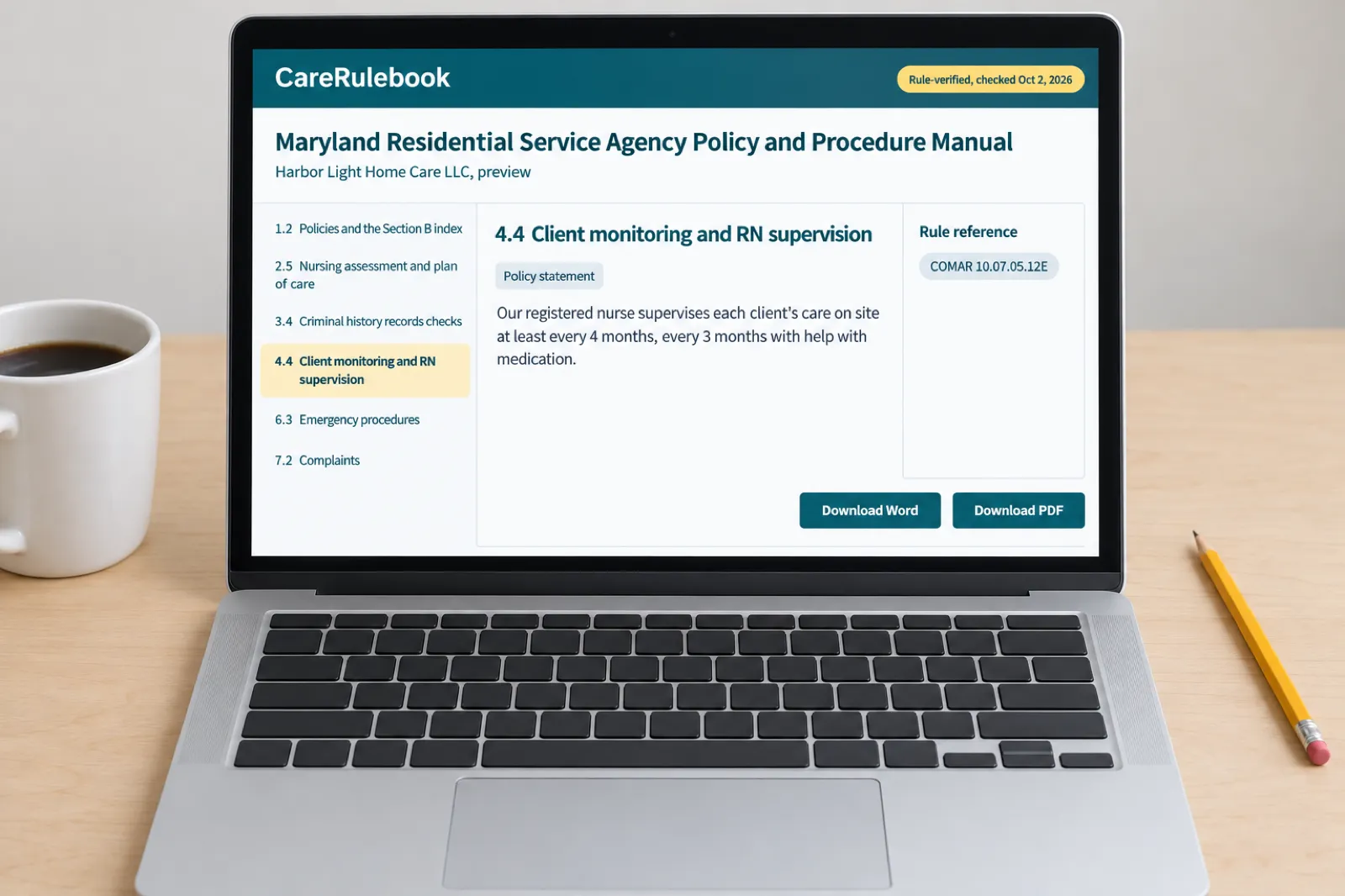
CareRulebook’s Maryland manual covers the 23 policy items COMAR 10.07.05.08B lists, in the order OHCQ’s application lists them, and the rest of OHCQ’s RSA rules, written from your answers with the rule quoted under each policy. With it comes a Section B index: for each item, the file name of your PDF manual and the pages of the policy that meets it, or N/A with your waiver request text. Your agency’s own registered nurse reads and adopts the clinical policies, and your governing authority adopts the manual before you apply.
$199CareRulebook founding price for the first 50 Maryland agencies, then $249. Not an OHCQ fee.
"A licensee shall immediately notify the Department of any change in the information the licensee had submitted with the most recent application." (COMAR 10.07.05.05C) OHCQ’s RSA page has online forms for licensed RSAs: Address Change, a Change Form for changes in demographics but not the name, Name Change, and New Branch Office. (OHCQ, RSA page) Failing to follow the change, sale and closure rules can bring a fine of up to $500 per violation (.05E).
Rule requires; OHCQ’s form
Tell the Department immediately. A name or address change with no change of ownership needs an amended license; the rule text says $50, and we could not confirm it is still charged. OHCQ’s RSA page has an Address Change form.
COMAR 10.07.05.05A(3), CRule requires; OHCQ’s form
You may not change the name you do business under without the Department’s approval. OHCQ has a separate Name Change form, and a name change needs an amended license.
COMAR 10.07.05.05A(1)(b); OHCQ, RSA pageRule requires
Any change to the information in your most recent application is reported immediately. OHCQ’s Change Form covers changes in demographics but not the name. The rule does not list which details count; by our reading contacts, business hours and owners do.
COMAR 10.07.05.05C; OHCQ, RSA pageRule requires; OHCQ asks
You may not provide services you are not approved for. Before offering a new home health care service, send the full application, marked New Service, with all attachments and the policies for that service. OHCQ says an RSA giving personal care through nursing and aide services may not add therapy under that license.
COMAR 10.07.05.05A(1)-(2); applicationRule requires; OHCQ’s form
A branch with the same owner tax ID, upper management, policies and service area may operate under your license; OHCQ has a New Branch Office form. A separate agency needs its own license.
COMAR 10.07.05.02B(3), .03CRule requires
A transfer of stock that changes who controls the agency, or of more than 25% of the stock, is a sale, which needs a new license. Selling or buying.
COMAR 10.07.05.05A(4)(b)Our suggestion: plan the sale with the RSA Team before it closes, so the buyer’s license is in place before the buyer provides services.
No. Policies and procedures as specified in COMAR 10.07.05.08B are attachment 3 of OHCQ’s application, and the rule lists copies of them among what an applicant submits. OHCQ says an application is not complete until it has every required material, and it closes an incomplete application 180 days after first receiving it. Index each of the 23 items in Section B, or enter N/A where you ask for a waiver.
"Copies of the agency’s policies and procedures as specified in Regulation .08B of this chapter;"
It depends. Not always. The Department may waive a .08B policy if the agency explains in writing why it is inappropriate or unnecessary for its operation, for example enteral and parenteral nutrition at an agency that offers none. The application has a waiver field above the Section B index, and you enter N/A for that item in the index. OHCQ does not publish which waivers it grants, so ask the RSA Team if you are unsure.
"The Department may waive the requirement of a policy and procedure that is required in §B of this regulation upon the agency’s written explanation as to why the policy and procedure is inappropriate or unnecessary to the agency’s specific operation."
No. OHCQ’s application says every RSA applicant completes it, including those that do not plan to hire personal care aides. Someone with authority over the agency’s pay or employment practices reads the Attorney General’s guidance and completes OHCQ’s online form. The statute makes it a condition of the initial license and of every 3 years after.
"This is a requirement for all RSA applicants, including those that do not plan to hire personal care aides."
No. OHCQ’s application says there is no fee to apply, and Chapter 661 of 2018 struck the statutory fee requirement. COMAR 10.07.05.04 still prints $1,000; the chapter was last amended in March 2017, before that law.
"There is no fee to apply for a license."
No. You must be licensed before you operate, and you may not hold yourself out as an RSA until licensed. Advertising before licensing can bring penalties. OHCQ’s past process for nursing-and-aide agencies used a provisional license under which the first clients were admitted before the on-site survey; ask OHCQ how that works today.
"A person may not operate, attempt to operate, or hold one’s self out as operating a residential service agency, unless the person is licensed under this subtitle."
No. Adding a home health care service, such as nursing, takes the full RSA License Application, marked New Service, with all the attachments and the policies for the new service, before you offer it. OHCQ’s change forms cover address, demographic, name and branch changes. OHCQ also says an RSA that gives personal care through nursing and aide services may not add therapy under that license.
"If a licensed RSA is adding a new home health care service, the RSA must complete this initial licensure application and submit it along with all required attachments to OHCQ, including any policies or procedures related to the new service."
No. The license is valid only in the name of the licensee and cannot be sold, assigned or transferred. A sale or transfer that changes who controls or operates the agency, including a transfer of more than 25% of the stock, makes it a new agency. The buyer applies for a new license at least 45 days before the transfer, the seller gives OHCQ and clients 45 days’ written notice, and the seller stays responsible until the buyer’s license is issued.
"The license is valid in the name of the licensee to whom it is issued, and is not subject to sale, assignment, or other transfer."
It depends. Probably not, but confirm with OHCQ. COMAR still describes a 3-year license and renewal, but Chapter 661 of 2018 struck the renewal language from the statute, and OHCQ’s RSA page has no renewal process. Every 3 years you must still renew the worker classification certification under Health-General §19-4A-11.
"and the renewal of licenses for a 3–year term"
Download OHCQ’s RSA License Application and type it. Attach a business plan, an organizational chart, your policies and procedures as specified in COMAR 10.07.05.08B (indexed item by item in Section B), an SDAT letter of good standing and workers’ compensation proof. Have someone with authority over pay or employment practices complete OHCQ’s online RSA Certification. Then upload everything through the “Submit a License Application” link on OHCQ’s RSA page. OHCQ reviews the application, may inspect before deciding, and approves or denies it.
OHCQ’s application says there is no fee to apply. COMAR 10.07.05.04 still prints a nonrefundable $1,000 fee for a 3-year license, but Chapter 661 of 2018 struck the statutory fee requirement, so by our reading the application is right. Other costs are not OHCQ’s: workers’ compensation, your registered nurse and, once you hire, State criminal history checks at $38 per worker fingerprinted in person at the Central Repository (a DPSCS fee).
OHCQ does not publish a current processing time for RSAs. Its 2018 instructions said 2 to 3 months after all documents arrive, and it says a nursing referral service agency license generally takes 1 to 2 months. We cannot give you a date; ask the RSA Team (410-402-8040).
No rule asks for clients before you apply, and you may not operate or hold yourself out as an RSA until licensed. You do need the people your policies name, above all the registered nurse who oversees care for clients who need help with activities of daily living. In 2020 OHCQ described admitting three clients under a 90-day provisional license after approval, with the signed RN contract sent in with a Statement of Readiness; we could not confirm that for 2026.
OHCQ’s current application says to submit it and the attachments through the “Submit a License Application” link on its website, and it must be typed: handwritten applications are returned. It mentions no paper route.
OHCQ holds an application for 180 days from when it first receives it. After that the application is treated as inactive and closed, and you can reapply with a new application. You may also withdraw at any time by telling OHCQ in writing.
You get a detailed letter with the reasons and your appeal rights. To appeal, file a request for a hearing with the Office of Administrative Hearings, with a copy to OHCQ, within 30 days of receiving notice of the decision, and include a copy of it.
Not if it is a branch: a satellite office with the same owner tax ID, upper management and policies, serving the same area, may operate under your license, and you list it in Section C or use OHCQ’s New Branch Office form. Otherwise each agency needs its own license.
COMAR 10.07.05 still prints the fee and renewal rules Chapter 661 of 2018 took out of the statute, and OHCQ has signalled a 2026 update to the RSA training rules. Leave your email and we will tell you when a Maryland change affects your application or your policies.
No spam. Only emails about Maryland home care rule changes. How we use your email.
Maryland
How to start a home care agency in Maryland
Who needs the RSA license, the registered nurse, the 23 policy items, background checks and fees.
Maryland
The registered nurse in a Maryland RSA
Lining up your RN before you apply: the role, employee or contractor, and cover.
Tool
Maryland license checklist
Every step to an RSA license, tailored to your agency, emailed to you.
Maryland
Maryland RSA inspections
Prelicensure visits, the first survey OHCQ described in 2020, and plans of correction within 10 calendar days.
Manual
Maryland policy manual
The 23 policy items in the application’s order, with a Section B index. Preview free.
Maryland
Maryland RSA policies and procedures
The 23 items you index in Section B, waivers, and the written duties outside the list.
Maryland
Maryland RSA license cost and timeline
No OHCQ fee to apply, the $1,000 COMAR still prints, other state fees and each step to the license.
Maryland
Maryland caregiver background checks
The CJIS or private check and the reference, before work starts.
Maryland
Maryland home health vs home care
RSA, nursing referral agency or home health agency with a Certificate of Need.
Tennessee
The Tennessee license application
How Tennessee does it: four forms to a TDMHSAS regional office and an electronic desk audit.
Virginia
The Virginia license application
The VDH OLC Portal, 60 days before opening.
North Carolina
The North Carolina license application
DHSR also reviews your policies before it licenses you.
Illinois
The Illinois license application
A paper form, your policies in the envelope and a 240-day provisional license.
Washington
The Washington license application
DOH’s orientation class, a paper packet and a manual DOH approves.
Colorado
The Colorado license application
A letter of intent, COHFI and a survey with zero deficiencies.
Indiana
The Indiana license application
The IDOH Gateway, nine policies with seven forms, and IDOH’s $250 fee each year.
Georgia
The Georgia license application
GAHLES and a three-month provisional license.