Skip to content
CareRulebook
MenuClose

Where are you starting?

United StatesTexas, North Carolina, Georgia, Virginia, Indiana, Ohio, New York, Illinois, Washington, Colorado, Tennessee, Maryland, Kansas, South Carolina, Nevada
TexasManual
North CarolinaManual
GeorgiaManual
VirginiaManual
IndianaManual
OhioGuideNew YorkGuide
IllinoisManual
WashingtonManual
ColoradoManual
TennesseeManual
MarylandManual
KansasManual
South CarolinaManual
NevadaManual
All US states →
United KingdomEngland
Free toolsChecklists, calculators and templates

South Carolina · Who runs the agency and where · R.60-122 §401 and §103.D

South Carolina in-home care administrator and office requirements

A South Carolina in-home care provider needs one administrator, who signs the policy reviews and any plan of correction, and one in-state primary office in a commercially zoned or unzoned area, where every record is kept. Here is what the 2026 rule says about both, what it leaves open, and what to have on file when DPH arrives without notice.

  • Rule-verified October 2, 2026
  • Quoted from R.60-122 as rewritten May 22, 2026
  • And DPH’s application and exception forms
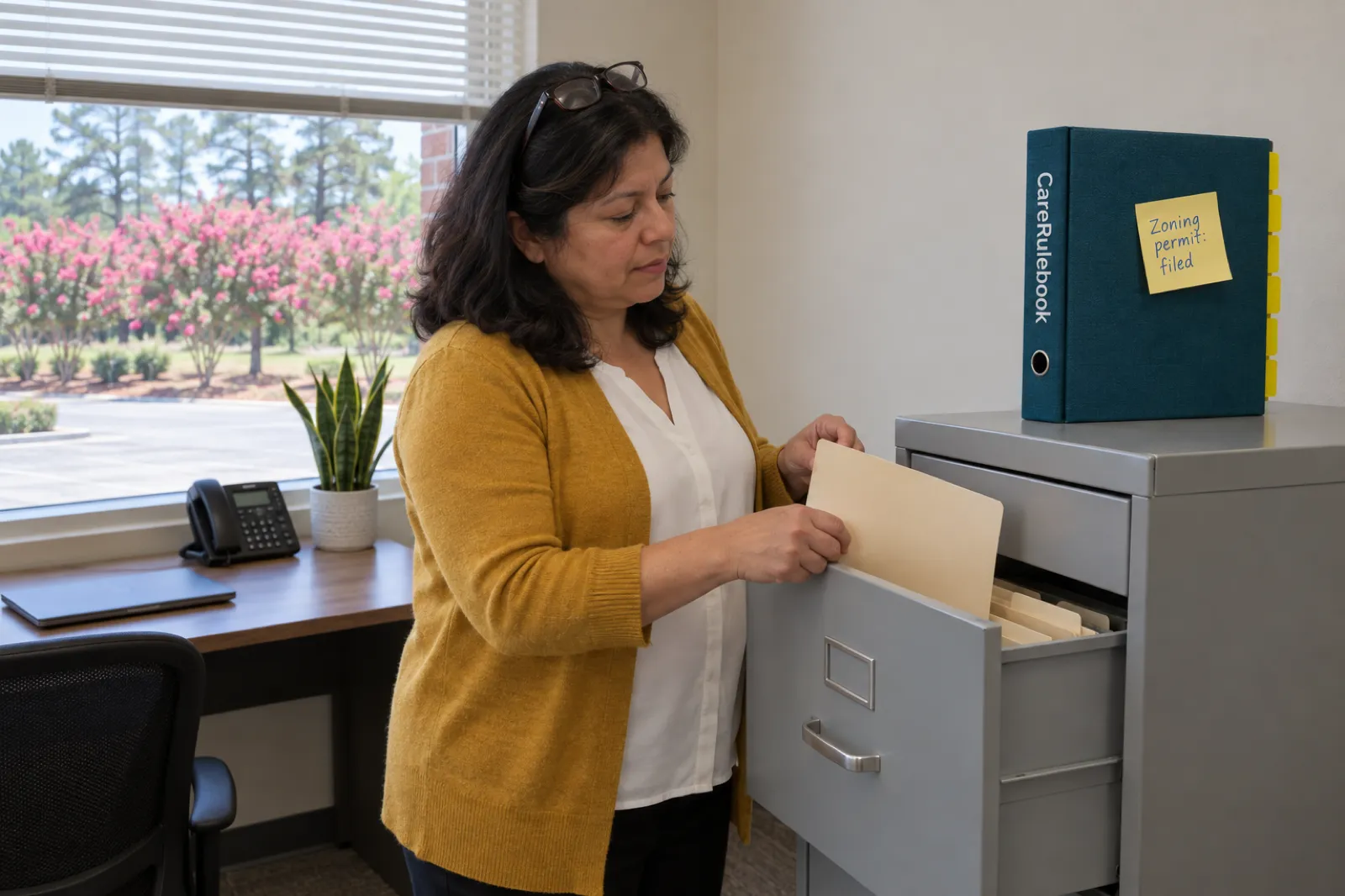
A woman in a mustard cardigan with glasses on her head files a folder into a grey filing cabinet in a small office, beside a teal CareRulebook binder with a sticky note reading Zoning permit: filed, with pink crape myrtles and pines outside the window

Quick answer

"Each provider shall have an administrator who is responsible for the overall management and operation of the provider." (R.60-122 §401) The rule sets no qualifications for that person and does not require an alternate. The administrator signs each policy review and any plan of correction (§301.B; §202.C).

The agency also needs at least one in-state primary office. "The primary office must be in an office that is in a commercially zoned or unzoned area." The applicant gets a county or municipal zoning permit to operate the provider there, or a letter from the county or municipality if the area is unzoned (R.60-122 §103.D.1). The primary office is where all records are kept, secured and accessible (§102.S). Both duties apply to every licensee from May 22, 2026, with no transition period in the text (§101).
1

Administrator every provider must have, with no qualifications set

R.60-122 §401

2 years

Longest gap between policy reviews the administrator signs

R.60-122 §301.B

Zoned

Primary office: commercially zoned or unzoned, with a permit or letter

R.60-122 §103.D.1

5 years

Client records kept after services end

R.60-122 §602.C

The administrator

The rule defines the administrator as "the individual designated by the licensee to have the authority and responsibility to manage the in-home care provider and is in charge of all functions and activities of the provider" (R.60-122 §102.A). Designating one does not move the legal duty: the licensee is the person or body "with whom rests the ultimate responsibility for compliance with this regulation" (§102.O).

  • No qualifications. R.60-122 sets no education, experience, training or license for the administrator (§401). An owner can be the administrator; the rule does not say otherwise.
  • No nurse. R.60-122 does not require a nurse for the license at all (§402.B, §406.A).
  • A Class II standard. "401. Administrator. (II)" (R.60-122 §401). Class II covers standards whose breach has a negative impact on clients (§205.D). Penalties range from $100 to $5,000 per violation, set by a schedule: for example $500 to $1,500 for a first Class I, $300 to $800 for a first Class II and $100 to $300 for a first Class III violation. (§205.F)
  • On the application. Part A of DPH’s application asks for the administrator’s name, telephone number, fax and email address. (DPH Form 1307, Part A)
  • Medicaid sets a bar. SCDHHS requires the owner or administrator of a Medicaid personal care agency to have at least three years of health care administrative experience. (SCDHHS Personal Care Scope, B.1) That is a condition of the Medicaid contract, not of the DPH license.

Before May 22, 2026, the rule defined the administrator in the same words but had no administrator section (R.60-122 before May 22, 2026); §401 came with the rewrite that took effect that day (Document No. 5407). More on what else changed: the South Carolina guide.

What the rule asks the administrator to sign or receive

Most of R.60-122 places duties on "the provider". These are the places it names the administrator:

DutyRule
Sign each review of the written policies and procedures. The provider sets a review period of no more than two years for all of them, and each review is documented.R.60-122 §301.B
Sign the written plan of correction after a DPH inspection or investigation finds noncompliance, and return it by the date on DPH’s report. The plan covers the action taken on each deficiency, how recurrence is prevented and the completion dates.R.60-122 §202.C
Receive and review drug test results, and review and sign staff health self-assessments, if the agency gives that job to the administrator rather than to a nurse or to human resources or hiring staff.R.60-122 §402.B-C, §406.A
Receive caregivers’ reports about their health and activities as they relate to communicable diseases, under the agency’s own policy.R.60-122 §406.C

Everything else falls to the administrator through §401’s "overall management and operation". When DPH inspects without notice and staff are out, the provider says when they will be back (§202.A), and people authorized by law, such as DPH’s inspectors, get timely access to all areas and records (§202.B). DPH asks administrators to send plans of correction through its online form (DPH, Submit a Plan of Correction). The whole inspection process: South Carolina inspections and incidents. What the written policies the administrator reviews must cover: South Carolina policies and procedures.

When the administrator is away or leaves

No alternate in the rule

R.60-122 does not mention an alternate or acting administrator. §401 says each provider shall have an administrator and sets no gap, so by our reading the agency should never be without one, and should name the day the post falls vacant who takes over.

R.60-122 §401

Duties only the administrator signs

Policy reviews and plans of correction are signed by the administrator. By our reading a person acting in a short absence can prepare them but should not sign them; a new administrator, once designated, signs.

R.60-122 §301.B, §202.C

Telling DPH about a new administrator

DPH says: “Any change in administrator must be reported to the Bureau as defined by the appropriate regulation.” It takes the report on its online change in administrator form. R.60-122 sets no deadline or method, so by our reading report promptly and keep the confirmation.

DPH, Change in Administrator

At renewal

Part A of Form 1307 names the administrator. By our reading a renewal completes Part A too (the form limits only change requests to Parts C and D), so it should match the person in post.

Form 1307-ENG-DPH, Part A

Whether DPH expects a deadline for the report, or an interim administrator named at once, is not settled; ask DPH.

The administrator’s own checks

  • If they sign the application. Each person who signs needs a SLED name-based criminal record check no older than 90 days when DPH receives the application (§103.G), and a 5-panel drug screen taken no earlier than 30 days before (§103.H). Signers are also in the random drug testing pool (§402.C).
  • If they could meet clients. South Carolina’s criminal record check law counts as a direct caregiver "a person employed by or under contract with by a direct care entity whose duties include the possibility of patient or client contact" (S.C. Code 44-7-2910(B)(2)(e)). By our reading that takes in an administrator who visits clients, so run the same check you run for caregivers. See South Carolina caregiver background checks.
  • If they have client contact. Staff with client contact complete a health self-assessment before first client contact (§406.A-B).
  • Medicaid agencies. For Medicaid personal care, SCDHHS requires a SLED check before hire and at least every two years for all employees, including the administrator, office manager, nurse supervisor and managers on the organizational chart. (SCDHHS Personal Care Scope, D.5)

Who supervises the caregivers

R.60-122 has no supervision section. It mentions supervising caregivers twice, both in the caregiver qualifications: a caregiver must "be able to read, write, and communicate effectively with client and supervisor" (§405.A) and "be capable of providing care as provided in the care services plan with minimal supervision, if applicable" (§405.C). Care must be given effectively and safely under the agency’s policies (§700.A).

  • No schedule. The rule sets no supervisory visits, calls or ratios, and does not say who the supervisor is. By our reading the administrator, as the person responsible for overall operation, is the supervisor unless the agency names someone else.
  • No nurse. Care is strictly non-medical (§700.B), so supervision under the DPH license is about following the care services plan, not clinical oversight.
  • Medicaid adds a nurse. Medicaid personal care must be supervised by an RN or LPN (which may be contracted), who visits before care starts and writes the task list. (SCDHHS Personal Care Scope, D.1, E.2-3)

A written supervision policy is good practice even though the rule does not ask for one by name: who caregivers call, when they must call (a change in the client’s condition, a missed visit, a request outside the plan, an incident), and any spot checks you choose (§405.C, recommended practice). Caregiver qualifications and training are on the South Carolina guide.

The primary office

"An applicant or licensee must maintain at least one in-state office location that is its primary office." "The primary office must be in an office that is in a commercially zoned or unzoned area." "For the primary office, the applicant must obtain a county or municipal zoning permit to operate the provider." In an unzoned area, the applicant gets a letter from the county or municipality saying a provider may be operated from the location (R.60-122 §103.D.1).

  • What it is for. The primary office is "the main office of an in-home care provider where all records are kept, secured, and accessible", and from which the provider oversees, administers and coordinates services at any multiple location (§102.S).
  • The license is tied to it. "A license shall be effective for a specified provider at specific locations, to include the primary office and multiple location(s), if applicable." (§103.C.4) The license is posted in a public area of the business office or kept readily available to the public (§103.C.1).
  • Existing licensees. The office duty names "an applicant or licensee"; the permit and letter duties name only "the applicant". By our reading existing licensees should hold the permit or letter too, since renewal is an application. Ask DPH.
  • No set office hours now. Before May 22, 2026, the rule required the provider to be accessible in person, by phone or page from 9 a.m. to 5 p.m., Monday to Friday, except state holidays. The 2026 text has no office hours rule. (R.60-122 §103.J, before May 22, 2026) Today, when DPH arrives and staff are out, the provider says when they will return (§202.A).
  • Medicaid already had the rule. "Provider agencies must be housed in an office that is in a commercially zoned or unzoned area." (SCDHHS Personal Care Scope, B.3)
  • Other services, separate lines. If you also offer services other than in-home care, they need separate marketing, caregiver records and client records (§103.C.6).

The rule sets no size, layout, signage or equipment standard for the office beyond space and equipment adequate to protect and store client records (§602.A).

Can the primary office be your home?

The rule does not mention homes. It says the primary office must be "in an office" in a commercially zoned or unzoned area, with the zoning permit or local letter (§103.D.1). Our reading, which DPH has not confirmed:

  • A home in a residential zone does not qualify, even with a home business or home occupation permit, because the area is neither commercially zoned nor unzoned.
  • A home in an unzoned area may qualify if the county or municipality gives a letter saying a provider may be operated from it.
  • A building in a commercial zone may qualify if you hold a zoning permit to operate the provider there, whatever else the building is used for. Check with DPH that a space inside a home counts as "an office".

Agencies already running from home. The 2026 text has no exception or transition period for agencies licensed before May 22, 2026 (§101). "The provider may request a variance to this regulation in a format as determined by the Department." Variances are considered case by case and DPH may revoke them (§103.N). DPH’s Request for Exception to Licensing Standard (form 0226) is completed by existing or proposed providers, names and is signed by the administrator, and goes to ExR.BHFL@dph.sc.gov or by mail; DPH replies in writing. (DPH form 0226) Ask before relying on a variance, and plan for a move if DPH says no.

Other states treat home offices differently: Texas allows one with conditions, while the rules of North Carolina, Georgia and Virginia say nothing either way (see Georgia’s office rules).

Getting the zoning evidence, step by step

Our suggested order. Tick steps off as you go; your progress is saved in this browser only.

  1. Find out how the address is zoned

    Before you sign a lease

    Ask the planning or zoning office of the county, or of the city or town if the office is inside its limits, whether the address is commercially zoned, residentially zoned or unzoned.

    R.60-122 §103.D.1
  2. Commercially zoned: apply for the zoning permit

    Before the application

    The rule asks for a county or municipal zoning permit to operate the provider. Our suggestion: describe the business plainly, as an office that sends caregivers to clients’ homes, with no care given at the office.

    R.60-122 §103.D.1
  3. Unzoned: ask for the local letter

    Before the application

    If the area is unzoned, ask the county or municipality for a letter saying an in-home care provider may be operated from the location.

    R.60-122 §103.D.1
  4. Residentially zoned: find another office or ask DPH

    Before you commit

    By our reading a home or office in a residential zone does not meet the rule. Look for a qualifying office, or ask DPH about a variance on its exception form before you rely on one.

  5. Keep the evidence with your license papers

    From day one

    DPH’s application form does not ask for the permit or letter, and the rule does not say what evidence DPH wants. Keep it where an inspector can see it.

  6. Moving later? Amend the license first

    Before any move

    A change of location from one geographic site to another needs an amended license before the move ($50, DPH’s fee). Get the zoning evidence for the new address first.

    R.60-122 §103.L

Multiple locations and moving office

A multiple location is "a properly registered additional site, other than the licensed primary office, from which an in-home care provider provides in-home care services" (R.60-122 §102.Q).

  • Register before you open it. "A provider shall not establish, operate, or maintain a multiple location or represent itself as such without first registering the multiple location by application to the Department and receiving approval of the registration from the Department." The application is on DPH’s form (§103.D.2-3).
  • How long it lasts. The registration is effective until the license in force when DPH approved it expires (§103.D.4). Whether it carries on when the location is listed at renewal, or needs registering again, is not stated; ask DPH.
  • The full scope. DPH’s application asks the provider to affirm that all multiple locations provide the full scope of service. (Form 1307, Part C, Section 3)
  • Zoning for extra offices. §103.D.1 names the permit and letter only for the primary office. Whether DPH expects zoning evidence for a multiple location is not stated.
  • Moving the primary office. A provider applies for an amended license before changing its location from one geographic site to another ($50, DPH’s fee). (§103.L)

All of DPH’s fees, including the $50 amendment fee, are on the South Carolina guide.

Records the office keeps, and for how long

All records must be readily accessible, in a timely manner, for DPH’s inspections and investigations (R.60-122 §601.A.2, §202.B). "Providers that use electronic systems must provide for data backup and retrieval in the event of a system shutdown or power outage." (§601.A.3)

RecordHow long or whenRule
Client records: visit notes, the service agreement, the care services plan, the signed rights formCompleted within 30 calendar days after care ends; kept at least five years after services endR.60-122 §602.B-C
Incident records: the review, investigation, evaluation and any corrective actionKept five years after the client leavesR.60-122 §501.A
Staff records: current address, phone, training, all drug test results, criminal background checks and self-assessmentsNo retention period set in the ruleR.60-122 §403
Drug test records: the lab result, or for in-house kits the five items the rule listsPart of the staff recordR.60-122 §402.B-C
In-service training records, signed and dated by trainer and trainee (trainer signature not needed for computer-based training)Part of the staff recordR.60-122 §404
Policy reviews, documented and signed by the administratorAt least every two yearsR.60-122 §301.B
Disaster notifications, or attempts, when services could not be givenEach time it happensR.60-122 §1001
A copy of the licensing standards, accessible to all caregiversAt all timesR.60-122 §103.B
The license, posted in a public area of the business office or readily available to the publicAt all timesR.60-122 §103.C.1
The zoning permit or local letter for the primary officeNot stated; keeping it with the license papers is our suggestionR.60-122 §103.D.1

Before closing. The licensee arranges to preserve the records. "The licensee shall notify the Department, in writing, describing these arrangements and the location of records." (§602.B)

What goes in each client’s record, from the service agreement to visit notes: South Carolina client paperwork.

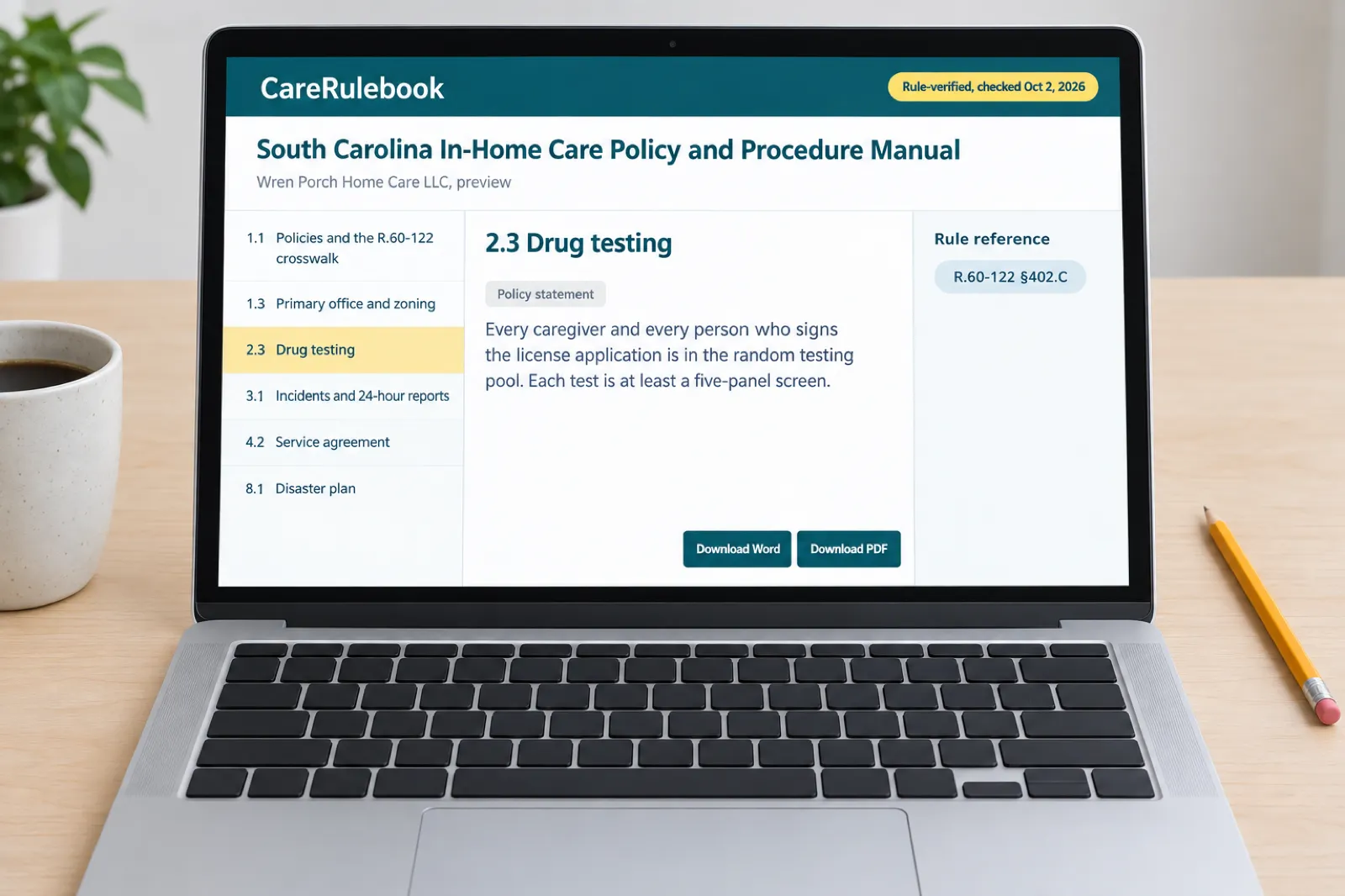
The CareRulebook South Carolina manual preview on a laptop: policy 2.3 on drug testing for a sample agency, citing R.60-122 §402.C, with six of the manual’s policies listed beside it

CareRulebook

The office, the administrator and the records, written the way R.60-122 reads

CareRulebook’s South Carolina manual includes Policy 2.1, administrator; Policy 1.3, primary office, zoning and multiple locations, with a zoning evidence record; Policy 1.4, inspections, investigations and plans of correction; and Policy 2.7, supervision of caregivers.

  • 29 policies, 84 requirements mapped to R.60-122 and S.C. Code 44-70
  • A designation letter for the administrator and the person who acts for them
  • Already licensed? A checklist of what changed on May 22, 2026, including the office rule
  • Editable Word and print-ready PDF, with the rule quoted under each policy
Preview your manual

$199CareRulebook founding price for the first 50 South Carolina agencies, then $249. Not a DPH fee.

Myths about the administrator and the office

Does a South Carolina in-home care administrator need a license, a degree or set experience?

No. Not for the DPH license. R.60-122 says each provider shall have an administrator responsible for overall management and operation, and sets no education, experience, training or license for that person. Medicaid is different: SCDHHS requires the owner or administrator of a personal care agency to have at least three years of administrative experience in the health care field.

"Each provider shall have an administrator who is responsible for the overall management and operation of the provider."

Can I run a South Carolina in-home care agency from my house?

It depends. Only if it is in a commercially zoned area with a county or municipal zoning permit, or in an unzoned area with a letter from the county or municipality saying a provider may be operated there. That is the rule for the primary office since May 22, 2026. By our reading, a home in a residential zone does not qualify; ask DPH about your address. SCDHHS already required a commercially zoned or unzoned office for Medicaid agencies.

"The primary office must be in an office that is in a commercially zoned or unzoned area."

Frequently asked questions

What are the requirements to be an in-home care administrator in South Carolina?

R.60-122 says each provider shall have an administrator who is responsible for the overall management and operation of the provider (§401), designated by the licensee to manage the provider and in charge of all its functions and activities (§102.A). The rule sets no education, experience, training or license for the administrator. DPH’s application asks for the administrator’s name, telephone number and email. If you want Medicaid personal care work, SCDHHS requires the owner or administrator to have at least three years of administrative experience in the health care field.

Does a South Carolina in-home care agency need an alternate administrator?

R.60-122 does not require one. It requires an administrator at all times by our reading, because §401 says each provider shall have one and sets no gap. Naming someone who acts when the administrator is away is sensible, but some duties are the administrator’s by name: signing policy reviews (§301.B) and plans of correction (§202.C).

How do I tell DPH about a new administrator?

DPH has an online change in administrator form and says any change must be reported to the Bureau as defined by the appropriate regulation. R.60-122 sets no deadline or method for this report, so by our reading report it promptly on DPH’s form and keep the confirmation. Part A of Form 1307, which by our reading a renewal also completes, names the administrator too.

Does South Carolina require a commercial office for home care?

Yes, since May 22, 2026. Every applicant or licensee must keep at least one in-state primary office in a commercially zoned or unzoned area. For the primary office the applicant gets a county or municipal zoning permit to operate the provider, or, in an unzoned area, a letter from the county or municipality saying a provider may be operated there (R.60-122 §103.D.1).

Can I run my South Carolina home care agency from home?

Only if the home is in a commercially zoned area with a zoning permit to operate the provider, or in an unzoned area with a letter from the county or municipality. By our reading a home in a residential zone does not qualify, even with a home business permit. You can ask DPH for a variance under §103.N on its Request for Exception form; DPH decides each request case by case.

Do I need DPH approval to open a second office?

Yes. A provider may not establish, operate or maintain a multiple location, or represent itself as having one, until it has registered the location on DPH’s form and DPH has approved it. The registration runs until the license in force when it was approved expires (§103.D.2-4). DPH’s form asks you to affirm that every multiple location provides the full scope of service.

How long must a South Carolina in-home care provider keep records?

Client records are completed within 30 calendar days after care ends and kept at least five years after services end (§602.B-C). Incident records are kept five years after the client leaves (§501.A). The rule sets no retention period for staff records. Before closing for any reason, the licensee arranges to preserve the records and tells DPH in writing where they will be (§602.B).

Get South Carolina rule-change alerts

DPH has not published guidance on how the 2026 office rule applies to agencies licensed before May 22, 2026. Leave your email and we will tell you when DPH clarifies it or changes R.60-122.

No spam. Only emails about South Carolina home care rule changes. How we use your email.

Keep reading

Sources

  1. Regulation 60-122, Standards for Licensing In-Home Care Providers (Document No. 5407, State Register Vol. 50, Issue 5, effective May 22, 2026, with the errata in Vol. 50, Issue 6, June 26, 2026) · South Carolina Department of Public Health; South Carolina Legislative Council (State Register) · retrieved October 2, 2026
  2. Regulation 60-122 (formerly 61-122) as in force before May 22, 2026: the 2014 text (Doc. No. 4433), from the S.C. Code of Regulations, Chapter 60, and DHEC’s unofficial copy of R.61-122 · South Carolina Legislative Council (Code of Regulations); S.C. Department of Health and Environmental Control · retrieved October 2, 2026
  3. S.C. Code 44-7-2910 to 44-7-2950, criminal record checks of direct caregivers · South Carolina Legislative Services Agency · retrieved October 2, 2026
  4. Licensure Application for In-Home Care Provider, form 1307-ENG-DPH (08/2026) · South Carolina Department of Public Health · retrieved October 2, 2026
  5. Submit Information to Healthcare Quality (plan of correction, accident/incident reporting, change in administrator; updated March 30, 2026) · South Carolina Department of Public Health · retrieved October 2, 2026
  6. HCBS Provider Manual, Scope of Services for Personal Care, HASCI Agency Attendant Care and Respite (July 1, 2025) · South Carolina Department of Health and Human Services · retrieved October 2, 2026
  7. Request for Exception to Licensing Standard, form 0226-ENG-DPH (07/2025), with its instructions · South Carolina Department of Public Health, Bureau of Health Facilities Licensing · retrieved October 2, 2026
Build your South Carolina manualfrom $199