Skip to content
CareRulebook
MenuClose

Where are you starting?

United StatesTexas, North Carolina, Georgia, Virginia, Indiana, Ohio, New York, Illinois, Washington, Colorado, Tennessee, Maryland, Kansas, South Carolina, Nevada
TexasManual
North CarolinaManual
GeorgiaManual
VirginiaManual
IndianaManual
OhioGuideNew YorkGuide
IllinoisManual
WashingtonManual
ColoradoManual
TennesseeManual
MarylandManual
KansasManual
South CarolinaManual
NevadaManual
All US states →
United KingdomEngland
Free toolsChecklists, calculators and templates

Nevada · Training · NAC 449.3975 to 449.3977

Nevada caregiver training: topics before the first client, 8 hours a year after

Nevada sets attendant training by topic, not hours. Before working alone, each attendant gets a copy of the rules, completes a training program with supervised on-the-job instruction, is found competent, and has elder abuse training. First aid and CPR need live skills practice. Then come cultural competency within 90 days, infection control and elder abuse every year, and at least 8 hours of training a year.

  • Rule-verified October 3, 2026
  • Quoted from NAC 449 as amended by R089-24
  • And NRS 449B, R063-21 and R004-24
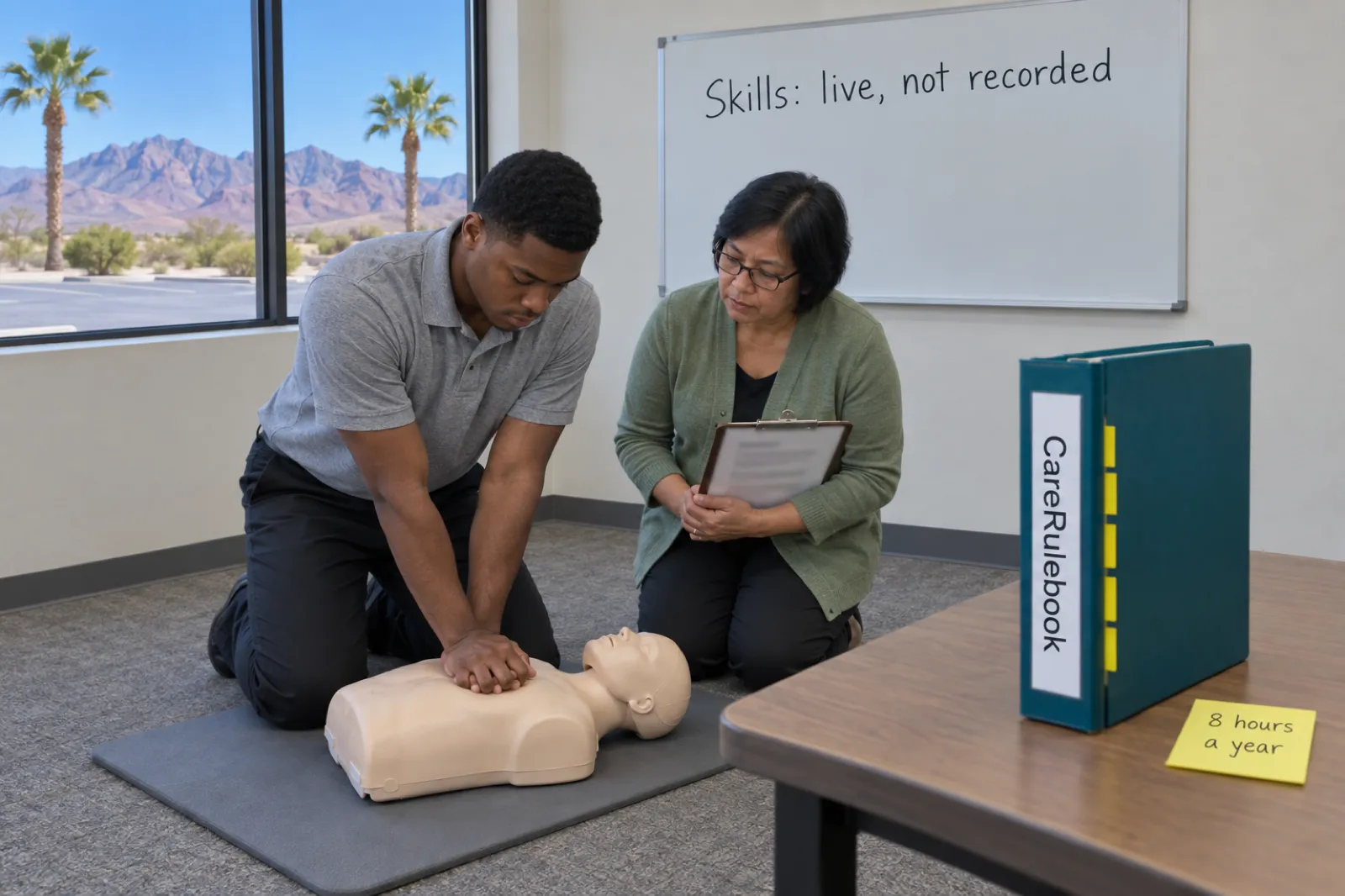
A young man in a gray polo shirt practices chest compressions on a CPR manikin while a woman in a green cardigan with a clipboard watches, under a whiteboard reading Skills: live, not recorded, beside a CareRulebook binder and a sticky note reading 8 hours a year, with palm trees and mountains outside

Quick answer

Each attendant must "participate in and complete a training program before independently providing personal care services to the clients of the agency", with on-the-job instruction supervised by the administrator or designee (NAC 449.3977(1)(b)). The rules set the topics, not the hours: HCQC’s workbook says "Initial PCA training (NAC 449.3977) -No hour requirement, only subjects required per the regulation" (HCQC workbook). The program must be completed within the 12 months before the first client (NAC 449.3977(3)), and each attendant must be found competent (NAC 449.3977(2)).

On top of that: elder abuse training before the first client and yearly (NRS 449B.225(5)), first aid and CPR certification with live skills practice (R089-24 section 2), infection control every year (R063-21 section 4), cultural competency within 90 days and every two years (NAC 449.011931), and at least 8 hours of training a year (NAC 449.3975(6)).

No set hours

for the initial program, only required topics (HCQC’s workbook)

HCQC workbook; NAC 449.3977

8 hours

of training a year related to clients’ needs

NAC 449.3975(6)

90 days

to complete an approved cultural competency course

NAC 449.011931 (R004-24)

16 hours

of approved medication training before assisting with medication

R089-24 section 14(2)

From hire to first client, and after

Every training and health step for a new attendant, in order. Tick steps off as you go; progress is saved in this browser only.

  1. Health certificate and TB test

    Before starting work

    A physical examination or health care provider’s certificate that the person is free of active TB and other communicable disease, and a TB screening test from the past 12 months. Details.

  2. A copy of the rules

    Before any client

    Give the attendant the personal care agency rules; they gain a working knowledge of them before serving clients.

    NAC 449.3977(1)(a)
  3. Elder abuse training

    Before any client

    Recognizing and preventing abuse of older persons, for every employee who will provide care.

    NRS 449B.225(5)
  4. The initial training program

    Before working alone

    Every topic in NAC 449.3977(1)(c), including first aid and CPR that ends in certification, completed within the 12 months before the first client. The topics.

    NAC 449.3977(1)(c), (3)
  5. Supervised on-the-job instruction

    Before working alone

    With clients, supervised by the administrator or designee, who decides whether the attendant can work alone.

    NAC 449.3977(1)(b)
  6. Competency evaluation

    Before working alone

    The agency evaluates the attendant and finds them competent in every required area.

    NAC 449.3977(2)
  7. Cultural competency course

    Within 90 days of hire

    An approved course for staff with weekly direct client contact and their supervisors.

    NAC 449.011931 (R004-24)
  8. First aid and CPR certification on file

    Within 6 months of starting

    The latest date the rule allows. CareRulebook’s manual has it done before the first client, because it is also part of the initial program. Why.

    NAC 449.3976(1)(f)
  9. Every year after

    Yearly

    At least 8 hours of training on clients’ needs, elder abuse training, infection control training for unlicensed caregivers, a TB screening test, and 8 hours of medication training if the attendant assists with medication.

  10. Every two years

    Every 2 years

    At least 2 hours of approved cultural competency training.

    NAC 449.011931 (R004-24)

Who may serve clients. The administrator is responsible for "Ensuring that only trained attendants are providing services to a client of the agency" (NAC 449.3973(2)(b), as amended by R089-24). Attendants need no certificate such as a CNA: each is at least 18, responsible and mature, understands the rules and can "demonstrate the ability to read, write, speak and communicate effectively with the clients of the agency" (NAC 449.3975(1)-(5)). The fingerprint check runs alongside; see Nevada caregiver background checks.

A copy of the rules

Each attendant must "obtain a working knowledge of the provisions of this chapter which govern the licensing of agencies before providing personal care services to the clients of the agency", and "The agency must provide a copy of those provisions to an attendant before the attendant may provide personal care services to the clients of the agency." (NAC 449.3977(1)(a)).

Which copy. The compiled code on the Legislature’s website does not yet show R089-24’s changes of February 27, 2026 (compiled NAC 449; R089-24). By our reading, a copy that leaves those changes out would mislead attendants about medication, nail care and appointments, so give them the compiled text together with R089-24, or a version that includes it. CareRulebook’s manual gives the compiled text with the R089-24 sections that changed it.

Signed or not. HCQC’s workbook is not consistent. Its index asks you to "Include Attendants’ Signed Statement they have received, read and understood the provisions of this chapter." (workbook index, P0150), while the tag itself accepts a policy or an acknowledgement form and adds "Signed statement not required." (tag P0150). Our suggestion: have each attendant sign a short acknowledgement; it satisfies both readings.

The initial training program

The program must include on-the-job instruction with clients, and the administrator or designee "provides supervision during this instruction to determine whether the attendant is able to provide personal care services successfully and independently to the client" (NAC 449.3977(1)(b), as amended by R089-24). It covers these topics (NAC 449.3977(1)(c)):

TopicWhat it includesNAC 449.3977(1)(c)
Written documentationRecording the personal care services given and verifying time records.(1)
Client rightsIncluding methods to protect client confidentiality under state and federal rules.(2)
Special needs of elderly persons and persons with disabilitiesIncluding the sensory, physical and cognitive changes of aging.(3)
Communication skillsActive listening, problem solving, conflict resolution, and communicating with people with communication or sensory impairments.(4)
First aid and CPREnding with the attendant certified under R089-24 section 2.(5)
The agency’s own services, as they applyDuties and techniques; emergencies, including fires and medical emergencies; adverse behaviors; nutrition and hydration, special diets and meals; bowel and bladder care, including catheter drainage bags, colostomy bags and urinary tract infection signs; skin care and reporting skin changes; preventing skin breakdown, contractures and falls; hand washing and infection control; body mechanics, mobility, transfers and simple nonprescribed range of motion; a clean and safe environment.(6)(I)-(X)

"As applicable." The service topics in (6) apply as they relate to the services your agency gives. The rule does not say how an agency decides which topics apply. CareRulebook’s manual teaches every topic, because each can arise in daily living help and HCQC’s workbook asks for certificates showing all the listed topics (workbook, P0152).

Within 12 months. Each attendant needs evidence of completing the required training within the 12 months before first providing care. (NAC 449.3977(3)) HCQC’s workbook puts it as "Completed no more than 12 months prior to start of care" (HCQC workbook) and, for tag P0160, asks for a certificate showing all the required topics (workbook, P0160).

Who teaches it. The rules do not name a qualified trainer for the initial program (they do for health-related tasks, below). The administrator or designee supervises the on-the-job part (NAC 449.3977(1)(b)). You can teach the classroom part yourself or use an outside course.

Competency evaluation

"Each attendant of an agency must be evaluated and determined to be competent by the agency in the required areas of training" set out in NAC 449.3977(1)(c) (NAC 449.3977(2)). For this tag HCQC’s workbook expects "Competency Evaluation or Examination after initial PCA training." (workbook, P0155).

Experienced hires. The administrator or designee "shall evaluate the competency of an attendant in each competency area required by the agency if the attendant provides written proof of his or her current or previous training", and after that first evaluation, further training can be limited to the areas where the attendant needs to improve (NAC 449.3976(3)). By our reading, earlier training still needs to fall within the 12 months before the first client to count toward NAC 449.3977(3), and CareRulebook’s manual counts it only then. The evaluation itself is Policy 4.7.

First aid and CPR

Each personnel file holds proof that the attendant is certified in first aid and CPR within 6 months of starting work (NAC 449.3976(1)(f), as amended by R089-24). Since February 27, 2026, the course can be:

  • in person;
  • blended, with the hands-on skills part in person; or
  • fully virtual, "if interactive, hands-on skills training or skills verification is not prerecorded." (R089-24 section 2(1)).

The Division accepts certificates from the American Red Cross, the American Heart Association, the Health and Safety Institute or a similar nationally recognized organization (R089-24 section 2(2)). Staff whose CPR certification did not meet the new rule had 180 days from February 27, 2026 (to late August 2026) to recertify. (R089-24 section 88(2))

Six months, or before the first client?

The initial training program also includes first aid and CPR training "that culminates in the attendant being certified in first aid and cardiopulmonary resuscitation" (NAC 449.3977(1)(c)(5), as amended by R089-24), and that program comes before the attendant works alone (NAC 449.3977(1)(b)). By our reading, the 6 months is the outside limit for the file, and the safer course is certification before the first client. CareRulebook’s manual does that. Whether HCQC reads the two rules the same way is on our list of questions for HCQC.

HCQC’s workbook is older. It still says the course "must have in-person skills demonstration component" (HCQC workbook). The workbook is dated 12.2024, before R089-24; by our reading, a fully virtual course with live, interactive skills verification now meets the rule. If you want no argument at a survey, choose a course with in-person skills.

Protection in an emergency. An agency employee who has completed a CPR or first aid course and in good faith gives emergency care to an elderly person or a person with a disability, in line with that training, is not liable for civil damages short of gross negligence. (NRS 449B.470)

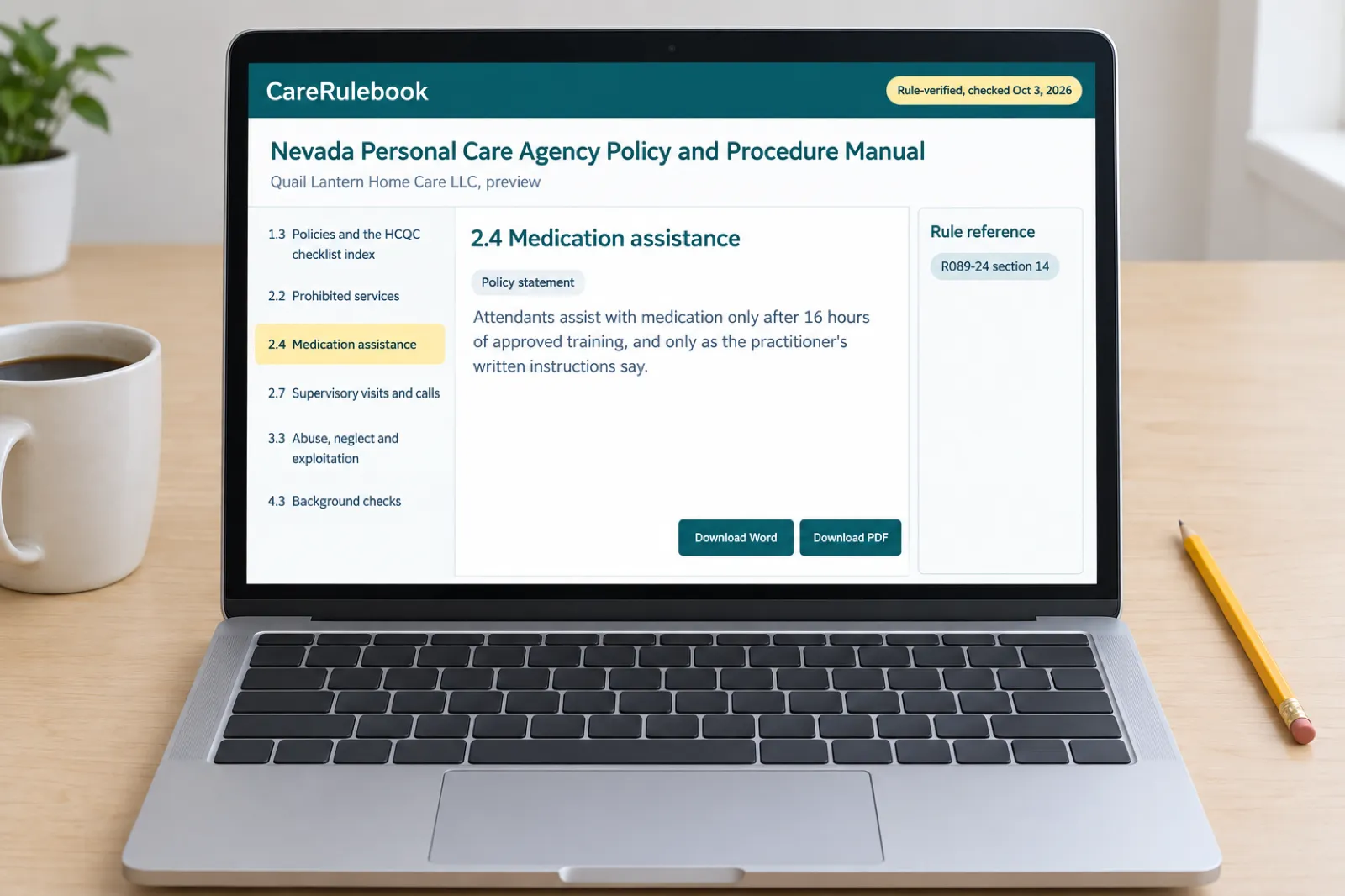
The CareRulebook Nevada manual preview on a laptop: policy 2.4 on medication assistance for a sample agency, citing R089-24 section 14, with six of the manual’s policies listed beside it

CareRulebook

Training written for your agency

CareRulebook’s Nevada manual includes Policy 4.6 (Orientation and initial training) with every NAC 449.3977 topic on an initial training record, Policy 4.7 (Competency evaluation) with a competency checklist, and Policy 4.8 (Annual and required training) with a yearly record for the 8 hours, elder abuse, infection control, cultural competency and CPR renewal dates.

  • 35 policies, 127 requirements mapped
  • Written to the rules as amended by R089-24 (February 27, 2026)
  • Editable Word and print-ready PDF, with the rule quoted under each policy
Preview your manual

$199CareRulebook founding price for the first 50 Nevada agencies, then $249. Not an HCQC fee.

Elder abuse training

NRS 449B.225 covers everyone in the chain:

  • The applicant. The applicant (for a company, the person in charge) completes training to recognize and prevent abuse of older persons before the license is issued, then yearly before each renewal. (NRS 449B.225(1)-(3)) An applicant who completed the training within the year before applying, and includes evidence with the application, has met the before-licensing requirement. (NRS 449B.225(1))
  • The administrator and every caregiver. The administrator before the agency provides care, and every employee who provides care before their first client, then every year. The agency pays for it. (NRS 449B.225(4)-(7)) HCQC’s workbook lists "Initial and Annual Elder Abuse training(NRS 449.093)" before client contact, under the section’s old number (HCQC workbook).
  • What it covers. The training covers recognizing and responding to abuse of older persons, including sexual abuse and the NRS 200 offenses, and the laws on elder abuse and on personal care agencies, with any changes. (NRS 449B.225(6))
  • Where to take it. HCQC’s Training & Education page links an Elder Abuse/Adult Protective Services course. (HCQC, Training & Education) The statute does not require that course; any training that covers the topics meets it, by our reading.
  • Enforcement. The licensee makes sure everyone required completes the training, and the Division may take disciplinary action for any violation. (NRS 449B.225(8)) Each renewal includes a statement that the licensee, administrator and employees have completed it (NRS 449B.210(2)).

The statute says "employee". The NAC training rules apply to every attendant, and an attendant can be an employee or a contractor (NAC 449.3963). By our reading, contracted attendants should take elder abuse training too; CareRulebook’s manual includes them. How to report abuse is on the Nevada hub guide.

Infection control training

Each unlicensed caregiver completes evidence-based infection control training from a nationally recognized organization every year, covering hand hygiene, PPE, cleaning and disinfection, the goals of infection control, how pathogens spread and source control. (R063-21 section 4(1))

  • Who. For the infection control training, an unlicensed caregiver is a person who gives care and is not required to hold, and does not hold, a professional license or certificate under title 54 of NRS. (R063-21 section 2) Personal care attendants usually hold no such license, so it applies to them.
  • Proof. Each caregiver gives proof of completing the infection control training to the administrator or other person in charge. (R063-21 section 4(2)) The administrator documents each caregiver’s completion in the personnel file and makes sure the best practices taught are used at the agency where appropriate. (NRS 449B.220(3)(a)-(b))
  • Free courses. HCQC offers two free options with certificates: its own course or listed CDC modules. It says "the unlicensed caregiver infection control training requirement is based on topics, not a set number of hours" (HCQC, Unlicensed Caregiver Infection Control Training). HCQC says its own infection control course needs a NEOGOV account, which may take a few days, and takes under 30 minutes. (same page)
  • When for new hires. The rule says "annually" and does not say whether a new caregiver must finish it before the first client. CareRulebook’s manual sets it within 12 months of starting work, and its Recommended practice books it in the first weeks.

A different, longer course for one person. HCQC’s workbook also expects a named infection control staff member and designee with 15 hours of training, citing NAC 449.0109 (HCQC workbook). That section is written for facilities for the dependent, not personal care agencies (NAC 449.0109), so we label it as HCQC’s survey expectation rather than a rule.

Cultural competency training

Staff who give care or support with direct client contact at least weekly on average, and their supervisors, complete an approved cultural competency course within 90 days of hire and at least 2 hours every two years. Staff who take such a course for their own license renewal are exempt. (NAC 449.011931(1), as amended by R004-24; NRS 449B.280(2)-(3))

  • Phone contact counts. Direct client contact means contact "which is in person or using telephone, electronic mail or other electronic means, except that the term does not include incidental contact" (NRS 449B.280(7)). By our reading, a scheduler who phones clients every week needs the course as well as the attendants.
  • What it covers. The training helps staff understand clients of different racial, ethnic and religious backgrounds, sexual orientations and gender identities or expressions, children and seniors, and people with disabilities. (NRS 449B.280(1))
  • Approved courses only. The course must be approved by the Nevada Health Authority. HCQC lists approved third-party courses, and an agency may apply to have its own course approved. (NRS 449B.280(4), (6)) The Authority must approve or deny an agency’s own course within 10 business days of receiving the application (NRS 449B.280(6)).
  • No borrowing. HCQC says courses approved for a particular facility are approved for that organization only and cannot be used elsewhere. (HCQC, Cultural Competency) Use a course on HCQC’s third-party list, or your own once approved.
  • Proof. HCQC says facility inspectors check employee files for proof of cultural competency training. (HCQC, Cultural Competency) Keep proof of completion, or of the professional license that makes someone exempt, in the personnel file (NAC 449.011931(3)-(4)).

The 8 hours a year

Each attendant must "receive annually not less than 8 hours of training related to providing for the needs of the clients of the agency" (NAC 449.3975(6)).

  • What counts. The rule says only "related to providing for the needs of the clients". It does not say whether the yearly elder abuse, infection control or medication courses count toward the 8 hours, and HCQC has not published guidance. By our reading they do, because each relates to clients’ needs; CareRulebook’s manual counts them and adds hours if HCQC says otherwise.
  • Which year. The rule says "annually" without saying whether that means a calendar year or 12 months from the start date. CareRulebook’s manual uses each attendant’s anniversary of starting work.
  • How to record it. For each course: a description of the content, the date, the hours, the instructor’s name and signature, and a certificate of completion (NAC 449.3976(1)(i), (2)).

Medication assistance and health tasks

Medication (only if you offer it)

Since February 27, 2026, an attendant may assist with medication (including over-the-counter medicines and supplements) if there is a written agreement where the law requires one, the attendant has completed the required training, and the medication is prescribed or ordered and given per the practitioner’s written instructions. (R089-24 section 14(1))

  • Before assisting. Before assisting with medication, an attendant completes at least 16 hours of medication management training from a Division-approved course and gets a certificate, then at least 8 hours a year. (R089-24 section 14(2))
  • Every year. The attendant must "provide the agency with satisfactory evidence of the content of the training and his or her successful completion of the training" (R089-24 section 14(2)(b)).
  • The agency’s part. An agency whose attendants assist with medication develops a training program and keeps a record for each client: medication type, date and time given, refusals or missed doses, and current instructions from the practitioner. (R089-24 section 14(3))
  • Which courses. R089-24 ties the attendant medication course to the approved courses for residential facilities for groups (LCB File No. R043-22). HCQC’s medication management page is still written for group homes. (HCQC, Medication Management; R089-24)

More on what attendants may do since R089-24 is on what Nevada attendants may and may not do; CareRulebook’s manual covers it in Policy 2.4.

Vital signs, blood glucose tests and insulin pens

Before doing these tasks, each year after, and whenever the device changes, the attendant is trained and shows understanding, follows the manufacturer’s instructions and meets CLIA rules where they apply. Trainers are a physician, PA, licensed nurse, pharmacist (insulin and glucose) or an experienced trained employee. (NAC 449.39775(1), (7)) These tasks, and weighing a client, are the only ones for which the rules name who may train attendants; medication training instead comes from a Division-approved course. CareRulebook’s manual covers them in Policy 2.3.

Health certificate and TB tests

NAC 449.3976(1)(c) brings the TB rule for health facilities into each attendant’s personnel file (NAC 449.3976(1)(c)).

  • Before starting. Attendant files must show the tests and certificates NAC 441A.375 requires: before starting, a physical examination or health care provider certificate that the person is free of active TB and other communicable disease, and a TB screening test within the past 12 months. (NAC 441A.375(3)) If only the first step of a 2-step Mantoux skin test was done in the past 12 months, the second step or another single-step test is given. (NAC 441A.375(3))
  • Every year. Then a TB screening test within 12 months after the month the job offer was accepted, and every year after, unless a documented risk assessment allows less often. (NAC 441A.375(4)) The exception is a decision by the facility’s medical director or designee, documented every year. Personal care agencies usually have no medical director, so by our reading the yearly test is the safe course; CareRulebook’s manual tests every year.
  • A past positive test. Someone with a documented positive TB screening test has a chest X-ray (or shows one) within 6 months of starting and is declared free of TB disease. (NAC 441A.375(5))
  • HCQC’s course. HCQC’s Training & Education page lists a course on tuberculosis testing for Nevada health facilities. (HCQC, Training & Education)

HCQC’s workbook lists "Pre-employment Physical Clearance and TB Testing" among the personnel file items it checks (workbook, P0130). CareRulebook’s manual covers this in Policy 4.5.

Who pays, and the records

  • The agency pays. The agency provides or arranges the required training, pays the course cost and, for training away from the agency, the travel cost, and pays staff their wage for training time and the usual travel time. It need not pay the course and travel costs for an employee who attends but fails to complete a course; the wage rule has no such exception (NAC 449.39735(1), (4)). Elder abuse training is the agency’s cost by statute too (NRS 449B.225(7)).
  • Training on your premises. An agency that trains on its own premises, meets the rules and pays all costs need not arrange or pay for training elsewhere. (NAC 449.39735(2))
  • Medicaid. Nevada Medicaid’s personal care rate already covers basic training, in-service requirements and CPR and first aid; they are not reimbursed separately. (MSM 3503.7)
  • The records. Completion documents go in the personnel file (NAC 449.39735(5)), with the content, date, hours, instructor’s name and signature and a certificate for each course (NAC 449.3976(2)). The Division may review personnel files on request (NAC 449.3976(4)).

Myths about Nevada caregiver training

How many training hours do Nevada personal care attendants need?

It depends. There is no set number of hours for initial training: attendants must complete a program covering the required topics, with supervised on-the-job instruction, within 12 months before their first client, and be found competent. After that they need at least 8 hours a year, plus elder abuse training before care and yearly, first aid and CPR within 6 months, annual infection control training, and cultural competency training within 90 days (2 hours every two years). Medication assistance adds 16 hours.

"Initial PCA training (NAC 449.3977) -No hour requirement, only subjects required per the regulation"

Does an online CPR course count for Nevada personal care attendants?

It depends. Since R089-24 (February 27, 2026), yes, if the hands-on skills training or skills check is live and interactive, not prerecorded. In-person and blended courses also count. The Division accepts certificates from the American Red Cross, the American Heart Association, the Health and Safety Institute or a similar national body. A course with only recorded videos does not count. HCQC’s 2024 workbook, written before the change, still says the skills part must be in person.

"Virtual or electronic instruction only, if interactive, hands-on skills training or skills verification is not prerecorded."

Is Nevada’s elder abuse training only for the agency owner?

No. The applicant (for a company, the person in charge) completes it before the license is issued and yearly before each renewal, the administrator before the agency serves anyone and yearly, and every employee who will provide care before their first client and every year after. The agency pays for it.

"An employee who will provide care for an agency to provide personal care services in the home must receive training to recognize and prevent the abuse of older persons before the employee provides care to a person in the agency and annually thereafter."

Can personal care attendants in Nevada help clients with their medication?

It depends. Since February 27, 2026, yes, under conditions. R089-24 lets an attendant assist with prescribed or ordered medication, over-the-counter medicines and supplements after at least 16 hours of medication management training from a Division-approved course (then 8 hours a year), with a written agreement where the law requires one. The agency must run a training program and keep a medication record for each client. Before that date the rule banned medication administration except insulin pens.

"successfully complete not less than 16 hours of training in the management of medication from a course approved by the Division"

Frequently asked questions

How many hours of training do Nevada personal care attendants need before starting?

No number is set. The rules list the topics the initial program must cover, with supervised on-the-job instruction, and HCQC’s workbook says there is no hour requirement for it. The program must be completed within the 12 months before the attendant’s first client, and the attendant must be found competent in every required area. After that, at least 8 hours of training a year.

Do Nevada caregivers need a CNA certificate?

No. A personal care attendant must be at least 18, mature, understand the rules, communicate effectively with clients and be able to meet their needs. The agency trains them. A license changes little: someone who takes cultural competency training for their own license renewal is exempt from yours, and the yearly infection control rule is written for unlicensed caregivers.

When must a Nevada attendant be CPR certified?

The personnel file rule allows up to 6 months after the attendant starts. But first aid and CPR, ending in certification, is also one of the topics in the initial training program, which must be completed within the 12 months before the first client. By our reading of the two rules together, the safe course is certification before the first client; that is what CareRulebook’s manual does.

Is online CPR accepted for Nevada home care workers?

Since February 27, 2026, yes, if the hands-on skills training or skills verification is live and interactive rather than prerecorded. In-person and blended courses also count. The Division accepts certificates from the American Red Cross, the American Heart Association, the Health and Safety Institute or a similar national organization.

What training do Nevada caregivers need every year?

At least 8 hours of training related to clients’ needs; elder abuse recognition and prevention training; infection control training for unlicensed caregivers on six set topics; and, for attendants who assist with medication, 8 hours of approved medication training. Cultural competency is every two years (at least 2 hours), and attendants also have a yearly TB screening test.

Can personal care attendants in Nevada help with medication?

Since February 27, 2026, yes, for medication a practitioner has prescribed or ordered, given as the practitioner’s written instructions say, with a written agreement where state law requires one. The attendant first completes at least 16 hours of medication management training from a Division-approved course, with a certificate, then at least 8 hours a year. The agency runs a training program and keeps a medication record for each client.

Who pays for caregiver training in Nevada?

The agency. It provides or arranges the required training, pays the course and travel costs, and pays staff their wage for training and travel time. It need not pay course costs for an employee who fails to complete a course. Elder abuse training is also the agency’s cost by statute.

Get Nevada rule-change alerts

R089-24 changed attendant training on February 27, 2026 (CPR rules, medication training), and the compiled code and HCQC’s workbook have not caught up. Leave your email and we will tell you when a Nevada change affects your training or your policies.

No spam. Only emails about Nevada home care rule changes. How we use your email.

Keep reading

Sources

  1. NRS chapter 449B, Agencies to Provide Personal Care Services and Related Entities (added by AB 519, 2025; page revised 4/15/2026) · Nevada Legislature, Legislative Counsel Bureau (Internet Archive copy) · retrieved October 2, 2026
  2. NAC 449.396 to 449.3982, Agencies to Provide Personal Care Services in the Home (compiled text, NAC-449 revised 8-24, as amended by LCB File No. R089-24, filed February 27, 2026) · Nevada Legislature, Legislative Counsel Bureau (State Board of Health regulations; Internet Archive copies) · retrieved October 3, 2026
  3. LCB File No. R089-24, approved regulation of the State Board of Health (filed February 27, 2026), with the adopted text, informational statement, notice of hearing and Board packet · Nevada Legislature, Legislative Counsel Bureau, Register of Administrative Regulations; Nevada Health Authority · retrieved October 3, 2026
  4. NAC chapter 449 general provisions that apply to personal care agencies (449.0112, 449.0113, 449.0114, 449.0116, 449.0118, 449.01065, 449.011901 to 449.011951, 449.013, 449.9987), compiled text revised 8-24 · Nevada Legislature, Legislative Counsel Bureau (Internet Archive copy) · retrieved October 2, 2026
  5. LCB File No. R063-21, approved regulation (filed August 22, 2023): infection control training for unlicensed caregivers and the written infection control plan · Nevada Legislature, Legislative Counsel Bureau, Register of Administrative Regulations (Internet Archive copy) · retrieved October 3, 2026
  6. LCB File No. R004-24, approved regulation (filed November 15, 2024): cultural competency training, complaint policy and log, preferred names and pronouns · Nevada Legislature, Legislative Counsel Bureau, Register of Administrative Regulations (Internet Archive copy) · retrieved October 3, 2026
  7. NAC 441A.375, tuberculosis surveillance and testing of employees (applied to attendants by NAC 449.3976) · Nevada Legislature, Legislative Counsel Bureau (Internet Archive copy) · retrieved October 3, 2026
  8. Agencies to Provide Personal Care Services in the Home Workbook (12.2024), linked as the Initial Inspection Workbook, with the PCS Policies & Procedures/Form/Document Checklist · Nevada Health Authority, Bureau of Health Care Quality and Compliance · retrieved October 2, 2026
  9. Training & Education, Cultural Competency, Unlicensed Caregiver Infection Control Training and Medication Management pages · Nevada Health Authority, Bureau of Health Care Quality and Compliance · retrieved October 3, 2026
  10. Medicaid Services Manual chapter 3500, Personal Care Services Program (July 1, 2026) · Nevada Health Authority, Nevada Medicaid · retrieved October 3, 2026
Build your Nevada manualfrom $199