Skip to content
CareRulebook
MenuClose

Where are you starting?

United StatesTexas, North Carolina, Georgia, Virginia, Indiana, Ohio, New York, Illinois, Washington, Colorado, Tennessee, Maryland, Kansas, South Carolina, Nevada
TexasManual
North CarolinaManual
GeorgiaManual
VirginiaManual
IndianaManual
OhioGuideNew YorkGuide
IllinoisManual
WashingtonManual
ColoradoManual
TennesseeManual
MarylandManual
KansasManual
South CarolinaManual
NevadaManual
All US states →
United KingdomEngland
Free toolsChecklists, calculators and templates

Kansas · Hiring · K.S.A. 65-5117

Kansas caregiver background checks: the KDADS check, provisional hires and waivers

Every Kansas home health agency, supportive care only included, asks KDADS for an eligibility determination on each applicant before hire. It is not the KBI’s online search: KDADS sees juvenile records the public search does not. KDADS’s system, live since November 19, 2025, runs name-based checks and searches the Kansas Nurse Aide Registry. While a result is pending you may hire someone once, for up to 60 days, under supervision.

  • Rule-verified October 2, 2026
  • Quoted from K.S.A. 65-5117 and K.A.R. 28-51-103
  • With KDADS’s CRC instructions and offense list
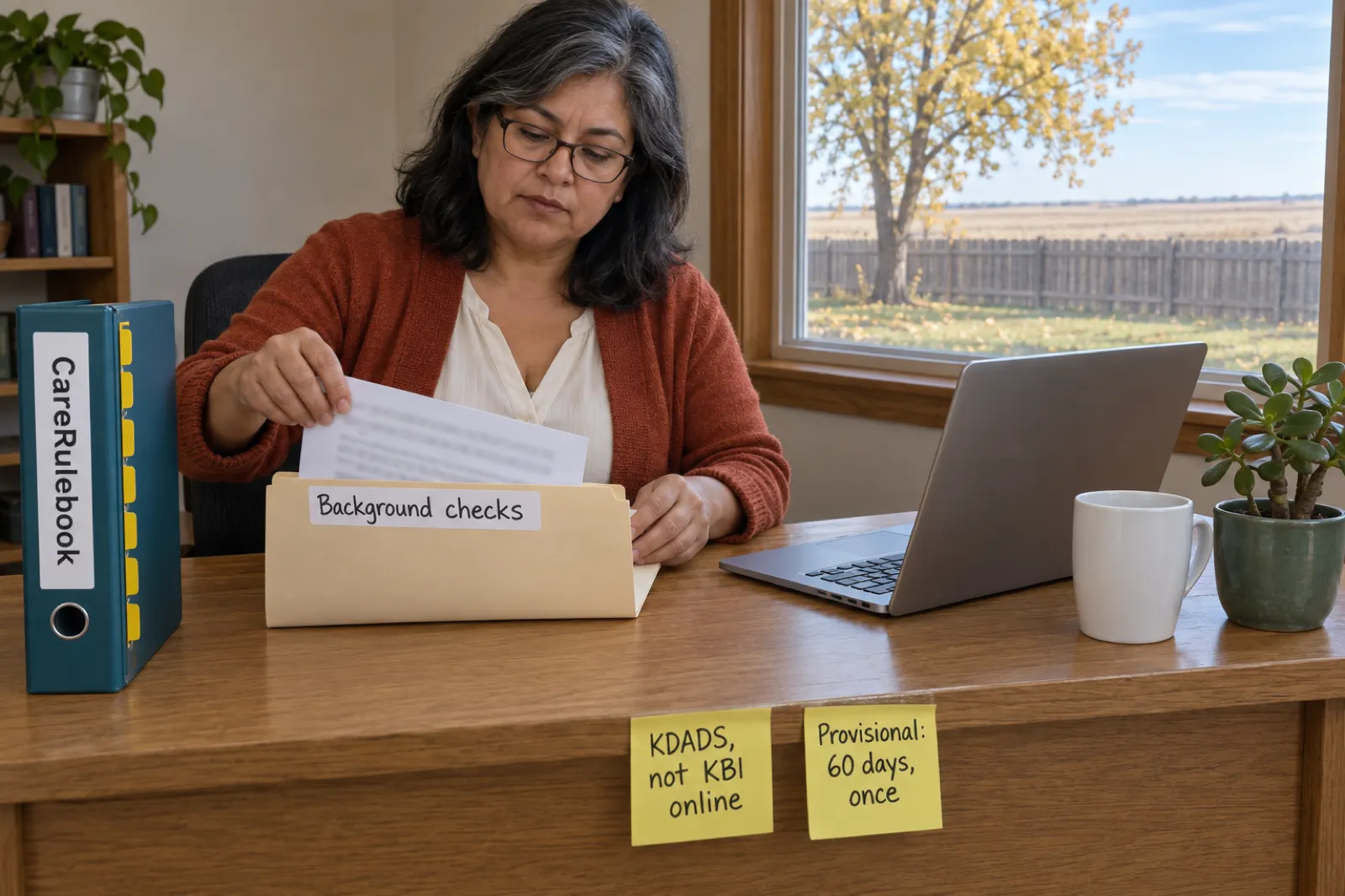
A woman with dark, gray-streaked hair and glasses, in a rust cardigan, slides a page into a manila folder labelled Background checks at a desk, beside a CareRulebook binder, a laptop and two sticky notes reading KDADS, not KBI online and Provisional: 60 days, once, with flat farmland outside the window

Quick answer

For each applicant, "the operator of a home health agency shall request from the Kansas department for aging and disability services an eligibility determination regarding adult and juvenile convictions and adjudications" (K.S.A. 65-5117(e)). KDHE explains why a KBI online search will not do: "These laws allow KDADS access to juvenile records." (KDHE Instruction Guide).

KDADS gives a pass or fail in writing within three working days of receiving the criminal history (K.S.A. 65-5117(f)). While it is pending, you may hire the person once, for up to 60 calendar days, supervised by an employee who has completed all required training (K.S.A. 65-5117(e); K.A.R. 28-51-103(e)). A copy of your request and the result go in the personnel file (K.A.R. 28-51-103(d)(8)-(9)).

3 working days

for KDADS’s written pass or fail, once it has the criminal history

K.S.A. 65-5117(f)

60 days, once

of provisional employment while the result is pending

K.S.A. 65-5117(e)

6 years

after the sentence for the time-limited bars; a waiver can be asked for after five

K.S.A. 65-5117(b)(2)-(3)

20 days

to give fingerprints, if KDADS asks for them

K.S.A. 65-5117(d)(3)

Who is checked

Every applicant for a job with you

For each applicant, the operator "shall request from the Kansas department for aging and disability services an eligibility determination regarding adult and juvenile convictions and adjudications".

K.S.A. 65-5117(e)

Contract and staffing agency workers

The statute’s definition of an applicant includes anyone applying to work for an employment agency, or as an independent contractor, that provides staff to a home health agency. KDHE adds that staffing agencies supplying workers must also submit checks.

K.S.A. 65-5117(a)(1); KDHE Instruction Guide

Volunteers who do staff work

"A person who volunteers to assist a home health agency shall not be subject to the provisions of this section unless the volunteer performs functions equivalent to functions performed by direct access employees."

K.S.A. 65-5117(g)

Exception: checked in the last year

You are not required to run a check on an applicant who was checked under the Act within the year before applying. Our suggestion: run your own anyway, because each personnel file must hold a copy of your request and the result (records).

K.S.A. 65-5117(i)

Office staff too. The duty covers applicants for employment, not only caregivers. The statute’s own definition of direct access reaches well beyond hands-on care: "‘Direct access’ means work that involves an actual or reasonable expectation of one-on-one interaction with a consumer or a consumer’s property, personally identifiable information, medical records, treatment information or financial information." (K.S.A. 65-5117(a)(4)). By our reading, a scheduler or bookkeeper who can see client files or finances is an applicant to check like anyone else, and CareRulebook’s manual checks every applicant.

Contract and staffing agency workers. "‘Applicant’ means an individual who applies for employment with a home health agency or applies to work for an employment agency or as an independent contractor that provides staff to a home health agency." (K.S.A. 65-5117(a)(1)) KDHE’s guide adds: "Staffing agencies who supply employees to work in an adult care home or home health agency must also submit criminal record checks." (Instruction Guide, Background Checks). Our suggestion: before a staffing agency worker’s first visit, get a copy of their KDADS result for your file, and put that duty in the contract.

The owner. K.S.A. 65-5117 checks the people who work for the agency. If you, as the owner, also visit clients, you work for the agency too, and by our reading you should be checked like any other caregiver. KDHE’s separate review of the administrator and alternate administrator at application is covered in Kansas administrator and manager rules.

Each new hire, step by step

The statute’s duties, with KDADS’s published steps for its system in between. Tick steps off as you go; progress is saved in this browser only.

  1. Set up your account in KDADS’s system

    Once, before your first hire

    Create a user account, then link your agency. A new provider with no Facility ID selects "Create New Facility". You can add other authorized users.

  2. Search for the person first

    After the conditional offer

    Use "Request Existing Individual". The system searches KDADS’s records and the Kansas Nurse Aide Registry for an active prohibition. If the person is not found, add them with "Request New Individual".

    KDADS CRC instructions
  3. Check the OIG exclusion list and a sex offender registry

    Before you submit

    KDADS’s instructions say that submitting a check attests that both have been checked. More on this.

    KDADS CRC instructions
  4. Request, pay and submit

    The same day

    Click "Request CRC", pay the invoice by card or e-check, then click "Submit CRC". KDADS says the last click is the step most often missed.

  5. Hire provisionally, if you need to

    While the result is pending

    Once, for up to 60 calendar days while the result is pending, supervised by an employee who has completed all required training. The rules.

  6. Act on the result

    Within 3 working days of KDADS’s receipt

    KDADS gives a written pass or fail determination within three working days of receiving the criminal history. In the system the status reads Cleared, Prohibited or Contingent.

    K.S.A. 65-5117(f)
  7. File the request and the result

    As you go

    A copy of the request and the results, with any registry findings, go in the personnel file. KDHE checks for this evidence in the files you upload.

KDADS’s system since November 19, 2025

KDHE licenses your agency, but the checks run through the Kansas Department for Aging and Disability Services (KDADS), Health Occupations Credentialing. "The new Criminal Record Check (CRC) system went live on Wednesday, November 19, 2025", and "CRCs will continue to be processed as name-based checks" (KDADS, Criminal Record Check Program, archived Aug 2026). KDADS says "the new system now serves as the single location for requesting CRCs and receiving all results", that "Prohibition Letters and Court Letters will no longer be sent via email." and that "The system now supports multiple authorized users for each facility or provider." (KDADS).

  • The Nurse Aide Registry search. KDADS says that when an agency uses the system’s “Request Existing Individual” option, it automatically checks the Kansas Nurse Aide Registry for prohibitions, including abuse, neglect or exploitation findings and criminal convictions, and, if a prohibition exists, shows a message that a check cannot be completed. (KDADS) KDADS’s instructions add: "The system will search both our internal database and the Kansas Nurse Aide Registry for existing records and any Employment Prohibition related to an active KDADS Abuse, Neglect, Exploitation (ANE), or Criminal Conviction." (KDADS CRC instructions, archived May 2026).
  • Paying. "Complete payment using a credit card or e-check (subscriber account functionality is not available)." (KDADS CRC instructions)
  • The step people miss. "This “Submit CRC” step has frequently been missed, which is the most common reason CRC statuses remain in the Pending phase." (KDADS CRC system update)
  • Two more searches before you submit. KDADS’s instructions say: "By submitting, the facility is attesting that the OIG Exclusion List and Sex Offender Registry have been checked." (KDADS CRC instructions). Neither K.S.A. 65-5117 nor K.A.R. 28-51 names those two searches, and the instructions do not say which sex offender registry. Because KDADS asks for them, CareRulebook’s manual makes them Procedure steps before each KDADS submission: the administrator searches the federal OIG List of Excluded Individuals and Entities and the sex offender registry, saves the dated results and enters them on the KDADS check log (Policy 2.3). Searching the national sex offender website as well as the Kansas registry is a Recommended practice choice. Which registry KDADS means is on our list of questions for KDADS.

What we could not read. KDADS’s website could not be reached when we checked, so this page relies on Internet Archive copies of KDADS’s pages: the program page from August 2026 and the instructions from May 2026. KDADS’s page now links a newer version of the instructions that the archive does not hold. Check the current instructions when you set up your account, and email KDADS at kdads.crcstaff@ks.gov with questions (KDADS).

Cleared, Prohibited or Contingent

The statute calls the outcome a pass or fail determination: KDADS provides each operator "with a pass or fail determination after review of any criminal history information in writing and within three working days" of receiving the information from the KBI or the FBI (K.S.A. 65-5117(f)). KDADS’s system shows one of three statuses next to each name:

StatusWhat KDADS says it meansWhat you do (our suggestion)
Cleared"No prohibiting offenses were found. The individual is eligible to work." KDADS CRC instructionsFile the result. The person can work, subject to your other hiring steps, training and competency.
Prohibited"A prohibiting offense was identified. The individual is not eligible for employment (Employment Prohibition)." KDADS CRC instructionsDo not hire. A provisional employee stops working. Give the person KDADS’s letter and tell them about the waiver and the KBI appeal routes.
Contingent"The individual has a pending court case. They may work, but their status could change to Prohibited depending on the outcome." KDADS CRC instructionsThe person may work, but watch for a change. Ask the person to bring the court outcome to KDADS, and do not rely on the status lasting.

Pending court cases. KDADS said in 2018: "Individuals with pending arrests/charges/court hearings related to offenses that would be prohibited if convicted will be responsible for providing the court documentation regarding the outcomes." It notifies the facility by letter and asks it to share the letter with the person (KDADS letter, June 25, 2018). Those letters now appear in the system rather than by email (KDADS).

Good faith. The statute protects you when you follow it: no home health agency, operator or employee is liable for civil damages over a decision to employ, refuse to employ or discharge someone based on compliance with K.S.A. 65-5117, if the agency "acts in good faith to comply with this section" (K.S.A. 65-5117(e)).

Which offenses bar work

K.S.A. 65-5117(b) sets three groups. KDADS applies them and gives you the result; you do not have to judge a record yourself. KDHE still asks that your background check policy include the offense list: "The policy must also include the current State of Kansas list of offenses, KSA 39-970 and 65-5117" (Instruction Guide, Background Checks). KDADS publishes one list for adult care homes, home health agencies and HCBS providers, effective July 1, 2018 (KDADS, Prohibited Offenses).

1. Permanent bars, with no waiver

No one may knowingly operate a home health agency where anyone works "who has adverse findings on any state or national registry", or who has been convicted of, or adjudicated a juvenile offender for, the crimes listed in (b)(1): capital murder, first and second degree murder, voluntary manslaughter, assisting suicide, mistreatment of a dependent adult or elder person, human trafficking and aggravated human trafficking, rape, aggravated criminal sodomy, sexual battery and aggravated sexual battery, and the listed sex offenses against children (K.S.A. 65-5117(b)(1)). KDADS’s list marks these "Yes": "The prohibition does not expire and waivers are not available." (KDADS list, key). The same goes for an attempt, conspiracy or criminal solicitation to commit one of them (KDADS list, notes 1 to 3).

2. Six-year bars: felonies in (b)(2)

Paragraph (b)(2) bars, for six years after the sentence, a felony conviction for a crime described in articles 54, 55 or 56 of chapter 21 or in K.S.A. 21-6420 (other than the permanent bars and one article 56 offense the statute leaves out), or for theft under K.S.A. 21-5801, and attempts, conspiracies and solicitations to commit them. (K.S.A. 65-5117(b)(2)) KDADS’s list puts each offense in a row with its bar, for example kidnapping, robbery and aggravated battery as six-year bars (KDADS list). The theft bar in (b)(2)(C) does not apply to someone employed by a home health agency on or before July 1, 2010 and continuously employed by the same agency since, or to anyone during or after successfully completing a diversion agreement (K.S.A. 65-5117(b)(1)).

3. Six-year bars: (b)(3)

Paragraph (b)(3) adds six offenses not limited to felonies (interference with custody of a committed person, mistreatment of a confined person, unlawful administration of a substance, violation of a protective order, promoting obscenity, cruelty to animals) and listed felonies: drug manufacture, cultivation or distribution offenses, forgery, criminal use of a financial card, Medicaid fraud offenses, identity theft or fraud, and social welfare fraud. (K.S.A. 65-5117(b)(3)) The (b)(3) bars do not apply to someone employed by a home health agency on or before July 1, 2018 and continuously employed by the same agency since, or to anyone during or after successfully completing a diversion agreement. (K.S.A. 65-5117(b)(3))

When six years have passed

For both six-year groups, you may employ the person once six or more years have passed since the completion of the sentence or discharge from probation, parole or similar supervision, or since a juvenile was discharged from custody or probation or adjudicated, whichever is longer, or if KDADS has granted a waiver (K.S.A. 65-5117(b)(2)-(3)). The statute defines the starting point: "‘Completion of the sentence’ means the last day of the entire term of incarceration imposed by a sentence, including any term that is deferred, suspended or subject to parole, probation, diversion, community corrections, fines, fees, restitution or any other imposed sentencing requirements." (K.S.A. 65-5117(a)(2)). So by our reading, unpaid fines or restitution can keep the clock from starting.

Records from elsewhere. Each group also covers "similar statutes of other states or the federal government" (K.S.A. 65-5117(b)), and the KBI releases convictions and adjudications from any other state or country to KDADS (K.S.A. 65-5117(d)(1)). How fully a name-based check finds out-of-state records is not stated; that is one reason to ask about work and addresses elsewhere at interview.

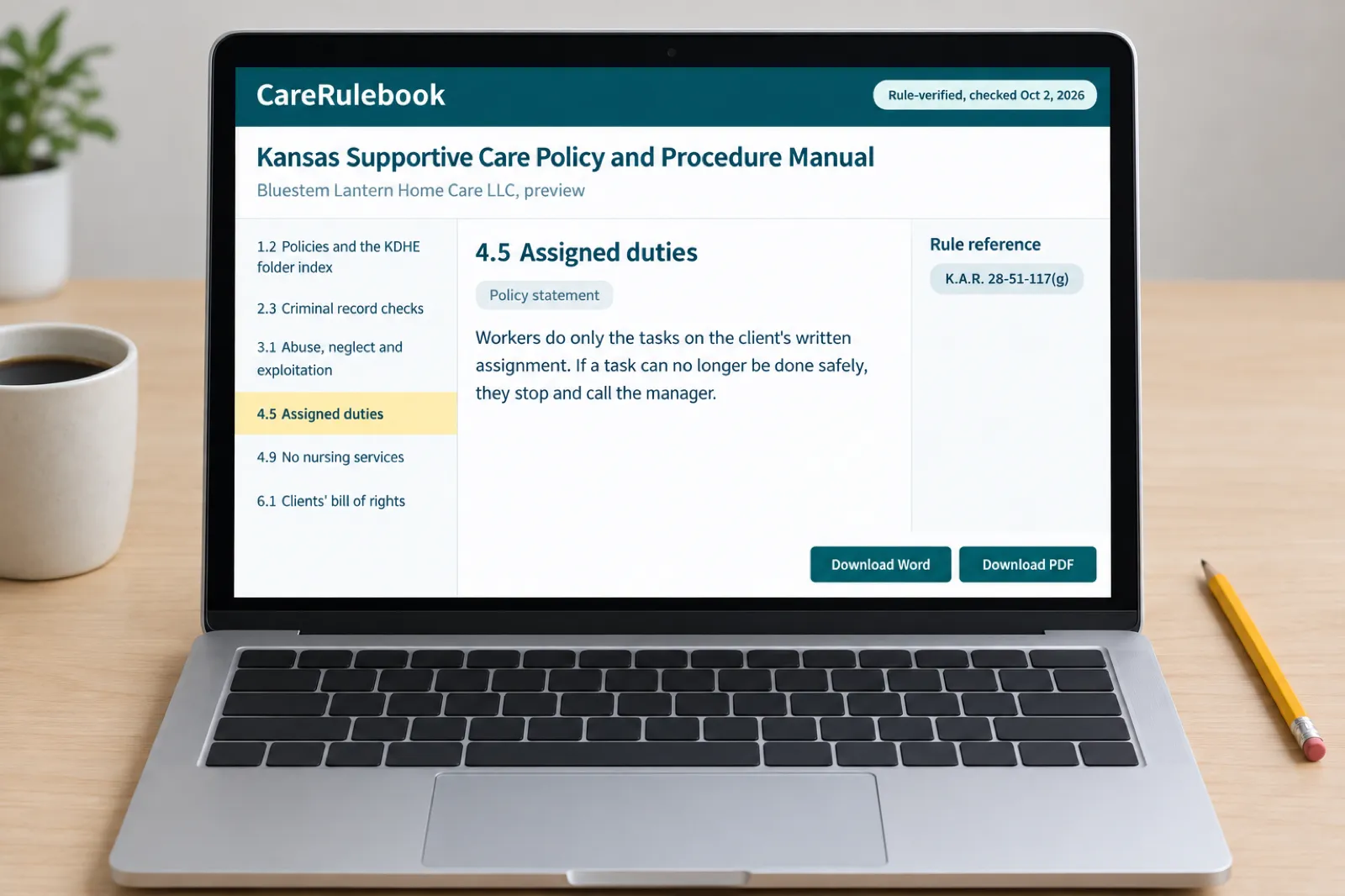
The CareRulebook Kansas manual preview on a laptop: policy 4.5 on assigned duties for a sample agency, citing K.A.R. 28-51-117(g), with six of the manual’s policies listed beside it

CareRulebook

Hiring checks written for Kansas

CareRulebook’s Kansas manual includes Policy 2.3 (Criminal record checks and provisional employment): the KDADS request before the first day, the OIG exclusion list and sex offender registry searches KDADS asks for before each submission, what to do with each result, contract and staffing agency workers, waivers and disputes, fingerprints if KDADS asks, the one-time 60-day provisional hire with a named supervisor, a KDADS check log and the Kansas list of prohibited offenses for KDHE’s Bkrnd. Chk. folder. Policy 2.2 covers interviews, references and credentials.

  • 31 policies, 130 requirements mapped
  • Ordered to KDHE’s 13 upload folders
  • Editable Word and print-ready PDF, with the rule quoted under each policy
Preview your manual

$199CareRulebook founding price for the first 50 Kansas agencies, then $249. Not a KDHE fee.

Waivers and disputes

A waiver is the disqualified person’s application to KDADS, not yours. For the six-year offenses, the person "may apply to the secretary for aging and disability services for a waiver of such disqualification if five years have elapsed since completion of the sentence for such conviction" (K.S.A. 65-5117(b)(2)-(3)). The statute also says a disqualified person "may apply for a waiver with the department within 30 days of the receipt of the notice of employment prohibition" (K.S.A. 65-5117(d)(6)). By our reading, the safe course is for the person to apply within 30 days of the notice once the five years have passed.

  • What KDADS weighs: "Passage of time; extenuating circumstances; demonstration of rehabilitation; and relevancy of the criminal history record information to the position for which the applicant is applying." (K.S.A. 65-5117(d)(7))
  • Until then: "Any employment prohibition issued shall remain in effect unless or until a waiver is granted." (K.S.A. 65-5117(d)(7))
  • The form: "The form must be completed by the person disqualified by a criminal conviction." "The court document (Journal Entry of Completion of Sentence) must be attached to the waiver application." KDADS asks the person to contact it at kdads.crcstaff@ks.gov before completing the form (KDADS waiver instructions, archived May 2026). The application form itself has no archive copy, so we have not seen it.
  • Permanent bars: no waiver is available (KDADS list, key).
  • A record that is wrong: "If an applicant disputes the contents of a criminal history record check, then the applicant may file an appeal with the Kansas bureau of investigation." (K.S.A. 65-5117(d)(5))

A person with a waiver can apply to you again. Our suggestion: keep a copy of the waiver in their file with the new KDADS result.

Provisional employment: once, 60 days, supervised

The statute says the operator "may hire an applicant for provisional employment on a one-time basis of 60 calendar days pending the results from the Kansas department for aging and disability services", and the rule adds: "Each applicant provisionally hired by a home health agency shall be supervised by an employee who has completed all training required by federal regulations, department regulations, and the home health agency’s policies and procedures." (K.A.R. 28-51-103(e); K.S.A. 65-5117(e)). KDHE asks for a provisional employment policy among your personnel policies (Instruction Guide, Personnel Policies (18)).

  • "Supervised" is not defined. The statute defines a stricter term, "‘Direct supervision’ means that a supervisor is physically present within an immediate distance to a supervisee and is available to provide constant direction, feedback and assistance to a client and the supervisee." (K.S.A. 65-5117(a)(5)), but the provisional sentence says only "supervised". Whether a supervisor must be present at each visit is on our list of questions for KDHE.
  • The manager is there anyway, at first. Separately, "each licensee shall ensure that each supportive care worker demonstrates competency before providing supportive care services to a client without the manager being present" (K.A.R. 28-51-117(c)). So a new worker’s first visits are with the manager present in any case. How competency works.
  • "One-time basis". By our reading this means a person is provisional once at your agency: if 60 days pass with no result, they stop until a pass arrives. Whether it means once in a person’s working life is on our list of questions for KDHE.
  • Fingerprints and the 60 days. If KDADS asks for fingerprints, the applicant has 20 calendar days after authorization to submit them "in order to be eligible for provisional employment", or the application is treated as withdrawn (K.S.A. 65-5117(d)(3)).

CareRulebook’s manual keeps the supervising employee physically present at every client visit a provisional employee makes, records their first day and day 60 on the KDADS check log, and names the supervisor on a provisional employment supervision record (Policy 2.3). That is the manual’s own, cautious practice; the rule sets the minimum.

Fingerprints and fees

Fingerprints are not routine yet. The statute lets KDADS require an applicant to be fingerprinted for a state and national check (K.S.A. 65-5117(d)). KDHE’s page still says "National Finger-Print Based Criminal Record Checks will be implemented in phases." (KDHE, Criminal Record Check tab), and KDADS’s November 2025 system processes name-based checks (KDADS). We found no announcement that fingerprints are required for home health agency applicants.

Who pays. "The current or prospective employer of an applicant shall pay a reasonable fee for criminal history record information to the department for each applicant submitted." (K.S.A. 65-5117(d)(4)(A)). If fingerprints are taken, the collection site’s fee is paid there by the employer, the employee or the contractor (K.S.A. 65-5117(d)(4)(B)).

How much. "All fees charged by the secretary for criminal history record checks conducted pursuant to this section shall be established by rules and regulations of the secretary." (K.S.A. 65-5117(k)(1)). KDADS’s March 2020 guide showed $19 a check plus a 48-cent processing fee (KDADS KanCheck guide, 2020, archived), and KDADS said in 2018 there would be no increase until fingerprint checks start. These are KDADS’s fees, not CareRulebook prices, and we could not confirm the current amount: the new system’s invoice shows it when you request a check. Budget for one check per applicant, including people you do not end up hiring. Other start-up costs are on Kansas license cost and timeline.

After hire: is there a re-check?

Not under the current law and rules. K.S.A. 65-5117 and K.A.R. 28-51-103 tie the check to applicants and set no re-check interval. But the bars keep applying to everyone who works for you: no one may knowingly operate an agency where a barred person works (K.S.A. 65-5117(b)(1)). KDHE put it this way in April 2026: "An employee that commits an offense listed on the prohibited offenses after the initial background check is not eligible to be employed by a home health agency." (KDHE, Questions and Feedback).

  • Drafted, not in force. KDHE’s drafted rewrite of K.A.R. 28-51 says: "Added criminal history and background check requirements which include being conducted every two years or after allegations of abuse, neglect, or exploitation." (KDHE Summary of Changes, Sept 2025). KDHE told providers the proposals are in the early phases (KDHE). We found no Notice of Hearing, but we could not search the 2026 Kansas Register on rules.ks.gov, which blocks automated access.
  • Our suggestion. Ask staff to tell you promptly about any arrest, charge or conviction, or any registry finding, and request a new KDADS determination when they do. CareRulebook’s manual offers a re-check every two years as a Recommended practice choice, so you can start now if you want to be ready for the draft.

Records, and what KDHE looks for

  • In each personnel file: "a copy of the eligibility determination request submitted to the department for aging and disability services" (K.A.R. 28-51-103(d)(8)) and the "results of the state and national criminal history record check pursuant to K.S.A. 65-5117", with the findings of any state or national registry (K.A.R. 28-51-103(d)(9)).
  • For surveyors: Personnel records kept for KDHE show all training received, qualifications, performance evaluations and evidence of a background check clearance. (K.A.R. 28-51-104(d)(2)). How surveys run is on Kansas home health agency surveys.
  • In KDHE’s upload before licensing: the Personnel Recs folders hold up to 10 personnel files, and KDHE lists what each shows, including criminal record check evidence (Instruction Guide, Personnel Records). The Bkrnd. Chk. folder holds your background check policy and the current Kansas list of offenses (Instruction Guide, Background Checks). The whole upload is on the Kansas license application.
  • How long to keep them. K.A.R. 28-51 sets a retention period for client records only. CareRulebook’s manual suggests keeping personnel files for five years after someone leaves, as Recommended practice (Policy 2.1).

Health assessments, the TB test and training records sit in the same file; see Kansas caregiver training and health screening (Policy 2.6 in the manual).

Myths about Kansas hiring checks

Is a KBI online background check enough for Kansas caregivers?

No. Home health agencies must request an eligibility determination from KDADS under K.S.A. 65-5117. KDADS can see juvenile records that the KBI online service does not show. You may hire someone provisionally, once, for up to 60 days while the result is pending, under supervision.

"These laws allow KDADS access to juvenile records."

Must a Kansas caregiver wait for the KDADS result before starting work?

It depends. Not always. Once you have requested the KDADS eligibility determination, you may hire the person provisionally, on a one-time basis, for up to 60 calendar days while the result is pending. A provisional employee may only be supervised by an employee who has completed all required training. And until they have shown competency, the rules keep the manager present at their client visits anyway.

"may hire an applicant for provisional employment on a one-time basis of 60 calendar days pending the results from the Kansas department for aging and disability services"

Does any criminal conviction stop someone working for a Kansas home care agency?

No. K.S.A. 65-5117 bars adverse findings on a state or national registry and listed offenses, not every conviction. Some offenses, such as murder, mistreatment of a dependent adult or elder and serious sex offenses, bar work permanently. Others bar it for six years after the sentence is complete, and the person can ask KDADS for a waiver after five. A conviction for an offense not on the list does not bar employment under the statute. KDADS makes the pass or fail decision; you act on it.

"may apply to the secretary for aging and disability services for a waiver of such disqualification if five years have elapsed since completion of the sentence for such conviction"

Do my Kansas caregivers need to be CNAs or have a set number of training hours?

No. Supportive care workers are not home health aides, and the rules set no hours. Each worker must show competency in 10 areas before working without the manager present, be re-checked every year, get annual ongoing training and abuse training at hire and yearly. CNAs can work as supportive care workers but may not use their skilled tasks under this license.

"Each licensee shall ensure that each supportive care worker demonstrates competency before providing supportive care services to a client without the manager being present"

Frequently asked questions

Is a KBI online background check enough for a Kansas caregiver?

No. K.S.A. 65-5117 requires the operator of a home health agency to request an eligibility determination from KDADS. KDHE explains that KDADS can see juvenile records through the KBI, which the KBI’s public online search does not show. A private or KBI online search can be extra, never a substitute.

How long does a KDADS background check take?

The statute says KDADS gives a written pass or fail determination within three working days of receiving the criminal history information from the KBI or the FBI. That clock starts when KDADS has the information, not when you click submit, and KDADS has published no overall turnaround time. In the meantime you may hire the person provisionally, once, for up to 60 calendar days.

Can a provisional employee work alone with clients in Kansas?

The statute says a provisional employee may only be supervised by an employee who has completed all required training. It does not say the supervisor must be present at every visit. Separately, no supportive care worker may serve a client without the manager present until they have demonstrated competency. CareRulebook’s manual keeps a supervisor with provisional employees at every client visit; whether KDHE requires that is on our list of questions for KDHE.

What does a Contingent result mean?

KDADS’s instructions say a Contingent person has a pending court case. They may work, but the status could change to Prohibited depending on the outcome. KDADS said in 2018 that the person is responsible for providing the court documentation of the outcome.

Can someone with a criminal record work for a Kansas home care agency?

It depends on the offense. Some offenses, such as murder, mistreatment of a dependent adult or elder and serious sex offenses, bar work permanently with no waiver. Others bar work until six years after the sentence is complete, and the person may ask KDADS for a waiver once five years have passed. A conviction for an offense not on the list does not bar employment under the statute. KDADS decides each case.

Who pays for a Kansas caregiver background check?

The statute puts KDADS’s fee on the current or prospective employer. If KDADS ever asks for fingerprints, the collection site’s fee may be paid by the employer, the employee or the independent contractor. KDADS’s 2020 guide showed $19.00 a check plus a 48-cent processing fee; we could not confirm the current amount.

Do I have to re-run background checks every two years in Kansas?

Not under the current law and rules, which set no re-check interval. KDHE’s drafted rewrite of K.A.R. 28-51 would require checks every two years and after any abuse, neglect or exploitation allegation, but it has not been published as a proposed rule.

Get Kansas rule-change alerts

KDHE has drafted a rewrite of K.A.R. 28-51 that would add background re-checks every two years. No official text has been published yet. Leave your email and we will tell you when a Kansas change affects your hiring checks or your policies.

No spam. Only emails about Kansas home care rule changes. How we use your email.

Keep reading

Sources

  1. K.A.R. 28-51-100 to 28-51-118, Home Health Agency Licensure (as amended or adopted in Kansas Register Vol. 41, No. 18, May 5, 2022, effective May 20, 2022; 28-51-108 and 28-51-114 to -116 from the Cornell LII mirror) · Kansas Secretary of State, Kansas Register (KDHE regulations); Cornell Legal Information Institute mirror · retrieved October 2, 2026
  2. K.S.A. 65-5101 to 65-5117, Home Health Agency Act (65-5101 as amended by L. 2025, ch. 85) · Kansas Office of Revisor of Statutes · retrieved October 2, 2026
  3. Home Health Agency Non-Medical Supportive Care Services Application Submission Requirements and Instruction Guide (reviewed/revised 03/2024) · Kansas Department of Health and Environment, Bureau of Facilities and Licensing · retrieved October 2, 2026
  4. Non-Medical Supportive Care Services (license scope, documents, renewal, criminal record check) · Kansas Department of Health and Environment · retrieved October 2, 2026
  5. 2025 Home Health Agency Regulations Summary of Changes Guide (September 8, 2025), with the October 9, 2025 Supportive Care listening session slides and KDHE’s answers to feedback (April 2026) · Kansas Department of Health and Environment, Bureau of Facilities and Licensing · retrieved October 2, 2026
  6. HHA Listening Sessions Questions and Feedback (KDHE responses; PDF dated April 14, 2026) · Kansas Department of Health and Environment, Bureau of Facilities and Licensing · retrieved October 2, 2026
  7. Criminal Record Check Program (Health Occupations Credentialing), Internet Archive copy of August 14, 2026, with KDADS’s June 25, 2018 letter on the criminal record check changes · Kansas Department for Aging and Disability Services · retrieved October 2, 2026
  8. KanCheck Facility Users Guide for Requesting a Criminal Record Check (March 2020), Internet Archive copy · Kansas Department for Aging and Disability Services · retrieved October 2, 2026
  9. Criminal Record Check Prohibited Offenses, effective 7.1.18 (adult care homes, home health agencies and HCBS), Internet Archive copy · Kansas Department for Aging and Disability Services · retrieved October 2, 2026
  10. Updates: KDADS HOC Criminal Record Check (CRC) System (effective November 19, 2025) and KDADS’s CRC instructions for the new system (version archived May 15, 2026), Internet Archive copies · Kansas Department for Aging and Disability Services, Health Occupations Credentialing · retrieved October 4, 2026
  11. Instructions for the Request for Waiver of Employment Disqualification under K.S.A. 39-970, K.S.A. 65-5117 and K.S.A. 39-2009, Internet Archive copy of May 15, 2026 · Kansas Department for Aging and Disability Services, Health Occupations Credentialing · retrieved October 4, 2026
Build your Kansas manualfrom $199