Quick answer
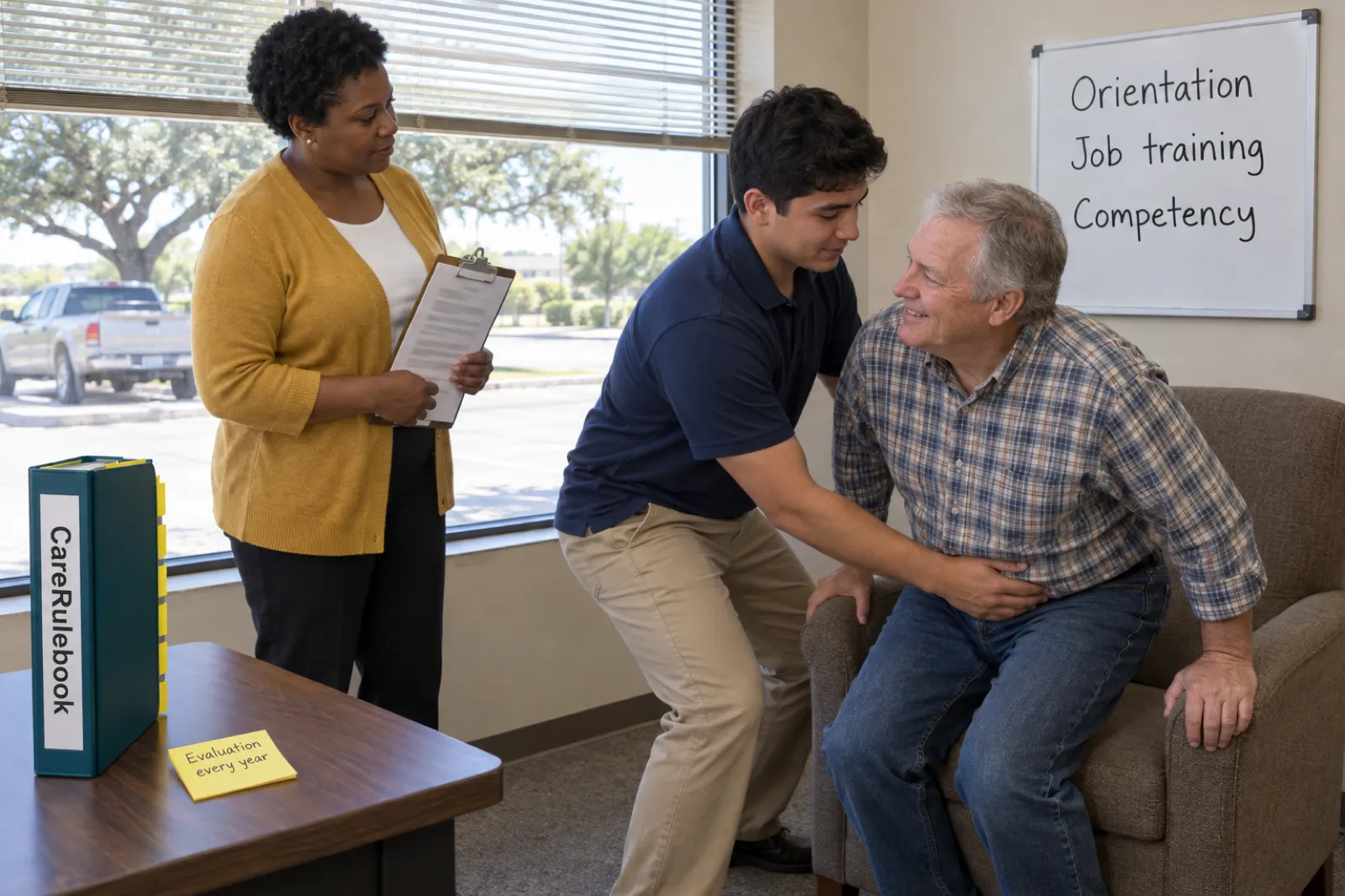
Chapter 558 puts attendant training into your written staffing policies. "An agency's written staffing policies must: (1) include requirements for orientation to the policies, procedures, and objectives of the agency;" They must also require job-specific training, and the training program must "ensure demonstration of competency for tasks when competency cannot be determined through education, license, certification, or experience" (26 TAC §558.245(b)). The PAS standards add that personal assistance services "may be performed by an unlicensed person who is at least 18 years of age and has demonstrated competency, when competency cannot be determined through education and experience, to perform the tasks assigned by the supervisor." (§558.404(c)).
We found no hour minimum, no general curriculum and no certification for PAS attendants in Chapter 558; the one set program is for g-tube tasks. Set hours apply to other roles: home health aide and hospice aide training programs are at least 75 hours (§558.701(d); §558.843(c)), and Nurse Aide Registry listing needs at least 100 hours of course work (HSC §250.0035). We found no rule requiring a nurse to train PAS attendants in general; a nurse comes in when an RN delegates a health-related task, and g-tube training has its own trainer rules.
18+
minimum age for attendants, with exceptions for high school graduates and vocational students
26 TAC §558.404(c)Yearly
performance evaluation for each employee and volunteer
§558.245(b)(6)CareRulebook
Training records your surveyor can follow
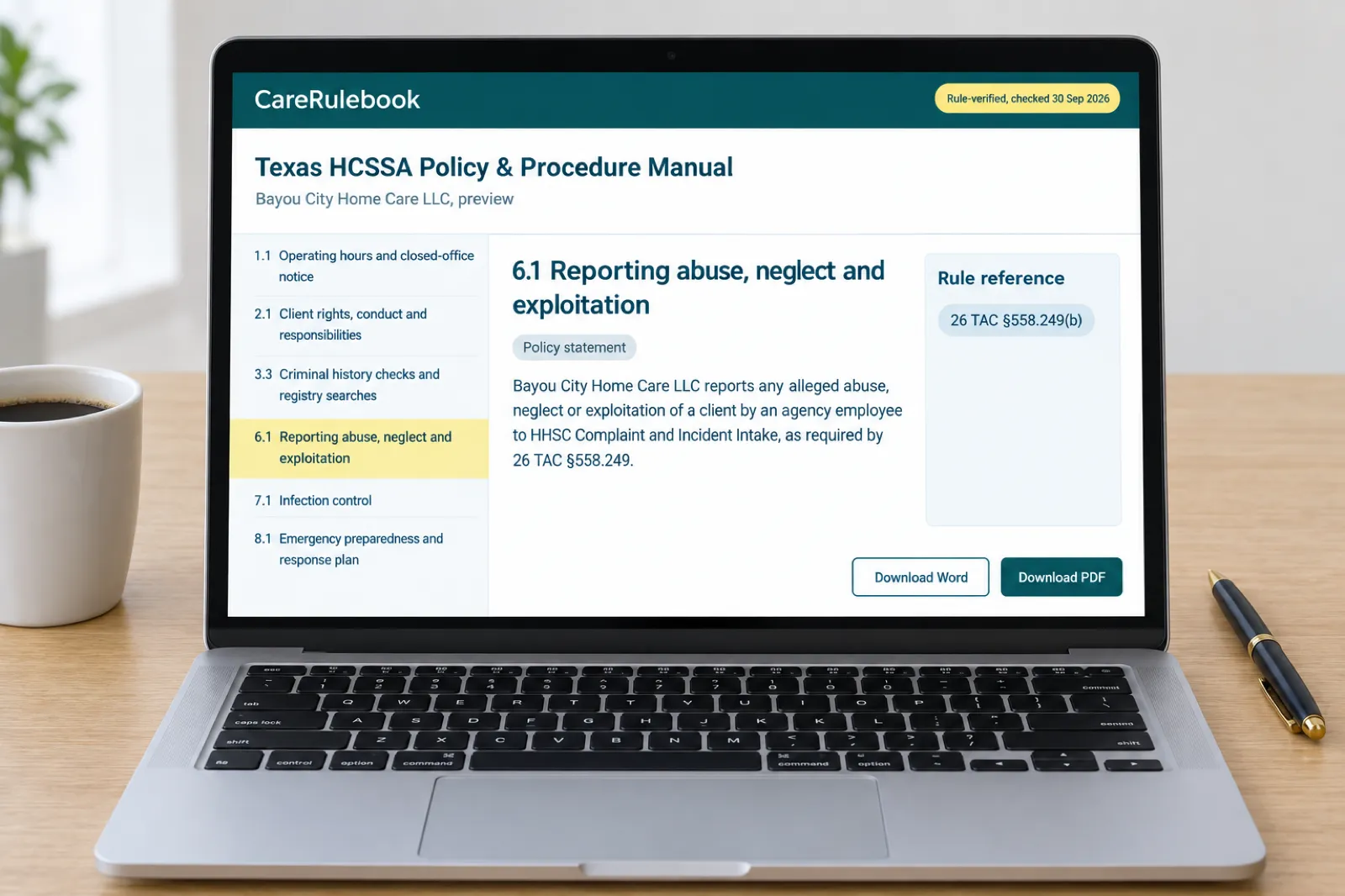
CareRulebook’s Texas manual includes Policy 4.1 (Orientation, job training and competency): orientation, job-specific training, task-by-task competency records, pediatric competency, the yearly training plan and privacy law training with the signed statement. Supervision is Policy 5.2, RN delegation Policy 5.3 and personnel records Policy 3.2.
- 35 policies, 48 rule requirements mapped
- G-tube training and competency program, included only if your attendants do g-tube tasks
- Editable Word and print-ready PDF, with the rule quoted under each policy
Preview your manual$199CareRulebook founding price for the first 50 Texas agencies, then $249. Not an HHSC fee.
Frequently asked questions
How many hours of training do Texas home care attendants need?+
We found no hour minimum for personal assistance services (PAS) attendants in 26 TAC Chapter 558. Your staffing policies must require orientation, job-specific training and a continuing training program, and an attendant must show competency in each assigned task when education, license, certification or experience does not show it (§558.245(b); §558.404(c)). Set hours apply to other roles: at least 75 hours for home health aides (§558.701(d)) and for hospice aides (§558.843(c)), and at least 100 hours of course work to be listed on the Nurse Aide Registry (Health and Safety Code §250.0035).
Do Texas PAS attendants need to be certified nurse aides?+
Not under Chapter 558’s PAS standards. Section 558.404(c) allows an unlicensed person aged 18 or over to give personal assistance services once they have shown competency in the tasks the supervisor assigns, where their education and experience do not already show it. Nurse Aide Registry listing is one of the ways a licensed home health agency can qualify a home health aide (§558.701(a)(6)).
Who can train PAS attendants in Texas?+
By our reading, Chapter 558 sets no qualification for whoever gives general attendant training. There are two exceptions. When an RN delegates a task, the RN must have taught the task or verified the person’s competency from personal knowledge of their training, education, experience or certification (22 TAC §225.9(a)(2)). G-tube feeding training must be taught by an RN, physician, physician assistant or qualified trainer (§558.404(h)(1)). The PAS supervisor, who assigns tasks, must be a licensed nurse or meet the education or experience test in §558.404(g)(2).
Is yearly training required for Texas home care attendants?+
Your staffing policies must ensure “a continuing systematic program for the training of all personnel” and a yearly performance evaluation for each employee and volunteer (§558.245(b)(2)(C) and (b)(6)). We found no yearly hour minimum for PAS attendants. HHSC’s proposed new §558.251 would add abuse, neglect and exploitation training before starting work and at least every year after; it is a proposal, not in force.
Can attendant training be online in Texas?+
We found nothing in the current Chapter 558 on how training is delivered. HHSC’s 2026 proposal would allow virtual training, but where clinical tasks are taught virtually, the PAS supervisor would have to verify competency in person (proposed §558.245(d)). Our suggestion, whatever format you use: check hands-on tasks in person.
Can someone under 18 work as a PAS attendant in Texas?+
Yes, in limited cases. Section 558.404(c) allows an unlicensed person under 18 who is a high school graduate or is enrolled in a vocational educational program, and who has demonstrated competency to perform the tasks assigned by the supervisor, to perform personal assistance services.
Does a nurse have to check an attendant’s competency?+
For a task an RN delegates, yes: the Board of Nursing rule requires the RN to verify the person’s experience and competency, and requires that competency to be documented (22 TAC §225.9(a)(2), (c)), and HHSC’s FAQ says the RN is responsible for supervising and evaluating the competency of the staff the task is delegated to. For personal care, Chapter 558 ties competency to the tasks the supervisor assigns (§558.404(c)), and the supervisor need not be a nurse (§558.404(g)(2)).
What training records should a Texas agency keep?+
Section 558.246(a) lists what each personnel record must hold, including verification of educational requirements, performance evaluations and disciplinary actions, and the signed policy statement. It does not name training or competency records. By our reading, a written record is how you show a surveyor that your training and competency policy was followed, so keep them in the personnel record. HHSC’s FAQ says an agency must follow what its own policy says.
Get Texas rule-change alerts
HHSC has proposed a rewrite of Chapter 558, including yearly abuse, neglect and exploitation training and rules for virtual training. Leave your email and we will tell you when the new rules are adopted and what changes for your training policy.
No spam. Only emails about Texas home care rule changes. How we use your email.
Keep reading
US
Caregiver training requirements by state →
How Texas’s attendant training compares with the other states we cover: hours, competency checks, orientation and yearly training.
Texas
How to start a home care agency in Texas →
License, fees, training and the initial survey.
Manual
Build your Texas policy manual →
Including Policy 4.1 on orientation, job training and competency.
Texas
Caregiver background checks and SEMARC →
Criminal history, registries and the yearly re-check.
Texas
Administrator requirements →
The administrator’s own 24 first-year hours and 12 hours a year after.
Texas
Home health vs home care license →
PAS or licensed home health, and when aides come in.
Texas
Every policy Chapter 558 requires →
Including staffing, supervision and RN delegation.
Texas
The Texas initial survey →
What surveyors check, including personnel records.
Texas
The proposed Chapter 558 rewrite →
Every change, and how to comment by October 19, 2026.
Tennessee
Tennessee caregiver training →
Competency in seven areas before work, then training every year.
Colorado
Colorado caregiver training →
Homemaker and personal care worker topics, competency checks and supervision.
Maryland
Maryland caregiver training →
Seven COMAR topics, a skills demonstration and dementia training hours.
Washington
Washington caregiver training →
75 hours of training and the home care aide certification.
Sources
- 26 TAC Chapter 558, Licensing Standards for Home and Community Support Services Agencies · Texas HHSC (text via Cornell LII) · retrieved September 30, 2026
- HCSSA Frequently Asked Questions (updated July 2026) · Texas HHSC · retrieved September 30, 2026
- Provider Letter PL 2026-10: Search Engine for Multi-Agency Reportable Conduct (SEMARC) · Texas HHSC · retrieved September 30, 2026
- Regulatory Services Annual Report FY 2025 · Texas HHSC · retrieved September 30, 2026
- Texas Health and Safety Code Chapter 250 (nurse aide registry and criminal history checks) · Texas Legislature · retrieved September 30, 2026
- Proposed Rules, 26 TAC Chapter 558 (rule project 22R045), 51 TexReg 6429, September 18, 2026 · Texas Register · retrieved September 30, 2026
- 22 TAC Chapter 225, RN Delegation to Unlicensed Personnel and Tasks Not Requiring Delegation in Independent Living Environments · Texas Board of Nursing (text via Cornell LII) · retrieved September 30, 2026
- Texas Health and Safety Code Chapter 181 (medical records privacy) · Texas Legislature · retrieved September 30, 2026