This is the only leadership role the PSSA rules create: "The licensee shall designate an individual responsible for the operation of the agency." (0940-05-38-.05(4)). DDA’s PSSA chapter, for agencies serving mainly people with an intellectual or developmental disability, uses exactly the same words (0465-02-17-.03(4)).
What the rules do not say. We found nothing in 0940-05-38, 0940-05-02 or 0940-05-06-.03(1)-(6) that sets this person’s qualifications, training, experience, title, hours or duties, or that requires a written designation or a backup. If the person also gives care to clients, the worker rules apply, including the minimum age of 18 (0940-05-38-.07(2)(a)).
What TDMHSAS still asks about them. The application rule asks for background information on "the person or persons responsible for the operation", including a criminal background check (0940-05-02-.04(3)(c)), and TDMHSAS’s general definitions describe a chief executive officer or director as the person "appointed, designated, or hired by the governing body to be responsible for the day-to-day operation of the facility or facilities operated by the licensee" (0940-05-01-.01(7)). By our reading, the person you designate under .05(4) is usually the person named as having overall responsibility on the application, or the site manager on the Fact Sheet. If they are three different people, ask your regional office whether it wants background papers for each.
Pick a title and keep it. The forms use chief executive officer, executive director and site manager or director (MH-4385, item 3; MH-4386, item 5). Tennessee does not name the role, so any title works if it is the same on your designation, chart, job descriptions and forms. CareRulebook’s manual suggests Agency Director and lets you change it.
What the job involves, in practice. The rules put the governance duties on the licensee. By our reading, the person responsible carries them out day to day: keeping the license and TDMHSAS paperwork current, being TDMHSAS’s main contact at the desk audit and inspections, staffing visits, hiring, checking, training and evaluating workers, making sure incidents are reported, and keeping records. When TDMHSAS quotes the statute on records, it says "The chief officer shall keep records detailing services or supports received by each person." (PSSA slides, slide 30).
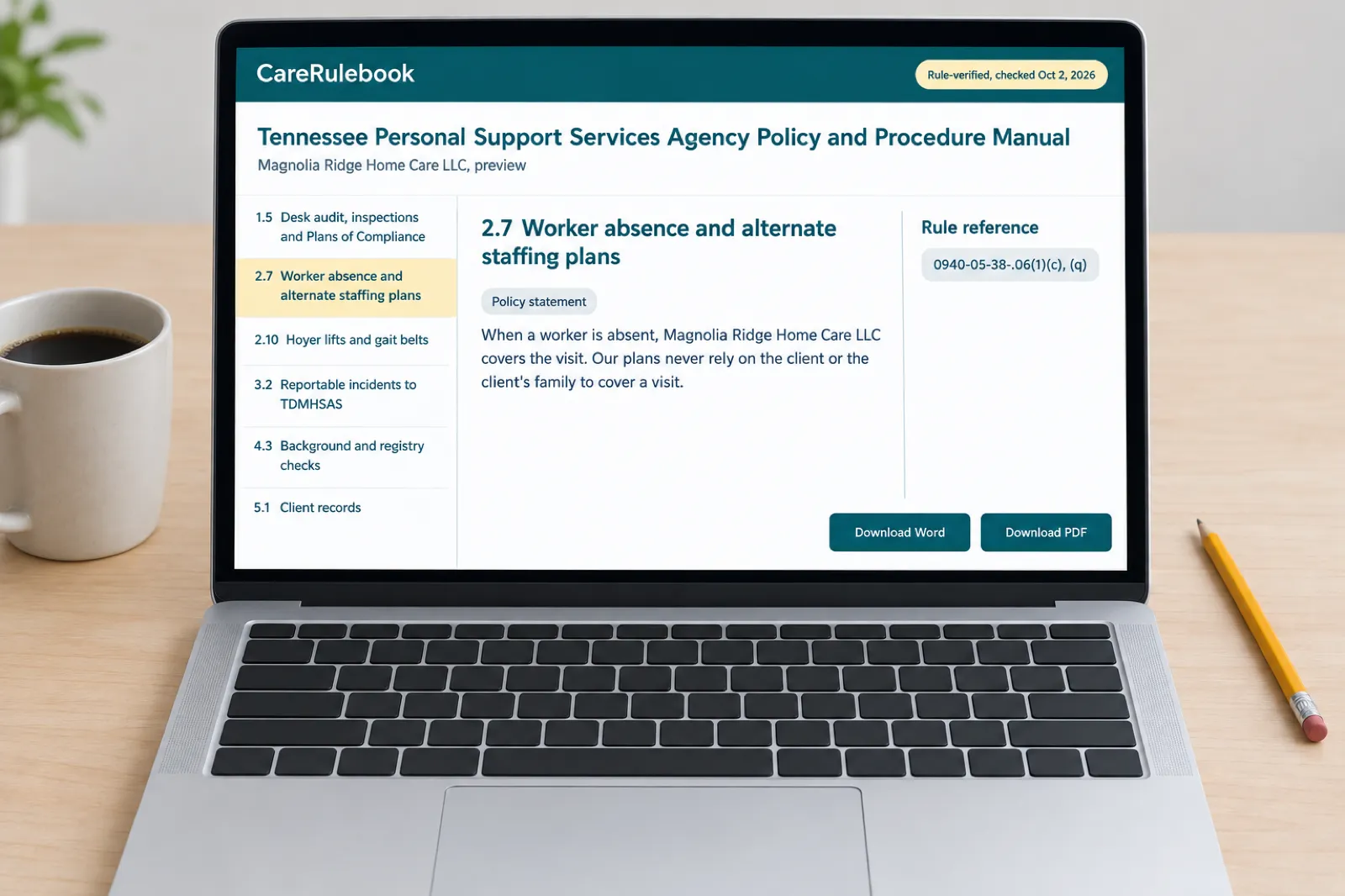
CareRulebook’s manual has the licensee designate the person responsible on a signed form that also names a backup, and lists the duties above (Policy 1.1). The backup and the duty list are the manual’s choices, not rule requirements.